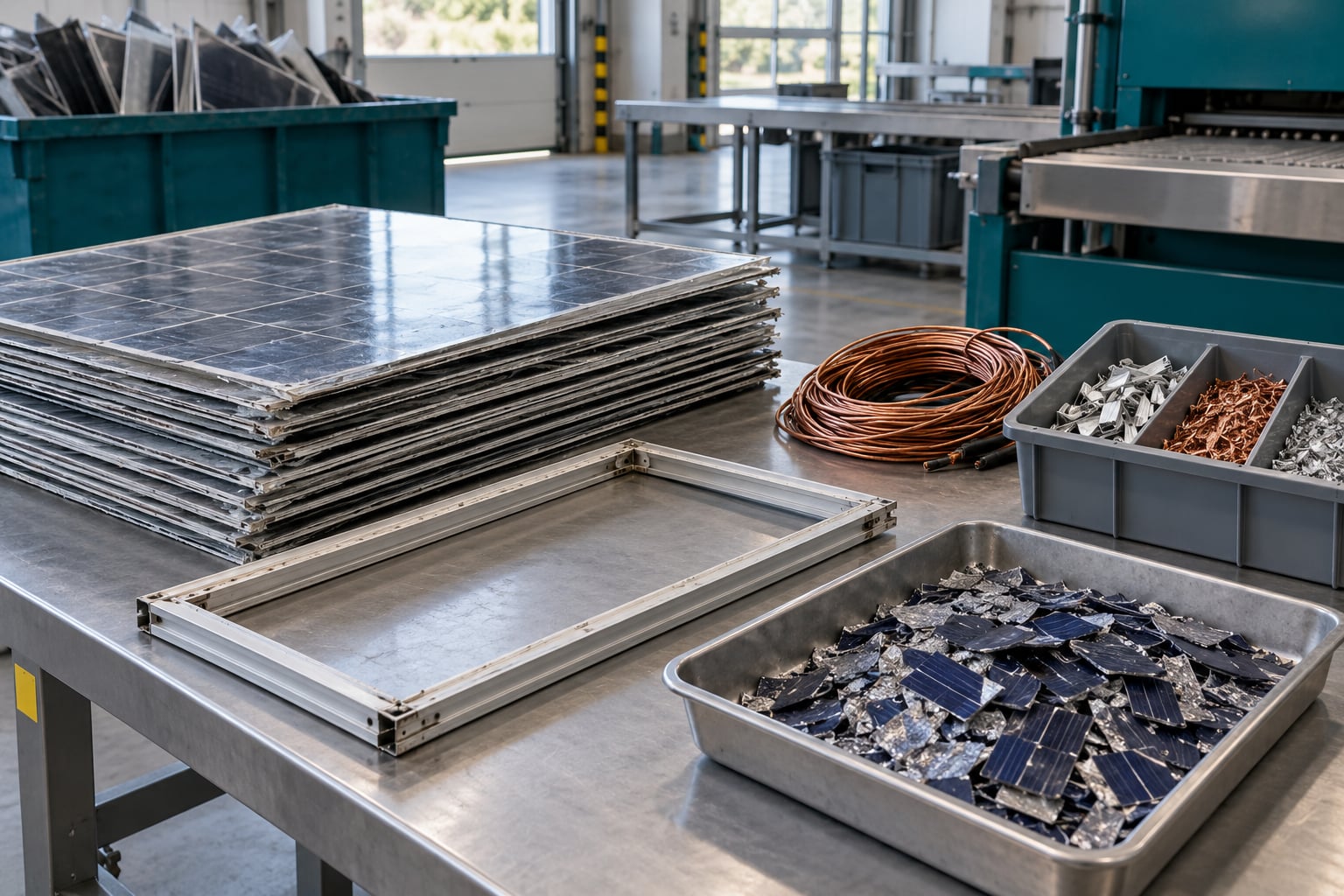
Recycling separates the module into glass, aluminium, copper, silicon, silver and tin using mechanical, thermal and chemical methods, so those materials go back into manufacturing instead of sitting in landfill.
Most residential systems are small enough that the volume is easy to underestimate. Every array that comes off a roof eventually lands somewhere, and understanding exactly how solar panels are recycled tells you whether that somewhere should be a reuse project or a processing line.
Table of Contents
- What Happens When Solar Panels Are Recycled?
- What Materials Can Be Recovered From Solar Panels?
- How the Recycling Process Works Step by Step
- Can Homeowners Recycle Solar Panels Themselves?
- Where Can You Take Old or Damaged Panels?
- What Is the Environmental Value of Recycling Solar Panels?
- Frequently Asked Questions
- Conclusion
What Happens When Solar Panels Are Recycled?
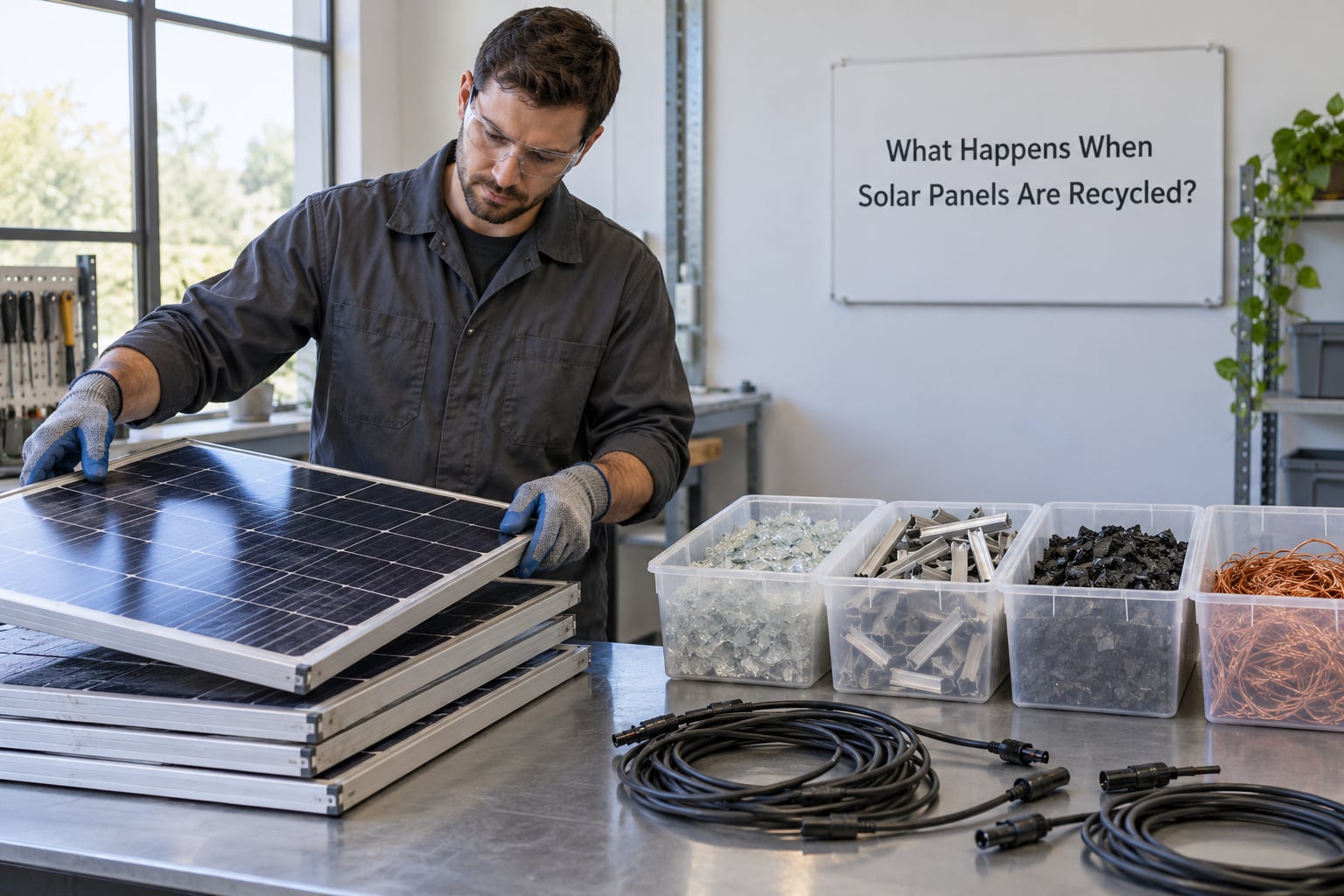
Recycling a solar panel means taking an end-of-life photovoltaic module apart and recovering the materials inside it — glass, aluminium, copper, silicon, silver and tin — using mechanical, thermal and chemical methods so those materials re-enter manufacturing instead of sitting in landfill.
Panels do not belong in ordinary household waste. The laminate is a bonded sandwich of glass, plastic encapsulant and cells, and a cracked panel can still hold a live charge in its wiring and junction box. Ordinary kerbside collection treats it as bulky refuse at best and as an unknown hazard at worst.
At a proper facility the sequence is straightforward: collect and assess, remove the external parts, separate the glass, shred and sort the cells, purify the outputs, then certify and sell the clean fractions back to manufacturers. The next sections walk through each of those, and the materials section explains why the order matters.
What Materials Can Be Recovered From Solar Panels?
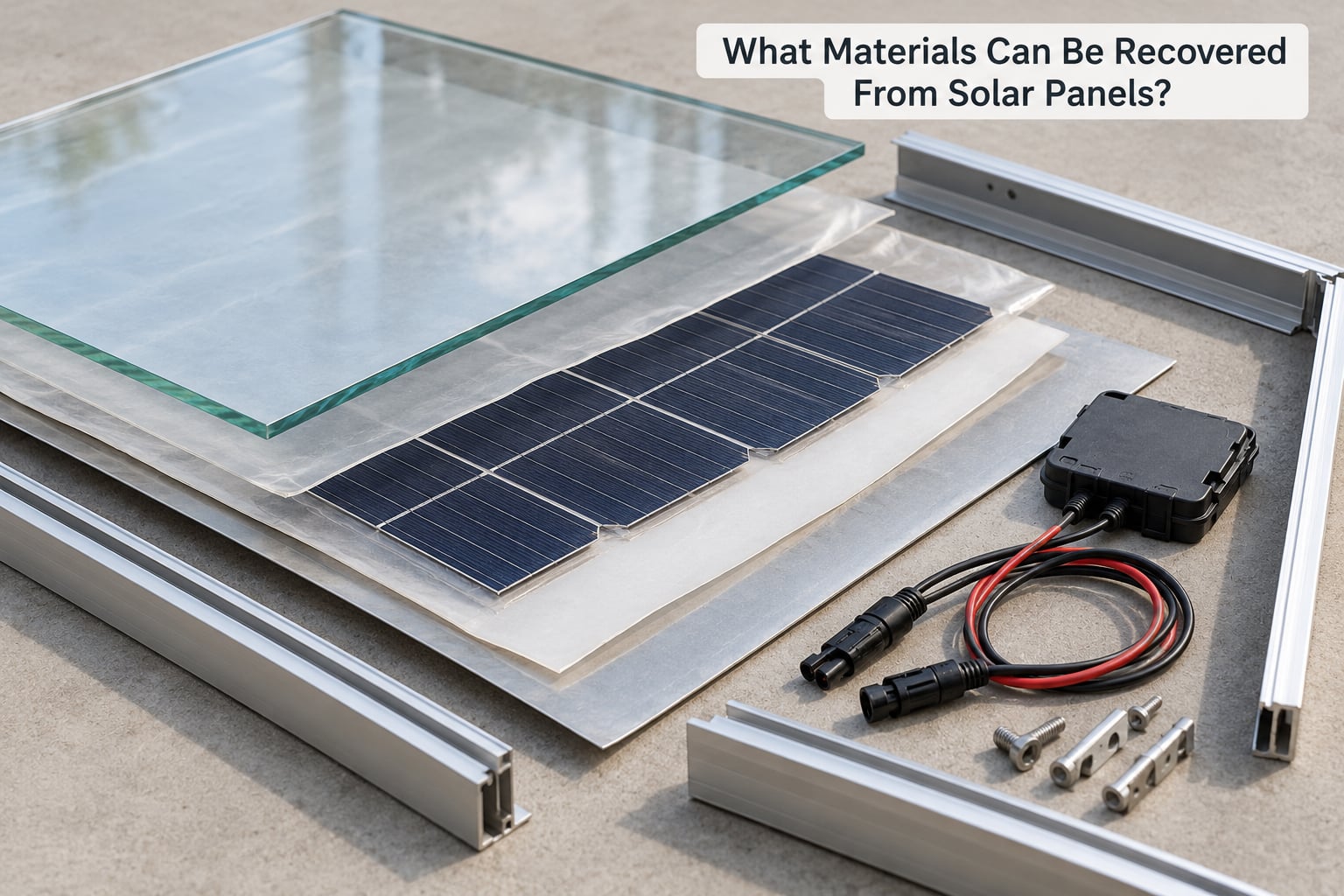
The easiest materials to recover are the ones you can see and pull off by hand. The hardest are the ones bonded inside the laminate by the EVA encapsulant, a plastic film that has to be broken down before the cells underneath can be reached.
| Material | Where it sits | How it comes back out |
|---|---|---|
| Tempered glass | Front surface and often the rear of the module | Freed by thermal or mechanical delamination, then cleaned and crushed for new glass products |
| Aluminium | Frame, mounting rails and junction box | Removed by hand at collection, sold straight back as metal |
| Copper | Cell interconnect ribbons and cabling | Shredded loose with the cells, then separated by air classification and sieving |
| Silicon | Crystalline cells | Recovered as wafer or powder fragments, then purified for reuse in new modules |
| Silver | Printed on the front surface of each cell as paste | Recovered through etching or froth flotation from cell fragments |
| Tin and lead | Solder on the cell edges, lead in some backsheets | Separated in the chemical stage and handled as controlled residues |
| EVA and backsheet plastic | The encapsulant layers bonding everything together | Broken down by heat or solvent, partly recovered as polymer |
That table explains the two numbers people find online and cannot reconcile. By mass, roughly 95% of a module can be routed into a recovery stream, mostly glass and aluminium. By value, the high-value materials — silver, copper, high-purity silicon — are under about 6% of the mass, and that is where nearly all the money is.
How the Recycling Process Works Step by Step
The process families are mechanical, thermal and chemical, and most plants use a combination rather than one pure approach. Where the plant sits on that spectrum determines what it can recover and what it has to burn off.
| Method | How it works | Best at | Trade-off |
|---|---|---|---|
| Thermal delamination and pyrolysis | Heated so the EVA encapsulant breaks down and the layers lift apart | Freeing intact glass and clean wafer material | Energy intensive, and some polymer is lost in the heat |
| Mechanical | Shredding, sieving and air classification to sort fractions by size and weight | Recovering glass, aluminium, copper and plastics cheaply | Cells are damaged, so silicon and silver recovery is messier |
| Hydrometallurgical | Chemical baths dissolve the metals out of cell fragments | High-purity silver, copper, tin and silicon | Chemical handling, wastewater treatment, higher running cost |
1. Collection and assessment
How solar panels are recycled starts here, with the least glamorous and most useful step. Panels arrive from installers, manufacturers and decommissioning contractors, often grouped into batches by type. Workers inspect and weigh each module, note whether it is crystalline silicon or thin-film, and check for cracked glass and live wiring before anything is cut.
2. Frame, junction box and cable removal
The aluminium frame comes off, along with the junction box, the cabling and the mounting hardware. This is the one stage with almost no technology in it, and it is why aluminium recovery is so clean: the frame is simply lifted off and sold as metal.
3. Delamination of the laminate
The remaining laminate is heated, roughly to the range where EVA softens and decomposes, or it is mechanically abraded. Either way the goal is the same — separating tempered glass, the plastic layers and the photovoltaic cells without losing the cell material to heat damage.
4. Glass separation and cleaning
Glass is peeled or washed free and sorted by quality. Clean glass with no cell residue goes to crushed glass products; glass still carrying cell fragments goes down a further cleaning route or to lower-grade outlets.
5. Shredding and sorting the cells
Cells are shredded down to small fragments, typically a few millimetres. Screens and air classification pull out the light polymers and heavier fragments, concentrating copper, silver-bearing material and silicon together for the next step.
6. Metal extraction and purification
Here the route splits. Chemical leaching dissolves silver, copper and tin into solution so they can be recovered at high purity, while flotation is used to concentrate silver-bearing powder from the fines. Silicon fragments are cleaned and purified for reuse.
7. Re-entry into manufacturing
Outputs are weighed, sampled and documented before sale. Aluminium goes back to metal merchants, glass to glassmakers, and purified silicon and silver back to cell and electronics manufacturing, though in practice a lot of recovered glass is downcycled into lower-grade products rather than returning to a new panel.
What is different about thin-film panels
Cadmium telluride and CIGS modules do not have the crystalline silicon stack at all. They are shredded to fine fragments and run through a chemical bath route, with a rotating screw separating solid and liquid fractions, which routes more of the glass straight back into reuse. The trade-off is handling: cadmium, and in some CIGS builds lead, means tighter containment rules throughout.
Can Homeowners Recycle Solar Panels Themselves?
No, not for the panels themselves. Dismantling a photovoltaic module releases sharp tempered glass edges, breaks the encapsulation that traps everything in place, and leaves wiring that can still be live. Panel glass also has a high lead and cadmium content in some older designs, which is exactly the kind of material waste facilities are set up to contain.
What a homeowner can reasonably do is small and specific: unbolt racking that is accessible from the ground, coil and bag the DC cabling once the array is de-energised, and keep each panel upright and padded so it cannot flex. A panel removed flat and sat on can micro-crack cells you cannot see, and then it has to go to a recycler as damaged material.
Anything involving the modules themselves belongs with the installer or a licensed electrician. If your system is grid-tied, that is not negotiable — a qualified installer disconnects it properly and handles the panels with the right handling equipment and lifting for a roof height.
Where Can You Take Old or Damaged Panels?
The practical answer is almost always to start with whoever put the panels on your roof. Installers commonly have a take-back arrangement with the distributor or manufacturer, and in many cases removing and transporting is cheaper than any fee you would be charged for disposal at the gate.
Beyond that, four routes exist, and acceptance varies by country and region. Manufacturer take-back and distributor schemes handle end-of-life modules at the point the supply chain started. Certified recyclers and dedicated e-waste facilities process panels properly, and they are the right destination for damaged or cracked modules. Local authority or household hazardous-waste facilities sometimes accept small quantities, though many exclude solar panels outright, so it is worth calling before loading up the van.
Community solar projects and off-grid builds are worth a look first. Panels removed early for a roof repair or an upgrade often still produce usable power, and homeowners on solar forums describe donating them to community projects or keeping them for a small DIY array. A panel tested at around 80% of its original output is worth far more reused than shredded.
What Is the Environmental Value of Recycling Solar Panels?
Recycling diverts a bulky, hard-to-process waste stream from landfill and returns glass, aluminium, copper and silicon to manufacturers who would otherwise mine or smelt them. Aluminium in particular is one of the most energy-intensive metals to produce, so recovering a frame is worth real carbon savings.
It is worth being honest about the limits. Recovered glass usually goes into lower-grade applications rather than back into a new module, which is downcycling. Recovered silicon competes on price with virgin material and only wins when supply is tight. And an old panel in the ground does not become a good new panel — recycling is about keeping materials out of landfill and in circulation, not about reviving lost performance.
Scale is the other problem. Most panels from the huge installation wave of the 2010s have not reached end of life yet, but very few are being designed for easy disassembly, and there is no universal take-back rule in many countries. That is why the honest summary is that the technology behind how solar panels are recycled works well, and most panels still do not get recycled.
Frequently Asked Questions
What percentage of a solar panel can be recycled?
By mass, roughly 95% of a crystalline silicon module can enter a recovery stream, mostly as tempered glass and aluminium. By economic value the picture is very different: silver, copper and high-purity silicon make up under about 6% of the mass but nearly all of the recoverable value. That gap is why the two numbers are both accurate.
What is the 33% rule in solar panels?
The 33% rule is not a recycling rule at all. It comes from quality control in module manufacturing: panels are binned out when their output falls more than roughly a third below their rated power, usually because of cracks, corrosion or cell defects. It explains why some panels are retired early, but it has nothing to do with the recycling process.
Why are people getting rid of solar panels?
Most panels are removed well before their 25 to 30 year technical life. The usual triggers are roof repairs or re-roofing, a system upgrade to a more efficient array, storm, hail or fire damage, and a house sale where the buyer does not want the array. Output also fades around 20% over 25 years, though most systems are retired for reasons that have nothing to do with age.
Are solar panels hazardous waste?
A modern crystalline silicon panel is not classed as hazardous waste, but it is not ordinary rubbish either. It contains an aluminium frame, tempered glass with sharp edges, plastic encapsulants and copper wiring that can still carry a charge, and older designs can include lead or cadmium. That is why panels need controlled handling rather than a kerbside bin.
Do small solar lights need the same disposal route?
Small garden solar lights are a separate case. The panel itself is tiny and the body usually contains a rechargeable battery, which is the part that needs special handling and must not go in household waste. Take the light to a household hazardous-waste or battery collection point, or check whether a local take-back scheme accepts small lighting.
Conclusion
Do not put panels in ordinary household waste and do not dismantle them yourself. If you have an array coming off, contact the installer who fitted it first, then your local authority or a certified recycling provider, and ask which route they accept — rules differ by region. Knowing how solar panels are recycled makes that conversation much easier.
Before anything is broken up, test the output. A panel still making useful power is worth more donated to a community build or reused in a small off-grid project than it is as recycled raw material.