
Comparing electricity providers comes down to one thing: read each plan’s Electricity Facts Label at your own monthly kilowatt-hour usage instead of chasing the smallest headline rate. That only works in deregulated US markets. In a regulated state your utility sets one price and there is nothing to compare.
Budget about an hour for the first pass. Once you know which fields on the label actually move your bill, later comparisons take twenty minutes.
This guide is written for readers in Texas, Pennsylvania, Ohio, New York, New Jersey, Illinois, Massachusetts, Maine, Michigan, Georgia, Maryland, New Hampshire and other competitive states. It names no provider as the cheapest, because that answer changes by ZIP code, by usage level and by the month you look. We have no affiliate relationship with any retail electric provider or comparison site.
Table of Contents
- What You Need
- Step-by-Step: How to Compare Electricity Providers
- Step 1: Decide What Matters Most to You
- Step 2: Compare the Full Cost at Your Usage, Not the Headline Rate
- Step 3: Check Contract Terms and Billing Flexibility
- Step 4: Review Service, Support, and Reputation
- Step 5: Compare Renewable Energy and Overall Plan Quality
- Step 6: Make a Shortlist and Verify Before You Switch
- Common Mistakes
- Frequently Asked Questions
- What is the best site to compare electricity prices?
- How do I know which electricity provider is cheapest?
- How do I read an Electricity Facts Label?
- What is the difference between fixed and variable electricity rates?
- Will switching electricity providers cut off my power?
- Do comparison sites charge more for electricity?
- What to Do First
What You Need
Most people start a comparison with the wrong information. They open three shopping sites and read three sets of headline rates, which is the least useful comparison available. Start at the source instead.
- Twelve months of bills. Your usage in kilowatt-hours changes with the seasons, and a plan priced well at 1,200 kWh can be badly priced at 2,000. Most providers show three reference tiers on the label: 500, 1,000 and 2,000 kWh per month. Find which tier your household resembles.
- Your price to compare. This is the baseline rate you would pay if you changed nothing and simply stayed with the default or expired plan. It appears on your current bill and on your state utility commission’s official portal. It is the number every other plan should be measured against.
- Your current plan terms. Contract end date, contract length, early termination fee, base charge and whether you are on a fixed, variable or time-of-use rate.
- Your exact service address. Not just the ZIP code. In many territories one ZIP code contains several transmission and distribution utilities, and your actual delivery utility is set by your street address.
- Access to your state portal. Examples include Power to Choose in Texas, PAPowerSwitch in Pennsylvania, Energy Choice Ohio, and the Power to Choose service run through the New York Department of Public Service. Official sites are free and non-commercial.
- A recent credit check assumption. Some providers screen new customers and can ask for a deposit or prepaid enrollment. Knowing that in advance prevents a surprise on day one.
Three months of bills is workable if twelve is not available. One month is not enough, because it tells you nothing about how your usage moves between summer and winter.
Step-by-Step: How to Compare Electricity Providers
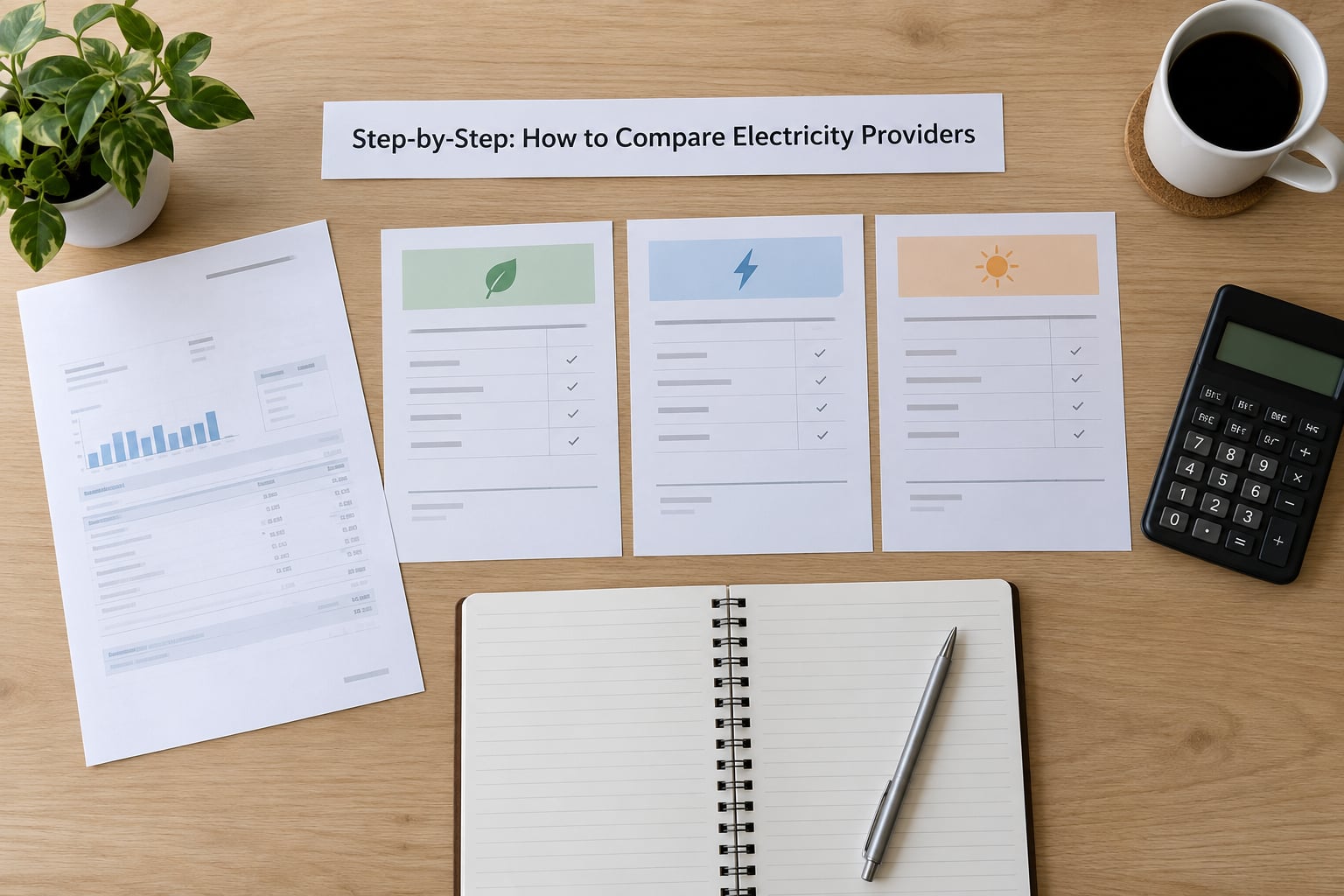
Step 1: Decide What Matters Most to You
There is no single correct plan. Write down your two or three priorities before you look at a single offer, because the cheapest headline rate and the best plan for a fixed budget are frequently not the same plan.
- Lowest predictable total cost. Best for households that want a number they can budget around.
- Rate protection. A fixed rate holds the per-kWh price for the term. A variable rate tracks the wholesale market and can move sharply in a heat wave.
- Month-to-month freedom. No term, no early termination fee, and a different risk profile.
- Renewable sourcing. A stated percentage of renewable energy certificates, which matters if that is a personal or values-based requirement.
- No deposit or prepaid terms. Worth checking for recent movers and first-time account holders.
- Support quality. Hours, phone and chat availability, and whether the provider handles billing questions in-house.
Step 2: Compare the Full Cost at Your Usage, Not the Headline Rate

Every plan’s cost breaks into three pieces, and only two of them vary between providers.
The energy charge is the price per kilowatt-hour for the power itself. This is the number most sites lead with. The base charge is a flat monthly fee that covers billing, metering and account costs. The utility delivery charges, billed through your transmission and distribution utility, are the poles, wires, meter reading and outage repairs. Delivery charges are identical no matter which retail supplier you pick, so they do not belong in your comparison, even though they make up a large share of the bill.
Now the part that catches people. Take two hypothetical plans, both with no bill credit.
Plan A advertises 6.9 cents per kWh, adds a 15 dollar base charge, and applies a minimum usage fee of 10 dollars on any month below 1,000 kWh. Plan B advertises 7.9 cents per kWh with no base charge and no usage minimum.
| Monthly usage | Plan A | Plan B | Cheaper |
|---|---|---|---|
| 500 kWh | 59.50 dollars | 39.50 dollars | Plan B by 20 dollars |
| 1,000 kWh | 84.00 dollars | 79.00 dollars | Plan B by 5 dollars |
| 2,000 kWh | 153.00 dollars | 158.00 dollars | Plan A by 5 dollars |
Plan A won the headline comparison, the cheapest on paper at 6.9 cents, and it still loses to Plan B at both 500 and 1,000 kWh. Over a year at 1,000 kWh the gap is roughly 60 dollars in Plan B’s favor. Plan A only catches up in a household that consistently uses more than 1,000 kWh a month, where the minimum usage fee stops applying and the lower per-kWh rate finally shows.
Multiply by twelve and compare. That single exercise removes most of the confusion from the whole process.
Step 3: Check Contract Terms and Billing Flexibility
Now check the terms that decide whether you are locked in. Note the contract length, which runs from one month to three years, and the early termination fee, which is usually a flat dollar figure per remaining month up to a cap.
The switch-or-stay math is simple once you have both numbers. Multiply the months left on your term by your monthly kWh, then multiply that by the per-kilowatt-hour difference you would gain by leaving.
Say eight months remain on a contract, you use 1,000 kWh a month, and the better plan is five cents per kWh cheaper. That is 8 x 1,000 x 0.05, or 400 dollars, against a 150 dollar termination fee. Leave. Now narrow the gap to two cents and the same calculation gives 160 dollars against a 150 dollar fee, which is not worth the switch, the paperwork or the risk of landing on a worse plan in a hurry.
Also look for what happens when the term ends. Many contracts roll onto a month-to-month default at a variable rate, which is where the community reports its worst surprise bills. A short term that expires right before peak summer leaves you exposed. Ask the provider in writing what the renewal rate will be and whether it is fixed, variable or the same promotional rate.
Finally, read the billing terms: autopay discounts, late fees, deposit or prepaid requirements, payment plan availability, and whether switching interrupts service. Switching mechanics differ by state, and some states waive the early termination fee when you move to a new address.
Step 4: Review Service, Support, and Reputation
Price gets the attention, but service quality is what you live with. Two things are worth knowing up front. Your delivery utility stays the same no matter which retail supplier you choose, so reliability, outage response and the physical lines are not a reason to pick one supplier over another. The difference shows up in billing accuracy, customer service and how fast a credit gets resolved.
Check your state utility commission’s website for the provider’s licensing status and its complaint record. Most commissions publish enforcement actions, complaint totals and, in some states, customer satisfaction survey results. A provider with a pattern of unresolved billing complaints is telling you something you will not find on a shopping site.
Read verified customer reviews with the same skepticism you would apply to any product. Reviews skew toward memorable billing problems, so read for recurring themes rather than counting individual complaints.
Step 5: Compare Renewable Energy and Overall Plan Quality
Renewable claims vary in how much they mean. One provider buys renewable energy certificates covering the same kilowatt-hours as your usage, another matches only a portion of supply, and a third simply buys a small share for marketing reasons. The Electricity Facts Label states the renewable percentage for the plan, and in some states the certificates are retired on your behalf and listed separately. Read that field rather than trusting a plan name.
The plan structure matters at least as much as the green claim. This table is the filter most experienced shoppers use.
| Plan type | How it is priced | Suits | Main risk |
|---|---|---|---|
| Fixed rate | Locked cents per kWh for a term | Households that want a predictable budget | You may pay above market in a soft year |
| Variable rate | Tracks the wholesale market, usually month-to-month | Flexible households watching the market | Sharp spikes during peak demand |
| Time-of-use | Cheaper off-peak, dearer during set hours | Households that can shift most usage overnight | Discount rarely materializes for average use |
| Bill credit or usage-banded | Low headline rate that depends on hitting a usage band | Households whose usage sits reliably inside the band | Miss the band and the rate jumps sharply |
| Prepaid | Pay in advance, often at a discount | Households avoiding a deposit or credit check | Less flexibility, disconnect risk if you miss a payment |
Time-of-use plans deserve a specific warning. The off-peak discount looks generous until you notice how much the on-peak rate rises. Unless you can genuinely move laundry, dishwashing, water heating and vehicle charging into the cheap window, the savings rarely show up. If a plan requires a utility account to be remotely started or stopped for credit, the friction alone usually erases the discount.
Bill credit plans advertise a headline rate far below your price to compare, then only deliver it if your usage lands inside a narrow band. Households with a predictable pattern can profit from them. Households with a variable pattern, an electric vehicle charging overnight, or a new addition to the home can end up paying more than a plain flat plan. Check whether the plan is billed on your metered usage alone or requires a utility account.
Step 6: Make a Shortlist and Verify Before You Switch
Narrow the field to three plans and put their labels side by side, not their marketing pages. Then run these checks:
- Read the disclosure chart portion of the label, which shows how your price moves as usage changes. The energy price section and the disclosure chart answer different questions, and the second one is where cost traps hide.
- Confirm the plan is actually available at your service address, with your delivery utility. Availability varies street by street within a ZIP code.
- Confirm the EFL is available before you enroll, not just the summary rate. Providers are required to publish it.
- Check the renewal terms and the month-to-month default rate in writing.
- Ask whether the headline rate is introductory, and if so, what rate follows and for how long.
- Verify the provider’s licensing and complaint record at your state utility commission.
Ignore any comparison that depends on a rate expiring in days. A promotion that ends before you have read the label is pressure, not a deal.
Common Mistakes
These are the errors that cost households the most money, roughly in the order they show up.
1. Comparing different usage levels. Every provider publishes rates at 500, 1,000 and 2,000 kWh. Comparing Plan A’s 500 kWh rate against Plan B’s 2,000 kWh rate is meaningless. Fix: pick the tier closest to your real average before you look at anything else.
2. Ignoring the base charge. A low per-kWh rate with a heavy monthly base fee loses for small and medium users. Fix: run the multiplication above at three tiers before deciding.
3. Treating every renewable plan as equivalent. Fix: read the renewable percentage field on the label and check whether certificates are retired for your specific usage.
4. Overlooking contract terms. Fix: note the end date, the early termination fee and the renewal rate in writing on day one, then set a reminder for two weeks before the term ends.
5. Falling for a teaser rate. An introductory rate is a discount on the first period only. Fix: read the EFL for the rate that applies in month thirteen.
6. Switching on impulse to avoid an end-of-term cliff. Fix: if your contract is about to expire, you have leverage and no fee. Slow down and compare properly instead of accepting the first offer.
7. Assuming comparison sites rank neutrally. Fix: treat marketplaces as a discovery layer and your state portal plus the EFL as the source of truth.
How comparison sites and brokers get paid
This is the part most guides skip, and it explains something that confuses nearly everyone: the same provider can show a different plan set, or different economics, on different comparison sites for the same ZIP code.
Two models are common. Comparison marketplaces are usually paid by the provider, either a fee per enrollment or a small residual amount per kilowatt-hour for as long as you stay. Brokers, including subscription services, charge the consumer an ongoing fee and may also take a commission from the provider.
Neither model makes a site dishonest. Both make ranking a business decision rather than a purely editorial one, which is why your state’s official portal is the better starting point. A site that discloses how it makes money in plain language is easier to trust than one that simply claims neutrality. Use a marketplace to find candidates, then open each plan’s Electricity Facts Label before you decide anything.
Two timing tips worth knowing
Experienced shoppers pay attention to when a contract ends, not only what it costs. A term that expires at the start of a peak summer or peak winter month leaves you exposed to the most expensive stretch of the year, so a contract ending in spring or autumn usually carries less risk. Note also that several states give you a short window before expiry to switch without an early termination fee, and that moving to a new address can waive the fee entirely. Those exemptions exist, but they are provider and state specific. Ask before you assume.
Frequently Asked Questions
What is the best site to compare electricity prices?
Use your state utility commission’s official portal as the source of truth: Power to Choose in Texas, PAPowerSwitch in Pennsylvania, Energy Choice Ohio, the New York DPS Power to Choose service, or your commission’s own site. These are free, neutral and required to list every licensed plan at your address. Commercial comparison marketplaces are useful for discovery but rank plans commercially. Never enroll from a marketplace listing without opening the plan’s Electricity Facts Label first.
How do I know which electricity provider is cheapest?
There is no single cheapest provider. There is only the cheapest plan for your usage at your address, and that changes with the season. The reliable method is to find your monthly kWh, multiply it by each plan’s energy charge, add the base charge and any minimum usage fee, and compare totals at 500, 1,000 and 2,000 kWh. The plan with the smallest headline rate often loses this comparison.
How do I read an Electricity Facts Label?
The label has two halves. The energy price section lists your energy charge per kilowatt-hour, the base fee, and the delivery charges set by your utility rather than the supplier. The disclosure chart section shows how the price changes as your usage moves, plus the contract length, whether the rate can change, the early termination fee, any additional fees, and the renewable energy percentage. Ignore the delivery charges when comparing suppliers; read the second half carefully, since that is where traps appear.
What is the difference between fixed and variable electricity rates?
A fixed rate locks your cents per kilowatt-hour for the contract term, which makes budgeting easy and protects you from a summer spike. A variable rate follows the wholesale market, usually with no term at all, so it can rise sharply during high demand. A third option, time-of-use or bill credit plans, prices the same kilowatt-hour differently depending on when you use it or how much you use, and those savings usually require specific habits most households do not have.
Will switching electricity providers cut off my power?
No. Your transmission and distribution utility owns the poles, wires and meter and keeps maintaining them no matter which retail supplier serves you. Switching changes only the company that supplies your power and sends you the bill. Service does not interrupt. The new provider handles the switch with your utility, and you keep the same account number and meter.
Do comparison sites charge more for electricity?
Usually not directly. Comparison marketplaces are typically paid by providers, through a fee per enrollment or a small residual amount per kilowatt-hour, while brokers may charge you a subscription fee and also take a commission. That funding model is why the same provider can show different plans or economics on different sites for the same ZIP code. It does not make a site dishonest, but it does mean ranking is partly a business decision.
What to Do First
Pull out your last twelve bills and write down your average monthly kilowatt-hours. That single number determines which of the three usage tiers on every Electricity Facts Label you should be reading, and it is the input everything else depends on.
Then open your state utility commission’s portal, compare three plans at your own usage tier rather than at the headline rate, and read the disclosure chart on the two you like best. Rates change regularly, so verify every figure against the plan’s own label and your state commission before you enroll.