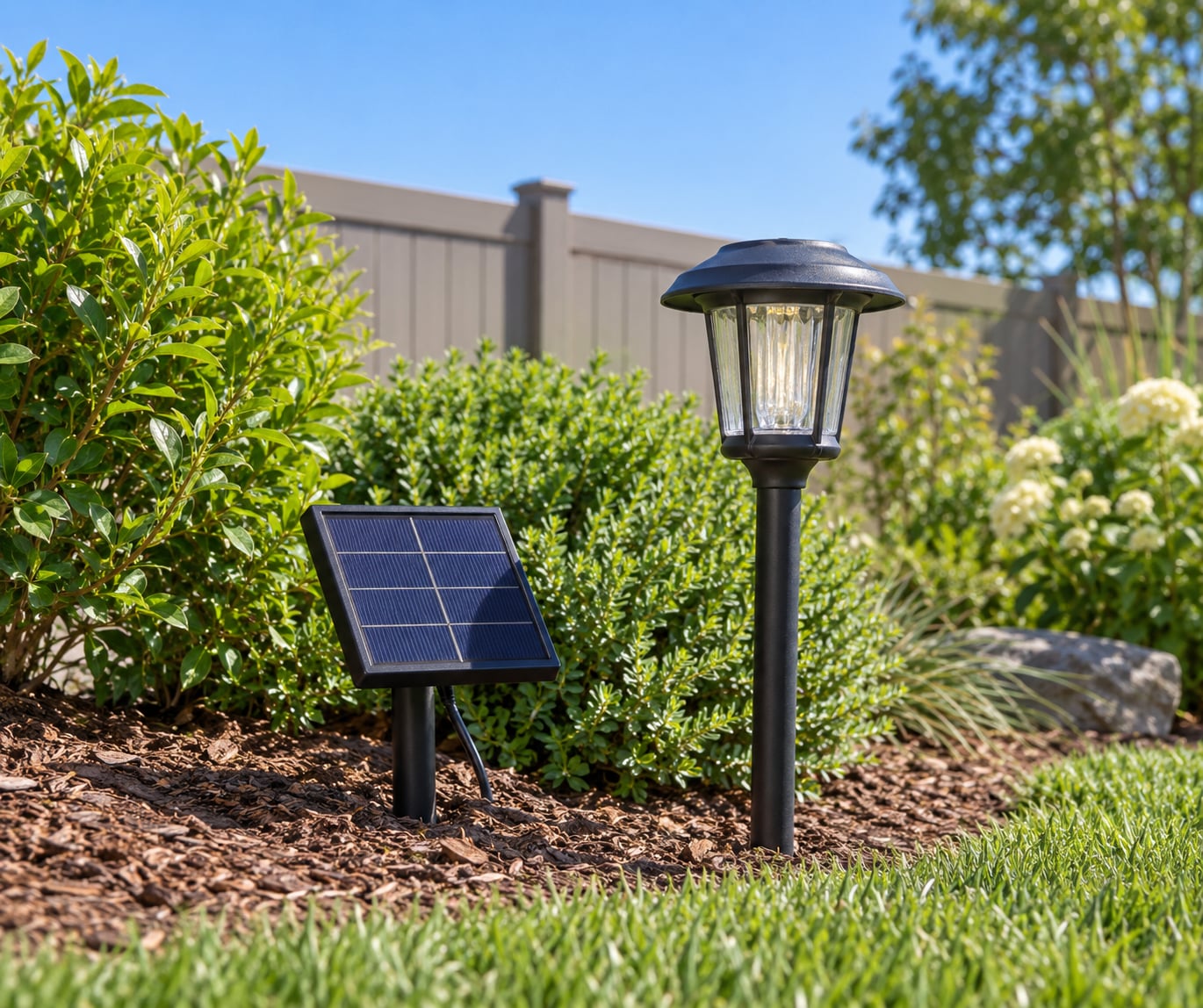
What is peak sun hours? It is the number of hours in a day when the sunlight reaching your site equals one hour of full sun at 1,000 watts per square meter. It is a measure of energy, not a stretch of the clock, and it is the first number worth checking before you buy solar lights or size a home solar-power system.
A quick way to picture it: if your roof collects 6 kWh of sunlight on a clear June day, that energy spread out at full 1,000 W/m2 intensity would take 6 hours. Nothing about your day required six unbroken hours of brilliant sun.
Table of Contents
- What Are Peak Sun Hours?
- Why Do Peak Sun Hours Matter for Solar Energy?
- Peak Sun Hours vs. Average Sunlight Hours
- How Do You Find Peak Sun Hours for Your Location?
- How to Calculate Peak Sun Hours
- What Is a Good Number of Peak Sun Hours?
- How Peak Sun Hours Affect Solar Garden Lights
- Peak Sun Hours for a Home Solar-Power System
- Common Peak Sun Hour Myths
- Frequently Asked Questions
- Conclusion
What Are Peak Sun Hours?
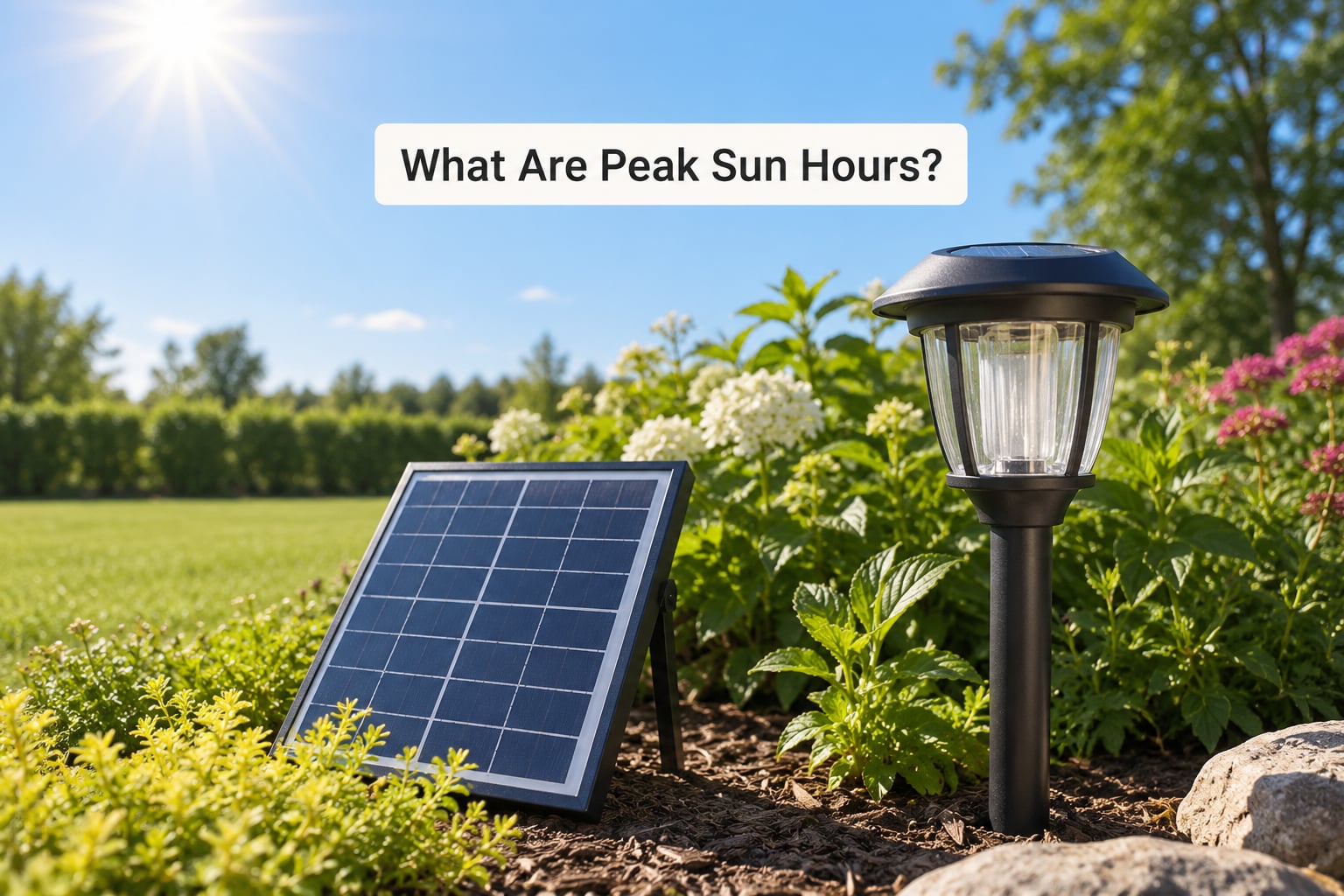
A peak sun hour is one hour of solar irradiance at an intensity of 1,000 watts per square meter (W/m2). Shine that much light onto one square meter of panel for an hour and you have one peak sun hour. Double the square meters or double the hours and you have two.
The important word is equivalent. A partly cloudy day can produce four peak sun hours spread as weak morning light, a strong hour around solar noon, and a fading evening tail. You do not need four consecutive hours of brilliant sun to get four peak sun hours.
Here are the four concepts that get mixed up most often:
- Definition: one hour of sunlight at 1,000 W/m2 arriving at the surface of your panel.
- Not total daylight: the sun can be above the horizon for fourteen hours and still yield only three peak sun hours.
- Equivalence, not consecutive time: the figure is a converted total, not a block of real hours.
- An average: daily numbers vary with clouds, and most published figures are long-term averages for your area.
Solar irradiance is the intensity of light hitting a surface at a given moment, measured in W/m2. Solar insolation is the total energy received over a whole day, usually in kWh/m2 per day. Divide one by the other and you get peak sun hours.
Solar noon is the moment the sun crosses your local meridian and sits at its highest point. That is when irradiance peaks, and it is why most of your daily energy arrives in a window roughly between 10 a.m. and 3 p.m.
Why Do Peak Sun Hours Matter for Solar Energy?
Every sizing decision in solar starts with this one number. It sets how much energy a panel area can collect on a typical day, which in turn sets how many panels you need and how big the battery must be to carry you through a dark stretch.
Ignore peak sun hours and you do one of two things. You oversize, spending money on panels that produce more than you can use, or you undersize, watching the battery go flat every January. Diyers building solar garden lighting hit the same wall in miniature: a lamp with a small panel and a small battery needs a certain number of peak sun hours to refill before it can light anything again.
It also sets expectations. A homeowner who reads 5 peak sun hours expects a 5 kW array to make 25 kWh on a sunny day. That is the right arithmetic and the wrong expectation, because a real array loses energy to heat, dust, wiring and inverter conversion. Knowing the gap early is cheaper than discovering it after the install.
Peak Sun Hours vs. Average Sunlight Hours
| Measure | What it means | Units | What it misses |
|---|---|---|---|
| Daylight hours | Time the sun is above the horizon | Hours | Cloud cover, low sun angle, haze |
| Sunshine duration | Hours with the sun actually visible | Hours | Weak versus strong light |
| Solar irradiance | Light intensity at one moment | W/m2 | Does not describe a whole day |
| Solar insolation | Total solar energy received in a day | kWh/m2/day | Does not convert to a usable time figure |
| Peak sun hours | That daily energy expressed as equivalent full-sun hours | Hours | Reflects long-term averages, not one afternoon |
Read the table as one conversion chain. Irradiance measured through the day becomes insolation; insolation divided by 1,000 W/m2 becomes peak sun hours. Daylight hours never enter the calculation, which is exactly why a cloudy December day can have fifteen hours of daylight and two peak sun hours.
How Do You Find Peak Sun Hours for Your Location?
Three routes work, and they agree closely when your address is entered correctly.
Read an NREL solar irradiance map
The National Renewable Energy Laboratory publishes solar resource maps that show average daily insolation across the United States. Look at the color band for your county, translate the kWh/m2/day figure into peak sun hours, and treat the result as the long-term average. Read the map legend carefully: darker bands mean more energy, and the scale runs in kWh, not hours.
Run a PVWatts estimate
PVWatts, also from NREL, takes an address, a system size and a tilt and returns estimated monthly and yearly output. It is free, it uses the same national dataset, and it already folds in some losses. This is the fastest route for a homeowner who wants a number rather than a shade study.
Make a site-based estimate
For a garden or a specific roof face, weather history plus an honest look at obstructions beats any regional average. Count the hours your site gets direct sun, note the tree that blocks the afternoon in summer, and subtract the shading you saw rather than the shading on the map. Homeowners on solar forums repeat the same advice: a stated peak sun hour number with no loss factor attached produces an over-optimistic estimate every time.
How to Calculate Peak Sun Hours
There are two calculations worth knowing, and you rarely need both.
From measured production
If your meter or inverter shows daily production, convert it to peak sun hours:
Peak sun hours = energy collected (kWh) ÷ panel area (m2)
A 1 kW array is roughly 5 m2 of panel. So a system that logged 20 kWh on a clear day produced about 4 peak sun hours, once the array is doing its job properly.
From your local solar resource
Take the daily insolation figure from the NREL data for your site and divide by one:
Peak sun hours = insolation (kWh/m2/day) ÷ 1 kW/m2
A location listed at 4.8 kWh/m2/day sits at 4.8 peak sun hours per day on average. No further math is involved, which is why some people think the calculation is more mysterious than it is.
Using it to size an array
Once you have peak sun hours, the sizing step needs a loss factor. DIYers who divide their load by peak sun hours alone regularly end up with a system far larger than the naive division suggests:
Required kW = daily kWh needed ÷ (peak sun hours × derating factor)
Worked example: a household needing 30 kWh a day at a site with 4.5 peak sun hours and a 0.80 derating factor needs 30 ÷ (4.5 × 0.80) = 8.33 kW. Installers quoting larger than that are usually shading the quote for worst-case assumptions, not padding it.
What Is a Good Number of Peak Sun Hours?
There is no magic threshold. Most US locations average somewhere between 3.5 and 6 peak sun hours per day, and the spread inside that band is what actually decides your design.
Below 3.5
Higher latitudes with heavy winter cloud cover sit here. A home array still works, but you size battery storage on the worst month rather than the annual average, and you plan for several cloudy days in a row without generation.
Between 3.5 and 5
The broad middle of the country and much of the Northeast and Midwest. Grid-tied systems are comfortable here; off-grid and battery-backed setups need real planning.
Above 5
The Southwest and desert regions. More hours mean a smaller array and shorter battery recharge for the same load, but summer heat still trims output and dust on panels is worth watching.
Do not treat these bands as a ranking. A shaded suburban roof in a 6-hour county can produce less than an unobstructed one in a 4-hour county, and that is where a site-specific check pays off.
How Peak Sun Hours Affect Solar Garden Lights
Solar lighting compresses the whole calculation into something a homeowner can do in an afternoon. The lamp’s panel size and its battery capacity have to match your local peak sun hours, or the light will run short on dark nights.
Here is what each part depends on. Panel area sets how fast the battery fills, and battery capacity sets how long the LED burns after dark. Peak sun hours tell you how much charge the day actually delivers, which means the same fixture behaves very differently in Arizona and in Ohio. Winter output drops because both the day length and the sun angle fall, and battery capacity falls with cold, so a light that runs all night in July may barely reach midnight in January.
Two settings make a bigger difference than most buyers expect. Many fixtures ship with a motion or dusk sensor set to full brightness, which drains the battery far faster than the label runtime assumes. Turning brightness down or using a dim mode buys hours, and mounting the panel where nothing shades it buys more than an extra watt of LED output.
If your garden gets under four peak sun hours, look for fixtures with larger panels and higher-capacity batteries rather than brighter LEDs. Brighter light you cannot keep on past midnight helps nobody.
Peak Sun Hours for a Home Solar-Power System
For a grid-tied or battery-backed home system, peak sun hours set the ceiling on how much you can produce and nothing else. Household load decides what you need. Peak sun hours decide whether your panels can cover it.
Panel efficiency and size convert sunlight into watts, orientation and tilt decide how much of that light the panels actually face, and shading takes a bite out of the total. Temperature losses, soiling, wiring and inverter conversion sit on top. Seasonal weather decides the month you will look at first when the system underperforms, and battery autonomy decides how many days of darkness you want to ride out.
One number is not a whole system design. It is the input you cannot skip, and the input most often left out of quotes that arrive without a stated performance ratio.
Common Peak Sun Hour Myths
The longest day equals the best day. Midsummer gives you the longest daylight window but a shallow sun angle, so the extra hours arrive weak. The strongest light still arrives around solar noon.
You only need to think about summer. A summer average hides the winter problem. Battery owners say the array must be sized for worst-month recharge, or they go short every year at the same time.
The figure guarantees what your panels will produce. It does not. A regional average assumes average conditions; your roof has its own tilt, its own tree and its own dust.
One sunny day proves the site. Clear-sky readings sit at the top of the range. The long-term average that matters sits lower because clouds are part of the average, not an exception to it.
Frequently Asked Questions
Do solar panels need direct sunlight or just daylight?
Direct sunlight is what produces current. A panel under cloud or haze still generates power, but far less, and a panel in shade produces close to nothing. That is why daylight hours are a poor stand-in for peak sun hours: the sun can be above the horizon for fourteen hours while delivering the equivalent of two full-sun hours.
Does shade really change peak sun hours that much?
More than most buyers expect. A tree, a chimney or a neighbouring fence can cut output sharply during the brightest part of the day, which is exactly the part a peak sun hour is made of. Regional maps assume open ground, so a site-specific shade check is worth an afternoon of walking your yard at a few different times.
How is peak sun hours different from kWh?
Peak sun hours are a normalized time figure: sunlight energy converted into equivalent hours at 1,000 W/m2. Kilowatt-hours are actual energy. Multiply one by the other and a panel area and you get the energy a system collects, which is why peak sun hours work as the input to a sizing calculation rather than the output.
How many peak sun hours do I need for my system?
Enough to cover your daily load after losses. Divide your daily kWh by your local peak sun hours and a derating factor of roughly 0.75 to 0.85 to get required system size in kW. Off-grid projects should use the worst month rather than the annual average, and grid-tied systems can usually work from the annual figure.
Can I see the peak sun hours for today, not the average?
Live monitoring on a solar inverter or a connected meter will show you current power output, and dividing that by your array size gives you the effective peak sun hour so far. Weather services and solar resource dashboards also publish current irradiance readings for a region. Treat any single day as a data point, not a verdict on your site.
Conclusion
Start with the free number: look up your county on an NREL solar irradiance map or run a PVWatts estimate, then walk your site and note what shades it and when. Match that result to the product or system in front of you, and if the math comes out close, buy the bigger panel.