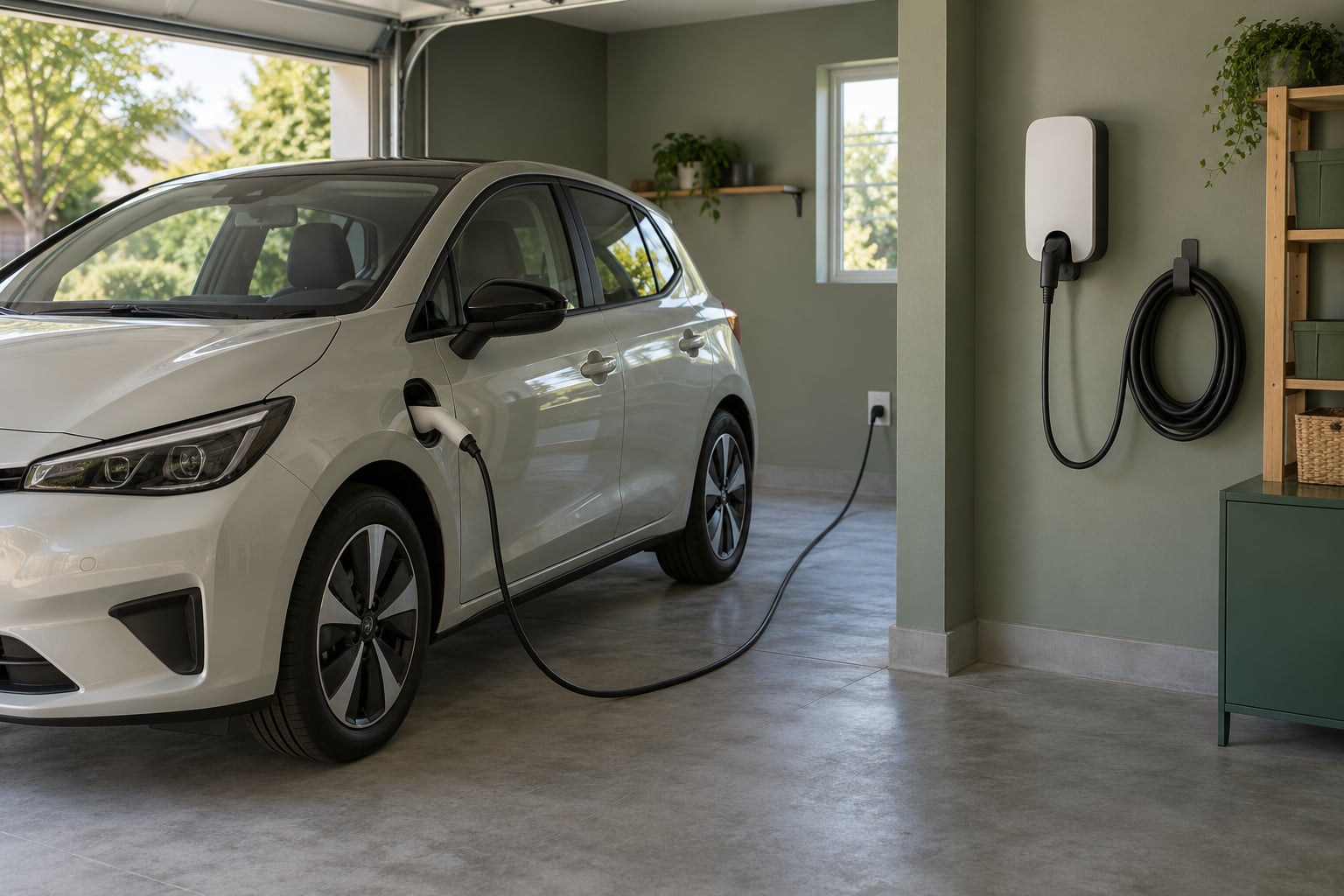
Level 1 vs level 2 EV charging explained in one line: Level 1 runs off an ordinary 120-volt household outlet and adds roughly 3 to 5 miles of range per hour, while Level 2 runs off a dedicated 240-volt circuit and adds roughly 20 to 36 miles per hour. Both are AC charging, so your car does the same conversion work either way.
Short version for most people: if you drive under about 35 miles a day, Level 1 is genuinely enough and you can leave it that way for years. If you drive 40 or more miles a day, run a large-battery truck, or want two cars on one outlet, Level 2 changes how you use the car. This guide walks through both, then the installation and cost realities nobody puts in the sales pitch.
Table of Contents
- Level 1 vs Level 2 EV Charging Explained at a Glance
- What Is Level 1 EV Charging?
- How Level 1 Charging Works
- What Is Level 2 EV Charging?
- How Level 2 Charging Works
- Level 1 vs Level 2 Charging Speed
- Level 1 vs Level 2 Charging Cost
- Home Installation and Safety
- Which Charging Level Do Most EV Owners Use?
- Which Should You Choose?
- Frequently Asked Questions
- Is Level 2 EV charging always better than Level 1?
- How long does Level 1 charging take for a typical electric car?
- Can I install a Level 2 charger at home?
- Does Level 2 charging use more electricity than Level 1?
- Can I charge an electric car with a regular extension cord?
- Is Level 2 charging safe for my home?
- Conclusion
Level 1 vs Level 2 EV Charging Explained at a Glance
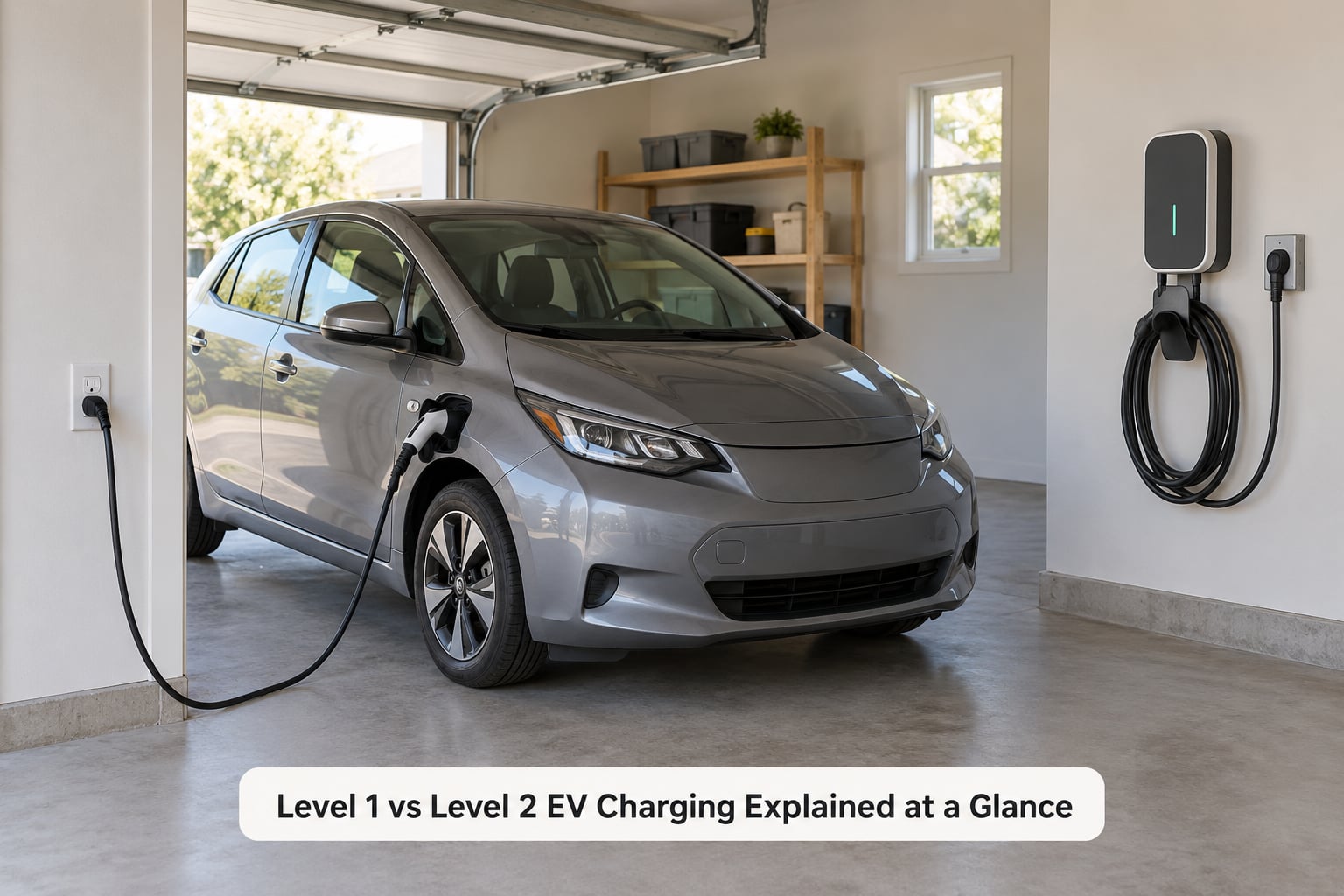
Level 1 charging uses a standard 120-volt household outlet at about 1.4 to 1.9 kW, adding 3 to 5 miles of range per hour. Level 2 charging uses a dedicated 240-volt circuit at about 7.2 to 11.5 kW, adding 20 to 36 miles of range per hour. Most EVs ship with a Level 1 cable and can accept Level 2.
| What you get | Level 1 | Level 2 |
|---|---|---|
| Voltage | 120V AC | 240V AC |
| Typical current | 12 to 16 amps | 32 to 48 amps |
| Typical power | 1.4 to 1.9 kW | 7.2 to 11.5 kW |
| Miles of range per hour | 3 to 5 | 20 to 36 |
| Range added over 8 hours | 25 to 40 miles | 160 to 290 miles |
| Time to fill a 75 kWh battery from empty | About 50 to 70 hours | About 8 to 10 hours |
| Outlet | Standard wall receptacle, no install | NEMA 14-50 or hardwired, dedicated circuit |
| Who installs it | You, tonight | A licensed electrician, usually with a permit |
| Best fit | Under 35 miles a day, small batteries, plug-in hybrids | 40+ miles a day, big batteries, two EVs, irregular schedules |
One naming note, because it confuses almost everyone. A long-running thread on r/electricvehicles asks why charging is not simply labelled 7 kW and 22 kW. The answer is that the levels describe which hardware is used, not how fast a given car charges: Level 1 means a normal household receptacle, Level 2 means a dedicated 240-volt circuit, and Level 3 means DC power from a high-voltage public charger.
Because of that, a 48-amp wall unit plugged into a car with a 7.2 kW onboard charger still only delivers 7.2 kW. The wall unit is supply equipment; the charger is in the car, and the car has the final say.
What Is Level 1 EV Charging?
Level 1 is AC charging from a normal 120-volt outlet, the same kind you use for a lamp. Most new EVs include a portable Level 1 cable with a J1772 connector on the car end, so owning one costs nothing beyond the cable that came with the vehicle.
At roughly 1.4 to 1.9 kW, it adds 3 to 5 miles of range per hour. Over a full night, an owner typically recoups 25 to 40 miles, which covers the roughly 31-mile average US daily commute that the Department of Energy’s Alternative Fuels Data Center and Plug In America track, with almost nothing to spare.
How Level 1 Charging Works
You plug the car into a 120-volt receptacle. Alternating current travels through the cable into the car’s onboard charger, which converts it to direct current and manages the rate, temperature and cutoffs before it reaches the battery.
Two things limit the speed. The outlet usually sits on a 15- or 20-amp circuit shared with household loads, and the car itself draws as much as its own design allows. Speed drops further if a refrigerator or a clothes dryer runs on the same circuit while the car is charging.
That shared-circuit reality is the main reason people call it trickle charging. It is genuinely slow, and it is genuinely enough for a lot of drivers.
What Is Level 2 EV Charging?
Level 2 is AC charging on a dedicated 240-volt circuit, the same voltage an electric clothes dryer uses. It draws between 32 and 48 amps, which is roughly five to seven times the power of Level 1.
Three amperage tiers are common. A 32-amp circuit gives about 7.7 kW, a 40-amp circuit gives about 9.6 kW, and a 48-amp circuit gives about 11.5 kW. Most cars with onboard chargers above 7.2 kW are paired with a 48-amp circuit, though many drivers settle for 40 amps because it costs less to run.
Level 2 is the standard home setup for a reason: it refills most cars overnight while you sleep, so the car is never the thing you think about.
How Level 2 Charging Works
Electricity runs from a double-pole breaker in your panel through a properly sized circuit, usually 6 or 8 AWG copper, to a wall unit, and from there into the car through the same J1772 plug Level 1 uses. The connector looks identical. The power behind it is not.
The wall unit can be hardwired directly, or plugged into a NEMA 14-50 outlet, the four-slot receptacle a dryer typically uses. A plug-in setup costs less and keeps the breaker visible and easy to use. Hardwiring looks tidier and lets the electrician fit a safety disconnect right at the unit, which local codes sometimes require.
Sizing is the part that trips people up. The circuit, the breaker, the wall unit’s amperage setting and the car’s maximum input all have to agree. Under- or over-sizing causes tripped breakers, or a charger that never reaches its rated speed. This is electrician work under the National Electrical Code, not a weekend job.
Level 1 vs Level 2 Charging Speed
Kilowatts are hard to act on. Miles of range per hour is what tells you whether you will be ready for tomorrow morning, and on that measure Level 2 adds roughly five times what Level 1 does.
Here is what that looks like for common vehicles, using a 10 to 80 percent charge window, which is the range most drivers actually use day to day.
| Vehicle | Usable battery | On Level 1 | On Level 2 |
|---|---|---|---|
| Nissan Leaf | 40 kWh | About 21 hours | About 3 hours |
| Chevy Bolt EV | 66 kWh | About 37 hours | About 5 to 6 hours |
| Tesla Model 3 Long Range | 75 kWh | About 40 hours | About 5 to 6 hours |
| Ford F-150 Lightning (extended range) | 131 kWh | About 70 hours | About 8 to 10 hours |
Read the Lightning row carefully. On Level 1, that truck adds roughly 30 miles overnight while its owner may drive 50 or more a day. That gap is why large-battery owners on Level 1 tend to top up during the day at work or public chargers, and why many of them eventually upgrade.
Real results vary for three reasons. Your car’s onboard charger sets the ceiling, so the wall unit cannot push past the car’s rated input. The battery management system tapers charging as it approaches full, so the last 20 percent takes disproportionately longer. In cold weather, below about 40F, recovery slows noticeably, and some tests put the Level 1 penalty at 20 to 30 percent overnight.
That last point decides a lot of purchases. A Level 1 owner who bought in spring can discover in January that the car no longer keeps up, which is exactly the pattern owners describe in charging forums.
Level 1 vs Level 2 Charging Cost
The electricity itself costs almost the same per mile at either level, because Level 2 is actually more efficient. Home AC charging typically runs a few cents per mile, and the level you choose barely moves that number.
Where the difference shows up is the hardware and the install. A Level 2 project has three separable line items: the wall unit, the circuit and its installation, and any panel work such as a service upgrade or a sub-panel. Ask for a quote that separates them. A single headline number tells you nothing about whether the installer is charging you for the charger or for two days of labour.
Panel capacity is the expensive variable. Where the panel already has an open slot and spare capacity, and where the run to the parking spot is short, the work sits at the lower end of what homeowners report. Where the panel is far from the garage, has no spare slots, or is on a 100-amp service that needs upgrading first, the same charger costs several times more. Forum reports for identical jobs range from roughly the high hundreds to well over a thousand dollars for a straightforward circuit, which is why nobody should accept the first quote without a written breakdown.
Incentives can offset part of that. The federal Alternative Fuel Vehicle Refueling Property Credit has covered a share of home charging equipment and installation, and many utilities run their own rebates or time-of-use rate plans designed to reward overnight charging. Both change with federal policy and local programmes, so verify your current eligibility with your installer and your utility before you count on either in a budget.
Time-of-use rates are worth a second look even if you skip the credit. A Level 2 unit with scheduling can charge only between midnight and 6 a.m., when off-peak electricity is cheapest. Level 1 cannot usefully do that, because the session is longer than the cheap window in most plans.
If your home has solar, the same scheduling logic applies in reverse. A car parked at the house through the middle of the day can absorb midday generation that would otherwise be pushed onto the grid, which is the cheapest kilowatt-hour available to most homeowners. If you are already looking at panels, charging the car inside the solar window changes the payback maths more than most buyers expect.
Home Installation and Safety
Level 1 needs no install at all. Level 2 needs a dedicated 240-volt circuit, a double-pole breaker in the 40 to 50 amp range, wire sized for the load, a permit, and an inspection. A licensed electrician should do all of it.
Before you call anyone, you can answer most of the question yourself in five minutes. Open the panel cover and look for two empty breaker slots next to a 40 or 50 amp double-pole breaker, which is what an EV circuit looks like when one is already there. Note the amperage printed on the main breaker itself, because that is your service size. A 200-amp service usually has room for an EV circuit. A 100-amp service often does not, and that is the situation where a service upgrade or a sub-panel comes into the conversation.
Photograph what you see and send it to the electrician with your panel and parking distances. It turns a vague estimate into a specific one, and it is the fastest way to find out whether you are facing a simple circuit or a much larger project.
Two safety points are worth stating plainly. Never run a Level 2 charger off an extension cord or a power strip, and never share a circuit with loads the car does not know about. If your electrician tells you a 200-amp upgrade is mandatory, ask what the load calculation shows. Owners in r/AskElectricians and r/evcharging report being told it was required when it was not, and the calculation is a specific, checkable number.
Whichever way you go, follow the charger manufacturer’s instructions and the local electrical code. Permits and inspections are not bureaucracy for its own sake; they are what catches a mis-sized circuit before it becomes a problem.
Which Charging Level Do Most EV Owners Use?
Most owners use both, without thinking about labels. Level 1 covers the overnight top-up when the car is not going far. Level 2 covers the morning it has to be ready for a long day.
Several patterns show up repeatedly among owners. Plug-in hybrid drivers with 10 to 25 kWh batteries recharged overnight on Level 1 usually never install anything else, because the smaller pack fills in a few hours. Two-EV households hit a hard limit fast, since one Level 1 outlet cannot serve two cars and there is rarely a second spare receptacle outdoors.
Renters and apartment dwellers have a narrower set of options. Without a dedicated circuit, a portable Level 2 unit on a permitted shared 40-amp outlet is the realistic path, and landlord approval is part of it. Workplace and school parking often has Level 2 available, which quietly removes the home question for plenty of commuters.
The group most likely to outgrow Level 1 quickly is owners of long-range sedans and electric trucks. They are the ones describing the first winter as the moment the car stopped keeping up.
Which Should You Choose?
Start with your daily driving distance, because it predicts the answer better than battery size does. Plug In America and the Department of Energy’s Alternative Fuels Data Center both put the average US commute near 31 miles a day, but plenty of drivers sit well above that.
| Your daily driving | What Level 1 gives you overnight | Verdict |
|---|---|---|
| Under 20 miles | Two to three times more than you need | Stay on Level 1. No install, no cost. |
| 20 to 35 miles | A full night’s charging with margin | Stay on Level 1 unless more is coming. |
| 35 to 50 miles | Enough most nights, not in winter or on a bad day | Level 2 if you can get it. Level 1 with occasional public top-ups otherwise. |
| 50 to 70 miles | Not enough on a regular basis | Level 2. Treat it as infrastructure, not an accessory. |
| Over 70 miles | Well short of a full recharge | Level 2, and plan around workplace or public charging too. |
Three other things decide it. Panel headroom tells you whether a Level 2 install is straightforward or a project. Budget after any credit and utility rebate tells you whether now is the time. And a second EV changes the arithmetic immediately, because one outlet cannot charge two cars.
If your daily drive is under 35 miles, your battery is under roughly 50 kWh or you own a plug-in hybrid, and you can park near an outlet every night, Level 1 is the correct answer. That is not a compromise; plenty of owners never upgrade and never regret it.
Frequently Asked Questions
Is Level 2 EV charging always better than Level 1?
No. Level 2 is roughly five times faster, but it is only necessary if your driving outruns what Level 1 can replace overnight. Under about 35 miles a day with a battery under roughly 50 kWh, Level 1 keeps the car ready without any installation work. Level 2 earns its place above 40 miles a day, with a large battery, a second EV, or a schedule that needs flexibility.
How long does Level 1 charging take for a typical electric car?
Expect about 3 to 5 miles of range per hour on Level 1, or roughly 25 to 40 miles over eight hours. Filling a 75 kWh battery from empty takes around 50 to 70 hours, and a 40 kWh pack takes around 30. That works well for short commutes and small cars, but a large battery driven hard every day will not fully recover between evenings.
Can I install a Level 2 charger at home?
Most homes can, provided your panel has spare capacity and a free slot or room for a new double-pole breaker. You need a licensed electrician to run a dedicated 240-volt circuit on 40 to 50 amps with appropriately sized wire, then a permit and inspection. A 200-amp service usually makes it straightforward; a 100-amp service may need a sub-panel or a service upgrade first.
Does Level 2 charging use more electricity than Level 1?
It draws far more power per hour, but roughly the same total energy, because a Level 1 session simply runs longer. Level 2 is also slightly more efficient, typically around 88 to 92 percent compared with roughly 77 to 85 percent on Level 1, so the cost per mile actually comes out marginally lower. The thing that costs more is the equipment and installation, not the electricity.
Can I charge an electric car with a regular extension cord?
Only with the manufacturer’s own portable Level 1 cord, plugged directly into a grounded wall outlet. Household extension cords, power strips and any adaptor are not safe for vehicle charging because they can overheat under sustained load and the car cannot monitor them. Always follow the cord and charger instructions supplied with the vehicle, and never daisy-chain a second cord to extend reach.
Is Level 2 charging safe for my home?
Yes, when it is correctly installed and sized. A licensed electrician should match the circuit, breaker, wire gauge and wall unit amperage to your car’s maximum input, using 6 or 8 AWG copper on a 40 to 50 amp double-pole breaker under the National Electrical Code. Permits and inspections are part of the process, and they are what catch a mis-sized circuit before it causes trouble.
Conclusion
Level 1 is enough for most households, and it costs nothing to keep it that way. Level 2 is worth installing once your daily driving passes 35 to 40 miles, your battery is large, or a second EV joins the household.
Before you decide, check four things: your actual daily driving distance, the outlet and parking space available to you, the amperage on your main breaker and how full your panel is, and your vehicle’s maximum AC input. Those four answers settle the question faster than any brand comparison, and they tell you exactly what to ask a licensed electrician.