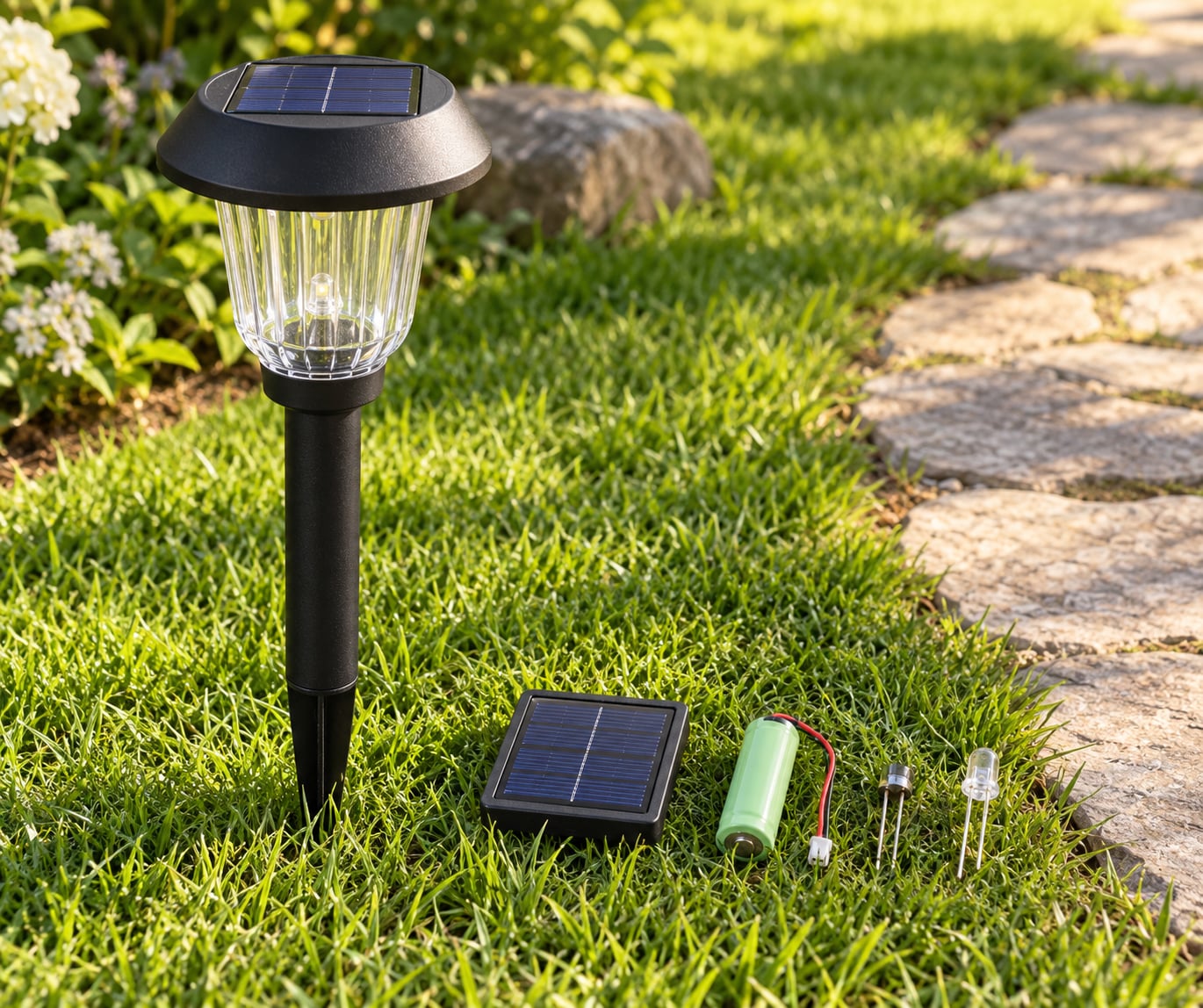
How do solar lights work? They run on a simple loop: a solar panel converts sunlight into electricity, a rechargeable battery stores that electricity all day, and a light sensor switches an LED on when darkness falls. There is no wiring, no mains power and no plug. Everything happens inside the housing you stake into the ground.
That single loop explains almost everything you will ever wonder about these lights. Why one glows for six hours and another dies at midnight. Why a new light does nothing on its first night. Why the one under a shrub never lights up at all. Once you know which part of the loop is weak, you can fix the light instead of throwing it away.
Table of Contents
How Do Solar Lights Work?
How do solar lights work, in plain terms? Photons from sunlight strike the photovoltaic cells on the panel and knock electrons loose in the silicon, which produces direct current. A charge controller meters that current into a rechargeable battery. At dusk a small light sensor detects the drop in ambient light, closes the circuit, and the battery powers the LED until dawn.
Four parts do the work, and every other component is a supporting player:
- Solar panel — turns light into direct current electricity.
- Rechargeable battery — holds that electricity for hours after the sun has gone.
- Light sensor and charge controller — decide when to switch on and protect the battery from overcharging.
- LED — draws the stored power and gives off the light.
Because the panel is the only power source, brightness and runtime are both limited by yesterday’s weather. A solar light does not store sunlight in the day and use it forever. It stores roughly what it collected, and it only collected what the sky allowed.
What Are the Main Parts of a Solar Light?
A cheap stake light and a heavy-duty solar floodlight share the same five-part anatomy, even though the parts look very different. This is the part breakdown, including what each piece does and the symptom you see when it fails.
| Part | What it does | Typical version | What happens when it fails |
|---|---|---|---|
| Photovoltaic panel | Converts light into direct current | Small monocrystalline or polycrystalline cell under a clear lens | Light charges fine during the day but never switches on at night |
| Rechargeable battery | Stores energy for the night | NiMH, lithium-ion or LiFePO4 pack, sometimes with a plastic pull tab | Light dims after an hour or two, or glows faintly and dies |
| Charge controller | Regulates charging, stops overcharge and over-discharge | Small circuit board in the base | Battery stays empty no matter how long the light sits in the sun |
| Light sensor | Detects darkness and triggers the switch-on | Photoresistor, sometimes paired with a motion sensor | Light stays on in daylight, or never comes on at all |
| LED | Produces the light from stored power | Cool or warm white LED on a small driver | Very dim or amber output, or nothing at all |
| Housing and seals | Protects the electronics outdoors | Weather-resistant plastic, stainless steel or aluminium | Water gets in, corrosion follows, battery dies early |
The pull tab deserves its own mention. Some batteries ship with a small plastic insulator between the contacts, and the light will not charge while it is in place. It is a shipping protection, not a fault.
How Do Solar Lights Work Step by Step?
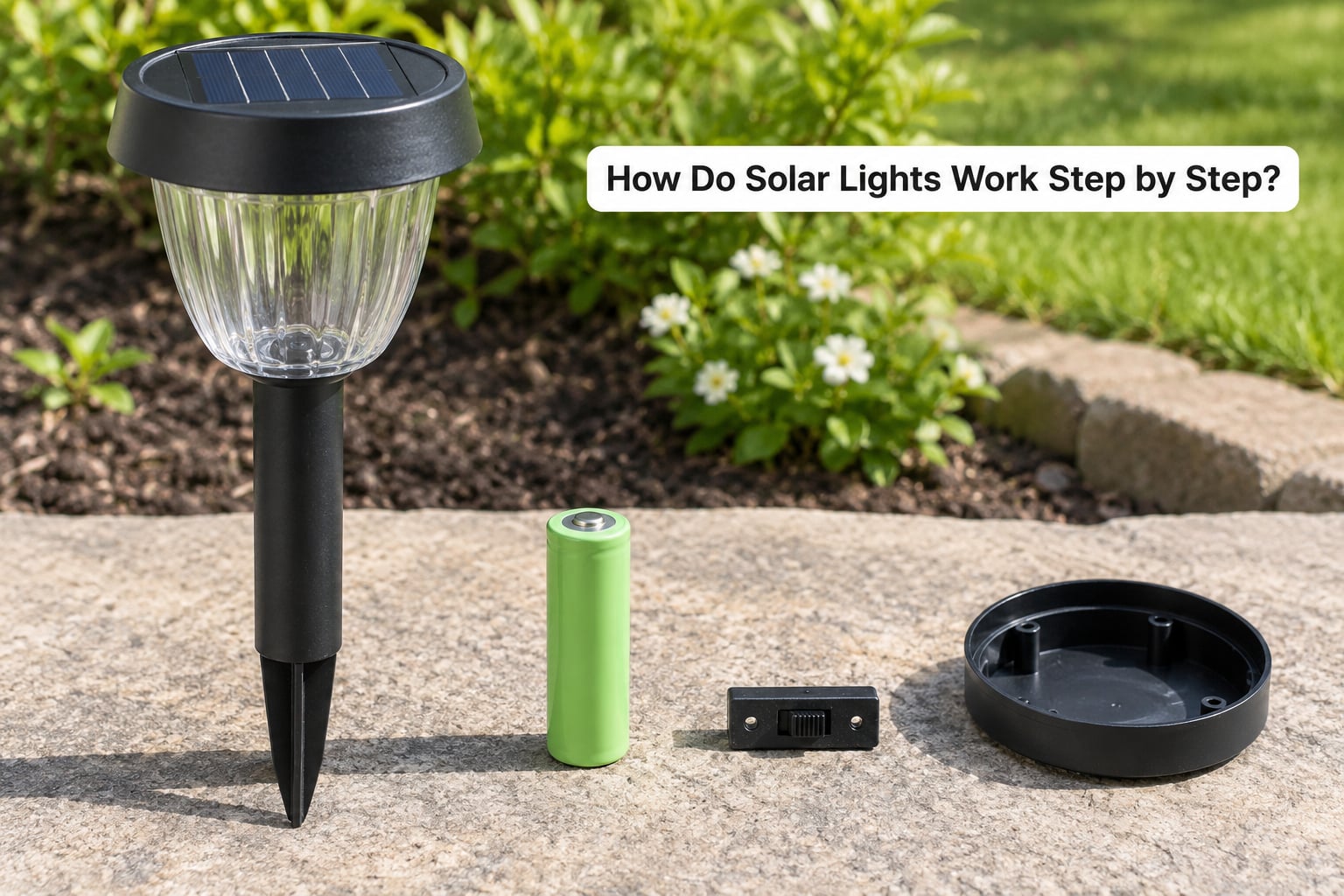
Here is the daily sequence, start to finish.
During the day:
- The panel sits in sunlight and its photovoltaic cells absorb photons.
- Those photons excite electrons in the silicon, producing direct current (DC) power.
- The charge controller regulates that power and routes it into the battery, stopping the charge before the cells overcharge.
- The battery holds the energy as chemical energy for the night ahead.
While the sun is up, the light itself stays off. The controller keeps the LED circuit open during daylight hours, because the photoresistor is still detecting bright light.
After dark:
- The photoresistor detects falling light levels and sends a signal to the controller.
- The controller closes the circuit and current flows from the battery to the LED.
- The LED runs until the battery voltage drops below the controller’s cut-off point or dawn arrives.
- At sunrise the sensor reverses the switch, the LED goes dark, and the panel starts charging again.
On lights with a motion sensor, there is an extra step: the LED stays at a low level or stays off until something moves in front of the PIR sensor, then jumps to full brightness. That saves a lot of battery power, which is why motion models so often outlast steady-burn models on the same panel.
How Much Sun Do Solar Lights Need?
Most garden lights want a full day of direct sun before their first night, and roughly six to eight hours of direct sun per day after that to reach their rated runtime. Cloud cover cuts charging substantially, and a light under an eave or a dense shrub will manage a fraction of what the same light manages in the open.
The 20% rule is a useful sanity check. Give a light at least six hours of direct sun, and treat anything less as 20% performance or worse. That is why the same model performs so differently on a west-facing patio than it does beside a south-facing path.
Placement by location:
- Garden paths: stake them where nothing casts a shadow across the panel for most of the day, and keep them out of the way of sprinklers.
- Patios and balconies: these often have more shade than people expect. Check the shadow the railing or a neighbouring building throws at noon.
- Driveways: good sun exposure, but pick a model with a higher IP rating because car spray and grit wear the housing down.
- Under trees and shrubs: generally a poor choice. Re-aim or relocate the light when growth starts shading the panel.
Keep the small top panel clean of leaves, dust and bird mess. A dirty panel can lose a meaningful share of its charging ability, and it is the easiest thing on the whole light to fix.
How Long Do Solar Lights Stay Lit?
Runtime is the number most likely to disappoint, because it depends on the battery, the load, the previous day’s sun and the temperature. Manufacturer estimates assume a full charge in good sun, and shaded locations run much shorter.
| Factor | What it changes |
|---|---|
| Battery capacity (mAh) | The bigger the pack, the longer it holds power at the same LED draw |
| LED brightness and mode | Full-bright output drains the battery far faster than a dim or motion-only setting |
| Previous day’s sunlight | A short, cloudy charge simply means less energy available at dusk |
| Temperature | Cold nights reduce battery output, so winter lights often run several hours shorter |
| Motion sensing | The LED only draws power when something triggers it, which can extend runtime dramatically |
| Battery age | A cell that has been through a few seasons holds noticeably less charge than a new one |
A dim light for five hours beats a bright light for one, for most garden situations. If you are choosing a brightness level, look at where the light sits and how much of the area it needs to cover before you decide.
Why Are My Solar Lights Not Turning On?
Work through these in order, cheapest test first. It matches the order a technician would use, and it solves the large majority of cases without opening anything up.
- Check the switch. Many lights have a small ON/OFF switch on the bottom or the back. In the OFF position the panel cannot charge at all, which is the single most common reason a light looks dead.
- Check the battery pull tab. If a thin plastic strip sits between the battery contacts, pull it out.
- Give it a full day. A new or long-idle light often needs one complete day of direct sun before the first night. Skip this and you will conclude it is faulty when it is simply uncharged.
- Clean the panel and free the sensor. Wipe the panel and make sure the small light sensor is not covered by leaves, dirt, a sticker or paint.
- Test in the dark. Cover the solar panel with your hand or a dark cloth. A working light will come on within a few seconds, which isolates the problem to the battery, the LED or the panel.
- Look for shade and damage. Check whether plants have grown over the panel, whether water has crept in, and whether the switch, contacts or housing are corroded.
If the light is more than a year or two old and holds only a few hours, the battery is usually the culprit, not the electronics. Swapping the rechargeable cell is usually cheaper and far less waste than replacing the whole fixture, and generic cells are widely available. Follow the manufacturer’s instructions for your specific model, and use a cell with the same chemistry and voltage.
Can Solar Lights Work in Winter or Bad Weather?
They work, but expect less. Winter brings three problems at once: shorter days, weaker sunlight and colder temperatures, all of which cut the energy you can collect and the energy the battery can deliver.
Rain and snow are mostly a housing question. Check the IP rating before you assume a light is waterproof — IP65 means protected against water jets, IP68 means protected against immersion, and anything without a rating is not something to leave out in a downpour. Clear snow off the panel, because a white layer is a very effective shade.
Dirty panels are the most underrated winter failure. Splashback from wet leaves and road spray leaves a film on the lens that cuts charging without anyone noticing.
How Can I Make Solar Lights Work Better?
- Place the panel in open sun. South-facing positions work well in the northern hemisphere. Avoid anywhere shaded by a wall, a tree or a dense hedge.
- Clean the panel twice a season. A soft cloth and water are enough. Grit and dried mud are the usual culprits, and both come off easily.
- Keep the sensor uncovered. Leave a finger’s width of clear air around the light sensor, and never paint over it or stick a decoration on it.
- Re-aim as plants grow. Check paths each spring. A fixture that was in full sun two summers ago is often in half shade now.
- Use the right mode. A motion-activated light on a path gives you a long runtime. A full-bright steady light gives you a shorter, brighter one. Pick on purpose rather than by default.
- Replace the battery, not the light. If the light still charges in the sun but barely runs at night, the cell has reached the end of its useful life.
One more habit worth having: pull the switch to OFF when you are not using a light for a long spell, such as over winter in a colder climate. Leaving a light permanently on means a trickle charge through months of freeze-thaw cycles, which ages the cell faster than storing it does.
Frequently Asked Questions
How long should a new solar light charge before its first use?
Give a new solar light a full day of direct sunlight before switching it on at night, ideally six to eight hours. Manufacturers do not ship batteries full, and many have a protective pull tab that must be removed first. A light tested in the evening straight out of the box will look broken when it is simply uncharged. Leave the switch ON while it charges, then check it after the first full night.
Should solar lights be on or off while charging?
ON. The switch has to be in the ON position for the charge controller to accept power from the panel and route it into the battery. In the OFF position most lights stop charging entirely, which is why a light left switched off for a few weeks will not light up when you switch it back on. The only common exception is long-term storage, where switching off and keeping the light dry protects the cell.
What battery do solar lights use?
Most garden and pathway lights use a small rechargeable NiMH or lithium-ion pack, often two or three cells taped together. Newer and higher-output models increasingly use LiFePO4, which tolerates more charge cycles and handles cold better than NiMH. Some budget fixtures use a non-rechargeable cell, which is why those lights die permanently. Always match the replacement chemistry and voltage to what the light already had.
How do solar lights know it is night?
A small light-sensitive resistor, called a photoresistor, sits behind a clear window on the housing. It measures the ambient light level continuously, and when that level drops below a threshold set at the factory, it tells the controller to switch the LED on. At sunrise the reading rises above the threshold and the controller opens the circuit again. Covering the panel with a dark cloth is the easiest way to test this yourself.
Can I replace the battery in a solar light?
Yes, on most models, and it is usually cheaper than replacing the whole fixture. Open the base, note the chemistry and voltage of the existing pack, and fit an equivalent rechargeable cell. Check the contacts for corrosion while you are in there, and follow the manufacturer’s instructions where they exist. If water has damaged the control board or corroded the terminals, replacing the battery will not save the light.
Do solar lights need electricity or wiring?
No. A standalone solar light needs no mains power and no wiring, which is what makes it useful for paths, driveways and off-grid spots. That is also its main limitation: the panel and battery are sized for a small LED load, so a single fixture will not light a whole garden or power anything larger. For genuinely large outdoor power needs, grid-tied solar with a battery bank is the right route, not a stake light.
Conclusion
How do solar lights work? A panel turns sunlight into current, a charge controller meters it into a rechargeable battery, a light sensor closes the circuit at dusk, and the LED runs on what was stored that day. Nothing about that is complicated, and every common complaint traces back to one of those four steps.
Start here: pick a light sized for the spot, put the panel where it gets several hours of direct sun, set the switch to ON, and leave it through a full day before you judge it. After that, clean the panel a couple of times a year and swap the battery when the runtime drops. That is enough to keep a solar light doing its job for seasons rather than weeks.