Solar quotes are confusing because nobody explains the document while you are holding it. Knowing how to read a solar installer quote takes about 30 minutes per proposal, and another hour or two to compare two of them properly.
The reason it matters: two installers can quote the same roof wildly different totals without either one lying to you. One includes scaffolding, an electrical panel upgrade, permits and utility interconnection, while the other quietly outsources them and expects you to arrange it yourself. Comparing the totals alone compares two different jobs.
This guide walks through a solar proposal block by block, then shows you how to normalize two quotes so the numbers actually mean the same thing. Last reviewed for 2026.
Table of Contents
- What You Need
- Twelve months of utility bills
- Roof details
- Your actual goal
- Every proposal you have received
- A question list
- Step-by-Step: How to Read a Solar Installer Quote
- 1. Check the System Design and Layout
- 2. Identify Every Piece of Equipment
- 3. Separate Equipment, Labor, and Permitting Costs
- 4. Verify Production and Savings Estimates
- 5. Review Installation Scope and Timeline
- 6. Examine Warranties, Financing, and Payment Terms
- 7. Compare Quotes on an Equal Basis
- Common Mistakes
- Comparing totals before system size
- Letting the tax credit into the headline price
- Accepting a production estimate without assumptions
- Ignoring the exclusions
- Skipping installer verification
- Giving up your bargaining room early
- Frequently Asked Questions
- Is a solar quote legitimate?
- Why do solar quotes vary so much between companies?
- Should my solar quote be itemized?
- Is a very low solar quote a scam?
- How many solar quotes should I get, and how do I compare them?
- Should the tax credit be included in my solar quote?
- Conclusion: Start With the Line-Item Total
What You Need
You cannot check a quote against reality without the facts it should have been built from. Gather these first.
Twelve months of utility bills
Installers size a system from your electricity usage, and the projection is built from the same number. Twelve months, not three, so you can see your summer peak.
Roof details
Age, material, approximate area, how many planes it has, and whether anything shades it after about 9am. A tree that was small three years ago is the single most common thing a satellite-only estimate misses.
Your actual goal
Offset most of your bill, cut a specific amount per month, or power a future electric vehicle and heat pump. Write it down. System size follows from the goal, not the other way around.
Every proposal you have received
Put all of them side by side, with the date each one was priced. Prices and equipment costs move, and a quote older than a few months is comparing a stale document to a fresh one.
A question list
Keep a running note as you read. By the end you should have a page of things that were vague, not just a feeling that something was off.
Step-by-Step: How to Read a Solar Installer Quote
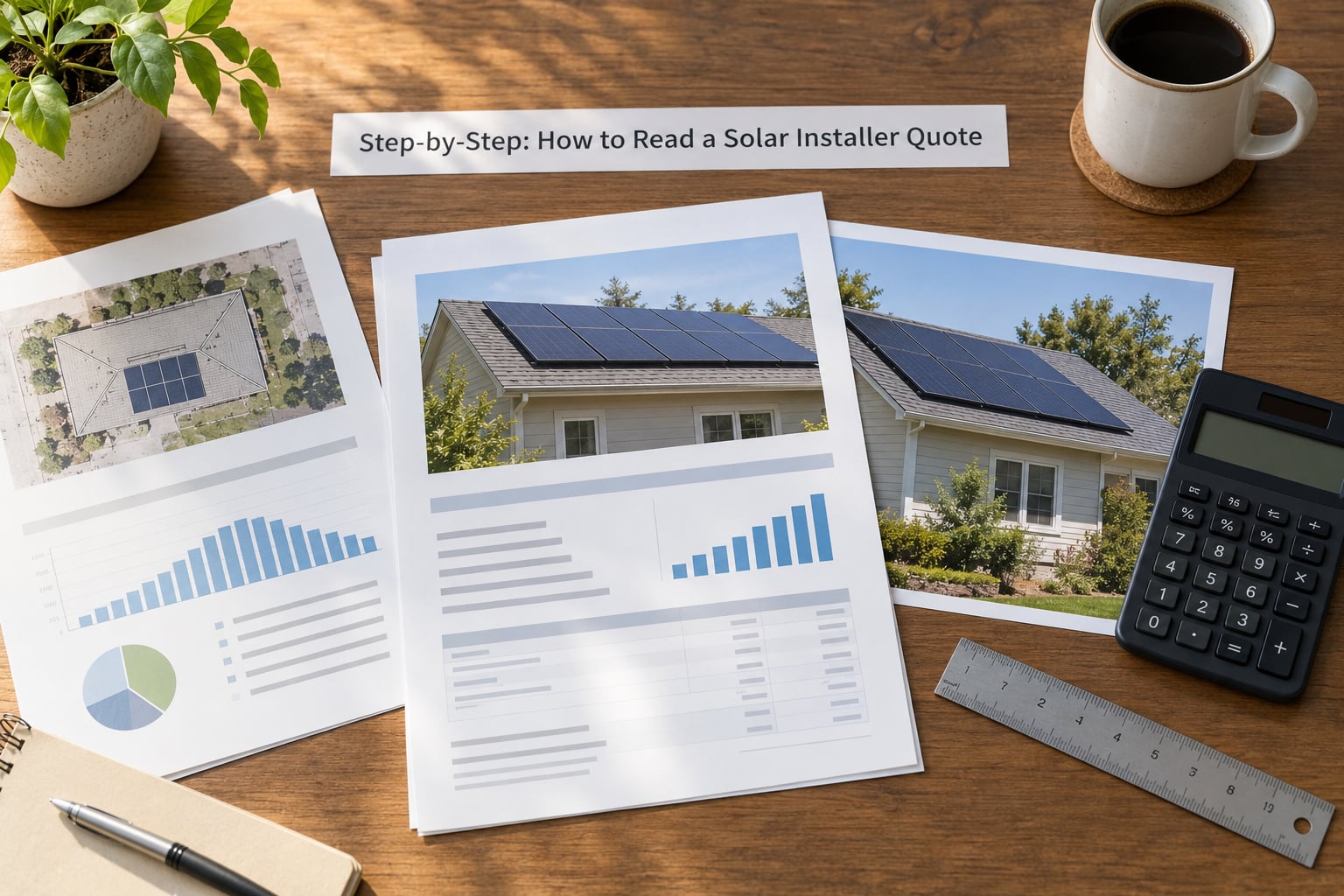
Work bottom-up. The design page is the marketing; the payment and warranty terms at the back are where the commitment lives.
1. Check the System Design and Layout
Start with the layout page. It should show your roof with panels drawn on it, panel count, total system size in kilowatts peak (kWp, the nameplate capacity at standard test conditions), and where the inverter goes.
Ask whether the design reflects your roof or a generic one. Panels filling the entire south or southwest-facing plane is normal in most of the US. A layout that leaves usable roof empty usually means the design is conservative, or that the installer sized the system to a budget rather than to your usage.
Four things tell you whether a person actually stood on your property:
- Shading is addressed in writing, with either a shading analysis or a sentence saying the roof is unshaded.
- The main service panel and meter location are identified, along with where the conduit runs.
- The roof plane count and any obstructions, vents and skylights are reflected in the layout.
- Scaffolding or access method is priced, which almost always requires someone to have looked at the pitch and height.
A quote built from an aerial photo will be clean, fast and wrong about at least one of those four. Forum users on r/solar and r/solarenergy describe this pattern constantly, posting quote screenshots and asking whether anyone can tell what was actually inspected.
2. Identify Every Piece of Equipment
This is where most quotes become impossible to compare. A brand name is not a specification. You want manufacturer, model, power class and quantity for the modules, and manufacturer, model and type for the inverter.
- Modules: the model number should identify a specific wattage class. Panels across several wattages cannot be priced or compared fairly.
- Inverter: note whether it is hybrid (battery-ready) or a plain grid-tied unit. This is a small decision now and an expensive one later.
- Optimizers or microinverters: these attach to individual panels and can rescue output on a partially shaded roof. If the quote is silent, ask whether the design assumes no shading.
- Racking and mounting: the mounting system should be named and flashed for the roof type, not just “standard racking”.
- Monitoring: ask what is included and whether the app needs a paid subscription after the warranty period.
Write the model numbers down. Those five or six lines of text are what let you compare two quotes that differ by thousands of dollars.
3. Separate Equipment, Labor, and Permitting Costs
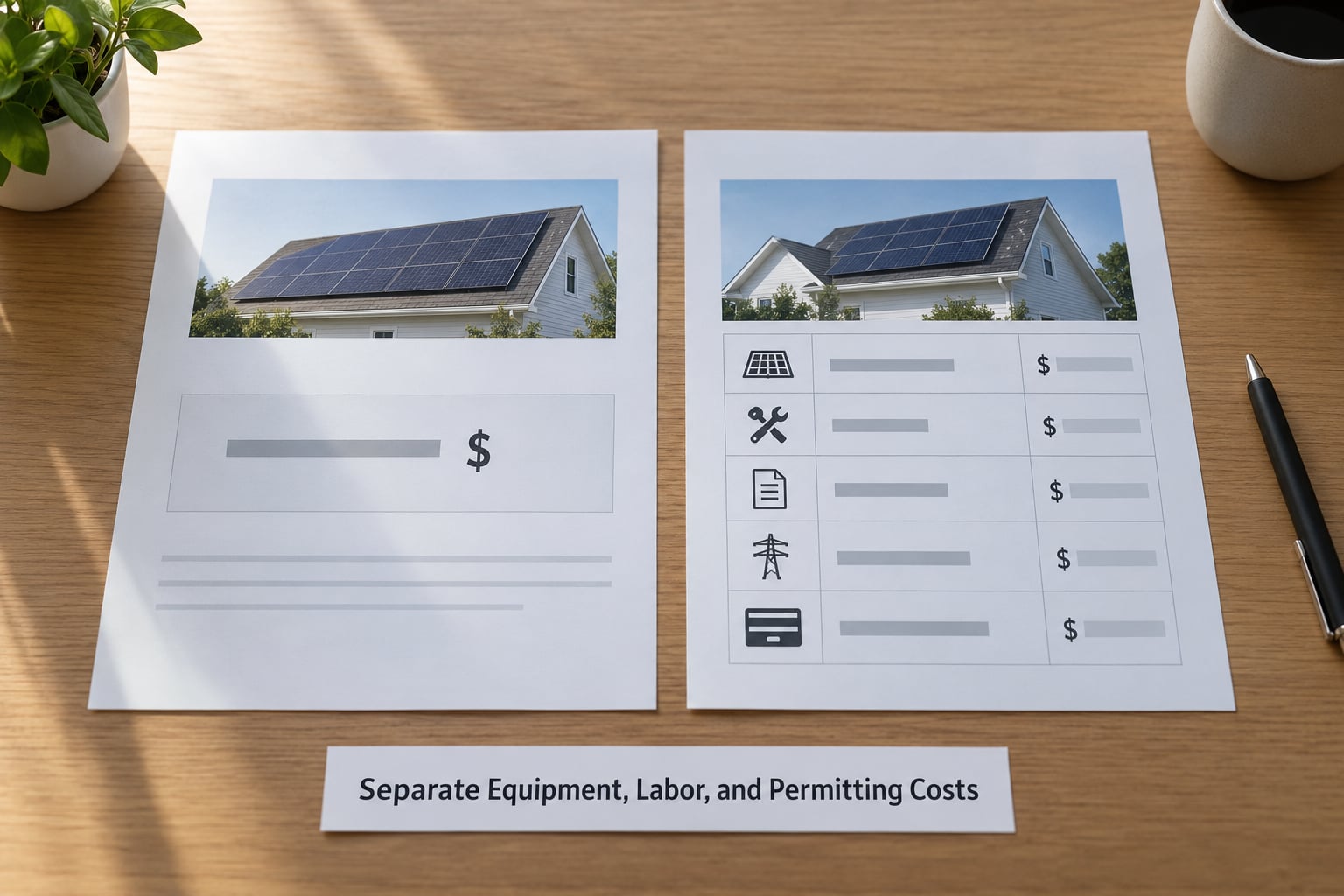
A complete proposal separates what you own from what gets done to your house. Equipment should be itemized. Labor should be itemized. Permitting, interconnection and inspection should each be named.
The blocks you should expect to see:
- Modules and inverter, with model and quantity
- Mounting, racking and roof attachments, plus who is responsible for watertight penetrations
- Scaffolding or fall protection
- Electrical work: DC and AC runs, conduit, meter box work, and any service panel upgrade
- Permitting, plan review and inspection
- Utility interconnection application and the follow-up until approval
- Monitoring setup, commissioning, and system documentation handover
- Optional battery, wallbox or EV charger, priced separately if offered
Both lump sum and itemized quotes are legitimate. A lump sum is simply less legible, and it only stays legitimate if the scope is named somewhere in writing.
The phrase to watch for is “all-inclusive” with no list attached. That is an interpretation you would be making after a change order arrives, not a commitment. If an installer declines to itemize, send this:
“Before I compare your proposal to others, please send the scope of work in writing, separating equipment, labor, electrical, permits and interconnection, and noting anything excluded.”
Installers say competitors will not do this. The ones worth signing with generally will.
4. Verify Production and Savings Estimates
The savings page is the part of a proposal most likely to disappoint, and it is the part most homeowners skim. It should show assumptions, not just a conclusion.
Five numbers define it:
- System size in kWp, which you already verified against the layout.
- Estimated annual production in kWh. A rough sanity check for the US is roughly 3.5 to 4.5 kWh per kWp per day, adjusted downward for latitude, roof pitch and shading. A figure far above that range deserves a question.
- Panel degradation. Current mainstream modules are typically warranted around 0.3 to 0.5 percent per year, and quotes commonly assume degradation near the top of that range.
- Utility rate escalation. This is an assumption about the future, not a measurement. Four percent per year for thirty years changes the payback figure dramatically.
- Export credit rate. What your utility pays for the electricity you send back to the grid. Many states changed their net metering rules recently, and several now credit exported power well below retail rates. A proposal that assumes full retail credit for every exported kilowatt-hour in a state that has moved away from it is optimistic by construction.
Treat “100% offset” and “save up to 70%” as sales language, not engineering. First-year solar offset above about 120 percent is physically possible in sunny regions but produces annual credits rather than bill elimination, and a proposal that promises your bill goes to zero is describing a year, not your experience.
5. Review Installation Scope and Timeline
This section tells you who is responsible for what, and it is where “by others” does its damage. The phrase is not automatically suspicious, but each instance should be a decision you consciously accept.
Check whether permits, plan review, inspection scheduling and the utility interconnection application are handled by the installer or by you. Most homeowners have no way to run an interconnection application and should not be asked to.
Look for the construction window. Utility approval can take weeks to months depending on your state and utility, and it belongs on the critical path. Roof work, electrical upgrades, utility coordination and site cleanup should all be in the installer’s scope unless stated otherwise.
Change orders deserve a sentence in the contract. Unforeseeable extras happen: a panel board that fails inspection, a roof deck that needs repair, a permit fee the city revises. What you want is a clause naming the process and who approves the cost before work starts.
6. Examine Warranties, Financing, and Payment Terms
Turn to the back of the document. Equipment warranties come from the manufacturer and are usually measured in decades. Workmanship warranty comes from the installer and is the one you should actually read carefully, because it is the one that can lapse.
Ask in writing how long the workmanship warranty runs, what triggers it, and who responds to a service call. This matters more if a national lead-generation company subcontracts the actual installation to a local crew, which is common in the industry and worth confirming either way.
If you are financing rather than paying cash, the loan or lease terms are a separate document. Read the interest rate, the term length, any dealer fee rolled into the principal, and whether payments escalate annually. Leases and power purchase agreements produce no purchase price at all, so they cannot be compared to a cash purchase total. They trade ownership for a lower or zero upfront cost and a long payment stream.
Payment milestones should follow progress: a deposit at signing, a payment after permits or a portion of the system on site, a larger payment after inspection and commissioning, and a final balance after interconnection approval. A large balance demanded at delivery is a negotiation point.
On timing, door-to-door solar sales made in your home carry a federal three-day cancellation right, and the rule for those contracts is specific. Verify the current terms before relying on them, and do it before you sign anything.
7. Compare Quotes on an Equal Basis
Once each proposal has been read, put them on the same page. Two normalization steps are enough.
First, use the pre-incentive total. Some installers fold the federal solar tax credit into the quoted price so the headline looks lower. Resist it. The credit is an offset against tax you owe, not a payment from the government, and whether you can claim it depends on your own tax situation, your roof, and your lease or filing status. A quote that includes it cannot be compared to one that does not. Strip it out and apply it yourself after you file.
Second, compute dollars per watt on the DC nameplate. Take the pre-incentive dollar total and divide by the system size in watts. That is your comparable number. Equipment pricing alone often sits in the range of 2.50 to 3.50 dollars per watt, and a fully installed residential system commonly lands somewhere around 3.00 to 3.40 dollars per watt for a system in the region of 8 kW, though regional labor costs, roof difficulty and equipment choice move these figures and they change over time.
A worked example. Quote A covers 8.0 kW at 29,600 dollars pre-incentive, which is 3.70 dollars per watt. Quote B covers 7.2 kW at 25,200 dollars, which is 3.50 dollars per watt. B looks cheaper until you notice it excludes the service panel upgrade and lists interconnection as by others. Normalize both to the same system size, price the excluded scope, and only then compare. That exercise usually collapses most of the gap.
Typical US ranges vary by region and change over time, so treat these as comparison tools rather than fair-market prices. A useful follow-up is checking what a dollar per watt means for the equipment versus the whole job, since they are not interchangeable numbers.
Common Mistakes
Comparing totals before system size
The most expensive mistake, and the one that generates the most forum panic. A smaller system is always cheaper. Normalize to dollars per watt first, then compare scope.
Letting the tax credit into the headline price
It makes quotes incomparable and quietly lets the installer capture part of the benefit. The federal residential solar credit runs at 30 percent through 2032 and steps down to 26 percent in 2033, but it lands on your tax return, not on the installer’s invoice.
Accepting a production estimate without assumptions
A kWh number with no degradation rate, no escalation assumption and no export rate attached is a marketing figure. Ask for the assumptions page, or compute your own production estimate from the system size and check whether their number is plausible.
Ignoring the exclusions
Scan for “by others”, “not included”, “time and materials”, “subject to availability” and “additional costs to be determined”. Each one is a cost you may own. Anything unpriced on the quote comes back later as a supplementary invoice.
Skipping installer verification
Check the business record with your state licensing authority and the Better Business Bureau, and look for NABCEP certification or an equivalent credential on whoever designs the system. Ask for the legal entity name that appears on the contract, not just the sales brand.
Giving up your bargaining room early
Once a contract is signed your negotiating position largely disappears. The questions that feel pedantic while you are comparing quotes cost you nothing, and they are the only moment you can ask them.
A long-running thread on r/solarenergy runs on exactly this ground: a homeowner collecting several quotes that all named their equipment brands, all stayed vague, and all declined to break out equipment from labor. There is no neutral reviewer in most local markets. If you cannot find an independent solar consultant who sells nothing, at minimum get three written scopes and compare them yourself.
Frequently Asked Questions
Is a solar quote legitimate?
A quote is legitimate when the scope of work is named in writing, equipment is specified by model rather than brand alone, site-specific work such as scaffolding, electrical work, permits and interconnection is included and priced, and the savings projection shows its assumptions. Missing scope, not a high number, is what makes a quote weak. Ask for the exclusions page and the assumptions behind the production estimate.
Why do solar quotes vary so much between companies?
Equipment is priced from shared wholesale markets, so the module and inverter half of a quote looks similar across installers. The labor, electrical, permitting and site-specific half does not. One installer includes scaffolding, a panel upgrade and interconnection while another outsources them and passes the cost to you. Comparing totals without normalizing system size compares different scopes of work.
Should my solar quote be itemized?
An itemized quote is easier to compare, but a lump sum is perfectly legitimate as long as the scope of work is written down somewhere. The problem is a lump sum described only as all-inclusive with no list, because then you are guessing at what is included. Ask for the scope in writing, separating equipment, labor, electrical, permits and interconnection, and naming anything excluded.
Is a very low solar quote a scam?
Not automatically, but treat it as a prompt to check rather than a bargain. Convert the total to dollars per watt on the pre-incentive price and compare it with your other quotes. If the per-watt figure is well under the typical range, find out what was removed: a smaller system, an excluded panel upgrade, or interconnection assigned to you. Scams usually show up as pressure to sign immediately.
How many solar quotes should I get, and how do I compare them?
Three is the working minimum, and more is better if any of them came from a door-to-door salesperson under time pressure. Compare them on system size in kWp, pre-incentive dollars per watt, named scope, equipment model numbers, warranty terms and financing cost. Use the same worksheet for each one so nothing gets compared on a headline number alone.
Should the tax credit be included in my solar quote?
No. The federal residential solar credit is an offset against tax you owe when you file, not a discount the installer applies to your invoice, and whether you owe enough tax to use it depends on your own situation. Quotes that build the credit into the price cannot be compared with quotes that do not. Take the pre-incentive total, compare those, and apply the credit yourself later.
Conclusion: Start With the Line-Item Total
Reading a solar installer quote comes down to one habit: normalize before you compare. Strip out any incentive built into the price, divide the remaining total by system size in watts, and check that every block of scope you would expect is named and priced.
Then take your list of vague lines back to the installer and get answers in writing. That is the last moment your negotiating position is intact, and it costs one email.