The best roof pitch for solar panels sits within about 10 degrees of your local latitude, which for most US homeowners lands between 20 and 30 degrees, roughly a 6:12 to 8:12 roof. If your roof is anywhere between a 4:12 and a 10:12 pitch, you do not need to change it. Orientation, shading and roof area decide whether solar pays far more than pitch does.
Most of the anxiety I see about roof pitch comes from homeowners who assume they need tilt framing, or even a roof rebuild, before panels can go on. That is almost never true. NREL has found that at least 82% of US buildings receive enough sunlight for solar, and the roofs people actually live on cluster tightly around 18 to 34 degrees.
This guide covers what pitch actually does to output, how to convert your roof’s ratio into degrees, which pitch suits which location, and when a non-standard roof is genuinely workable. Last reviewed in 2026; every production figure below is a modelled estimate with its assumptions stated, not a guarantee.
Table of Contents
- What Is the Best Roof Pitch for Solar Panels?
- How Does Roof Pitch Affect Solar Panel Production?
- What the pitch actually changes for you
- Which Roof Pitch Is Most Practical by Location?
- One caution for readers outside the US
- What Are the Main Factors to Consider Besides Pitch?
- What about the 20% rule and the 33% rule?
- How Do Installers Handle Roofs That Are Not Flat?
- Can You Install Solar Panels on Any Roof Pitch?
- How Do You Calculate the Right Solar Panel Tilt?
- What Pitch Should You Choose for Your Home?
- Frequently Asked Questions
- What is the perfect roof pitch for solar panels?
- Is a 20 degree roof pitch ok for solar panels?
- Can you put solar panels on a flat roof?
- What is the minimum roof pitch for solar panels?
- Does roof pitch or roof orientation matter more?
- Is the 20% rule or the 33% rule a real solar standard?
- Conclusion
What Is the Best Roof Pitch for Solar Panels?
Within roughly 10 degrees of your latitude is the working rule, and the practical range for most American homeowners is 20 to 30 degrees. The US Department of Energy’s Solar Energy Technologies Office calls 15 to 40 degrees south-facing the “Goldilocks zone,” a deliberately loose range that reflects how little a few degrees actually cost you.
Two refinements matter. The first is cloud cover: on cloudy days the light is diffuse, and a flatter panel catches more of it. Diffuse light is also why the ideal tilt in a frequently overcast location can sit a few degrees below the latitude rule rather than above it.
The second is what you optimise for. Annual kWh is not the same as bill savings. A flatter array produces more in the early evening, which matters if your tariff prices power by time of use, and a steeper array front-loads winter production. Decide which of those you care about before you argue about degrees.
| Pitch ratio | Degrees | Modelled output vs ideal tilt | What it usually means |
|---|---|---|---|
| 2:12 | 9.5 | 94-96% | Needs tilted racking; snow and ponding risk |
| 3:12 | 14.0 | 97-98% | Low-slope; usually needs tilt racking |
| 4:12 | 18.4 | 98-99% | Very common; flush mount is fine |
| 6:12 | 26.6 | 99-100% | Near ideal for most of the US |
| 7:12 | 30.3 | 100% | Near ideal from roughly 25 to 35 N |
| 8:12 | 33.7 | 98-100% | Good in the South; a little flat in the North |
| 10:12 | 39.8 | 96-99% | Winter bonus; steeper install cost |
| 12:12 | 45.0 | 92-96% | Steep; scaffolding and access costs rise |
The conversion itself is one formula: the angle in degrees equals the arctangent of the rise divided by the run. For a 6:12 roof that is arctan(6 divided by 12), which gives you 26.6 degrees.
Homeowners on Reddit’s r/SolarUK with roofs in the 30 to 32 degree range have reported installing standard flush mounts with no modification at all and entirely satisfactory output. That matches what installers tell me: most roofs are fine.
How Does Roof Pitch Affect Solar Panel Production?
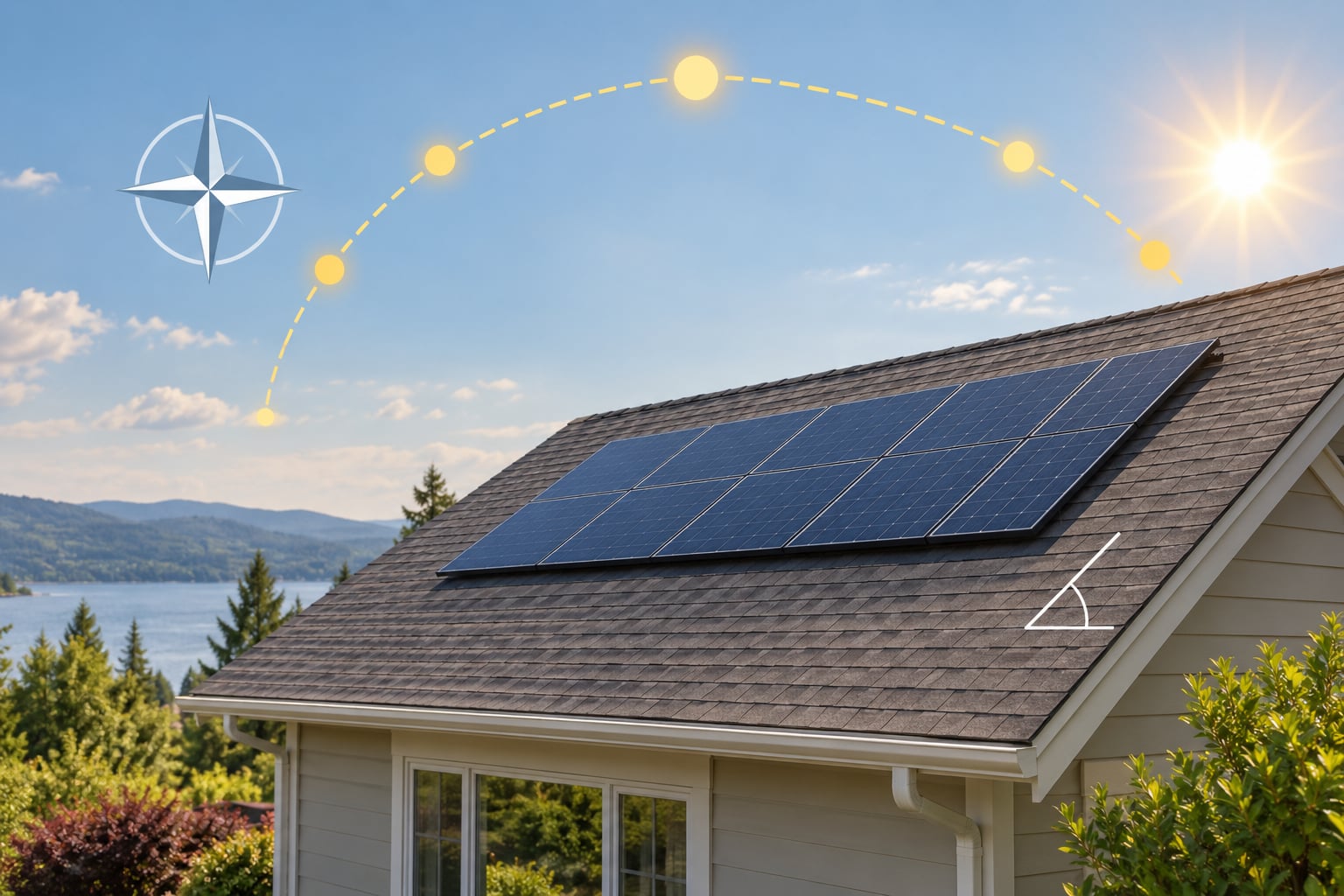
Panels produce most when sunlight hits them square. The closer the sun is to perpendicular, the less energy bounces off or heats the glass as waste heat, and that relationship follows the cosine of the angle between the sun ray and the panel face.
In practice the effect is gentler than the maths suggests. Being 15 degrees off the ideal angle costs about 3% of output, 30 degrees off costs roughly 13%, and 45 degrees off costs close to 29%. Nobody’s bill changes because of a 3% difference, which is exactly why sellers who describe a 4:12 roof as unusable are overselling.
A useful real-world data point: someone posting in Reddit’s r/solar reported a 14 degree roof generating 1.75 kWh from a panel on a given day, beating a neighbour’s shallower angle. Small pitch differences get washed out by cloud cover, and real output is far less pitch-sensitive than calculators imply at the daily level.
What the pitch actually changes for you
Beyond a few percent of annual yield, pitch changes four practical things: whether standard flashings can be used, how fast snow slides off, how well rain washes dust and pollen away, and how much the installer has to charge for access and safety.
Shedding is a real benefit people underrate. A 6:12 roof clears most snowfall under its own weight, while a 3:12 roof can hold a winter’s accumulation and needs a rake or a de-icing plan.
Self-cleaning works the same way. Salt spray along a coastal roof and pollen in the spring both wash off a steep face more completely than a shallow one. Panels on low slopes do fine, but they need an annual hose-down or a soft-wash service that people forget to budget for.
Which Roof Pitch Is Most Practical by Location?
Latitude sets the target, and then climate, roof style and local weather trim it. Use this table as a starting point rather than a specification, because the shade, cloud and tariff conditions of your own street beat any regional rule.
| Latitude band | Example locations | Starting tilt | Matching roof pitch |
|---|---|---|---|
| 26-28 N | South Florida | 20-25 degrees | 5:12 to 6:12 |
| 29-32 N | Houston, Atlanta, Dallas | 25-30 degrees | 6:12 to 7:12 |
| 33-36 N | Atlanta, Memphis, Oklahoma City | 28-33 degrees | 6:12 to 8:12 |
| 37-40 N | Denver, St. Louis, Raleigh | 30-35 degrees | 7:12 to 8:12 |
| 41-45 N | Chicago, New York, Salt Lake City | 33-38 degrees | 8:12 to 9:12 |
| 46-49 N | Minneapolis, Seattle | 35-42 degrees | 9:12 to 10:12 |
The differences between those bands are small enough that most roofs in the middle of the country are fine regardless of which band they sit in. A Denver homeowner on an 8:12 roof and a Chicago homeowner on the same 8:12 roof are both close enough to ideal that neither should pay to alter anything.
One caution for readers outside the US
Several of the top-ranking pages for this question come from Australia and South Africa, and they quote ranges like 26 to 30 degrees using southern-hemisphere logic. Northern-hemisphere rules are mirrored: tilt toward the equator, which in North America means south. A 30 degree figure means different things in Sydney and San Diego.
What Are the Main Factors to Consider Besides Pitch?
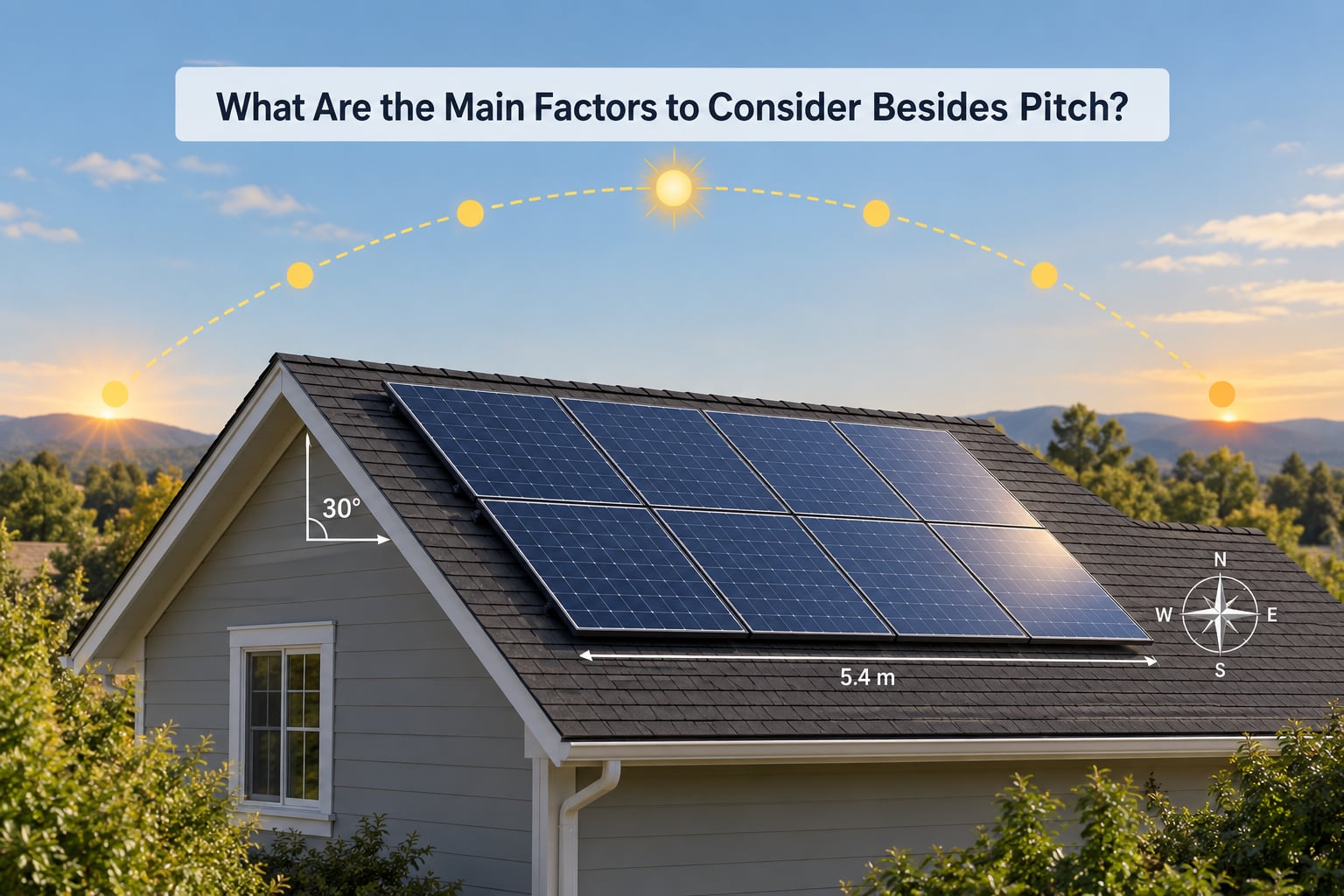
Direction comes first. A south-facing array produces roughly 100% of the reference yield at the same tilt, west about 90%, east about 85%, and north far less. Somebody measuring a 45 degree roof on speakev.com logged about 2,432 kWh a year facing south, 1,964 east and 1,923 west, with north the weakest of all. That spread dwarfs anything pitch can do.
Shading is second. A chimney or a neighbouring tree that crosses your array at 9am can cost more than ten degrees of tilt. Run a shade study before you sign anything, and look at your roof on the shortest day of the year rather than a bright afternoon in spring.
Roof condition and age matter more than homeowners expect. Panels last around 25 to 30 years, asphalt shingles far less. If your roof has five good years left, reroof first, and the new roof is the natural moment to plan mounting points and conduit runs properly.
Roof material changes the mounting hardware. Asphalt shingle takes standard flashed penetrations. Standing seam metal often allows non-penetrating clamps, which is a genuine advantage in hurricane country. Tile roofs need care with the drilling and a slower, more skilled crew.
Structure comes next. Solar adds roughly 3 to 5 pounds per square foot plus wind load. Someone in Reddit’s r/solar raised the case of a 3:12 shingled roof built for 30 psf on 2×4 trusses at 24 inches on centre, wondering whether the added weight was safe. It is the kind of question a licensed engineer answers in an afternoon, and it is worth asking before anything is drilled.
Set-backs quietly eat usable area. Keep panels at least 30 centimetres from any roof edge, which also reduces wind uplift. On a small roof, that perimeter allowance can be the difference between ten panels and fourteen.
What about the 20% rule and the 33% rule?
Neither is a real standard. They show up in search results because people ask about them constantly, and the honest answer is that there is no code, industry body or utility that defines a “20% rule” or a “33% rule” for panel placement. The 36 inch figure you hear quoted usually refers to roof-edge clearance and fire-setback guidance rather than any pitch requirement. Treat all three as conversation starters for your installer, not as rules to design around.
One genuine distinction worth keeping straight: roof pitch is the angle of the roof itself, while solar panel tilt is the angle of the panel relative to horizontal. Flush-mounted panels on a pitched roof have a tilt equal to the pitch. Panels on a rack can have any tilt at all, which is the entire reason racks exist.
How Do Installers Handle Roofs That Are Not Flat?
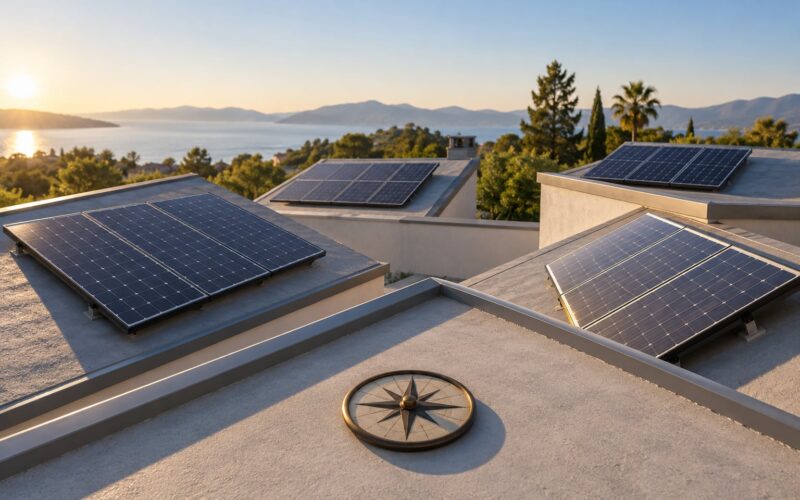
Flush mounting is the default and the cheapest option. The panel sits flat on the roof with a flashed mounting foot at each corner, so the panel’s tilt equals the roof’s pitch. That works cleanly anywhere from about 4:12 to 10:12, and it is the answer for most houses.
Rafter offsets handle the smaller misalignment. Where rafters sit at 16 or 24 inches on centre and the rails want 48 inches, an offset bracket steps up or down a few inches rather than forcing the installer to notch wood.
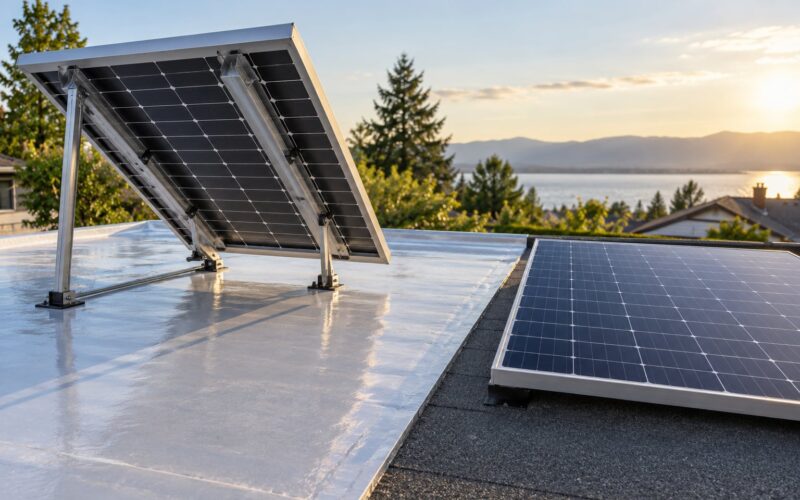
Tilt racking lifts panels above the roof on angled frames, and it is the standard answer for anything under about 4:12. On very low slopes the rows must be spaced apart so that one row does not shade the next at midday, and that row spacing costs you a lot of roof area. A 10 degree tilt increases wind uplift by roughly 40 to 60 percent, and a 20 degree tilt by 80 to 120 percent, so ballast and anchoring get serious.
Ballasted tilt systems weigh the array down instead of penetrating the roof. They suit flat commercial membranes, but a residential shingle roof rarely has the structure or the waterproofing warranty to support that approach.
Can You Install Solar Panels on Any Roof Pitch?
Within reason, yes, and the practical range most installers work in is 10 to 45 degrees. Below 10 degrees you need tilt racking with generous row spacing, snow management and ballasted or fully anchored mounting. Below about 5 degrees, roof-mounted residential solar usually stops making financial sense and ground mount or community solar becomes the better comparison.
Steep roofs are harder rather than impossible. A 10:12 or 12:12 roof brings scaffolding or a bucket lift, and installers report steep pitches running two to four times the installation time of a moderate one. On older homes the access problem can cost more than the panels did.
Steep also has real benefits. Snow clears itself, panels shed salt and grime, and a 45 degree roof facing south still produced roughly 2,432 kWh a year in one published measurement. That was less than a flatter south-facing array would manage, but comfortably more than the same roof facing east.
The point at which a roof becomes genuinely difficult is when access equipment alone exceeds the value of the extra generation. Past roughly 45 degrees, compare a ground-mounted array and a community solar subscription before you commit to the roof.
How Do You Calculate the Right Solar Panel Tilt?
Start with latitude. Find your latitude, then add or subtract depending on which season you want to favour: a winter-optimised tilt is your latitude plus 15 degrees, and a summer-optimised tilt is your latitude minus 15 degrees. Annual-average performance lands in between.
To work out the sun’s angle at solar noon, the simplest expression is 90 degrees minus your latitude, plus 23.45 degrees for the winter solstice. At 40 degrees north that puts the winter noon sun at about 73.5 degrees above the horizon, which is why a steeper winter-tilted array earns its keep that far north.
A worked example: a homeowner at 33 degrees north in Raleigh could reasonably choose anything from 25 to 35 degrees. Their existing 6:12 roof at 26.6 degrees is 6 degrees off latitude, so they would be losing a couple of percent against a perfect tilt. The sensible move is to leave the roof alone. If instead they had rafter setbacks and a small 2:12 roof plane, a rack at 30 degrees for the whole array would recover more energy than it costs.
Rules of thumb only get you into the right neighbourhood. NREL’s PVWatts calculator, or the Global Solar Atlas, will model your exact pitch, azimuth and shading assumptions in minutes. Ask your installer to run it for two or three tilt options and compare the annual kWh directly.
What Pitch Should You Choose for Your Home?
Work through four comparisons in this order. First, annual production: get modelled kWh figures for your real pitch and for the nearest ideal tilt. Second, access and safety cost on a steep roof. Third, usable area after edge set-backs. Fourth, how the seasonal production profile lines up with your tariff, particularly if your utility credits exports at a lower rate under net billing.
The decisive comparison is usually tilt racking versus adding panels. Tilt racking on a shallow roof buys a few percent more per panel and takes years of savings over decades to pay back the extra hardware and labour. Two additional panels mounted flush usually deliver more total energy for a fraction of the cost, and the payback on those extra panels is a handful of years rather than a couple of decades. Forum users push back on tilt-racking quotes constantly for exactly this reason, and the arithmetic supports them.
Tracking and adjustable racks are a harder sell again. They add moving parts, maintenance and wind load for a small production gain, and on a residential scale the money almost always does better spent on capacity.
So: if your roof is between 4:12 and 10:12 and reasonably unshaded, install on it as it is. If it is shallow, ask for both a tilt-racked quote and a ground-mount or community-solar comparison. If it is steeper than 10:12, get the access cost priced before you sign, and check whether microinverters are worth it if panels end up on more than one roof plane.
Frequently Asked Questions
What is the perfect roof pitch for solar panels?
The best roof pitch for solar panels is generally within 10 degrees of your local latitude, which for most US homeowners falls between 20 and 30 degrees, roughly a 6:12 to 8:12 roof. The Department of Energy’s Solar Energy Technologies Office puts the practical south-facing range at 15 to 40 degrees, so almost every existing home qualifies without changes.
Is a 20 degree roof pitch ok for solar panels?
Yes. A 20 degree pitch is about a 4:12 roof, and it sits well within the workable range of 10 to 45 degrees that most installers use. A modelled south-facing 4:12 array typically produces within 2 to 3 percent of the ideal tilt for most latitudes, so flush mounting works and no tilt racking is needed.
Can you put solar panels on a flat roof?
Yes, but not flush. Flat and very low-slope roofs need panels on tilt racking, usually 10 to 15 degrees, with rows spaced far enough apart that one row does not shade the next at midday. Ballasted tilt frames are common on flat commercial membranes. On a residential flat roof, ground mount or community solar often costs less for the same energy.
What is the minimum roof pitch for solar panels?
Around 10 degrees, which is roughly a 2:12 roof, is the practical minimum for roof-mounted panels. Below that, tilt racking with row spacing, added anchoring and snow management become necessary, and wind uplift rises sharply. Above about 45 degrees, access and scaffolding costs usually exceed the extra generation the roof provides.
Does roof pitch or roof orientation matter more?
Orientation matters considerably more. At a given tilt a south-facing array is the reference yield, west produces about 90 percent, east about 85 percent, and north far less. Pitch differences within the normal range usually cost only a few percent. One measured 45 degree roof produced about 2,432 kWh facing south against 1,964 east and 1,923 west.
Is the 20% rule or the 33% rule a real solar standard?
No. Neither the 20% rule nor the 33% rule is defined by a code, industry body or utility. They persist in search results because people ask about them often. The 36 inch figure usually quoted alongside them refers to roof-edge clearance and fire set-back guidance rather than any pitch requirement, so ask your installer about each one directly.
Conclusion
Start by asking for a site-specific production comparison at your actual roof pitch and at one or two alternative tilt angles, with the azimuth, shading and system size assumptions written down. Then have a qualified installer verify the structure, the attachment method and the waterproofing before you commit. Pitch is a modest variable in that decision, and most roofs already fall in a good place.