Your utility rate plan sets two prices: what you pay for each kilowatt-hour your panels feed straight into your house, and what the utility credits you for each kilowatt-hour you send back to the grid. How utility rate plans affect solar savings comes down to those two numbers plus the fixed charges solar never removes. The same 8 kW system can pay back in eight years or drag to fourteen.
Put simply, here is the whole formula:
Solar savings = (kWh you consume yourself x your retail rate) + (kWh you export x your export rate), minus the fixed customer charges, demand charges and taxes that solar does not touch.
Every clause in that line is set by a rate plan, not by your installer. Two neighbors with identical panels on identical roofs can have completely different economics if one sits on a flat full-retail net metering plan and the other exports at a few cents under a net billing schedule.
I have read a lot of electric rate schedules for this blog, and the mistake almost everyone makes is treating savings as a single blended cents-per-kWh number. It is not a number. It is a structure.
Table of Contents
- Key Takeaways: What Actually Determines Your Solar Savings
- What a Rate Plan Decides About Your Solar Savings
- Flat Rate Plans: Simple, Predictable and Usually Fine for Solar
- Time-of-Use Rates: When Solar Produces More Than You Use
- Tiered Rate Plans: Solar Helps More the More You Consume
- Demand Charges: Where Commercial and Small-Business Solar Breaks Down
- Net Metering vs. Net Billing: The One Decision That Changes Everything
- How export credits roll over and expire
- Seasonal rate switching versus seasonal solar output
- The Same 8 kW System Under Three Different Rate Plans
- Why Your Bill Can Stay High After the System Is Paid Off
- Do Solar Batteries Help? It Depends Entirely on Your Rate Plan
- How to Find and Read Your Own Utility Rate Schedule
- Six questions to ask your utility before you sign
- Frequently Asked Questions
- Why is my electric bill so high if I have solar?
- Why aren’t my solar panels saving me money?
- How much should solar save you on your electric bill?
- Is solar still worth it in 2026?
- Why is my NEM bill so high?
- Does a home battery save money on time-of-use rates?
- What to Do First
Key Takeaways: What Actually Determines Your Solar Savings
- Your retail rate prices the solar you use at home. Every kWh your panels supply while you are awake and running the house is worth your full energy rate, minus any demand component.
- Your export rate prices the solar you do not use. Under full-retail net metering that equals your retail rate. Under net billing it is often a fraction of it, sometimes an order of magnitude lower.
- Fixed customer charges survive solar completely. The monthly grid connection charge does not fall by a cent because your roof produces power, so high fixed charges shrink your percentage savings.
- Time-of-use pricing rewards the hours you cannot control. Solar output peaks at midday; TOU peak windows often run 4pm to 9pm, so exported midday kWh earn less than the window suggests.
- Rate-plan changes after installation are the real risk. California cut net-metering export credits by roughly three-quarters when NEM 3.0 took effect in April 2023, and homeowners who signed before that found the ground moved.
- The single best move is to read your own tariff sheet. Rates, riders and export rules vary by state, utility and contract year, so any statewide average is a starting point, not an answer.
What a Rate Plan Decides About Your Solar Savings

Five components make up most residential electricity bills, and solar treats them five different ways. This is the part almost every savings calculator gets wrong, because the calculator only models the first line.
| Bill component | What it is | Does solar remove it? |
|---|---|---|
| Energy charge | Cents per kWh for the electricity you buy | Yes, on the kWh you generate and consume yourself |
| Fixed customer charge | A flat monthly connection fee | No, not at all |
| Demand charge | Based on your highest kW in a billing period | Only partially, and rarely for solar without storage |
| Fuel and power adjustment riders | Pass-through clauses tracking generation cost | Partially, since they apply per kWh bought |
| Taxes and fees | Local, state and utility assessment levies | No, on the kWh you still buy from the grid |
Look at that third column and the reason for the paid-off-but-still-paying complaint becomes obvious. Solar zeroes out a slice of one line and leaves the other four running. On a plan built around a high per-kWh rate and a thin fixed charge, that slice is large. On a plan built around a low per-kWh rate and a chunky fixed charge, the same slice is small, and your percentage savings look unimpressive even though the panels work fine.
Taxes deserve a special note. Utility rates are usually published pre-tax, so a household paying 28 cents per kWh on the rate sheet may really be paying closer to 33 cents all-in once local surcharges are added. That gap between the published rate and your effective rate is a routine source of confusion, and it is also the number you should be using for savings estimates.
Flat Rate Plans: Simple, Predictable and Usually Fine for Solar
A flat rate charges one number for every kWh regardless of when you use it. That simplicity makes it the easiest plan to model and, for a solar household, usually the safest choice: your self-consumed kWh and your exported kWh are priced by the same clock.
The downside is that you get nothing for being smart about timing. If you can shift the dishwasher, the dryer and the EV charging to the middle of the day and sit through a 4pm to 9pm peak on flat rates, you leave real money on the table. Most households never notice, because nobody prices their own hour-by-hour usage.
Time-of-Use Rates: When Solar Produces More Than You Use
Time-of-use rates divide the day into peak, shoulder and off-peak windows and price each one differently, sometimes with a seasonal schedule on top. The hourly spread is real, often 40 to 50 cents per kWh at peak against 12 to 18 cents off-peak.
The structural problem for solar is a timing mismatch. Rooftop output climbs around 10am and tops out near solar noon, while many TOU peak windows run 4pm to 9pm in summer precisely because that is when the grid is strained. You generate into the shoulder period, sell it into a window nobody rewards, and then buy your evening electricity back at peak prices.
| Rate plan | How solar is credited | Where it suits you |
|---|---|---|
| Flat, full-retail net metering | Every exported kWh credited at your full retail rate, all hours | Almost everyone with solar and no battery |
| Flat with net billing | Exports credited at a fixed export rate, often 5 to 10 cents | High self-consumption households who mostly use what they make |
| Time-of-use, rate-plan matched | Exports credited at the time-of-day rate they were generated in | Flexible loads plus a battery that can discharge at peak |
| Tiered or graduated | Credits apply only after you pass each usage threshold | Households whose consumption climbs steadily through the year |
| Demand-charge commercial | Demand component barely moves unless storage shaves the peak | Businesses pairing solar with load management and storage |
There is one more wrinkle worth knowing about. Some utilities offer TOU rates only to households without solar, or refuse a TOU switch once a grid-tied system is installed. That gatekeeping is documented repeatedly on r/solar, where users report being denied a move to time-of-use after their panels went up. If a TOU switch matters to your plan, find out before the installer shows up, not after.
Tiered Rate Plans: Solar Helps More the More You Consume
Tiered, or graduated, pricing raises the cents-per-kWh as you pass usage thresholds: a cheap first block, a mid-priced second block, and an expensive tail above a high-water mark. Almost every US residential tariff has one of these somewhere, even when marketed as a flat plan.
The effect on solar is counterintuitive. On a tiered plan, a big system that pushes you below your normal usage is worth a great deal, because it avoids the expensive blocks entirely. Solar generation in the middle of the day lands you in a lower tier for that month, so the savings per kWh self-consumed can be far above the headline rate. If your household also plans to add a heat pump or an EV, tiered pricing quietly gets more generous as your load grows.
Demand Charges: Where Commercial and Small-Business Solar Breaks Down
A demand charge is based on the highest power draw you pull in a billing period, measured in kW over a 15-minute or hourly window, not on total energy. It exists because building a grid for a one-hour spike costs far more than one for steady use. For a homeowner this barely matters. For a small business it can dominate the bill.
Solar makes almost no dent in demand charges, because demand is a timing problem and panels are an energy problem. At Colorado Springs Utilities a public meeting on proposed net metering structure drew the blunt assessment that under the proposed terms you are not really going to be saving money with a solar system, with payback stretching past fifteen years. That reaction is about the rate design, not the array.
What does move the needle is demand management: battery discharge timed to your peak, load shifting away from your worst hour, and careful control of HVAC and compressor startup. A commercial battery is not an energy-arbitrage purchase on a TOU plan. It is a demand-charge product wearing a battery’s clothes.
Net Metering vs. Net Billing: The One Decision That Changes Everything
Net metering credits every kWh you export at your full retail rate, all hours, and credits often roll forward indefinitely. Net billing pays you a separate, usually much lower export rate. The panels do not know the difference. Your bank balance does.
California’s shift to NEM 3.0 in April 2023 cut export compensation by roughly 75 percent and shortened credit rollover to a limited banking period. Homeowners who had financed a system on the old terms discovered the change afterwards, which is exactly the risk that makes reading the tariff before signing so important. Dominion Energy’s NEM 2.0 proposal drew similar debate over whether exporting solar should be valued at retail at all.
How export credits roll over and expire
Under classic net metering, unused credits bank month to month and often carry indefinitely. Under net billing and post-2023 net metering structures, they typically expire at the end of the billing year or after a set number of months. Annual rollover rules matter enormously for solar households, because panels produce most in summer while your consumption peaks in winter. A credit that expires at year end is destroyed exactly when your system is most productive.
Seasonal rate switching versus seasonal solar output
Many tariffs carry separate summer and summer-peaking schedules, so the price of a kWh in July is not the price of a kWh in January. Solar output peaks in summer too, which sounds like a match, but your consumption often peaks in the opposite months. A credit accrued in August against winter usage is only worth something if it survives until December. Check the rollover rules before you assume it does.
The Same 8 kW System Under Three Different Rate Plans
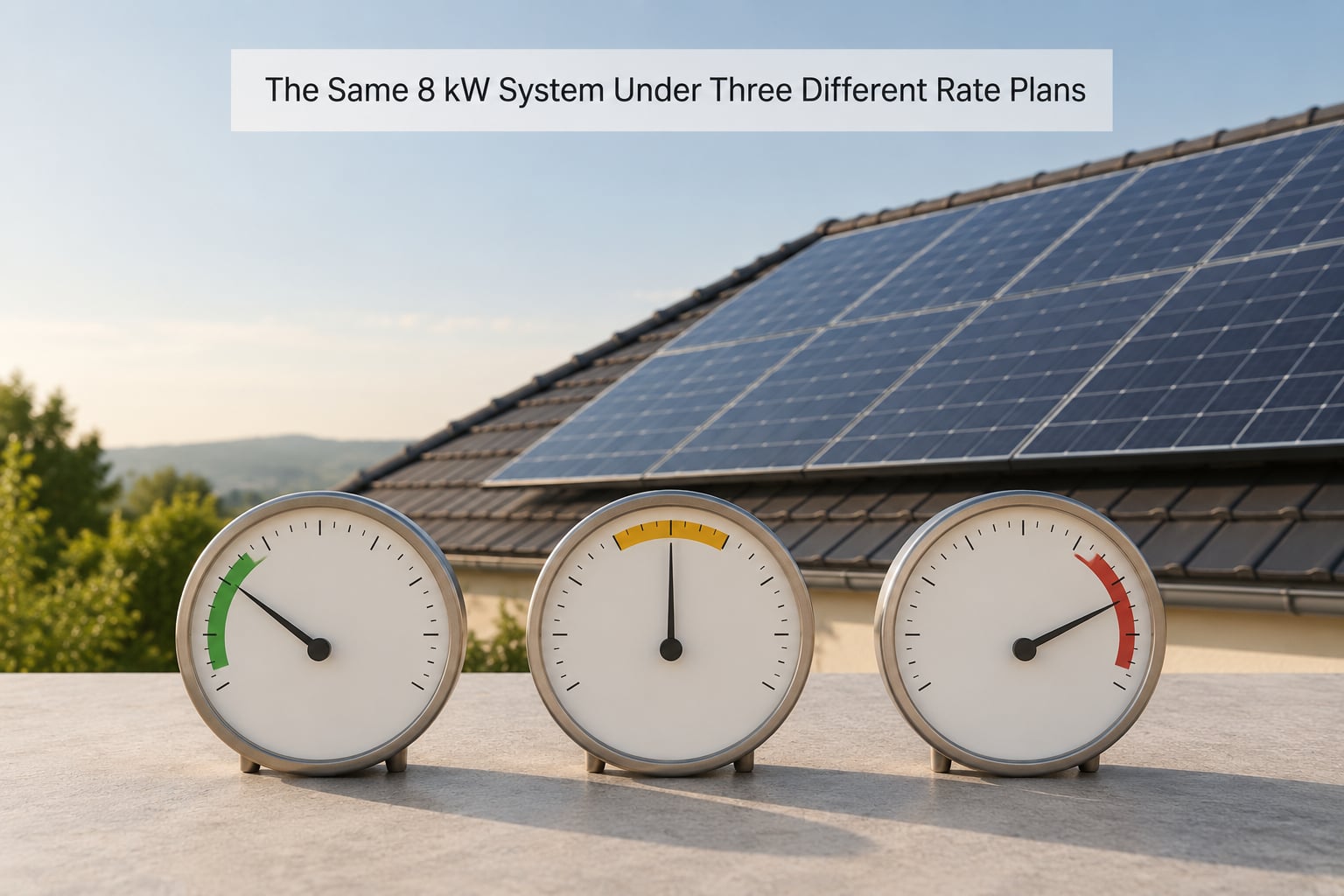
Here is one homeowner, one roof and one system. Production in year one is about 10,000 kWh. The household uses 11,000 kWh a year and can absorb 4,000 kWh of its own solar on a flat plan, exporting the remaining 6,000. After federal credits, assume an installed cost near 20,000. Every figure below is illustrative and assumes current rules in your area; your own tariff will differ.
| Rate plan | Retail rate | Export credit | Bill without solar | Bill with solar | Year-one savings | Payback |
|---|---|---|---|---|---|---|
| Flat, full-retail net metering | 24 c/kWh | 24 c/kWh | 2,856 | 456 | 2,400 | About 8 years |
| Time-of-use with net billing | 46 c peak, 28 c shoulder, 16 c off-peak | 8 c/kWh | 3,236 | 1,426 | 1,810 | About 11 years |
| Tiered with net billing | 18 c to 500 kWh/mo, 24 c to 2,000, 38 c above | 7 c/kWh | 2,497 | 1,117 | 1,380 | About 14 years |
The system did not change. What changed is what a kWh is worth. The gap between eight years and fourteen years on the same array is the entire argument for reading your tariff first.
That spread also explains why payback estimates vary so much across the country. Households in high-rate states such as California, Massachusetts and Hawaii see simple paybacks in the four-to-seven-year range. Households in genuinely cheap-rate states such as Washington or Louisiana are more likely to see 13 to 18 years. Same panels, same sun, different tariff. In low-rate states, solar still works financially, but you should size it carefully and plan on self-consumption rather than export.
Why Your Bill Can Stay High After the System Is Paid Off
If your array is finished and your bill still hurts, the reason is almost always on the rate-plan side of the ledger rather than the panel side. Homeowners in a Murrieta, California group have described this precisely: system paid off, and a bill around 420 dollars. Four causes account for most of it.
- Fixed customer charges. A 20 to 30 dollar monthly connection fee plus taxes sets a floor that solar cannot touch. It is simply the price of staying connected.
- Migrated rate plans. Utilities move customers onto new schedules as tariffs get rebuilt. A TOU migration after installation changes what your exports are worth without any change to your system.
- Expired credits. Under a plan with annual rollover, summer generation can be forfeited before winter use consumes it.
- Underproduction. Shading, snow, a dirty array or a failed string drops output below the original estimate, and your rate plan will not make up the difference.
Start by pulling twelve months of bills and separating the energy charge from everything else. That single split usually tells you which of the four is happening.
Do Solar Batteries Help? It Depends Entirely on Your Rate Plan
A home battery is a rate-plan product. Its job is to move stored energy from the cheapest hour on your tariff to the most expensive one, so its value is exactly the price spread you are trying to capture.
On a flat plan with full-retail net metering, a battery adds very little, because exported and self-consumed kWh are already worth the same thing. On a TOU plan with a real peak spread, charging from solar during the shoulder window and discharging at peak is where the money is. On a commercial tariff with demand charges, the battery earns its keep by shaving the demand peak instead.
Sequencing is where people get this wrong. The community advice in the r/solar Illinois net metering thread is to run a flat plan for a year or two, build up generation history, and only then consider a TOU move. One Tesla Motors Club poster in the NEM 3.0 thread picked the flat plan and said outright that they could not see how a TOU schedule would save them money. For plenty of post-NEM 3.0 households, that instinct is correct.
How to Find and Read Your Own Utility Rate Schedule
You do not need an analyst to do this. You need your last bill and about twenty minutes. Your utility publishes a rate schedule, usually identified by a code such as TOU-2, TOU-R or EV-9, and your bill will name the schedule you are on.
- Find the rate schedule code. It usually sits on page one or two of the bill, near the service address and account summary.
- Pull the tariff sheet. Search your utility’s site for the schedule code, or use your state public utility commission’s rate case database, which holds the tariff filings themselves.
- Find the export compensation rule. Look for net metering, net billing or buy-all/sell-all language, and write down the export rate in cents per kWh and whether it varies by hour or season.
- Read the rollover and expiration terms. Look for banked, carried forward, or annual expiration. This one line decides whether your summer surplus is worth anything in January.
- Note the fixed charge and any demand component. These are your floors. Multiply the fixed charge by twelve to see the bill you pay even at zero grid consumption.
- Check for riders and credits. Fuel adjustment clauses and usage-based bill credits change your effective rate from the published rate, often by several cents per kWh.
Six questions to ask your utility before you sign
These are the questions that show up again and again on forums like Bogleheads, where pre-purchase checklists tend to be blunt and specific. Ask them before the contract, not after.
- Is my interconnection net metered at full retail, and is that 1:1 regardless of the hour of day?
- What is my export rate, and does it change by season or time of day?
- Do unused export credits roll over, and when do they expire?
- What is my fixed customer charge per month, and are demand charges applied to residential accounts?
- Which time-of-use plans am I eligible for, and does solar disqualify me from any of them?
- Under what future tariff changes would my export compensation be reduced, and how much notice would I get?
If your utility cannot answer question five clearly, treat that as information. Several homeowners on r/solar found out only at the counter that a TOU switch they had planned around was unavailable to them once the panels were live.
Frequently Asked Questions
Why is my electric bill so high if I have solar?
Usually because solar only removes the energy charge on the kWh you consume yourself. Your fixed customer charge, taxes, and any demand charge keep running, and if your utility moved you to a time-of-use or net billing schedule, your exports are now worth much less than they were. Check twelve months of bills and separate the energy line from everything else to confirm which of these it is.
Why aren’t my solar panels saving me money?
Four causes cover most cases: a high fixed customer charge shrinking your percentage savings, export credits that expire before winter use consumes them, an hourly export rate that pays your midday generation far less than retail, or output below the original estimate because of shading or degradation. Compare your actual monthly kWh against what the system was modelled to produce before touching the rate plan.
How much should solar save you on your electric bill?
It depends on your rate plan more than on your roof. In our worked example an 8 kW system saved roughly 2,400 in year one on flat full-retail net metering, about 1,810 on a time-of-use plan with net billing, and about 1,380 on a tiered plan with net billing. High-rate states often see four-to-seven-year paybacks; cheap-rate states commonly see 13 to 18 years.
Is solar still worth it in 2026?
On a high per-kWh retail rate with full-retail net metering, usually yes, with simple paybacks in the four-to-seven-year range. On a low-rate plan, or one that pays a few cents for exports, the same system stretches to 13-18 years, which changes the financing conversation more than the technology. Model your own numbers using your own tariff rather than a statewide average.
Why is my NEM bill so high?
Post-2023 net metering structures no longer credit exports at full retail in many states. California cut export compensation by roughly 75 percent when NEM 3.0 took effect in April 2023, and shortened credit rollover at the same time. If your bill rose after a policy change rather than after installation, the cause is export compensation and credit expiry, not your system.
Does a home battery save money on time-of-use rates?
It can, because a battery captures the spread between your cheapest and most expensive hours by charging off-peak or from solar and discharging at peak. On a flat plan with full-retail net metering it adds little, since exported and self-consumed energy are already worth the same. Many households do better staying flat for a year or two and only then modelling a TOU switch with real generation history.
What to Do First
Pull your last twelve bills and find the rate schedule code printed on them. Then write down three numbers: your retail cents per kWh, your export credit in cents, and your monthly fixed charge. Those three figures tell you more about your solar economics than any sales presentation will, and they take one evening to find.
Once you have them, size the system for your rate plan rather than for your roof. On a flat plan with full-retail net metering, a larger array is straightforwardly better. Under net billing with a thin export rate, self-consumption is where the value sits, and a battery earns its place only if your hourly spread is wide enough to pay for it.
Finally, remember that every number in this article is a general US range, not a rule. Rates, riders, tax treatment and export compensation vary by state, utility and contract year, and they change. The tariff in your hand beats anything written here, including this paragraph.