A solar loan is a home improvement loan that pays for a rooftop system: the lender sends the money straight to your installer, you own the panels, and you repay the principal plus interest in fixed monthly payments over a set term. How solar loans work comes down to four numbers — the cash price, the financed price, the rate, and the fees.
The gap between those first two numbers is where most people get caught. A typical residential system runs about 30,500 dollars before any incentive, and installer financing often folds a dealer fee of 15% to 30% into the amount you sign for. Two homeowners can see the same panels quoted at completely different totals, and the difference is usually that fee rather than the hardware.
Financing also lives in a different world than it did two years ago. The 30% federal Residential Clean Energy Credit applied to qualifying systems placed in service through the end of 2025 and is not available for installations going in now, so any deal built around money arriving in April needs a fresh look. State rebates, utility incentives and property-tax exemptions are still around, and they differ enormously by county.
Table of Contents
- What Is a Solar Loan?
- How Solar Loans Work: The Basic Process
- How solar loans work step by step
- How solar loans work when the lender funds the installer
- How solar loans work when an incentive payment lands
- What Does a Solar Loan Cost?
- What Credit Score Do You Need for a Solar Loan?
- Secured vs. unsecured solar loans
- How Do You Apply for a Solar Loan?
- How Are Solar Loan Payments Made?
- Re-amortized and combo loans
- Can You Claim Tax Credits with a Solar Loan?
- Solar Loan vs. Solar Lease: What’s the Difference?
- What Risks Should You Consider?
- How to Choose a Solar Loan Lender
- Frequently Asked Questions
- Are solar loans a good idea?
- What is the average interest rate on a solar loan?
- Is solar loan interest tax deductible?
- Is it hard to get approved for a solar loan?
- Can you pay off a solar loan early?
- What happens to a solar loan if you sell the house?
- Conclusion
What Is a Solar Loan?
A solar loan is a loan used to buy and install a residential solar system. You borrow the cost, the money usually goes directly to the installer rather than to you, and you repay the principal plus interest in monthly payments over a set term while keeping ownership of the system and any incentives it qualifies for.
The money typically covers panels, the inverter, racking, labor, permits, interconnection and monitoring, and sometimes a battery. What makes it different from a home equity loan is the collateral: instead of borrowing against the house, most solar loans are secured by the equipment itself through a UCC-1 lien, or they are unsecured and rely on your signature and your promise to repay.
It is also not the same as a lease or a power purchase agreement. With a loan you buy the system, so you keep the panels, keep the incentives, and can sell them with the house. A lease and a PPA hand you the use of someone else’s system for a set period, with an option to buy at the end that is rarely as good as it sounds.
Almost all mainstream solar lenders want the same three things from you: you own the home, your name is on the title, and your credit and income support the payment. Renters, manufactured homes, and recent buyers without enough equity are the usual exclusions.
How Solar Loans Work: The Basic Process
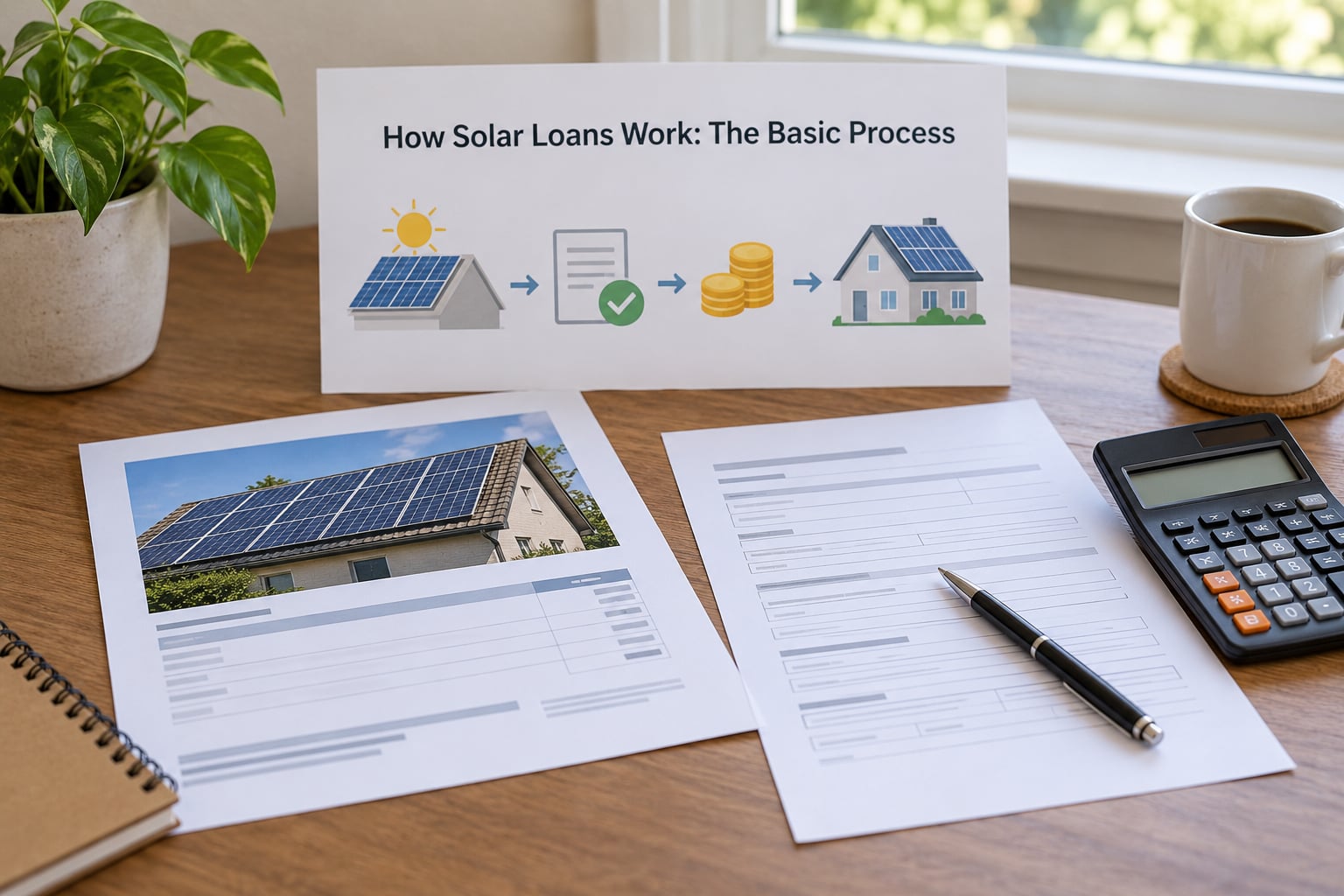
The sequence runs from shopping to first payment in about four to eight weeks, and most of that calendar belongs to the installer rather than the lender. Here is how solar loans work in practice, in order.
How solar loans work step by step
- Get at least three quotes in writing. Every quote should show the cash price, the panel count, the panel brand and model, the inverter, the warranty lengths, and the expected annual production. If a quote omits the cash price, walk away.
- Compare the cash price against the financed price. Subtract the two. That spread is the fee you are paying for borrowing, and on installer financing it is frequently 15% to 30% of the system price.
- Pick a lender before the installer does. Your own bank, a community credit union, a clean-energy credit union and a specialist online lender will quote different rates. Letting the installer choose locks you into their lender and their price.
- Prequalify, then apply. Prequalification usually uses a soft credit pull and a self-reported income. A full application triggers a hard inquiry.
- Underwriting. The lender reviews credit, income, existing debt, the home’s value and the cost of the system relative to that value. Approvals come with a written estimate of rate, term, monthly payment and fees.
- Sign, install, get funded. Most loans are signed first and the lender pays the installer directly at completion. You never handle the money yourself.
- Pay, then apply incentives to principal. Payments begin the month after completion. Any state rebate, utility incentive or tax refund you receive should go straight to the balance rather than into your checking account.
How solar loans work when the lender funds the installer
This detail matters more than people expect. When the lender pays the installer directly, the loan only funds what is actually installed, and you avoid handing over cash you might spend twice. It also means a change in scope mid-project, such as adding a battery, usually needs a loan modification rather than a second contract.
Ask for the funding milestone in writing: how much is released at permitting, how much at inspection, and how much at interconnection approval. Installers who cannot answer that clearly are the ones to slow down for.
How solar loans work when an incentive payment lands
A rebate or tax refund is a lump sum, while your loan is a monthly bill, so sending the entire payment to principal is the move that makes financing competitive with paying cash. Ask the lender in writing how to direct extra payments and whether any prepayment penalty applies. Homeowners in r/solar report paying loans off well ahead of the stated term once an incentive arrives, and it happens because they made that a condition from day one.
What Does a Solar Loan Cost?
A solar loan costs you five things: the system, the interest, the term, the fees, and whatever incentives claw some of it back. Most people look at the first one and ignore the fourth, which is exactly how a 2.99% teaser rate turns into an expensive loan.
- System price. About 30,500 dollars is a common national average before incentives, and it moves with system size, panel tier, rafter layout, roof complexity and your utility’s interconnection rules.
- Interest rate. Unsecured solar loans typically land somewhere in the 4% to 17% range depending on credit, term and lender. Secured and home-equity-backed borrowing sits at the lower end.
- Term. Common terms run 8 to 25 years, with a 10- to 15-year loan the sweet spot for most homeowners. Every extra year of term buys a smaller payment and a bigger interest bill.
- Fees. Origination or dealer fees, application fees, closing costs and admin fees. These are the number to interrogate.
- Incentives. State rebates, utility incentives, property-tax exemptions and any remaining federal eligibility for older-placed-in-service systems.
Here is the arithmetic that makes the term choice obvious. A 25,000 dollar system financed at 7% looks like this:
| Term | Monthly payment | Total repaid | Total interest |
|---|---|---|---|
| 8 years | about 341 dollars | about 32,700 dollars | about 7,700 dollars |
| 12 years | about 257 dollars | about 37,000 dollars | about 12,000 dollars |
| 15 years | about 225 dollars | about 40,400 dollars | about 15,400 dollars |
| 20 years | about 194 dollars | about 46,500 dollars | about 21,500 dollars |
| 25 years | about 177 dollars | about 53,000 dollars | about 28,000 dollars |
Going from 12 years to 25 years drops the payment by roughly 80 dollars a month and adds about 16,000 dollars of interest. A 12-year loan only qualifies if the payment is genuinely comfortable, but if it is, the shorter term usually wins. Prices, rates and terms vary by location, lender, credit profile and system design, so treat these figures as a worked example rather than a quote.
One more piece of framing that helps: a loan lets you fix the price of the electricity your panels make. Instead of paying whatever your utility charges ten years from now, you pay a known amount. That is a real benefit, but only if the total interest you pay is lower than the utility rate increases you avoid.
What Credit Score Do You Need for a Solar Loan?
There is no universal threshold, and every lender publishes its own guidelines rather than a hard cutoff. As a working picture, a 650 score is usually the floor for an unsecured solar loan, 680 to 719 tends to unlock mid-range rates, and 720 and above opens the best pricing. Local credit unions and clean-energy credit unions are often more flexible than online installment lenders.
Lenders also look at debt-to-income ratio, generally keeping total monthly debt near or under 50% of gross household income once your solar payment is added. Income stability matters: self-employed borrowers are usually asked for two years of tax returns. Ownership matters too, because the home’s value and your equity set the ceiling on how much a secured lender will advance.
Secured vs. unsecured solar loans
| Factor | Secured solar loan | Unsecured solar loan |
|---|---|---|
| Collateral | The solar equipment, via a UCC-1 lien | Nothing; you sign a promissory note |
| Interest rate | Lower | Higher |
| Credit needed | Moderate to strong | Stronger, often 680 or above |
| Approval speed | Slower, includes a title and lien search | Faster |
| Risk to you | Missed payments can mean losing the equipment | Missed payments hurt credit and can lead to collection |
| Effect on later financing | A lien can complicate a refinance or sale | No equipment lien on title |
The unsecured version is the default for most homeowners and is what most installer financing actually is, whatever the paperwork calls it. Ask directly whether the loan is secured and whether a lien will be filed.
How Do You Apply for a Solar Loan?
The application is routine; the work happens before it. Prepare two years of income documents, recent pay stubs, the last two credit report pages, your home’s estimated value and a rough idea of the panel count you need. Then work through the rest in this order.
- Request itemized quotes from at least three installers. Insist on the cash price broken out from any financing price.
- Audit the financed price. Take the cash price, add the interest you will pay over the term, then add every fee. That total is your real cost. One long-term loan quoted a headline 2.99% over 144 months only looked affordable until a 6% dealer fee was written on a separate line — the missing line item, not the math, caused the problem.
- Check licensing and warranties. Verify the contractor’s license with your state licensing board and read the equipment warranty separately from the workmanship warranty. A 25-year panel warranty is worth nothing if the company that installed it has folded.
- Get written fee disclosure before signing. A legitimate lender itemizes the dealer fee, origination fee and closing costs. Anyone who produces a single all-in number and refuses to break it down is telling you what you need to know.
- Prequalify with two or three lenders. Soft pulls, no commitment, and it gives you a rate to negotiate with.
- Apply formally and read the loan estimate. Check the rate, term, monthly payment, APR, every fee, the lien, and the prepayment terms line by line before signing.
- Confirm the payoff figure. Ask how to get a written payoff quote, because you will want it if you sell the house or refinance.
How Are Solar Loan Payments Made?
Each payment splits into two parts: principal, which reduces what you owe, and interest, which is the lender’s charge on the remaining balance. Early payments are mostly interest; later payments are mostly principal. That is not a trick, it is just how amortization works, and it is why paying extra early saves the most interest.
Most solar loans are fixed-rate, so the payment stays the same each month even though the split changes. A smaller number of loans are variable, which means the payment can move with an index and your budget has to survive a rise. Payment dates are almost always the first of the month, beginning the month after the install, and autopay is worth setting up on day one.
The payment is also completely independent of what your panels produce. A cloudy month does not lower it, and a great production month does not raise your savings. Your savings depend on production, your utility rate, and how your utility compensates you for exported power under net metering rules that vary by state.
Re-amortized and combo loans
A re-amortized loan looks like a short 5- to 7-year loan, but a large payment at the end is required to pay off the balance, and that payment is re-amortized over a long period. A combo loan is a bridge: the short portion covers what you can pay, and the balance is folded into a new longer loan later. These structures produce an attractively small monthly number and a large obligation, and several have become much harder to find since the federal credit lapsed, because the tax refund was the usual source of the lump sum. Treat any teaser rate with a balloon as a warning, not a feature.
Can You Claim Tax Credits with a Solar Loan?
Financing does not disqualify you from incentives, but it does not create them either. The 30% federal Residential Clean Energy Credit applied to eligible residential systems placed in service through December 31, 2025, so a system installed in 2026 does not qualify for it. That is why the old sales pitch about financing now and collecting a credit in April no longer works for many borrowers.
What is still available depends entirely on where you live: state rebates, state income tax credits, utility incentives for certain equipment, and property-tax exemptions that often run for several years. Utilities in the highest-rate states tend to offer the richest programs, and local programs come and go with budgets.
Two mechanics are worth planning around. First, incentive money is best applied directly to the loan principal, which cuts both the balance and your future payment. Second, whether interest is deductible depends on your filing status, whether you itemize, and how the borrowing is structured. Nobody should tell you the answer without looking at your return, so confirm the treatment with a qualified tax professional before signing.
Solar Loan vs. Solar Lease: What’s the Difference?
The loan and the lease answer the same question, buying energy, with opposite answers: you own the equipment, or you rent it. Everything else follows from that.
| Factor | Cash purchase | Solar loan | Solar lease | Power purchase agreement |
|---|---|---|---|---|
| Ownership | You own it immediately | You own it after the final payment | Lessor owns it | Provider owns it |
| Upfront cost | Full system price | Usually little or nothing | Usually little or nothing | Nothing |
| Payment | None; you pay the utility | Fixed loan payment plus the utility | Fixed lease payment | Rate per kilowatt-hour |
| Incentives | Yours to claim | Yours to claim, after installation | Lessor claims them | Provider claims them |
| Maintenance | You | You | Usually the lessor | Usually the provider |
| Selling the house | Systems transfer | Pay off the lien, then transfer | Needs lessor consent | Needs provider consent |
| End of term | Nothing owed | You own a paid-off system | Buyout, sometimes at fair market value | Buyout or system removal |
Homeowners in r/solar generally treat a lease as the weakest of the four, because incentives you cannot claim, equipment you do not own and a lessor’s consent at resale all stack against you. That is not a universal rule, but the incentive point alone decides it for most people who were expecting a credit in the first place.
What Risks Should You Consider?
- Variable rates. The payment can rise. Read the cap and the index, and know your exit.
- Missed payments. A solar payment is a debt payment. It lands on your credit report exactly like a car loan.
- Installer failure. This is the risk homeowners raise most often. If the company that installed your system folds, your equipment warranty may be worthless even though the panels are fine. Fund the system through a lender that outlives your installer, and check whether the lender offers protection if your installer goes under.
- Equipment warranties. Panel, inverter and workmanship warranties are three different promises with three different lengths. Read all three.
- Production variability. Shading, snow, a dirty array and an underperforming inverter all cut output. Annual production in the proposal should be a modeled number with a stated assumption set, not a guess.
- Tax uncertainty. Rules, state programs and utility policies change. Assume incentives can be reduced and check current terms with a tax professional.
- Early-payoff rules. Some loans charge a prepayment penalty. Ask before signing, not after.
- Lien language. A UCC-1 lien on the equipment can complicate a refinance, and some buyers or their lenders balk at it. Get the payoff process in writing.
- Documented fees. A dealer fee above 10% of the system price, a teaser rate, or a balloon payment are the three flags worth stopping for.
On selling the house, the mechanics are simple. The buyer either pays off the remaining balance at closing from the proceeds, assumes the loan if the lender allows it, or asks you to clear the lien before the sale. Some lenders will not transfer, and the sale can stall until the lien is released. Get a written payoff quote about 60 days before closing.
How to Choose a Solar Loan Lender
Ask these six questions and compare the answers in writing, not over the phone.
- What is the APR, and what fees are rolled into it? APR is the only number that compares two offers honestly, provided the fees are in it.
- Is the rate fixed or variable? If variable, what is the cap and the index?
- What is the term, and what is the total repayment amount? Ask for the total dollars, not just the monthly payment.
- Is there a prepayment penalty, and how do I pay extra toward principal?
- Is the loan secured, and will a lien be filed on my property or the equipment?
- What happens if my installer goes out of business? Some lenders step in and complete commissioning. Ask who owns that obligation in writing.
Where you shop matters as much as what you ask. Your bank or credit union, a clean-energy credit union, a local bank, a specialist online lender, and a PACE program on your property tax bill all have different structures. Community consensus on r/solar is consistent on one point: financing through the installer locks you into their lender, and going to your own institution usually produces a lower APR.
PACE deserves a separate mention because it is repaid on the property tax bill rather than to a lender, is generally transferable with the home, and in many programs has no interest at all. It is also slow to approve and eligibility varies by county.
Frequently Asked Questions
Are solar loans a good idea?
A solar loan is a good idea when the total financing cost stays below the rising cost of the electricity it replaces, and when the rate and term are comfortable without straining your budget. Loans of 10 to 15 years usually produce the strongest math. A 25-year term adds substantial interest, so treat it as a last resort and compare the financed price against the cash price before signing anything.
What is the average interest rate on a solar loan?
Unsecured solar loans typically fall between 4% and 17% depending on credit profile, loan term and lender, with most borrowers landing in the middle of that range once fees are counted. Secured loans and home equity borrowing price lower because the collateral is stronger. Always compare the APR rather than the headline rate, since a low rate with a large dealer fee is an expensive loan.
Is solar loan interest tax deductible?
It depends on whether you itemize deductions, how the loan is structured, and whether the borrowing is secured by your home. Interest on a home equity loan or HELOC used for a qualified home improvement may be deductible within existing mortgage debt limits, while interest on an unsecured personal-style solar loan generally is not. Confirm the treatment for your situation with a qualified tax professional before signing.
Is it hard to get approved for a solar loan?
Not especially, if you own the home, have your name on the title, keep debt-to-income near or under 50%, and hold a credit score of at least 650. Scores of 720 and above usually price best. The harder part is rarely approval; it is finding a lender that does not bury a 15% to 30% dealer fee in the financed price. Prequalify with several lenders before committing to any installer.
Can you pay off a solar loan early?
Usually yes, and it is one of the best moves you can make. Ask in writing whether a prepayment penalty applies and how to direct extra payments to principal, since some lenders apply extra cash elsewhere. Because early payments are mostly interest, extra principal in year two saves more than the same amount in year twelve. Homeowners routinely clear these loans years ahead of schedule using rebates and tax refunds.
What happens to a solar loan if you sell the house?
The lien must be dealt with before the sale closes. Typically the remaining balance is paid off from the sale proceeds and the lien is released, or the buyer assumes the loan if the lender permits it. Some lenders refuse to transfer, and buyers with their own lender may decline to take on the obligation. Request a written payoff quote about 60 days before closing so there are no surprises at the table.
Conclusion
The decision comes down to one comparison: take the cash price, add every dollar of interest and fee you would pay to finance it, subtract the incentives you will actually receive, and see how that total stacks up against what your electricity would otherwise cost over the same years. Judge the loan on that number rather than the monthly payment, and choose the shortest term your budget can carry.
Start by getting three itemized quotes with the cash price stated separately, then prequalify with a bank or credit union so you have a real rate to negotiate against. Everything else on this page matters less than those two steps.