The cheapest way to shade a house from the sun is to put a physical barrier outside the glass, where sunlight is intercepted before it ever becomes heat. Awnings, exterior screens, shutters, shade cloth and trees all work better than indoor curtains, and you can mix them to suit the rooms that actually overheat.
Windows are the weak link in most homes. The U.S. Department of Energy says heat gain and loss through windows accounts for roughly 25 to 30 percent of residential heating and cooling energy use, and Lawrence Berkeley National Laboratory estimates that glass covers only about 8 percent of a home’s thermal envelope while driving up to 45 percent of envelope heat loss in climate zones 4 and 5. Shading intercepts that load before your air conditioner ever sees it, so the savings show up as a system that cycles less and pulls less power on the hottest afternoons.
The order of work matters more than the shopping. Find the rooms that heat up first, shade the outside of them, then go back and adjust. Run through this before the cooling season in 2026 and you will have the house sorted by the time the first heat wave arrives.
Table of Contents
- What You Need
- Step-by-Step
- 1. Map the sun and identify the hottest areas
- 2. Match the shading method to the problem
- 3. Size and position the shade correctly
- 4. Install or arrange the shading safely
- 5. Test the result and make seasonal adjustments
- Common Mistakes
- Frequently Asked Questions
- What is the best way to shade west-facing windows?
- Are trees a good way to reduce home cooling costs?
- How much of a window should an awning cover?
- Do indoor curtains or blinds provide the same cooling benefit as exterior shading?
- Is solar screen mesh effective in hot climates?
- Conclusion
What You Need
Shading projects go wrong when people measure the window instead of the wall, or buy hardware without knowing whether the surface can hold it. Gather a few things before you decide what to install.
A compass or a sun-tracking app. Spend a morning and an afternoon noting where the sun lands on each side of the house. A notebook, a tape measure and a step ladder are enough for most jobs. You want the height and width of every window you plan to shade, the distance from the window to the closest obstruction, and the direction that wall faces.
Also worth having: your last few energy bills or a utility app so you can compare runtime later, the climate you actually live in rather than a general label like hot, and any permissions that apply. A fixed awning bolted to a facade, a sail over a patio, or anything attached to a rental wall usually needs a landlord’s written OK, and homeowners associations often control visible exterior changes. Fixed shades also carry wind load that a groundskeeper can check against local code.
Step-by-Step
1. Map the sun and identify the hottest areas
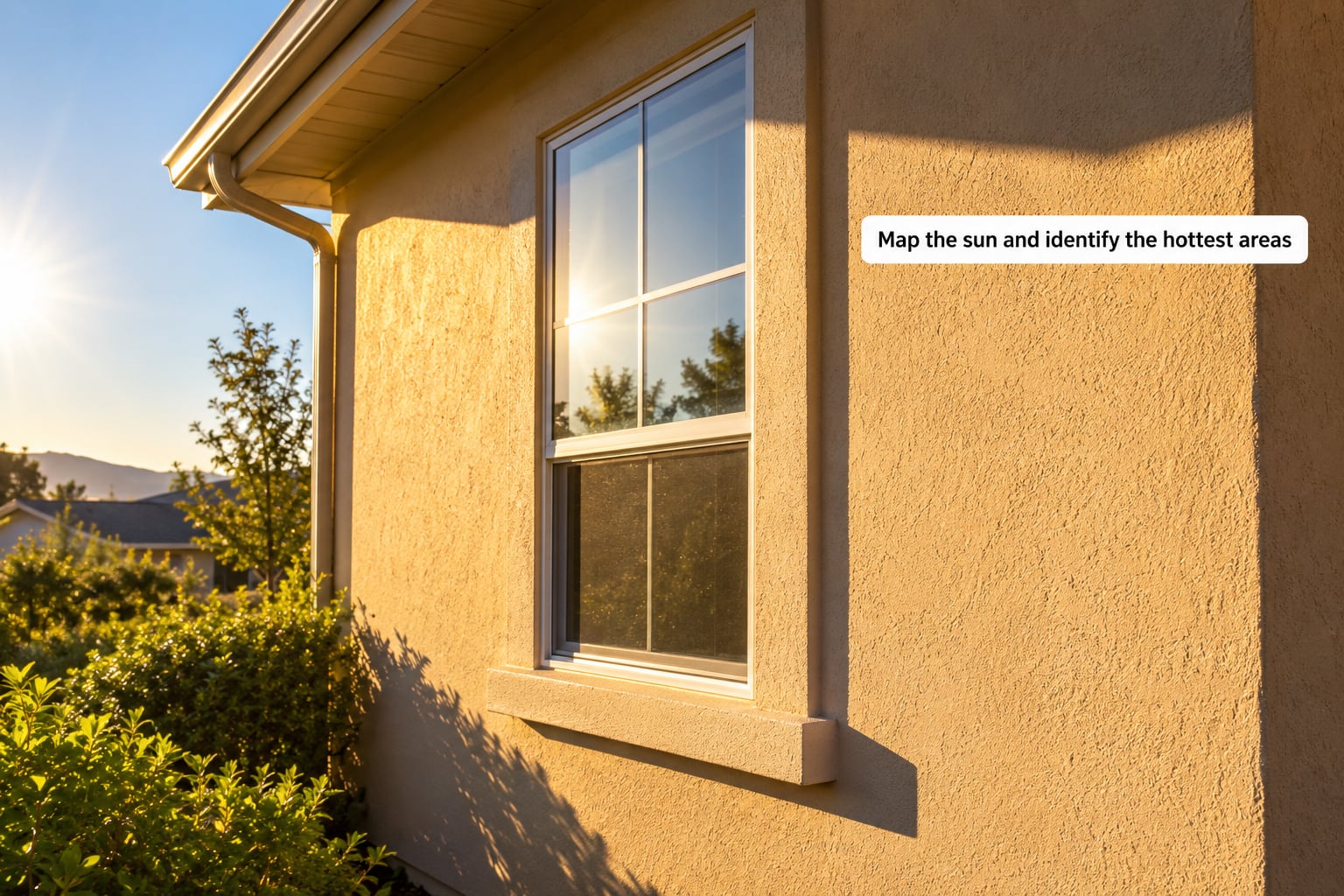
Start by watching the house rather than by reading a chart. Note when direct sun first hits each window, when it leaves, and which room holds the heat longest afterward.
West and southwest elevations usually win the heat race, because the sun hits them late in the day when outdoor air is already at its warmest and your AC has been working all afternoon. South-facing glass gets steady, near-vertical exposure around midday. East-facing glass cooks at breakfast and is usually an easy fix.
The best early clue is not the sun at all. It is which room your household avoids in the afternoon. A home office with a west window and no shade is the room that makes people buy something. Note the wall, not just the window, because the sun striking a bare exterior wall radiates heat inward for hours.
2. Match the shading method to the problem
Different problems call for different tools. Pick by exposure, wind, how much maintenance you want, and whether you rent.
Deciduous trees are the only option that grows on your schedule, giving free shade in summer and letting winter sun through. They take years to matter, so treat them as a long-term investment, not a fix for this August.
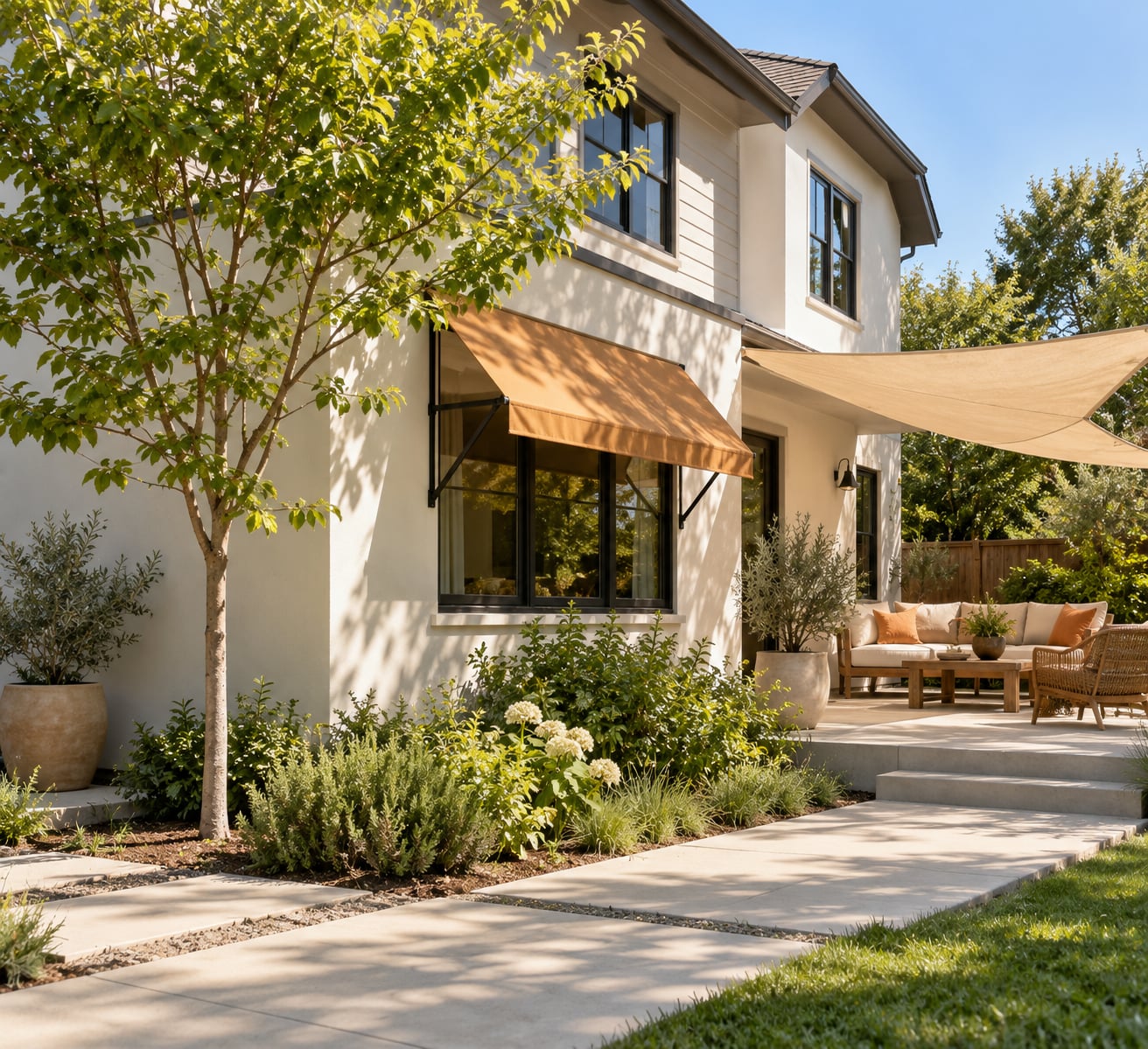
Awnings are the fastest single improvement for windows. The Department of Energy credits window awnings with reducing solar heat gain by up to 65 percent on south-facing windows and up to 77 percent on west-facing windows. Louvered exterior shutters do the same job and survive winter, at the cost of being there year-round.
Exterior solar screens are the renters’ and the lightweight option. The Department of Energy notes that solar screens can block up to 90 percent of solar heat gain before it reaches the window. Shade cloth of 70 to 90 percent density does nearly the same thing for a fraction of the money, which is why homeowner forums keep recommending it, and why they recommend 90 percent rather than lighter cloth for exposed walls.
Shade sails and fabric over a pergola cover patios and sunrooms where there is no window to treat. Vines on a trellis do the same slowly and cheaply. Interior curtains and cellular shades are worth adding as a second layer for privacy and glare, but they act after sunlight has already crossed the glass and turned into trapped heat. They are not a substitute for outside shade.
3. Size and position the shade correctly
Measure width first, then height, taking each dimension at three points along the frame and ordering to the largest reading. Ordering to the smallest is the classic way to end up with a kit that is two inches short and leaves a gap at one corner.
The shade needs to extend beyond the edges of the glass. Light entering at an angle clips the room rather than the pane, so a shade that covers the window exactly still leaks glare around its sides. As a practical rule, overhang the frame by several inches on each side and angle or extend it far enough out that midday and late-afternoon sun both fall outside the opening.
Mind the seasons too. A fixed awning sized for high summer sun can block the lower winter sun you may want for warmth. And keep clear of practical trouble: do not shade over a downspout, an attic vent, a window you need to open for egress, or a walkway where the fabric could sag into head height.
Check the fabric against your climate. Light, open weaves shed heat well and dry fast. Heavy, dark cloth traps heat in hot humid summers unless air can move between it and the wall, so leave that gap.
4. Install or arrange the shading safely
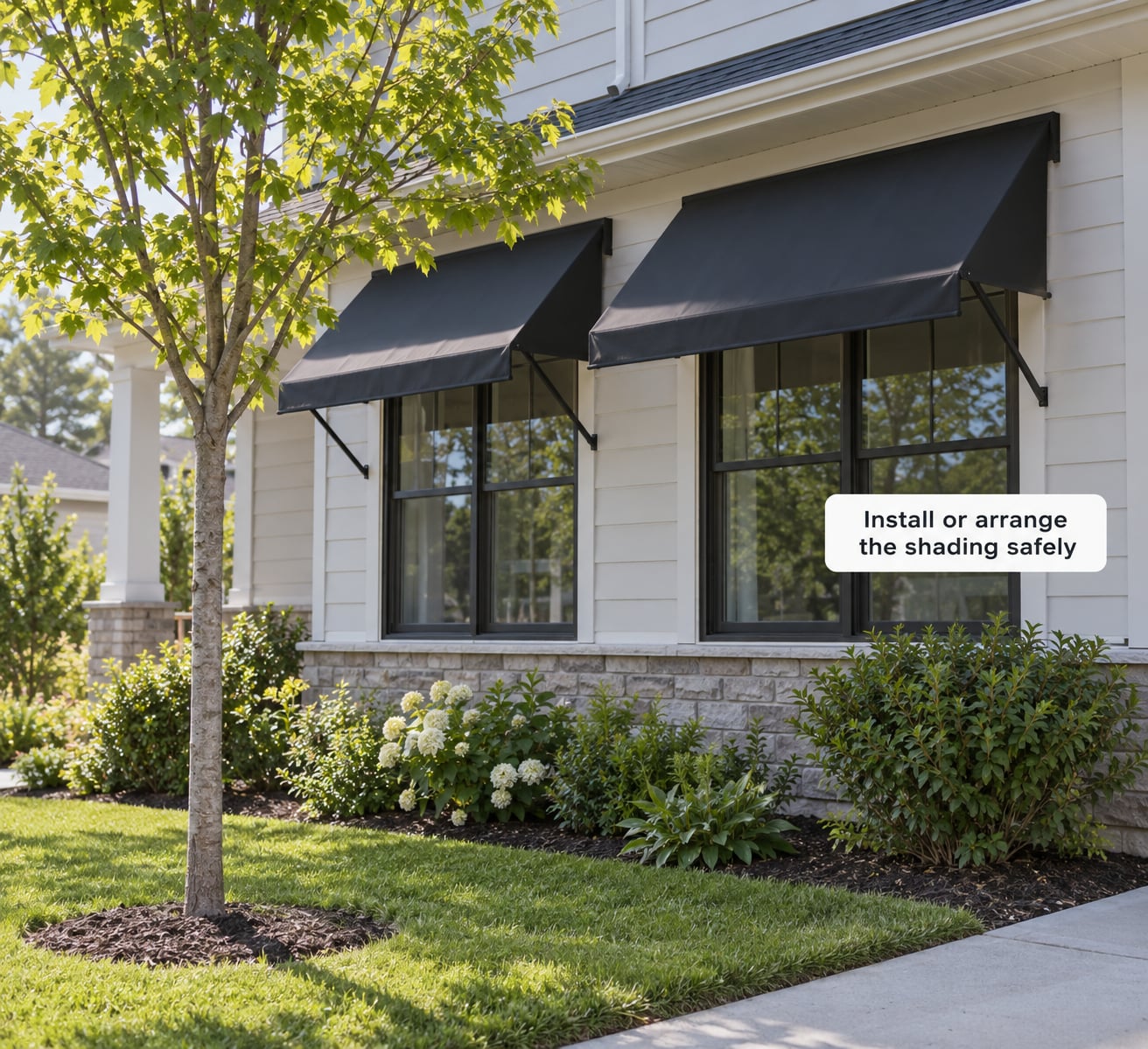
Work from the ground where you can. A large planter with a young tree, a tension-frame screen clamped into a window reveal, or a roll of exterior shade fabric fixed with hook-and-loop strips needs no ladder at all. One homeowner described on a forum how they cut a roll of shade fabric to size and stuck it to the outside of the windows, and it made a real difference on the west side of the house.
Use whatever mounting hardware the manufacturer specifies, and follow the instructions on torque and spacing. Anything drilled into a facade, hung over a patio, or mounted above a two-story wall is structural work, and awnings and sails catch real wind load. Hire a qualified contractor or installer for that part rather than improvising with a ladder and a drill.
For planting, keep new trees a reasonable distance from the foundation and away from utility lines, and check what your local code requires before planting anything large. Roots that find a water line or a foundation crack cost far more than the shade ever saved.
5. Test the result and make seasonal adjustments
Give it a few weeks before you judge it. Compare indoor temperature readings in the treated room against an untreated one at the same time of day, and note how long the thermostat runs.
Watch for glare as much as for heat. A screen that blocks the sun but turns the room into a cave will get pushed aside within a day and quietly stop working, so trade density for a bit of visibility if your room needs it.
Adjustable shades are meant to move. Retractable awnings and exterior screens get extended when the sun reaches that wall and pulled back when it moves off, which preserves daylight and view when you want them. Revise the settings each season as the sun path shifts, and again after you swap furniture around a window.
Common Mistakes
Most wasted money comes from shading the wrong surface or the wrong side of it. These are the ones I see repeat.
Shading only the glass. A sunlit exterior wall radiates heat inward long after the sun leaves. Extend coverage to the wall around a window, or add a trellis or screen that shades the whole elevation.
Treating thin indoor curtains as the whole plan. Light-colored sheers block almost nothing, and by the time sunlight reaches the fabric it is already heat inside the room. Use curtains as a second layer only.
Choosing dark, tight-weave awnings for a humid climate. Those absorb sunlight and hold it near the wall. Lighter, permeable material with airflow behind it works better where humidity is high.
Planting a tree hard against the foundation. It may look great for a decade and cause real damage after that. Set it back far enough to grow to its mature size.
Blocking air movement. Screens and cloth close to an open window can choke the air exchange you rely on, and fully sealed screens can trap insects against the glass.
Leaving shade up year-round. Winter sun gain is free warmth, and a permanently closed exterior shutter or awning gives it away.
Doing high work yourself. Anything above a first-story reach belongs to someone with proper equipment, and sails and awnings are engineered for wind, not eyeballed.
Expecting shading to erase the bill. It lowers cooling demand, and a properly shaded room often needs no AC at all, but window and envelope upgrades, insulation and air sealing are separate jobs. The EPA estimates 25 to 40 percent of a home’s heating and cooling energy loss leaks through cracks around doors and windows, and no amount of shade fixes that gap.
Frequently Asked Questions
What is the best way to shade west-facing windows?
A west-facing window needs the deepest coverage you can get, because late-day sun hits it at a low angle and the outdoor air is already hot. Retractable exterior awnings or exterior solar screens work best, since both extend past the glass and block light before it enters. The Department of Energy credits awnings with cutting solar heat gain by up to 77 percent on west-facing windows. A large deciduous tree on that side adds the most over time.
Are trees a good way to reduce home cooling costs?
Yes, but only as a long-term fix. A mature tree over a west or south wall shades the facade and the ground around it, and the American Lung Association reports that urban trees and greenspaces can lower temperatures by up to 7 °F by day and 22 °F at night. A newly planted tree will not move your meter much for three to five years. Pair it with an awning or screen if you need relief this summer.
How much of a window should an awning cover?
Cover more than the glass. Measure width and height at three points and order to the largest reading, then extend the awning several inches past the frame on each side and far enough out that both midday and late-afternoon sun fall outside the opening. Light arriving at an angle still enters through the sides of the opening, so an awning sized to the exact frame leaves glare in the room.
Do indoor curtains or blinds provide the same cooling benefit as exterior shading?
No. Interior treatments work after sunlight has already passed through the glass and become trapped heat in the room, so the heat is inside before the blind moves. Exterior shading stops that radiation at the glass, which is why the Department of Energy points to awnings and solar screens as the more effective option. Curtains and cellular shades still earn their place as a second layer for glare, privacy and winter heat gain.
Is solar screen mesh effective in hot climates?
Yes, and it is one of the most cost-effective options in a hot climate. The Department of Energy says solar screens can block up to 90 percent of solar heat gain before it reaches the window. Pick a mesh density around 70 to 90 percent for exposed walls, leave an air gap between the screen and the glass, and choose a darker mesh only where you can live with less daylight.
Conclusion
Start outside and start small. Spend an afternoon watching which wall and window heat up first, then put the simplest shade you can find on that one spot, sized to cover the glass and the wall around it. If you do only that one thing this October 2026, make it the west side.