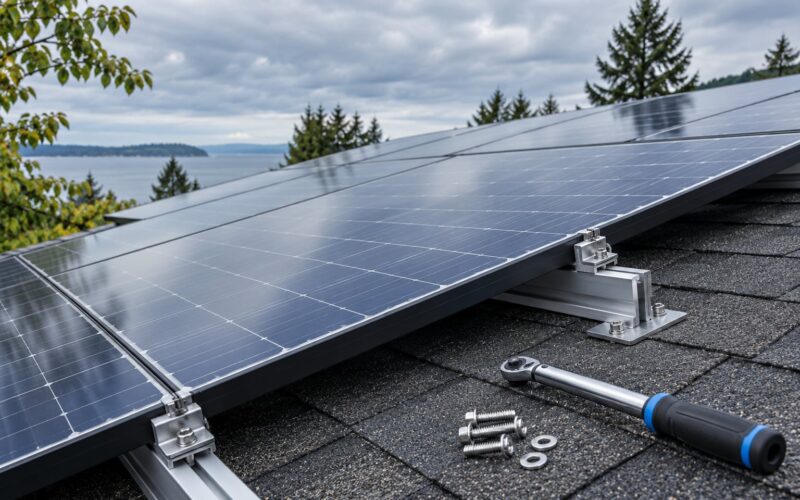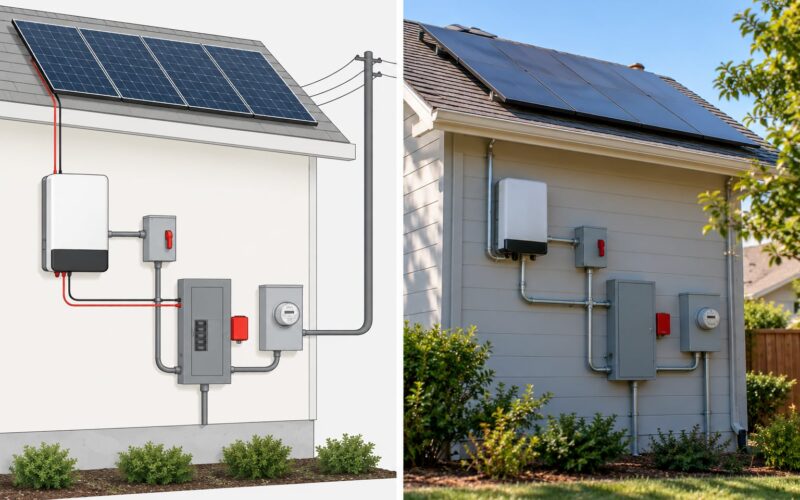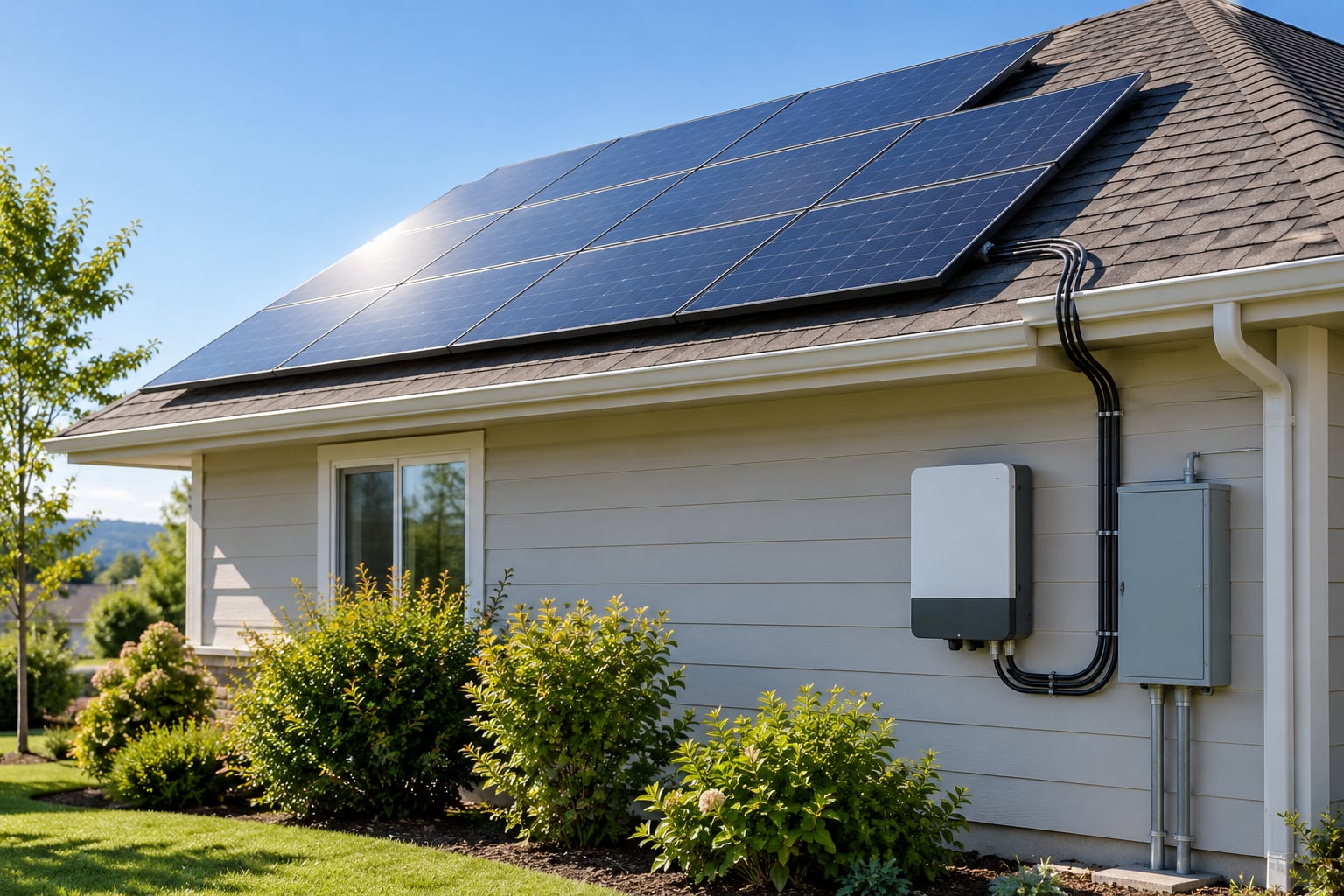
Understanding how electricity flows from panels to outlets comes down to one fixed chain. Photovoltaic cells turn sunlight into direct current, the cells are wired into strings and an array, an inverter converts that DC into grid-matching alternating current, and the AC enters your service panel where branch-circuit breakers hand it to individual 120V and 240V wall outlets. The utility grid and a battery feed that same panel in parallel, so nothing has to switch between sources.
The direction of travel is one way during the day: roof to inverter to panel to receptacle to appliance. The direction that confuses people is what happens at the edges, when the sun sets, when the clouds roll in, or when the grid drops out and your panels are sitting in full sunlight doing nothing.
Table of Contents
- What Happens When Solar Panels Receive Sunlight?
- How Electricity Flows from Panels to Outlets
- The Seven-Step Path From Sunlight to Socket
- What Does the Solar Inverter Do?
- How Does a Grid-Tied Solar System Send Power to the House?
- How Does Solar Power Flow With a Battery?
- What Is the Difference Between AC and DC Solar Electricity?
- How Much Solar Power Can Reach Household Outlets?
- What Happens During an Outage?
- Which Parts Control Power Flow and Safety?
- How Can You Verify That Solar Electricity Is Reaching Your Outlets?
- Frequently Asked Questions
- How does electricity get to an outlet?
- How do solar panels that plug into outlets work?
- Do solar panels and the grid fight each other?
- Do outlets pull electricity when nothing is plugged in?
- Why is my electric bill high even though I have solar?
- Do solar panels work when the power goes out?
- Conclusion
What Happens When Solar Panels Receive Sunlight?
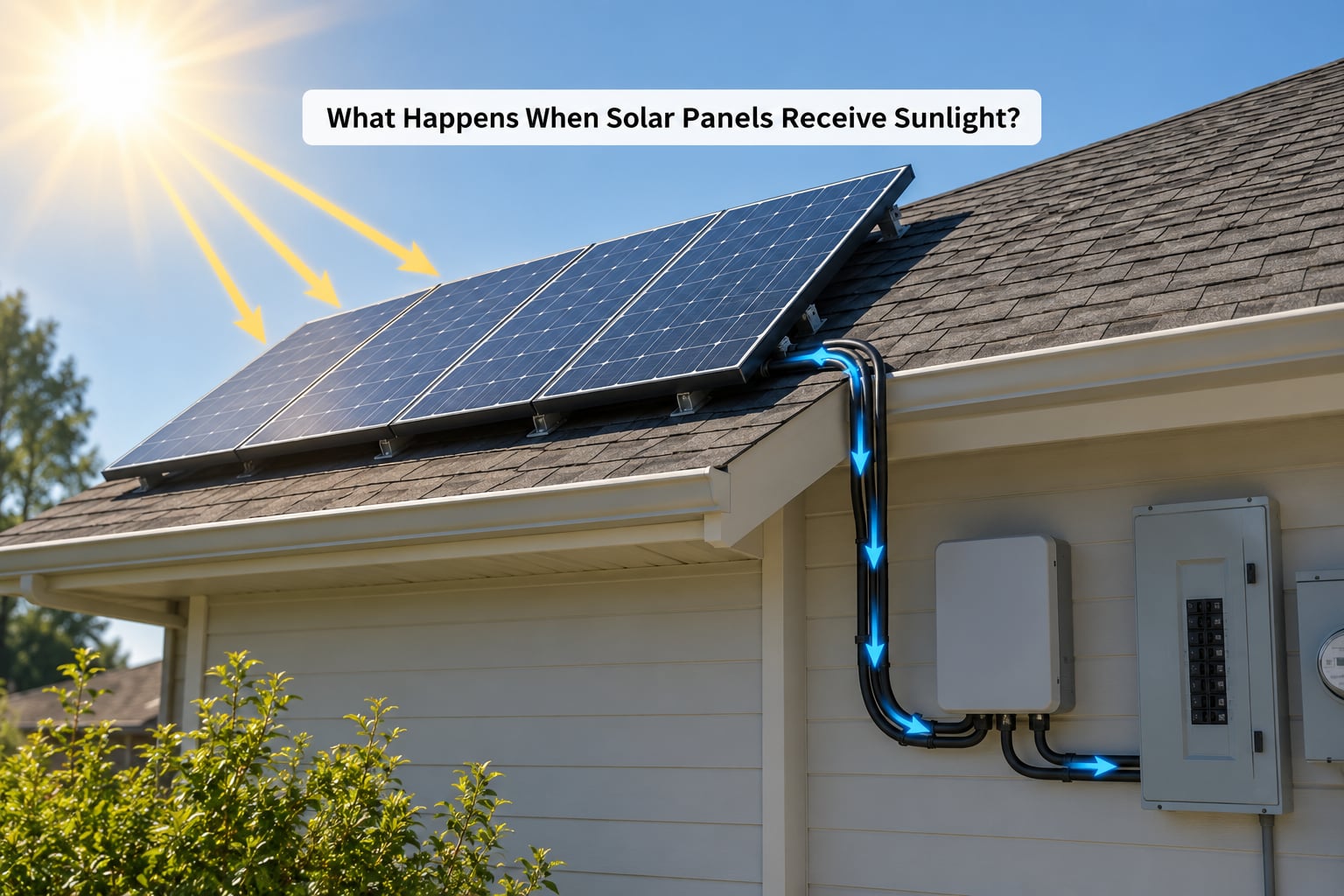
Inside every solar cell sits a thin semiconductor layer, usually silicon, formed into two layers with different electrical properties. When a photon of sunlight hits it with enough energy, it knocks an electron loose from an atom.
The junction between the two layers has a built-in electric field pointing one way, and that field pushes the freed electrons in a single direction. That one-way push is the photovoltaic effect, and it produces direct current, where electrons flow one way and stay that way.
Output is not fixed. Sun angle matters, because a panel sitting at an angle to the sun catches fewer photons per square meter than one facing it squarely. Temperature matters too, and this is the part that surprises people: a panel actually produces less in hot weather. Cell temperature above roughly 25 degrees Celsius drags performance down a little for every extra degree.
Shade is the biggest factor of all, and it does not average out. A tree, a chimney or a vent casting a shadow across part of a panel cuts production far more than the shaded area alone would suggest, which is why a single bypass diode that routes current around a shaded section of a panel exists at all.
How Electricity Flows from Panels to Outlets
Here is the short version. Panels make DC. Wiring collects it into an array. An inverter turns it into AC at the same frequency the grid uses. A disconnect and the service panel take that AC and distribute it to branch circuits. Each branch circuit has its own breaker, and each breaker feeds specific outlets. The appliance plugged into that outlet is the destination.
Nothing in that chain decides which source a given electron came from. Electricity inside your walls is electricity. The meter and the monitoring software work out the arithmetic afterward by comparing what the system produced against what the home consumed.
| Component | What it does | AC or DC | Where it sits |
|---|---|---|---|
| Solar cell | Converts photons into electron flow | DC | Inside the panel laminate |
| String | Panels wired in series to raise voltage | DC | On the roof, under conduit |
| Array | Strings combined for total output | DC | Roof and roof-to-wall run |
| Combiner box | Gathers several strings into one circuit | DC | Roof or exterior wall |
| Inverter | Converts DC to grid-frequency AC | DC in, AC out | Garage, exterior wall, attic |
| AC disconnect | Visible, lockable way to cut solar AC | AC | Beside the service panel |
| Service panel | Busbar distributes power to circuits | AC | Exterior or utility room wall |
| Branch breaker | Protects one circuit and feeds its outlets | AC | In the service panel |
| Wall outlet | Delivers power to a plug | AC | Kitchen, laundry, workshop |
| Net meter | Records import and export in both directions | AC | At the utility point of common coupling |
| Battery | Stores DC, discharges as AC through the inverter | DC storage | Garage, exterior wall, utility room |
The Seven-Step Path From Sunlight to Socket
- Photons hit the cells. Light strikes the semiconductor layer and frees electrons.
- An electric field pushes those electrons one way. That is the DC current leaving each cell.
- Panels are wired in series into strings. Voltage adds up. Strings are combined in parallel into a full array.
- The array feeds the inverter. One high-voltage DC circuit enters the inverter on the DC side.
- The inverter makes AC. It synthesizes a sine wave at 60 Hz in phase with the grid, then sends it out to the AC disconnect and the service panel.
- The busbar splits it into branch circuits. Each circuit has its own breaker, sized for the wire and the loads.
- The outlet delivers it to the appliance. The plug completes the circuit, current flows, and the device runs.
That is how electricity flows from panels to outlets in any grid-tied home, whether the array is eight panels on a garage or forty on a warehouse roof.
What Does the Solar Inverter Do?
The inverter exists because of a mismatch that cannot be engineered away. Solar cells produce low-voltage direct current. Wall outlets in North America run 120 or 240 volts of alternating current, and the grid itself is held at 60 Hz. DC will not do what AC does in a motor or a transformer, so the inverter sits in the middle and does the translating.
Beyond the voltage translation, the inverter does three jobs that matter. It synchronizes its output to the grid frequency and phase, so it is pushing current in step with the utility rather than against it. It monitors the system for faults and shuts down on abnormal conditions. And it produces a usable waveform, either a clean sine wave or a modified square wave in cheaper units.
There are three common arrangements. A string inverter sits at the end of the whole array and handles every panel at once, which is efficient and inexpensive but means one shaded panel can drag on the entire string. A microinverter mounts behind each individual panel, so each one converts its own DC and shaded panels stop mattering to their neighbors, at the cost of one box per panel.
A hybrid inverter is a string inverter that also manages a battery and, in some models, a backup panel for essential circuits. Electricians on forums often describe the whole device in a simpler way, calling it a current pump that pushes current into the switchboard at grid frequency. That analogy holds up, and it is a good one to keep.
How Does a Grid-Tied Solar System Send Power to the House?
Here is the part that clears up most people’s confusion. A grid-tied system does not switch between solar and utility power. Solar and the grid are connected in parallel at the service panel, feeding the same busbar at the same 60 Hz, in phase. There is no controller anywhere deciding who wins.
What actually happens is a continuous, physical balancing. Your appliances draw current continuously and only as much as they need. If the solar system is making 4 kW and the house is using 1.5 kW, roughly 1.5 kW flows into the home’s circuits and the remaining 2.5 kW has nowhere inside the house to go, so it flows back through the service panel, through the utility meter, and into the distribution network. The grid does not have to accept it. Grid-tied systems simply cannot send power into a dead circuit, and that is a safety feature, not a limitation.
When a cloud crosses the sun and output drops from 4 kW to 600 W while the house is still pulling 1.5 kW, the grid supplies the difference within milliseconds. Nobody switches anything. A r/solarenergy poster who described the wiring correctly but could not work out how the system handles fluctuating output without a battery gets the same answer: it does not need to know. The panel and the grid are the same circuit.
That is also why a grid-tied system with no battery does not fail on a cloudy day. Output falls, the grid makes up the gap, and the difference shows up on your bill rather than as an outage.
How Does Solar Power Flow With a Battery?
A battery changes when power is used, not where it travels. The path stays identical: panels to inverter to service panel to outlets. What changes is the choice of destination for the AC coming out of the inverter.
Normally a hybrid inverter sends surplus AC to one of three places, in roughly this order of priority: serve the house first, charge the battery second, export whatever is left to the grid third. Many modern inverters let you change that order, which is how a time-of-use tariff gets arbitraged: charge the battery at the cheap off-peak rate, then run the house from stored energy during the expensive peak hours.
At night the flow reverses in one specific place. With no sunlight, the panels produce nothing, so the battery discharges DC into the inverter, the inverter converts it to AC, and that AC flows out through the service panel to the same branch circuits and the same outlets as before. The plugs do not know the difference.
What a battery does not do is make a home off-grid. Without backup panels, a hybrid inverter still has no local grid to form when the utility drops out, so it shuts down at the same moment a plain grid-tied inverter would. A battery moves energy through time. Backup capability is a separate feature that requires its own transfer mechanism and its own panel of essential circuits.
What Is the Difference Between AC and DC Solar Electricity?
Direct current flows one way and never reverses. Alternating current reverses direction many times per second, sixty times a second on a North American grid, which is why it can be stepped up and down by transformers and why it can drive an induction motor at all.
Solar panels, batteries and most electronics internally run on DC. Your refrigerator, your washer and your laptop charger all run on AC, which is why every home system includes an inverter, and why almost every device with a wall plug has a small power brick that converts AC back down to low-voltage DC inside the cable.
Electrons themselves move far slower than most people assume. In a lamp filament they drift at a fraction of a millimeter per second. What travels down the wire at a substantial fraction of the speed of light is the energy, the changing electromagnetic field that pushes them along. This is a useful thing to keep in mind when you imagine electricity racing from the roof to the kitchen.
Monitoring apps use the terms constantly. Production, consumption, export and import are all measured in kWh, and grid and battery readings are AC while array readings are DC.
How Much Solar Power Can Reach Household Outlets?
The number that matters is not the panel’s nameplate rating but the inverter’s AC output, and the number that matters at a given outlet is what that circuit’s loads are drawing at that moment. Generation and available power are two different things.
Take a typical clear-sky afternoon. The array is 6 kW, the inverter is rated 5 kW, and the home is pulling 1.5 kW. The inverter is producing 4 kW AC. Of that, 1.5 kW is consumed inside the house, roughly split across the 120V kitchen and laundry circuits and a 240V clothes dryer running at 3 kW, and the other 2.5 kW goes out through the net meter as export or into the battery.
Now the same system at 7 pm. Production is zero, the house still draws about 1.5 kW, and the grid supplies all of it. The outlets feel no difference in either case, because the same branch breaker and the same receptacle are supplying the load.
To estimate daily production, multiply array watts by peak sun hours and a system factor. A 6 kW array with four peak sun hours and a 0.80 factor gives 6 × 4 × 0.80 = 19.2 kWh for a day. Peak sun hours are the standard-test-condition figure for your location, and the factor covers inverter losses, wiring, temperature and dust. Production estimates on any reputable site will sit in the same ballpark, and a cold sunny day will beat it.
What Happens During an Outage?
On an ordinary grid-tied system, the panels stop the moment the grid stops, even at noon in full sun. This is called anti-islanding protection, and it exists because a live solar array feeding energised lines with no one to balance them can electrocute line workers and start fires. The inverter detects the missing grid reference and disconnects itself in well under a second.
There are four reasons panels alone cannot run a house during an outage. The inverter needs the grid’s frequency and phase reference to know what to produce. Its anti-islanding relay is designed to open. There is no local grid forming, so the voltage and frequency have nothing to synchronise to. And there is simply no energy stored anywhere, because panels make power rather than keep it.
A system that does keep running needs deliberate hardware: a hybrid inverter with a backup output, a separate breaker panel for the circuits you want to save, and a transfer device that opens the grid connection before forming a local one. The fridge and internet router might be on that list. The electric range and the whole-house air handler probably are not.
Do not attempt to wire or modify any of this yourself. Panel and service equipment work on lethal voltages even after the main breaker is off, and grid-tied interconnection is controlled by the utility and by the local electrical code. Use a licensed installer and a licensed electrician for every change to the panel, the meter, the disconnects or the battery.
Which Parts Control Power Flow and Safety?
Between the inverter and your first outlet sit several devices whose only job is to make the flow predictable and safe.
The AC disconnect is the visible handle beside the service panel. Line voltage from the inverter arrives here first, and opening it stops solar AC dead. It may sit on the same wall as the panel or a few feet away, depending on the design and the local code.
The service panel is where solar AC and utility AC meet on the busbar. The main breaker is the house-side disconnect. Individual branch breakers feed each circuit, which is why flipping the breaker for the kitchen counter outlets kills power there and nowhere else.
Rapid shutdown hardware on the roof limits how much voltage is present in panel wiring so firefighters are not working around live DC on a ladder. Grounding and bonding give faults a safe path to earth. And anti-backfeed protection is the part that answers the question people ask most often: can solar push power back into a wall socket?
No. On a grid-tied system, a backfed breaker is physically prohibited from being installed in the normal manner, and a permit and utility interconnection are required. A grid-sensing microinverter in a plug-in or balcony system behaves the same way: it refuses to produce anything the moment it loses grid reference. That is why a plug-in array certified to UL 3700, the safety standard for that equipment, cannot energize a dead circuit or backfeed the receptacle it is plugged into.
The bidirectional net meter records import and export separately, and most utilities credit exported energy back on the bill, commonly with credit that carries forward across a twelve-month settlement period. Terms vary by state and utility, so check your specific tariff.
How Can You Verify That Solar Electricity Is Reaching Your Outlets?
There are several non-invasive ways to watch the flow, and none of them require you to touch anything.
Start with the inverter display or app. It will show current production in watts or kilowatts, today’s and this month’s total in kWh, and whether the system is currently grid-connected. This is the closest thing to a real-time picture of the flow described above.
The utility meter is the second source. A modern bidirectional meter shows consumption and generation in separate registers, and the spinning direction tells you the net flow at a glance. Older meters that spin one way only simply treat export as a credit, and some utilities swap the meter at interconnection.
Then look at the service panel labels. Every branch breaker should be legibly identified. If a breaker is marked solar, you have found the circuit the system is feeding before it reaches the panel busbar.
Clamp-style monitors or plug-in energy monitors on individual appliances give you the draw at one outlet, which is a useful cross-check when the total and the device readings disagree.
One caution about all of this: solar production numbers are usually metered on the DC side before conversion losses, so AC delivered to the house runs a few percent lower than the array’s stated output. A gap of 3 to 5 percent is normal, not a fault.
Frequently Asked Questions
How does electricity get to an outlet?
Power arrives at your service panel on the busbar, either from the utility meter or from solar AC coming through the AC disconnect. The panel splits that AC across branch circuits, each protected by its own breaker. A circuit breaker feeds a run of wiring to a wall outlet, and current flows only when a plug completes the circuit. The breaker does not know or care where the electricity came from.
How do solar panels that plug into outlets work?
Plug-in and balcony solar kits pair small panels with a grid-sensing microinverter that plugs into a standard 120V outdoor outlet. The panels make DC, the microinverter converts it to AC, and your appliances use it. The inverter shuts down instantly if grid power disappears, so it cannot energize a dead circuit. Safety is governed by UL 3700 certification, and many states cap this type of system at 1,200 W.
Do solar panels and the grid fight each other?
No, because the connection is parallel rather than switched. The solar inverter and the utility feed the same service panel busbar at the same 60 Hz and in phase, so current balances itself physically. Appliances take what they draw from the combined supply, and any difference moves through the meter in whichever direction is needed, within milliseconds.
Do outlets pull electricity when nothing is plugged in?
An empty outlet draws essentially nothing, because the circuit is open until a plug bridges the contacts. What does draw current is standby load from devices that remain plugged in, which is why a television left connected still registers on an energy monitor, and why a charger with nothing attached draws a few milliwatts. On a solar home, those small loads are supplied first from whatever production is available.
Why is my electric bill high even though I have solar?
Most often the bill reflects time-of-use rates, so heavy evening use lands in expensive peak hours when panels are producing little or nothing. A battery sized to shift that usage is the usual fix. Other causes include non-solar charges such as delivery fees, a rate plan that credits export at a lower value, standby and phantom loads, and production that fell short of your estimate because of shade, orientation or a dull summer.
Do solar panels work when the power goes out?
A standard grid-tied system stops, even in full sunlight, because anti-islanding protection opens the connection when grid reference disappears. That is a safety requirement, not a fault. To keep power on, you need a hybrid inverter with a backup output, a separate essential-circuits panel, and a transfer device that forms a local grid. Panels generate power rather than storing it, so no panel alone can run a house.
Conclusion
Sunlight becomes direct current in the cells, the array gathers it, the inverter converts it to grid-frequency alternating current, and the service panel divides it among branch circuits until it reaches the outlet you were asking about. The grid and a battery join the same panel in parallel rather than in place of it.
Before you inspect any equipment, work out which system you actually have. A grid-tied system, a grid-tied system with a battery, and an off-grid system behave very differently at night and during an outage, and only the last two can keep your lights on when the utility goes away. If anything needs changing, that work belongs with a licensed installer and a licensed electrician.