Window film lowers cooling costs by intercepting the sun’s heat at the glass. A solar-control film reflects part of the infrared energy back outside and absorbs the rest in a microscopically thin layer, so less radiant heat ever reaches the room. The glass stays cooler, the air conditioner’s compressor cycles on less often, and you run it for fewer hours.
That is the whole mechanism. The rest of this guide is about which windows it works on, how much you should expect to save, and where film disappoints people. Plenty of installers quote a flat “up to 30 percent” number, and that framing is why so many homeowners end up skeptical.
Table of Contents
- How Window Film Reduces Cooling Costs
- The causal chain, step by step
- Why film does something blinds cannot
- The three ways heat enters a room
- What Is Solar-Control Window Film?
- Which Type of Window Film Works Best?
- How Much Can Window Film Lower Cooling Bills?
- A worked example
- What actually moves the number
- How to measure your own savings
- When window film will not lower your bill much
- How to Choose the Right Film for Your Home
- How Is Window Film Installed?
- Common Window Film Mistakes
- How Window Film Compares with Other Cooling Solutions
- Frequently Asked Questions
- Does window tint lower the electric bill?
- What are the downsides of using window film?
- Is it worth putting film on windows?
- What to use instead of window film?
- How much heat does window film actually block?
- Does window film work on double-pane or Low-E coated windows?
- What to Do First
How Window Film Reduces Cooling Costs
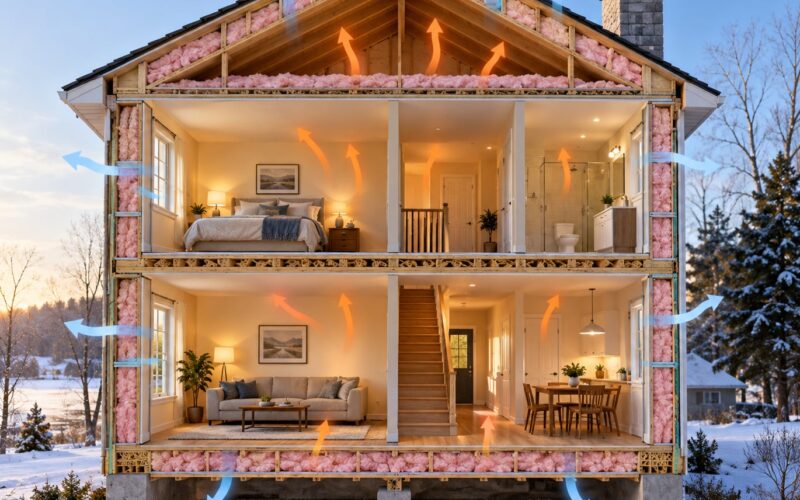
The sun delivers energy to a window in two very different ways, and only one of them responds to film. Radiation crosses the glass as electromagnetic energy. Conduction moves heat through the glass itself as the pane warms. Convection then carries that warmed air into the room.
Solar-control film attacks the radiation term only. It is a polyester laminate a few thousandths of an inch thick with microscopic layers of metal oxide or dye added to the face. Those layers sit between the sun and the glass and do the intercepting, so the glass temperature drops and everything downstream of it drops with it.
The causal chain, step by step
1. Radiation is intercepted. Infrared energy that would have passed through the glass is reflected outward or held in the film instead.
2. The glass stays cooler. Hold a hand on an untreated west-facing pane in July versus a filmed one, and the temperature difference is obvious.
3. The air against the glass stays cooler. That air is the air the system is already trying to cool.
4. The compressor runs fewer hours. Cooling load maps to run time fairly directly, which is where the money is.
5. Peak demand drops. Summer afternoon peaks are billed at the highest rates, and a load that never reaches those peaks is worth more than the same kilowatt-hours saved at 9 p.m.
Why film does something blinds cannot
Blinds and curtains block visible light, which is a tiny slice of the sun’s energy. Most of what makes a room hot is infrared and near-infrared radiation that passes straight through glass and through most fabrics. That is the exact band solar-control film is engineered to reject, which is why a room with closed blinds can still be uncomfortably hot.
The three ways heat enters a room
Radiation through the glass is the biggest term in a typical home, and it is the one film changes. Conduction through single-pane glass is significant in hot climates, and film does essentially nothing for it because the pane still conducts. Air leakage around frames and sash is a third path that film never touches at all.
So when someone says a room stayed hot despite film, the explanation is usually conduction or leakage rather than a bad film.
What Is Solar-Control Window Film?
Window film is a thin, optically clear laminate applied to glass that reflects and absorbs part of the sun’s infrared energy before that energy becomes indoor heat. That is the energy-saving category. Decorative film and privacy film are separate products: they tint the glass for looks or for visibility control, and many of them block a disappointing share of infrared energy because they are dyed for darkness rather than engineered for heat.
Four numbers on a spec sheet tell you what you are buying.
Solar heat gain coefficient, or SHGC. The fraction of solar energy the glass-plus-film assembly admits, expressed as a decimal. Clear single-pane glass runs around 0.85. Clear double-pane runs roughly 0.75. A good solar film applied to either one can pull that down into the 0.20 to 0.30 range. Lower is better.
Visible light transmission. How much of the view stays visible, also on a decimal. This is where film trades against your eyes. A film that blocks 78 percent of solar energy but only passes 25 percent of visible light turns a living room into a cave.
Infrared and ultraviolet rejection. UV blocking near 99 percent is common and inexpensive. IR rejection above roughly 80 percent is where the real heat work happens.
Reflectance. How much energy bounces back out. High reflectance is why metallized films work so well and also why they look like mirrors at night.
The National Fenestration Rating Council is the body behind the SHGC label, so those numbers are comparable across manufacturers rather than marketing claims. Most films also carry an NFRC or equivalent energy label you can ask a dealer for.
Which Type of Window Film Works Best?
There is no single best film, because the right answer depends on whether you care more about heat rejection, how the room looks, or what happens in January. Here is how the main families compare.
| Film type | Heat rejection | Appearance | Best fit |
|---|---|---|---|
| Reflective / metallized | High, typically 75 to 80 percent solar rejection | Mirror-like in daylight, opaque from outside at night | Southwest rooms where heat is the only concern |
| Dyed solar control | Moderate, roughly 40 to 60 percent | Coloured tint, dark at night | Budget installs on secondary rooms |
| Ceramic / nano-ceramic | High, comparable to metallized | Neutral, keeps the view, no mirror effect | Rooms where you need daylight and a view |
| Spectrally selective | Very high for the visible band it targets | Clear to slightly warm | Glare-heavy offices and screen-facing rooms |
| Low-E insulating film | Low for summer radiation, high for winter retention | Clear | Cold climates where heat loss matters more |
| Dual / climate-control film | High solar rejection plus a low-emissivity layer | Neutral | Homes with hot summers and cold winters |
Names attach to specific lines rather than categories: 3M, Llumar, V-Kool and Eastman Solar Gard all make films in most of these families. Compare the SHGC and visible light transmission, not the brand.
For most homeowners with an air conditioning problem, ceramic or spectrally selective is the safest buy. It rejects heat at close to reflective-film levels while leaving the view intact. Reflective film wins on raw dollars per square foot but costs you the view and can make a room dark by mid-afternoon, which is a real problem if you end up running lights.
For a rental or a single troublesome window, adhesive-backed film is removable. For a permanent retrofit on an old house, mechanically anchored film is heavier but shrugs off heat-related peeling.
How Much Can Window Film Lower Cooling Bills?
Here are the honest ranges, each with the conditions that produce it. Total building energy typically falls 5 to 15 percent when film goes on the sun-exposed glazing of a commercial building. Summer cooling cost reductions commonly reach up to about 30 percent in well-fitted applications. Annual energy costs are quoted anywhere from 15 to 30 percent, and treat that as an upper marketing figure rather than a planning number.
Every one of those numbers assumes direct sun exposure and air conditioning that is already oversized for the load.
A worked example
Take a 1,500 square foot home with about 1,200 dollars a month peak summer bill and ten windows averaging an SHGC of 0.75. High-performance solar film drops the effective SHGC to roughly 0.25, cutting solar heat gain through those windows by about two-thirds. If cooling is 40 percent of that bill and the load falls by 20 to 30 percent, you are looking at roughly 96 to 144 dollars a month during the summer months. Against a professional film installation of about 1,200 dollars, that is a payback somewhere around a year, and faster in a hotter climate with a higher cooling share.
Those are modelled figures, not a guarantee. Your result depends on the four variables below.
| Window orientation | Solar exposure | Relative savings from film |
|---|---|---|
| West | Direct afternoon sun, highest peak load | Highest |
| South | Steady mid-day sun through summer | High |
| East | Morning only, usually cooled later | Moderate |
| North | Little or no direct sun | Low |
What actually moves the number
Climate matters most. A film in Phoenix or Houston behaves nothing like the same film in Seattle. Window area matters: film on 20 percent of your glazing moves the total bill a little, film on a glass-walled sunroom moves it a lot. Glass type matters more than most people expect. If your windows already carry a decent Low-E coating, the baseline SHGC is already low and film has less left to remove.
Electricity rates matter too. On a flat per-kilowatt-hour rate, you save the rate times the kilowatt-hours you avoid. On a rate with demand charges, avoiding a summer afternoon peak is worth several times that.
Finally, how much of your bill is cooling at all. If your summer bill is mostly water heating and equipment, film cannot touch it.
How to measure your own savings
You do not need an energy auditor to get a defensible answer.
1. Record your meter reading on the same day of the month for a full cooling season before and after. Same day, same conditions, same habits.
2. Log thermostat runtime. Most thermostats keep a run-time history in their settings menu, and newer smart units report hours of compressor run directly in their app.
3. Use an infrared thermometer on the glass. Point it at the pane at the same hour on a sunny day, before and after. A drop of 8 to 15 degrees Fahrenheit on a west-facing window is typical and tells you the film is doing its job.
4. Ask your utility for a free bill analysis or energy audit. Some also run an online calculator that splits your usage by end use.
When window film will not lower your bill much
Film does little or nothing when the room has little direct sun, when the windows are already high-performance Low-E, when the real problem is a leaky duct or an undersized return, or when the glass area is small relative to the rest of the envelope. It also underperforms badly if the film is cheap dyed material chosen for darkness rather than heat rejection.
The U.S. Department of Energy treats window film as a retrofit that reduces solar heat gain at the glass. It does not treat it as a substitute for a sealed thermal envelope, and neither should you.
How to Choose the Right Film for Your Home
Start by listing which windows actually get sun and when. Note the hour, not just the direction. A west-facing bedroom that peaks at 4 p.m. is a different project from a south-facing living room that is shaded by trees after 3 p.m.
Then decide how much light you are willing to give up. Glare on a monitor or a television argues for spectrally selective film that keeps visible light high. A sunroom where nobody works argues for the cheapest reflective film that will do the job.
Next, check the spec sheet for three numbers and ignore everything else: SHGC, visible light transmission, and total solar energy rejection. Ask for the NFRC label. If a seller cannot produce one, that tells you something.
Consider the climate. In a cooling-dominated climate, prioritize solar rejection. In a heating-dominated climate, a Low-E or dual-climate film keeps heat in during winter, and dual-layer film is the honest answer when you need both rather than two single-purpose films competing on the same pane.
Then match the film to the glass. Textured, patterned or already-tinted glass needs a film rated for it. Laminated Low-E panes need an adhesive that will not cause seal failure, and that is a conversation for an installer, not a roll of film from a hardware store.
Finally, be honest about renter constraints. Get landlord permission in writing, because film on an interior surface is normally removable without damaging the glass, while a film that cures to a hard adhesive is a different proposition.
How Is Window Film Installed?
Interior adhesive film is a genuine do-it-yourself job on a small, square, single-pane window. Larger or fancier shapes are a different story.
1. Measure and cut with an extra 6 to 12 mm all round. Film is trimmed after it sets, so cutting undersize is the one mistake you cannot undo.
2. Wash the glass twice. A dust-free window is the entire job. Use ammonia-free cleaner, and dry with a lint-free cloth.
3. Prepare the glass and frame. Mask the sash with tape and scrape any old adhesive or paint flecks off with a plastic blade.
4. Soak the film in warm water. The water gives you ten or fifteen minutes of working time instead of about thirty seconds.
5. Peel a small corner and float it on. Work from the top down, keeping the strip of liner between the film and the glass until you are confident in your alignment.
6. Squeeze, do not scrub. A hard plastic squeegee at roughly 45 degrees pushes water and bubbles out toward the edge.
7. Trim after it dries. Leave the film 8 to 14 days before cutting the edges flush. Cutting early pulls the edge and creates the peel you see on failed installs.
8. Let it cure. Full cure takes up to a few weeks in warm weather. Cloudiness during that period is normal and clears up.
Get a professional for skylights, curved or divided-light glass, panels larger than a door, exterior-mounted film, any pane that already has a Low-E coating, or commercial work. Most manufacturers tie their warranty to professional installation, so a do-it-yourself job usually means no warranty on the film at all.
Common Window Film Mistakes
Residue from poor preparation. Nearly every peel, bubble and failed film traces back to a window that was not properly washed. Two passes, clean cloth, no shortcuts.
Wrong cut size. Film that overhangs the frame edge catches air and peels. Cut slightly undersize relative to the visible glass, and trim flush only after it cures.
Trapped bubbles and creases. Bubbles are normal on day one and disappear. Creases from dragging film sideways while sticking are not, and there is no fixing a crease.
Film on dirty or textured glass. Textured, rolled or antique glass traps air in its surface. The result looks permanently foggy no matter how carefully you squeegee.
Choosing darkness over heat rejection. This is the expensive mistake. A very dark decorative film can block 30 percent of solar energy while a neutral film of similar price blocks 80. Read the SHGC, not the sample on the shelf.
Treating every window the same. A west pane and a north pane do not need the same film, and using one product everywhere wastes money where it does nothing and starves the windows where it matters.
Expecting a magic fix. If the ductwork leaks, film cannot rescue the room. A do-it-yourself energy audit costs nothing and tells you which lever to pull.
How Window Film Compares with Other Cooling Solutions
Film is one cooling lever among several, and it is rarely the best first move. The table below is roughly how each option compares.
| Option | Relative cost | Heat reduction | Disruption | Best when |
|---|---|---|---|---|
| Window film | Low per room | Moderate to high on sun-exposed glass | Hours, removable | Renters, single hot rooms, quick payback |
| Thermal blackout curtains | Very low | Moderate, closes gaps | Minutes | Renters, bedrooms, quick fixes |
| Solar-control blinds | Low to moderate | Moderate | Hours | Glare plus heat, style-sensitive rooms |
| Exterior awnings or shades | Moderate to high | Very high | Exterior work | Ground floor, restaurants, patios |
| Exterior solar shades with motors | High | Very high | Professional install, wiring | Large west-facing glass |
| Low-E replacement windows | Highest | High plus reduced conduction | Days, mess, draft during swap | Failing windows, whole-home renovation |
| HVAC upgrade or duct sealing | High | Improves efficiency, not heat gain | Professional work | System is oversized, undersized or leaky |
Two points worth keeping in mind. First, film beats blinds at radiation but loses badly at glare and at cutting outside light at night, so the two are often combined. Second, Low-E replacement windows address conduction as well as radiation, which film never does, so they are the right answer when your existing windows are single-pane, cracked, or leaking around the sash.
One more honest caveat: highly reflective film on a window with integrated solar panels or a solar control screen can reduce the panel’s output by bouncing light back out. Anyone with home solar panels should use a spectrally selective or ceramic film rather than a mirror finish, and should check with their installer first.
ENERGY STAR, the U.S. Department of Energy and Angie’s List all frame film as a low-cost retrofit that improves an existing window rather than replacing it. That framing holds up. The right time to buy windows is when they are failing, not because film is getting expensive.
Frequently Asked Questions
Does window tint lower the electric bill?
Yes, usually, and the mechanism is mechanical rather than magic. Solar-control film rejects infrared energy before it becomes indoor heat, the glass stays cooler, and your air conditioner runs fewer hours. Installer-reported reductions run 5 to 15 percent of total building energy, with summer cooling cost reductions reaching up to about 30 percent in well-fitted jobs. Expect less if your windows are already Low-E, your climate is mild, or cooling is a small share of your bill.
What are the downsides of using window film?
Film only reduces the radiative share of heat gain. Conduction through single-pane glass and air leakage around frames are untouched, so a leaky room stays leaky. Reflective films cut visible light and can make rooms darker and cooler in tone, sometimes forcing lights on. Cheap dyed film blocks far less heat than its packaging implies. Do-it-yourself installs carry no manufacturer warranty, adhesive films can leave residue on removal, and mirror-finish films slightly reduce home solar panel output.
Is it worth putting film on windows?
It is worth it when a room takes direct sun, the glass is clear single or double pane, and cooling is a large share of your bill. Payback is commonly one to three years in that situation, and faster in hot climates with big west-facing glass. It is much less worth it on north-facing windows in a mild climate, or on windows that already have a decent Low-E coating, where there is little solar heat left to reject.
What to use instead of window film?
Thermal blackout curtains are the cheapest renter-friendly option and genuinely help when a room overheats. Solar-control blinds add glare control while cutting some heat. Exterior awnings and exterior solar shades cut more heat than any interior option but cost more and need outside access. Low-E replacement windows are the only choice that also reduces conduction. If your ductwork leaks or your system is badly sized, fix that first, because no film on earth will compensate for it.
How much heat does window film actually block?
It depends on the product, and the packaging will not tell you honestly. Reflective and ceramic films typically reject 75 to 80 percent of total solar energy. Dyed solar-control film often manages only 40 to 60 percent. The number that matters is the solar heat gain coefficient: clear single-pane glass sits near 0.85, clear double-pane near 0.75, and a good film applied to either can bring the assembly down to roughly 0.20 to 0.30.
Does window film work on double-pane or Low-E coated windows?
Solar-control film applies to double-pane windows routinely and works on Low-E units, but it changes the window’s optics. Any film adds heat absorption to the pane, so a low-emissivity coated surface can have more to absorb. Have an installer confirm the film and the glazing are compatible before applying anything to a sealed insulated glass unit, and never apply standard adhesive film to an exterior surface.
What to Do First
Write down which two windows actually make your house uncomfortable, note the hour the sun hits them, and check the SHGC label on any window paperwork you still have. If those windows are clear single or double pane and the sun lands directly on them, that is where film pays for itself fastest. If they already carry Low-E or the real problem is duct leakage, spend your effort there instead.
People on home improvement forums tend to land on the same conclusion from different directions: thermal curtains for a rental, a single professionally filmed west window for a house. Both are reasonable. Neither needs the marketing number to justify itself.