An IP rating is an Ingress Protection rating written under the IEC 60529 standard. It tells you how well a light’s housing keeps out solids such as dust and liquids such as water, using a two-digit code where the first digit rates solid protection and the second digit rates water protection. So IP65 means dust tight plus protected against water jets from any direction.
That is the short version of what does an IP rating mean for solar lights. It is a lab test number, not a marketing word. When IP65 is printed on a solar wall light, somebody put that enclosure through a dust chamber and a water jet test and it passed both.
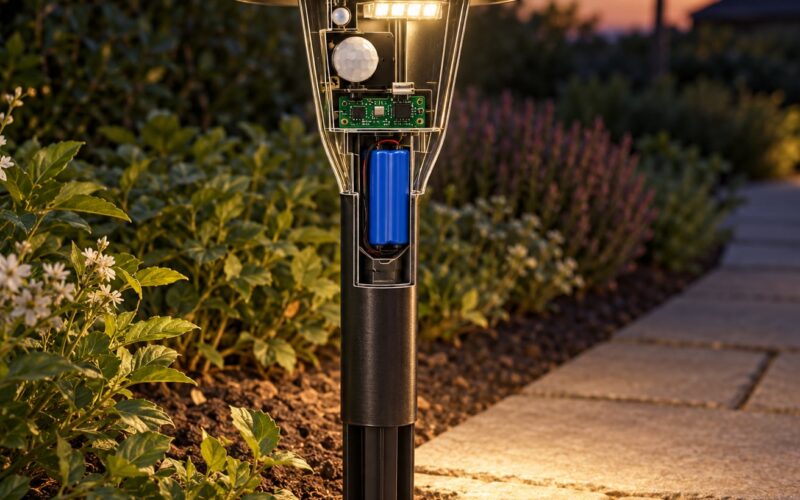
Solar lights make the rating matter more than it does for most household gear. Inside one small sealed box you have a battery, a charge controller, an LED board and a pair of charging contacts, and none of them enjoy being wet. Most are not designed to be opened, so water getting in usually ends the light rather than being a repair.
Table of Contents
- What Does an IP Rating Mean for Solar Lights?
- IP Ratings at a Glance
- How Do the Two IP Numbers Work?
- What the First Digit Means for Dust and Solids
- What the Second Digit Means for Water
- IP65 vs IP67 vs IP68 for Solar Lights: What Actually Changes
- Which IP Rating Is Best for Outdoor Solar Lights?
- What IP Rating Do Solar Garden Lights Usually Have?
- Is a Higher IP Rating Always Better?
- How to Check the IP Rating Before You Buy
- What an IP Rating Does Not Tell You
- IP Rating vs Waterproof: What the Label Really Means
- Why Solar Lights Die After Rain
- Frequently Asked Questions
- What does IP65 mean on a solar light?
- Is IP55 suitable for outdoor use?
- Which is better, IP67 or IP68 for a solar light?
- Will rain ruin my solar lights?
- Are you supposed to leave solar lights on all the time?
- Conclusion
What Does an IP Rating Mean for Solar Lights?
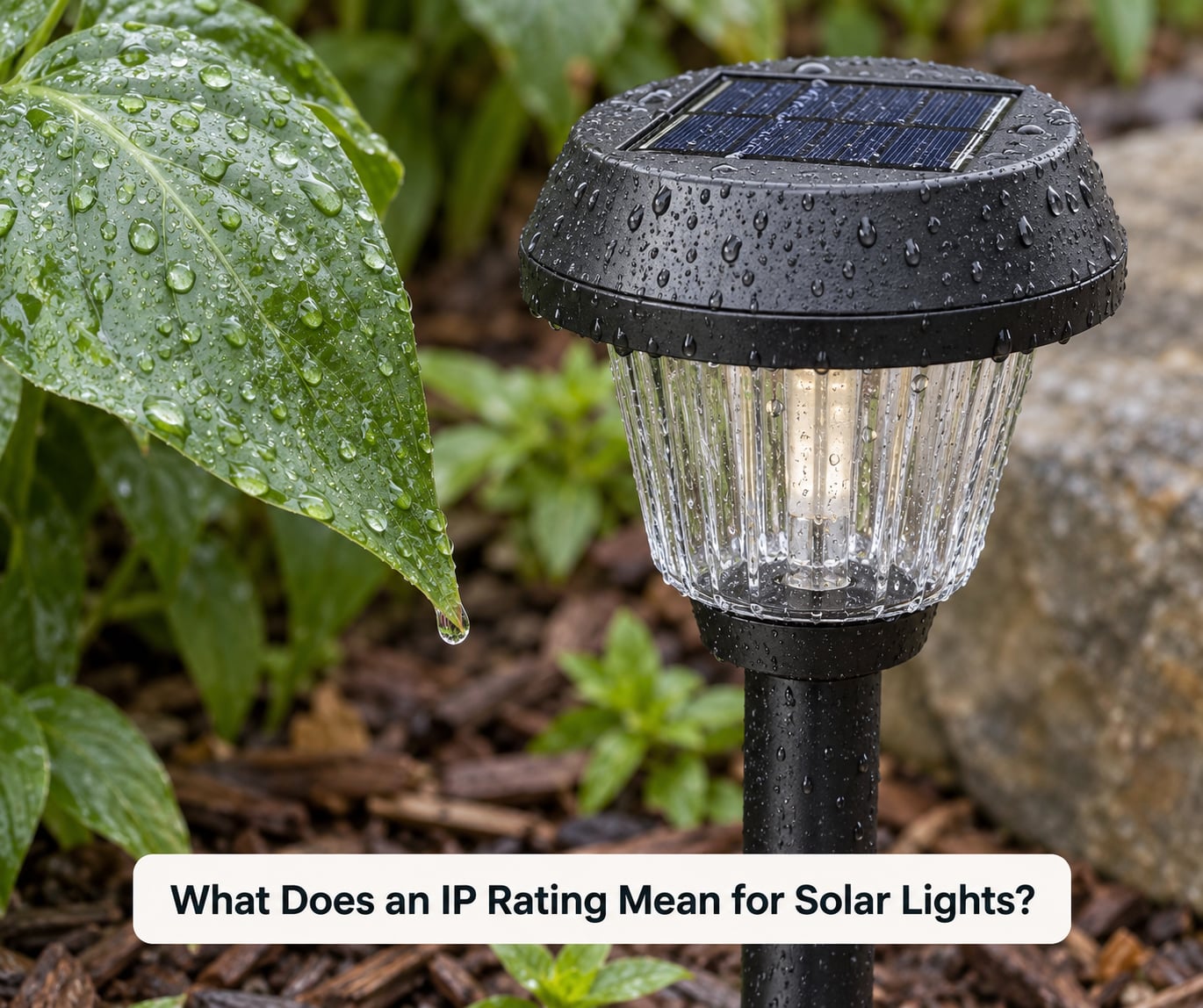
The letters come from Ingress Protection. The number that follows them is not a grade of quality or a brightness figure or a warranty length. It is a two-part answer to two questions: how well does this enclosure keep out solid stuff, and how well does it keep out water?
One thing worth clearing up straight away is that the rating applies to the enclosure, tested in a lab, in a specific configuration. It is not a promise that the finished light in your garden will stay dry forever. Sealant ages, gaskets harden, and a housing that was clamped correctly in a factory can be screwed together wrong in a backyard.
IP Ratings at a Glance
| Rating | First digit: solids | Second digit: water | Plain English | Typical solar light use |
|---|---|---|---|---|
| IP20 | 2: fingers | 0: none | No water protection at all | Indoor lamps, covered plug-in fixtures only |
| IP44 | 4: objects over 1 mm | 4: splashing from any direction | Good against splashes, poor against driven rain | Budget path lights under a porch, eave or covered deck |
| IP54 | 5: dust protected | 4: splashing from any direction | Dust limiting plus splash protection | Sheltered wall lights and lamp posts |
| IP55 | 5: dust protected | 5: low-pressure water jets | Splash plus gentle hose spray | Under trees, out of direct rainfall |
| IP65 | 6: dust tight | 5: low-pressure water jets | Rain from any angle, dust proof | The sensible default for open outdoor solar lights |
| IP66 | 6: dust tight | 6: powerful water jets | Survives heavier, higher-pressure jets | Exposed sites, rooflines, some street lights |
| IP67 | 6: dust tight | 7: temporary immersion | Dust tight plus up to one metre for 30 minutes | Pond edges, fountains, flood-prone ground |
| IP68 | 6: dust tight | 8: continuous immersion | Manufacturer-defined depth for permanent submersion | Submersible pond lights, submerged spotlights |
The jump people get wrong most often is between IP44 and IP65. Both sound outdoorsy, but IP44 is a splash rating and IP65 is a rain rating. Put an IP44 light in an open bed next to a downpipe and it will be tested by the weather far harder than the rating was.
How Do the Two IP Numbers Work?
Each digit comes from a defined physical test in IEC 60529, which is why the code is not a matter of opinion. The first digit climbs as the enclosure gets better at keeping out solid objects. The second climbs as the enclosure gets better at keeping out water.
The two scales are independent. IP65 and IP55 both have a second digit of 5, so both survive the same jet test, but their dust protection differs by a whole level. Equally, IP64 and IP54 have the same first digit and very different water handling.
What the First Digit Means for Dust and Solids
| First digit | Meaning | What stops getting in |
|---|---|---|
| 0 | No protection | Nothing is blocked |
| 1 | Protected against large solids | A hand or a forearm |
| 2 | Protected against medium solids | Fingers, roughly 12.5 mm and up |
| 3 | Protected against small solids | Tools and wires, roughly 2.5 mm and up |
| 4 | Protected against very small solids | Anything over 1 mm |
| 5 | Dust protected | Dust enters in some circumstances but not enough to interfere |
| 6 | Dust tight | No dust at all, verified under negative pressure |
Most garden solar lights claim a 5 or a 6 here, and a 5 is usually fine. Soil splash dries out on the outside of a stake light anyway. The 6 matters more for lights mounted high, near a dusty road or under a tree that drops debris onto the panel.
What the Second Digit Means for Water
| Second digit | Meaning | Test conditions |
|---|---|---|
| 0 | No protection | No water test |
| 1 | Drips | Vertical drops from up to 15 cm |
| 2 | Drips, tilted | Drops at up to 15 degrees from vertical |
| 3 | Spray | Spray at up to 60 degrees from vertical |
| 4 | Splashing | Water splashed from any direction |
| 5 | Water jets | Low-pressure jets from any direction |
| 6 | Powerful water jets | Higher-pressure, heavier jets from any direction |
| 7 | Temporary immersion | Up to one metre deep for up to 30 minutes |
| 8 | Continuous immersion | Depth and duration set by the manufacturer |
There are supplementary letters you may see after the digits, such as W for a weather test or M and S for whether the enclosure was moving or stationary during the water test. They are rare on consumer solar lights, so do not wait for one.
IP65 vs IP67 vs IP68 for Solar Lights: What Actually Changes
| Rating | Water event it survives | Where it earns its rating |
|---|---|---|
| IP65 | Rain, sprinkler spray, a splash from a hose, at any angle | Path lights, deck lights, wall lights, fence posts, driveways |
| IP67 | Everything IP65 handles, plus being dropped under water briefly | Pond surrounds, fountains, low spots that flood, exposed garden features |
| IP68 | Permanent submersion at a manufacturer-stated depth | Lights designed to sit underwater in a pond or fountain all season |
A worked example makes the choice easy. A 10-lumen stake light along a path gets rained on from above and splashed from the side, so IP65 covers it completely. The same lamp sitting in a gravel bed gets hosed accidentally once a week, which is still IP65 territory. Move that lamp to the lip of a pond where waves wash over it every evening and you have moved into IP67 country, because the immersion test is what separates the two.
The practical difference between IP65 and IP67 is not about how bright the light is or how long the panel lasts. It is only about whether the housing survives being wet from outside versus wet from outside and inside at the same time.
Which IP Rating Is Best for Outdoor Solar Lights?
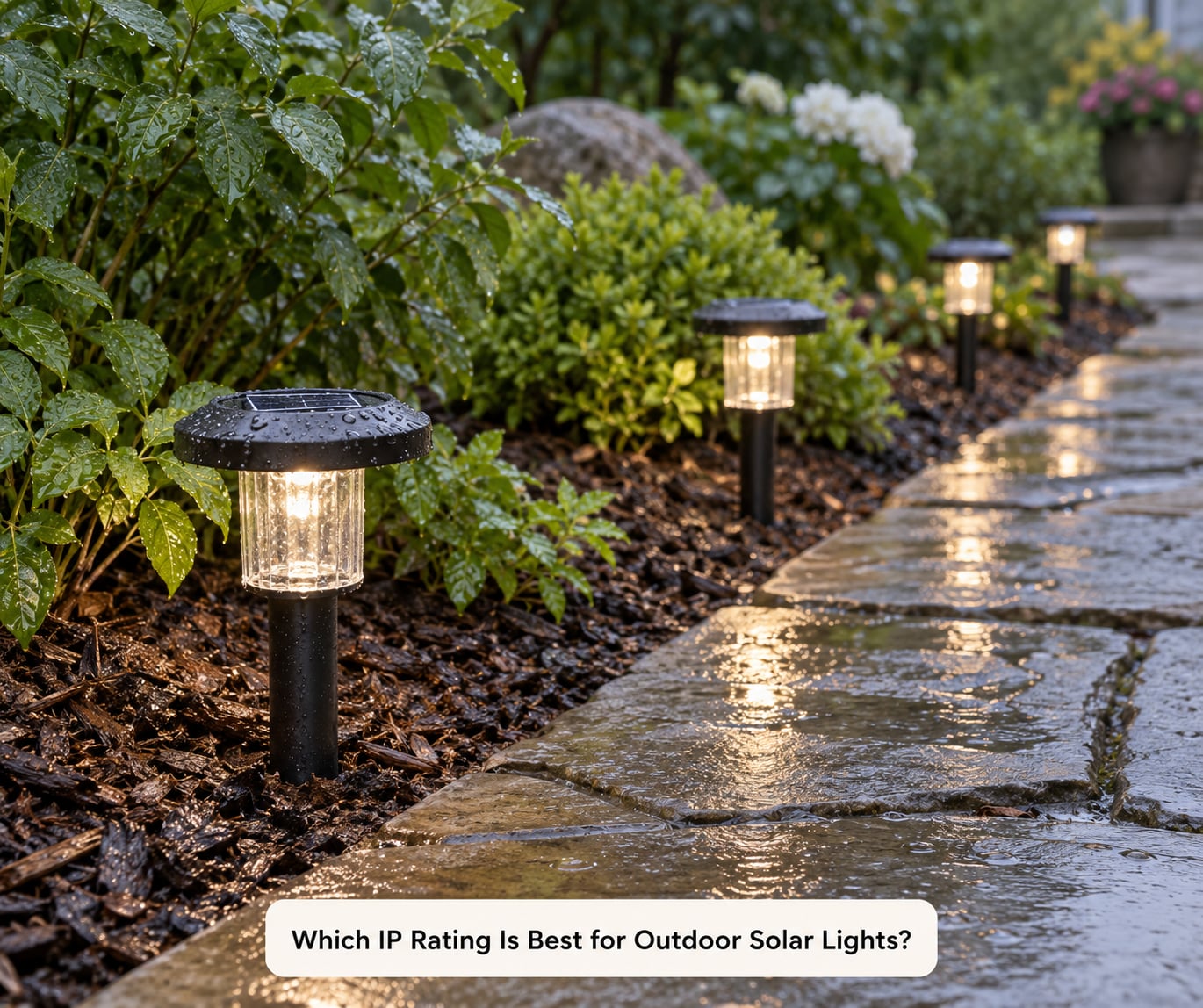
Match the rating to the exposure, not to the price. Here is how I would set it for the places people actually install these lights.
| Location | Exposure | Rating to look for |
|---|---|---|
| Covered porch or under an eave | Spray from below, no direct rain | IP44 is fine |
| Garden path or lawn | Open rain, occasional hose spray | IP65 |
| Deck, step or dock | Rain plus standing water on the surface | IP65, IP67 if it gets washed regularly |
| Wall, porch or fence mount | Driven rain from any angle | IP65 |
| Driveway under trees | Rain, sap, sprinkler overspray | IP65 or IP67 |
| Pond, fountain or waterfall | Continuous spray plus partial submersion | IP67, and check the stated depth on IP68 |
| Low-lying or flood-prone bed | Water pooling around the base | IP67 |
| Coastal or fully exposed site | Wind-driven rain and salt spray | IP65 or higher, with a corrosion-resistant finish |
After you pick the rating, the installation matters as much as the number. A stake light driven through a rubber gasket at an angle can leak regardless of its rating, and the seam between the solar panel and the body plus the cable entry are the two places water usually wins. Keep those joints above the soil line, and follow whatever the manual says about sealing and about orientation.
What IP Rating Do Solar Garden Lights Usually Have?
Basic solar garden lamps cluster around IP44, which covers splashing and little more. Once you move up to metal housings with glass panels and a proper charge controller, IP65 becomes the common claim. IP54 shows up on sheltered wall lights, and IP67 appears on pond and fountain products.
Check the written specification rather than assuming from the photo. A listing that says “IP65” in the bullet points but shows nothing in the technical table is weaker than one that states the rating, names IEC 60529 and offers a test report from a recognised lab.
Watch for component-level ratings too. Some products carry an IP65 LED module inside an overall housing that is only IP44, and the listing leads with the better number. The wording that gives it away is something like “IP65 rated LED head” or “IP65 solar panel” rather than a single figure for the whole fixture.
Is a Higher IP Rating Always Better?
No. A correctly rated light for the spot is what matters, and the extra levels cost you money and sometimes performance.
The obvious trade-off is money. Paying for IP67 on a lamp under a covered eave buys protection you will never use. The less obvious one is heat. A sealed housing traps heat around the LED board, and running hotter shortens the life of the board, so a 400-lumen flood light crammed into a fully sealed case may lose brightness sooner than a brighter lamp with a vented housing.
None of this changes the panel’s charging behaviour either. Sealing the box more tightly does nothing for output on a cloudy February day. A weak panel and a strong IP rating are independent problems, and buying a higher rating does not fix the first one.
Where a higher number is genuinely worth it, the exposure justifies it: standing water, pond edges, coastal sites and anywhere the light gets hit with a hose on a regular basis.
How to Check the IP Rating Before You Buy
- Look in the technical specification, not the title. The rating usually sits in a spec table or a bullet list below the images, and a listing with no number anywhere is a listing with no testable claim.
- Check whether the figure applies to the whole fixture or to one part of it, such as the panel or the LED module.
- Look for the standard. A seller who names IEC 60529 and can point to a test report is describing a real test. A seller who says only “waterproof” or “put it anywhere” is describing a marketing mood.
- Name the exposure before you choose. Open ground, a covered porch and a pond edge need three different answers, and the answer is not always the biggest number available.
- Look at the physical details in buyer photos: a tidy seam between panel and body, a sealed cable entry, and a battery compartment that is either properly closed or properly openable.
- Check the warranty length and whether the battery is replaceable. A three to five year warranty is a decent proxy for how confident the maker is about the seal, and a standard-cell battery means one dead unit is not a dead year.
If you have a specific light in mind and the rating is vague, ask the manufacturer for the certificate before you commit. It is a reasonable question and a fast way to sort a serious seller from a hopeful one.
What an IP Rating Does Not Tell You
IP ratings cover solids and water. That is genuinely all they cover, and several things that shorten a solar light’s life sit outside them. Impact resistance is a separate scale called IK. Ultraviolet exposure is not rated at all, even though UV is what hardens rubber gaskets and dulls silicone. Salt spray has its own test, and neither corrosion resistance nor operating temperature range appears in the two digits. Wind-driven rain is covered indirectly through the jet tests, but structural wind load is not.
So a light can carry a very good IP rating and still fade, embrittle or corrode in a sunny coastal yard. Look for UV-resistant seals and a coating finish in the spec sheet, not just the two numbers.
IP Rating vs Waterproof: What the Label Really Means
Waterproof is not a rating, it is an adjective, and on a solar light it usually means the marketing writer liked the sound of it. Water-resistant generally maps to something in the IP44 to IP54 range. Weatherproof tells you nothing testable. Outdoor rated usually means the maker expects it outside, not that it has survived a specific test.
A bare IPX code means the water digit was never tested. If you see IPX on the panel of a solar light, that is a weaker claim than IP65, not a shorthand for it.
The distinction that matters most in practice is rain-capable versus submersible. IP65 and IP66 are rain-capable. IP67 is briefly submersible. IP68 is designed to stay under. Anything advertised as submersible without one of those two digits is borrowing a word it has not earned.
Why Solar Lights Die After Rain
If a solar light stopped working around the time it rained, work through this order before you bin it.
- Check the switch. Most solar garden lights need to be switched ON to charge, because the panel only charges when the circuit is closed. On solar forums this one comes up constantly: a light switched off for a week is simply flat, and it looks identical to a water-damaged one.
- Look at the brightness, not just the on-off state. A dim light usually means the battery drained over several cloudy days, not that water got in.
- Open the base and look for corrosion, a white or green crust around the terminals, or a swollen cell. That is water damage and no amount of sun will fix it.
- If there is damp but no corrosion, dry the internals thoroughly and reseal the panel edge with clear silicone. This is the most commonly reported DIY repair and it buys a lot of second seasons.
- If the switch is on, the panel is clean, and the light is still dead after a full day of sun, treat it as water ingress. On a sealed unit that usually means replacement, because the battery is rarely user-replaceable.
Step one solves more dead solar lights than any other, and it costs nothing.
Frequently Asked Questions
What does IP65 mean on a solar light?
IP65 means the enclosure is dust tight, which is a 6 on the first digit, and protected against low-pressure water jets from any direction, which is a 5 on the second digit. Under the IEC 60529 standard that covers open-air solar lights: rain, splashing and the odd hose spray will not get inside. It does not mean the light can sit underwater, which needs IP67 or higher.
Is IP55 suitable for outdoor use?
IP55 means dust protected plus resistance to low-pressure water jets, so it will handle rain in a sheltered position. For a fully exposed garden light, an IP65 rating adds a dust-tight seal and the same water protection, which is why most installers treat it as the sensible outdoor default. IP55 is fine under trees, beside a wall or anywhere rain rarely hits directly.
Which is better, IP67 or IP68 for a solar light?
IP67 means the housing survives temporary immersion, up to one metre for about 30 minutes. IP68 means it is designed for continuous submersion at a depth the manufacturer states. For a pond edge or a fountain that gets splashed, IP67 is usually enough. Choose IP68 only when the light is meant to sit underwater for long periods.
Will rain ruin my solar lights?
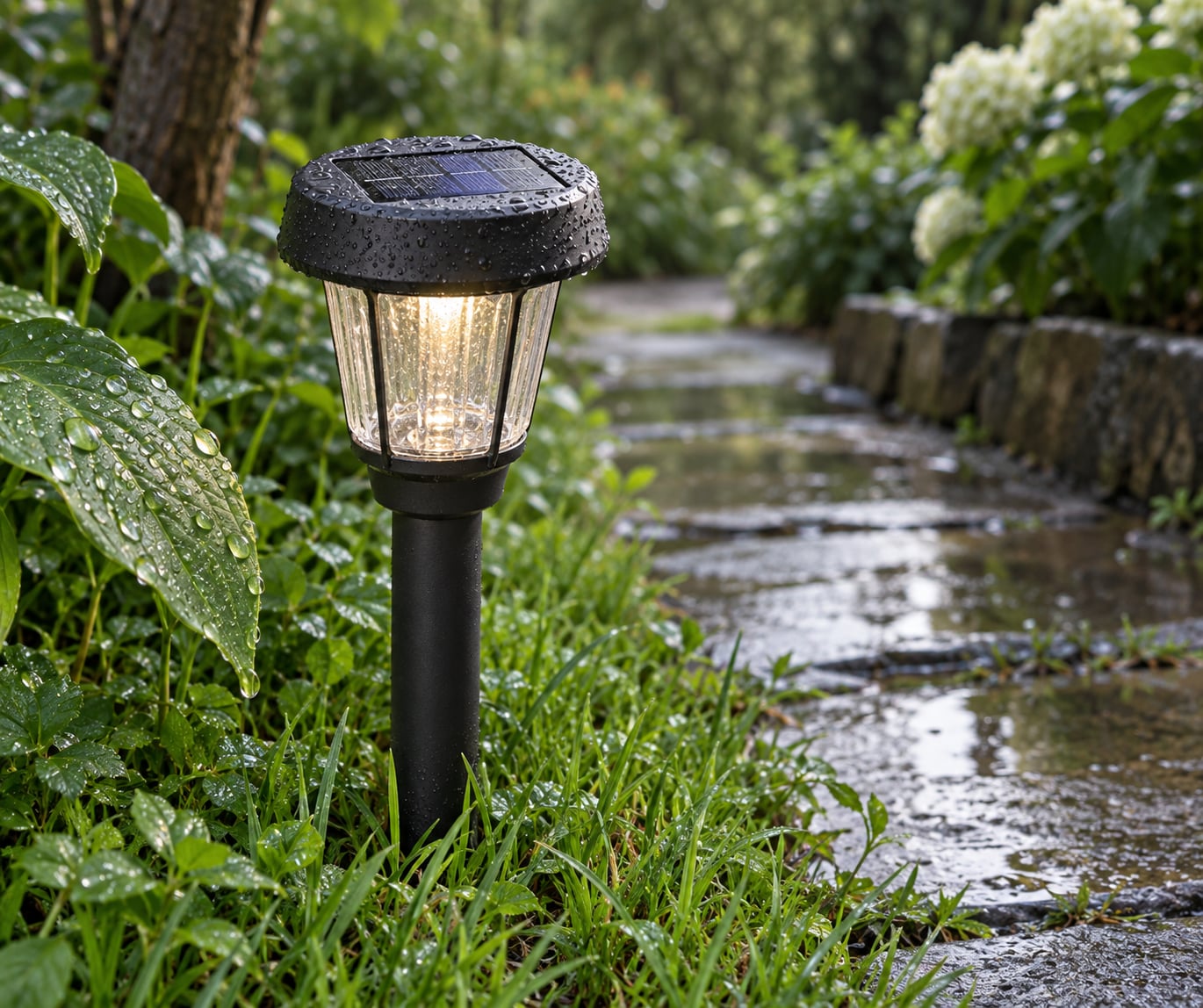
Not if the IP rating matches the exposure. Rain is exactly what an IP65 solar light is tested for. Lights die when water reaches the battery and charge controller, which usually means the rating was too low, the seam was badly sealed, or a seal has hardened with age. A light marked only IP44, or only IPX, is the one most likely to fail in a real downpour.
Are you supposed to leave solar lights on all the time?
For most solar garden lights, yes, the switch should stay on. The panel charges through the same circuit that powers the LED, so a light switched off all day never builds a charge and will look dead within a few days. Leaving it on also lets the automatic dusk sensor do its job. Only check the manual if your light uses a separate panel-to-battery arrangement.
Conclusion
Start by naming the exposure. Ask where the light actually sits, how much rain hits it, whether water pools around it and whether a hose ever finds it.
Then buy against a written number rather than an adjective. An exposed path, deck or driveway light should carry a documented IP65, pond and flood-prone spots deserve IP67, and anything under a cover can live happily with IP44. If a seller cannot give you the rating and the standard, that tells you everything you need to know before the first storm does.