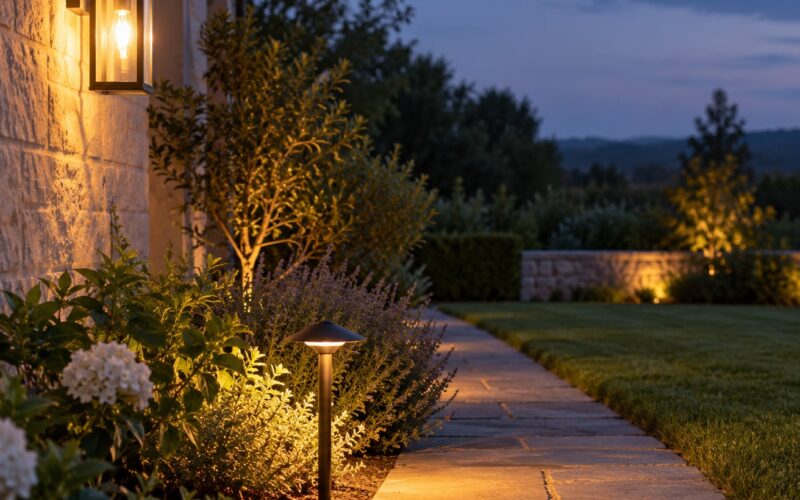
If you want one number to start from, use 2700K to 3000K. Answering the question directly: what color temperature is best for outdoor lighting is usually 2700K to 3000K, because that warm range suits residential outdoor spaces, from front paths to patios and garden beds. It flatters wood, brick, stone and foliage while staying easy on the eyes after dark.
Table of Contents
- What Color Temperature Is Best for Outdoor Lighting?
- Warm, Neutral, or Cool White: What Color Temperature Fits?
- Which Color Temperature Works Best by Outdoor Area?
- How Many Lumens and What Beam Angle Do You Need?
- What Color Temperature Looks Best on Solar Garden Lamps?
- How Do You Choose the Right Outdoor Light Bulb?
- What Do Warm and Cool Outdoor Lights Look Like at Night?
- How Can You Prevent Glare, Light Pollution, and Overlighting?
- Frequently Asked Questions
- Is warm white or cool white better for outdoor lighting?
- Should all outdoor lights on my property be the same color temperature?
- Does a higher color temperature make outdoor lights brighter?
- What color temperature should I choose for a solar garden lamp?
- Do outdoor LED bulbs need a high CRI to look good?
- Conclusion
What Color Temperature Is Best for Outdoor Lighting?
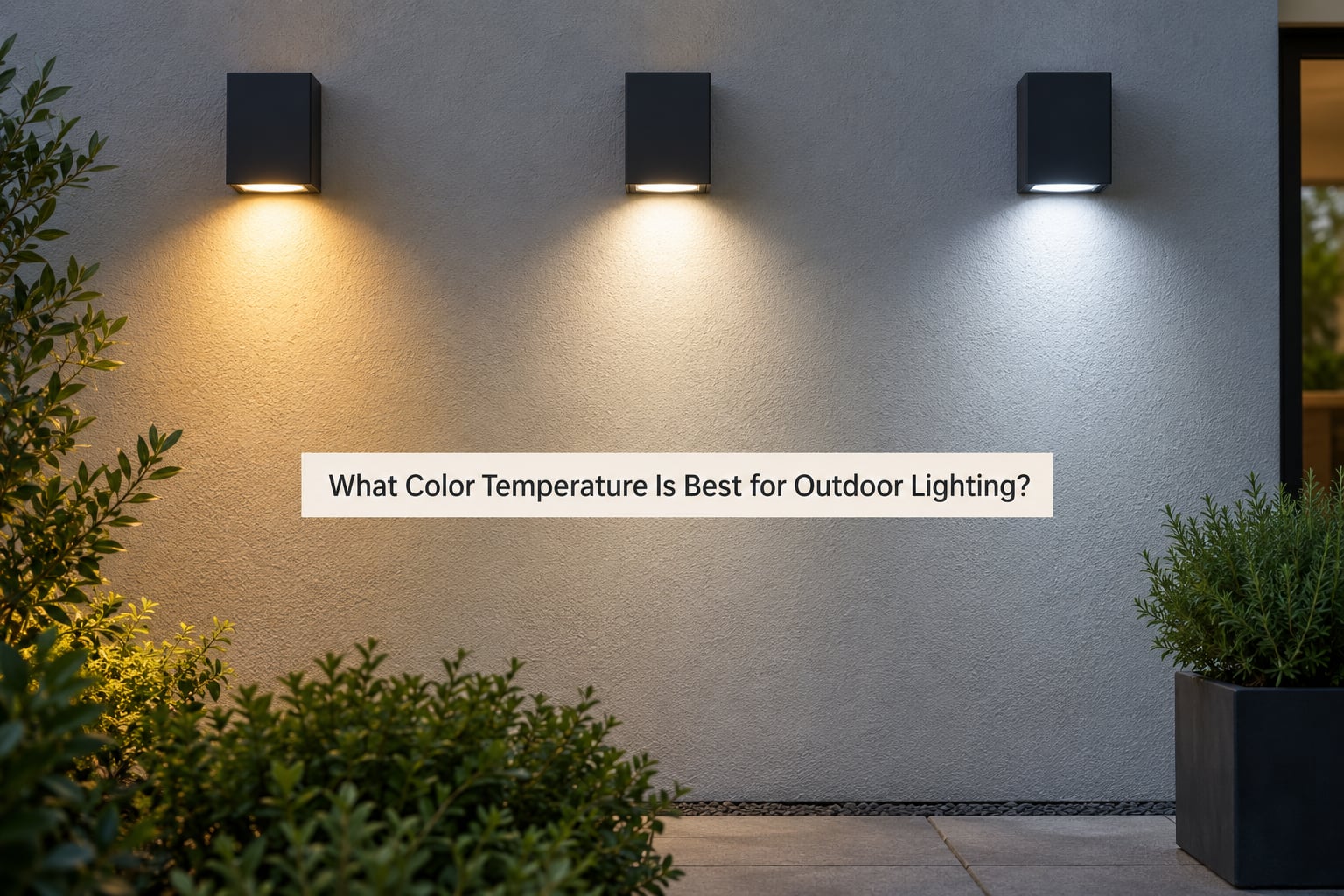
For most homes, 2700K to 3000K is the best color temperature for outdoor lighting. Warm white in that range suits traditional outdoor spaces, neutral white around 3500K to 4000K balances visibility and comfort, and cool white above 5000K belongs in task-oriented, high-visibility areas. There is no single winner that suits every yard, so match the range to what happens in each spot.
Kelvin (K) is a measurement of the hue of white light, not of heat. LEDs emit light at narrow wavelengths, and lower Kelvin values put more of that energy into the yellow and red end of the spectrum while higher values put more into blue and violet.
That last point is worth stating plainly, because it gets repeated backwards a lot online. Bluer light is not hotter. A 5000K LED and a 3000K LED of the same wattage put out roughly the same heat, and both run far cooler than the incandescent bulbs they replaced. You are choosing eye comfort, colour accuracy and neighbourhood friendliness, not degrees.
Warm, Neutral, or Cool White: What Color Temperature Fits?
Here is how the bands break down, with one outdoor job for each Kelvin value:
- 2200K (very warm white): flame-like and amber. Good for fire pits, hot tubs and lantern strings where you want the glow to feel like a candle.
- 2700K (warm white): the classic porch look, matching the incandescent lamps most yards had before. Comfortable for entryways and seating areas.
- 3000K (warm white): slightly crisper than 2700K. A good compromise for path lighting, garden beds and façade lighting, and the ceiling that most local light ordinances allow.
- 4000K (neutral white): clean and almost shadowless. Useful for driveways, garages and outdoor kitchens where you are working rather than relaxing.
- 5000K and above (cool or daylight white): bright and clinical. Mostly reserved for security floodlights, and rarely right in a residential garden.
Beyond hue, three other things change with temperature. Colour rendering, measured as CRI, decides whether brick looks like brick and leaves look green or grey. Higher Kelvin light usually shows more contrast and harsher shadows, which reads as glare after dark. And blue-rich light scatters further through the atmosphere, which is why cool fixtures create more sky glow and more complaints from neighbours.
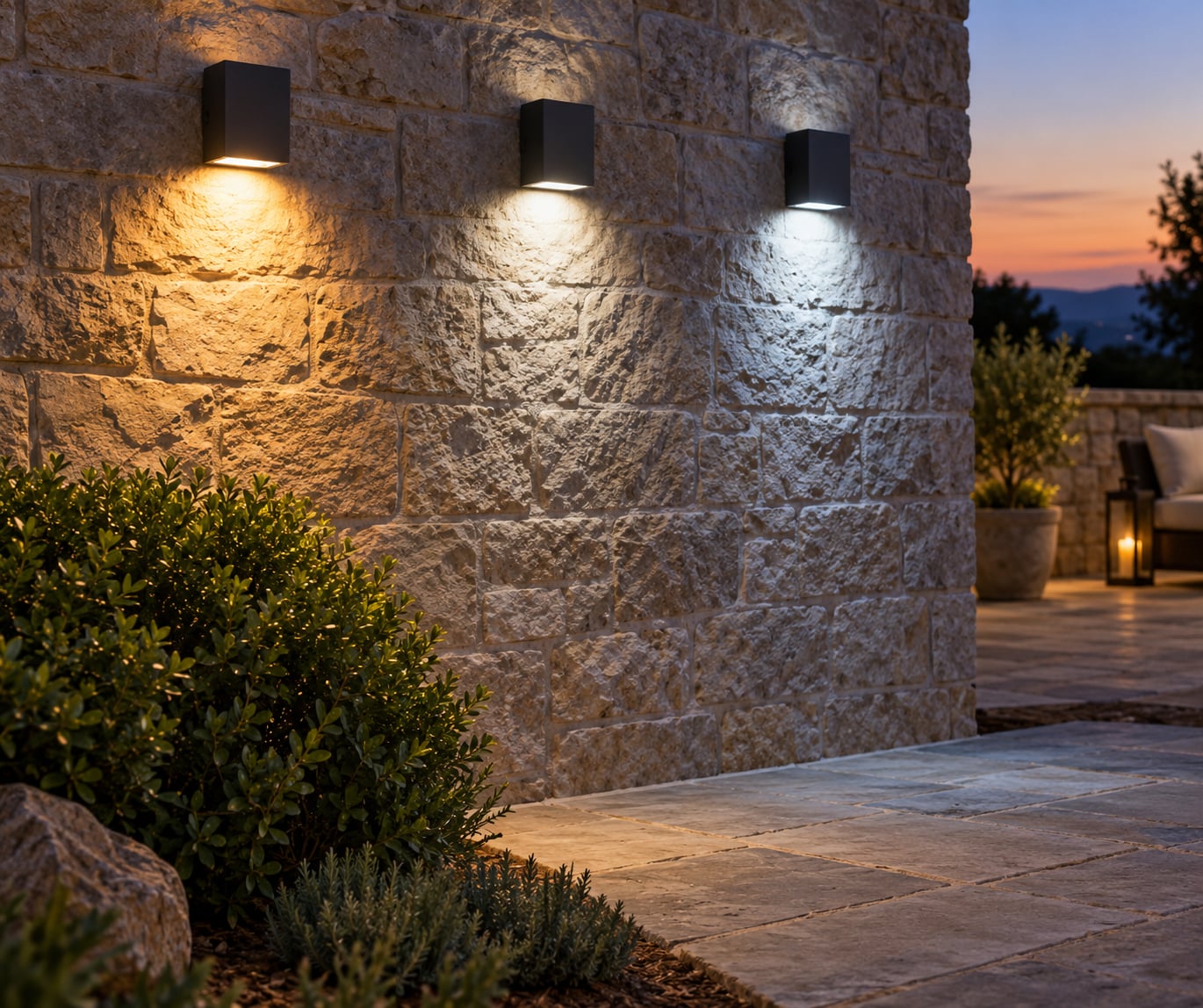
One practical example: the same sandstone paver under 2700K looks golden and soft, under 4000K it looks pale and chalky, and under 6500K it looks blue-grey. Same stone, three different rooms.
Which Color Temperature Works Best by Outdoor Area?
Most yards need two or three different ranges rather than one. Here is the mapping that works most often:
| Outdoor area | Recommended Kelvin | Why |
|---|---|---|
| Garden paths and step lights | 2700K to 3000K | Warm light marks the route without lighting the whole yard |
| Front entrance and porch | 2700K to 3000K | Welcoming tone that flatters brick, timber and skin tones |
| Patio, deck and outdoor dining | 2200K to 3000K | Keeps long evenings comfortable and food colours natural |
| Hot tub, fire pit and water features | 2200K to 2700K | Warm light hides surface glare and steam haze |
| Garden beds and foliage | 2700K to 3000K with CRI 90+ | High CRI keeps leaf greens and flower reds accurate |
| Tree and shrub uplighting | 2700K for bark texture, 3000K for green foliage | The two extremes of bark differ in hue, so split by species |
| Pool and pond lighting | 3000K to 4000K | Water reads blue on its own, so the fixture should not fight it |
| Driveway and security lighting | 4000K to 5000K | Maximum visibility and the sharpest motion detection |
| Garage, workshop and shed | 4000K | Neutral white shows tool colours and stains accurately |
Where a zone needs both comfort and visibility, layered lighting beats one fixture at one temperature. A warm 2700K bollard along the path handles ambience, and a motion-activated 4000K floodlight over the garage handles security. The two never sit in the same field of view, so the mismatch never becomes obvious.
If the whole yard has to run on one setting, choose 3000K. It reads warm enough to feel residential and neutral enough to light a path or a driveway without looking like a car park.
How Many Lumens and What Beam Angle Do You Need?
Brightness and colour temperature are two separate decisions, and mixing them up leads to over-lit yards. More lumens is not a substitute for good aiming. Use these as starting points, then adjust for mounting height and fixture optics:
| Fixture type | Typical output | Useful beam angle |
|---|---|---|
| Path and step light | 100 to 300 lumens | 15 to 40 degrees |
| Bollard light | 400 to 800 lumens | 360 degrees, shielded downward |
| Porch and entry wall light | 700 to 1,300 lumens | 80 to 120 degrees |
| Deck and step accent | 200 to 600 lumens | 30 to 60 degrees |
| Driveway floodlight | 1,300 to 3,000 lumens | 60 to 120 degrees |
| Garden uplight for a small tree | 500 to 1,000 lumens | 10 to 35 degrees, narrow spot |
Two numbers matter more than the fixture type: how high the light is mounted, and how narrow the beam is. A 1,000-lumen floodlight at 10 feet throws a bright pool straight into your neighbour’s bedroom window. The same output aimed down a path from a low bollard stays on your paving.
Check the lumens per fixture rather than the lumens on the box. A pack of four path lights rated at 300 lumens each gives you four small pools of light, not one bright one.
What Color Temperature Looks Best on Solar Garden Lamps?
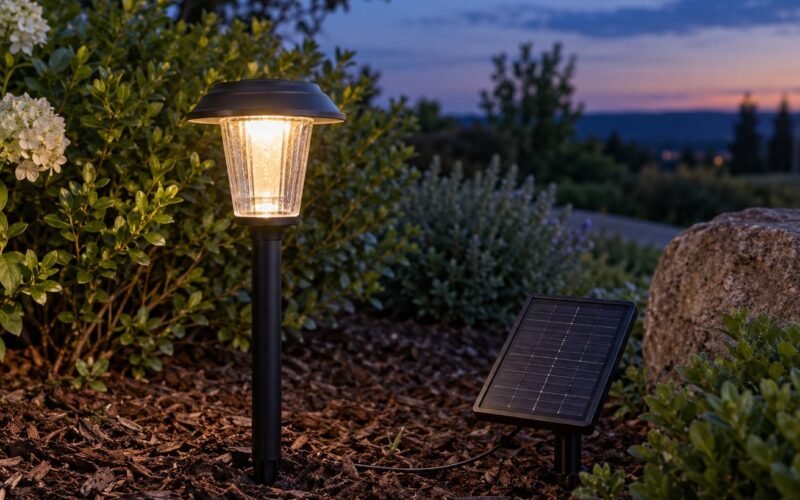
Solar lamps are the hardest case, because the LED module has to run all night off a small panel and a battery that spends the day charging. Warm white modules at 2700K and 3000K are the safer default: they read as decorative, they look deliberate in a border, and they match the rest of a warm-lit yard.
Cool white solar modules often look brighter at the same stated wattage. Your eye is more sensitive to shorter wavelengths in dim conditions, so a 4000K diode reads punchier under a dark sky even when the lumen figure is identical. That is a perception effect, not more output.
The blue cast people complain about usually comes from the fixture, not the bulb. When the photocell switches a lamp on, the battery voltage is lowest, and cheaper modules drift toward blue before the circuit reaches full brightness. A steadier driver or a higher-quality module costs more up front and looks less purple at dusk.
Warm output does not automatically cost you security. A well-aimed 2700K path light at 300 lumens shows a path edge perfectly well; what makes a path unsafe is a gap in coverage, not the hue of the light crossing it.
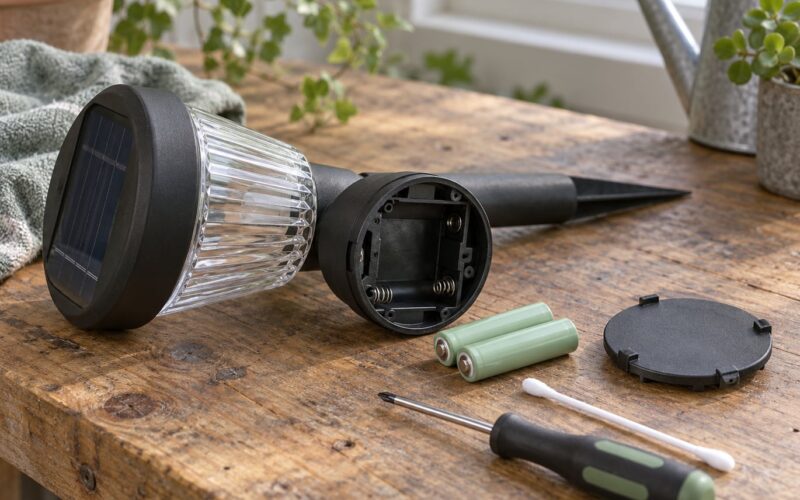
If you replace the module, match three things: the LED forward voltage and current of the original, the diameter and mounting of the board, and the colour temperature you want. Check the manufacturer’s specification sheet before ordering, since a mismatched module can dim the lamp or shorten the battery’s life.
How Do You Choose the Right Outdoor Light Bulb?
Work through this list in order, and it takes about two minutes per bulb:
- Kelvin value: 2700K to 3000K for most areas, 4000K for task and security lighting.
- Lumens: matched to the beam angle and mounting height from the table above.
- Beam angle: narrow for accents and paths, wide for walls and driveways.
- CRI: 80 is the bare minimum, and 90 or better matters for foliage, food and skin tones. Packaging rarely states it, so check the datasheet.
- IP weather rating: IP44 for fixtures under cover, IP65 for anything exposed to rain or sprinklers.
- Voltage and dimming: confirm 120V and that the bulb is listed as dimmable before you put it on a dimmer, since a non-dimmable bulb on a dimmer switch buzzes and shortens its life.
- Bulb base: E26 and E27 fit most residential sockets, but some solar and low-voltage fixtures use a small bayonet or a proprietary fitting.
- Sensor support: photocells, motion sensors and timer modules need compatible fixtures, not just compatible bulbs.
- Lumen maintenance: the rated lumen figure is the output at start of life. Check the manufacturer’s stated maintenance figure and rated life before trusting a cheap claim.
One last point that catches people: two bulbs both labelled 3000K from different brands can look noticeably different, because manufacturers bin within a tolerance rather than hit one value exactly. If you are matching fixtures across a path, buy them together and from the same batch.
What Do Warm and Cool Outdoor Lights Look Like at Night?
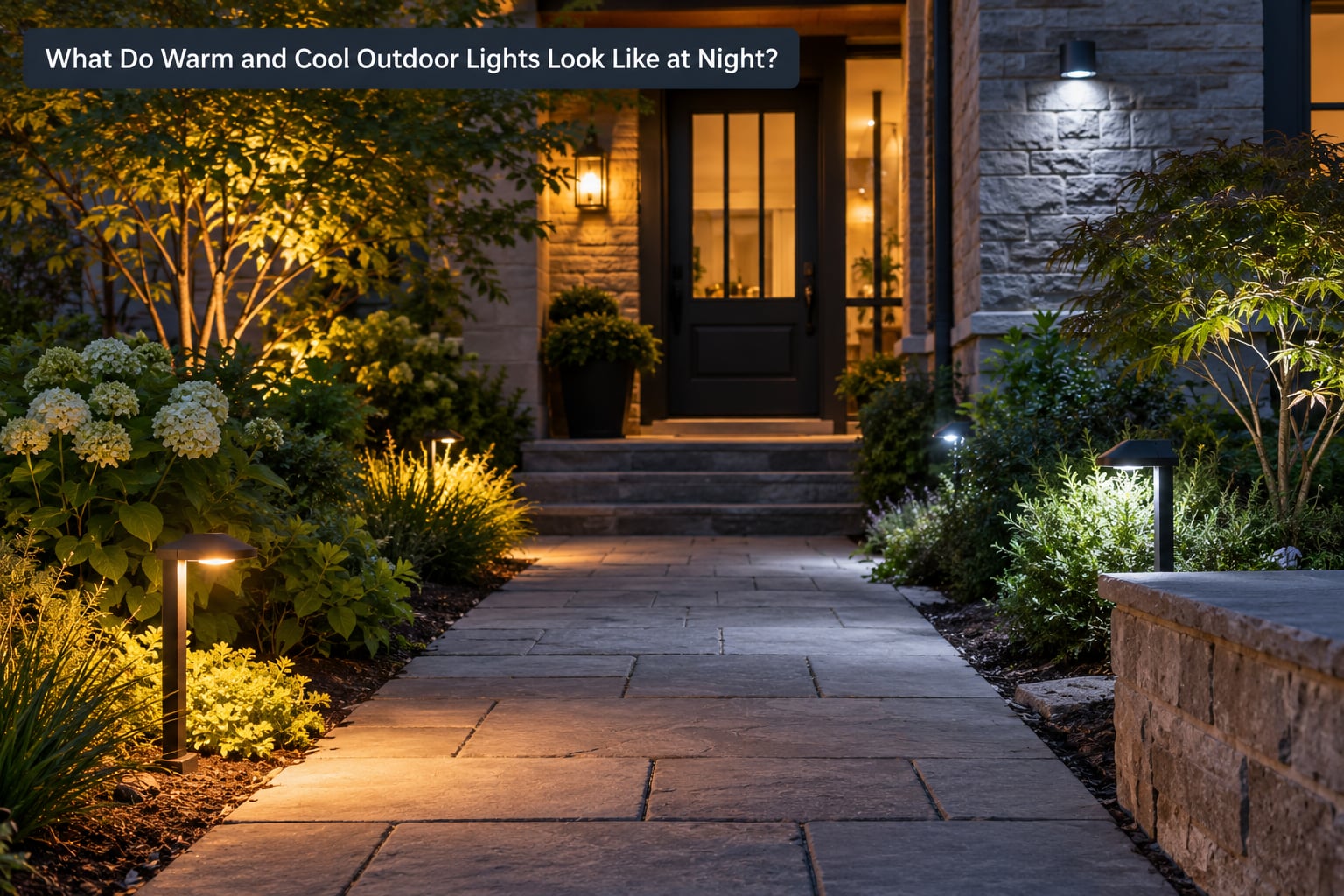
On a red brick wall, 2200K to 2700K pulls the orange out of the brick and makes the mortar lines disappear into shadow. Move the same wall to 4000K and the mortar goes pale, the brick turns flat brown, and every flaw in the pointing shows.
On foliage the effect flips. Warm light flattens greens into a single olive tone, while a slightly cooler 3000K with high CRI separates leaf from leaf and shows texture on bark and needles. That is why garden beds usually land on the warmer end of neutral rather than the cool end.
On paving, warm light hides the grey and flatters texture. Cool white exposes every stain, every weed in the joint and every uneven slab, which is useful for a driveway and unpleasant on a path you walk barefoot.
Before you commit to a Kelvin range for a large area, test it. Borrow or buy one bulb of each temperature and hold it against the wall, the planting and the paving after full dark. Ten minutes of that saves a weekend of regretting. The right way to settle what color temperature is best for outdoor lighting in your specific yard is to look at your own surfaces, not a chart.
How Can You Prevent Glare, Light Pollution, and Overlighting?
Most of the light that annoys people is aimed, aimed wrongly or left on too long. These steps handle nearly all of it:
- Shield the source. Choose full-cutoff fixtures where the lamp itself is not visible from eye level. A wall pack with a visible bulb creates glare no matter how good the Kelvin value is.
- Aim downward. Keep beams below the horizontal line from the property boundary. Light that leaves your garden is light trespass, whatever its colour.
- Lower the output. More lumens than you need is the single most common cause of complaints. Dimming or fewer fixtures solves what a brighter bulb cannot.
- Keep it warm. Blue-rich light scatters more widely through the atmosphere, so 2700K to 3000K reduces both sky glow and the glare people describe as harsh.
- Control the hours. Timers, dusk-to-dawn photocells and motion sensors keep fixtures off when nobody needs them. A lamp that burns until 2am invites a conversation with your neighbour that no Kelvin value will fix.
- Space fixtures properly. Two dim lights 10 feet apart look better than one bright light with a dark gap.
Check your local rules before ordering. Some municipalities cap outdoor colour temperature at 3000K or lower for wildlife and driver-safety reasons, and that limit is set by ordinance, not preference. Those rules get amended from time to time, so the Kelvin ranges quoted here are current as of 2026 and worth a quick check against your own council or utility guidance.
On the electrical side, switch off the breaker and check it is dead before touching any fitting, keep exterior sockets and connections on GFCI protection, use fixtures rated for outdoor use, and seal every cable entry with the gland the manufacturer supplied. For hardwired runs, new circuits or anything on the main panel, use a licensed electrician and follow your local code.
Frequently Asked Questions
Is warm white or cool white better for outdoor lighting?
Warm white between 2700K and 3000K suits most residential outdoor spaces because it flatters timber, brick, stone and foliage and reduces perceived glare after dark. Cool white above 5000K shows detail and colour better, which helps with security and task lighting, but it looks harsh in a garden and scatters more blue light into the sky. Most yards end up using both.
Should all outdoor lights on my property be the same color temperature?
You do not have to match everything, and layering usually looks better than a single range. Keep path, patio and entry fixtures in one warm range so the eye reads them as one layer, then use a neutral white for driveways, garages and other working areas that sit apart from the seating space. Mixing ranges within a single field of view is what looks wrong, not mixing them across the property.
Does a higher color temperature make outdoor lights brighter?
Not in the way most people mean it. Colour temperature describes hue, not output, so two bulbs with the same lumen rating produce the same total light. A cool white source can look brighter to the eye in low light because the eye is more sensitive to shorter wavelengths at night, which is a perception effect. If a fixture feels too dim, change the lumen output or the beam angle instead of the Kelvin value.
What color temperature should I choose for a solar garden lamp?
Warm white at 2700K to 3000K is the safer pick for a solar lamp, because it matches a warm-lit yard and needs less perceived brightness to look right after dusk. Cool white modules read punchier in the dark and sometimes drift blue when the battery is low. If you replace the module, match the LED forward voltage, current and board size from the original specification rather than guessing from appearance.
Do outdoor LED bulbs need a high CRI to look good?
A CRI of 80 is the minimum worth accepting. Above that, 90 or better makes the visible difference on brick, foliage, food and skin tones, and it matters most in warm ranges where the eye is already adjusting to amber light. CRI is usually missing from retail packaging, so check the datasheet. Buying a whole path of matching bulbs from one batch also avoids visible mismatches between fixtures.
Conclusion
Start at 2700K to 3000K for paths, patios, entryways and garden beds, then step up to 4000K only where you need to see detail in a driveway or garage. That split gives you a yard that feels warm where you sit and clear where you walk or work.
Do the first three things in this order. Name the area and what happens there, pick a Kelvin range for it, then choose lumens, beam angle and controls independently. If you only remember the question, remember this one: what color temperature is best for outdoor lighting is decided by the room you are standing in, and most rooms want 3000K.