Can you put solar panels on a metal roof? Yes, and metal is one of the better surfaces for solar because the panels mount to strong, long-lived material and the roof and the array often reach the end of their useful lives around the same time. The catch is that the mounting method has to match your roof profile, and the penetrations have to be detailed properly.
Most homeowners worry about two things: whether the roof will leak, and whether drilling holes voids the roof warranty. Both are manageable questions with concrete answers, and neither is a reason to rule out a metal roof.
Below is how the attachment methods differ, which metal roof profiles work best, what actually drives the cost, and the checklist to run before you sign anything.
Table of Contents
- Can You Put Solar Panels on a Metal Roof?
- Mounting on the existing metal roof
- Reroofing first, then mounting solar
- What Types of Metal Roofs Work With Solar Panels?
- Standing seam
- Corrugated, trapezoidal and R-panel
- Stone-coated steel and tiled metal
- Roof age and sheet condition
- How Is a Solar Panel Mounted on a Metal Roof?
- How to attach solar panels to a metal roof without drilling
- Where penetrations are unavoidable
- Will Installing Solar Panels Cause Leaks?
- Do Metal Roofs Make Solar Panels Work Better?
- What Can Damage a Metal Roof During Solar Installation?
- How Much Does It Cost to Put Solar Panels on a Metal Roof?
- Is It Better to Install Solar Before or After Replacing the Roof?
- How Do I Know If My Metal Roof Is Suitable?
- Frequently Asked Questions
- Can you put solar panels on a metal roof without drilling?
- What type of metal roof is best for solar panels?
- Do solar panels leak on a metal roof?
- Do solar panels void my metal roof warranty?
- Should I reroof before installing solar panels?
- What is the 20% rule for solar panels?
- Conclusion
Can You Put Solar Panels on a Metal Roof?
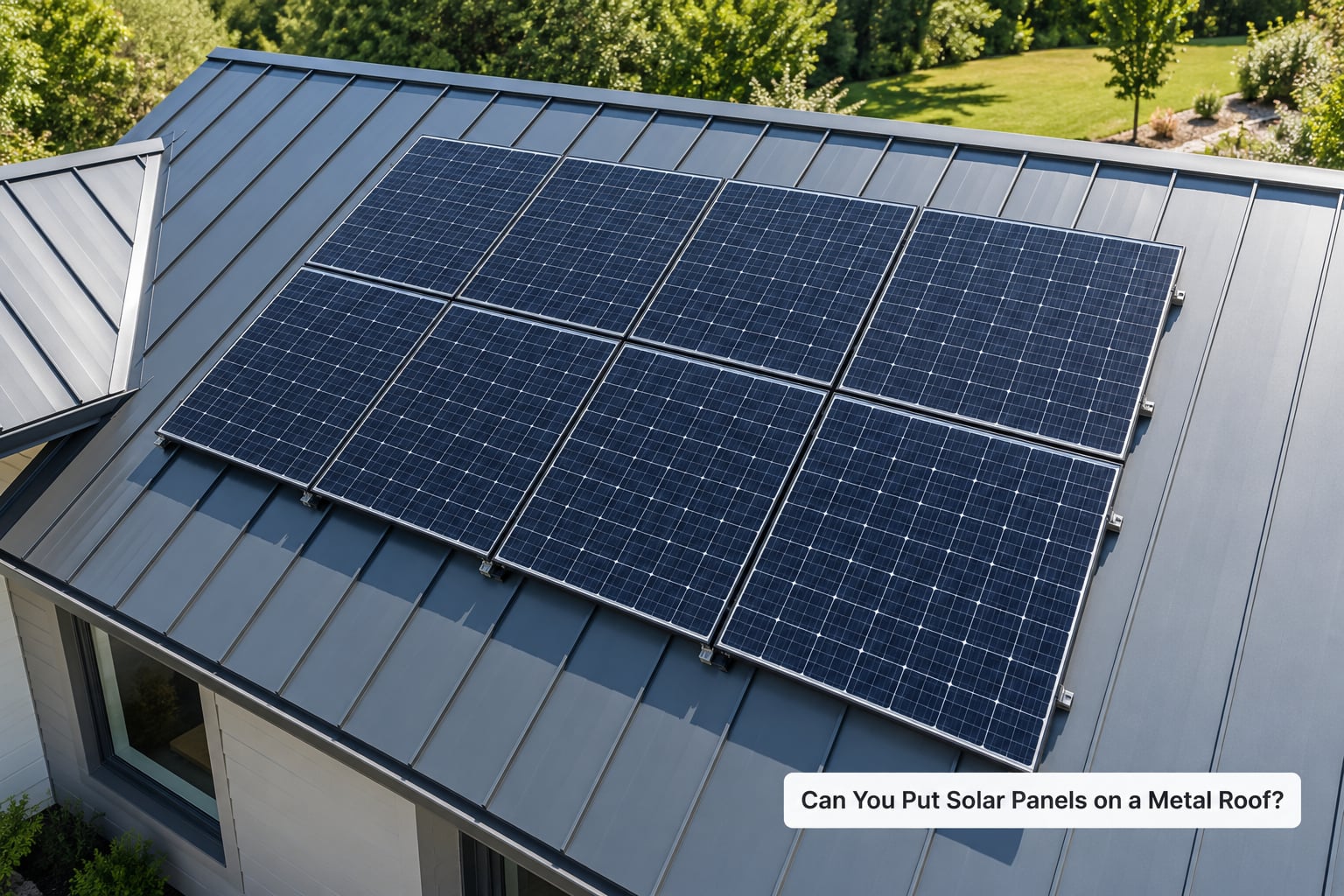
The direct answer is yes, provided three things are true: the roof is structurally sound, the panel system is compatible with the roof profile, and the installer details every penetration for water shedding rather than just drilling and hoping.
Metal roofing is common in areas with high fire risk, heavy snow or strong wind because a metal roof can carry the extra dead load of an array without the concerns you get on some older asphalt shingle roofs. Many metal roofs are rated for 40 to 70 years of service, and a solar array usually runs 25 to 30 years, so there is a reasonable chance the roof outlives the panels rather than the other way around.
There are two broad approaches, and the difference matters more than anything else on this page.
Mounting on the existing metal roof
The array attaches to the roof you already have. On standing seam roofs, clamps grip the raised seam with no holes at all. On corrugated or trapezoidal roofs, brackets bolt into the rib crests and the holes get flashed and sealed. This is the faster, cheaper path and it is what most installations use.
Reroofing first, then mounting solar
Here the old roof comes off, a new metal roof goes on, and the panels are installed onto the fresh surface. This makes sense when the roof genuinely needs replacing, or when a new roof can be specified as solar-ready with reinforced attachment points. Doing it purely to protect panels from a future reroof rarely pays for itself, which is why the timing question gets its own section below.
What Types of Metal Roofs Work With Solar Panels?
Compatibility comes down to the roof profile, the sheet thickness, the fastener pattern and the age of the roof. Most metal profiles have a tested mounting solution, but the age of the installation and the span of the purlins underneath decide whether a given roof is practical.
Standing seam
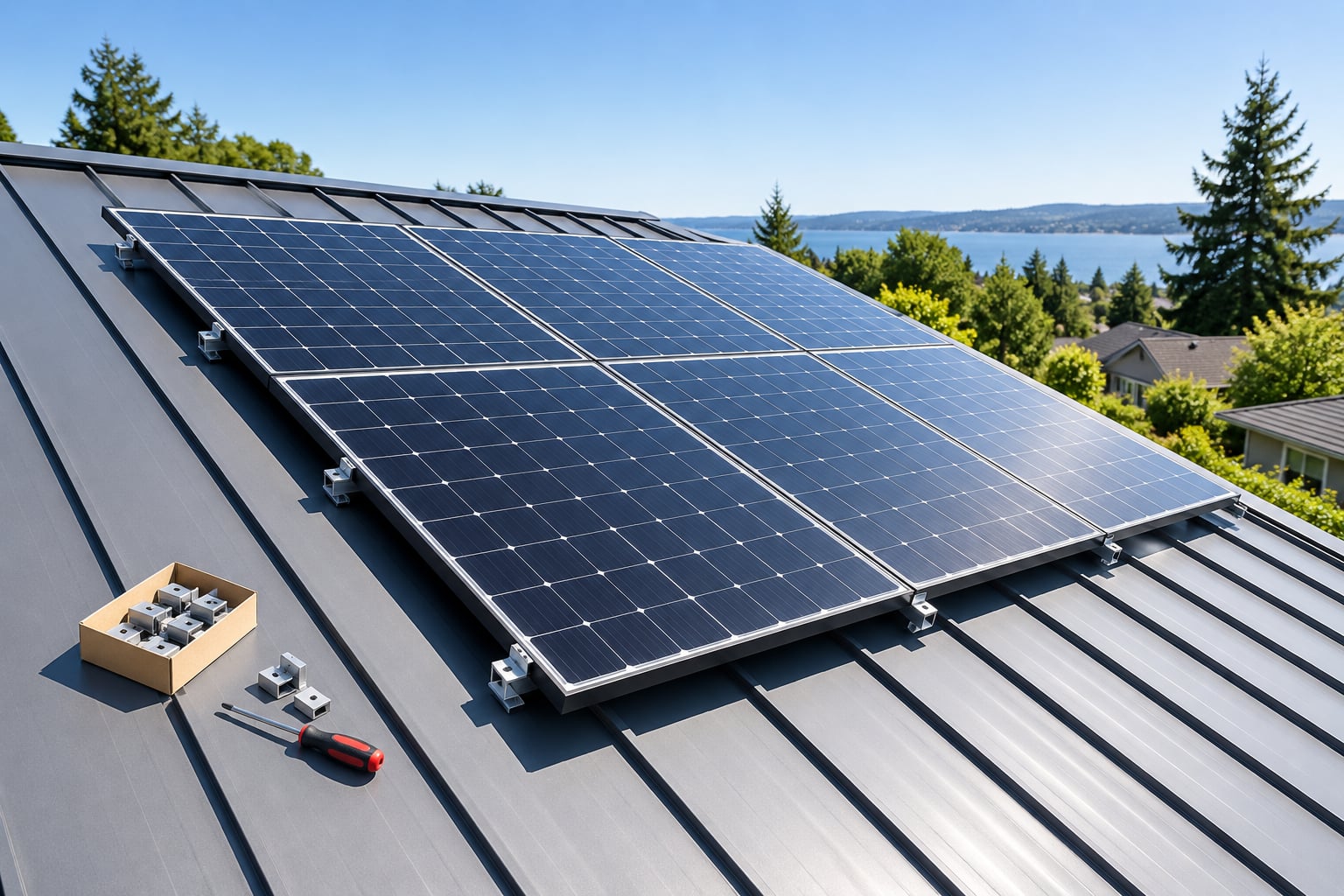
This is the cleanest case. The raised seams are extruded from the same sheet, so a purpose-made seam clamp can be tightened onto the metal without a hole. Clamps are matched to the seam height, and different seam profiles need different clamp designs, which is why the installer has to confirm the profile rather than assume a generic part fits.
Corrugated, trapezoidal and R-panel
These are ribbed profiles where the mounting hole goes through a rib crest. A practical rule of thumb in the field is 26-gauge steel as the thinnest sheet worth attaching to, with 24-gauge preferred where loads are heavy. Brackets need to sit on the crest, never in the valley, because water runs through the valleys and a fastener there is a leak waiting to happen.
Stone-coated steel and tiled metal
Stone-coated steel and tiled metal roofs are steel panels with a mineral or concrete-look surface, and they are popular in high-wind regions. Mounting works, but the coating is the part that gets damaged, so brackets are often bonded to the panel face rather than screwed through it. A bonded attachment depends on the surface staying clean and undisturbed, and it is worth asking which method the installer intends to use and why.
Roof age and sheet condition
Fasteners on metal roofs loosen over time, and a roof with loose screws, rust staining or a failed sealant bead is telling you something important. A roof in that condition should be repaired before panels go up, because every penetration sits on top of an already weakened water envelope. Sealed, painted or coated steel also needs a mounting approach that will not be pulled off later when the coating is stripped.
How Is a Solar Panel Mounted on a Metal Roof?
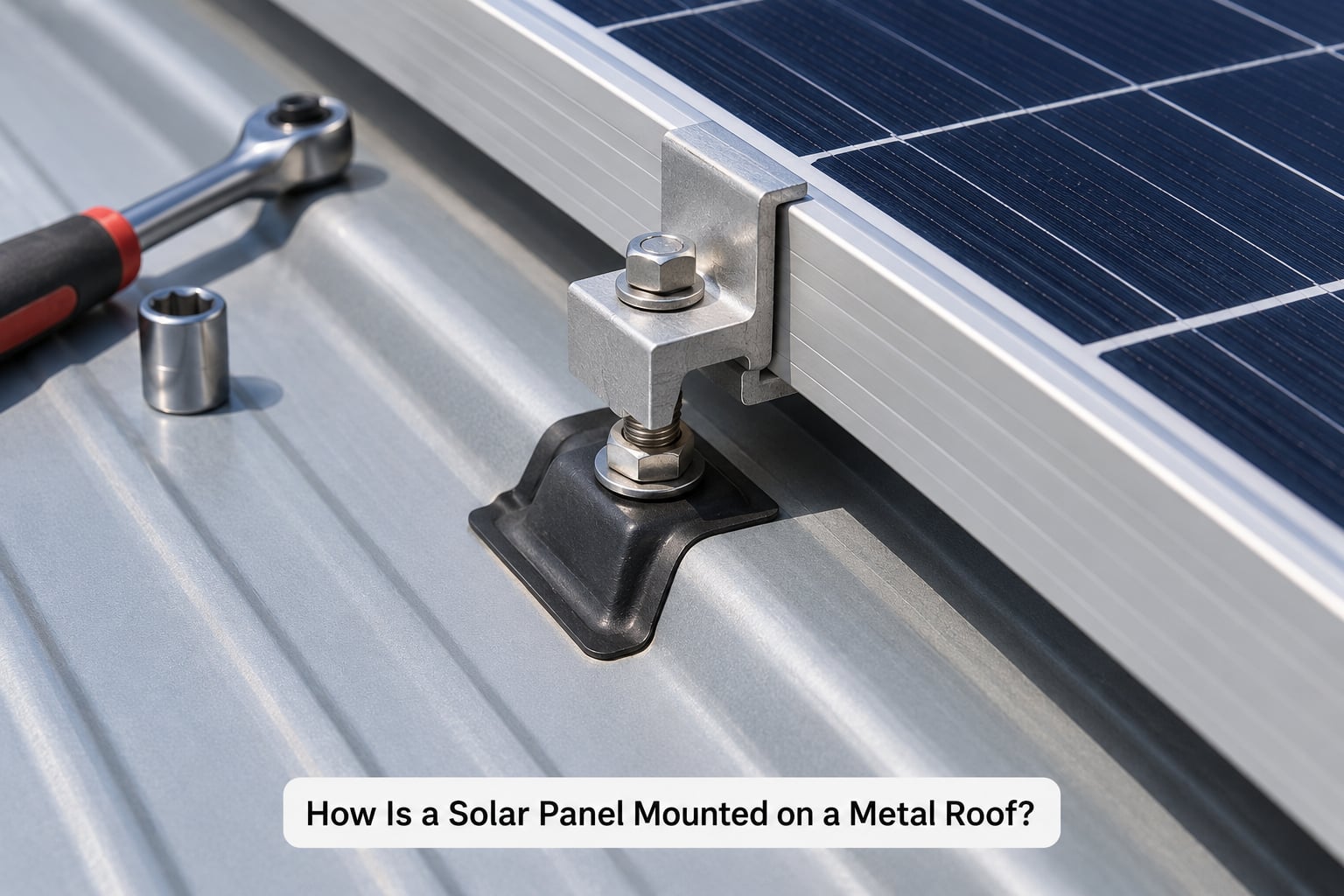
There are three main approaches, and the roof profile decides which one is available to you. On a standing seam roof you have two choices. On a ribbed roof you generally have one.
- Direct attachment with seam clamps. A clamp wraps around the raised seam and the panel frame bolts straight to the clamp. No roof holes, no sealants, and the panels can be removed without touching the roof surface at all.
- Rail-based systems. Clamps or brackets fix to the roof, then aluminium rails run across the roof and the panels clip to the rails. Rails allow the array to be tilted and adjusted, and they spread point loads across several attachment points.
- L-feet and rail-less systems. An L-foot is a fixed bracket that lands on a rib crest, is screwed down with a self-piercing screw and a bonded washer, and the panel frame attaches directly to it. Rail-less layouts are faster and use less hardware, but they give up the fine adjustment that rails provide.
How to attach solar panels to a metal roof without drilling
Non-penetrating seam clamps are the standard answer here, and on standing seam roofs there is nothing else you need. Installers working with forum communities like r/SolarDIY consistently favour seam clamps over penetration on this roof type, for the obvious reason that a hole you never drill is a leak you never have. The one constraint is that the clamp has to be sized to the exact seam height and profile, and a non-penetrating clamp on a corrugated roof is simply not possible because there is no seam to grip.
Where penetrations are unavoidable
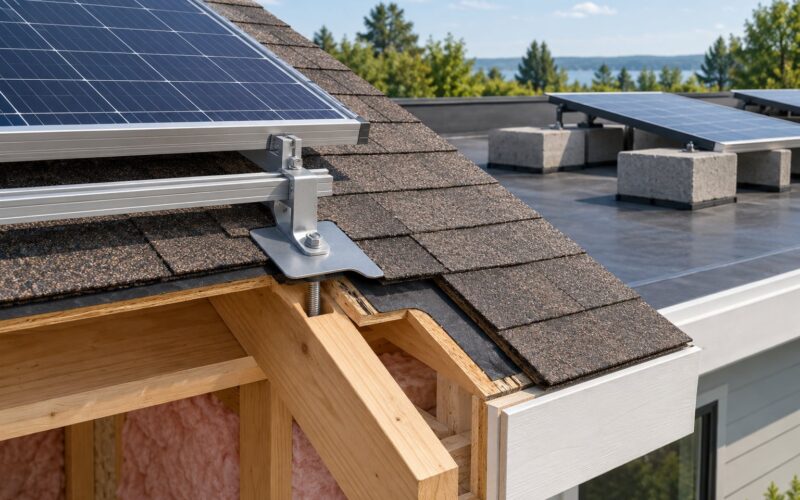
On ribbed roofs each penetration gets a self-piercing or self-drilling screw with an integrated EPDM gasket washer, seated on the rib crest and torqued to the manufacturer’s specification. Field practice and the wider DIY forums both point at gaskets compressed roughly 25 to 30 percent as the workable target, since an overtightened screw flattens the gasket and an undertightened one leaves a path for water.
Two more details separate a good detail from a bad one. Screws are fixed from the ridge downward so any thermal expansion of the sheet has slack to move into rather than fighting the fastener, and any flashing or plate above the penetration is lapped so water runs over it rather than into it. Stainless steel hardware is worth specifying on coated or dissimilar-metal roofs, because mixing metals in direct contact is the classic route to galvanic corrosion.
Will Installing Solar Panels Cause Leaks?
A well-detailed installation on a metal roof has a very low leak risk. A poorly detailed one has a higher risk than leaving the roof alone, and the difference comes down to a handful of specific workmanship items that you can ask about.
- Penetration location. Fasteners belong on rib crests and purlins, never in valleys, low points or areas where water ponds.
- Sealant choice. The sealant has to be compatible with the roof coating and with the metal itself, and it has to be the kind rated for the exposed temperature range on a roof surface that can get very hot.
- Fastener torque. Torqued to spec, a gasket seals and stays sealed. Overtorqued, it crushes and fails early.
- Seam and fastener condition. Pre-existing loose roof screws and open seams get repaired before the array goes on, not after.
- Sealant lifespan. Roof sealant has a shorter service life than the panels bolted through it. Plan a check of the penetrations every few years rather than assuming they are permanent.
On standing seam roofs with non-penetrating clamps, the leak question largely answers itself. Roofs that use penetrations deserve a little more attention, and that is a reasonable reason to prefer a clamp-based design where your roof profile allows one.
Do Metal Roofs Make Solar Panels Work Better?
Sometimes, but not automatically. A metal roof creates conditions that can help panel output, and it also creates conditions that can hurt it.
The useful effect is temperature. Panels lose output as they get hot, and a metal roof surface reaches high temperatures on a clear afternoon. Light-coloured and reflective metal coatings bounce more energy than dark asphalt shingles do, which can mean a cooler mounting surface under the array. A standing seam roof also holds no asphalt, so there is no shingle granule surface absorbing heat nearby.
The airflow between the panel and the roof matters too, and it is why a small standoff gap is usually specified rather than panels sitting flat against the metal. Light-coloured metal and a ventilated gap together tend to produce a cooler back surface, which is where the cooling benefit actually shows up.
The catch is that orientation, tilt, shading and local climate still dominate. A south-facing pitched array on an unshaded roof in a sunny climate will beat a flat roof-mounted array on a reflective roof, every time. And a metal roof cannot rescue a site with heavy afternoon shading from a neighbouring tree, because the panels still only see what the sky lets them see. Roof colour, slope and the shading map matter more than the roofing material when you are modelling production.
What Can Damage a Metal Roof During Solar Installation?
Most damage to a metal roof during a solar job is avoidable, and it usually happens during the two or three days the crew is on the roof rather than years later. These are the failures worth watching for, and most of them are visible if you walk the roof with the installer before the panels go down.
- Walking on panels or on unsupported spans. Panels are not designed to take a crew member’s weight across the frame. Walk on the roof deck or use designated walkways, and never on a module.
- Scratching the finish. Dragging a rail, dropping a bracket or setting a tool on a coated or painted surface leaves marks that never come out. Rubber-footed tools and a clean working surface prevent most of it.
- Drilling in the wrong spot. A hole in a valley, or one that misses the purlin entirely, is a leak and a failed fastener. Confirm the fastening point with the roof’s construction, not by eye.
- Over-torquing fasteners. It feels like more is better. It is not, and crushed gaskets are the reason.
- Damaging the coating. On stone-coated and tiled metal, drilling and adhesive work can chip or debond the surface, and those areas will not match later.
- Mixing metals. Ordinary aluminium hardware against copper or untreated steel can start a galvanic reaction that shows up as staining around every attachment point years later.
Ask who carries the workmanship warranty and for how long, because that tells you who is standing behind the attachment details rather than just the panels.
How Much Does It Cost to Put Solar Panels on a Metal Roof?
Most US homeowners land somewhere around $20,000 to $25,000 for a typical residential system before incentives. Straightforward installs on an asphalt roof can start near $15,000, and complex jobs with tricky electrical work or roof repairs push past $30,000. Mounting on metal rather than asphalt usually adds a smaller premium, somewhere from a few hundred dollars to a couple of thousand, and most of that is hardware rather than labour.
These are typical US ranges that vary by region and change over time, so treat them as a starting point for your own budget and ask for a written breakdown. Line items that differ from an asphalt roof installation:
- Mounting hardware. Seam clamps and profile-specific brackets are purpose-made parts, and non-penetrating systems price differently from L-feet even though they save labour on the roof.
- Labour time on the roof. A metal roof is fast to work on, which can offset the higher hardware cost. Ribbed profiles with lots of individual brackets are slower.
- Structural engineering. Some jurisdictions and some sites require an engineered design with stamped drawings, and that is a real line item.
- Roof repairs. Loose fasteners, resealing seams or replacing a section of corroded sheet get priced into the job, and it is fair to see them itemised separately.
- Removal and reinstallation. If a reroof is planned inside the array’s life, detaching and refitting panels later is a significant cost that most people forget to plan for.
- Permits and interconnection. The same in most regions, though code-driven requirements such as fire setbacks and pathway access can add design work in specific jurisdictions.
The reliable way to compare quotes is to ask each installer for the same three things: the attachment method they intend to use, what happens to every roof penetration, and what their plan is for future panel removal. If those answers are vague, the comparison is not apples to apples.
Is It Better to Install Solar Before or After Replacing the Roof?
Install solar on the existing metal roof when the roof is sound, has plenty of life left and shows no signs of rust or fastener failure. That is the normal case, and it is the cheaper, faster route.
Reroof first when the roof is genuinely near the end of its life, when a reroof is already being planned for other reasons such as a leak claim or an insurance requirement, or when the new roof can be built solar-ready with reinforcement and flashing details that would be difficult to add later.
The deciding factor is usually the age threshold installers talk about. A metal roof with 10 to 15 years of service left, and no distress, is generally fine to mount on. Well past that, with corrosion or recurring fastener loosening, the cost of removing and reinstalling an array later starts to look a lot like the cost of redoing the roof now.
Sequencing also affects the workmanship. When a roofing crew and a solar crew handle the same roof in the same week, the attachment details and the roof details get coordinated by the same set of eyes. The same coordination in reverse, months or years apart, is a common source of callbacks.
How Do I Know If My Metal Roof Is Suitable?
Run through this list before you request quotes. It takes an afternoon with a pair of binoculars and it will tell you a lot about whether a project is straightforward.
- Roof age and remaining life. Compare the install date against the service life of the profile. Fifteen-plus years on a visibly healthy roof is usually workable.
- Fastener condition. Look for missing or backed-out screws and rows of sealant that has cracked or peeled.
- Rust and staining. Rust around fasteners or streaking down the panels points to a coating failure that needs attention first.
- Existing leaks or damp. Fix the water problem before adding twenty-five years of hardware to the surface.
- Seam or rib profile. For standing seam, note the seam height and profile. For ribbed roofs, note the rib spacing and the sheet thickness.
- Purlin spacing. Wide spans, six feet or more in some cases, mean the array load lands between supports and structural review becomes important. This is a common sticking point discussed at length on structural engineering forums.
- Roof orientation and tilt. Note the compass direction of the roof planes and any obstructions to the south or west.
- Shading. Walk the property at a few times of day and note what blocks the roof, including trees that will grow into it.
- Attic and structure condition. Rafters, decking and the roof’s attachment to the structure all matter more than the roofing material itself.
- Local code requirements. Fire ratings, pathway setbacks and engineering stamps vary by state and county, and fire-prone regions are the strictest.
After the list, get a site assessment from a qualified solar installer, and add a structural professional if the purlin spacing is wide, the roof is old, or the home is in a high wind or seismic zone. A site visit is cheap relative to the cost of finding out later.
Frequently Asked Questions
Can you put solar panels on a metal roof without drilling?
On a standing seam metal roof, yes. Purpose-made clamps grip the raised seam and the panel frame bolts directly to the clamp, so no holes are made in the roof and the panels can be removed without touching the metal. On corrugated or trapezoidal roofs, clamping is not possible because there is no seam, so the array is screwed into the rib crests and those penetrations are flashed and sealed.
What type of metal roof is best for solar panels?
Standing seam is the most favourable profile, because non-penetrating clamps can be matched to the seam and the roof keeps its warranty intact. Corrugated, trapezoidal and R-panel roofs also work well, with L-feet or rails fixed into the rib crests using self-piercing screws and EPDM gasket washers. Stone-coated and tiled metal are mountable too, but the surface coating needs care around every attachment point.
Do solar panels leak on a metal roof?
A properly detailed installation has a low leak risk. Seams and loose fasteners get repaired before work starts, penetrations stay on rib crests away from valleys, screws are torqued to spec so the gasket seals without being crushed, and flashing is lapped so water runs over it. On standing seam roofs with clamps there are no penetrations at all, which removes the question entirely.
Do solar panels void my metal roof warranty?
It depends entirely on how the panels are attached. Non-penetrating seam clamps leave the roof untouched and are the safest option for warranty purposes. Penetrating installations can affect coverage, since some manufacturers exclude work that violates their fastening or sealant specifications. Ask the roofing manufacturer in writing before signing, and give the installer your roof’s warranty document to work from.
Should I reroof before installing solar panels?
Reroof first if the metal roof is close to the end of its life, shows rust or loose fasteners, or already needs replacing for another reason. A roof with 10 to 15 years of healthy service left is generally fine to mount on. Reroofing only to protect the panels from a future removal rarely makes financial sense, but a solar-ready roof built during a planned replacement is easy to justify.
What is the 20% rule for solar panels?
The 20% rule is a quick sizing shortcut used during early design conversations: a system sized at roughly 20 percent of a home’s annual electricity use gives a workable starting point before shading, roof geometry and usage patterns are modelled properly. It is a conversation starter, not a design. A proper production estimate uses hourly weather data and your actual interval usage, and that is what determines the final array size.
Conclusion
Metal roofs can carry solar panels safely, and for a lot of homes they are the better surface to own: the roof and the array have comparable service lives, and standing seam designs need no holes at all. What decides a good outcome is not the roofing material, it is the attachment design and the workmanship around every fastener.
Before signing a contract, ask for a written plan that shows the attachment method for your exact roof profile, the detail at every roof penetration, the fastener torque specification, and what the installer will do about the existing roof fasteners and seams. Get the same plan from more than one installer, because the answers are where the real differences show.
If purlin spacing is wide, the roof is old, or you are in a high wind, seismic or fire-prone region, add a structural assessment to that conversation. It is a small step that settles most of the uncertainty before any hole is drilled.