If you are choosing a battery for a house rather than a phone, lithium iron phosphate is the safer default: it cycles two to three times longer, tolerates heat better, and costs less to run over its life. The denser lithium-ion chemistries, mainly NMC and NCA, only win when floor space and weight are the binding constraints.
Here is the part that trips up most buyers. Lithium iron phosphate vs lithium ion home batteries is not really a contest between two rival things. Lithium-ion is the family name for every battery that moves lithium ions between two electrodes. LFP is one member of that family, defined by what sits on the positive electrode.
Table of Contents
- lithium iron phosphate vs lithium ion home batteries at a Glance
- What chemical differences matter for home batteries?
- How do the lithium iron phosphate vs lithium ion home batteries compare on safety?
- Which chemistry lasts longer and supports more cycles?
- Which provides more usable power in the same amount of space?
- How do temperature and discharge depth affect performance?
- What do lithium iron phosphate and lithium ion home batteries cost?
- Which Should You Choose?
- Frequently Asked Questions
- Can I connect lithium iron phosphate and other lithium-ion home batteries together?
- Do lithium iron phosphate batteries work with any home inverter?
- Can I mix battery brands or replace only one module in a lithium-ion battery system?
- What battery temperature range should I check before installing a home battery?
- How can I tell whether a home battery uses lithium iron phosphate or another lithium-ion chemistry?
- What happens to lithium iron phosphate and lithium-ion batteries at end of life?
- Conclusion
lithium iron phosphate vs lithium ion home batteries at a Glance
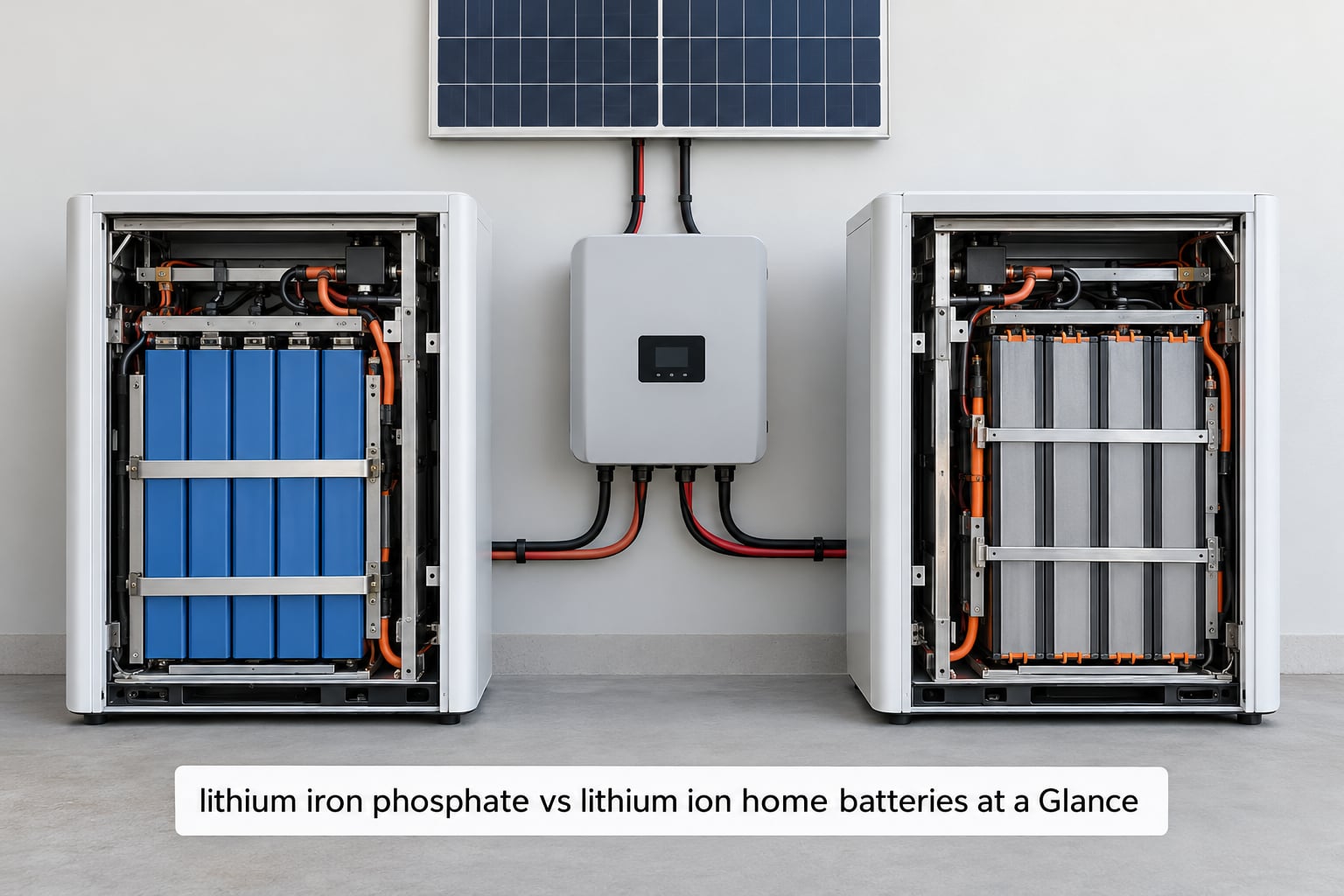
The table below is the whole argument in one place. The right-hand column says who wins each row, which is usually more useful than the number itself.
| Specification | Lithium iron phosphate (LFP) | NMC and NCA lithium-ion | Which wins for a home |
|---|---|---|---|
| Cathode material | Iron phosphate in an olivine crystal structure | Nickel-manganese-cobalt or nickel-cobalt-aluminium | LFP, because it uses no cobalt |
| Nominal cell voltage | 3.2 to 3.3V | 3.6 to 3.7V | Neither; each needs its own charge profile |
| Full charge per cell | About 3.65V | About 4.2V | LFP, with more headroom before damage |
| Charge voltage for a 12V pack | 14.2V to 14.6V depending on maker | 14.4V to 14.7V | LFP, with a wider safe window |
| Specific energy | 90 to 120 Wh/kg at cell level | 150 to 220 Wh/kg at cell level | NMC and NCA, clearly |
| Cycle life | 2,000 to 6,000+ cycles depending on cell and depth of discharge | 500 to 2,000 cycles | LFP, by a wide margin |
| Usable depth of discharge | Typically 80 to 90 percent | Typically 80 to 90 percent | A tie; read it on the spec sheet |
| Round-trip efficiency | About 95 percent | About 90 percent | LFP, which matters for solar self-consumption |
| Thermal runaway onset | Around 270C in laboratory testing | Around 210C for NMC, near 150C for LCO | LFP, by a wide margin |
| Calendar life | 10 years and often more | Typically 5 to 10 years | LFP |
| Maintenance | None beyond firmware and ventilation checks | None beyond firmware and ventilation checks | A tie; both beat lead-acid |
| Typical weight for the same stored energy | Heavier, by roughly a third | Lighter | NMC and NCA |
| Best home application | Whole-home backup, grid-tied solar storage, off-grid cabins, frequent daily cycling | Tight utility rooms, high peak power, weight-limited retrofits | LFP for nearly every installation |
| Relative cost over the life of the system | Lower, because fewer replacements are needed | Higher, because capacity fades sooner | LFP |
Read those figures as representative ranges rather than promises. Cycle counts assume a shallow daily discharge, room temperature, and a charge profile the manufacturer approves; push any of those and the number drops.
What chemical differences matter for home batteries?
Both chemistries store and release energy the same way. Lithium ions shuttle back and forth between an anode and a cathode through an external circuit, and the design of that circuit, not the chemistry, decides most of what a battery can do. The cathode material is where the two families diverge.
Lithium-ion is the umbrella term. Inside it sit four common cathode chemistries you will see on spec sheets:
- LCO, lithium cobalt oxide, packs the most energy per kilogram of any of them. It is why phones and laptops are light. Its thermal runaway onset sits near 150C, the lowest of the group, which is why you rarely find it in a house.
- NMC, nickel-manganese-cobalt, is the workhorse of electric vehicles and grid storage. Energy density of 150 to 220 Wh/kg, good cycle life, and cobalt content that drops as chemistry improves.
- NCA, nickel-cobalt-aluminium, sits alongside NMC with slightly higher energy density and a reputation for being less forgiving to charge hard.
- LFP, lithium iron phosphate, trades energy density for everything else. Its olivine crystal structure does not release oxygen when it fails, and its cycle life in the 2,000 to 6,000 range is the reason it has taken over residential storage.
There is a second difference that will bite you before the chemistry does: the voltage window. An LFP cell is nominally 3.2 to 3.3V and tops out near 3.65V, so a 12V LFP pack charges to 14.2V or 14.6V depending on the maker. An NMC cell is nominally 3.6 to 3.7V and charges to 4.2V.
Put an LFP pack on a charger set to the NMC profile and you push every cell roughly half a volt past its limit. That is not a slow degradation. It is a thermal event waiting for a reason. Any charge controller, inverter charger, or DC-DC converter you connect has to speak LFP’s voltage window, and the battery management system has to be configured for it.
How do the lithium iron phosphate vs lithium ion home batteries compare on safety?
LFP wins on thermal stability, and the mechanism is worth understanding rather than just accepting. The olivine structure of the iron phosphate cathode holds its oxygen in place when the cell is overloaded. The nickel-based cathodes release oxygen at high temperature, and that released oxygen feeds the reaction that turns a cell into a thermal runaway. Laboratory onset figures put LFP around 270C, NMC near 210C, and LCO close to 150C.
A thermal runaway is not a house fire on its own, and neither chemistry is risk-free. The failure mode depends on cell format, enclosure, the battery management system, and how the system was installed. A certified home battery that is wired correctly with functioning BMS protection is a different proposition from loose cells in a metal box, whichever chemistry is inside.
What the numbers do mean in practice: a fault in an LFP pack is far less likely to propagate from cell to cell into a venting event. For a system sitting in a garage, a utility room, or a closet next to living space, that margin is the single strongest reason to pick LFP.
Neither chemistry makes the electrical work optional. Any wiring, conduit, or interconnection in this country belongs to a licensed electrician working to local code, and the installation manual takes priority over anything written on a blog, including this one.
Which chemistry lasts longer and supports more cycles?
LFP lasts longer, and the gap is big enough to drive the whole buying decision. Expect 2,000 to 6,000 or more cycles from quality LFP home cells, against roughly 500 to 2,000 for NMC, NCA, and LCO packs used in the same way.
A cycle is a full charge and discharge, and the depth matters. A daily cycle from 20 to 80 percent is a partial cycle and does less damage than a full 0 to 100 percent run. Deep cycling, running hot, and charging to the absolute ceiling every day all pull the real cycle count below the number on the datasheet.
Here is the translation that matters for a house. A grid-tied system that shifts solar into the evening might cycle once a day, which is roughly 365 cycles a year. At a conservative 3,000 cycles, that is a little over eight years of cycling, plus several years of sitting partially charged. An LFP bank sized for a 10 to 15 year warranty usually outlives its warranty, not the house. An NMC bank in the same duty often shows noticeable capacity fade in the first five years.
Calendar life tells the same story from a different angle. LFP chemistry holds capacity well when it sits unused, which matters for a backup system that discharges twice a year and then sits idle for eleven months. Sealed lead-acid, the thing most of these systems replace, loses capacity steadily on standby and needs watering if it is flooded.
Two honest caveats. First, the wide LFP cycle range is a quality range, not a chemistry guarantee; cell matching, BMS design, and thermal management separate a 2,000-cycle pack from a 6,000-cycle pack. Second, none of these batteries last forever, and a pack that is eight years old may have a replacement module available, may not, and may have lost its warranty. Ask the seller to put the cycle number, the temperature limits, and the depth-of-discharge rating in writing, because a warranty that counts only years and ignores cycles is worth less than it looks.
Which provides more usable power in the same amount of space?
Higher-density lithium-ion wins on space, and it is not close. NMC and NCA cells reach 150 to 220 Wh/kg; LFP cells sit at 90 to 120 Wh/kg at the cell level. Real installed systems narrow that gap a little because housings, wiring, and mounting hardware weigh the same either way, but the direction never reverses: an LFP bank of the same capacity is roughly a third heavier and needs a bigger shelf.
That weight is a real constraint. It lands on the joists, on the wall framing, and on whoever is carrying it up a ladder. It decides whether the system fits in a utility room or forces a slab-mounted enclosure outside. It is the reason NMC and NCA still appear in weight-sensitive retrofits and in very compact installations.
Power is a separate question from energy, and buyers mix them up constantly. Energy is capacity in kilowatt-hours: how much the house can run, and for how long. Power is the delivery rate in kilowatts: whether the inverter can start a well pump, the air conditioner, and the microwave at the same time. A battery can be enormous and still be the wrong choice for a home with a large motor load, and a modest bank of the right voltage and C-rate can suit a small cabin perfectly.
So match the battery to the inverter first, and treat the chemistry as a second decision. Confirm the DC voltage window, the continuous and peak discharge limits, the maximum parallel strings, and the communication protocol the inverter expects. Many hybrid inverters from the last several years are documented as LFP-only. The chemistry choice often makes itself once you open the inverter manual.
How do temperature and discharge depth affect performance?
Cold is the environment’s best friend to NMC and its worst enemy to LFP. Charging a lithium battery below freezing can plate metallic lithium on the anode, which is permanent damage and a safety hazard, not a temporary inconvenience. The risk is the charging direction: cold-charging is the problem, while discharging a cold LFP pack is merely less powerful.
Every serious LFP home battery solves this with a low-temperature BMS that blocks charging below roughly 0C, or with a self-heating pack that draws a small current to warm its own cells before charging resumes. In an unheated garage, a detached shed, or an RV, that feature is not optional if the battery sits below freezing for weeks. Check the datasheet for the charging temperature floor, and if it is not printed, treat the battery as unusable in that space until it is.
Hot weather is the mirror image, and LFP handles it better. Above 40C, nickel-based chemistries accelerate degradation faster, and a garage in Arizona or Florida regularly hits that. Keep either chemistry out of direct sun, leave clearance for airflow, and follow the manufacturer’s temperature limits rather than guessing.
Depth of discharge cuts both ways. LFP is a chemistry with a long flat voltage plateau, so the terminal voltage barely moves across most of the discharge curve. That is good news for delivering usable power, and awkward news for anything that estimates state of charge from voltage alone, including some older DIY monitoring setups. If you are doing your own monitoring, use coulomb counting or a differential voltage method rather than trusting a voltage curve that stays almost flat until it suddenly does not.
Set the cutoff where the manufacturer says, not where the app suggests. Running a pack to zero to squeeze out one more cycle trades a long service life for a number that the display shows for an afternoon.
What do lithium iron phosphate and lithium ion home batteries cost?
Neither chemistry is simply cheaper. LFP cells cost more per kilowatt-hour than commodity NMC at the cell level, but a home bank lasts roughly two to three times as long, so the useful kilowatt-hour is usually cheaper. Installed figures vary with capacity, region, inverter compatibility, and how much electrical work the site needs.
The comparison worth doing is cost per usable kWh cycle, and the formula is simple enough to do on paper. Divide the installed cost by the nameplate kWh, then by the usable depth of discharge, then by the expected cycle count.
Worked through with round numbers, no product named: a 10 kWh LFP bank at 85 percent usable depth of discharge and 3,000 cycles delivers about 25,500 usable kWh over its life. A 10 kWh NMC bank at the same depth of discharge and 1,500 cycles delivers about 12,750. The LFP side came from a lower starting cost and an even lower cost per usable cycle; that is where the gap opens.
Round-trip efficiency pushes the same way, and solar owners should care more than most people do. Roughly 95 percent for LFP against roughly 90 percent for NMC means each cycle keeps more of what you put in. Over a daily evening shift of a few kilowatt-hours, the extra five percent compounds into real self-consumption.
The costs people forget are the balance-of-system ones: a battery that needs an inverter upgrade, a new breaker, longer conduit runs, a permit, or a structurally sound wall to mount to. An unheated garage install may also need a heating solution, and that can move the total more than the chemistry choice ever will.
Which Should You Choose?
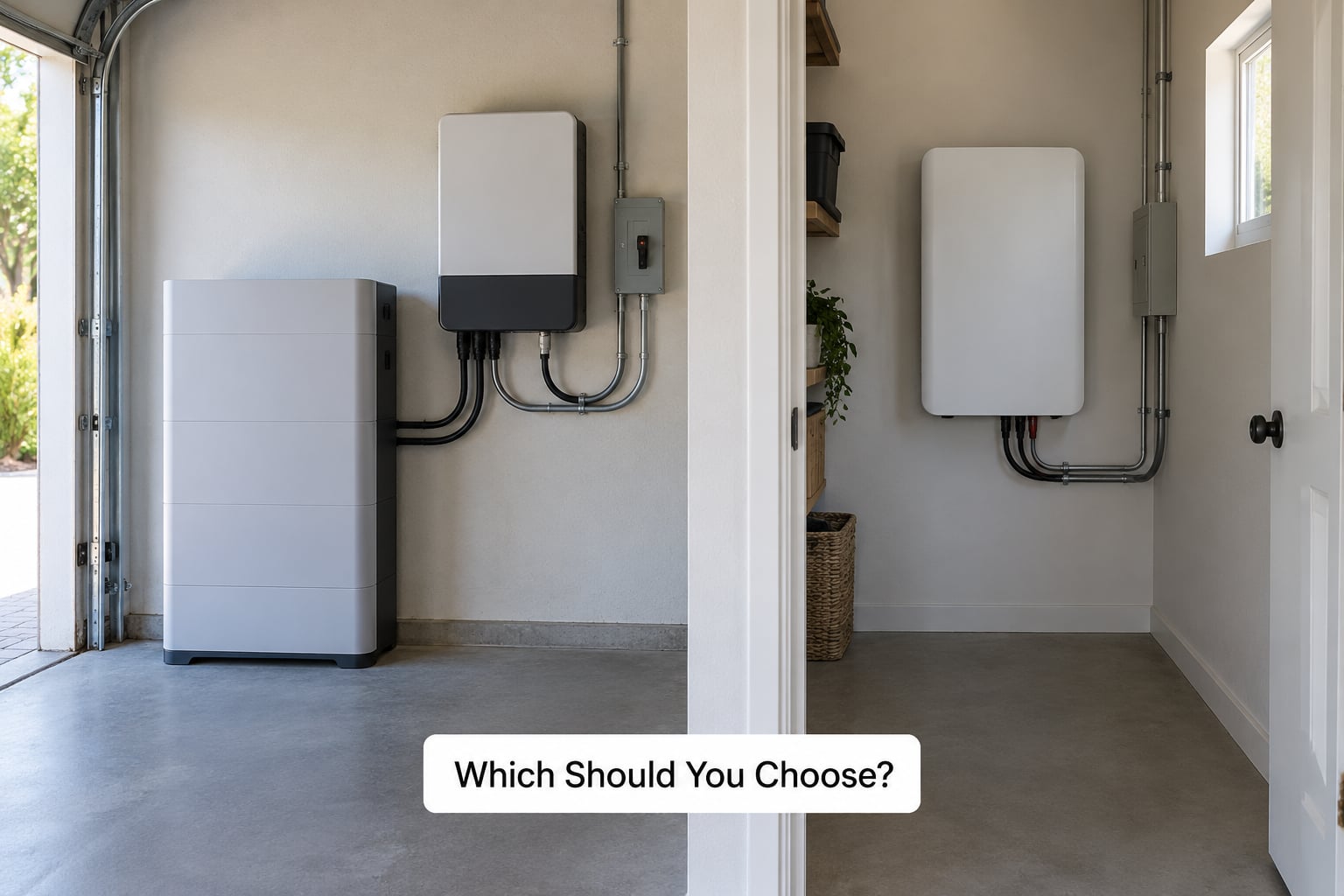
Choose LFP for almost every whole-home decision. If your system cycles daily, sits in a garage, or has to run medical equipment, a sump pump, or a well pump, the longer cycle life and wider thermal margin pay for the extra weight every time.
Choose LFP specifically for:
- Whole-home backup, where starting a large motor and holding a stable voltage matter more than footprint.
- Grid-tied solar storage, where daily cycling rewards the 2x to 3x cycle difference and the 95 percent round-trip efficiency directly increases self-consumption.
- Off-grid cabins and remote power, where a battery that still works after fifteen years beats a lighter one you replace twice.
- Cold or unheated spaces, provided the pack has low-temperature charge protection or self-heating.
- Lead-acid replacements, where LFP typically triples the usable capacity for the same footprint and drops the watering, corrosion, and ventilation chores entirely.
Consider higher-density lithium-ion only when the constraint is real and named. A tight mechanical room with a fixed shelf size, a retrofit where the floor loading cannot take the extra weight, or a site needing high continuous discharge from a small pack are legitimate reasons. Write the constraint down and confirm the installer agrees with it, because most such sites turn out to fit LFP once someone measures.
For small low-voltage DC systems, including solar garden lighting and off-grid lighting runs, both chemistries work. Low-voltage LFP packs have good cycle life and a wide safe charge window, which suits unattended equipment, while denser lithium-ion can pack more runtime into a box nobody wants to dig a trench for. Match the charge controller profile either way, and check the low-temperature floor if the pack lives outside.
For a first-time buyer, the buying guide comes down to six lines on a spec sheet. Confirm the chemistry label, since a pack marked lithium-ion may be either. Read the nominal and full charge voltages. Find the usable depth of discharge. Check the cycle count and the warranty in years, and whether the cycle cap overrides the year cap. Confirm the low-temperature charge cutoff. Then verify inverter compatibility, DC voltage window, and parallel expansion limits.
Frequently Asked Questions
Can I connect lithium iron phosphate and other lithium-ion home batteries together?
No. LFP and NMC or NCA cells have different nominal voltages and charge ceilings, so a shared bus would drive some cells past their safe maximum. Parallel strings must use the same chemistry, the same nominal voltage, and a matched BMS. Run separate inverters or separate DC circuits instead, and let each system run its own charge profile.
Do lithium iron phosphate batteries work with any home inverter?
Not any, and plenty of manuals make that clear. Many hybrid inverters in recent years support LFP only and will refuse to negotiate with an NMC pack, while a few older units are NMC-only. Check the inverter manual for the supported chemistry and DC voltage window, then confirm the battery’s maximum continuous discharge and the maximum number of parallel strings. A licensed electrician should confirm the settings.
Can I mix battery brands or replace only one module in a lithium-ion battery system?
In one system, no. Manufacturers match modules internally by capacity, impedance, and age, and a mismatched module ages faster than the rest and can drag the whole pack down. When you replace within warranty, get an identical module from the same maker with the same chemistry and firmware. Running two different battery systems on one inverter is a different question, and only works if the inverter is documented for it.
What battery temperature range should I check before installing a home battery?
Check the charging temperature floor first, because that is where LFP installs fail. Most LFP packs block charging below roughly 0C unless they have internal self-heating. Note the maximum operating temperature too, which is usually around 40C, and keep the enclosure out of direct sun with airflow clearance. For a garage in a cold climate, a heated or self-heating pack is the safe choice.
How can I tell whether a home battery uses lithium iron phosphate or another lithium-ion chemistry?
Use the voltage, since it is the giveaway. An LFP cell is nominally 3.2 to 3.3V and charges to about 3.65V, so a 12V LFP pack floats near 13.6V. NMC and NCA cells are nominally 3.6 to 3.7V and charge to 4.2V, putting a 12V pack near 14.7V. A label saying only lithium or lithium-ion tells you nothing, so confirm the charge voltage in writing before buying.
What happens to lithium iron phosphate and lithium-ion batteries at end of life?
Retired packs do not just vanish. A recycler takes the cells apart to recover lithium, nickel, cobalt, and iron, and the recovered material goes back into new cells. Some manufacturers and installers offer take-back or recycling programs, and a few offer partial credit toward a replacement. Ask what the take-back terms are before you buy, since disposal rules differ by country, state, and municipality.
Conclusion
Lithium iron phosphate vs lithium ion home batteries comes down to one trade: give up about a third of the energy density and you get two to three times the cycle life, a far wider thermal margin, and a chemistry with no cobalt in it. For a house that cycles, that is a good deal. For a very tight space where weight cannot be accommodated, the denser nickel-based chemistries still make sense.
Start with four things before you pick a brand. Size the bank in usable kilowatt-hours for the loads you actually care about, not nameplate capacity. Confirm inverter compatibility, including chemistry, DC voltage window, and parallel limits. Compare warranty years and cycles side by side with usable capacity and round-trip efficiency. Then get a site-specific quote that includes the electrical work, the permit, and any cold-weather provisions.