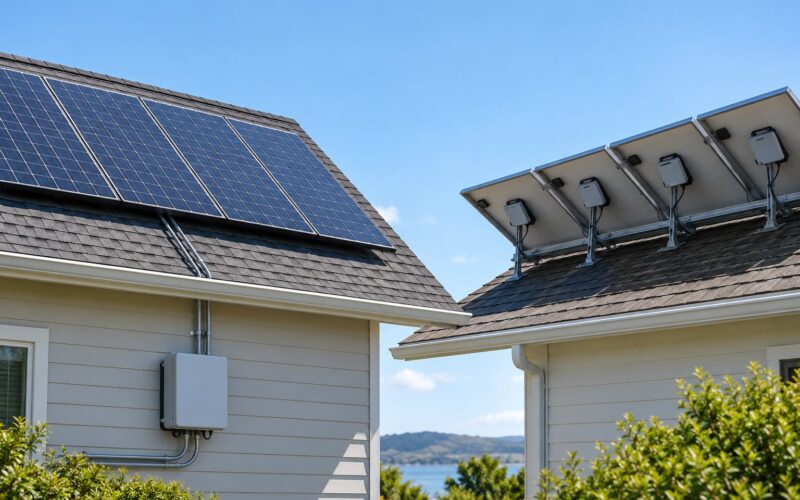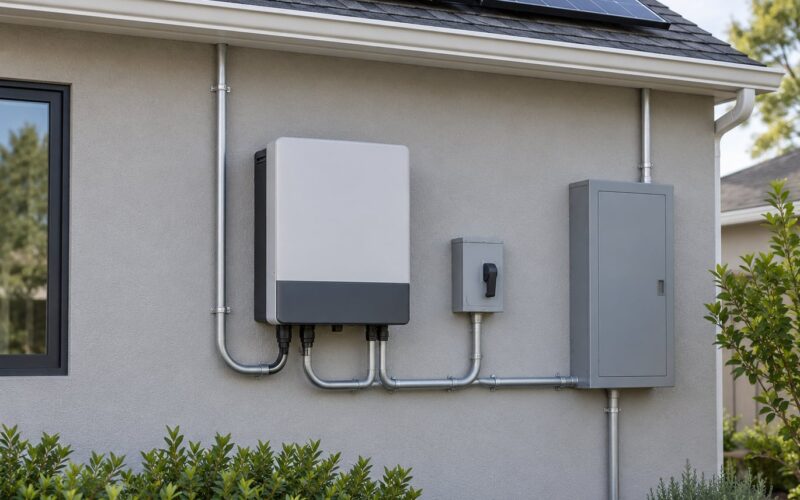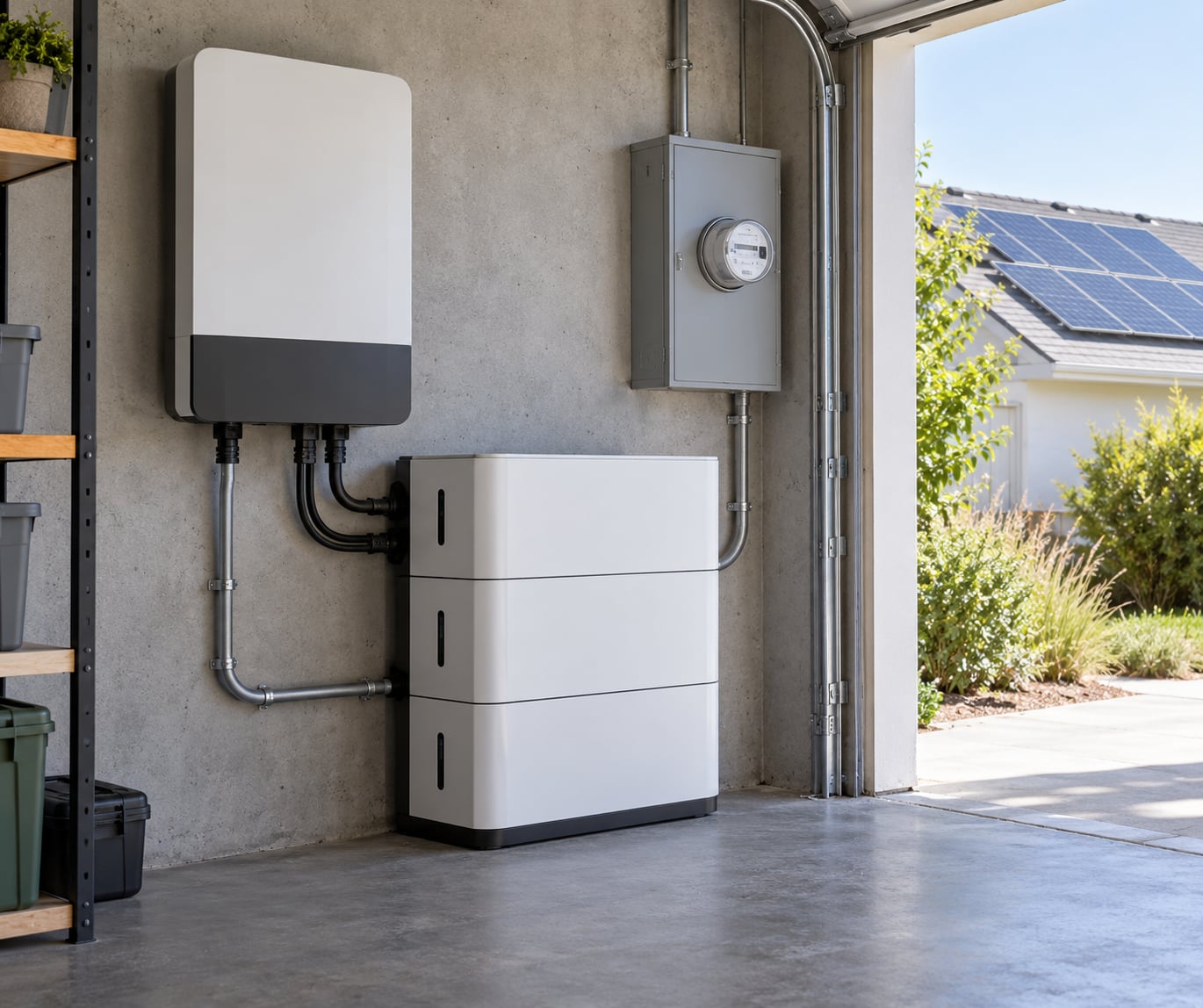
A hybrid inverter is a single device that combines a solar inverter, a battery inverter/charger and an MPPT solar charge controller into one unit. That one box turns your panels’ direct current into household alternating current, decides what to do with the surplus, and can carry your essential circuits through an outage.
Most people arrive at this question after a solar quote mentions batteries. The jargon gets thrown around loosely, so it’s worth knowing exactly which box does what before you sign anything. I’ll walk through the pieces, the day-to-day energy flow, the honest downsides, and the handful of specs that actually decide whether a given model fits your home.
Table of Contents
- What Is a Hybrid Inverter? Three Functions in One Box
- How Does a Hybrid Inverter Work?
- The four things a hybrid inverter manages
- Where the power goes when solar is high or low
- Hybrid Inverter vs. Standard Solar Inverter
- Where a string or microinverter still wins
- What Are the Main Benefits of a Hybrid Inverter?
- What Are the Limitations and Risks?
- What you should not plug into a hybrid inverter
- How Do You Choose the Right Hybrid Inverter?
- Battery compatibility is the first filter
- Continuous output and surge power
- Then work through the rest
- How Is a Hybrid Inverter Installed?
- Frequently Asked Questions
- Do I need a battery to use a hybrid inverter?
- Can a hybrid inverter work during a power outage?
- Is a hybrid inverter the same as a solar inverter?
- How long does a hybrid inverter last?
- Can I add a hybrid inverter to an existing solar system?
- Conclusion
What Is a Hybrid Inverter? Three Functions in One Box
The term gets used loosely in sales conversations, so it helps to pin down what the box actually contains. A hybrid inverter bundles three separate pieces of equipment into a single chassis, and each one handles a different direction of energy flow.
The solar inverter is the part that converts the DC coming off your panels into AC your appliances can use. The battery inverter and charger handle the battery bank in both directions: charging it from whatever spare energy is around, then converting it back to AC when you need power. The MPPT charge controller is the piece that finds the most efficient operating point on your panel string and pushes that harvested energy where it needs to go.
A standard grid-tied solar inverter does only the first job. It converts DC to AC, feeds your house, and pushes anything extra out to the utility through the meter. The moment the grid goes down, most of them shut right down, because grid-tied units are not allowed to power a house on their own.
That single difference is why people ask the question. A hybrid inverter can sit between the grid, the panels and the battery and arbitrate between all three, and many models will pick up the load themselves in an outage without you touching a switch.
How Does a Hybrid Inverter Work?
The four things a hybrid inverter manages
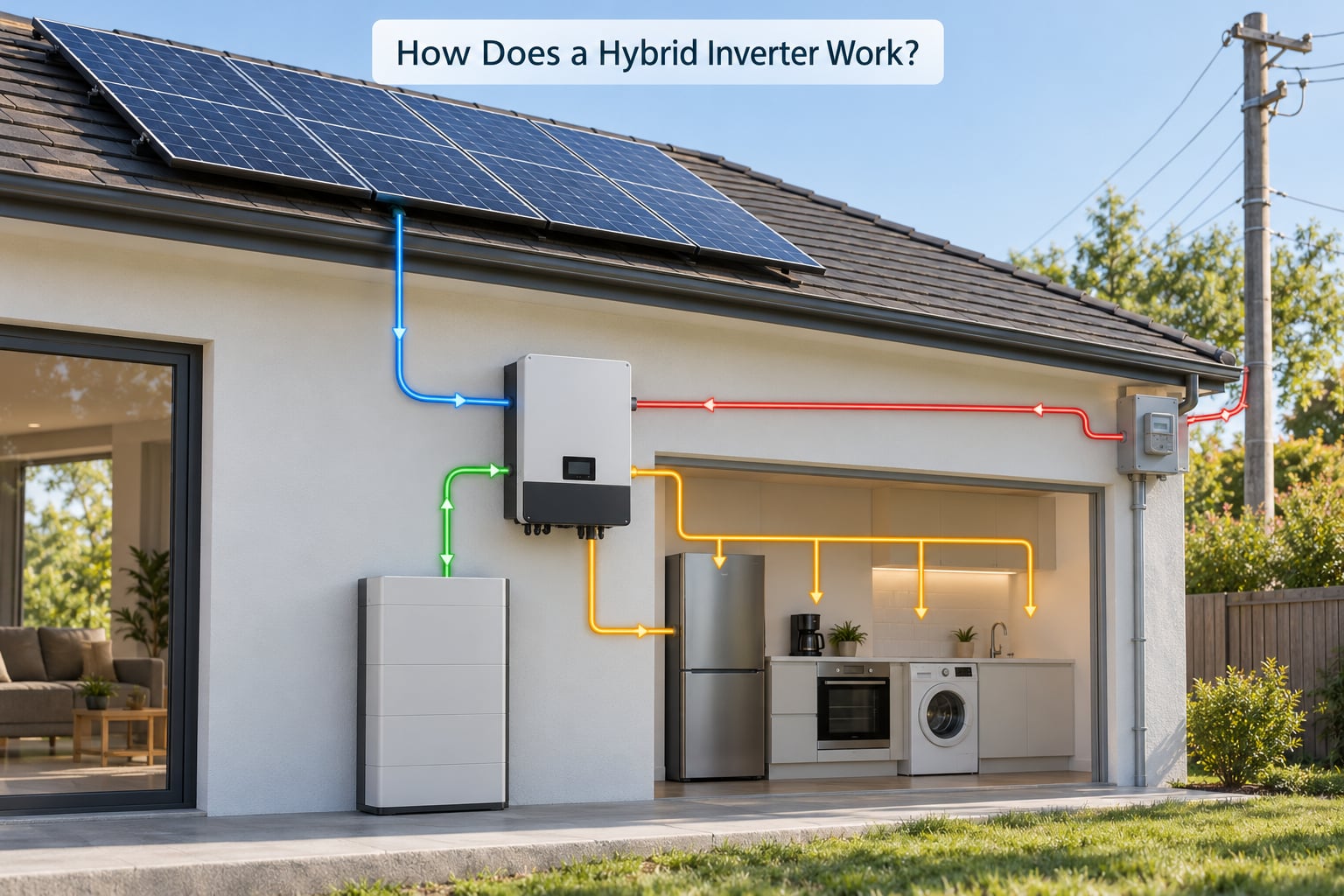
Every hybrid system has four hardware nodes, and the inverter is the traffic controller sitting in the middle of them.
- The PV array — your panels, feeding DC into the MPPT inputs.
- The battery bank — usually a 48V (51.2V nominal) LiFePO4 stack that stores energy in DC.
- The grid or a generator — the AC supply that tops up what solar and battery can’t cover.
- The household AC loads — everything from your fridge to your well pump.
The inverter measures what each side is doing and blends the sources. On a bright afternoon you might have 3 kW coming from the roof, a 2 kW deficit at the house, and the inverter supplying the difference from the battery instead of pulling it from the utility. That’s source blending, and it’s the core of how a hybrid inverter behaves in a real home.
Where the power goes when solar is high or low
When solar production is high and the house uses less than the panels produce, the surplus has somewhere to go. Most hybrid inverters prioritise charging the battery, then send the remainder to the grid if export is enabled, or hold it back if you have configured zero export.
When solar is low — a cloudy afternoon, or after dark — the inverter discharges the battery first if your settings say to. Only when the battery hits its configured floor does it pull from the grid, and the charge point for that decision is set in the monitoring app rather than in the wiring.
During an outage, a hybrid with backup capability opens its transfer switch and forms a small island with your battery and the essential circuits. Transfer times on current models are typically in the range of a few milliseconds to around ten, fast enough that most laptops, routers and TVs never notice the switch happened.
Hybrid Inverter vs. Standard Solar Inverter
| Consideration | Hybrid inverter | Standard grid-tied string inverter |
|---|---|---|
| Battery built in | Yes, battery inverter and MPPT charge controller in the same chassis | No, solar inverter only |
| Backup power in an outage | Yes on models with a backup output, for essential circuits | No, unit shuts down when the grid dies |
| Standalone off-grid use | Yes, it forms its own grid | No, requires the utility |
| Equipment count on the wall | One main unit plus the battery | Inverter plus a separate charge controller and battery inverter if storage is added later |
| Upfront equipment cost | Higher, and only partly justified without a battery | Lower, the cheaper starting point |
| Install complexity | More wiring: battery, backup panel, grid tie, generator input | Simpler, panels straight to inverter |
| Shading tolerance | One MPPT tracker per input, so a shaded string drags the whole input down | Same limitation; this is where microinverters and optimisers win |
| Best fit | Homes with frequent outages, high tariffs or planned storage | Homes on net metering with reliable grid and no storage plans |
Where a string or microinverter still wins
None of this makes hybrids the automatic winner. If your roof has two or three trees throwing shade across different parts of the array, panel-level electronics handle it far better than a single MPPT tracker, because one shaded panel no longer drags down its neighbours.
Microinverters also give you per-panel monitoring, which is genuinely useful when something underperforms. The trade-off is that most microinverter systems have no clean path to a battery, so if storage is on your list for later, a hybrid is usually the more sensible starting point. That’s the honest version of the comparison, and it’s the one most competitors skip.
What Are the Main Benefits of a Hybrid Inverter?
Backup power for the circuits you care about. Fridge, internet, lights, a freezer in the garage. It’s not whole-home by default — the backup output is usually a smaller subset of your main panel — but it covers the loads that actually hurt when they stop.
Higher self-consumption. Instead of exporting midday power at whatever your utility pays, you store it and use it in the evening when you’re drawing from the grid anyway.
Time-of-use scheduling. On a peak pricing plan you can charge the battery from cheap off-peak grid power, or from a free midday solar window, and discharge it into the expensive evening hours. Settings like these do the work automatically once you set them.
One box instead of three. Fewer devices to mount, fewer failure points, one commissioning screen, usually one monitoring app. It also means the battery inverter and the MPPT controller are matched to each other by the manufacturer rather than by you.
Storage-ready designs. Plenty of hybrid models ship without a battery fitted and accept one later, which lets you put solar in now and add storage when the budget or the tariff makes sense. Check the wording carefully, though — some units need the battery present at commissioning and will not start without it.
Generator input. Most have a dedicated generator port that can auto-start a generator when the battery hits a state-of-charge threshold you set, which is common where outages are frequent.
What Are the Limitations and Risks?
Nobody wins a sale by dwelling here, so this is the section to read before you commit to anything.
- You pay more before the battery exists. A hybrid inverter costs more than a plain grid-tied unit, and that premium buys you nothing until storage is actually installed. People who never add a battery bought a feature they never used.
- Battery compatibility is not automatic. Owners on solar forums report charging faults from mixed-brand pairings when the inverter firmware cannot talk to the battery’s BMS over CAN or RS485. Check the manufacturer’s supported-battery list before buying either half.
- Voltage matching matters. A 24V battery bank on a 48V inverter, or the reverse, will not work, and the failure can be expensive rather than obvious.
- Sizing errors are the top install mistake. Undersize the inverter and motor starts trip it; oversize it and you’ve paid for capacity you never use.
- Heat shortens inverter life. People troubleshooting premature failures point at airflow and placement more than anything else. A unit crammed into a hot closet dies early.
- It is not a surge protector. Switching on a compressor or a kettle demands a burst of current well above the running draw. Internal protection exists, but a proper surge protection device on the board is still worth installing.
- Firmware and app dependence. Commissioning, tariff schedules and export limits are often set through vendor software, and some functions shift between versions.
- Backup is only as good as the panel wiring. Essential circuits have to be moved to a separate backup panel, and that is electrical work for a licensed installer.
What you should not plug into a hybrid inverter
Avoid running heavy motor and heating loads straight off the backup circuit: refrigerators, freezers, air conditioners, water pumps and compressors, kettles, microwaves, space heaters and power tools. Their start-up surge is many times their running wattage, which is what trips the inverter into a protective shutdown.
Sensitive electronics deserve their own thought too. A pure sine wave output is much cleaner than a modified sine wave, but medical or audio equipment with its own regulation should sit on a properly conditioned outlet rather than being assumed fine.
How Do You Choose the Right Hybrid Inverter?
Battery compatibility is the first filter
Start with the battery, not the inverter. Confirm the chemistry and nominal voltage the model expects — 48V with a 51.2V LiFePO4 bank is common — and then confirm the BMS communication protocol. If the unit only lists a specific battery family, plan to buy from that family; it removes the most common source of support headaches.
Continuous output and surge power
Read two numbers, not one. Continuous power is what it delivers all day; surge rating is the short burst it can handle at start-up. Size continuous output to your essential loads plus headroom, and check that the loads you care about during an outage stay under the continuous figure, not just the surge one.
Then work through the rest
- Pure sine wave output — treat anything else as a dealbreaker for a modern home.
- MPPT voltage window and input count — your string voltage has to sit inside it, and you’ll want enough inputs if part of the array faces a different direction.
- Phase and voltage — single phase for most homes; check what your supply actually is before ordering.
- Export control — zero-export mode matters if you cannot export or do not want to.
- Monitoring — a good app showing power flow, battery state of charge and fault codes saves calls later.
- Grid support features — frequency shifting for high generator penetration is worth having in some regions.
- Warranty — on both the inverter and the battery, and check what it excludes.
How Is a Hybrid Inverter Installed?
Solar and electrical work like this belongs to a licensed electrician, and the grid-connected portion needs utility approval. The sequence is worth understanding even if you never touch a wire.
- Load assessment. Your essential circuits get measured and totalled so the inverter can be sized against them rather than guessed.
- Equipment selection. Inverter, battery, panels and any generator input, matched to each other before anything is ordered.
- Mounting. The unit goes where airflow is decent and sunlight is not, with clear working space around it.
- Wiring. Battery, PV input, grid tie and backup panel connections, all done and terminated by the licensed electrician.
- Commissioning. The installer sets battery chemistry, charge parameters, export limits and time-of-use schedules, then tests the outage transfer.
- Monitoring setup. The app is linked, alerts are configured, and someone in the household learns what the fault codes mean.
- Inspection and permission to operate. Electrical inspection and utility sign-off before the system runs grid-connected.
Frequently Asked Questions
Do I need a battery to use a hybrid inverter?
Not always. Most hybrid inverters will run grid-connected solar happily with no battery fitted, and models described as storage-ready are designed for a battery to be added later. Check the manual, because a few units will not power up or commission until a battery is connected. If you never plan to add storage, a standard grid-tied inverter is the cheaper, simpler choice.
Can a hybrid inverter work during a power outage?
Models with a backup output can, and they will form their own small grid using the battery and the connected panels. Only the circuits wired to the backup panel are powered, not the whole house. Transfer typically happens in a few milliseconds. Some cheaper units have no backup function at all, so confirm this specific feature rather than assuming it from the word hybrid.
Is a hybrid inverter the same as a solar inverter?
No. A solar inverter converts panel DC to household AC. A hybrid inverter does that and adds a battery inverter/charger plus an MPPT solar charge controller, so it can also store and release energy and often carry essential circuits during an outage. The extra capability is why hybrid units cost more than standard grid-tied inverters.
How long does a hybrid inverter last?
The inverter electronics commonly last somewhere in the region of five to ten years depending on heat, load and build quality. The battery is usually the shorter-lived component: a quality LiFePO4 bank is usually quoted in cycle counts and calendar years, and loses capacity gradually whether or not it is cycled. Budget for a battery replacement well before you expect to replace the inverter itself.
Can I add a hybrid inverter to an existing solar system?
Often, yes. If your existing panels feed an old grid-tied string inverter, the panels can usually be re-terminated into the MPPT inputs of a new hybrid unit, provided their string voltage falls inside the new inverter’s window. You may also need a different battery bank, updated balance of system equipment and utility approval. Have a qualified installer check the existing array before ordering anything.
Conclusion
A hybrid inverter puts three jobs in one box: converting panel DC to household AC, charging and discharging a battery, and harvesting solar efficiently through MPPT. That is what makes backup power and time-of-use savings possible, and it is why the units cost more than a plain grid-tied inverter.
Before you commit, write down three things: the loads you actually want kept alive during an outage, the battery capacity that would serve them, and the solar window your roof gives you. Take those to a qualified solar installer, who can size the unit around your real numbers rather than a rule of thumb.