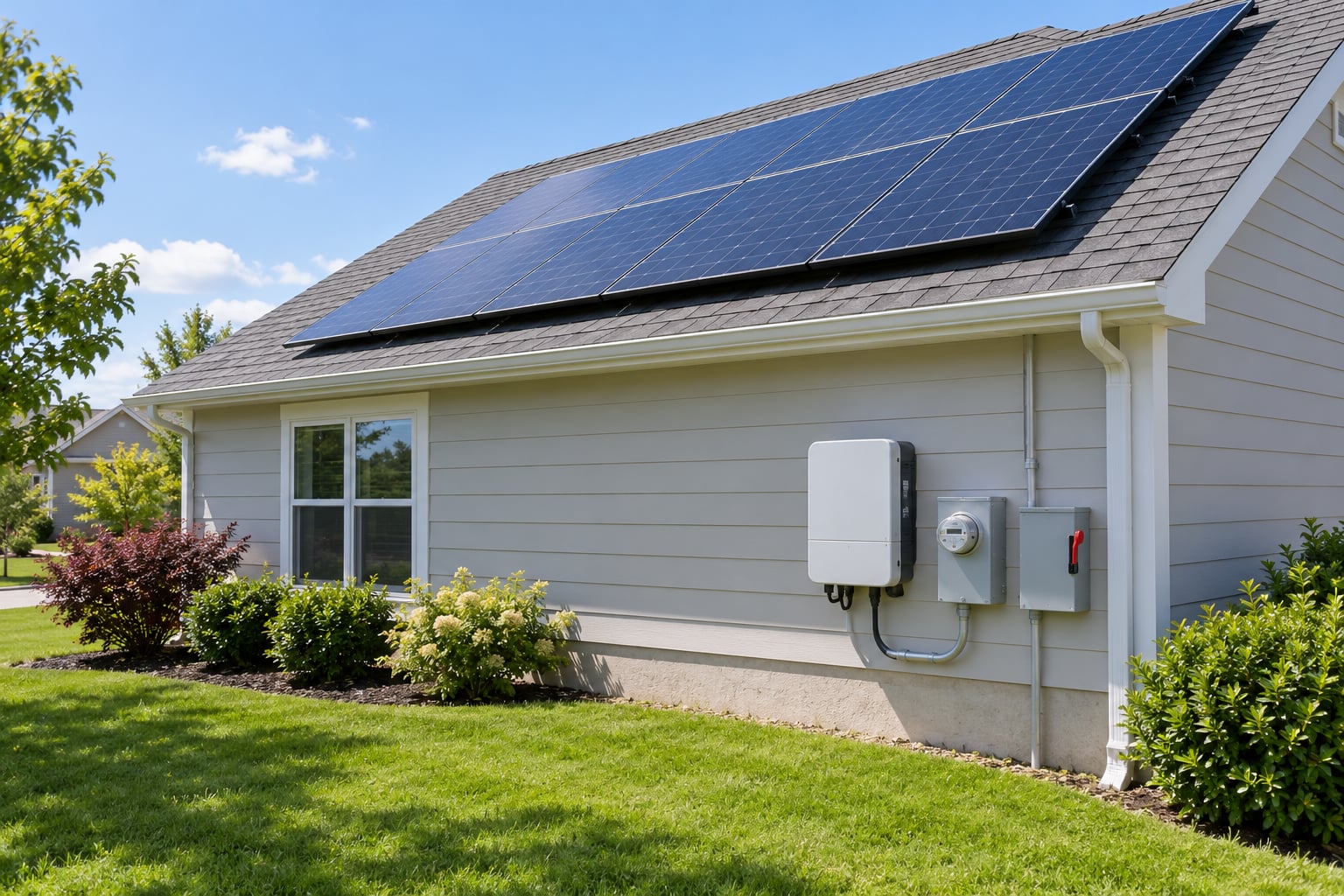
An interconnection agreement is the contract between a homeowner with rooftop solar or a home battery and the local utility that sets the rules for connecting that system to the electric grid. It spells out the technical standards, metering, costs and responsibilities on both sides, and it must be in place before your system is allowed to run.
Most people only notice this document when a project stalls. Panels go up, the inverter lights up, and then nothing happens until a signature lands. Knowing what the agreement actually does — and what it deliberately does not do — saves months of confusion.
This guide covers what an interconnection agreement is, what it covers, who signs it, how the process runs from application to permission to operate, and what it can cost. Rules change by state and by utility, so treat everything below as a working map of how these agreements work, not a substitute for your own utility’s application requirements.
Table of Contents
- Solar Grid Connection Basics
- What Is an Interconnection Agreement?
- What Does an Interconnection Agreement Cover?
- Who Needs to Sign an Interconnection Agreement?
- How Does the Solar Interconnection Process Work?
- How Is an Interconnection Agreement Different From a Net-Metering Agreement?
- What Will It Cost to Connect a Home Solar System?
- What Should a Homeowner Review Before Signing?
- Can You Install Solar Without an Interconnection Agreement?
- Frequently Asked Questions
- Is an interconnection agreement the same as a solar lease?
- How long does utility interconnection approval take?
- Does an interconnection agreement affect my electricity bill?
- What happens if I add panels after signing?
- Are interconnection agreement rules the same everywhere?
- Conclusion: What to Do First
Solar Grid Connection Basics
Solar only works on your roof, but the electricity your panels make has to travel onto a shared network owned and operated by someone else. That handoff is what the utility calls interconnection, and it is the reason a grid-tied system needs a formal agreement instead of just a permit.
Without one, the utility has no record of what equipment is coming onto its wires, no approved way to measure what flows in each direction, and no agreed rule for what happens during an outage. The agreement is how all three of those get settled on paper.
What Is an Interconnection Agreement?
An interconnection agreement is a legally binding contract between the owner of a distributed energy resource, such as rooftop solar or a home battery, and the local utility or grid operator. It records the technical and commercial terms for connecting that system to the electric grid.
Beyond that headline, the document is doing a lot of quiet work. It sets the technical standards the system has to meet, says who is responsible for what, puts a clock on the utility’s review obligations, defines how generation and consumption get metered, allocates costs, and lists the conditions under which the system can operate.
One clarification worth making early, because search results mix it up constantly: this is an energy document, not a telecom one. Telecom interconnection agreements govern how two networks physically link and how traffic moves between them. What follows is about the electric grid, and the homeowner is the customer.
What Does an Interconnection Agreement Cover?
Every utility’s form is worded differently, but the substance falls into the same set of provisions. Here is what you will find and why it matters.
| Provision | What it sets out |
|---|---|
| Equipment | Approved inverters and modules, nameplate capacity, voltage rating and the model list the utility accepts |
| Electrical requirements | Conduit, disconnects, service voltage, grounding, protection settings and the point of common coupling |
| Metering | Meter type, who installs it, who owns it, and how generation and export get measured |
| Operation | Permitted export capacity, any export limiter, anti-islanding protection and control during outages |
| Safety | Disconnect requirements, labelling, inspection access and conditions for utility disconnection |
| Billing and credits | How excess energy is measured and which tariff treatment applies, if any |
| Costs | Application, study, design review, metering and upgrade charges, and which party pays each one |
| Maintenance | Who keeps the equipment in working order and who responds to faults |
| Insurance and liability | Coverage the owner must carry, indemnification and limits of liability |
| Disputes and termination | Notice periods, complaint steps, and the conditions that end the agreement or force disconnection |
Read the equipment and export rows with the most care. Those two determine what your system is actually allowed to do once it is turned on, and a mismatch between the panels on your roof and the numbers in the agreement is one of the most common reasons a project gets sent back.
Who Needs to Sign an Interconnection Agreement?
The signature usually belongs to the system owner and the utility. In a third-party owned arrangement, where a company owns the panels and sells you the electricity, the owner of the system is the party that signs, not the homeowner, though you may still sign a separate power-purchase or lease contract.
An installer or designer often files the application and manages communication with the utility on the owner’s behalf. That is normal and efficient, but the authorization for it should be explicit. Homeowners on solar forums describe the confusion that shows up when an installer submits paperwork as the named party without a clear written mandate, and then the owner discovers it mid-project who is actually the customer of record.
Whatever the arrangement, two responsibilities stay with the homeowner. You pick the contractor, so you are the one who has to be comfortable that they are licensed and insured. And you stay responsible for complying with utility requirements and local electrical and building rules, even when the installer filed the paperwork.
All of that is advice about paperwork, not legal advice. If you are unsure what a specific form obligates you to, a local attorney is the right call.
How Does the Solar Interconnection Process Work?
The process is a sequence of milestones, and the single most useful thing a homeowner can do is learn the names because the utility will use them in every status update. A system that is installed, generating and switched off is usually sitting between milestone two and milestone six.
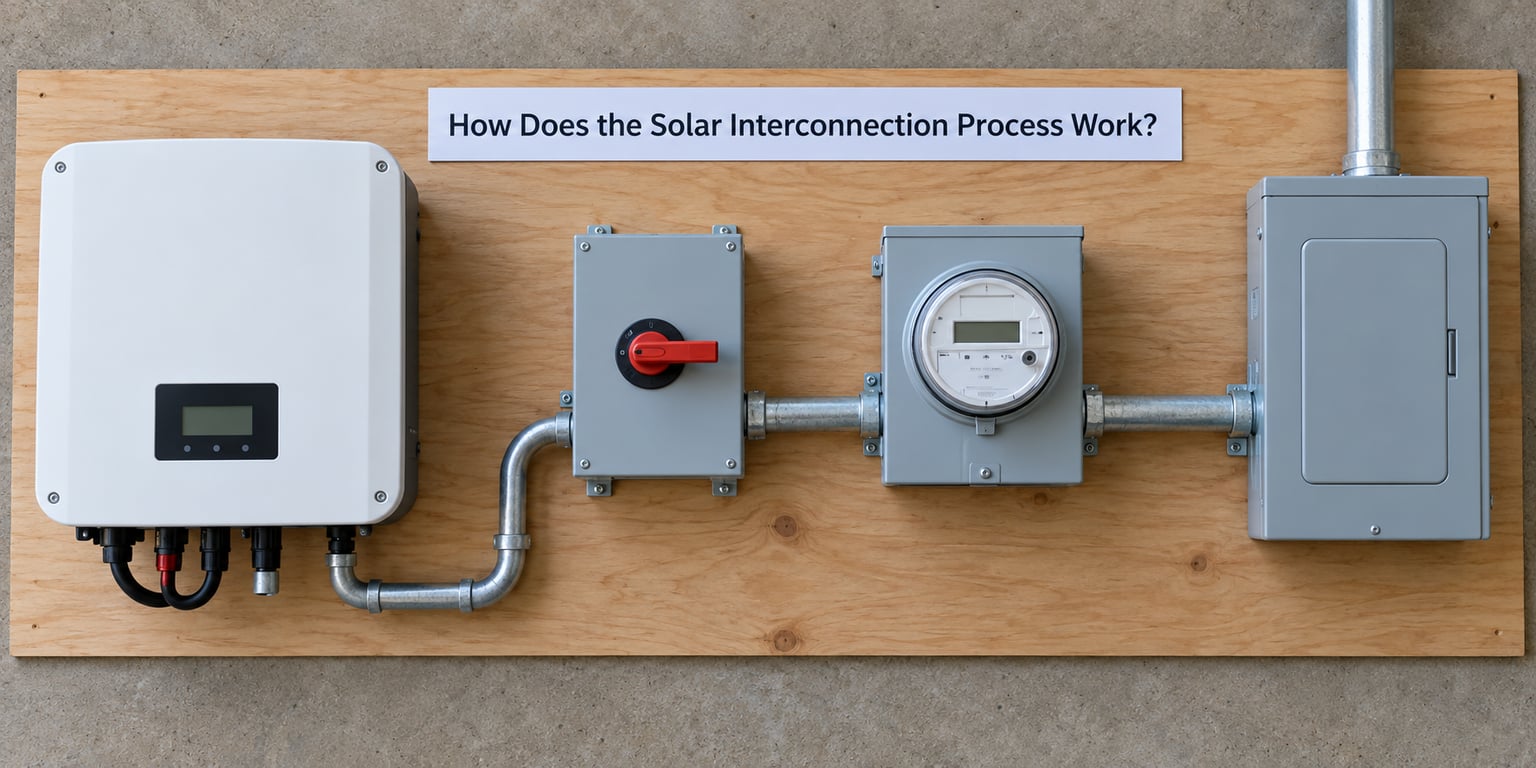
| Milestone | What happens |
|---|---|
| Interconnection application | Owner or installer submits system details, site address, equipment list and proposed capacity |
| Application accepted as complete | The utility confirms nothing is missing. This is not the same as approval |
| Design review or interconnection study | Utility engineers check the design and may model voltage, capacity and protection impacts |
| Agreement executed | Both parties sign. The system still is not authorized to run |
| Construction and inspection | Install, then the authority having jurisdiction inspects the work |
| Permission to operate | Utility issues PTO. Only now may the system energize and the meter start crediting |
| Final closure | Utility completes billing setup, final paperwork and test results |
Two real-world examples show how much variation there is. A homeowner on r/solar reports that adding a battery under an existing interconnection usually does not require a brand new agreement, while a panel addition often triggers a change. And a DIY homeowner in Massachusetts reports that no interconnection agreement is issued at all until an inspected system is already installed by a licensed electrician, which reverses the usual order entirely.
State rules matter too. California utilities have their own application tracks and equipment lists, and other states run on commission-approved tariffs with different processes. Never assume your neighbor’s timeline describes yours.
How Is an Interconnection Agreement Different From a Net-Metering Agreement?
These get conflated more than any other pair of solar documents. The interconnection agreement handles the physical and technical connection. The net-metering arrangement handles what happens to the energy you push onto the grid and how you are credited for it. Some utilities fold parts of both into a single application, which adds to the confusion.
| Point of difference | Interconnection agreement | Net metering arrangement |
|---|---|---|
| Core purpose | Permission to physically connect and operate in parallel with the utility system | Rules for measuring exported energy and crediting it on your bill |
| Answers the question | Can this equipment safely run on the grid | What each exported kilowatt-hour is worth to you |
| Governing document | The agreement itself plus the utility’s interconnection rules | The utility’s net metering tariff and state rules |
| Typical term | Long-lived, often continuing for as long as the system is connected | Frequently tied to a program, rate plan or a grandfathered agreement |
| Dependency | Required for any grid-connected system | Not always available; some systems export with little or no credit |
Owners with legacy net-metering agreements describe a specific kind of frustration: they paid a one-time fee years ago, have no recurring charges, and then watch a neighbor get billed for interconnection fees again. Those systems are not being charged twice, but the difference between an old and a new agreement can be hard to see without opening the paperwork.
What Will It Cost to Connect a Home Solar System?
There is no universal figure, and anyone quoting you a single national number is guessing. Costs fall into a handful of categories, and which ones you pay depends on your utility, your state and your project’s size relative to the local grid.
- Application and administrative fees. A flat charge to open the interconnection file. Some utilities refund part of this if the project completes, others do not, so ask about refundability before you pay.
- Design review and study costs. Engineering work the utility performs to check your design. A simple residential project may carry a small fixed charge, while larger systems get billed by the hour for detailed studies.
- Metering charges. A new meter or meter change-out, and sometimes a bi-directional meter. Some utilities cover this, others pass it to the customer.
- Upgrade costs. The big variable. If the study finds the feeder cannot absorb your output, the utility may require a transformer, switchgear or line upgrade, and the agreement often assigns that cost to the applicant.
- Inspection and permit fees. Usually local rather than utility charges, but they sit in the same approval sequence and delay the same milestones.
- Cancellation or withdrawal fees. Some utilities charge if you pull the application after a study has already been done. Worth asking about before you commit to a design.
The honest summary: the small administrative charges are predictable, and the upgrade category is where budgets get surprised. Get the cost responsibility language from the agreement itself rather than from a blog, and get it in writing before installation.
What Should a Homeowner Review Before Signing?
These forms run to dozens of pages and nobody reads them end to end. Read the rows below, then skim the rest for anything your state or utility has layered on.
| Topic | Question to ask |
|---|---|
| System size and export limit | Is the permitted export capacity the same as the nameplate capacity, and is a limiter required? |
| Equipment | Does the named inverter model appear on the utility’s current approved list? |
| Deadlines | What is the construction completion deadline, and what happens to the agreement if it passes? |
| Upgrade costs | Who pays for each study-identified upgrade, and is there a cost cap or security deposit? |
| Metering | Who owns the meter, who installs it, and who reads it for billing? |
| Insurance | What coverage is required, in what amount, and must the utility be named as an interested party? |
| Unauthorized changes | Does swapping equipment or adding capacity without written approval void the agreement? |
| Performance remedies | If the system is limited or disconnected, what happens to the agreement and to any compensation? |
| Cancellation terms | What fees apply if the project is cancelled after studies are complete? |
| Term and transfer | Does the agreement transfer automatically if the home is sold, or must it be re-executed? |
Two rows get skipped most often and both cause real problems later. The unauthorized changes row decides whether your battery add or inverter swap needs a fresh agreement or a formal amendment, and the transfer row decides what happens the day the house closes.
On changes after signing, the pattern homeowners report is simple: a battery added under an existing interconnection usually rides on the existing agreement, while more panels, a different inverter or a system upgrade is more likely to require a modification. Ask your utility directly rather than assuming, and get the answer before the crew is on the roof.
Can You Install Solar Without an Interconnection Agreement?
For a grid-tied system, no. A system connected in parallel with the utility network needs utility authorization, and the sequence ends with permission to operate. Running without it is not a shortcut; it is an unpermitted connection, and it exposes the owner to liability for anything that goes wrong on a circuit they share with everyone.
A genuinely stand-alone system is different. An islanded installation with its own battery and no grid connection does not involve the utility at all, and that is a legitimate design choice with real trade-offs, including no grid support during an outage beyond what the battery holds.
There is also the DIY grey zone people argue about online. Building and even energizing your own system is a legal grey area whose answer changes with state, county and utility. Get the project-specific answer from your utility and from a licensed electrician before installing anything.
Everyone involved should work from the manufacturer’s specifications and the local electrical code, and the actual work belongs with a licensed professional. That is not a formality; interconnection is exactly the kind of project where a well-meaning shortcut creates a problem that surfaces years later.
Frequently Asked Questions
Is an interconnection agreement the same as a solar lease?
No. A solar lease is a financing contract between you and a provider that lets you use a system you do not own. An interconnection agreement is between the system owner and the utility, and it governs how the system connects to the grid. In a leased or third-party owned system, the provider signs the interconnection agreement and you sign the lease or power-purchase contract.
How long does utility interconnection approval take?
It varies widely by utility, state and project size. A straightforward residential system can move through in a few weeks, while projects needing studies or upgrades can take several months. Delays cluster at design review, when a utility may request changes for voltage rise or protection settings, and again while waiting for assignment of a reviewer. Ask your installer for the utility’s current historical timeline before you commit to a construction date.
Does an interconnection agreement affect my electricity bill?
Indirectly, yes. The agreement itself does not set your rate; your retail rate and any net metering or export compensation come from the utility’s tariff and state rules. What the agreement does is determine how your system is metered and how much energy is credited back. Whether you gain anything from exported power depends on your utility’s export rules, which vary widely and have changed in many states.
What happens if I add panels after signing?
Adding capacity usually requires a formal modification to the existing agreement rather than a brand new one, and the new capacity may be subject to a different export limit. Your utility needs to review the change because the feeder study was based on the original system size. Get written approval before any equipment is ordered or installed, and confirm with your installer who files the modification.
Are interconnection agreement rules the same everywhere?
No. Each utility publishes its own application process, fee schedule and technical requirements under state public utilities commission rules, and some states have additional state-level requirements. That is why one neighbor’s project moves in three weeks and another takes months. The agreement you actually get is the one from your own utility, and the version filed publicly in your state is the reference worth reading.
Conclusion: What to Do First
An interconnection agreement is what allows your solar or battery system to legally connect to and run on the grid, and it decides the technical limits, the costs and the responsibilities for the life of the connection. Signed does not mean finished, which is why permission to operate is the milestone that actually matters.
Contact your utility before you sign anything with an installer, and ask for the current application requirements for a project your size. Have a qualified solar installer or licensed electrician review the proposed system against the utility’s technical requirements, and read the equipment, export limit and upgrade cost rows before you sign. Those three sections cause most of the surprises.
Rules and tariffs change, so this guide is current as of 2026 and your utility’s own published application is the version that governs your project.