If you are weighing solar lease vs buying panels explained, the short version is this: a lease keeps the panels off your balance sheet and off your closing paperwork, while buying puts an asset on your roof that you own, claim incentives for, and hand to the next buyer. Most homeowners who stay in their home for a decade or more come out ahead owning. People who cannot fund a purchase, expect to move soon, or do not want to manage equipment sometimes have good reason to lease.
Everything else is detail, and the detail matters more than the sales pitch suggests. A lease is a 20 to 25 year financial commitment with an annual increase built into it. A purchase is an asset with a payback period and a resale payoff. Below is what each one actually involves, what it costs over the full term, and the contract details worth checking before you sign anything.
Table of Contents
- Solar Lease vs Buying Panels Explained at a Glance
- What Is a Solar Lease?
- What Does Buying Solar Panels Mean?
- Solar Lease vs Buying Panels: Upfront Cost and Monthly Payments
- Solar Lease vs Buying Panels: Ownership and Control
- Solar Lease vs Buying Panels: Maintenance, Repairs, and Equipment Risk
- Solar Lease vs Buying Panels: Savings, Incentives, and the Contract
- How to Compare the Total Cost of a Solar Lease and Panel Purchase
- Glossary of the terms you will meet
- When Leasing Solar Panels May Make Sense
- When Buying Solar Panels May Make Sense
- Questions to Ask Before Signing a Solar Agreement
- Which Should You Choose?
- Frequently Asked Questions
- Is it better to lease or buy solar panels?
- Do you own the panels if you sign a solar lease?
- Can you claim tax credits with a leased solar system?
- What happens to leased solar panels when you sell your home?
- Who is responsible for maintaining leased solar panels?
- Can you buy out a solar lease later?
- Bottom Line
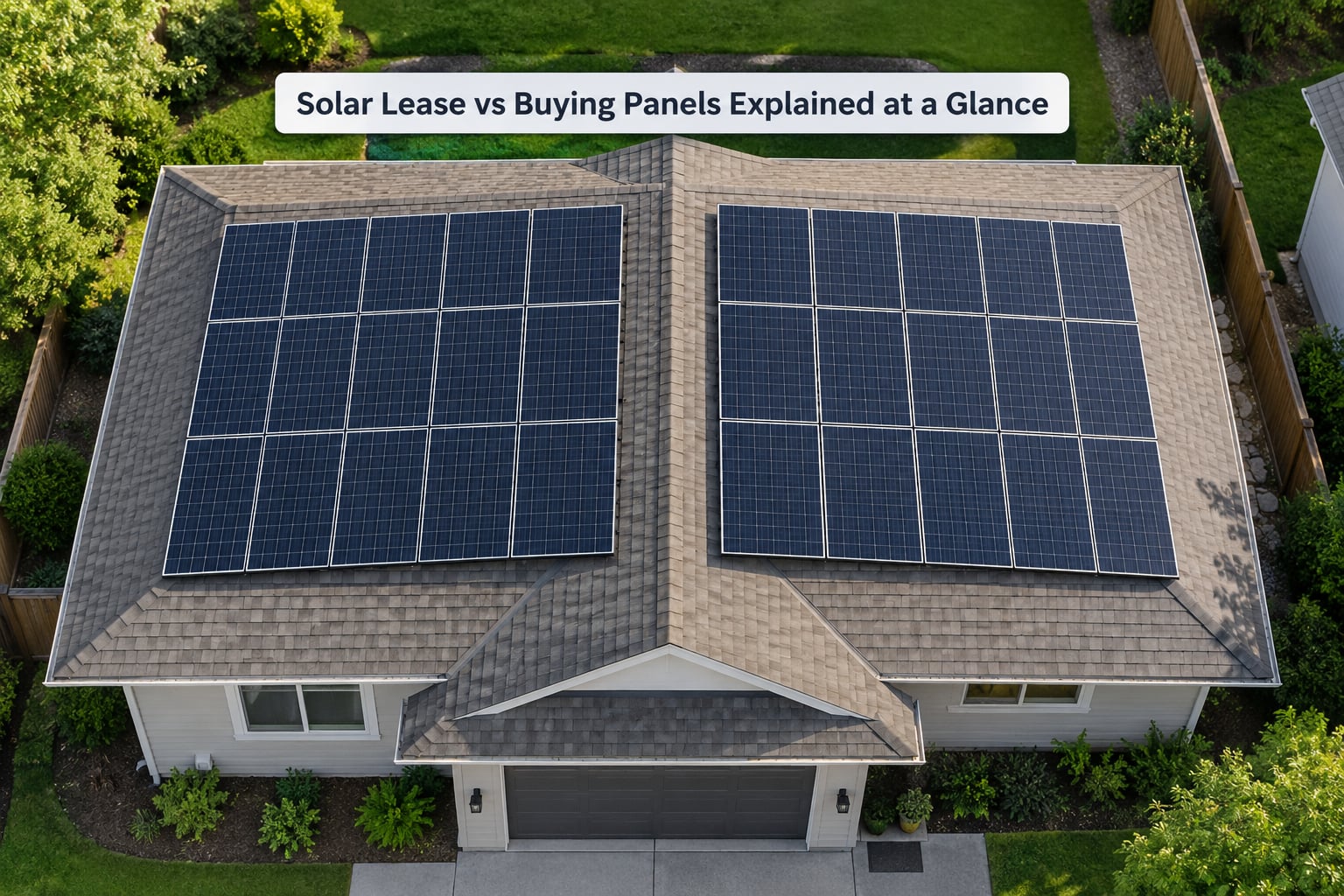
Solar Lease vs Buying Panels Explained at a Glance
| What changes | Solar lease or PPA | Buying the panels |
|---|---|---|
| Upfront cost | Little to none | Full system cost in cash, or financed over 10 to 25 years |
| Monthly payment | Set by contract and usually rises each year | Loan payment that stays level, then stops entirely |
| Who owns the system | The solar company | You |
| Who claims the incentives | The solar company | You, if you qualify |
| Maintenance and repairs | Company’s responsibility, per the contract | Your responsibility, or covered by warranties and insurance |
| Contract term | Typically 20 to 25 years | No contract; you own the asset outright |
| Inverter replacement | Handled by the company | Your cost, typically a major unplanned expense |
| Roof replacement | Company may control removal and reinstallation timing | Your call, your contractor, your schedule |
| Selling the home | Buyer must qualify and assume the lease, or you buy it out | Panels sell with the house, no qualification step |
| End of term | Buyout at fair market value, renewal, or removal | Nothing; you keep producing |
The single biggest difference in that table is the row nobody advertises: with a lease, the company owns the equipment, collects the incentives, and prices the contract to recover both over two decades. You are buying electricity, not solar panels.
What Is a Solar Lease?
A solar lease is a financing arrangement where a company installs panels on your roof and you pay a fixed monthly fee for the electricity they produce. The equipment stays the company’s property for the whole term, usually 20 or 25 years.
Many leases are structured as a power purchase agreement, or PPA, and the two get talked about as if they are the same thing. They are close. A lease bills you a flat monthly amount no matter how much power the system makes that month. A PPA bills you a set rate per kilowatt-hour, so a sunny month costs more than a cloudy one. Either way, you do not own the panels.
Three features define almost every lease contract. First, an annual escalator, typically between 1.5% and 3% a year, that raises the payment once a year and is the single most important number in the document. Second, a production guarantee, often around 95% of the promised first-year output with a small allowed annual decline, which protects you if the system underperforms. Third, a buyout clause that tells you what it costs to take ownership partway through, usually based on fair market value.
Leases often come with zero down payment and, depending on the provider, no hard credit check. That accessibility is the pitch, and for some households it is the whole reason the deal works.
What Does Buying Solar Panels Mean?
Buying means the system is yours. You pay for it outright, or more often you fund it with a solar loan, a home equity loan, a personal loan, or a PACE assessment added to your property tax bill. With a loan you still own the panels the day they go on the roof; you are simply repaying the purchase over time.
Because you own the asset, you claim the federal residential clean energy credit and any state or utility rebates you qualify for. Those programs have been rewritten more than once, most recently by the 2025 legislative changes, so treat any figure a salesperson gives you as suspect until you confirm the current rules for your situation at IRS.gov and DSIRE. DSIRE tracks state and utility programs in one place.
Ownership also puts you in charge of maintenance, monitoring, inverter replacement, and insurance claims. Most panels carry 25 year performance warranties and inverters run 10 to 25 years, so budgeting for at least one inverter replacement over a system’s life is sensible. Homeowners insurance frequently treats solar as part of the structure and covers fire and storm damage, but coverage varies enough that you should confirm in writing.
Solar Lease vs Buying Panels: Upfront Cost and Monthly Payments
This is where the two paths look most different, and most misleading. A lease advertises a monthly payment that sounds like an electric bill, sometimes lower than the bill it replaces in year one. That comparison flatters the lease, because it measures year one against a bill that rises while the lease payment also rises.
Owning the same system with a loan means a larger monthly payment at the start, since you are repaying principal and interest, and then nothing at all once the loan is cleared. Forum discussion on r/solarenergy and r/Frugal makes the recurring point that homeowners describe paying more with a lease than with grid power alone once the escalator is counted. One homeowner described a lease payment that was still costing noticeably more per year than the utility bill it was supposed to replace.
The honest framing is that a lease spreads a purchase price across 20 to 25 years at a high rate, while a loan spreads it across 10 to 15 years and then ends. Longer term, higher interest, no incentives, and no asset at the end are what separate them.
Solar Lease vs Buying Panels: Ownership and Control
Ownership is not a formality in a lease. The company that owns the equipment usually decides when it is installed, when it is removed, and who works on your roof. If you need a new roof, re-roofing, or have a leak traced to a penetration point, the contract may give the company scheduling rights over that work.
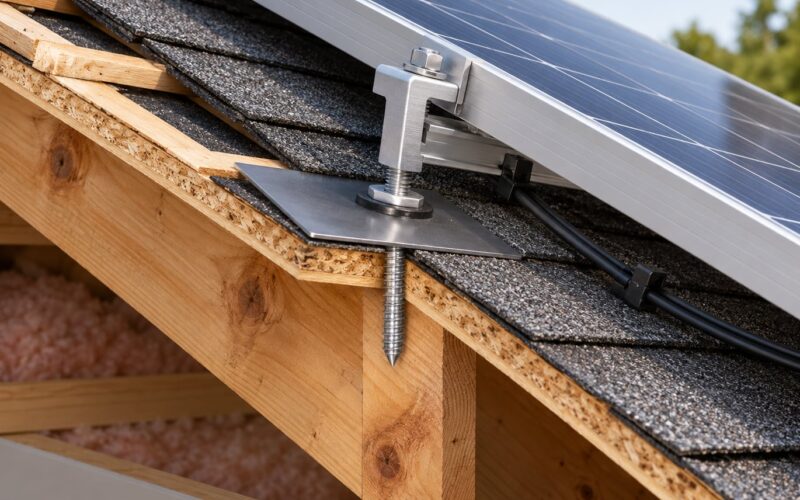
Leased systems are also mounted with more attachment points than a typical owner-installed array, because nothing can be glued or ballasted if it has to come off later. Fire code rules in many jurisdictions limit how much of a roof a third-party system may penetrate. That limit is commonly described as the 33% rule, and it can cap system size on a steep or complex roof. Owned systems can be laid with lighter racking and fewer penetrations, so the same roof often allows a bigger array for the homeowner.
If you want panels removed, relocated, or resized mid-term, a lease makes it a negotiation with a counterparty who has no obligation to agree. With ownership, it is your roof and your call.
Solar Lease vs Buying Panels: Maintenance, Repairs, and Equipment Risk
Under a lease, the company handles inverter replacement, panel damage from hail or a fallen tree, monitoring software, and most repairs. That is a real benefit for anyone who does not want to hunt for a contractor when an inverter fails at 8pm on a Sunday.
The catch is the contract language. Ask precisely what is covered: labour only, parts only, or both; whether there is a trip fee; whether storm damage counts; whether the company can replace your inverter with a different model. One r/solar buyer reported being offered a lease with a 95% first-year production guarantee and a 0.5% annual decline cap, a genuinely strong guarantee. Guarantees are common. They say nothing about the escalator, which is where the money moves.
When you own the system, you absorb the risk and also the upside. Warranties from the panel and inverter manufacturers apply to you, so keep the paperwork and the serial numbers, and register the system. Read your homeowners policy for solar coverage. Owners have more to lose to a missed warranty step, but nobody can leave them with an inverter bill at the end of a term.
Solar Lease vs Buying Panels: Savings, Incentives, and the Contract
Any savings claim should be treated as arithmetic, not marketing. Ask for the modelled bill with and without solar over the full term, including the utility rate escalation assumption, the degradation rate, and the lease escalator. Vendors frequently show only the optimistic half of that comparison.
Federal and state incentives are the biggest quiet differentiator, because ownership is the trigger. The company in a lease claims the federal residential clean energy credit and keeps it. Homeowners who buy can claim what they are entitled to. Rules, percentages, and eligibility have changed repeatedly, and the still-ranking pages out there quote figures from the 2024 era, so verify current details for your own home at IRS.gov and DSIRE rather than trusting a blog or a salesperson.
On the contract side, the numbers to find are the annual escalator and its cap, the buyout schedule by year, the roof penetration and roof work rights, the removal cost at end of term, the production guarantee, the transfer rules, and the early termination fee. If a document is missing one of those, treat that as an answer in itself.
How to Compare the Total Cost of a Solar Lease and Panel Purchase
Do not compare monthly payments. Compare everything, over the same number of years, with the same assumptions. Here is a five-minute method you can run yourself on a notepad.
Start with one system size in kilowatts and one quoted price for that exact size from each side. Then line up four totals for each option: what you pay out of pocket on day one, what you pay in interest over the financing, what you pay in total to the company across the term, and what you receive in incentives. Add the endgame: for the lease, the buyout price at the end of the term or the removal cost; for the purchase, the value of the system and what it adds to the home at resale.
Run it over 25 years for both so the terms line up. A 25 year lease against a 12 year loan is not a fair race unless you add up what happens in years 13 through 25, when the loan is gone and the panels are still producing for free while the lease payment keeps climbing.
Then repeat with conservative assumptions: utility rates rising slowly, panel output declining at the usual rate, and the lease escalator at the top of its stated range. If buying still wins under the pessimistic case, the decision is easy. If it only wins under the optimistic case, the lease deserves a serious look.
Glossary of the terms you will meet
Power purchase agreement (PPA): you buy the electricity at a set rate per kWh rather than paying a flat lease fee. Net metering: the credit for exported power at the same rate you pay for imported power. Annual escalator: the yearly percentage increase in your lease payment. Fair market value buyout: the lump sum to take ownership before or at the end of a lease. UCC-1 lien or UCC-3 filing: a public record that a company filed against your property as security, which a buyer’s title company will see. PACE: property-tax financing repaid on your tax bill. Degradation: the annual drop in panel output, usually under one percent a year.
When Leasing Solar Panels May Make Sense
Leasing is defensible in specific situations, and pretending otherwise is not useful to anyone standing on your roof. It makes sense when cash is genuinely unavailable and no lender will approve you. It makes sense when you expect to sell within about five years and the transfer rules make ownership unlikely to pay off. It makes sense when your credit history or lack of collateral rules out a loan.
It also makes sense when you plan a full roof replacement in the next couple of years and do not want to negotiate with a lease company about taking panels off. And it makes sense when you genuinely do not want to own equipment. Some people would rather hand over a problem than think about it again, and that is a legitimate preference, not a character flaw.
Two more situations where leasing holds up. Renters, condo owners and HOA residents usually cannot install owned panels at all, since they do not control the roof, which makes shared or community programs the only route. And developers in new-construction communities sometimes offer a lease option instead of rolling solar into the unit price, which can be the simplest choice for someone who plans to be there a while anyway.
When Buying Solar Panels May Make Sense
Buying wins when you plan to stay a long time. The payback period on a purchased system commonly lands somewhere in the seven to ten year range, after which every kilowatt-hour is free, while a lease escalates for the full 20 to 25 years. Anyone who stays past that point is paying a contractor to own an asset they will never own.
Buying also wins when incentives are available to you. Since ownership is the trigger for the federal credit and for many state programs, buying is the only way to capture that value. It wins when you value control over your roof, want the system to sell with the house, and expect your own energy use to stay predictable so the system sizes correctly.
Owned panels also transfer cleanly at a sale. There is no credit check for the buyer and no 2 to 6 week qualification process, a delay that forum buyers describe as a real risk of deals collapsing at the last minute. Buyers in r/BayAreaRealEstate consistently treat owned panels as a resale asset and leases as a lower payment in exchange for owning nothing.
Questions to Ask Before Signing a Solar Agreement
Insist on the lease or PPA document itself, not a summary sheet, and read these ten items before you sign anything.
- What is the annual escalator, and is it capped?
- What is the buyout price in year 1, year 10, and year 25?
- Who files a UCC-1 lien or UCC-3 financing statement against the property?
- What happens to the lease if you sell, refinance, or die?
- Must the buyer qualify with a credit check, and on what terms?
- What are your rights to remove, relocate, or resize the system?
- Who pays for roof removal and reinstallation, and what does it cost?
- What exactly does maintenance cover, including parts, labour, and trip fees?
- What is the production guarantee and the allowed annual decline?
- What are the early termination and arbitration clauses?
Two warning signs worth naming. The first is a salesperson who will not let the contract leave the property. The second is urgency, especially a same-day sign or a door-to-door offer that appeared uninvited. Take the document home, and give it to a real estate attorney if you are buying or selling within a few years. The FTC publishes guidance on solar sales tactics that is worth reading before the visit.
Which Should You Choose?
Buy the panels if you expect to stay five years or longer, can fund the system with cash or a loan, and want the incentives, the resale benefit, and full control of your roof. That is the majority of homeowners who are in a position to choose.
Lease if you cannot fund a purchase, if credit rules out borrowing, if you are selling soon, if the roof needs work first, or if you would rather hand the whole responsibility to someone else and stop thinking about it. Leasing under those conditions is not a failure of financial planning. It is the option that fits the situation.
The middle case worth thinking hard about is the solar loan. Many homeowners skip it because the monthly payment looks worse than the lease payment, but a loan buys the same asset a cash purchase would, in nearly every other respect.
Frequently Asked Questions
Is it better to lease or buy solar panels?
Buying is usually better value if you plan to stay five years or more, can fund the system, and want the incentives, the resale benefit and control of your roof. Leasing fits when cash is unavailable, credit rules out a loan, you are selling within a few years, or you do not want to manage the equipment. The decision comes down to time on the roof and who owns the asset.
Do you own the panels if you sign a solar lease?
No. The solar company owns the panels, the inverter and the production for the entire 20 to 25 year term. You pay for the electricity they generate, and the company keeps any incentives it claims. You can become the owner later, but only by paying the buyout price set out in the contract, which is based on fair market value.
Can you claim tax credits with a leased solar system?
Not the federal residential clean energy credit, because ownership is the trigger for claiming it. The solar company claims it instead and builds that value into your payment. Some states offer property tax or rebate programs that reach lessees, though it varies widely. Check your own eligibility at IRS.gov and DSIRE, since these rules have changed repeatedly and most ranking pages still quote outdated figures.
What happens to leased solar panels when you sell your home?
The buyer has to qualify for and assume the lease, or you buy out the contract before the sale. Qualification takes roughly 2 to 6 weeks and the company can reject a buyer who does not pass its credit standards, which can sink a deal at the last minute. Owned panels avoid all of this: they sell with the house and no one has to qualify.
Who is responsible for maintaining leased solar panels?
The solar company is, under the terms of the contract. That normally covers inverter replacement, panel damage, monitoring software and most repairs. Ask exactly what is included: labour only, parts only, trip fees, and whether storm damage counts. Purchased systems shift all of that to you, though manufacturer warranties still apply if you register the equipment and keep the paperwork.
Can you buy out a solar lease later?
Yes, and the contract sets the price. Most leases let you buy the system at fair market value at any point, and the schedule should list what you would owe in year 1, year 10 and year 25. Near the end of the term that figure can exceed what the equipment is realistically worth, so read the schedule before you sign rather than assuming an exit is cheap.
Bottom Line
Solar lease vs buying panels explained comes down to two questions: how long will the panels stay on your roof, and who owns them when they do. If the answer is a long stay and you can finance the system, buy. If cash, credit or timing makes ownership impossible, lease deliberately and read the escalator and buyout schedule first.
Get three current quotes for the same system size, run each one through the total-cost method above over 25 years, and check the incentive rules for your own address at IRS.gov and DSIRE before you sign. That hour of homework is what keeps a twenty-year contract from becoming a twenty-year regret.