Wiring solar panels in series stacks their voltages together while current stays the same; wiring them in parallel stacks their currents together while voltage stays the same. Total wattage comes out identical either way, so the choice is really about cable size, shade behaviour and whether your charge controller will wake up in low light. Getting how to wire panels in series vs parallel right is what separates an array that quietly wastes harvest from one that produces what its nameplate promises.
There is a third option almost everyone ends up using eventually: series-parallel, where you build identical series strings and then parallel those strings together. That hybrid usually gives the best fit for a real roof, a real battery bank and a real charge controller. As of 2026, the panels and controllers on the market have enough published specifications that you can do the whole calculation on paper before you touch a single connector.
One warning before anything else. Solar panels produce power the moment light hits them, and there is no off switch. Covering them with an opaque cloth is the only way to de-energise them, and even then the back sheet is not a guarantee. Plan on working with the array disconnected from the controller rather than trying to make the panels themselves dead.
Table of Contents
- How to Wire Panels in Series vs Parallel at a Glance
- What Happens When You Connect Panels in Series?
- What Happens When You Connect Panels in Parallel?
- How to wire panels in series vs parallel safely
- Series vs Parallel: Voltage, Current, and Power
- Which Connection Handles Shade and Mismatched Panels Better?
- How Cables, Fuses, Breakers, and Controllers Change the Choice
- Common Wiring Mistakes to Avoid
- Which Panel Wiring Method Should You Choose?
- Frequently Asked Questions
- Can I mix series and parallel connections in one solar panel array?
- Is it better to connect solar panels in series or parallel?
- What happens if I connect panels with different wattages?
- How many solar panels can I connect in series or parallel?
- Do I need an electrician to wire solar panels?
- Conclusion
How to Wire Panels in Series vs Parallel at a Glance
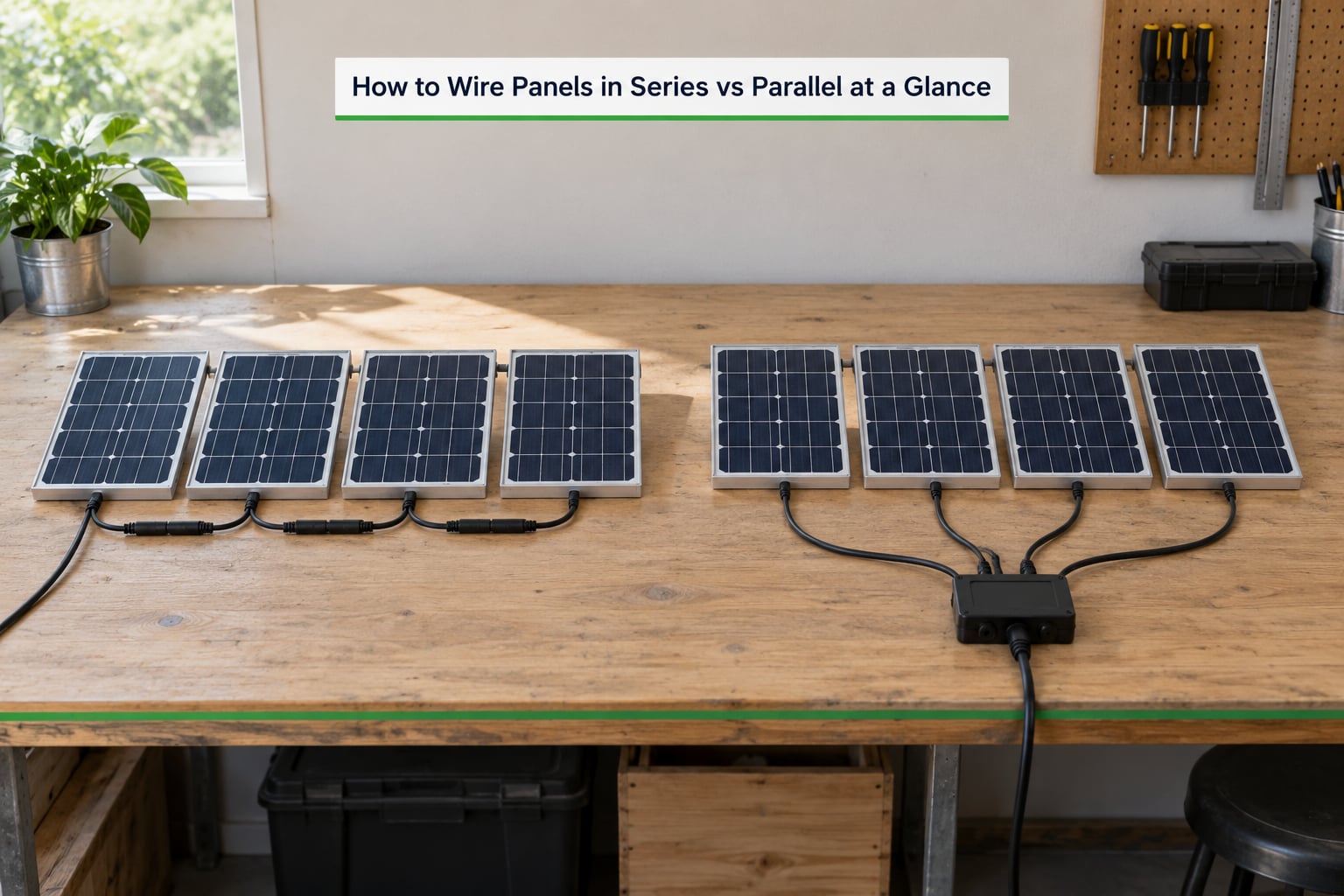
| Factor | Series | Parallel | Series-Parallel |
|---|---|---|---|
| Voltage | Adds up. Three 38V panels make about 114V. | Stays at one panel’s voltage, about 38V. | Adds up within each string only. |
| Current | Stays at one panel’s current, about 10.5A. | Adds up. Three panels make about 31.5A. | Adds up between strings. |
| Total watts | Same as parallel. The wattage never changes. | Same as series. The wattage never changes. | Same again, once every string matches. |
| Cable run | Carries less current, so thinner wire works. | Carries the combined current of every panel. | Middle ground, split into two runs. |
| Shade tolerance | Poor. One shaded panel drags down the whole string. | Better. A shaded panel only loses its own share. | Compromise, one lost string instead of all. |
| Controller fit | Needs an MPPT with a high max input voltage. | Needs an MPPT or PWM rated for the summed current. | Usually the cleanest fit for both limits. |
| Battery match | Suits 24V and 48V banks. | Suits 12V banks. | Fits a 48V bank from 12V panels. |
| Best for | Unshaded roofs, long cable runs, 48V banks. | Partly shaded roofs, 12V banks, small RV arrays. | Most home systems and anything you plan to expand. |
What Happens When You Connect Panels in Series?
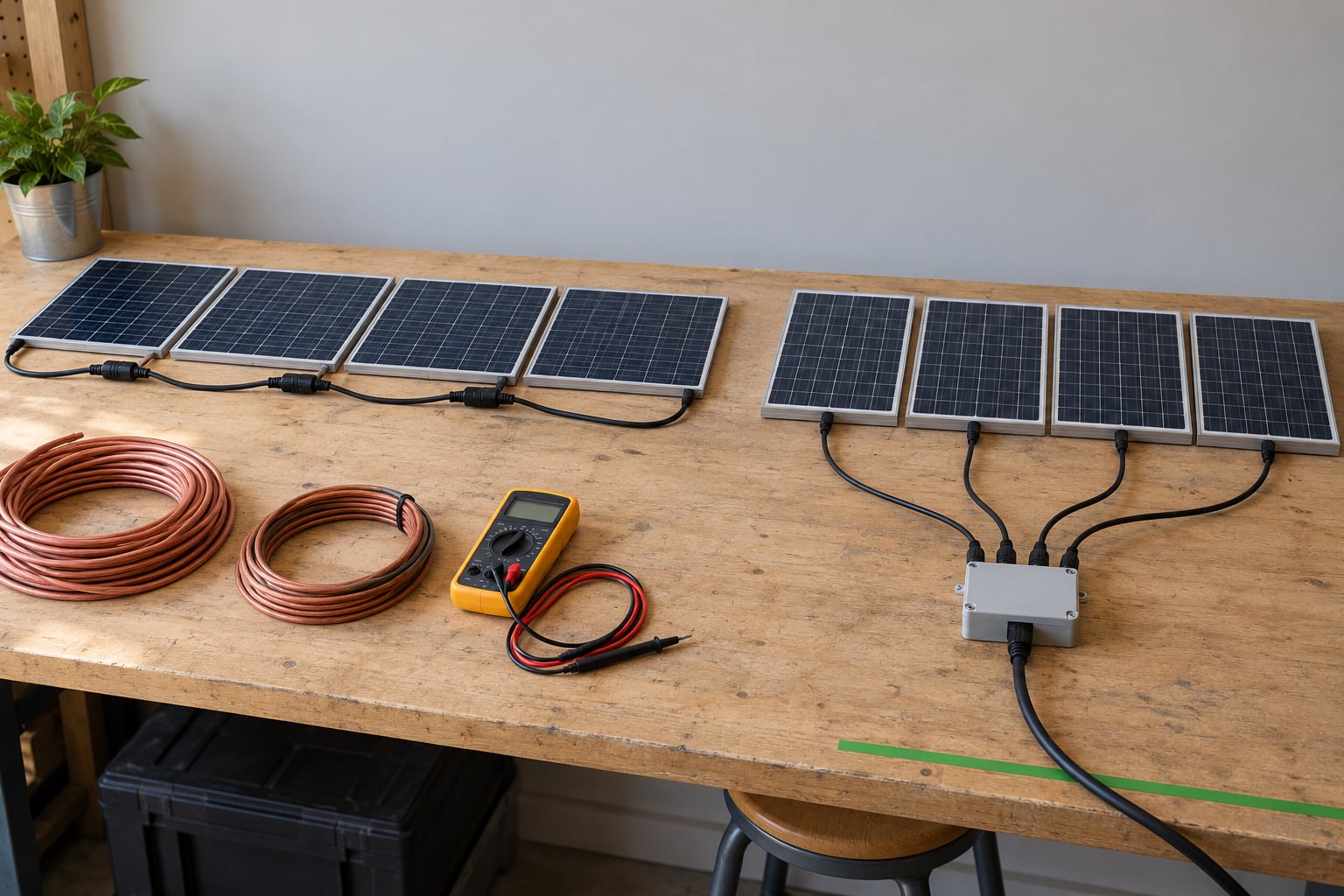
In a series connection you run a cable from the positive terminal of one panel to the negative terminal of the next, and keep chaining until you reach the far end of the row. Every volt one panel makes gets added to every volt the others make. Current takes the path of least resistance, so the whole string moves only as much current as its weakest panel can carry.
That is the bit that trips people up. Series does not mean the strongest panel wins. String a 400W panel and a 100W panel end to end and the current settles at the 100W panel’s rating, which on a typical 400W panel nameplate means 2.6A instead of 10.5A. The 400W panel still sits there generating, but that surplus is wasted as heat inside the cheaper panel.
Panels in a series string also have to match closely on current rating. Vmp and Voc can differ a little without drama, but a big gap in Imp means the whole string runs at the lowest current in it. The most common version of this mistake is a van or boat owner trying to make a single string out of two different panel types, and the honest answer is one controller input per panel type.
What Happens When You Connect Panels in Parallel?
Parallel wiring joins all the positive terminals together and all the negative terminals together, so each panel pushes its current into the same two conductors. Voltage is set by the panels themselves and stays at one panel’s rating. Three 38V panels in parallel still give you roughly 38V, but the current goes up to about 31.5A.
Every panel needs its own path to the junction point. Two positives tied directly together on the roof is not a parallel string, it is a loop with no protection, and current will find the least resistant path through it. Use proper branch or Y-branch MC4 connectors so each panel joins the bus through its own lead.
Panels going into the same parallel group should share the same voltage and current rating. If one string sits at a higher voltage than another, current flows backwards out of the weaker string and into the stronger one all day, which is the failure mode battery installers keep warning about on the DIY forums.
How to wire panels in series vs parallel safely
Six habits cover nearly every safe install. First, read the charge controller or inverter manual before you mount a single panel and write both limits down: maximum PV input voltage and maximum input current. Second, keep the panels disconnected from the controller until the array measures what you expect. Third, use the connectors and cable the panel manufacturer specifies, rated for PV service and outdoor exposure. Fourth, measure the finished array in full sun before and after connecting. Fifth, never work on the controller side while the panels are lit. Sixth, and most importantly, if your local rules require a permit or a licensed electrician for this work, stop and use one.
These rules are not decoration. NEC Article 690 sets a 600V DC ceiling on residential PV circuits, and Article 690.9 requires overcurrent protection per string once you have three or more parallel strings. Your breaker box or disconnect rating is part of the same calculation, not a separate detail.
Series vs Parallel: Voltage, Current, and Power
Watts equal volts times amps, so as long as you keep both numbers correct the total power is fixed. Take a common 400W panel with Voc around 46V, Vmp around 38V, Imp around 10.5A and Isc around 11.5A. That nameplate spread is the whole story of series versus parallel in four numbers.
Three of those panels in series give you 3 x 38V = 114V at the maximum power point, and 3 x 46V = 138V open circuit. Current stays at 10.5A, or 11.5A with the terminals shorted. Output is 114V x 10.5A = 1197W, which is three panels at roughly 400W each, minus normal losses.
Three in parallel give you 38V at the maximum power point and 46V open circuit, with current at 3 x 10.5A = 31.5A working and 3 x 11.5A = 34.5A short circuit. Output is 38V x 31.5A = 1197W. Same watts. Very different cable and controller requirements.
Series-parallel is just arithmetic on top of that. Two strings of two panels in series, written 2S2P, give 76V at 21A for 1596W. Three strings of two, 2S3P, give 76V at 31.5A. A common 4S3P build, twelve panels, gives 152V at 31.5A for 4788W. The shorthand is just S for panels in series per string, P for parallel strings.
Cable sizing is where the difference bites. Size conductors on Isc multiplied by 1.25, never on Imp. Three panels in series carry 14.4A of design current, so 12 AWG PV wire is comfortable to roughly 40 feet. Three in parallel carry 43A, and the same run wants 10 AWG. On a long cable run the higher series voltage also cuts percentage voltage drop, since drop depends on current and cable resistance, not on voltage.
One sizing detail catches experienced installers out: cold weather pushes open-circuit voltage above the nameplate figure. A panel rated at 46V Voc can read 52V or more on a clear winter morning, which is why string length is always checked against the controller’s maximum with the temperature correction applied.
Which Connection Handles Shade and Mismatched Panels Better?
Parallel wins on shade, and it is not a subtle difference. Every panel on a solar module has bypass diodes that let current step around the cells when a panel is partly shaded. In a parallel array, a shaded panel simply produces less current while the rest carry on. In a series string, one shaded panel raises the resistance of the whole chain, so every panel in it backs off to match.
How badly is worth quantifying. A ten-panel series string running at 38V per panel that drops to 30V on one panel can lose 30 to 50 percent of the string’s output, not 10 percent. Bypass diodes reduce the damage but do not remove it, which surprises people who assume the built-in diodes solve shading completely. It is the single most common complaint from DIY installers: the whole array collapsing in the afternoon when one panel sits under a vent or a roof edge.
Mismatched panels follow the same split. In series, everything is capped by the lowest current panel. In parallel, a weaker panel just contributes less current and the rest are unaffected. The destructive case is parallel strings built from panels with different voltage ratings, where the higher-voltage string pushes current backwards into the lower one.
How Cables, Fuses, Breakers, and Controllers Change the Choice
Series lets you use thinner cable, which is a real saving on a long run to a shed or an inverter at the back of the house. Parallel puts every panel’s current in the same conductors, so that run is heavier cable, more copper and a bigger disconnect.
Protection requirements follow the current. Per-string overcurrent protection is required for three or more parallel strings, and many installers fit fuses on two-string arrays too because the price is trivial against the cost of one reverse-current event.
The controller is usually what actually decides the layout. A PWM controller needs array voltage close to battery voltage, so it suits 12V panels on a 12V bank and does poorly with a series string on a low-voltage bank. An MPPT controller accepts either and tracks the panel’s real maximum power point, but it has a minimum start-up voltage that a low-voltage parallel array may never reach. That plays out in plain numbers: a parallel array sitting at 38V feeding a controller with a 32V minimum on a 24V system can simply never climb high enough on a cloudy morning to wake up.
Two numbers govern controller sizing, and both have to hold at once. Maximum PV input voltage must exceed string Voc, panel count and cold correction. Maximum input current must exceed array Isc multiplied by 1.25. You can oversize on the current side, because unused current capacity simply goes unused, but you must never oversize on the voltage side.
Microinverters and power optimizers sidestep the whole question. Each panel gets its own conversion, so there is no string voltage to calculate and shading affects only that panel. That is worth considering before you commit to a topology your roof will fight you on.
Common Wiring Mistakes to Avoid
- Exceeding the controller’s input voltage. Add one more panel to a string and the open-circuit voltage may pass the limit on the coldest morning of the year, not on the day you commissioned it.
- Mixing panel models inside one series string. Differing current ratings quietly cap the whole string at the weakest panel.
- Joining parallel strings of different voltage. The stronger string pushes current backwards into the weaker one.
- Skipping branch protection. Three or more parallel strings need per-string overcurrent protection under NEC 690.9.
- Sizing wire to Imp instead of Isc. Use Isc multiplied by 1.25, always.
- Connecting or disconnecting panels while the system is live. Follow the controller manual’s shutdown order; do not improvise it.
- Ignoring grounding on the PV side. Stray current to ground quietly bleeds away amperage and can trip protection.
- Believing series-parallel needs an even panel count. It does not. What matters is that every parallel string is identical.
Which Panel Wiring Method Should You Choose?
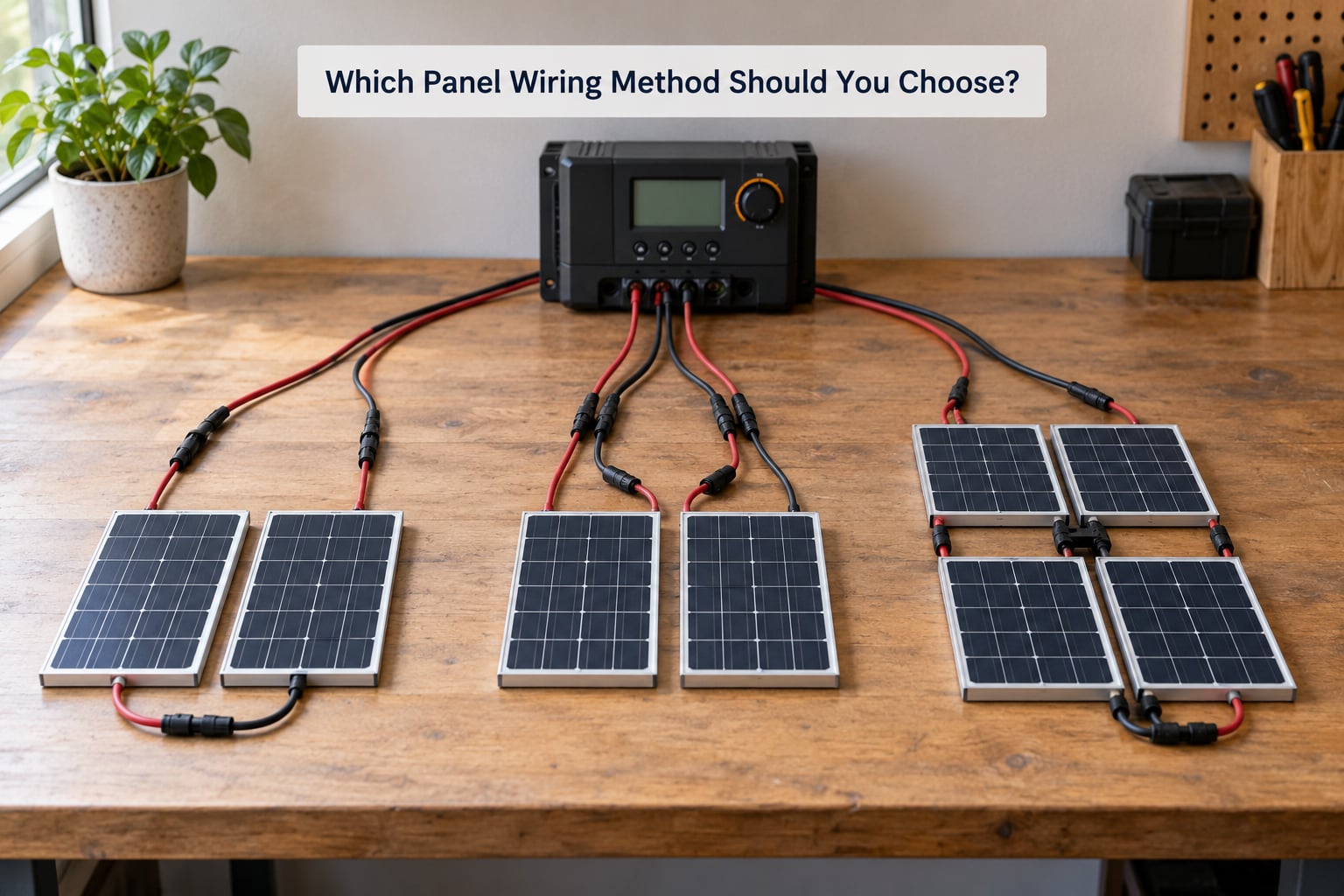
Choose series when the roof is clear of shade for the full production window, the cable run to the controller is long, and the battery bank is 24V or 48V. Series is the right answer for most grid-tied residential arrays feeding a string inverter, and for RV roofs where you want voltage up and cable weight down.
Choose parallel when you are on a 12V bank, the roof has chimneys or vents that will cast shade at some point in the day, and the run from array to controller is short. This is the classic 2×2 panel van and boat layout.
Choose series-parallel when the array is large enough that a single string would exceed your controller’s input current, when you want to add panels later without stranding what you already have, or when you need to land a 48V bank voltage from 12V panels. Build the strings first, confirm each string measures the same, then parallel the strings.
For small solar garden lighting and low-voltage DC circuits the arithmetic is much simpler, and the same rules still apply. Keep the runs short, match the panels, and size the fuse to the panel rather than the other way around.
Frequently Asked Questions
Can I mix series and parallel connections in one solar panel array?
Yes. Series-parallel wiring is standard practice: build several identical series strings, confirm each one measures the same open-circuit voltage, then parallel those strings into the controller. The only rule is that every parallel string must be identical in panel model, count and orientation, because a string sitting at a different voltage will push current back into the weaker one.
Is it better to connect solar panels in series or parallel?
Neither is better in the abstract, because total wattage is identical either way. Series gives you higher voltage and lower current, which suits long cable runs, 24V and 48V banks, and MPPT controllers with a high input voltage ceiling. Parallel gives you lower voltage and higher current, which suits 12V systems and partly shaded roofs. Pick based on your controller, your battery bank and your shading.
What happens if I connect panels with different wattages?
In a series string the whole array is capped by the panel with the lowest current rating, so mixing a 100W panel into a string of 400W panels wastes most of the bigger panels’ output. In a parallel group the weaker panel simply contributes less current and the rest carry on normally. Mixing is workable in parallel, discouraged in series, and the cleanest answer is a separate controller input for each panel type.
How many solar panels can I connect in series or parallel?
The panel count is set by your charge controller or inverter, not by the panels themselves. For series, the limit is maximum PV input voltage: multiply panel Voc by the number of panels and add a cold temperature correction. For parallel, the limit is maximum input current: add up each panel’s Isc, multiply by 1.25, and stay under the controller’s rating. Check both limits before you commit to a layout.
Do I need an electrician to wire solar panels?
For small DC lighting circuits and simple battery-charging arrays, many people wire their own. For anything grid-tied, anything feeding a 48V bank, anything on a house roof, and anything requiring a permit or a utility interconnection, use a licensed electrician. Panels cannot be switched off, the NEC 600V DC ceiling applies, and a mistake here is a fire risk rather than a tripped breaker.
Conclusion
Series adds voltage and holds current; parallel adds current and holds voltage; wattage lands in the same place either way. Start by writing down your array voltage, array current and total watts on paper, then check both of those numbers against your charge controller’s maximum input voltage and maximum input current, including the cold-morning correction on Voc. Wire to Isc multiplied by 1.25, protect each parallel string, and measure the finished array before you connect it to anything.
Once you know how to wire panels in series vs parallel for your own numbers rather than a generic example, the layout choice usually makes itself. And if the answer depends on a permit, a utility interconnection or a roof you would rather not drill, that is the point to bring in a licensed electrician.