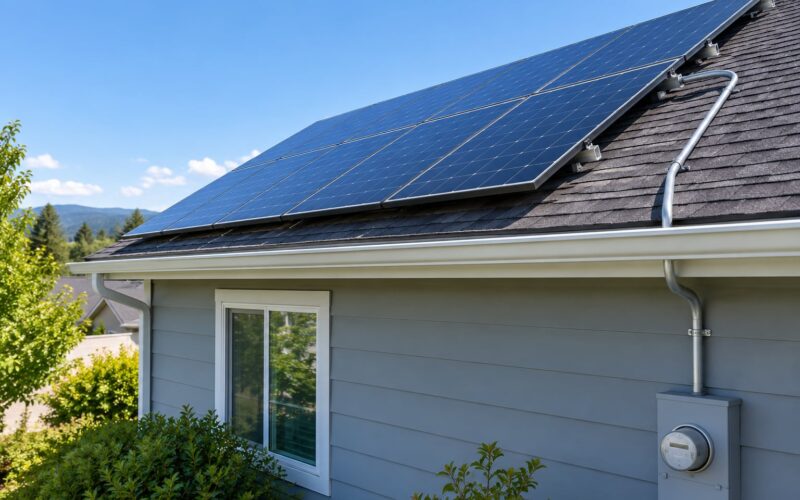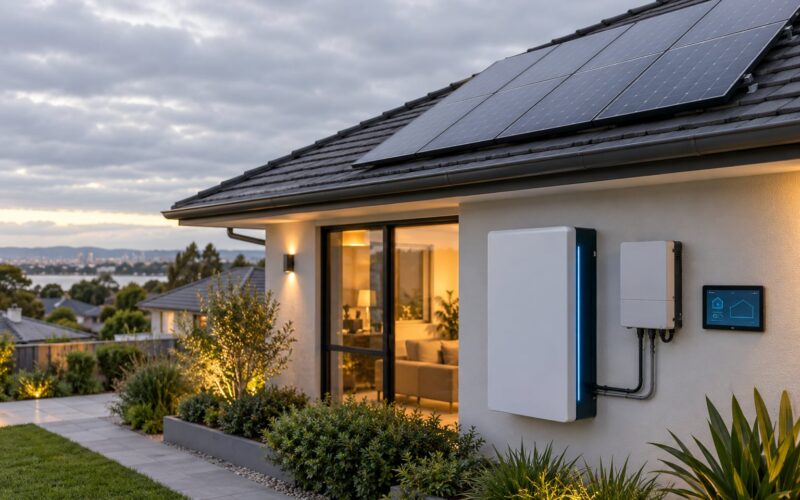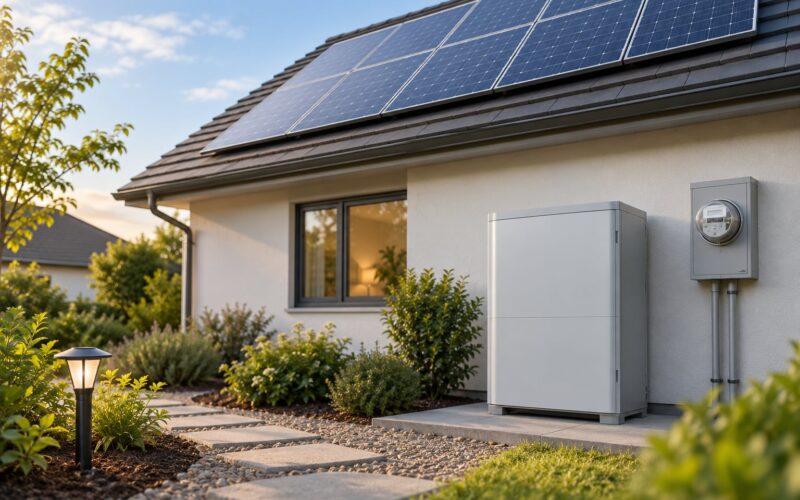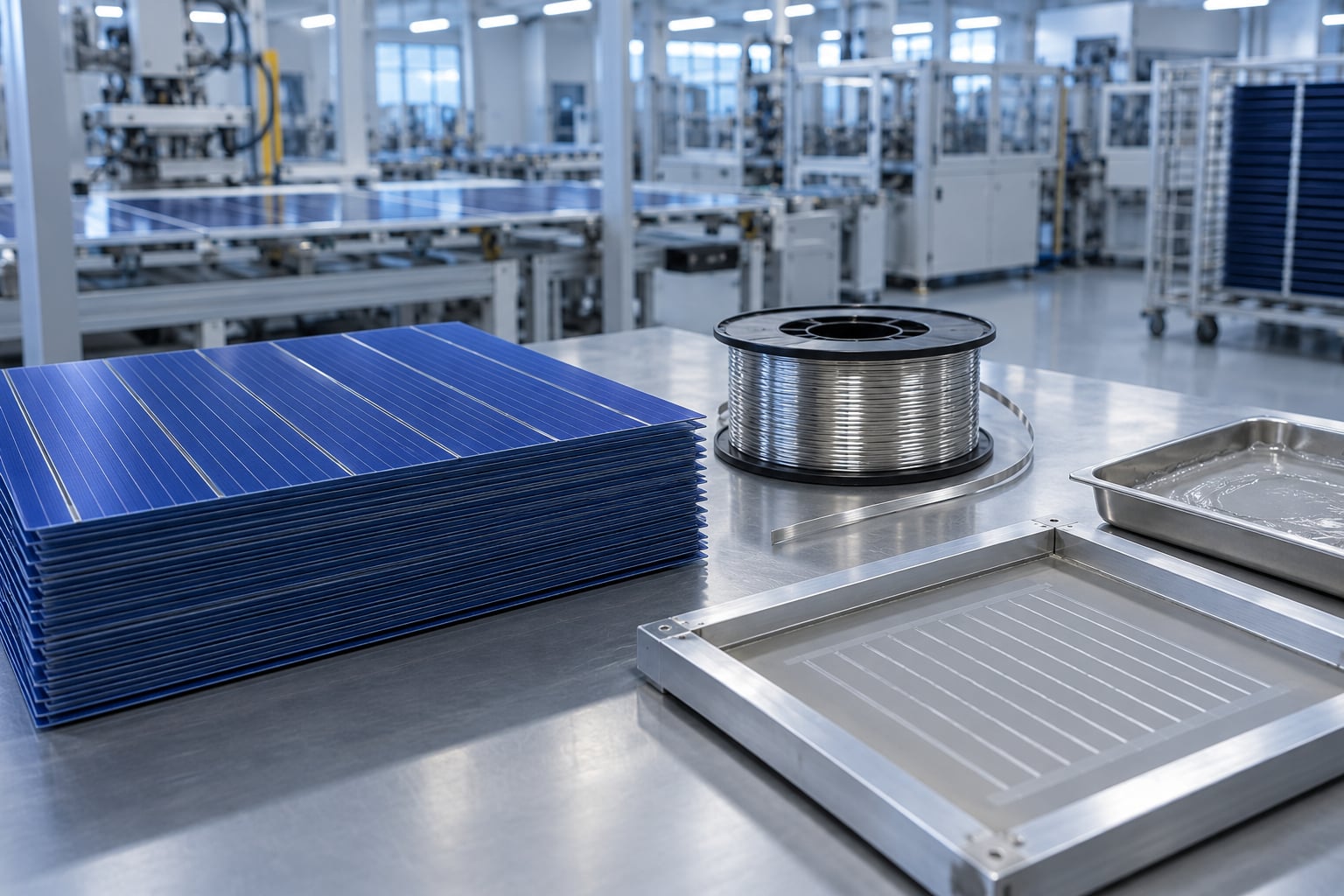
Solar panels are made by purifying quartz sand into silicon so pure that only nine parts per billion are anything else, melting that silicon into ingots, slicing the ingots into wafers about 0.2 mm thick, printing the wafers into photovoltaic cells, and sealing those cells between glass and plastic film inside an aluminium frame. A finished panel is mostly a sandwich with a power-producing layer in the middle.
That chain takes about three to four months from raw sand to a boxed module, and every step explains something you can read on a spec sheet later: why one panel is darker than another, why efficiency sits near 20% instead of 30%, and why a cheap panel is not always a badly made one.
Table of Contents
- What Materials Are Solar Panels Made Of?
- How Solar Panels Are Made: From Raw Materials to Finished Modules
- Step 1: From Quartz Sand to Pure Polysilicon
- Step 2: Growing the Ingot
- Step 3: Slicing and Texturing the Wafer
- Step 4: Turning a Wafer Into a Solar Cell
- Step 5: How Solar Panels Are Made Into a Module
- Step 6: Framing, Wiring and Final Assembly
- How Is Solar Cell Technology Different?
- How Are Solar Panels Tested Before They Leave the Factory?
- What Happens After Solar Panels Are Installed?
- Frequently Asked Questions
- How long does it take to make a solar panel?
- Why is silicon used to make solar panels?
- What is the 33% rule in solar panels?
- Are Chinese solar panels good quality?
- What parts of solar panels cannot be recycled?
- Does a solar panel work at night?
What Materials Are Solar Panels Made Of?
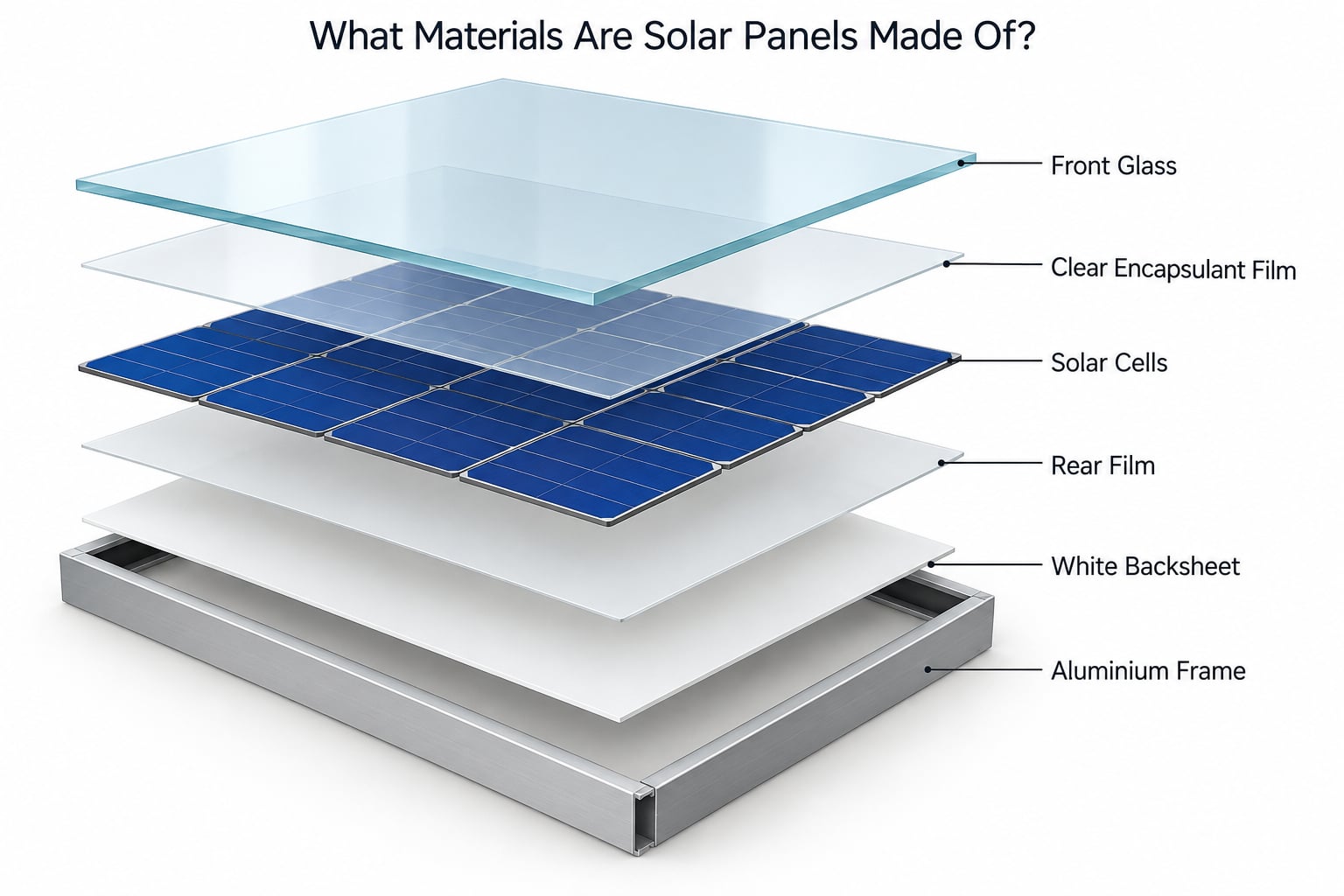
Most panels you see on a roof share the same six layers. Only the cells themselves generate anything; every other material exists to keep them alive for 25 years outdoors.
| Component | What it does | Common material |
|---|---|---|
| Solar cells | Converts sunlight to direct current | Doped silicon wafer, or thin film |
| Front glass | Takes hail and wind, spreads load | Low-iron tempered glass, roughly 2 mm |
| Encapsulant | Bonds cell to glass, blocks water | EVA (ethylene vinyl acetate) |
| Conductive ribbon | Carries current cell to cell | Tinned copper wire |
| Backsheet | Seals the rear, resists moisture | Polyester, polyamide and PVF layers |
| Frame | Rigidity and mounting surface | Anodised aluminium alloy |
| Junction box | Houses bypass diodes and terminals | Weather-sealed plastic on the rear |
| Cell contacts | Collect current off the wafer face | Screen-printed silver paste |
Two details catch people out. Silver paste belongs to crystalline silicon cells; cadmium telluride thin film has no silver grid at all, which is a misconception that turns up constantly in forums. And the aluminium frame is not decoration, it is what holds the glass flat while thermal cycling tries to buckle it.
How Solar Panels Are Made: From Raw Materials to Finished Modules
Step 1: From Quartz Sand to Pure Polysilicon
Solar-grade silicon starts as high-purity quartz sand or quartzite. The sand is reduced in arc furnaces held above 2,000 °C, producing roughly 98% pure metallurgical silicon.
That is nowhere near good enough for a solar cell. The silicon is repeatedly melted and chemically processed, typically in a trichlorosilane or silane gas stream, until the purity reaches 99.9999% (often called 6N). A single foreign atom at the wrong place in the crystal is enough to ruin a cell, which is why this stage takes weeks and why a new factory costs so much.
Step 2: Growing the Ingot
The purified polysilicon is melted again and pulled into a single cylindrical crystal using the Czochralski method. A seed crystal dips into the melt at just below silicon’s melting point of about 1,414 °C and rotates as it rises, with the melt solidifying around it.
Slower pulling makes purer ingots, which is why monocrystalline plants run shifts measured in days per ingot. Multicrystalline plants skip the pulling entirely and simply cast the melt into a block, then carve the block into bricks. Casting is faster and cheaper, and the grain boundaries left behind cost a few points of efficiency.
Step 3: Slicing and Texturing the Wafer
The ingot is trimmed and ground to a cylinder, then sawn into wafers with a diamond wire saw. Modern wire is about 40 micrometres thick, down from roughly 350 micrometres a couple of decades ago, and it moves fast enough to leave a mirror-smooth surface.
Wafer thickness has fallen from about 400 micrometres to around 200 micrometres on mainstream production lines. That matters because silicon is the single most expensive input in a panel, and less silicon per panel means more panels per kilogram of polysilicon.
The wafer then gets textured, usually with an alkaline etch, which roughens the surface into tiny pyramids. Those pyramids trap light that would otherwise bounce off, and a thin anti-reflective coating, often silicon nitride, is deposited on top. A bare silicon wafer reflects around 30% of the light that hits it, which is why the step matters so much.
Step 4: Turning a Wafer Into a Solar Cell
A solar cell becomes a solar cell when it gains a junction. The wafers are loaded into a diffusion furnace and treated with a dopant: phosphorus for one side to create an n-type layer, boron for the other to create a p-type layer. Where the two meet sits the p-n junction, and that boundary is where the photovoltaic effect begins.
Next comes metallisation. Silver paste is pushed through a fine steel screen onto the wafer, printing the thin finger lines between busbars and the wide busbars along the cell edge. The panel is then fired in a conveyor oven so the paste penetrates and the metal makes real electrical contact rather than sitting on top.
Modern architectures add steps after this base flow. PERC cells etch back a small slice of the emitter and add a rear passivation layer to recover light that would otherwise be lost at the back. TOPCon lays an ultra-thin oxide over the rear. Heterojunction cells add an amorphous silicon layer on both faces. Each one buys a little efficiency and costs a little more in factory time.
Step 5: How Solar Panels Are Made Into a Module
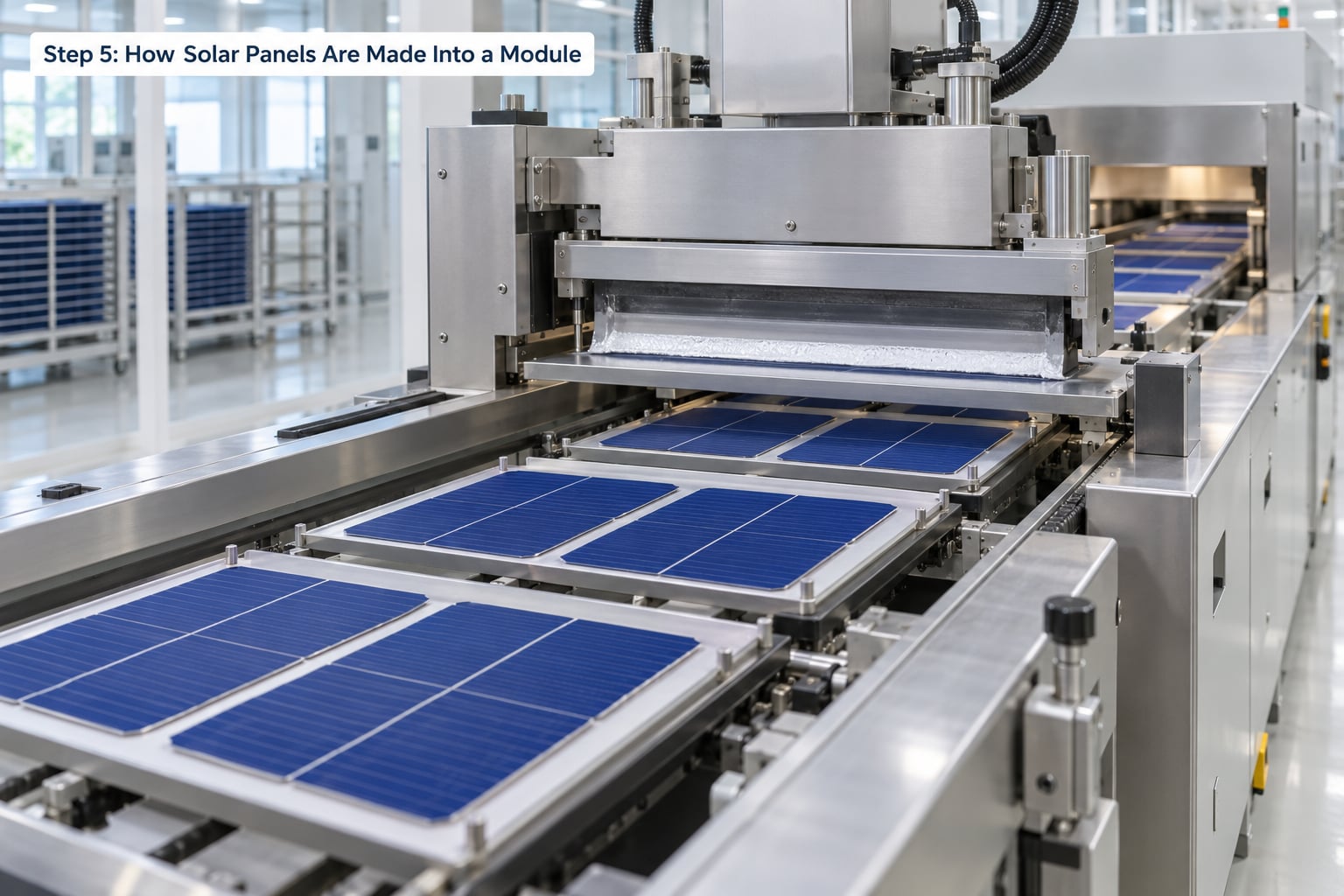
Cells are cut into shape with a laser scribe, laid out in strings, and soldered together with tinned copper ribbon. A 60-cell residential panel is typically three strings of 20, arranged so that shaded sections do not knock out the whole panel.
Those strings go into a layup press in a strict sandwich: front glass, EVA sheet, cells with their ribbons, a second EVA sheet, then the backsheet. The stack enters a vacuum laminator, where heat and pressure squeeze out almost all the air and cross-link the EVA so it becomes a single solid seal.
Lamination is where most field failures get their start. A bubble or a contaminated contact trapped inside that stack stays there for the life of the panel, and it shows up years later as corrosion creeping out from a crack.
Step 6: Framing, Wiring and Final Assembly
The sealed laminate is edged with an aluminium frame, crimped and sealed with a butyl or silicone gasket. A junction box is potted onto the rear, and three bypass diodes sit inside it, each one bridging a third of the panel’s cells.
Those diodes matter more than they look. When a tree shades one section, the shaded cells would otherwise drag the whole string down and, worse, could reverse-bias and cook themselves. Each diode switches off around its string so the panel produces less rather than failing.
How Is Solar Cell Technology Different?
The five steps above describe crystalline silicon, which covers the large majority of panels sold today. The alternatives differ in what gets deposited and how thin everything can be.
| Cell type | How it is made | Typical efficiency | Where it fits |
|---|---|---|---|
| Monocrystalline | Single-crystal ingot pulled by the Czochralski method, then sawn and processed | About 20-23% | Roof arrays where space is tight |
| Polycrystalline | Melt cast into a block, sawn into bricks, no crystal pulling | About 15-19% | Larger, cheaper ground-mount arrays |
| PERC | Standard silicon cell with a rear passivation layer added | About 21-23% | The mainstream residential cell |
| TOPCon and HJT | Extra oxide or amorphous silicon layers on the cell surface | About 23-26% | Newer premium panels and utility sites |
| Thin film (CdTe, CIGS) | Absorber deposited as a film a few micrometres thick on a substrate | About 10-22% | Hot climates, low light, curved surfaces |
| Perovskite | Tunable semiconductor printed or coated from solution | Still in pilot production | Lab and pilot lines, not yet mainstream |
Thin film is the outlier worth understanding. Because the absorber is microscopic, almost no silicon is needed, but the deposition equipment is expensive and the manufacturing window is narrow. That is the whole trade: less material, more capital.
How Are Solar Panels Tested Before They Leave the Factory?
Every module gets electrically tested, then a sample from each production batch gets destroyed in an accelerated test. The point is to find a defect in two hours rather than on a roof in year three.
| Test | What it detects | A good result |
|---|---|---|
| Visual inspection | Cracks, chips, contamination, edge damage | No visible defect over the cell area |
| Electroluminescence (EL) | Micro-cracks and inactive cell areas invisible to the eye | Uniform glow across every cell |
| Flash or IV testing | Actual power output at standard conditions | Within the tolerance of the nameplate wattage |
| Insulation and wet leakage | Breakdown between conductors and frame | Passes at the rated voltage with no leakage |
| Thermal cycling | Delamination, cracked solder, seal fatigue | No power loss beyond a small set limit |
| Humidity (HAST or damp heat) | Moisture ingress and corrosion of contacts | Power loss held under about 5% |
| Mechanical load | Frame and glass strength under wind and snow | No delamination or glass failure |
EL and flash testing are the two a buyer can actually ask about. A reputable supplier will tell you which cells were binned together and what their flash-test tolerance is, and that answer tells you more than the warranty brochure does.
Panels are certified to standards such as IEC 61215 for design qualification and IEC 61730 for safety, and the labels must carry that certification mark. As of 2026, most residential panels carry performance warranties of 25 years with output guaranteed at around 85% of nameplate, and many now promise degradation under 0.4% a year.
What Happens After Solar Panels Are Installed?
A finished module produces direct current. Your house runs on alternating current, so a device called an inverter sits between them, converting DC to AC at a frequency and voltage the grid accepts. Mounting, wiring and grid connection are licensed electrical work, and this is not a good DIY corner of the project.
With a battery bank, a charge controller sits between the panels and the batteries to regulate how much current flows into storage. Without batteries, the array feeds the grid through a meter that can run backwards, and the home draws from the array first when production exceeds demand.
On an RV, a boat or a portable kit, the same chain works without the grid, with a smaller inverter and often a 12 or 24 volt system. Solar garden and pathway lights use the same cell technology in miniature, usually a small monocrystalline or polycrystalline disc instead of a full panel, with a tiny charge controller and a dusk sensor built in. The manufacturing origin is identical; only the scale differs.
Solar manufacturing energy is not free either, but a rooftop array in most sunlight regions generates enough clean power in one to two years to offset the energy spent making it, then keeps going for a quarter century or more. Recycling at end of life recovers the glass, the aluminium and much of the silicon and metal; the cross-linked encapsulant and some adhesives are the parts that are hardest to separate cleanly.
Frequently Asked Questions
How long does it take to make a solar panel?
Roughly three to four months from raw quartz sand to a boxed module. Growing a monocrystalline ingot takes several days on its own, and wafer slicing, cell processing and lamination add the rest. A module that has already passed wafer production as a half-finished cell takes about a day to finish, which is why cell capacity and module capacity are tracked separately.
Why is silicon used to make solar panels?
Silicon is the second most abundant element in the crust, it forms a very pure crystal, and it is already processed at enormous scale for computer chips. That combination of abundance, stability and an existing mature industry is hard to beat. Its main drawback is that it absorbs visible light poorly until it is doped and textured, which is why nearly every silicon cell carries an anti-reflective coating.
What is the 33% rule in solar panels?
It refers to the practical ceiling on a single-junction silicon cell, which converts roughly 20 to 23% of the sunlight that hits it into electricity, with losses from reflection, heat and recombination. Add module-level losses from mismatch, wiring, dirt and inverter conversion, and a real panel lands nearer 15 to 20% at the meter. Beating 33% needs multiple junction layers rather than a better laminate.
Are Chinese solar panels good quality?
The manufacturing process is essentially identical wherever it happens, and most global capacity sits in China and Southeast Asia for economic reasons rather than technical ones. Quality tracks cell technology, quality control intensity and warranty backing rather than country of origin. Ask the seller for flash-test tolerance, cell binning and who stands behind the warranty, because those answers separate good panels from cheap ones anywhere.
What parts of solar panels cannot be recycled?
Glass, aluminium frames, silicon wafers and most silver and copper are recoverable. The difficult fraction is the cross-linked EVA encapsulant and the multilayer backsheet, which are fused together during lamination and resist clean separation. Adhesives and sealants fall into the same category. Processes that recover more of this stack exist but cost more than the material value justifies at current scrap prices.
Does a solar panel work at night?
No. A photovoltaic cell needs photons, so a panel produces nothing meaningful after dark, and moonlight is far too weak to matter. What keeps a home running overnight is the battery bank, not the panel. This is also why panel output follows the sun rather than a schedule, and why cloudy-day output is lower even though the panels are still working correctly.
Next time you read a spec sheet, the numbers trace back to a specific step: efficiency to the cell architecture and metallisation, the 25-year warranty to lamination and humidity testing, degradation to wafer thickness and silver contacts. Once you know where each number comes from, the spec sheet stops being marketing and starts being a summary of a factory you can picture.