If you want the plain number: most US households with a properly sized system cut roughly 2,000 dollars a year off the electricity bill, which turns into somewhere between 40,000 and 155,000 dollars over the 25 years a rooftop system is warranted to run. The spread is enormous because four things decide where you land inside it, and none of them is the panels themselves.
Those four drivers are your utility’s rate per kilowatt-hour, how much electricity your household actually uses, how big the system is, and how you pay for it. A household paying 0.33 dollars per kWh on an unshaded south-facing roof gets a very different return than a household paying 0.14 dollars per kWh behind a shaded chimney.
Everything below is typical US range, written as of 2026. Rates, rules and incentives change by state and over time, so run the numbers with your own twelve months of bills and your utility’s current policy before anyone hands you a contract.
Table of Contents
- How Much Do Solar Panels Really Save? Typical US Savings
- How Much Do Solar Panels Really Save Per Month?
- How to Calculate Your Solar Panel Savings
- Why Your Electric Bill Is Not Zero After Solar
- When Solar Panels Do Not Save You Money
- What Affects the Price and Savings
- Is Solar Worth It if My Electric Bill Is Low?
- Does a Solar Battery Add to Your Savings?
- Ways to Save on Solar Panel Installation
- Frequently Asked Questions
- How much can a typical 6 kW residential solar system save each year?
- Do solar panels reduce my electricity bill or my electricity use?
- How long do residential solar panels take to pay back?
- Is a solar battery necessary to save money with solar panels?
- Can I claim tax credits for installing solar panels?
How Much Do Solar Panels Really Save? Typical US Savings
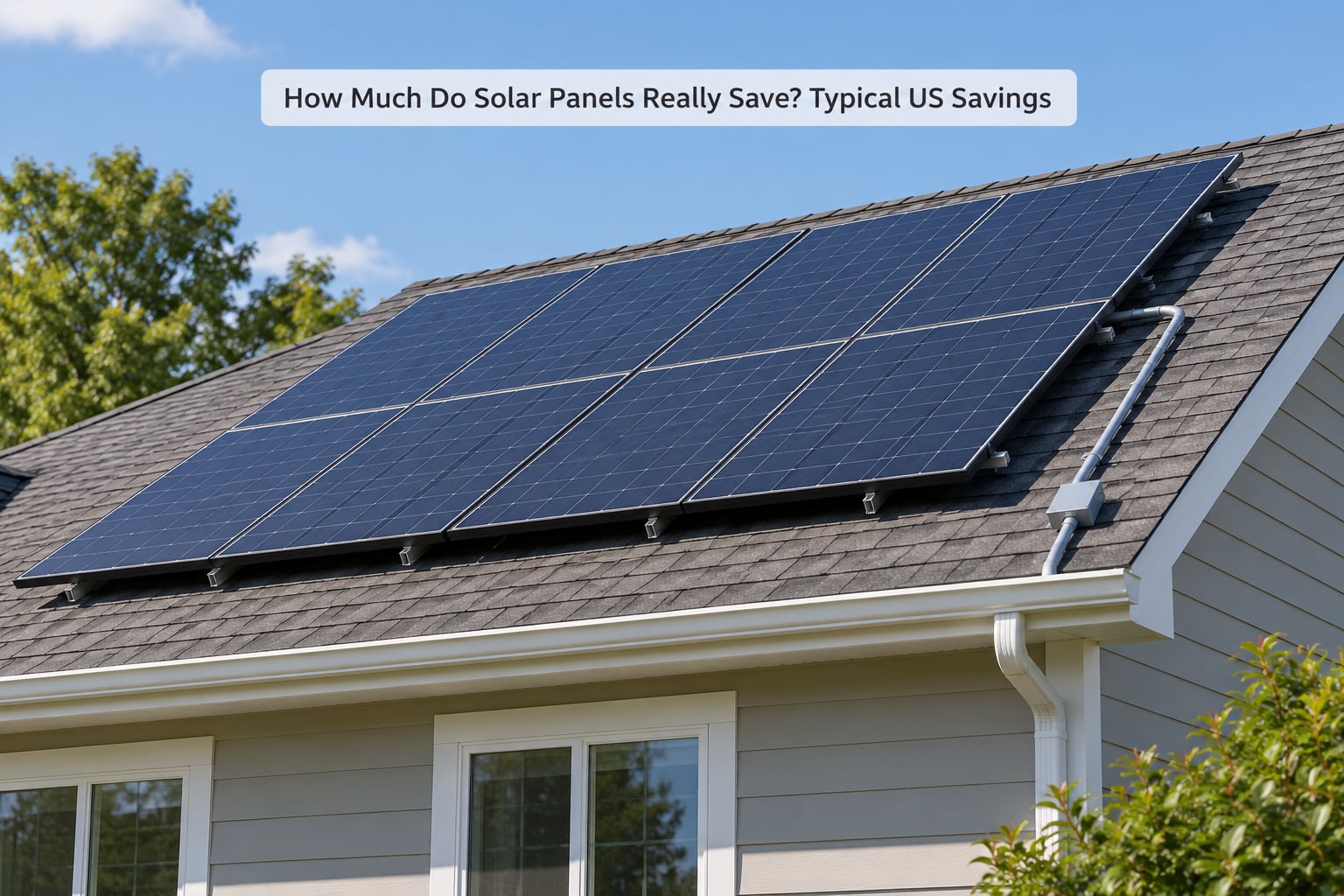
A typical US homeowner saves about 2,000 dollars a year on electricity and roughly 40,000 to 155,000 dollars across a 25-year system life, with the low end belonging to cheap-rate states with small systems and the high end to expensive-rate states with well-sized arrays.
The figures below scale that estimate by household usage, system size and local rate. They are illustrative, and the ordering matters more than the decimals: high usage plus a high rate is where the big numbers live.
| Household usage | System size | Utility rate | Year-one bill savings | 25-year net savings |
|---|---|---|---|---|
| 8,000 kWh a year | 5 kW | 0.15 dollars per kWh | about 1,000 dollars | about 40,000 dollars |
| 10,791 kWh a year (US average) | 7 kW | 0.19 dollars per kWh | about 2,000 dollars | about 65,000 dollars |
| 14,000 kWh a year | 9 kW | 0.28 dollars per kWh | about 3,100 dollars | about 105,000 dollars |
| 18,000 kWh a year | 11 kW | 0.33 dollars per kWh | about 4,400 dollars | about 155,000 dollars |
Two numbers get confused here, and separating that fixes most of the confusion. The first is production, the electricity your panels generate, and installers quote that in kWh per year. The second is money, which depends on what your utility does with every kWh you generate and every one you use.
A Lawrence Berkeley National Laboratory study that rooftop installers cite regularly puts average household solar savings at close to 2,000 dollars a year. That is a national average, so treat it as the middle of the range rather than a forecast for your roof.
How Much Do Solar Panels Really Save Per Month?
Divide the annual figure by twelve and expect the average to be wrong twice a year. Panels generate most of their power in late spring and summer, when many households are also running air conditioning, so a June bill can look like nothing changed. December tells the opposite story.
Homeowners on r/solar report the swing clearly: the best month they saved roughly 25 to 30 dollars, and the worst month cost them 20 to 75 dollars more than before installation. If you judge a system on a single month’s bill, you will draw the wrong conclusion about a system that is probably working exactly as designed.
How to Calculate Your Solar Panel Savings
Four steps, and you can do them with a bill and a calculator in about fifteen minutes.
- Find your real annual usage. Add up the kilowatt-hours on twelve months of bills. The EIA puts the average US residential household at 10,791 kWh a year, which is a useful sanity check on your own total.
- Multiply by your all-in rate. Use the cents per kWh figure from your utility, not a national average. Households on time-of-use plans or with demand charges need to include those too.
- Project forward with rate growth. Multiply year by year at roughly 2.8 percent, the commonly used long-run assumption for US electricity prices. This step is the engine of 25-year savings: you are locking in today’s rate against tomorrow’s price.
- Subtract what you paid, net of incentives. That difference is your payback period. If you financed instead of paying cash, add the interest you paid, and if you leased, add every lease payment and escalator.
Worked example: 10,791 kWh at 0.19 dollars per kWh is about 2,050 dollars a year in avoided grid purchases. Grow that 2.8 percent a year for 25 years and you land near 70,000 dollars of avoided electricity costs. Against a net system cost of roughly 20,000 dollars after incentives, payback lands inside the first ten years.
One caution on the production side. A 7 kW array in Arizona and the same array under a canopy of trees produce very different kWh from the same nameplate rating, and a production estimate is a model, not a promise. Ask for the estimate in kWh with its assumptions written down, and compare it against your own meter data rather than the sales pitch.
Why Your Electric Bill Is Not Zero After Solar
Because you still have a connection, and because generation and consumption do not happen at the same hour. Net metering is the mechanism that closes that gap: the electricity your panels send to the grid is credited back on your bill at your retail rate, and on most plans those credits roll over month to month until an annual true-up reconciles the year.
That rollover is the whole economics. If your utility credits expire monthly, a productive spring is worth little and a still winter is expensive, which is why owners describe monthly net metering as the worst-case arrangement. Some utilities also bill a fixed service charge, and commercial-style demand charges can keep a bill high no matter how much solar you add.
When Solar Panels Do Not Save You Money
The word really in your question deserves this section, because a fair number of households install solar and end up worse off. These are the cases that show up again and again on home finance and solar forums.
- Your rate is low. Below roughly 0.12 dollars per kWh, the value of every kWh you generate is small, and 25 years of modest savings rarely covers the system.
- Your usage is low. An undersized system against a small bill barely moves the number, and owners often assume the panels are broken when they are simply too few.
- Your roof needs work soon. Panels last around 25 years. A roof you know needs replacing within a decade is a bad host for a system you intend to keep.
- Your utility’s rules are unfriendly. Verify the current net metering policy before you trust any projection. Several states have changed credit rates or true-up timing in recent years.
- You lease. One family of four on r/personalfinance reported a lease that cost them 264 dollars more in year one and 135 dollars more over seven months of year two, because the fixed lease payment did not shrink when the utility bill did.
What Affects the Price and Savings
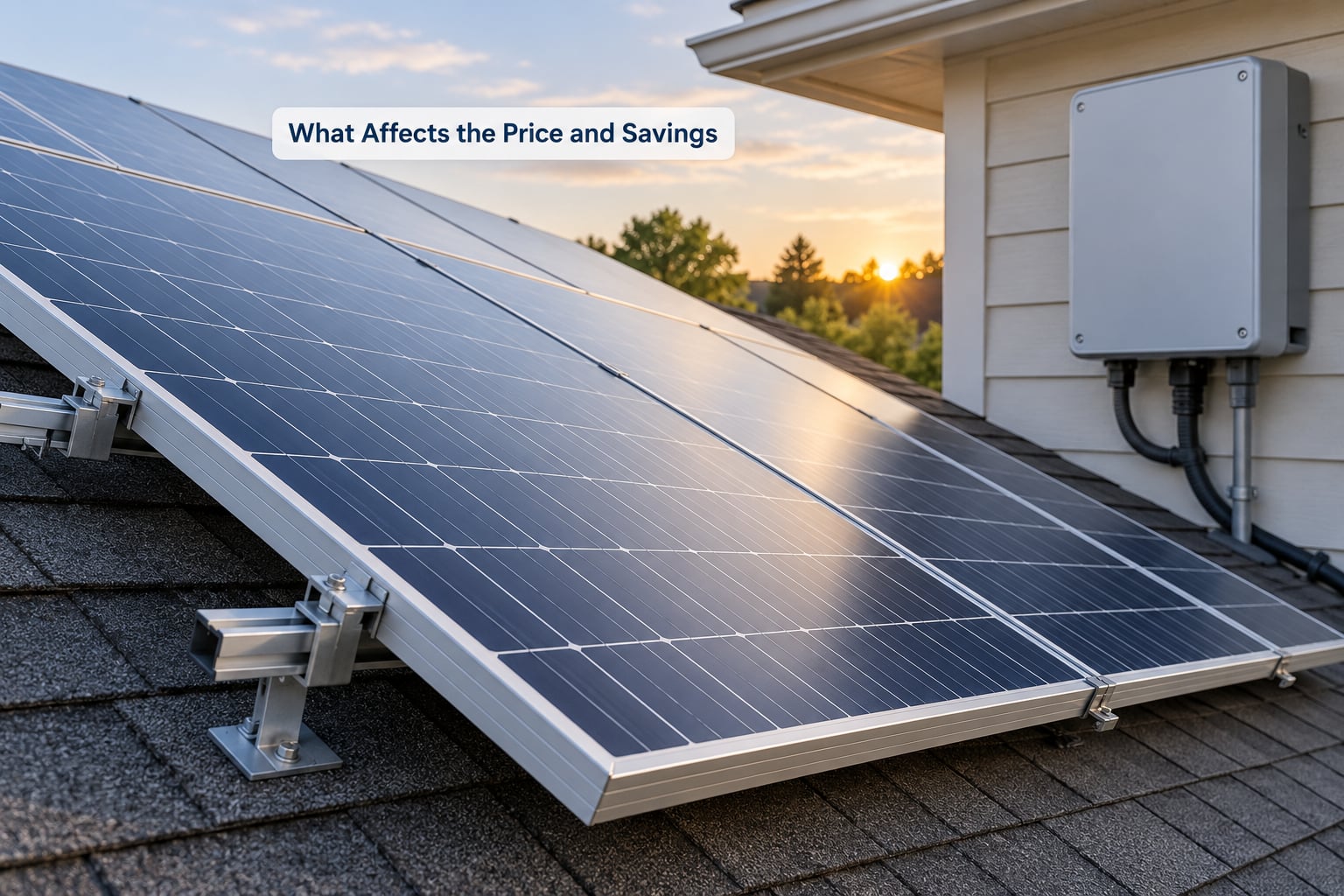
Cost and savings are two ends of the same system, so the same design decisions push both. Bigger arrays cost more and generate more, but a system much larger than your usage starts exporting energy you get credited for rather than energy that offsets a rate you would have paid.
Roof complexity is the cost item people forget. Composition shingles are straightforward; clay or concrete tile, a steep slope, or a roof split across several planes means extra rails, extra flashings and much more labor, and that labor is usually a larger share of the quote than the panels.
Panel efficiency matters in tight spaces. Higher-efficiency modules produce more per square foot, which is what makes solar viable on a small roof, and they usually cost more per watt, so the trade is roof area against budget.
Location drives output. Irradiance, cloud cover, snow shading and how much of the roof faces the useful direction all feed the production estimate, and that estimate is the numerator of every savings number a salesperson quotes.
Then the slower-moving costs. Panel output fades a fraction of a percent a year, and the inverter, a single component that carries most of the system’s failure risk, is often replaced once around the midpoint of a 25-year life. None of that is dramatic, but it belongs in a 25-year projection rather than being discovered later.
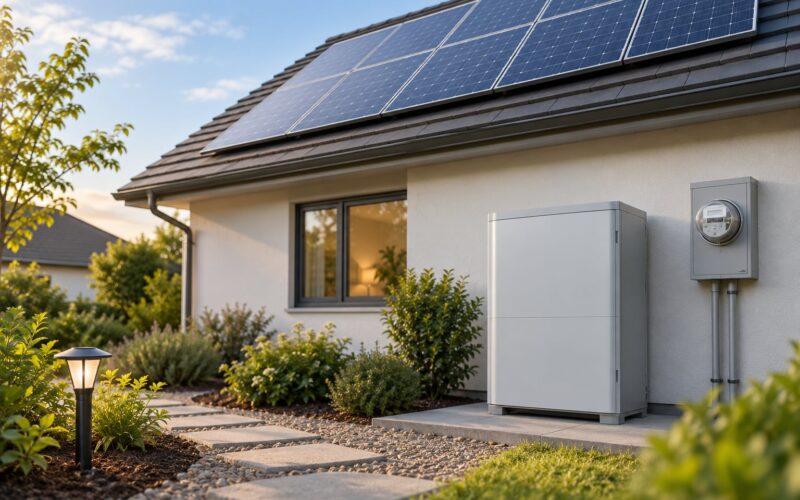
Batteries deserve their own paragraph because they are frequently sold as a savings device. Under full net metering, a battery mostly moves production you would have been credited for anyway, so the return is thin. It earns its cost in a specific set of situations: time-of-use rates where evening power is expensive, a demand charge on your bill, or a home that needs backup power during an outage.
Is Solar Worth It if My Electric Bill Is Low?
Usually not, and that is the honest disqualifier. If your household uses a typical amount but pays a very low rate, the avoided purchases are small no matter how efficient the hardware is. The math gets more workable when usage is high, when the rate is high, or both, and owners on forums consistently say the size of the bill mattered more than any equipment decision.
There are two sensible ways around a low bill. Buy or borrow an electric vehicle and charge it on solar, which lifts annual consumption into a range the system can serve, or start with a smaller system and size the interconnection for a larger array later.
Does a Solar Battery Add to Your Savings?
Only in specific setups. With full retail net metering and a flat rate, the battery’s main job is moving energy you already get credited for from afternoon to evening, which is worth a few dollars a month at most. On a time-of-use plan with a steep evening peak, a battery that shifts midday production into expensive hours can be modelled to pay back in seven to twelve years.
Owners with net metering tend to describe batteries as an independence purchase rather than a financial one. That framing is fair: if you want the lights on during an outage, buy it for that reason and stop expecting it to shorten payback.
Ways to Save on Solar Panel Installation
Start with incentives, and read the current rules carefully. The federal Residential Clean Energy Credit, which covered a large share of a residential system’s cost for years, expired at the end of 2025. A 2026 buyer should plan without it and treat any installer still advertising it as a reason to double-check the paperwork.
What remains is state and local: rebates, sales and property tax exemptions, utility performance-based incentives and any state income credit. These vary enormously, and they are usually applied through your tax return or your utility rather than at the point of sale.
On financing, cash purchase gives you the largest net savings because you pay no interest and keep every credit. A solar loan costs more in total but you still own the system, so it is usually the best financed option. A lease and a power purchase agreement both keep the panels with the provider and cap your upside; they also add an escalator that quietly rises while your utility bill shrinks.
Then the things you control on the day of the sale. Get three written quotes on the same system size and the same equipment tier, and compare them line by line rather than on the headline number. Ask each installer for the production estimate in kWh, the degradation assumption and the payback math, and watch what happens when you ask them to put it in writing.
Right-sized design saves money. Every extra panel and every extra roof penetration is cost, and a smaller array on a cleaner layout is often cheaper per watt than a large array on a complicated one. If the roof is already due for work, doing that first avoids paying to remove and reinstall panels later.
On quality and safety, use a licensed electrical contractor, follow the manufacturer’s mounting and torque specifications, and never pick an installer on price alone. The lowest quote is frequently the one with the thinnest rafter attachments and the most panel-level electronics, and both show up in year ten rather than at installation.
Finally, confirm your utility’s current net metering policy in writing before you sign. It is the single assumption that quietly flips a good project into a bad one, and it costs one phone call to check.
Frequently Asked Questions
How much can a typical 6 kW residential solar system save each year?
A 6 kW array usually generates around 7,200 to 8,400 kWh a year in good sun. At the US average retail rate of roughly 0.19 dollars per kWh, that is about 1,400 to 1,600 dollars avoided in the first year. In a high-rate state the same array can approach 2,500 dollars. Your own rate and your own production estimate are the two numbers that matter.
Do solar panels reduce my electricity bill or my electricity use?
They reduce your bill, not your consumption. A refrigerator or a heat pump draws exactly as much power with panels on the roof as it did before, but part of that power now comes from your array instead of the grid, so your utility purchases fall. A monthly bill may still show usage of the same size alongside a smaller amount due.
How long do residential solar panels take to pay back?
Six to ten years for a cash purchase in a high-rate state, and ten to fifteen for a loan or lease. Forum owners report roughly five to five-and-a-half years at rates near 18 cents per kWh with full net metering. Longer payback is common in low-rate states, and leases sometimes never break even because of escalating fees.
Is a solar battery necessary to save money with solar panels?
No, not under full net metering with a flat rate, because excess daytime generation is already credited back to you. A battery starts earning its cost when you are on a time-of-use plan with an expensive evening peak, when you face demand charges, or when you want backup power during outages. On flat net metering it is mostly an independence purchase.
Can I claim tax credits for installing solar panels?
It depends on your state and on your tax situation. The federal Residential Clean Energy Credit expired at the end of 2025, so a system installed now cannot claim it. Many states still offer income credits, sales and property tax exemptions, or utility rebates. Confirm current rules with your state energy office and a tax professional before you finalize a purchase.
Start with one number: pull twelve months of bills and find your total kilowatt-hours and your real rate per kWh. Multiply them, and you have your annual savings ceiling before anyone sells you anything. Take that figure to three installers, check your utility’s net metering policy, and only then talk about financing, because the payment structure changes the outcome far more than the panel brand does.