Curtailment in renewable energy is the deliberate reduction or shutdown of electricity output from wind turbines and solar panels, usually because the power being generated exceeds what the grid can carry or what customers are using at that moment. The energy still exists in the wind and the sunlight. It simply never reaches the meter.
It sounds like a design failure, and for a long time it was described as one. It is not. Grid operators use curtailment as a routine balancing tool, and a surprising amount of it is an economic decision rather than a technical one. Understanding which kind you are looking at explains almost everything else about the topic.
Below I break down what causes it, how it is physically carried out at a wind or solar plant, what it costs, and what a homeowner with rooftop panels can actually do about it.
Table of Contents
- What Is Curtailment in Renewable Energy?
- Why Does Renewable Energy Curtailment Happen?
- Oversupply of generation
- Transmission congestion
- Grid stability and balancing
- Negative or near-zero electricity prices
- Forecast errors
- Transmission outages
- What Is the Difference Between Curtailment and Reduced Output?
- How Does Curtailment Affect Solar and Wind Power?
- Project revenue and power purchase agreements
- Planning and investment
- Consumers
- Does curtailment mean renewables are failing?
- What Is an Example of Curtailment in a Home Energy System?
- How Can Renewable Energy Curtailment Be Reduced?
- Build more transmission
- Add storage, especially batteries
- Make demand flexible
- Improve forecasting and regional diversity
- Modernise the grid and market rules
- Frequently Asked Questions
- Does curtailment mean renewable energy is unreliable?
- Who pays for the cost of curtailment?
- Why can’t the grid just store all the extra renewable electricity?
- How do I know if my home solar is being curtailed?
- Can a home battery stop solar curtailment?
- Conclusion
What Is Curtailment in Renewable Energy?
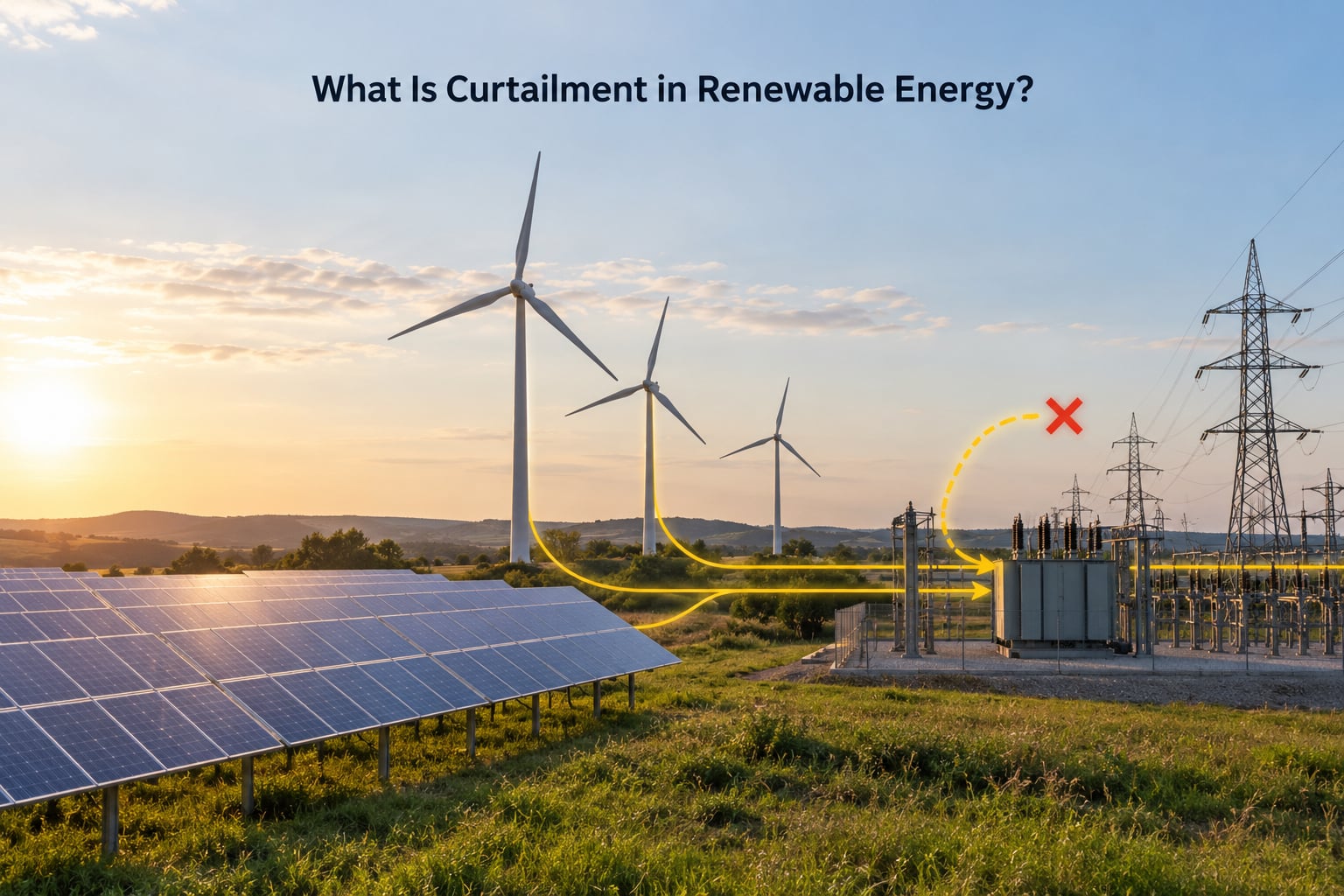
Curtailment is a grid operator’s or market’s decision to hold back part of the output from a generating plant. Wind farms are told to reduce production, solar farms are told to stop feeding power in, and the gap is filled by other plants or simply left unfilled because nobody needs it right now.
Three things distinguish it from other kinds of low output. First, the plant is capable of making more. Second, the reason is external to the plant itself, which is working fine. Third, the reduction is a decision, either an instruction from the operator or a response to a market price.
A quick example: a 100 MW solar farm reaches full output at 12:40 on a clear June day. Local demand at that moment is 60 MW and the export line out of the region is already loaded to its limit. The operator caps the farm at 30 MW. Those 70 MW of potential generation are curtailed, and the panels on site are performing exactly as designed.
That is different from a cloudy day, when the same panels produce 15 MW because there is less sunlight. Cloud reduces what the plant can do. Curtailment reduces what the plant is allowed to do.
Why Does Renewable Energy Curtailment Happen?
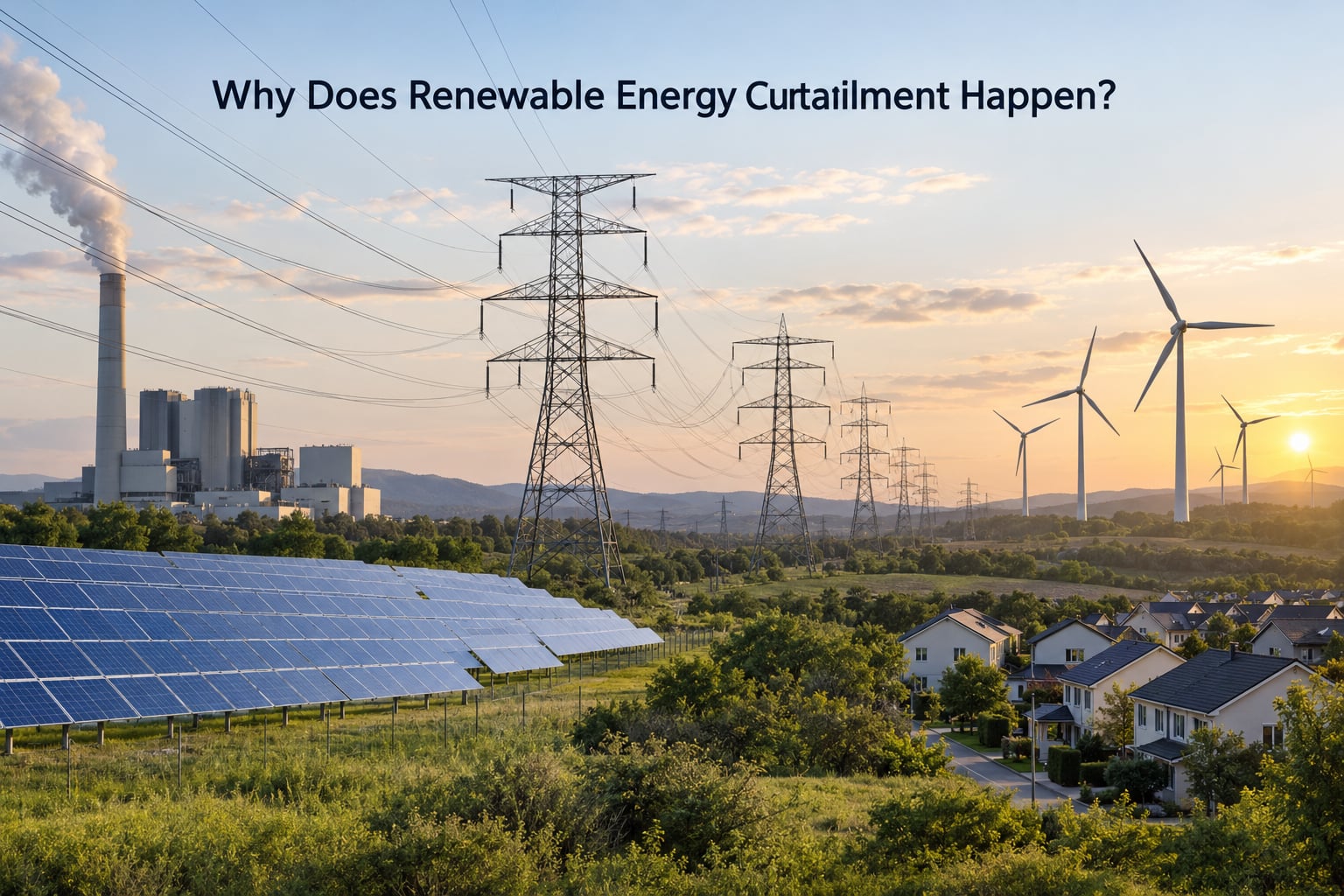
There are six recurring causes. The first four do most of the work.
Oversupply of generation
Solar output peaks in the middle of the afternoon and wind can be strong overnight. When the combined output of a large wind fleet plus a large solar fleet exceeds demand plus the export capacity, the surplus has nowhere to go. Grid planners call this the duck curve, because net demand plotted through the day looks like a duck: solar ramps up in the morning, pushes net demand to its low point at midday, then ramps back down as the sun sets.
Transmission congestion
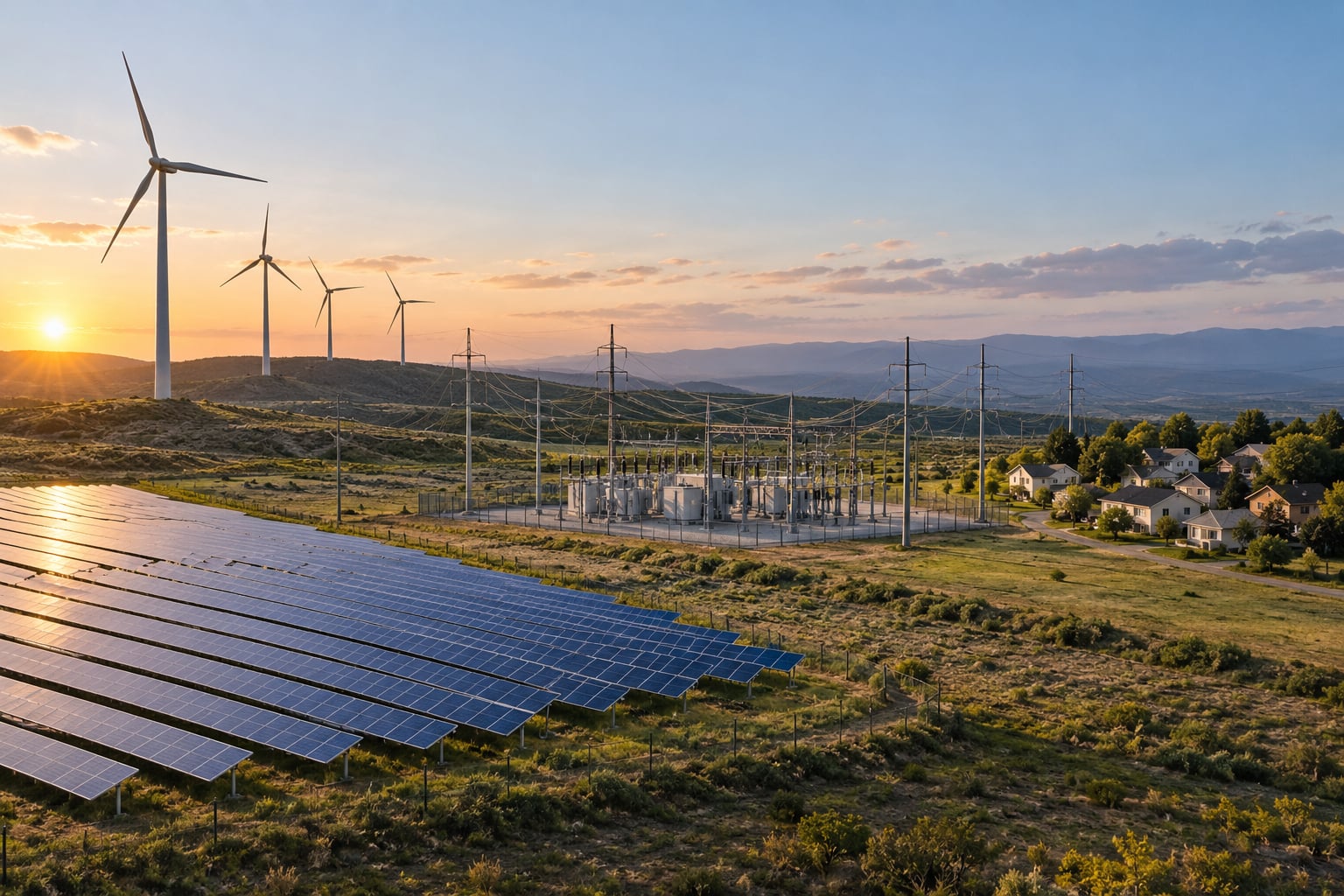
Electricity flows through a network, and power plants do not sit where the wind blows or the sun shines. This is the most common cause of curtailment and the least intuitive. A windy region can be full of spare generating capacity while the single transmission line serving it is at its thermal limit, and the turbines downwind have to stop.
Congestion is a geometry problem, not a generation problem. It is why two countries with similar renewable penetration can have wildly different curtailment rates.
Grid stability and balancing
Electricity supply and demand must match almost continuously, and frequency has to stay within a narrow band. Because wind and solar output depends on the weather, the grid operator relies on flexible plants to absorb the difference. When those flexible plants are already running flat out, the operator may curtail renewables instead. It is cheaper to reduce free energy than to run an expensive plant harder.
Negative or near-zero electricity prices
When a generator is paid to produce more than it costs to produce, and the price falls below zero, the rational response is to shut down. In several European markets, wind producers have been paid to take their turbines offline because their power was worth less than the subsidy they would have to repay. This is economic curtailment: the grid did not need to ask.
Forecast errors
Day-ahead markets commit plants using forecasts. Solar forecasting has improved enormously, but clouds are clouds. When actual output lands well above forecast, some of it gets dispatched down after the fact.
Transmission outages
A line outage, a transformer failure or storm damage removes capacity that was expected to be available. Undersupply is bad, but operators also have to respect their safety limits in the hours either side of an outage.
What Is the Difference Between Curtailment and Reduced Output?
Most of the confusion around this topic comes from lumping genuinely different things together. This table separates them.
| Situation | Who decides | Trigger | Is the plant working? |
|---|---|---|---|
| Curtailment (technical) | Grid operator | Congestion, balancing, stability limits | Yes, held back deliberately |
| Curtailment (economic) | Market or the owner | Price at or below zero | Yes, held back deliberately |
| Low output (weather) | Nobody | Little wind, cloud, darkness | Yes, at its natural limit |
| Planned maintenance | Owner | Scheduled service, component swap | Partly, by choice, on a known date |
| Unplanned outage | Nobody | Equipment failure | No |
| Inverter clipping | Automatic, local | Panel voltage above the inverter limit | No, the surplus never leaves the array |
| Load shedding | Utility | Emergency shortage | Usually, it protects supply |
The last two rows are the ones people mix up most. Inverter clipping happens entirely inside a rooftop system and is a design feature, not a grid decision. Load shedding is a last resort during a supply crisis, and it is a completely different event from a windy afternoon where a wind farm is paid to stop.
Two other terms come up constantly. Dispatch down is simply the operational name for the reduction instruction, and it usually means the same thing as curtailment. Clipping is the point where a panel’s DC output exceeds what the inverter can convert, so the excess is discarded before it ever reaches the alternating current grid.
How Does Curtailment Affect Solar and Wind Power?
It affects generators first, then everyone else.
Project revenue and power purchase agreements
A utility-scale solar or wind project is usually paid per megawatt-hour delivered. A megawatt-hour that is curtailed earns nothing while the capital, land lease and financing costs keep running. For a project with a fixed-price power purchase agreement, the lost revenue comes straight off the developer’s return. That is the single most direct financial impact.
Large buyers such as data centre operators and manufacturers increasingly ask for curtailment terms in their contracts, and some will not sign for a project in a heavily constrained region at all.
Planning and investment
Developers who model a project in a congested area now subtract expected curtailment from projected output before bidding. Persistent congestion in a region can price new projects out entirely, which pushes buildout toward better-connected areas. That is a real effect: curtailment shapes where the next solar farm gets built.
Consumers
The public argument runs that curtailed energy is energy consumers paid for and did not get, so it shows up on bills. In practice the cost is usually borne by generators and, in some markets, shared through network charges. Consumers also benefit indirectly, because curtailment tends to push wholesale prices lower during the hours it occurs.
Does curtailment mean renewables are failing?
No, and the honest version of the argument matters here. On expert forums the consensus is closer to the opposite framing: curtailment is an acceptable, manageable, planned part of running a system with a high share of variable generation. Preventing every last megawatt-hour can be a false economy if the fix costs more than the wasted power.
What curtailment does tell you is that generation is outpacing the wires and flexibility around it. That is a buildout problem, not a technology problem. Energy agencies, network operators and the IPCC treat rising curtailment as a signal to build transmission and storage faster, not as evidence that solar and wind are failing.
One caveat on the data. Curtailment statistics are not always comparable between countries. Some report energy physically constrained, some report economic curtailment from negative price hours, and some report only a subset of wind or solar. Always check what a given figure includes before comparing it to another.
What Is an Example of Curtailment in a Home Energy System?
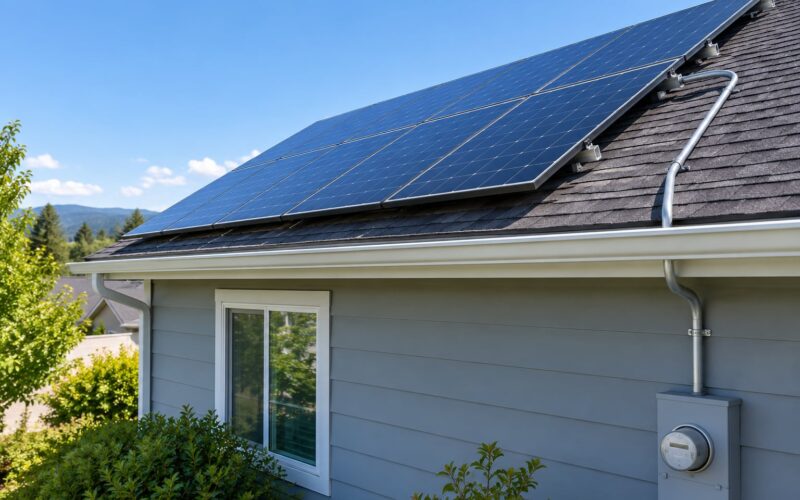
Rooftop solar gets curtailed, and the event is usually invisible to the owner. No notification arrives, the meter just shows less export.
Here is a realistic example. A household has 8 kW of rooftop panels and a 5 kW single-phase inverter. On a clear day the array produces 7.6 kW at midday while the house draws 1.2 kW. Only 6.4 kW reaches the inverter, so the remaining 1.2 kW is clipped at the array. Nothing is wrong. The inverter was simply sized smaller than the array.
That is a local, permanent condition, not grid curtailment. Real grid curtailment on a home system shows up differently: a network operator or the distribution network operator instructs the inverter to switch down or ramp back, usually during a network voltage or frequency event. Research published by the University of New South Wales, and widely reported in Australia, found average household curtailment around 1 per cent or less, with some individual households losing 10 per cent and in the worst cases close to 20 per cent of their annual output.
So self-consumption is not curtailment. When your panels power the kettle, the energy is used and nothing is wasted, but no wholesale market event is involved either. Curtailment specifically means the grid told the system, or the system could not export, so generation that existed was discarded.
Where to look: your inverter’s monitoring app or web portal usually logs events, and many inverters label them as export limitation, grid event, or frequency shift. Compare your daily generation on a clear day against your system size. If you consistently produce far less than you expect, something is limiting you.
How Can Renewable Energy Curtailment Be Reduced?
Every fix below attacks one of the four causes. None of them is a complete answer on its own.
Build more transmission
This is the single biggest lever for congestion-driven curtailment. A new line or upgraded corridor moves renewable power from where it is generated to where it is used. It is slow, expensive and politically difficult, which is why congestion persists for years in the regions that have the most renewables.
Add storage, especially batteries
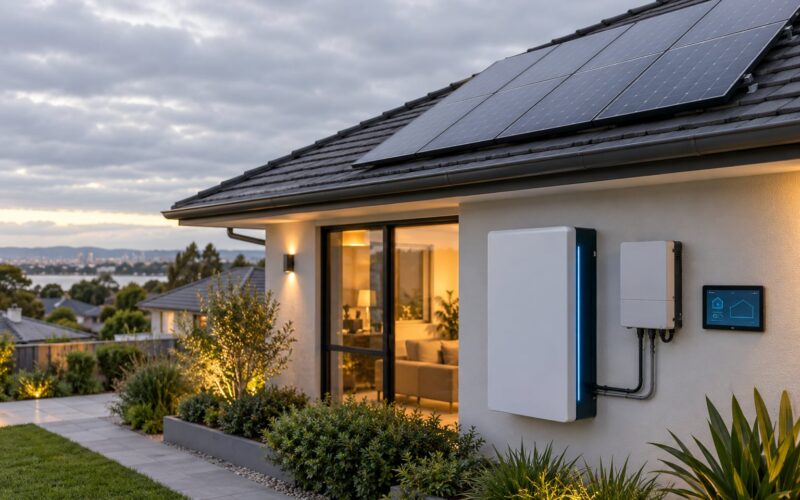
Storage shifts energy across time rather than across space, which is exactly what the midday solar surplus needs. Utility-scale batteries now routinely absorb a few hours of oversupply. Pumped hydro does the same job on a larger scale where geography allows it.
There is a limit worth being honest about. A two-hour battery can shift a solar surplus out of the afternoon. It cannot solve a week of high wind with weak demand, and it does not remove the need for transmission. That mismatch is the core of why surplus wind is harder to store than surplus solar.
Make demand flexible
If demand moves toward the hours of surplus, generation is used instead of curtailed. Electric vehicle smart charging, water heating, industrial processes that can run out of hours, and household demand response programmes all do this. Some large data centre operators now shift non-urgent computing load to hours of abundant clean power for exactly this reason.
Improve forecasting and regional diversity
Better short-term solar and wind forecasts reduce forecast-error curtailment and let operators commit less conservative. Generation spread across more regions and more weather types reduces the chance that a single front or a single cloud bank strands an entire fleet.
Modernise the grid and market rules
More frequent wholesale settlement intervals, better price signals, and interconnection queues that do not take a decade all change how much curtailment a market produces. Grid-enhancing technologies such as advanced conductors and topology control equipment can add capacity to an existing line without rebuilding it.
Frequently Asked Questions
Does curtailment mean renewable energy is unreliable?
No. A plant being curtailed is producing less than it physically could, not because the wind or sun failed, but because something else needed the room. Wind and solar reliability is measured by whether output meets forecasts, and curtailment is a downstream dispatch decision made after the power is already available. Rising curtailment usually signals a grid that needs more wires and storage, not a generation technology that cannot be relied on.
Who pays for the cost of curtailment?
Usually the plant owner, and in practice the developer or the utility-scale operator. Revenue for the missing megawatt-hours is simply not earned, while financing and operating costs continue. In some markets a generator is even paid to disconnect. Costs can spread indirectly through network charges or slightly higher financing costs passed on through power purchase agreements, but the first and largest loss lands on whoever owns the plant.
Why can’t the grid just store all the extra renewable electricity?
Because the volumes and timescales do not match the storage available. A surplus of a few hours on a sunny afternoon can be handled by batteries, pumped hydro or flexible demand. A surplus lasting several days during a spell of high wind and weak demand needs storage measured in days, which today does not exist at any meaningful scale. Converting power to hydrogen works chemically but loses much of the energy on the round trip and costs far more than the wasted electricity is worth.
How do I know if my home solar is being curtailed?
Check your inverter’s monitoring app or portal and look for events labelled export limitation, grid event or frequency shift, then compare your output on clear days against your system size. You will not get a letter when it happens, so the monitoring log is the main evidence available. Also rule out inverter clipping, which is a permanent design condition rather than a grid event, by checking whether your panels are consistently oversized for your inverter.
Can a home battery stop solar curtailment?
A battery reduces the risk but rarely removes it. It can absorb surplus solar and shift it into the evening, and it can also hold the system steady through a short grid limitation event. What it cannot do is guarantee you will never be curtailed, especially during a network-wide voltage problem that affects the whole street at once. Treat a battery as a hedge with a payback case of its own rather than a complete answer to curtailment.
Conclusion
Curtailment in renewable energy is the deliberate reduction or shutdown of wind and solar output when the grid cannot use everything being generated. It is not a malfunction, and it is not proof that renewables fail. It is a signal that generation has grown faster than the transmission, storage and flexible demand around it.
Your first step is local. Find out how your distribution network operator manages export limits, then read your inverter’s event log on a few clear days to see whether anything is limiting you at all. If it is, a home battery and shifting flexible loads into daylight and early evening will handle most of it. If nothing is limiting your system, curtailment is a grid problem a few miles away, and your local rules are what matter to you.