Sizing an off-grid solar system for a cabin means matching four numbers to your site: daily kilowatt-hours used, solar array watts, battery bank storage, and inverter output. You get there by listing every load, converting it to watt-hours per day, then dividing by your location’s worst-case winter peak sun hours and a 0.6 efficiency factor. Most cabin systems that fall short were sized on a summer average instead of the worst month.
That last part matters more than anything else in this guide. A site that gets 5.5 peak sun hours in June might get 2.5 in December, and annual averages hide the swing completely. Owners on r/OffGrid and diysolarforum describe the same failure repeatedly: everything works fine until the first real winter, then the bank runs flat by Thursday.
Here is the sizing chain in one block, then the full process below.
- Daily load = sum of (watts x hours per day) for every appliance, in watt-hours
- Array watts = daily watt-hours ÷ worst-month peak sun hours ÷ 0.6
- Battery amp-hours = (daily kWh x days of autonomy) ÷ depth of discharge ÷ battery voltage
- Inverter watts = largest simultaneous load, plus 3x to 5x for motor startup surge
Do the whole chain before you buy anything. Adjusting a battery bank later is cheap; re-roofing a cabin to add panels is not.
Table of Contents
- What You Need
- Step-by-Step
- 1. Estimate the Cabin’s Daily Energy Use
- 2. Add Safety and Reliability Margins
- 3. Size the Battery Bank
- 4. Size the Solar Array
- 5. Select the Inverter and Charge Controller
- 6. Check the Complete Design
- Common Mistakes
- Frequently Asked Questions
- How many solar panels do I need to run a cabin?
- How big a battery bank does an off-grid cabin need?
- What size inverter do I need for an off-grid cabin?
- Will solar panels work in winter at a remote cabin?
- Do I need a generator with an off-grid cabin solar system?
- Do I need a licensed electrician for an off-grid cabin solar system?
What You Need
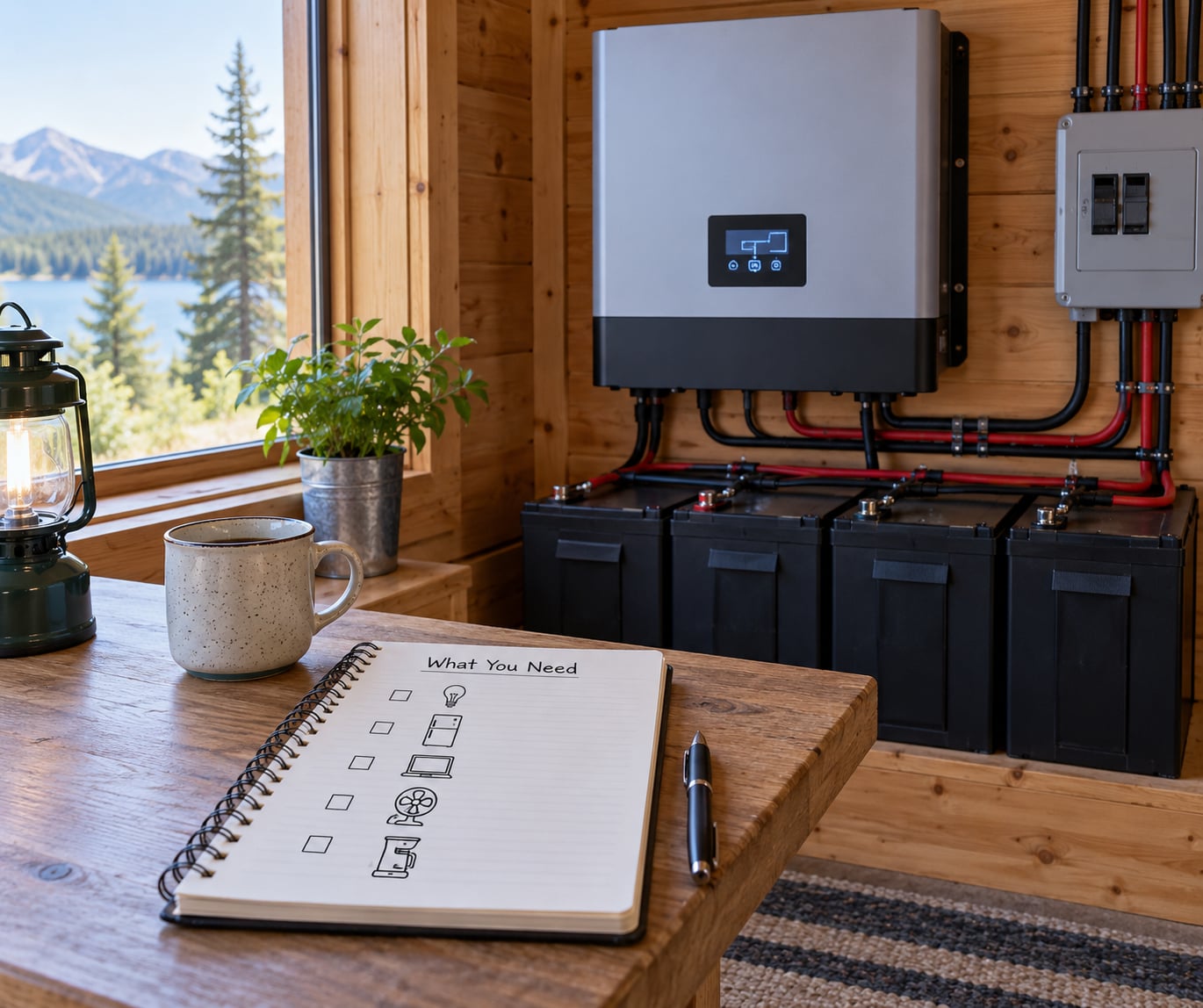
You do not need a utility bill, which is the hard part for most cabin owners. You need an honest inventory instead.
- A load inventory. Every appliance, its nameplate wattage, and roughly how long it runs on a typical day. The nameplate is usually on a sticker on the back or bottom.
- Seasonal sunlight data. Winter peak sun hours for your nearest city. NREL’s PVWatts calculator is free and takes a zip code and a tilt angle. Record the December or January figure, not the annual average.
- Occupancy pattern. A weekend cabin used 40 nights a year and a full-time cabin have completely different answers, and this is the single biggest fork in the sizing process.
- Battery options to compare. Lithium iron phosphate (LiFePO4) and flooded or sealed lead-acid differ sharply in usable depth of discharge and cycle life, and that changes the bank size.
- Inverter requirements. Continuous watts, surge rating, and whether you need AC-coupled support or a generator input.
- Local electrical guidance. Your authority having jurisdiction, which for a detached structure is often the county rather than the utility. Keep in mind that AC work still needs a licensed electrician even when the panels are yours.
A clamp meter and a kill switch for the battery bank are worth buying before the panels, not after. Measuring real draw from an existing appliance beats trusting a label.
Step-by-Step
To size an off-grid solar system for a cabin, list every load and convert it to watt-hours per day, divide that by your worst-case winter peak sun hours and a 0.6 efficiency factor to get array watts, multiply the daily load by your days of autonomy and divide by depth of discharge to size the battery bank, then pick an inverter that covers your largest simultaneous load plus motor surge. The whole calculation takes an afternoon, and getting it wrong costs far more.
1. Estimate the Cabin’s Daily Energy Use
Split loads into two buckets. Essential loads are what keeps the cabin habitable: refrigerator, freezer, lights, water pump, propane or wood heating controls, ventilation fan, phone charging, and internet. Discretionary loads are everything you chose: microwave, coffee maker, laptop, power tools, satellite TV, washer-dryer.
Most cabins run between 3 and 8 kWh per day for two people, with a refrigerator-freezer and a well pump at the top of that range. A heavily used cabin with a heat pump or electric heat can land well above 10 kWh.
Build the list in a table and fill it in. Multiply watts by hours of use, not by days, because a refrigerator runs in short cycles and its nameplate rating is far higher than its average draw.
| Appliance | Watts | Hours per day | Wh per day |
|---|---|---|---|
| Refrigerator-freezer | 150 (running) | 10 | 1,500 |
| LED lights (8 fixtures) | 80 | 5 | 400 |
| Well pump | 350 | 1.5 | 525 |
| Internet router and modem | 25 | 24 | 600 |
| Propane heating controls and fan | 60 | 8 | 480 |
| Laptops and phones | 90 | 5 | 450 |
| Microwave | 1,200 | 0.3 | 360 |
| Miscellaneous, lights, chargers | 150 | 4 | 600 |
| Total | 4,915 Wh/day |
Scale that total by how many nights you actually occupy the cabin. If you use it four nights a month in shoulder season, your real monthly draw is small and you can size a much smaller bank, accepting a long recharge after a storm. If you live there, treat the total as daily and year-round.
Account for planned additions while you are at it. People regretting their sizing usually forgot the second freezer, the tools, or the finished interior that added lighting and appliances. Add 15 to 20 percent for anything you know is coming.
2. Add Safety and Reliability Margins
The raw number is not the design number. Four adjustments sit between them, and each one covers a specific failure.
Inverter efficiency runs around 90 percent, charge controllers around 95 percent, and wiring, temperature and dust take a few percent more. Compounding all of that gives the 0.6 efficiency factor used in the array formula. Battery aging is the other one: lead-acid capacity fades noticeably within a few years, and lithium holds more of its rated capacity but loses it faster than most buyers expect at the end of life.
Weather streaks matter more than daily averages. Three gray days in November can take a system with 2 days of autonomy to zero. Owners on forum.solar-electric.com generally treat 2 days of autonomy as the practical floor for a cabin and 3 days where storms or winter road access are a concern.
The 20% rule for solar panels is simply an oversizing buffer: once your math lands on a wattage, round up about 20 percent. A larger array at a lower voltage produces more early-morning and late-afternoon energy and helps recover a bank after a cloudy stretch. The tradeoff is that an oversized array finishes charging before midday and sits idle, which is wasted hardware unless you have room to add loads.
Finally, add room for demand you did not plan. An inverter rated exactly at your measured peak load will trip the first time something new appears.
3. Size the Battery Bank
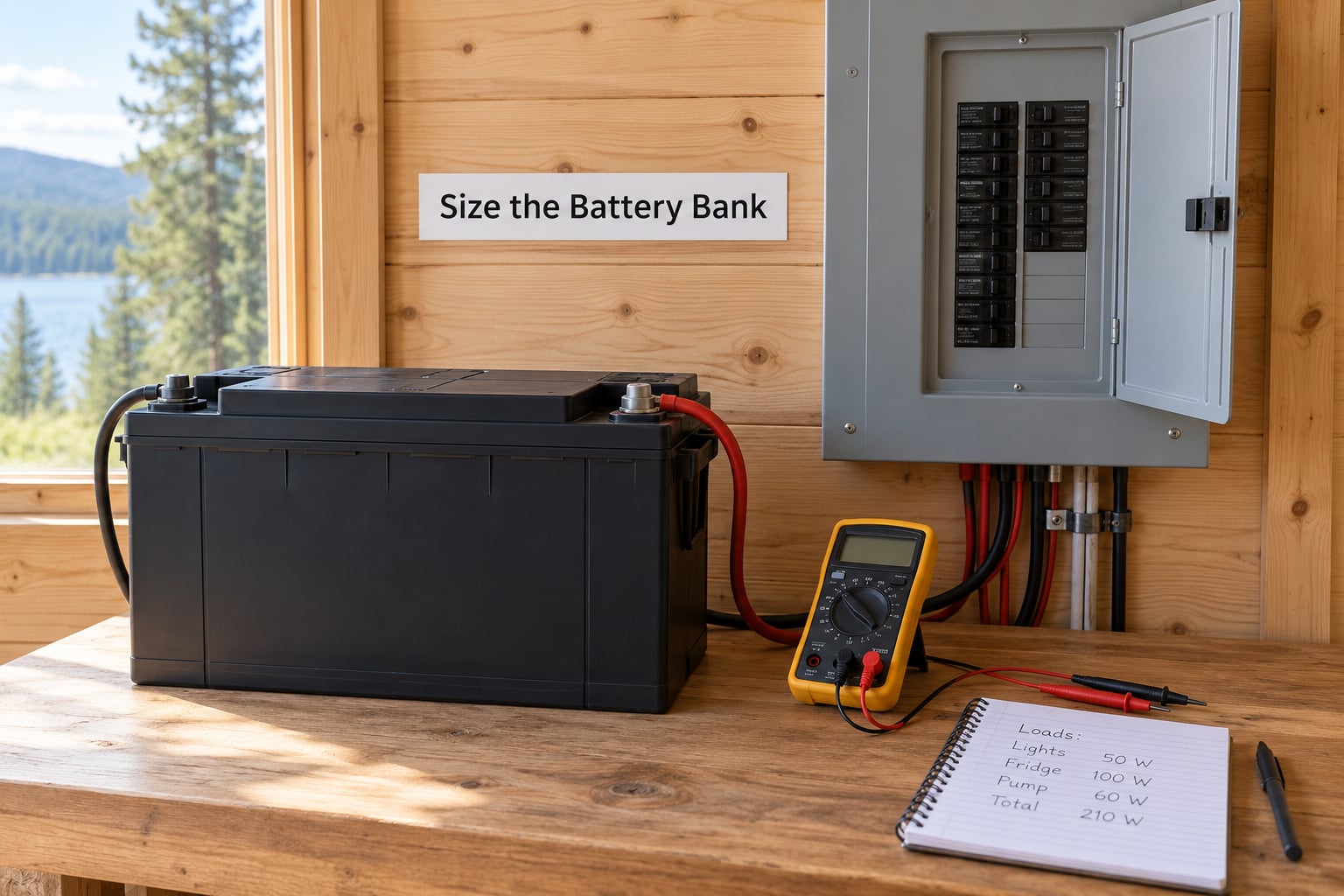
Storage sizing is arithmetic once you pick two numbers: how many days you want to run without sun, and how deep you are willing to discharge the bank.
The formula: battery watt-hours = daily kWh x days of autonomy ÷ depth of discharge. Then convert to amp-hours by dividing by nominal bank voltage.
Using the 4.9 kWh/day example with 2 days of autonomy: 4.9 x 2 = 9.8 kWh. At a 0.80 depth of discharge for LiFePO4, that is 12.25 kWh. At a 48V nominal bank, 12,250 Wh ÷ 48V = 255 Ah. Three 100 Ah 48V rack batteries covers it with a little headroom.
Depth of discharge is where most sizing goes wrong. A lead-acid bank’s nameplate capacity is not usable capacity. At 50 percent depth of discharge, a 200 Ah bank delivers about 100 Ah, and the Peukert effect means it delivers less than that under heavy load. LiFePO4 batteries can be cycled to 80 or even 90 percent without damage, so a lithium bank needs roughly 37 percent less nameplate capacity for the same usable storage.
Unheated cabins add a constraint. Most lithium banks have a low-temperature charge cutoff around 32F (0C) and will refuse to charge below it, which is the correct behavior but leaves you with no solar gain on a cold sunny day until the battery warms. Some models include internal heaters. If you cannot keep the battery room above freezing, either add heating or plan on a generator for deep winter.
For storage between visits, charge to 40 to 60 percent and disconnect loads. Long-term storage at full charge sitting cold is the fastest route to capacity loss.
4. Size the Solar Array
The array formula: array watts = daily watt-hours ÷ worst-month peak sun hours ÷ 0.6. The 0.6 is the system efficiency factor. The peak sun hours must come from your worst month, not your best.
Continuing the example with 4,915 Wh per day, a site at 3.0 peak sun hours in December, and a 0.6 factor: 4,915 ÷ 3.0 ÷ 0.6 = 2,730 W. Apply the 20 percent oversizing buffer and you land near 3,280 W. In practice that is twelve to fourteen 250 to 300 W panels, or a smaller count of 400 W panels.
If you had sized on a 5.5 peak sun hour summer figure instead, the same calculation gives 4,915 ÷ 5.5 ÷ 0.6 = 1,490 W. That system works beautifully from May through September and falls roughly half short in December. This is the most common sizing error in the field, and it is exactly what the winter complaints on r/OffGrid describe.
Snow is a real factor in northern climates. A fresh 6 inches can block output entirely, and melting takes hours of full sun. Tilt your panels at their winter angle (steeper, roughly 45 degrees in snow country) and mount them high enough that the lower row clears accumulated drifts.
5. Select the Inverter and Charge Controller
Two ratings matter. Continuous output covers the largest simultaneous load you expect; surge covers the startup spike from motors and compressors.
Add every load that could run at once. A refrigerator at 150 W, a well pump at 350 W, a microwave at 1,200 W, and lighting at 80 W is about 1,780 W of continuous demand. Inverters need roughly 3x to 5x that for startup surge, so look for 5,000 to 7,000 W of surge capability. Skip that and the inverter trips the first time the pump kicks on while the microwave is running, which is a complaint that shows up over and over on diysolarforum.
Choose a pure sine wave inverter for anything with a motor, electronics or sensitive electronics. Modified sine wave units are cheaper and will bother microwaves, some pumps and audio equipment.
Voltage architecture follows system size. 12V makes sense for tiny weekend cabins with one battery and low continuous load. 24V is the practical middle for 1 to 3 kW of inverter capacity. 48V is the right breakpoint for anything larger or any build you expect to expand, and it is the standard recommendation from experienced builders: start with a 48V inverter and one rack battery, then add capacity as real load data accumulates. Higher voltage means lower current for the same power, which means thinner cables and smaller breakers.
Size the MPPT charge controller from array watts and panel voltage, not from battery volts. A 3,000 W array on a 48V bank typically wants a controller rated at 60 to 70 amps, and it needs to accept your panel Vmp. Modern inverter-charge units often include the MPPT built in, which removes one more box from the wall.
Wire it like your life depends on it, because it partly does. The repeated advice across every off-grid forum is to size all wiring for 100 percent of load and step up a gauge rather than down. Owners running 8 AWG where others used 10 AWG report no regrets, and several describe overheating runs on the lighter gauge. Use the manufacturer’s chart for voltage drop rather than guessing.
Add the protection you cannot skip: a disconnect between panels and controller, a fuse or breaker at the battery bank sized to the wire, proper grounding and bonding, and appropriately rated PV wire. Keep the battery disconnect visible and reachable, and know where it is before you need it.
6. Check the Complete Design
Before buying, run four checks. Each one catches a different failure.
Can the array recharge the bank? Compare array watts against the daily load. If array production in your worst month is below your daily consumption, the bank never fully recovers and you will run perpetually flat. The example system at 2,730 W and 3.0 peak sun hours produces about 4,900 Wh, which covers a 4,915 Wh load almost exactly. That is a system with no margin, which is why the buffer mattered.
Can the inverter handle simultaneous loads? Add up everything that could run at once during the worst hour, not the worst day. Continuous rating must exceed that sum with roughly 30 percent in reserve, and surge rating must exceed it by 3x to 5x.
Does storage meet the backup goal? Confirm usable capacity covers the autonomy period after depth of discharge and after accounting for aging. If you sized on nameplate lead-acid capacity, your real autonomy is about half what the number suggested.
Do the voltages agree? Panel Vmp must fall inside the charge controller’s input window, and every component must agree on nominal bank voltage. A 48V charge controller cannot safely charge a 24V bank, and mismatched lithium and lead-acid banks on one controller is a genuine fire risk.
Sanity-check against a size table. These are rough targets for a two-person cabin with a refrigerator, lights, well pump and internet, sized for winter.
| Cabin type | Daily load | Array target | Bank target (LiFePO4) | Inverter |
|---|---|---|---|---|
| Small weekend cabin, 2 people, no well pump | 2 to 3 kWh | 1,500 to 2,000 W | 8 to 12 kWh usable | 2,000 to 3,000 W |
| Medium cabin, full-time for two | 5 to 8 kWh | 2,700 to 4,500 W | 15 to 25 kWh usable | 5,000 to 6,000 W |
| Large cabin or cabin with electric heat | 10 to 20 kWh | 5,500 to 11,000 W | 30 to 50 kWh usable | 10,000 W or split units |
The final question is whether to oversize the array or add a small backup generator. The honest answer depends on your weather and tolerance for cloudy stretches. A small propane or dual-fuel generator sized around 3,000 to 4,000 W handles a backup day, but it is fuel, noise, maintenance and a decision every time it runs. Oversizing the array pushes that decision further out at the cost of idle panels.
Forum consensus lands near 20 percent array oversizing as the reasonable middle, with a small generator added only where winter access, medical equipment or extended storms make reliability non-negotiable. Cabin builders who skip the generator entirely report that a larger array plus deeper bank was the better long-term call; those who added one rarely regret having it.
Common Mistakes
1. Sizing from peak watts instead of daily energy. Someone adds up nameplate wattage and divides by sun hours, which produces an array several times too small. Convert everything to watt-hours per day first, then divide. Watts tell you inverter size; watt-hours tell you array size, and mixing them up is the classic beginner error.
2. Sizing on annual average sunlight. Averages hide December. Always take the peak sun hour figure from your worst month, then add the 20 percent buffer.
3. Treating nameplate battery capacity as usable. A 200 Ah lead-acid bank gives about 100 Ah in real service. Use depth of discharge in the calculation, and remember the Peukert effect pulls the effective number lower under heavy draw.
4. Ignoring motor startup surge. Well pumps, compressors and power tools draw several times their running wattage for a moment. Rate the inverter on surge, not continuous.
5. Mixing incompatible voltages and chemistries. A 48V controller on a 24V bank, or lithium and lead-acid in one series bank, causes real damage. Every component must agree on nominal voltage and chemistry.
6. Undersizing the wiring. This is the one to fix without hesitating. Oversized cable costs a fraction of what a fire or a browned-out inverter costs.
7. Buying second-hand batteries. Forum owners are blunt about this: a used bank is a false economy that will fail sooner and unpredictably. Budget for new.
8. Forgetting future loads. A second fridge, finished walls, more tools, a second occupant. Wiring for the load you will have in five years costs almost nothing extra now.
A few habits catch problems early. Check battery state of charge and voltage after the first cloudy stretch of autumn, not in July. Clean panel glass before winter and check connectors for corrosion, which is the routine maintenance most cabin systems skip until output drops. Mount the array on the ground if the cabin is still under construction, since scaling later means new racking rather than a re-roof.
Frequently Asked Questions
How many solar panels do I need to run a cabin?
A two-person cabin running a refrigerator-freezer, LED lights, a well pump and internet typically needs 8 to 12 panels of 250 to 400 W, or about 2,700 to 3,500 W of array, when sized for winter rather than summer. Compute it yourself: daily watt-hours divided by your worst-month peak sun hours divided by 0.6. A weekend cabin with no well pump can often get by with half that.
How big a battery bank does an off-grid cabin need?
Multiply your daily kilowatt-hours by your desired days of autonomy, then divide by depth of discharge. For a 5 kWh daily load with 2 days of autonomy and LiFePO4 at 80 percent depth of discharge, that is 12.5 kWh, which at 48V nominal equals roughly 260 Ah. Add a third of that again for margin, and remember cold cabins may stop lithium from charging below freezing.
What size inverter do I need for an off-grid cabin?
Add up every load that could run simultaneously and size continuous output about 30 percent above that sum. Then require 3x to 5x surge capability for motors and compressors. A cabin with a 350 W well pump, 150 W refrigerator, 1,200 W microwave and lighting at 80 W totals roughly 1,780 W continuous, so look for a 3,000 W continuous inverter with 5,000 W or greater surge.
Will solar panels work in winter at a remote cabin?
They work, but production drops sharply. Many sites go from 5.5 peak sun hours in summer to 2.5 to 3 in winter, roughly a 50 percent swing. Tilt panels steeper in snow country, clear snow after storms, and size on the December or January figure. If your cabin is unheated in deep winter, add a small generator rather than buying enough panels to cover the worst month with no margin.
Do I need a generator with an off-grid cabin solar system?
Not always. A generator covering 3,000 to 4,000 W handles a backup day and gives real insurance against multi-day storms, but it adds fuel, noise, maintenance and a decision every time it runs. Most builders land on about 20 percent array oversizing plus 2 to 3 days of autonomy as the balance. Add a generator where winter road access, medical equipment or extended storms make reliability non-negotiable.
Do I need a licensed electrician for an off-grid cabin solar system?
For the DC side, many owners wire their own panels, controller and battery bank under self-permitting rules. The AC side, the panel tie-in and anything crossing into the habitable dwelling should go through a licensed electrician. Check with your county authority having jurisdiction, since a cabin can be treated as a dwelling, a structure or an accessory building depending on zoning, and that changes what needs a permit and inspection.
Start with the load table tonight. Fill in every appliance with its nameplate wattage and realistic hours, total the watt-hours, and that number drives everything else in the design.
Then pull your worst-month peak sun hours and run the array formula before you compare panels. That single step catches the mistake that ruins most cabin systems. If the answer leaves you more than 20 percent above your initial guess, the estimate was probably optimistic, not generous.
Finally, size the inverter and the wiring for the cabin you will have in five years, not the one you have this month. Panels and batteries expand cheaply. Cable, roof work and a tripped inverter at 10 pm in January do not.