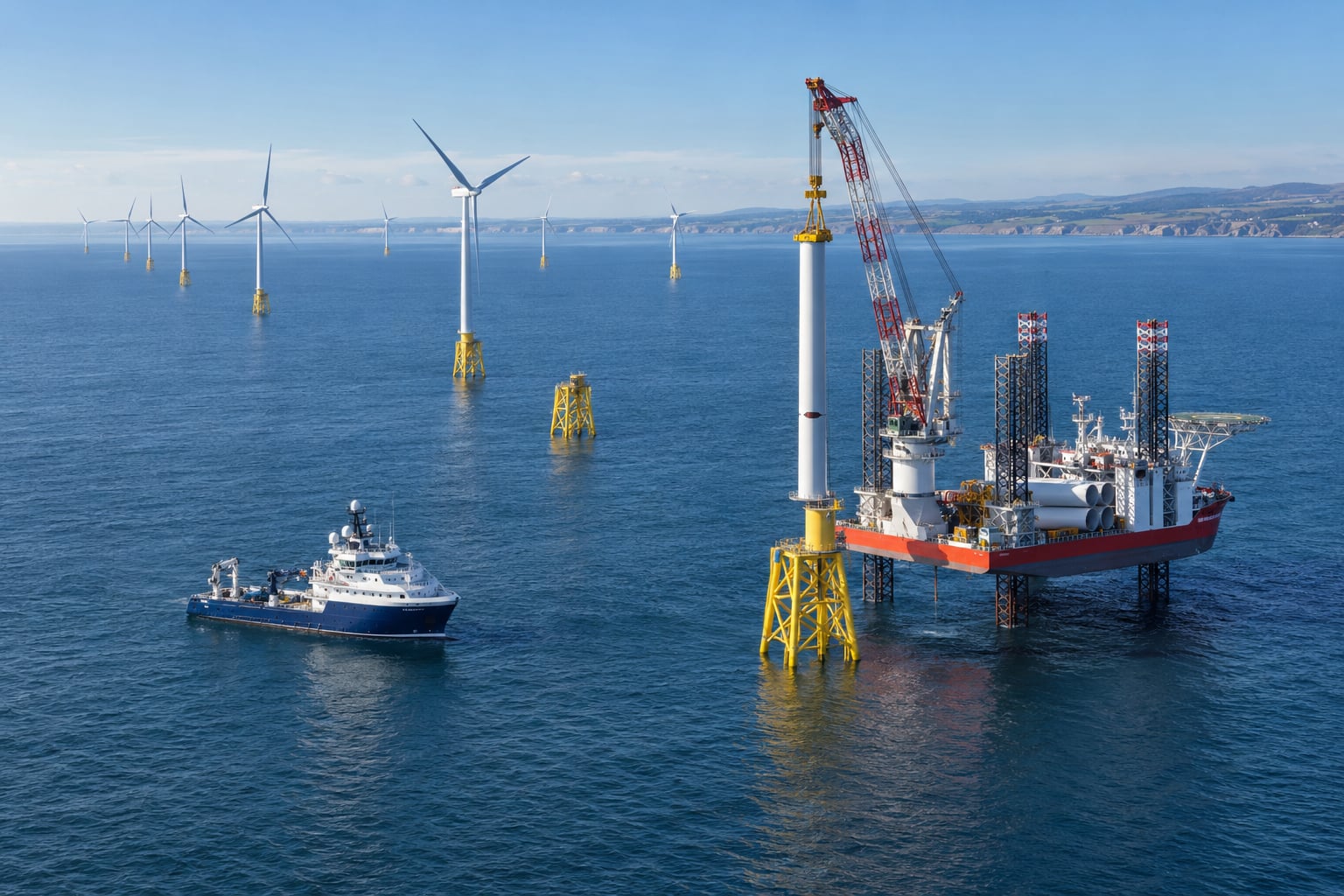
Offshore wind farms are built in a fixed order: survey the site, get the permits, install foundations, set the towers and rotors on top, run the cables to shore, then test the whole thing before it feeds power into the grid. The physics are simple — wind turns blades, the blades drive a generator — but everything around that box of hardware is marine construction done in open water, in weather that can shut the job down for a week.
This guide walks through the whole sequence, from the first survey boat to the day the substation energises. I’ve kept the engineering detail to what actually helps you understand a project: which vessel does what, why a site with good wind can still be a bad site, and where the long waits sit in a timeline that routinely runs eight years before the first electron moves.
Table of Contents
- How Offshore Wind Farms Are Built at a Glance
- How offshore wind farms are built, step by step
- What Developers Study Before Construction Starts
- Wind resource and energy yield
- Seabed conditions and water depth
- Shipping, fisheries and other sea users
- Environmental baseline and community impact
- How the Seabed and Wind Resource Are Surveyed
- Geophysical survey
- Soil investigation
- Metocean and wind measurement
- How Offshore Wind Farms Are Built: Planning and Permitting
- Project design and lease
- Environmental assessment and consultation
- Navigation, aviation and grid
- What Foundation Is Used for Each Turbine
- Bottom-fixed foundations for shallow water
- Floating foundations for deep water
- How the Offshore Foundation Is Installed
- Driving or drilling the pile
- Scour protection and the transition piece
- Grouting and the level check
- How the Cables and Electrical Grid Are Connected
- Inter-array cables
- The offshore substation
- Export cable, landfall and the onshore grid
- How Offshore Wind Turbines Are Installed
- Tower and nacelle
- Blades
- Why weather windows decide the schedule
- How Offshore Wind Farms Are Tested Before Opening
- What Happens During Operation and Maintenance
- Frequently Asked Questions
- How long does it take to build an offshore wind farm?
- Do offshore wind farms need deep-water foundations?
- What ships are used to install offshore wind turbines?
- Are offshore wind farms connected to the onshore power grid?
- Can offshore wind farms be built in environmentally sensitive areas?
- What maintenance is required after construction?
- Conclusion
How Offshore Wind Farms Are Built at a Glance
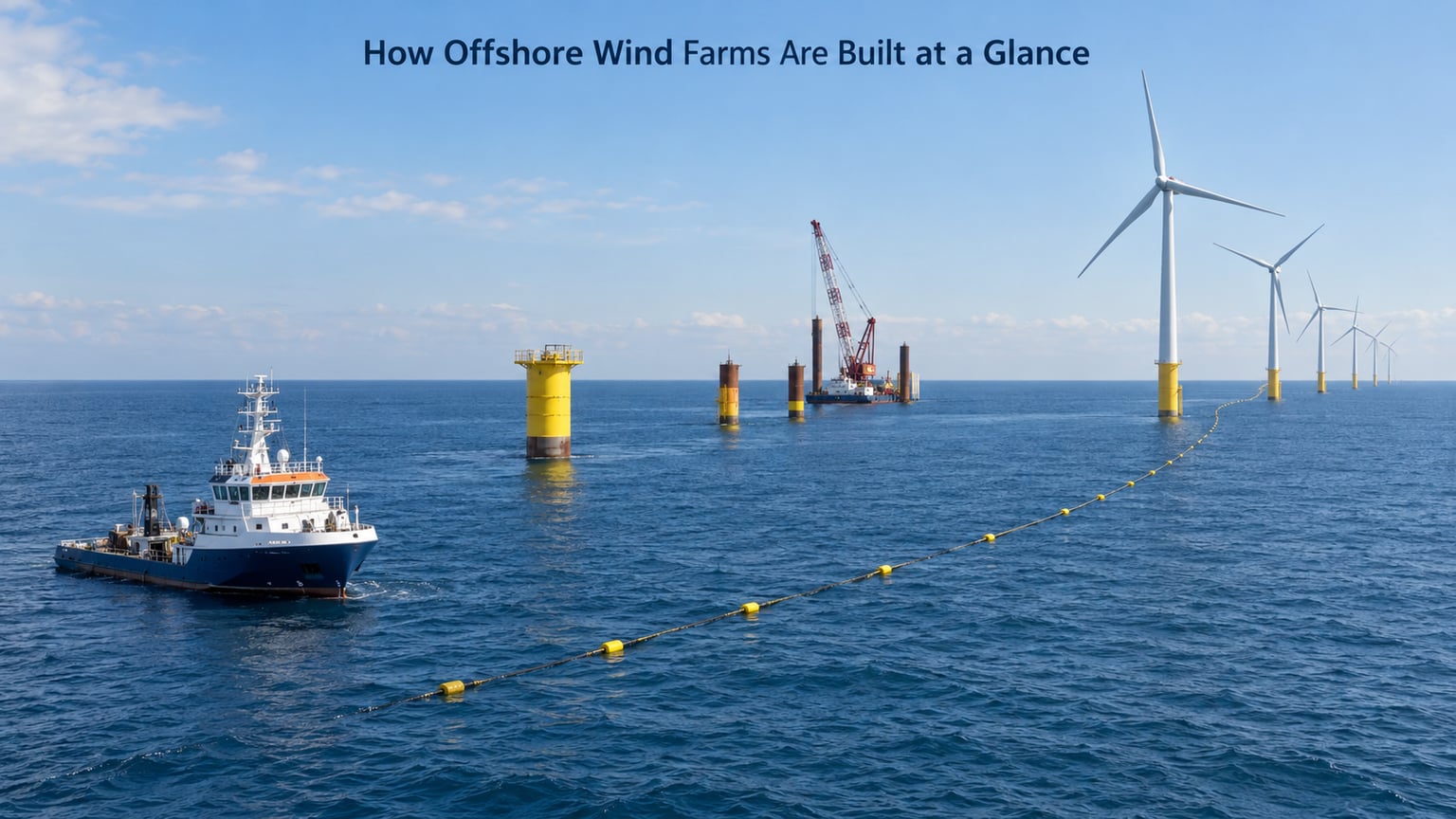
A farm of 50 to 100 turbines is assembled in a fixed order, and each stage depends on the one before it. You cannot drive a pile into a seabed you haven’t mapped, and you cannot pull an export cable to shore before the substation that feeds it is in place.
How offshore wind farms are built, step by step
- Survey the site. Vessels map the seabed with sonar, take soil cores, and measure wind, waves and currents for at least a year to pin down the layout.
- Design and get permission. Developers run environmental and navigational assessments, consult the public, bid for the seabed lease, and sign a grid connection agreement.
- Build the foundation. Steel monopiles or jackets are driven into the seabed, or drilled and grouted, then checked for level and scour protection is added.
- Lay the array cables. Inter-array cables run between turbines in strings, and a heavy-lay vessel installs the export cable out to the coast.
- Install the substation. A topside module — the transformer and switchgear that steps voltage up — is lifted onto its jacket foundation.
- Install the turbines. Tower sections, the nacelle and the three blades go up one at a time, usually from a feeder barge next to a jack-up turbine installation vessel.
- Test and export. Cables are energised and tested, turbines are commissioned one by one, and the farm goes live.
Two things sit underneath every step: money that was committed years earlier, and weather. Installation vessels need a calm sea and low wind — typically under 1.5 metres of significant wave height and roughly 10 metres per second of wind — and no more than about three or four days at a time. A missed window simply moves the following work to the next window.
It also helps to know the shape of a project before the detail. Site appraisal and wind measurement dominate year one, permitting consumes years two through four or five, and the offshore construction itself — foundations, cables, substation, turbines — is usually a two to three year push at the end.
What Developers Study Before Construction Starts
Before anyone orders steel, the team has to answer a set of questions that decide whether the project is worth building at all. Wind is the famous one. It isn’t the one that kills projects most often.
Wind resource and energy yield
Developers measure wind speed, direction and turbulence across the lease area, then model how much electricity each candidate turbine position would produce over 25 years. They discount the estimate for wake losses — the turbulence one turbine leaves in the air behind it — and for how often the crew can actually reach a machine for maintenance.
That last point surprises people. A theoretical yield that assumes a technician sails out in any weather is worth less than a slightly lower yield with realistic access, because unreachable time produces zero electricity.
Seabed conditions and water depth
Water depth drives nearly everything else. Shallow sites suit bottom-fixed turbines with a single steel pile. Past roughly 50 to 60 metres, a jacket or a suction-bucket foundation starts to make more sense, and past about 100 metres most developers move to floating designs. Seabed geology matters just as much: soft mud needs a different pile approach than dense sand or rock, and boulders can stop a foundation dead.
Shipping, fisheries and other sea users
Construction zones close over pipelines, cables, ferry routes and fishing grounds, so developers map all of it and agree detours with the harbour authorities and fishing fleets. Anchorage areas, dredged channels and existing offshore infrastructure get checked early, because moving a route after the design is fixed costs real money.
Environmental baseline and community impact
Surveys of birds, bats, seals, dolphins and whales run for at least one full seasonal cycle before construction. Developers also look at the onshore side: substation sites, cable landfall points, and what noise, traffic and jobs a build-out brings to nearby villages.
Grid connection is studied in the same phase. Some sites have spare capacity at the substation; others need a new substation and a reinforcement run, which can add years and a large share of the bill.
How the Seabed and Wind Resource Are Surveyed
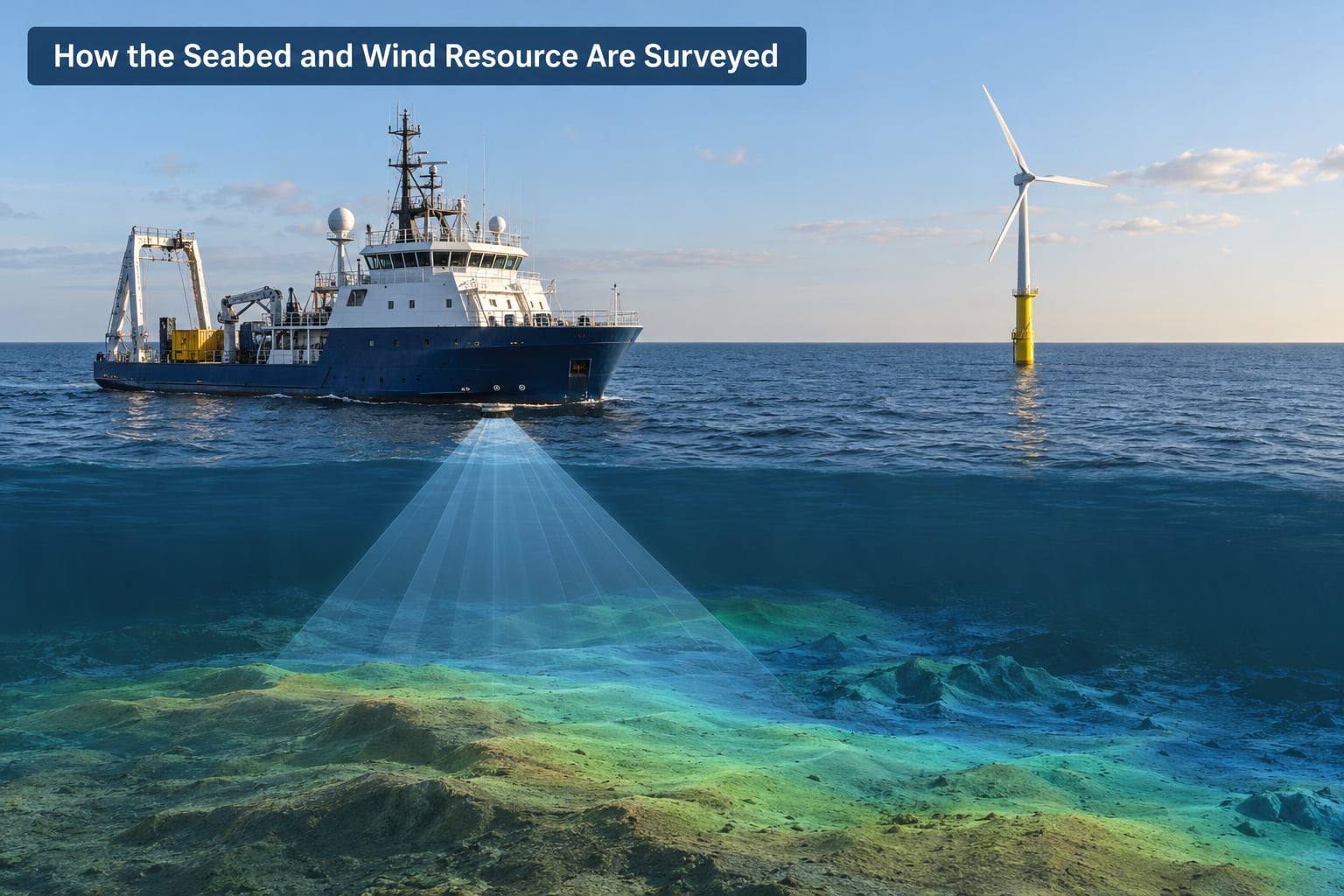
The survey campaign is where mistakes are cheapest to fix. Every turbine position, cable route and scour protection design later depends on what the instruments found.
Geophysical survey
A survey vessel tows a multibeam sonar package over the site and builds a depth map of the seabed. It picks out boulders, sand waves, existing pipelines and anything else that would interfere with a foundation or a cable. Side-scan sonar and sub-bottom profiling add detail on what’s sitting under the surface sediment.
Soil investigation
Cores are taken with vibrocorers or drilled to 30 to 60 metres below the mud line, whichever suits the ground. Engineers measure density, shear strength and clay content because those numbers decide whether a monopile can be driven through, whether drilling is safer, and how deep it must go. One unexpected boulder layer on a twenty-turbine site can add months.
Metocean and wind measurement
Floating buoys, wave radar on nearby structures and an offshore lidar or met mast record wave heights, currents, wind speeds and gusts. Onshore and roof-top met masts measure the wind coming onto the site, and both datasets run for twelve months minimum so a full seasonal cycle is captured.
What comes out the other end is a set of design criteria: the design sea state for the transition piece, wave and current loads for the tower, soil capacity for the pile, and a turbine size the water depth and the rotor can actually support. In shallow water, a very large rotor can be limited by water clarity and by waves rather than by wind.
How Offshore Wind Farms Are Built: Planning and Permitting
Permitting is the longest stretch of the whole project and the part that decides the schedule. It’s not bureaucratic box-ticking; each assessment produces constraints that feed straight back into the design.
Project design and lease
A developer first holds an exploration licence, usually obtained through a competitive auction of seabed acreage. That licence lets them survey for a period, after which they either apply for a consent to build or hand the acreage back. In the US the process runs through the Bureau of Ocean Energy Management and the relevant state, and in the UK through the Crown Estate alongside the planning inspectorate and the marine licensing body.
Environmental assessment and consultation
An environmental impact assessment covers the construction footprint, the noise and disturbance ranges, and the effect on birds, bats and marine mammals. Consultation is open — usually two to three formal rounds, plus ongoing engagement with fishermen and coastal residents. Objections land on the same list: fisheries disruption, views, noise, and the belief that local people get nothing from it.
Navigation, aviation and grid
Navigational risk assessments produce safety zones, marked cables and shipping alterations. Radar or aviation clearances are checked for turbine and blade-tip heights. A grid connection agreement is signed with the network operator, which fixes the export cable route, the landfall and the onshore works — and often decides whether the project can start at all.
Add financial close, supply chain contracts and nacelle factory slots to that list, and the reason a project announced in year one opens in year eight stops being mysterious. Offshore wind is a long-lead-time industry: the turbines and foundations are often ordered years before the first pile goes in.
What Foundation Is Used for Each Turbine
The foundation does one job: hold a rotor roughly 200 tonnes per blade spinning 150 metres up in wind for 25 years while the sea works on the structure underneath it. The choice is mostly driven by water depth and seabed geology.
Bottom-fixed foundations for shallow water
A monopile is a large steel tube, commonly 8 to 12 metres across, driven into the seabed and topped with a yellow transition piece. It is cheap, quick and by far the most common choice in shallow water, but it needs good lateral soil capacity and can’t be used in rock without drilling or a drilled-and-grouted insert.
A jacket is a lattice steel frame with four legs and horizontal bracing, stood on the seabed with a pile in each leg. It works from about 45 metres to 80 metres of water, and in some soils it is simply what makes the site possible, though the welds and members are heavy to fabricate.
A gravity-based foundation is a large concrete caisson that sits on the seabed and relies on weight and friction, most often at tidal or beach sites in shallow water. A suction bucket is a caisson with a closed bottom that is pumped until the seabed sucks it down, giving a silent, low-noise option where pile driving would be a problem.
A tripod and its larger relatives, the tetra- and quadripod, use three or four inclined legs to spread the load over a wide footprint where the seabed can’t take a small footprint.
Floating foundations for deep water
Past roughly 100 metres of water there is no seabed within reach of a normal foundation, so the turbine sits on a floating hull held down by mooring lines and anchors. A semi-submersible has submerged ballast tanks for stability. A spar buoy is a tall vertical cylinder that resists motion with its own deep draft. A tension leg platform is held by vertical tendons in taut tension, which damps motion very well.
Because floating turbines can be assembled at a quayside and towed out, the vessels involved are ordinary or near-ordinary port tugs, and the weather exposure during installation is far lower. That is the trade: floating costs more per turbine today, but it opens sites with world-class wind that bottom-fixed projects cannot reach.
| Foundation | Typical depth | How it works | Best fit | Main drawback |
|---|---|---|---|---|
| Monopile | Up to about 40-50 m | Single driven steel pile with transition piece | Shallow water, good sand or firm clay | Noise from pile driving; poor in rock |
| Jacket | About 45-80 m | Four-leg lattice frame, pile in each leg | Deeper water or weaker soils | Heavy fabrication and more steel |
| Gravity-based | Up to about 25 m | Concrete caisson set by weight and friction | Tidal flats and beaches | Needs heavy marine logistics at the shore |
| Suction bucket | Up to about 40 m | Caisson pumped into the seabed | Sites near sensitive marine mammals | Requires suitable sand or firm clay |
| Tripod | Up to about 40 m | Three inclined legs spreading the load | Very soft or uneven seabed | Large footprint; complex fabrication |
| Semi-submersible | About 50 m and deeper | Ballast-stabilised hull on catenary moorings | Deep water, harsh conditions | Higher cost, motion in big waves |
| Spar buoy | About 50 m and deeper | Tall cylindrical hull, deep draft | Deep water, calmer sites | Large fabrication and tow-out footprint |
| Tension leg platform | About 50 m and deeper | Vertical tendons in taut tension | Deep water, low motion needed | Tendon installation and anchor demands |
How the Offshore Foundation Is Installed
Foundations are usually installed first and turbines later, in separate campaigns with separate vessels. That ordering matters because the foundation work happens in an earlier, often calmer, part of the season, and because a pile-driving vessel and a turbine installation vessel are different animals entirely.
Driving or drilling the pile
A jack-up crane vessel lifts the monopile and holds itself in position on four legs. The pile is driven with a hydraulic hammer — a large hammer on a pile-driving rig that repeatedly strikes the pile head and pushes it down metre by metre, with vibration measurements taken throughout to check it stays vertical and to watch for damage.
In noisy or sensitive areas, a bubble curtain is placed around the pile: a perforated hose on the seabed releases pressurised air and forms a curtain of bubbles that absorbs and scatters sound pressure waves. Soft-start procedures ramp the hammer up slowly so animals can move away first. Where rock sits near the surface, drilling and grouting is used instead: a drill goes down, a foundation is grouted into a drilled socket, and the whole thing works like a socket rather than a friction pile.
Scour protection and the transition piece
Around any structure the current picks out sand, and the seabed can hollow out beneath it — scour. Rocks, mattresses or small stone are then placed around the base to keep the seabed stable for the life of the farm.
Grouting and the level check
The yellow transition piece sits on top of the monopile, splitting the structure into two: below it, steel that never moves; above it, everything the wave and the nacelle push around. Its interior is grouted, the two pieces are locked with shear keys and D-flanges, and once the grout cures the whole assembly is surveyed to confirm it is level within millimetres and plumb to tolerance.
How the Cables and Electrical Grid Are Connected
Cable work is the part visitors never see and the part that most often decides whether a project makes sense. Getting power from each turbine to shore takes three elements: the array cables, an offshore substation and the export cable.
Inter-array cables
Each turbine has a short piece of cable running from its foundation to a string of 5 to 20 turbines. These inter-array cables sit on the seabed, often with a section that rises up the monopile to a platform-mounted connector, and connect the strings to the substation. On larger farms several substations are linked to each other and then to shore.
The offshore substation
The offshore substation is a two-storey topside platform that collects power from every array cable, steps the voltage up from 34 kV to around 132 kV or 220 kV, and switches it into the export cable. It arrives as a module, complete and tested onshore, and is lifted in one piece by a heavy-lift vessel onto a jacket or two monopiles. Testing it at the quay first is standard practice, because fixing a fault offshore costs a small fortune.
Export cable, landfall and the onshore grid
Cable-laying vessels install the export cable in sections, feeding it out over a stern sheave while tension is controlled so the cable hangs in a long catenary rather than dropping straight onto the seabed. Where the seabed is mobile sand, the cable is buried; where it isn’t, rock dumping covers the exposed lengths. Longer crossings sometimes use a vertical lay system, where the cable drops to the seabed in a controlled curve instead of the usual long loop.
At the coast the cable comes ashore at a landfall, usually in a cove or tidal flat chosen because it keeps the shoreline crossing short. The cable rises through the beach to a joint bay, then runs to an onshore substation where the transformer steps the voltage up again for transmission to the grid. Some very large projects use high-voltage direct current instead of alternating current, with converter stations at both ends to limit losses over distance.
And then there is the part outside the water: the onshore substation, new transmission lines, and whatever reinforcement the local network needs. On several recent projects the onshore grid build has taken as long as the offshore work, which is why grid capacity now gets checked as early as the wind data.
How Offshore Wind Turbines Are Installed
Turbine installation is the sequence everyone pictures, and it’s the most weather-dependent work on the project. Nearly every large turbine goes up the same way: tower in sections, nacelle next, blades one at a time.
Tower and nacelle
A jack-up turbine installation vessel positions itself over the foundation, lowers its legs, and jacks itself up above the waves. The tower arrives in two or three sections, each lifted from the deck and bolted flange to flange; the yaw system is fitted on top before the tower is closed out.
The nacelle — the machinery housing holding the main bearing, gearbox or direct-drive generator, converter, control cabinet and transformer — is lifted as one piece weighing hundreds of tonnes, often using a self-elevating platform on deck rather than a crane, which allows the vessel to install in slightly rougher water. After landing, the yaw system rotates the nacelle into the wind and the crew bolts it down.
Blades
The three blades go up individually. The vessel sits alongside a feeder barge that carries the blades, and a blade lift with a heel-turning function picks each one up, raises it upright and attaches it to the hub, then hoists it into position. Single-blade installation is the standard now; a one-piece rotor was tried in the early 2010s and abandoned because the lift was too risky in any real sea state.
Why weather windows decide the schedule
Lifting a 500-tonne nacelle is not something you do in a swell. Installation typically needs waves below about 1.5 metres and wind under 10 metres per second, and each vessel has its own limits set by engineers and class rules. A season can be lost to weather in a way that no amount of planning removes — so schedules carry float, and developers value contracts that let them rebook a vessel and keep going.
Once the blades are on, the crew lands the lightning protection, the aviation warning lights, the boat landing and the nacelle crane, then closes the yaw ring bolts. The turbine is electrically complete but not yet producing.
How Offshore Wind Farms Are Tested Before Opening
Commissioning is the step that turns a collection of turbines into a power station. It runs in stages, and the farm only opens once every stage has passed.
Cold commissioning is electrical: insulation resistance, cable continuity, transformer energisation, switchgear checks, protection relay settings and earthing. Substation topsides and export cables are tested onshore before installation where possible, and the array cables are tested after lay-down with the far end terminated and the cable pulsed to detect faults.
Hot commissioning is mechanical. Each turbine runs with no load, then with a clutch or brake released and no power export, checking rotation, lubrication, gearbox noise, vibration and brake function. Yaw and pitch are exercised across their full range, the anemometer and wind vane are calibrated against a reference, and every sensor, alarm and emergency stop is triggered at least once.
Farm-level testing comes last. Grid connection approval, voltage and reactive power control under load, and a period of stable export at various power levels confirm the farm can deliver reliably. Technicians then stay offshore until the farm has run without an alarm for an agreed period, usually several weeks.
What Happens During Operation and Maintenance
An offshore turbine is designed for a quarter century without being lifted out of the water, which changes how maintenance works. Anything that can be fixed from shore is fixed from shore.
Each turbine reports continuously to the shore-based operations centre. Operators watch vibration, temperature, power curve performance and gearbox oil condition remotely, and most alarm investigations are done from a desk before anyone sails. Planned maintenance follows a schedule set by how many hours the machine has run, with major work involving a service operation vessel and crews living aboard on roughly two-week rotations.
Cable and foundation condition is monitored too. Scour is re-surveyed by sonar, the transition pieces and boat landings get inspected by rope access divers, and buried cable sections are checked with a survey vehicle towed along the route. If a fault is found, a repair crew grapples the cable, brings it to the surface, cuts out the damaged length, lays in a new section and re-buries it.
Storm procedure is part of the design, not an afterthought. Turbines pitch their blades out of the wind and shut down at sustained speeds around 25 metres per second, and operators run a structural loading check across the whole farm before a named storm, starting turbines up in a planned sequence so the surge doesn’t trip the export cable.
End of life comes up too. Foundations can be left in place in most cases, but blades are the hard problem, since they are built from composite material that is hard to recycle. Operators are now signing contracts to recycle blades at end of life rather than landfilling them, and several ports have opened dedicated blade recycling capacity for that reason.
Frequently Asked Questions
How long does it take to build an offshore wind farm?
Roughly eight years from the first lease to commercial operation, with most projects falling between six and twelve. Surveys and wind measurement take one to two years, permitting and design three to five years, and offshore construction two to three years. Fabrication of foundations and turbines starts earlier, often before permits are final, because of how long the steel and components take to make.
Do offshore wind farms need deep-water foundations?
Only when the water is deep. Bottom-fixed monopiles, jackets and suction buckets handle sites up to roughly 40 to 50 metres. Between about 50 and 100 metres, jackets become common. Past 100 metres, developers use floating designs on semi-submersible hulls, spars or tension leg platforms held by mooring lines, because there is no reachable seabed for a fixed structure.
What ships are used to install offshore wind turbines?
A jack-up turbine installation vessel does the turbine work, lifting legs onto the seabed so the deck sits above the waves. Heavy-lift vessels install substation topsides and transition pieces, cable-laying vessels lay array and export cables, and feeder barges sit alongside carrying towers, nacelles and blades. Pile-driving and drilling rigs mount on jack-up hulls to install foundations.
Are offshore wind farms connected to the onshore power grid?
Yes. Turbines feed into inter-array cables that run to an offshore substation, which steps voltage up and sends power through an export cable to a landfall point on the coast. The cable then runs to an onshore substation and out to the transmission network. Very large or distant projects sometimes use high-voltage direct current with converter stations at both ends.
Can offshore wind farms be built in environmentally sensitive areas?
Sometimes, but rarely without changes to the design. Developers survey birds, bats and marine mammals for at least a year first, then adjust layout, season or method: pile driving switches to drilled and grouted foundations, bubble curtains and soft-start hammer procedures cut underwater noise, seasonal limits protect migrating species, and suction buckets avoid impact noise altogether. Some locations are ruled out entirely.
What maintenance is required after construction?
Turbines are inspected on a schedule based on running hours, with crews living aboard service vessels on about two-week shifts for major work. Most checks happen remotely, since condition monitoring means most faults are diagnosed from shore before anyone sails. Seabed scour is re-surveyed by sonar, cables are inspected with a towed vehicle, and repairs to buried cable sections are done by a crew that grapples and relays the damaged length.
Conclusion
Offshore wind farms are built in a strict sequence: survey the wind and seabed, win the lease and the permits, drive or float a foundation under every position, run cables between the turbines and out to shore, set the substation on top, lift the towers and rotors into place, then test everything before exporting.
If you only understand one thing, make it this: the design is decided long before the first steel goes in, by water depth, seabed soil and the grid connection. Everything after that is execution against a plan that has already been tested against wind data, wave loads and weather windows.