Pumped hydro storage works by pushing water uphill when electricity is cheap or surplus, then letting that water fall back down through a turbine to generate power when the grid needs it. The stored energy is gravity itself: a mass of water held above ground level. Think of it as a giant water battery that never runs flat.
That simple loop is why pumped hydro still carries most of the world’s grid-scale energy storage. It stores far more energy than any battery farm, it lasts for decades, and a plant can go from idle to full output in under a minute. The catch is geography. You cannot build one on a flat suburban street.
Table of Contents
- How Pumped Hydro Storage Works at a Glance
- What Is Pumped Hydro Storage?
- The Step-by-Step Energy Cycle
- 1. Surplus electricity appears
- 2. Water is pumped uphill
- 3. Energy sits in the water
- 4. Water falls and drives a generator
- Why Water Is Stored Higher Up
- Pumping Mode: Charging the System
- Turbine Mode: Generating Electricity
- How Much Energy Does Pumped Hydro Store?
- Is Pumped Hydro Storage Efficient?
- How Does Pumped Storage Help Solar and Wind Power?
- What Are the Main Benefits and Limitations?
- Can Homeowners Use Pumped Hydro Storage?
- How Pumped Hydro Differs From Other Energy Storage
- Frequently Asked Questions
- Where does the water go after a pumped hydro plant uses it?
- Does pumped hydro storage make electricity or waste energy?
- How long can pumped hydro storage hold energy?
- How efficient is pumped storage hydropower?
- What are the main downsides of pumped hydro storage?
- Can a home use pumped hydro instead of a battery?
- Key Takeaways and What to Do First
How Pumped Hydro Storage Works at a Glance
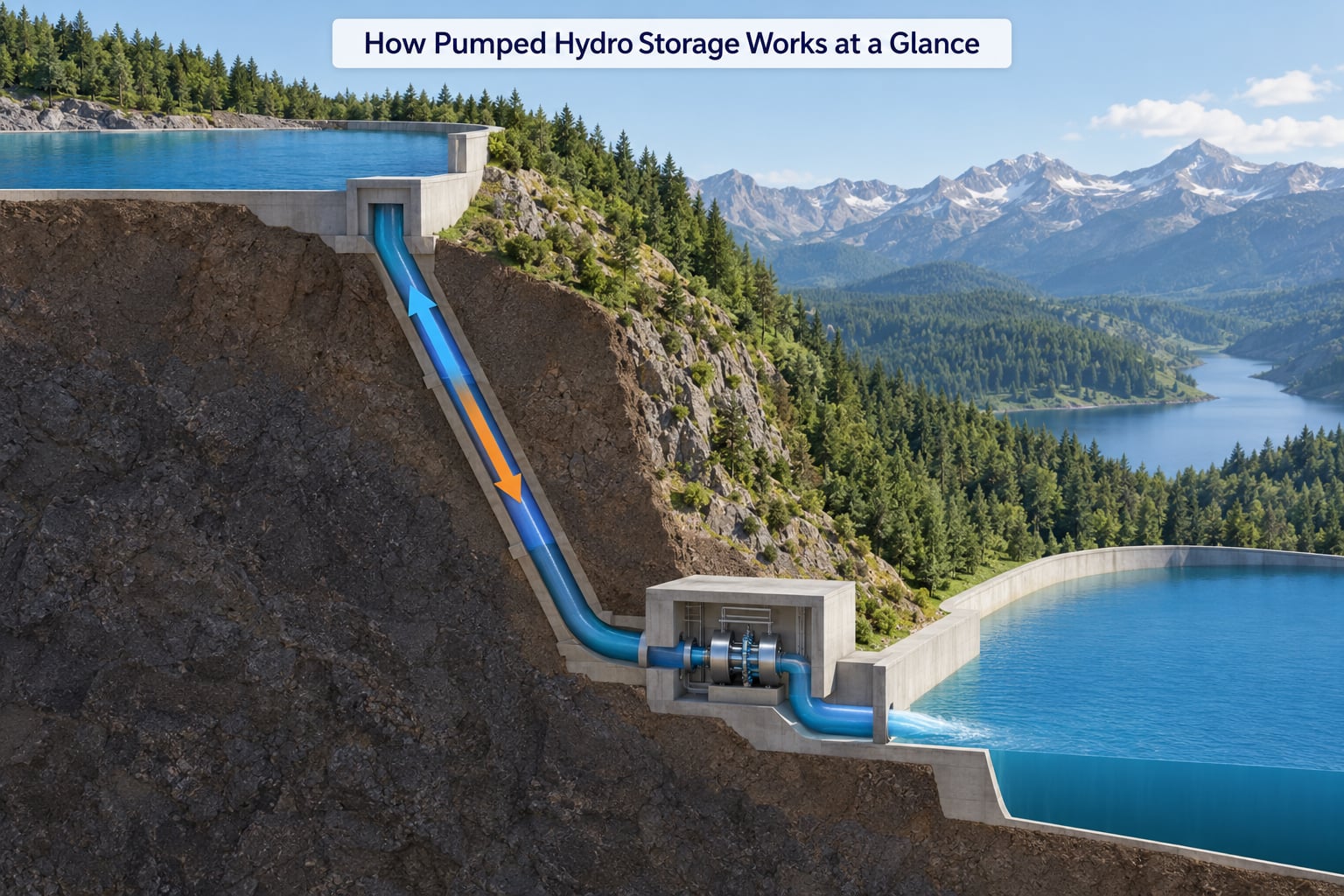
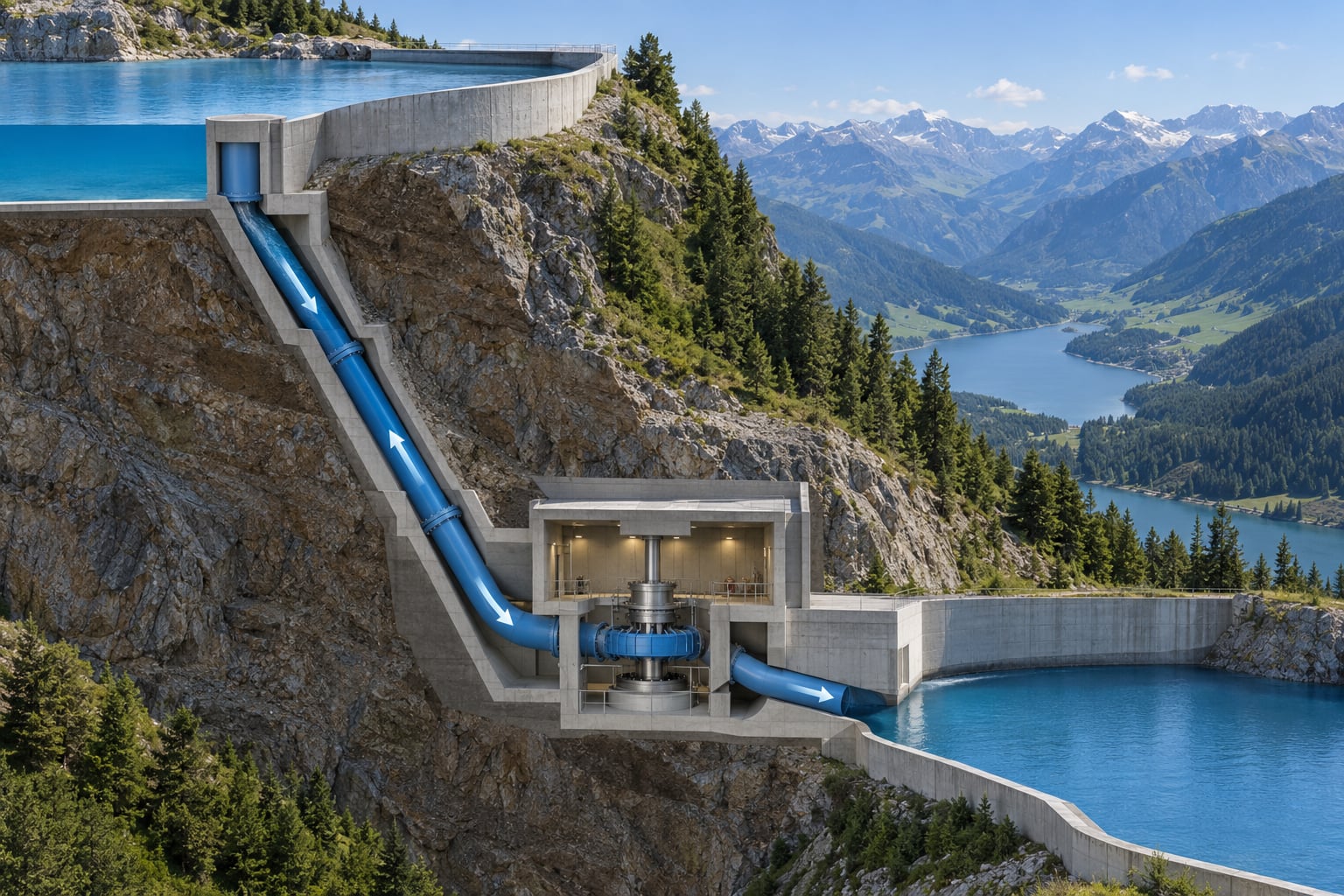
A pumped-storage plant has two reservoirs at different elevations, joined by a tunnel or pipe called a penstock. Between them sits a reversible machine that acts as an electric motor when pumping and as a turbine when generating.
- Storing energy. Off-peak or surplus electricity drives the machine as a motor. It pushes water from the lower reservoir up into the upper one, and the water’s height stores the energy.
- Generating electricity. Water is released from the upper reservoir and falls down through the same machine. Reversed, it becomes a turbine that spins a connected generator, sending power to the grid.
Nothing is consumed and nothing is added. The same water goes up and comes back down, repeatedly, for as long as the equipment lasts.
What Is Pumped Hydro Storage?
Pumped hydro storage is a battery, not a source of energy. It creates no electricity from scratch. Water moving downhill through a turbine does the same work as water flowing down a river, and the plant still needs a surplus of power over generation to fill back up.
That makes it different from a conventional hydroelectric dam, which uses a natural river flow to generate continuously. Pumped storage adds a pump and an upper reservoir, so the operator can choose when generation happens rather than simply following the river.
It is also different from a run-of-river plant, which diverts part of a stream through a turbine and leaves the rest downstream. Pumped storage cares far more about the height difference between its two reservoirs than about how much water runs past.
The Step-by-Step Energy Cycle
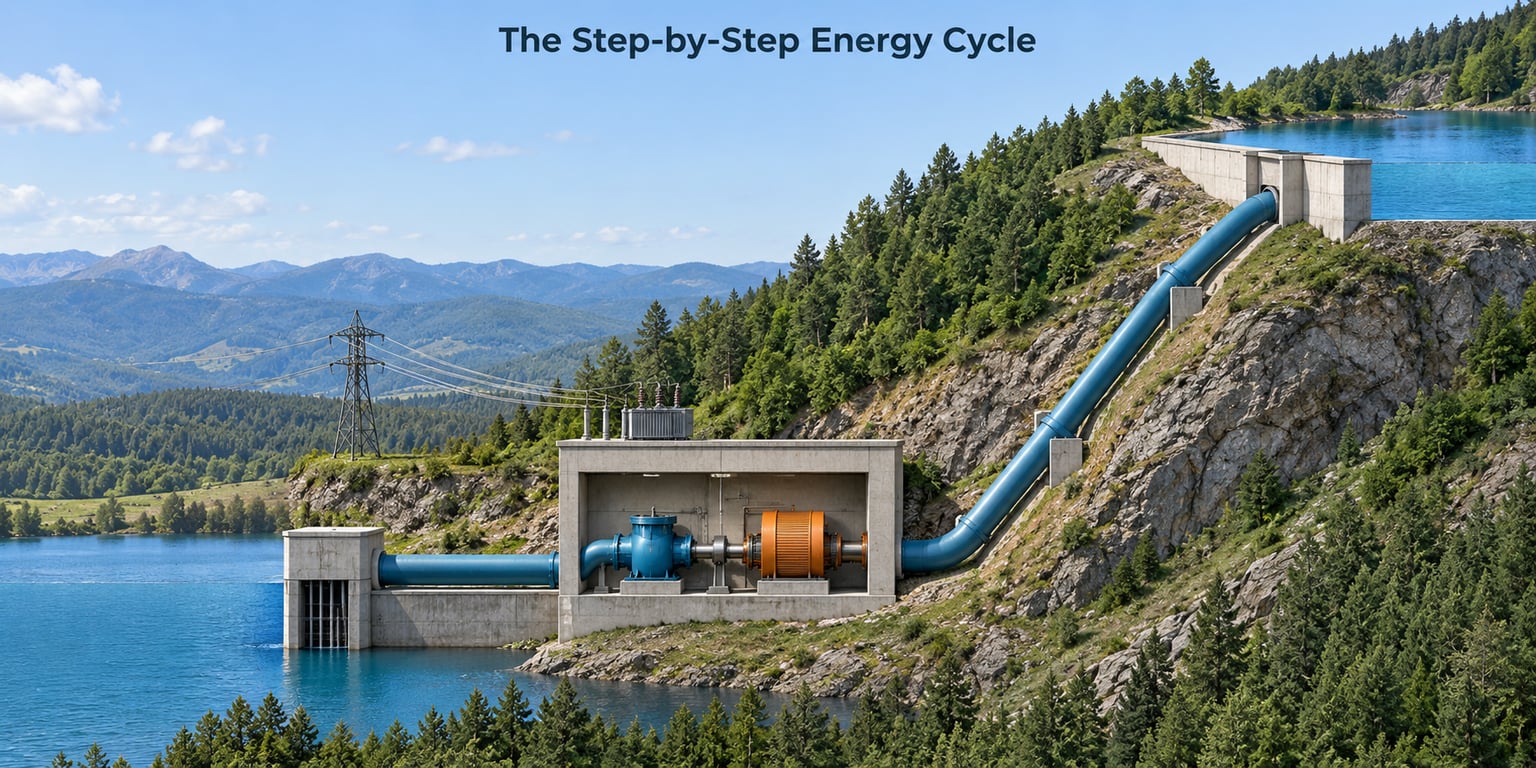
One full cycle has four physical stages, and a plant may run several of them a day.
1. Surplus electricity appears
Demand drops overnight, or a solar field produces more than the grid can absorb at midday. Power is available cheaply, and in some markets generators are paid to consume it because spot prices go negative.
2. Water is pumped uphill
Electricity drives the reversible unit as a motor. It pushes water from the lower reservoir through the penstock into the upper reservoir, which sits hundreds of metres higher.
3. Energy sits in the water
With the pump off, the water stays where it was put. There is no chemical reaction, no heat to fade and almost no self-discharge, so the energy can wait for hours or even days.
4. Water falls and drives a generator
Water released from the upper reservoir drops through the turbine, spinning it and the generator attached to it. The same water collects again in the lower reservoir, ready to be pumped again.
Why Water Is Stored Higher Up
The energy comes from height. Physicists express it as energy equals mass times gravity times height, written E = mgh, and every term is something you can picture: how much water, how strongly gravity pulls it down, and how far it falls.
Water is heavy. A cubic metre weighs about a thousand kilograms, so lifting a million cubic metres 300 metres stores roughly 850 megawatt-hours of potential energy. Lift it 600 metres instead and you have doubled the storage from the same water.
This is why the vertical drop, called the hydraulic head, matters more than the reservoir’s surface area. Height is the free variable an engineer designs around, and finding enough of it near a transmission network is the whole siting problem.
Pumping Mode: Charging the System
Pumping usually happens at night or during a midday solar surplus, when power is cheapest or would otherwise be wasted. The operator charges the plant the way you would fill a tank before a long drive: slowly, cheaply, ahead of when it is needed.
Pumps push water uphill against gravity, so they consume more energy than the water gives back later. Between 8 and 15 percent of the electricity in is lost in the pump, the motor and the pipework before the water even reaches the upper reservoir.
Some plants run in pure pumping mode overnight as load-balancing machines, sitting idle all day and topping up the upper reservoir after dark. Nothing about the cycle requires the plant to generate right after it pumps.
Turbine Mode: Generating Electricity
Generation reverses the physics. Gravity pulls water down, water pushes on the turbine blades, and the spinning shaft turns a generator that pushes current onto the transmission lines.
Output depends on two things at once: how much water flows through the machine and how far it falls. Engineers often write power as proportional to flow times head times gravity. Raise the flow and output climbs; raise the head and it climbs again.
Large plants typically use Francis turbines, a spiral-cased design that handles big flows at medium heads, and newer sites increasingly use variable-speed reversible units that can start and stop far more often than older fixed-speed machines.
Speed matters for the grid. A pumped-storage plant can typically reach full load from a standing start in 30 to 60 seconds, which is why operators keep some units on standby as spinning reserve rather than as energy storage.
How Much Energy Does Pumped Hydro Store?
Plenty of readers mix up power and energy here, so here is the short version. MW and GW describe how fast a plant works. MWh and GWh describe how much it can deliver before it runs dry. You need both to judge a storage plant.
| Term | What it measures | Plain meaning |
|---|---|---|
| MW or GW | Power | How big the tap is |
| MWh or GWh | Energy | How much water is in the tank |
| Head | Height in metres | How far the water falls |
| Round-trip efficiency | Percent | What comes back out of what you put in |
Worked example: a plant rated at 1.2 GW that can run for two hours holds about 2.4 GWh of energy. That same plant can deliver its full 1.2 GW for two hours, or hold that power back and release a smaller amount over ten hours.
Real facilities span a wide range. Goldendale in Washington is a closed-loop plant of roughly 1,210 MW built on two 60-acre ponds. Dinorwig in Wales delivers 1,728 MW, Ludington in Michigan 1,872 MW, Bath County in Virginia 3,003 MW, and Fengning in China 3,600 MW.
Because the stored energy depends on reservoir volume, plants like Dinorwig hold far more electricity than smaller sites for the same output rating. Duration, not peak power, is what makes these machines valuable on a multi-day grid.
Is Pumped Hydro Storage Efficient?
Modern plants recover roughly 70 to 80 percent of the electricity put into them. Push in 100 units and you get about 70 to 80 back out. That sounds poor next to a battery, and by the numbers it is: a well-managed lithium-ion system can return 85 to 92 percent.
Where the losses go is straightforward. The pump and motor lose energy to heat, friction and electrical resistance. The pipe and tunnel lose a little to friction as water moves. The turbine and generator lose another few percent. The rest is water that evaporates or leaks and water still sitting at the wrong height when the cycle is cut short.
Small experimental systems do considerably worse. Once you account for the pump’s own consumption, frictional losses in narrow pipework and a small turbine, a tabletop pumped-hydro rig can return well under half of what went in. That gap is the reason home-scale versions rarely make sense.
Net energy out is always below net energy in, and that is not a flaw in the design. Operators pay very little for the electricity they store and get paid well for the electricity they release. The value comes from timing, not from creating energy.
How Does Pumped Storage Help Solar and Wind Power?
Solar and wind output follows the weather, not the clock. A grid with a lot of both has to solve the midday problem, when panels are producing more than buildings need, and the evening problem, when demand rises hours after the sun goes down.
Pumped storage solves both in one move. It absorbs the midday surplus, which reduces curtailment, then releases it during the evening peak when it displaces expensive peaking generation. The same reservoir also smooths gusty wind output hour by hour.
It is not a battery in the lithium sense, and the comparison is worth doing honestly. Utilities-scale battery capacity in the United States climbed from about 1 GW in 2019 to roughly 20.7 GW by mid-2024, while pumped storage stayed flat near 22 GW. Pumping’s share of global grid storage fell from about 90 percent in 2020 to around 56 percent by the end of 2024.
That shift is not a verdict against gravity. Counted by energy rather than power, US pumped storage still held on the order of 553 GWh at the end of 2023, far more than the roughly 42.5 GWh of batteries. Batteries won the short-duration race on cost and speed. Pumps kept the long-duration niche because they are cheap per stored unit and built to last.
Beyond bulk storage, plants deliver services batteries find expensive: fast frequency response, spinning reserve, grid inertia and black start, the ability to bring a dead grid back online without help from outside it.
What Are the Main Benefits and Limitations?
On the strength side: a plant stores enormous amounts of energy in concrete and water rather than in chemicals, sits nearly idle without losing its charge, and keeps working for 50 years or more. Dinorwig has been running for roughly four decades, and it took ten years to build. Response is measured in seconds, not minutes.
On the limitation side:
- Geography. You need two reservoirs at meaningfully different heights, which rules out most flat land and many populated valleys.
- Build time. Permitting and construction routinely run 7 to 12 years from idea to operation, which makes it a poor answer to a problem that changes faster than that.
- Capital cost. Tunnels, dams and powerhouses are civil engineering projects, and a bad site can never be made economic.
- Water use. Reservoirs lose water to evaporation, and plants in dry regions need make-up water each year. Conventional dams alter rivers and sediment; closed-loop off-river plants disturb far less, though not nothing.
- Community objections. Siting proposals around projects such as Klamath Falls and Goldendale drew organised local and tribal opposition over land, habitat and equity, a pattern planners now treat as a schedule risk rather than a surprise.
None of those are fatal. They are reasons pumped hydro fills a specific role instead of replacing everything.
Can Homeowners Use Pumped Hydro Storage?
For most households, no. The physics demands a specific combination of head and flow, and a normal domestic setup has neither. A storage tank fed by a small pump and emptied through a micro-turbine will lose most of its input energy to friction and to the pump’s own draw.
DIY versions do exist and are genuinely fun to build, often as a demonstration on permaculture forums and homestead forums where people rig a reservoir above a turbine to light an LED. They are teaching projects, not storage systems. Once you subtract round-trip losses, the energy you recover is a small fraction of what you put in.
Micro pumped hydro does make sense in a few narrow cases: an existing dam, a steep site with steady flow, or a remote cabin with no grid connection where weight and volume matter more than efficiency. Community-scale off-river systems sit in the same category and can be viable where the geography is right.
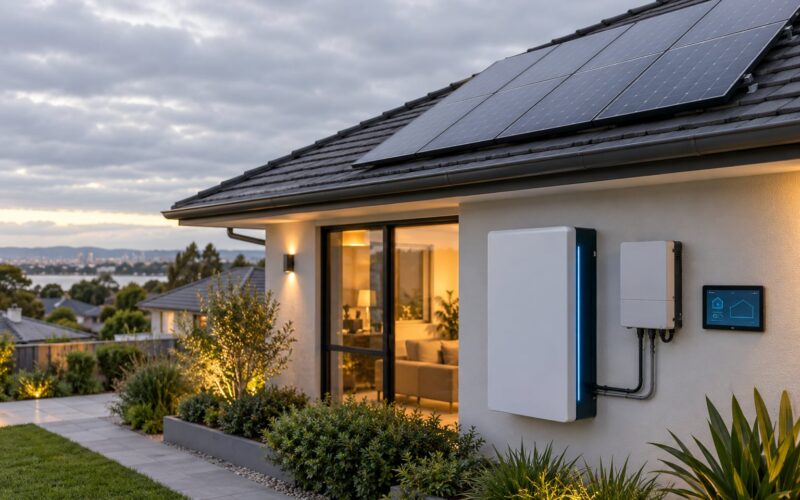
For a home with rooftop solar, the realistic comparison is against batteries. If your question is how to shift midday solar into an evening peak, size that battery against your actual evening load rather than against a grid-scale machine.
How Pumped Hydro Differs From Other Energy Storage
Every storage technology trades cost, speed, duration and lifetime against each other. Where pumped hydro wins is duration and lifespan; where it loses is speed and siting flexibility.
| Storage type | Typical duration | Strength | Weakness |
|---|---|---|---|
| Pumped hydro | 4 to 24+ hours | Very low cost per stored unit, decades of life, seconds-scale response | Needs head and flow, long lead times |
| Lithium-ion battery | 1 to 4 hours | Fast, modular, sited anywhere | Degrades, fire risk, costly per stored unit |
| Flow battery | 4 to 12 hours | Long life, deep discharge, non-flammable | Complex tanks and pumps |
| Compressed air | 10 to 100 hours | Uses geology, low energy density needed | Needs caverns, poor efficiency |
| Thermal storage | Hours to days | Cheap medium, useful with heat demand | Only works where heat is wanted |
| Mechanical gravity | Seconds to hours | Simple, fast, small systems possible | Very low energy density |
Open-loop, closed-loop and pump-back describe where the water comes from. An open-loop plant pumps from and returns to a natural river. A closed-loop, off-river plant uses two man-made ponds and touches no river at all. A pump-back plant sits below a conventional dam and stores water released above it. Closed-loop designs are increasingly preferred because they sidestep river permits and fishing rights.
Newer variants try to escape the geography problem: seawater pumped storage using salt-fresh density differences, storage in disused mine shafts, and dense-fluid systems using a heavy liquid. All are early, and none has yet matched pumped hydro’s installed base.
Frequently Asked Questions
Where does the water go after a pumped hydro plant uses it?
It goes straight back into the same lower reservoir it came from. A pumped-storage plant is a closed loop for the water itself, so the same water can cycle up and down many times a day for decades. Open-loop plants are the exception: they take water from a river or reservoir and discharge it downstream a little lower, and they lose a little volume to evaporation and seepage each time.
Does pumped hydro storage make electricity or waste energy?
It never makes electricity, because converting electricity into height and back always loses some. A modern plant returns roughly 70 to 80 percent of what it takes in. Operators do it anyway because they buy power when it is cheap or would be curtailed and sell it when demand is high. The margin comes from timing, not from a net gain.
How long can pumped hydro storage hold energy?
Realistically hours to a few days, depending on how much water the upper reservoir holds relative to the plant’s power rating. Multi-day performance comes from large storage volumes, not from better machinery. Storing a season’s worth of energy is a separate and still unsolved problem, and no pumped-storage design has reached commercial scale for it.
How efficient is pumped storage hydropower?
Large modern plants achieve about 70 to 80 percent round-trip efficiency, meaning 100 units of electricity in come back out as 70 to 80. The gap covers pump and motor losses, friction in the tunnel, turbine and generator losses, and evaporation from the upper reservoir. Small experimental rigs can fall below half, which is why household versions rarely pay back.
What are the main downsides of pumped hydro storage?
It needs two reservoirs at meaningfully different heights, so suitable land is limited and often contentious. Build times commonly run 7 to 12 years including permitting, capital costs are high, and reservoirs lose water to evaporation. Closed-loop off-river designs reduce the ecological impact but still face local opposition.
Can a home use pumped hydro instead of a battery?
Almost never. A domestic tank and small pump lack the head and flow needed, and round-trip losses can eat most of the energy you put in. Home builds are fun demonstrations that light an LED, not practical storage. For shifting rooftop solar into the evening, a properly sized battery is usually the better purchase.
Key Takeaways and What to Do First
Pumped hydro storage works by moving water uphill to store energy as height, then letting it fall through a turbine to generate power on demand. It is a battery rather than an energy source, it runs at 70 to 80 percent round-trip efficiency, and it stays useful for fifty years because the storage medium is water and concrete.
Before choosing a storage route, sort out four things: how many hours you need to hold, how fast the system must respond, what geography you have access to, and how long you are willing to wait for a project. Hours of storage plus a mountain nearby points to pumped hydro. A few hours, a garage wall and a fast payback points to batteries.
For anyone running rooftop solar in 2026, the honest starting point is a battery sized for your evening peak, with pumped hydro as the grid-level backstop that makes that battery affordable. Read our renewable energy news and energy saving tips to keep up as the storage mix shifts year by year.