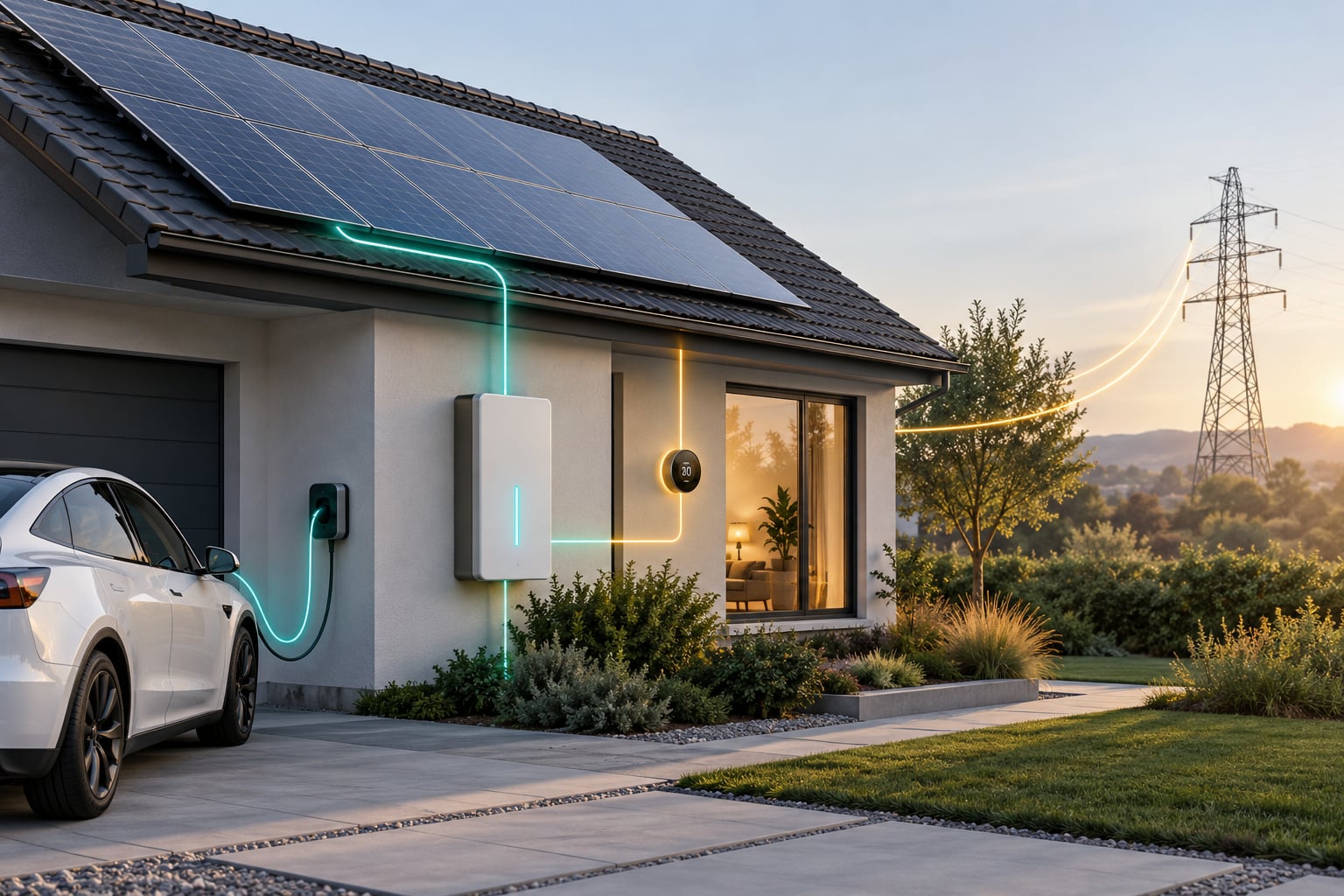
A virtual power plant is a network of home batteries, rooftop solar systems, electric vehicle chargers and smart thermostats, connected by software and operated together as a single power resource. Rather than one big facility with smokestacks, a VPP pools thousands of small devices and coordinates when each one charges, discharges or eases off.
The idea sounds abstract until you picture what actually happens during a hot July afternoon. The grid needs more electricity right now, a signal goes out, several thousand batteries discharge at once, and a peaker plant sitting idle does not have to fire up. That is the whole trick, and it is why utilities keep building these programs.
Table of Contents
- What Is a Virtual Power Plant?
- How Does a Virtual Power Plant Work?
- Why Do Homes Join a Virtual Power Plant?
- What Resources Can Be Part of One?
- Storage
- Generation
- Flexible loads
- A short glossary of the jargon
- What Benefits Can Households and the Grid Get?
- Is a Virtual Power Plant the Same as a Regular Power Plant?
- Can Solar Lights Be Part of a Virtual Power Plant?
- How Can a Homeowner Join a Virtual Power Plant?
- What Should Homeowners Check Before Joining?
- Frequently Asked Questions
- Do I need solar panels to join a virtual power plant?
- Can a virtual power plant keep the lights on during a power outage?
- Is it free to join a virtual power plant?
- What data does a virtual power plant collect from my home?
- Can renters participate in a virtual power plant?
- Conclusion
What Is a Virtual Power Plant?
A virtual power plant is a software-managed network of distributed energy resources, the official term for equipment that generates, stores or shifts electricity outside a traditional plant. Homes, small businesses, schools and even some industrial sites join through an aggregator, the company whose software translates grid needs into instructions for each device.
What makes it a “plant” is coordination rather than size. Thousands of small devices, spread across a service territory, can add up to a meaningful chunk of capacity and respond in seconds. The Department of Energy has estimated current US virtual power plant capacity at roughly 30 to 60 gigawatts, with a potential of 80 to 160 gigawatts, and projected annual grid cost savings in the billions of dollars.
There is no turbine, no cooling tower and no fuel line. The power plant is the platform plus the sum of everything plugged into it.
How Does a Virtual Power Plant Work?
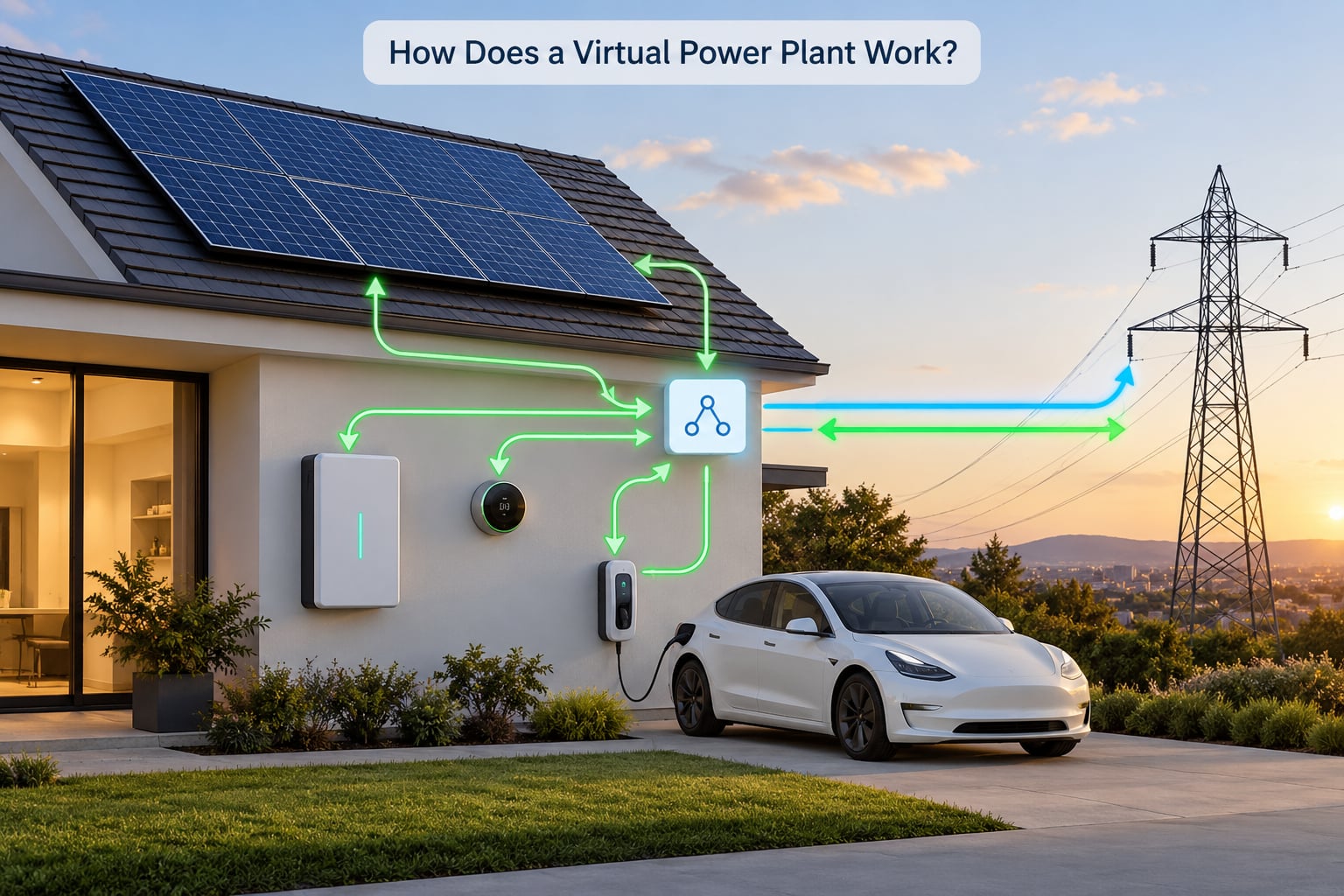
The sequence is much the same every time, whether the participants are in California, New England or Texas.
- Devices enroll. A homeowner signs up with a utility program or an aggregator and connects an approved battery, solar system, EV charger or smart thermostat to the platform.
- Software aggregates them. The platform adds up what every enrolled device could realistically deliver, based on its own limits rather than the theoretical maximum.
- A grid event triggers a dispatch. When demand spikes or a generator drops off, the utility calls for a specific amount of power and the platform sends instructions to the devices that agreed to respond.
- Response gets measured. The aggregator checks whether each device actually did what was asked, using interval metering data compared against a calculated baseline. Nominated amounts, expressed in kilowatts, are what the utility counts as delivered.
- Money moves. Participating households receive a share of the value through bill credits, direct payments or a subscription model, and the cycle repeats the next time the grid needs help.
Most of this happens without anyone noticing. Events often run in the late afternoon during peak season, and the device returns to its normal setting once the window closes.
Why Do Homes Join a Virtual Power Plant?
Homeowners join for four overlapping reasons, and the honest answer is that they usually mix.
The first is spare capacity. A battery sitting at 90 percent charge on a mild afternoon has nothing useful to do with that energy. A grid event gives it a job, and the household gets paid for the job.
The second is timing. Most home solar is produced in the middle of the day, when wholesale prices are often at their lowest and household demand is moderate. Discharging into the evening peak, when air conditioners are running hard, uses the same stored energy more usefully.
The third is the payment. Depending on the program, that payment can be a flat bill credit each month, a share of event revenue, or a discount on the battery purchase itself.
The fourth is a bit softer: helping the local grid. Plenty of owners describe a genuine sense of satisfaction that the equipment they already paid for is doing something useful, which is a theme that comes up repeatedly in homeowner forums.
What Resources Can Be Part of One?
Programs usually sort participating equipment into three groups, and this split is worth remembering because the utility treats each group very differently.
Storage
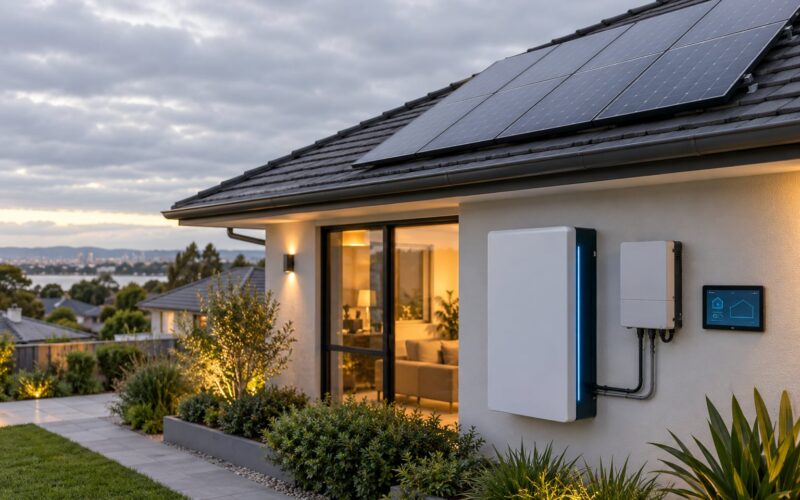
Home batteries are the most valuable asset in a virtual power plant because they can be told exactly when to charge and discharge. Tesla Powerwall, Enphase and Generac systems all appear in current US programs. Plug-in electric vehicles and smart EV chargers are treated as storage too, under the vehicle-to-grid label.
Generation
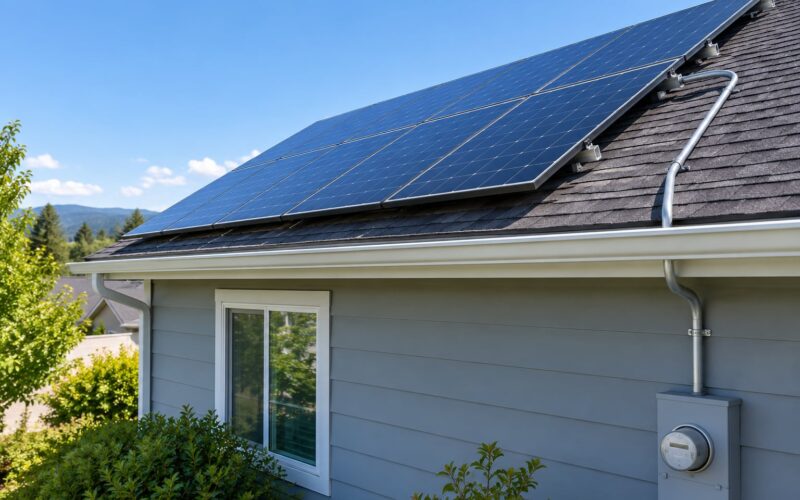
Rooftop solar is the main generation asset. A home with panels can be asked to hold output rather than push everything onto the grid at noon, or simply supply power during an event. Some programs accept standby generators and small wind systems as well.
Flexible loads
Not everything has to make power. Smart thermostats can nudge temperatures by a degree or two, water heaters can delay heating, and EV chargers can pause. Reducing demand at the right moment is as valuable as adding supply, and it is often the easiest thing to enroll.
A short glossary of the jargon
Aggregator: the company running the platform between the grid and your devices. DER: distributed energy resource, the formal name for any small generating, storage or controllable load asset. Dispatch: a specific instruction to change device behaviour. Baseline: the reference level used to work out how much a device actually delivered. Nomination: the amount of capacity a device promises in advance. Peaker plant: an expensive plant kept mostly idle, fired up only during the hardest peaks. Ancillary services: the fast-reacting support functions a grid needs, such as frequency regulation.
What Benefits Can Households and the Grid Get?
For the grid, the benefit is speed and cost. A gas peaker takes years to permit and build. A fleet of already-installed home batteries can be available in under an hour, which makes these networks useful as a non-wire alternative when a neighborhood needs more capacity quickly.
For households, the benefits are conditional. You gain event payments and possibly a lower bill. You also give up some control, and the size of the gain depends heavily on your hardware and how often events are called.
It helps to keep four limits in mind.
Availability is variable. Earnings are tied to grid events, and events do not happen every month. Homeowners in r/Powerwall point out that many programs only activate between May 1 and October 31, so the annual total is far from a flat monthly discount.
One home cannot deliver much. A Powerwall owner described installations configured in parallel that were capped near 5.8 kW regardless of how ambitious the grid request was. Your contribution is bounded by the equipment you own.
Batteries have a finite life, and dispatch cycles are added to the ones you already use. A platform operator reported recovering more than 6,000 dollars in a single event just by fixing ten installations that had failed to respond, which shows how much of the theoretical value is lost when hardware does not act.
Program terms are uneven. Availability is decided state by state and sometimes utility by utility, so a program that exists in one region may be entirely absent three states away.
Is a Virtual Power Plant the Same as a Regular Power Plant?
No. A regular power plant produces electricity in one place, on demand, from fuel. A virtual power plant produces or saves electricity in thousands of places, on command, from equipment that already exists. A microgrid sits between those two: a local network with its own generation that can disconnect from the larger grid and run on its own.
| Feature | Virtual power plant | Microgrid | Peaker plant |
|---|---|---|---|
| What it is | Software network coordinating small devices | Local network with its own generation | Standby generation facility |
| Physical infrastructure | None of its own beyond participating devices | Panels, batteries, switchgear on site | Turbines, stacks, fuel storage |
| How it delivers | Aggregates thousands of assets | Serves one campus or neighborhood | Runs a single site |
| Typical response | Seconds | Instant while islanded | Minutes to hours to start |
| Main purpose | Capacity and grid services | Local resilience and independence | Covering the hardest peaks |
All three can provide usable electricity or grid services. They are not rivals so much as different tools at different scales.
Can Solar Lights Be Part of a Virtual Power Plant?
Realistically, no. A standalone solar garden light stores a small amount of energy in a tiny built-in battery and runs on a photocell. That amount is far too small to register with a grid operator, and nobody is going to pay for dispatching it.
Solar-powered outdoor systems at the other end of the scale are a different story. A shed or pole-mounted solar array feeding a larger battery bank, with smart controls and possibly shared storage, has a footprint that can be managed alongside a building. Lighting loads that dim or shift their schedule during a peak window also count as flexible load, which is the easiest side of a virtual power plant to enroll.
If you are planning a larger solar setup, the sizing and controls matter more than the lighting itself. Ask the installer whether the system can be metered separately, whether the battery inverter supports outside dispatch signals, and what happens to the lighting schedule during an event.
How Can a Homeowner Join a Virtual Power Plant?
Start with your utility rather than with a brand. Some utilities run their own programs, some buy capacity from aggregators, and in a few markets both exist. Search for a virtual power plant program offered by your utility, then check which devices the program accepts and what it pays per event.
Next, look at what you already own. A home battery from an approved manufacturer is the fastest route in. A smart thermostat is often the lowest-effort entry point, since many utilities will enroll one for a small monthly credit with no hardware purchase at all.
Before you sign anything, read the control clause. Some programs let the utility drain your battery during an event. Others only limit charging or ask you to hold a reserve. That difference matters enormously if you bought the battery for outage backup, which is the single biggest complaint that shows up in homeowner discussions about these programs.
Finally, keep your own data. Save the event alerts, note when your battery discharged without you asking, and check the payments against the events on your utility bill. Owners who track it are far less likely to be surprised.
What Should Homeowners Check Before Joining?
Eligibility comes first, and it is narrower than most marketing suggests. Many programs require an enrolled home battery from an approved manufacturer, and coverage is decided utility by utility and state by state. Plenty of homeowners assume every utility has a program when only a handful do.
Then ask the practical questions: how much is paid per event, how quickly does payment arrive, is there a subscription fee, and can you leave without a penalty. Contracts that lock in several years with poor exit terms are a common regret, and door-to-door enrollment without clear disclosure has damaged trust in the whole category.
Ask specifically about backup power. Will the program still let your battery carry the house during an outage, or does dispatch take priority? What reserve, if any, is held back? A program that never touches your battery is a worse grid resource but a much easier homeowner arrangement.
Check battery warranty coverage against dispatch-driven wear, and ask who owns the equipment, the data and the contract. If the program pays so little per event that the extra cycling outweighs the credit, it is not worth the wear.
Rules vary by location and program, so treat every published figure as a starting point for your own research rather than a promise.
Frequently Asked Questions
Do I need solar panels to join a virtual power plant?
Usually not. Many programs accept a home battery on its own, and plenty of utility demand-response programs enroll a smart thermostat or controllable water heater with no solar at all. Solar improves your earnings because stored energy comes from somewhere, but it is not a requirement in most current offerings. Check your utility’s approved equipment list, since some battery manufacturers and some states restrict eligibility further.
Can a virtual power plant keep the lights on during a power outage?
Not on its own, because it is a grid resource rather than an islanded system. What a participating home gets is its existing equipment, which usually means battery backup sized for the home rather than the whole neighborhood. The catch is dispatch: if the program treats your battery as available capacity, it may discharge it before the storm. Read the control terms carefully and confirm that outage priority is protected.
Is it free to join a virtual power plant?
Enrollment is usually free, and most programs pay rather than charge. Some aggregator subscriptions bundle a modest monthly fee in exchange for a guaranteed bill credit or a hardware discount, and participating in an event usually means giving up a small slice of your own energy use during that window. The costs to check are the subscription, any equipment requirement, and the battery cycling involved. Ask for all three in writing.
What data does a virtual power plant collect from my home?
Typically interval metering data, meaning your energy use or battery output measured in short time blocks, plus device telemetry such as state of charge, temperature and whether your equipment responded to an event. Aggregators use this to measure delivery against a baseline and to settle payments. How long data is retained and whether it can be used for anything beyond settlement varies by program, so review the privacy terms before signing.
Can renters participate in a virtual power plant?
Rarely. Because most programs require a specific battery or solar system that the participant owns and controls, and renter agreements in the US usually prohibit roof-mounted solar without written landlord consent, the barrier is ownership rather than eligibility rules. Renters can sometimes take part in a utility demand-response program using a personal smart thermostat or plug-in control, which does not require touching the property.
Conclusion
A virtual power plant is simply many small devices acting together through software, trading control of your equipment for payments and a more flexible grid. The concept works, the payments are real but seasonal and hardware-limited, and the control question is the one worth thinking hardest about.
Your first step is quick: check whether your utility, your energy provider or a reputable local aggregator offers a virtual power plant or demand-response program that fits the equipment you already own. Then read the control clause twice.