Here is how grid scale batteries work in one sentence: they take in electricity when there is more of it than the grid needs, hold it as chemical energy inside big battery racks, then push it back out when demand climbs. Nothing is generated. The power has to come from somewhere first, usually a solar farm, a wind farm or the grid itself.
Once you understand that one idea, the rest follows. A grid-scale battery is a timing device. It moves electricity from a cheap hour to an expensive hour, and it does it fast enough to steady a grid that changes by the second.
Below is the full picture: what the parts do, how the charge and discharge cycle actually runs, which chemistries are used and what each one trades away, how long the hardware lasts, and where the honest limits are. Updated for 2026.
Table of Contents
- What Are Grid-Scale Batteries?
- MW versus MWh, the two numbers that trip everyone up
- How Grid Scale Batteries Work from Charging to Discharge
- What happens when the battery is full?
- What Are the Main Parts of a Grid-Scale Battery?
- How Do Grid-Scale Batteries Store Renewable Energy?
- What Battery Chemistries Are Used at Grid Scale?
- How Does a Battery Connect to the Power Grid?
- DC-coupled versus AC-coupled
- Why Are Grid-Scale Batteries Needed?
- How grid scale batteries work on a normal day
- How the numbers get measured and compared
- How Long Do Grid-Scale Batteries Last?
- How Grid Scale Batteries Work with Solar and Wind
- What Are the Benefits and Limitations?
- Frequently Asked Questions
- Do grid-scale batteries exist?
- How long do grid-scale batteries last?
- Will batteries work if the grid goes down?
- What do grid batteries do for the grid?
- How much does a grid-scale battery cost?
- What is the difference between a grid-scale battery and rooftop solar?
- Conclusion
What Are Grid-Scale Batteries?
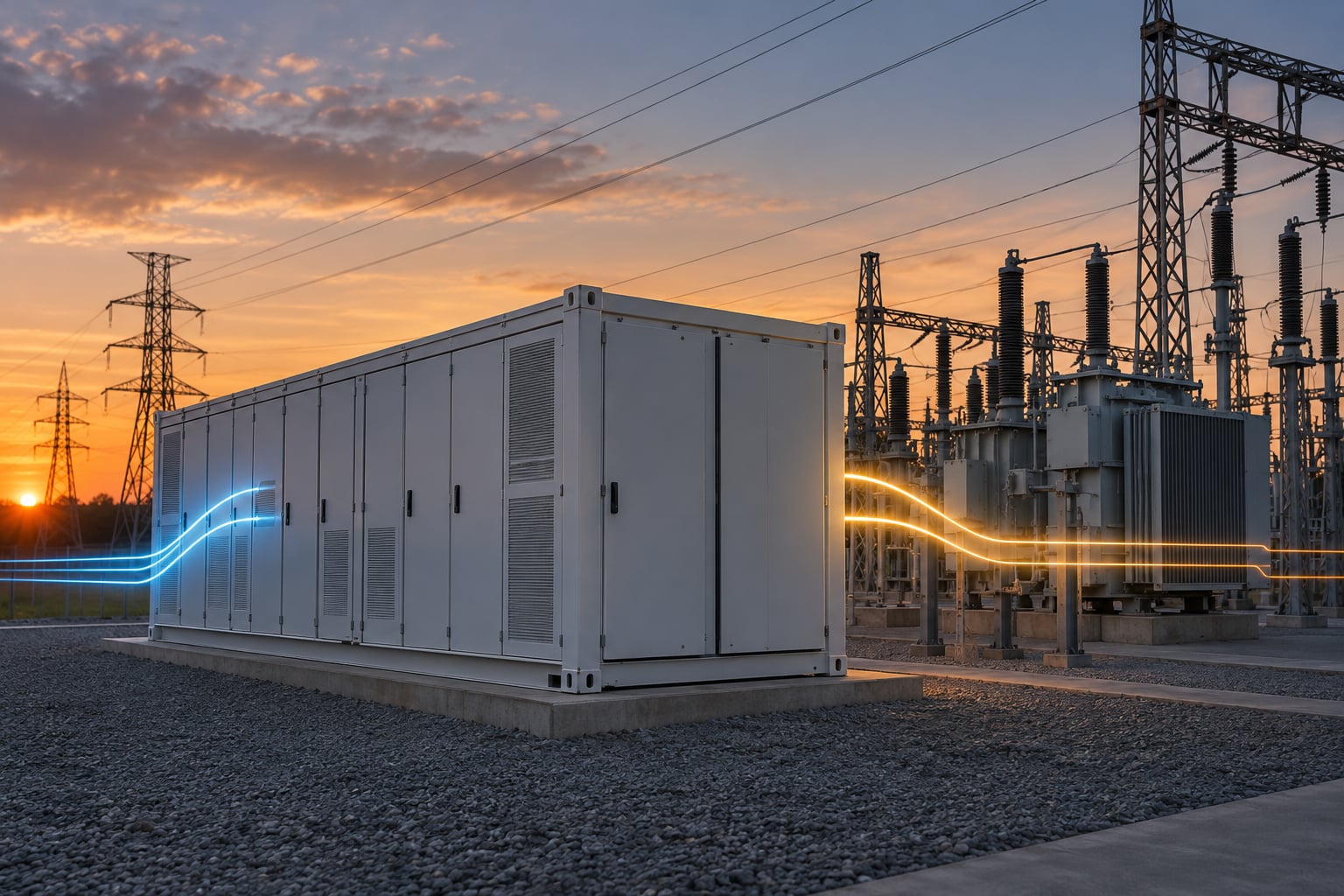
A grid-scale battery, also called a utility-scale battery or a BESS (battery energy storage system), is a large installation that sits on the utility side of your electric meter. It is usually built next to a substation or directly beside a solar or wind project, and it is owned by a utility, a developer or, more often these days, an independent power producer that sells its services to the grid operator.
They are not new. Dozens of utility-scale projects were running in the early 2010s, and the buildout since then has been steep, with lithium-ion now the dominant chemistry. What has changed fastest is size: today’s projects are routinely measured in hundreds of megawatt-hours.
MW versus MWh, the two numbers that trip everyone up
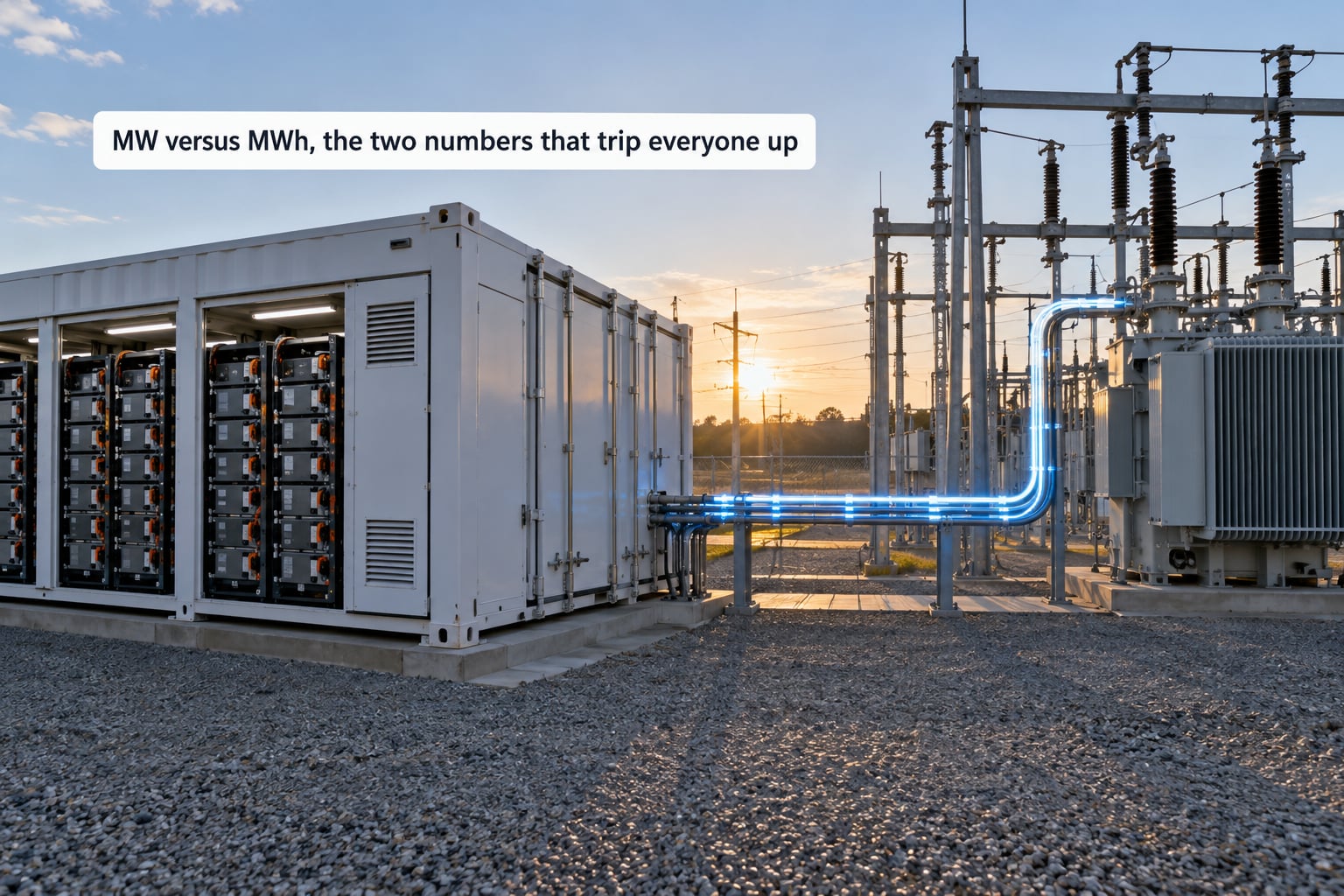
Megawatts (MW) measure how fast a battery can deliver power. Megawatt-hours (MWh) measure how much energy it can hold. A 50 MW / 200 MWh battery can push 50 megawatts onto the grid and keep doing it for four hours before it is empty. It cannot power 200 megawatts, and it cannot run for 200 hours.
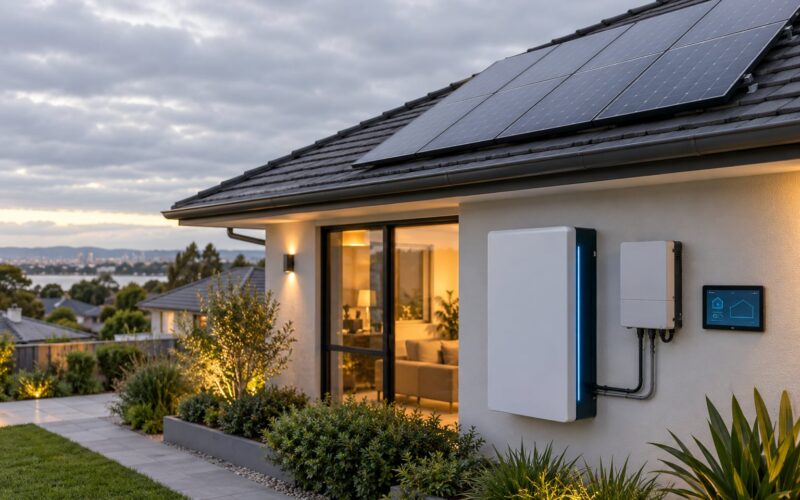
Scale makes the arithmetic more concrete. A single 50 MW / 200 MWh site stores roughly the daily electricity use of 10,000 homes, which is the comparison utility education programs use most often. A home battery, by contrast, holds 10 to 20 kilowatt-hours, about the power a typical house uses in an evening.
Grid-scale projects generally start around 10 MW of power and 100 MWh of energy. Behind-the-meter systems sit on the customer’s side of the meter and serve one building. The distinction matters more than the size does, because it decides who gets the electricity during an outage.
How Grid Scale Batteries Work from Charging to Discharge
The full energy path takes a few seconds while electricity is moving, and hours or months while it is sitting still. Here is the sequence, from the moment power arrives to the moment it leaves again.
- Power arrives. The battery is connected to the grid, to a co-located solar or wind project, or to both. A 50 MW project charging fully draws 50 MW off the network, which is a real load the grid operator has to account for.
- Power is converted to direct current. Grid electricity is alternating current, and battery cells store direct current. A bi-directional inverter handles the conversion in both directions.
- The battery management system takes control. The BMS balances thousands of individual cells, keeps them within a safe temperature and voltage window, and tracks state of charge so no cell is overused while others sit idle.
- Energy is stored as chemical energy. In a lithium-ion cell, charging drives ions from one electrode to the other. No electrons are consumed, and the electricity is genuinely held until something asks for it back.
- Power is converted back to alternating current. The same inverter runs in reverse, turning the stored direct current into grid-quality alternating current at the right voltage and frequency.
- The energy management system dispatches it. Software decides when to charge and when to discharge, based on wholesale prices, grid operator signals, reserve requirements or a contract that says exactly when to store and return power.
- Supervisory control monitors everything. SCADA systems report state of charge, temperature, power flow and alarms to the operator in real time, and step in automatically if a limit is crossed.
Then it starts again. A modern lithium-ion system completes thousands of these cycles over its working life, and the control software is constantly choosing between sitting idle, absorbing cheap power and releasing during an expensive or tight moment.
What happens when the battery is full?
Charging stops. The battery will not take in more than its maximum state of charge allows, and the inverter simply stops pulling power. If that happens while a solar field is producing more than the grid can absorb, the generation gets curtailed, which is the industry term for electricity that is deliberately wasted rather than pushing a grid into instability. Catching surplus renewable power before it reaches that point is one of the main reasons these projects get built.
What Are the Main Parts of a Grid-Scale Battery?
Six subsystems do nearly all the work. Understanding them separately is the fastest way to understand the whole machine.
- Battery modules and cells. The cells themselves, grouped into modules and stacked into racks inside a shipping-container-style enclosure. LFP and NMC are the common lithium chemistries.
- Battery management system (BMS). The low-level controller that balances cells, enforces safety limits and reports state of charge.
- Power conversion system (PCS). The bi-directional inverter that handles direct current to alternating current and back, including frequency and voltage regulation.
- Thermal management. Liquid cooling loops, fans or air conditioning that hold cells inside their safe temperature band, which is also what keeps efficiency up in hot weather.
- Energy management system (EMS). The commercial brain. It decides when to charge, when to discharge and what price or grid service that discharge is being sold into.
- Monitoring and communications (SCADA). Remote telemetry, alarms, dispatch commands and the audit trail operators rely on for settlement.
Around those sit the enclosure, the medium-voltage transformer that steps voltage up to grid level, cabling, fire detection and suppression, and the emergency shutdown chain. Sites are built to UL 9540 for the equipment itself and NFPA 855 for installation and emergency planning, which exist precisely because lithium cells can enter thermal runaway, an escalating self-heating reaction that is difficult to stop once a cell is involved.
How Do Grid-Scale Batteries Store Renewable Energy?
Solar and wind produce what the weather gives them, not what the grid needs. Midday on a clear day, rooftop and utility solar can generate more electricity than the region can use, and the surplus is either wasted or must be sold into a market that pays almost nothing. The evening peak arrives a few hours later, when solar output has collapsed and air conditioners are running hard.
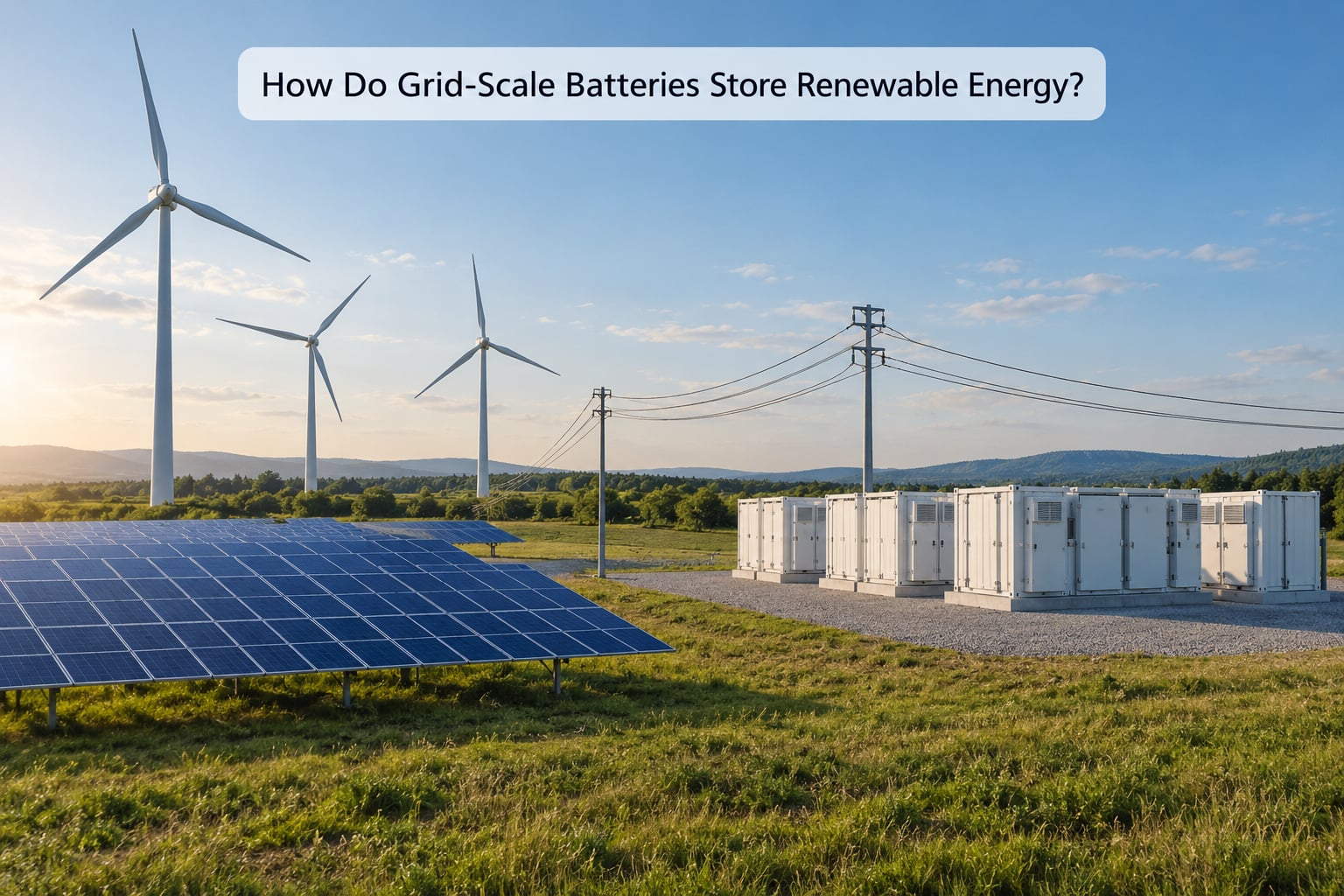
A battery fixes the timing mismatch. It absorbs the surplus, holds it for two to four hours, and releases it into the evening peak. Utilities call this solar firming, and it is why so many new projects are built physically next to a solar field rather than at a substation miles away. Co-location cuts the cable run, and DC-coupled designs can send array output straight into the battery without an intermediate inverter conversion.
Wind works the same way with different timing. Output often peaks overnight, when demand is low, so wind storage usually charges into the night and discharges through the following morning. The harder case is the multi-day wind lull or a long cloudy stretch, which is exactly the gap the section on limits comes back to.
What Battery Chemistries Are Used at Grid Scale?
Lithium-ion dominates because it is cheap, compact and fast. But it is not the only option, and the alternatives exist to solve lithium’s two weaknesses: cost per unit of energy stored, and degradation over a two-decade asset life.
| Chemistry | Round-trip efficiency | Typical duration | Typical lifespan | Main trade-off |
|---|---|---|---|---|
| Lithium iron phosphate (LFP) | 90% and above | 2 to 4 hours, some longer | 10 to 15 years | Forgiving with heat and chemistry, heavier and lower energy density |
| NMC lithium-ion | 90% and above | 2 to 4 hours | 10 to 15 years | More energy per kilogram, needs tighter thermal control |
| Vanadium redox flow | 50% to 75% | 6 to 12 hours | 20 years and more | Long duration and very low degradation, higher cost and less compact |
| Sodium-sulfur | Around 85% | 6 to 8 hours | 10 to 15 years | Abundant materials, needs a high operating temperature |
| Lead-acid | About 70% | 2 to 4 hours | 5 to 10 years | Cheap and proven, bulky with a much shorter life |
| Iron-air and other emerging | Lower than lithium | 100 hours and more | Long | Built for long duration, still early commercially |
For context, the two non-battery options that still hold the title for long duration are pumped hydro storage, which is efficient, proven and site-limited by terrain, and compressed air energy storage, which is cheap at scale but only works at very large plant sizes.
Cell makers such as CATL, BYD and LG Energy Solution supply the cells. Companies like Fluence and Tesla, with its Megapack, assemble them into containerised systems and handle the controls around them.
How Does a Battery Connect to the Power Grid?
The connection is deliberately unremarkable engineering. The battery’s direct current goes through the power conversion system into a medium-voltage transformer, which steps the voltage up to transmission or distribution level, and then out to the substation. From there it is ordinary electricity that the grid operator can dispatch like any other resource.
DC-coupled versus AC-coupled
DC-coupled systems wire the solar array, the battery and the inverter together on the direct current side. Fewer conversion steps means less energy lost and simpler hardware, but the solar field has to be designed around the battery from day one. AC-coupled systems run the array through its own inverter first, then charge the battery from the alternating current side. That is more flexible and more common when the battery is added to an existing solar farm, at the cost of an extra conversion.
To be clear about what batteries are not doing: they do not create electricity. Every megawatt-hour that leaves a grid-scale battery was generated somewhere upstream, and roughly 5% to 30% of it never made it back out, lost to conversion, heat and the battery’s own chemistry. That loss is the round-trip efficiency figure, and it is the number that decides whether a given arbitrage strategy makes money at all.
Why Are Grid-Scale Batteries Needed?
Because electricity demand peaks for a few hours a day while the rest of the grid has to keep running at all times. Batteries fill that gap, and the value of a battery changes completely with how fast it can respond.
| Grid service | Typical response time | What it does |
|---|---|---|
| Frequency response | Milliseconds to under a second | Pushes or absorbs power instantly to hold the grid at exactly 60 hertz |
| Regulation and ramping | Seconds to minutes | Follows load changes as demand rises and falls |
| Peaker replacement and capacity | Minutes | Stands in for costly gas peaker plants during the evening peak |
| Energy arbitrage and solar firming | Hours | Charges cheap, discharges expensive, and shifts solar into the evening |
| Transmission deferral | Hours | Avoids building new lines for a few years by managing local congestion instead |
Only the first two rows need power density, where lithium is strongest. The bottom rows need energy capacity, and plenty of hours of it, which is why flow and sodium-sulfur chemistries keep showing up in longer-duration projects.
How grid scale batteries work on a normal day
Take a battery contracted to serve the evening peak. It charges from the grid or a co-located solar field from late morning, sits at full charge through the afternoon, then discharges at its full megawatt rating for four hours as the sun goes down. The operator is paid for the discharge and charged for the charging, minus the round-trip loss, and keeps a small margin. The physical movement takes minutes. The economics depend on a spread between two prices that may be set a day ahead.
How the numbers get measured and compared
Projects get compared on levelized cost of storage, the per-unit cost of putting a megawatt-hour on the grid, accounting for capital cost, efficiency losses, cycling and lifespan. Purchase price alone is misleading, because a cheaper battery that fades in five years and delivers 85% of the power back is the more expensive asset. That is the same arithmetic a homeowner runs when comparing solar panels, and the reasoning is identical.
Installed cost per kilowatt-hour for utility-scale systems has fallen steeply as cell supply scaled, driven in part by EV incentive changes that pushed manufacturers to repurpose battery plants built for vehicles. Falling cost is the main reason the pipeline is as long as it is. It is also the reason developers keep building next to solar rather than substituting for it.
How Long Do Grid-Scale Batteries Last?
Ten to fifteen years for lithium-ion is the number most operators plan around, and they plan for a fade rather than a cliff. A battery loses capacity gradually as cells age, and the degradation curve depends heavily on temperature, depth of discharge and how hard the system is cycled.
| Chemistry | Working life | What changes over that life |
|---|---|---|
| LFP lithium-ion | 10 to 15 years | Capacity fades gradually; mid-life augmentation adds fresh modules to restore original output |
| NMC lithium-ion | 10 to 15 years | Similar fade, with tighter thermal requirements |
| Vanadium redox flow | 20 years and more | Minimal capacity loss, largely because the electrolyte can be rebalanced |
| Lead-acid | 5 to 10 years | Loses usable capacity quickly and needs more physical space for the same output |
Augmentation is the part most people miss. Rather than retire a fifteen-year-old system, an operator adds modules inside the existing enclosure during a scheduled window, buying back most of the original output for a fraction of a new build. Nobody should treat the nameplate figure on day one as the number a system delivers in year twelve.
Maintenance is mostly monitoring. The chemistry does the work on its own, and what needs attention is the climate control, the inverter, the detection and suppression systems, and the software that decides when the battery is allowed to charge or discharge.
How Grid Scale Batteries Work with Solar and Wind
Three real projects show how the pieces fit. In Saint John, New Brunswick, the local utility operates about 11.56 MWh of Tesla Megapack capacity on its own grid. Nova Scotia Power runs a 50 MW system providing four hours of capacity, or 200 MWh. In Summerside, a 20 MWh battery sits directly beside a 21.6 MW solar farm of roughly 48,000 panels, storing midday output for the evening.
That Summerside arrangement is the pattern the industry has largely settled on. The solar field charges the battery through the middle of the day, the battery covers the four-hour evening peak, and the community gets a flatter demand curve. The same logic, shifted by twelve hours, works for wind.
The economics get tighter as more storage arrives on the same grid. Spreads that looked attractive in a market with little storage compress once everyone is arbitraging the same two hours, which is the point forum discussions on r/solar and r/EnergyStorage keep returning to: cycles are finite, and so is the price gap.
What Are the Benefits and Limitations?
The benefits are real and measurable. Batteries cut the need to run gas peaker plants, which improves local air quality exactly when combustion is most likely. They let a grid absorb far more renewable generation than it otherwise could, and they can delay transmission upgrades by years. For a homeowner with rooftop solar, the practical effect is a grid that handles more variable power without becoming less reliable, which generally means steadier service and less pressure on retail rates.
The limitations deserve equal space, and the strongest version of the argument comes from critics rather than vendors. NCEA, a policy think tank, makes the case plainly: most of these systems are built to deliver power for one to four hours, and a grid facing a multi-day regional shortfall cannot be fixed with four-hour batteries. Long-duration critics make the same point in plainer terms. Neither argument is a reason to stop building, and both are a good reason to stop describing storage as a silver bullet.
Fire safety is the other honest limit. Lithium cells can enter thermal runaway, and while UL 9540 and NFPA 855 certified designs with detection and suppression are now standard, the risk is managed rather than eliminated. Material sourcing is a live supply chain question too, and while sodium and flow chemistries reduce the dependence on lithium and cobalt at the cost of density and price, they have not taken meaningful share. End-of-life recycling capacity is still scaling ahead of the installed fleet that will need it.
None of that means batteries are a mistake. It means they are one tool, aimed at problems measured in hours, doing work that generation and long-duration storage still have to cover.
Frequently Asked Questions
Do grid-scale batteries exist?
Yes. Hundreds of utility-scale battery projects are operating worldwide, and most were built within the last five years, with lithium-ion as the dominant chemistry. Projects of 100 MWh or more are now routine, and a single facility can supply the daily electricity use of thousands of homes. They sit on the utility side of the meter and are dispatched by a grid operator or a contracted energy management system.
How long do grid-scale batteries last?
Lithium-ion grid batteries are usually planned for 10 to 15 years, with lead-acid systems lasting 5 to 10 years and flow batteries 20 years or more. Capacity fades gradually rather than failing all at once, and operators commonly add new modules mid-life to restore the original output. Treat the nameplate figure on day one as an upper bound, not a fifteen-year guarantee.
Will batteries work if the grid goes down?
The battery itself keeps operating during an outage, but that does not mean it powers your house. A grid-scale battery normally discharges into a defined network or microgrid such as a hospital or data centre campus. Keeping an individual home lit requires a behind-the-meter battery with a transfer switch, which is a different purchase entirely.
What do grid batteries do for the grid?
They provide whatever service is worth paying for at that moment: millisecond frequency response, minute-scale ramping, four-hour evening peak coverage, or stored solar and wind released hours later. Batteries also relieve local transmission congestion, which can delay expensive grid upgrades. The fastest services reward power density, while multi-hour services reward stored energy capacity.
How much does a grid-scale battery cost?
Installed cost per kilowatt-hour for utility-scale systems has fallen steeply as cell supply scaled, and it continues to move. Purchase price is the least useful figure, because a cheaper battery that fades in five years and returns 85% of its energy is the more expensive asset over its life. Projects are compared on levelized cost of storage instead, which accounts for capital cost, efficiency, cycling and lifespan.
What is the difference between a grid-scale battery and rooftop solar?
Rooftop solar generates electricity for one building, and any surplus flows to the grid at whatever the local rate is. A grid-scale battery does not generate anything at all; it stores electricity from many sources and releases it on a grid operator’s instruction, often several miles from the homes it serves. The size gap is huge: a home battery holds 10 to 20 kWh, while a utility project holds hundreds of MWh.
Conclusion
The single idea to carry away is that grid-scale batteries move and time-shift electricity rather than produce it. That makes them genuinely valuable as solar and wind take a larger share of the grid, and equally clear that they do not replace firm generation for long lulls. Watch the megawatt-hour figure, the round-trip efficiency and the warranty term, and the rest of the story follows from those three numbers.