Solar panels do work on cloudy days, they do not burn through your roof, and almost every claim that solar does nothing during an outage is missing one important word: grid-tied. This is the version of common myths about solar energy explained with the short answer first, then the reasoning behind it, and no sales pitch at the end.
The reason these stories stick around is mostly boring. Panels got dramatically cheaper and far more efficient over the last two decades, and the marketing copy written a decade ago was never corrected. Meanwhile some genuinely deserve a second look, and pretending otherwise is how people end up with a system that does not suit their roof.
Everything below is aimed at homeowners weighing rooftop solar, people who already own a system and want to know whether their falling output is a problem, and anyone shopping for solar garden lighting in the autumn.
Table of Contents
- Common Myths About Solar Energy at a Glance
- 1. Solar Energy Does Not Work on Cloudy Days
- 2. Solar Panels Only Work in Hot Weather
- 3. Solar Energy Is Too Expensive to Be Worth It
- 4. Solar Power Stops During a Power Outage
- 5. Solar Panels Need Constant Maintenance
- 6. Solar Energy Is Only Useful for Large Homes
- 7. Solar Garden Lights Do Not Work in Winter
- 8. Bigger Solar Panels Always Produce More Energy
- 9. Solar Energy Creates More Pollution Than Fossil Fuels
- 10. Solar Panels Will Last Forever
- 11. Solar Lights Are Too Weak for Outdoor Use
- 12. Switching to Solar Means Going Off-Grid
- How Common Myths About Solar Energy Explained in Practice
- Frequently Asked Questions
- What is the 20% rule for solar panels?
- What is the 33% rule in solar panels?
- Do solar panels work at night?
- Can solar panels power a whole house?
- What happens to solar panels after 25 years?
- Conclusion
Common Myths About Solar Energy at a Glance
| The claim | Short answer | What actually changes |
|---|---|---|
| Solar does not work on cloudy days | False | Output drops, it does not stop. Sizing and storage plans should assume a cloudy stretch. |
| Solar panels only work in hot weather | False | Hot cells lose efficiency. Cold, clear days often produce the highest output of the year. |
| Solar is too expensive to be worth it | Misleading | The upfront cost is real. So is having no fuel bill for 25 years. |
| Solar keeps your lights on during an outage | True for grid-tied, false with a battery | You need a hybrid inverter and a battery, sized for essential loads only. |
| Solar panels need constant maintenance | Mostly false | They are close to maintenance-free, except in dusty, dusty-tree or snow-heavy spots. |
| Solar is only useful for large homes | False | Apartments, renters and partial offsets all work. Small standalone systems are common. |
| Solar garden lights do not work in winter | True-ish | Winter works if the panel is sized for the worst week, not the average one. |
| Bigger panels always produce more energy | Confused | Watts, watt-hours and battery size are three different numbers. |
| Solar creates more pollution than fossil fuels | False over the full life | Manufacturing is energy-intensive. A panel produces for decades with no combustion. |
| Solar panels last forever | False | Expect 25 to 30 years and roughly 0.5% annual output loss, not zero and not 2%. |
| Solar lights are too weak for outdoor use | False | Lumens, battery size and sensor quality decide it, not the word solar. |
| Going solar means going off-grid | False | Most systems stay connected. Off-grid is one of three options. |
1. Solar Energy Does Not Work on Cloudy Days
Panels keep generating under clouds. Cloud cover scatters the light instead of blocking it, and a photovoltaic cell will convert that diffused light into current.
What changes is the amount. On a bright, cloudless afternoon a system might produce close to its rated capacity; under heavy overcast, output often lands somewhere between 10% and 25% of that rating. Owners comparing numbers across a season often notice the gap first in winter, when the sun sits lower and there are fewer daylight hours regardless of the cloud cover.
Why it matters in practice: designers who ignore cloudy output oversize a system and then have to give value away under export rules. If you are only powering a fence, a gate or a path, size for your darkest week, not your brightest one.
2. Solar Panels Only Work in Hot Weather
Cold, clear weather is often the best conditions a panel gets. Cell efficiency falls as the panel itself heats up, so a hot summer day with strong sun can produce less than a crisp winter day with thinner but cleaner light.
Manufacturers publish a temperature coefficient for exactly this reason, and module ratings assume standard test conditions of about 25°C. A panel running ten degrees above that loses a fraction of a percent for each degree, which sounds small until you multiply it across a hot roof for three months.
Angled mounting helps twice: it lifts the panel away from the hot roof surface and lets snow slide off. In snowy regions, that second benefit matters more than people expect.
3. Solar Energy Is Too Expensive to Be Worth It
The honest version: solar has a large upfront cost and close to zero fuel cost after that. The myth is the idea that the two numbers cancel out in a way that leaves you worse off.
Break the cost down and you will find four pieces. Equipment covers the panels, inverter and mounting. Installation covers labour, permitting and interconnection. Incentives come from federal, state and utility programmes. Operating cost is the one column that stays near empty for 25 years, because sunlight has no invoice.
What decides whether it pays back is your usage pattern, your local electricity rate, how much you are paid to export surplus, and how much sun your roof actually gets. Net metering is the piece people argue about most, and the rules differ by state and change over time, so read the current schedule for your utility before you model a return. High daytime use is the best case; heavy evening use is the harder one, and a battery changes the arithmetic.
4. Solar Power Stops During a Power Outage
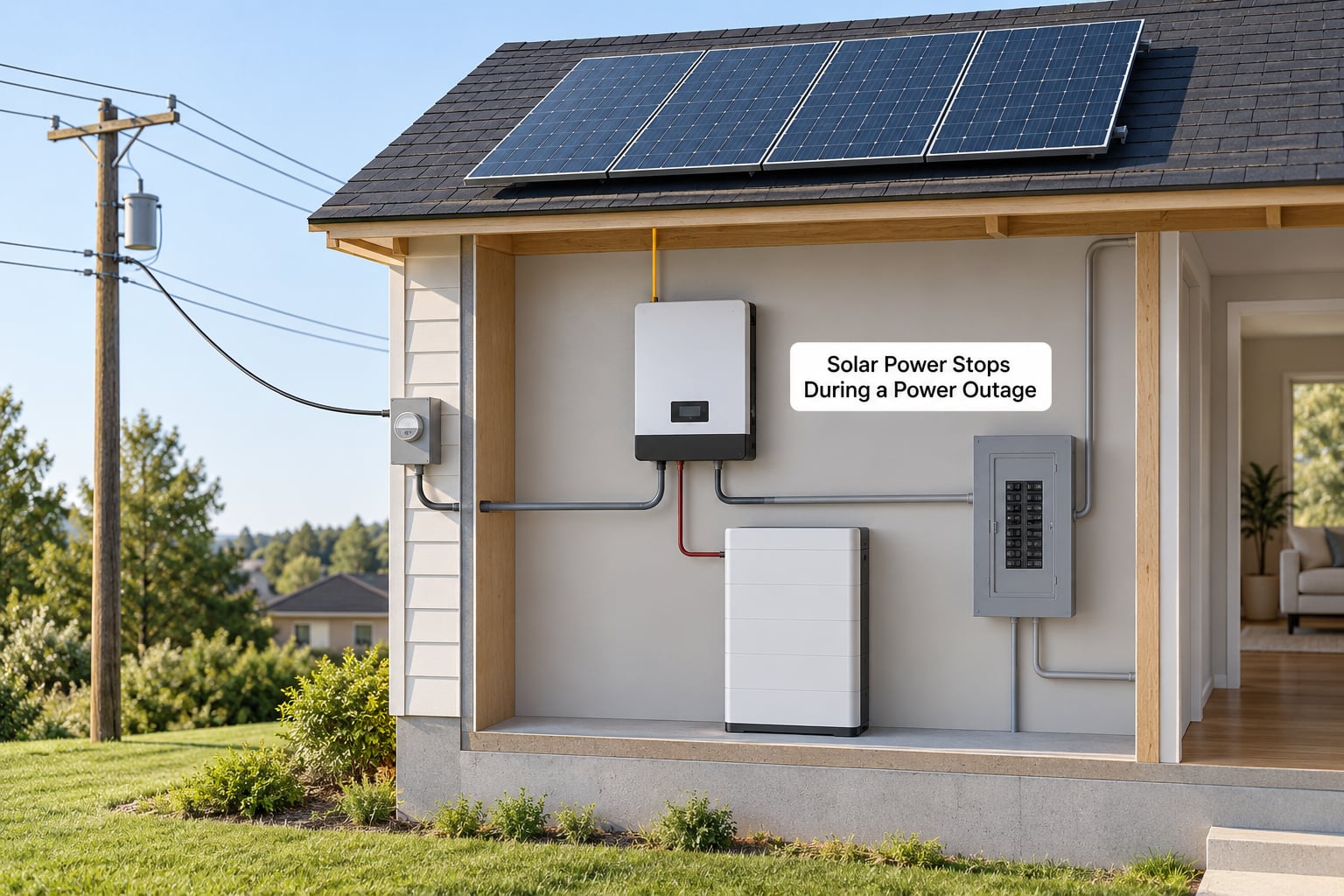
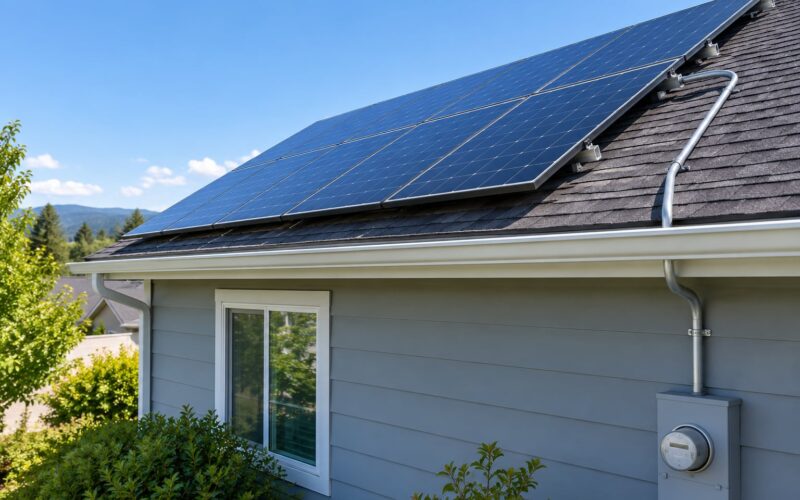
This one is true for most systems, and the reason is deliberate safety, not failure. When the grid goes down, utility crews may be working on live lines nearby. A grid-tied inverter detects the loss of grid reference and shuts off within seconds so it cannot push electricity back into a network that is being repaired.
That behaviour is called anti-islanding, and it is required by code. The inverter tripping during a storm is the system working exactly as designed, which is why so many owners describe it as a betrayal when nobody warned them.
What you need instead is a hybrid inverter with islanding capability, a battery, and a transfer switch or transfer relay that isolates the grid. Size it for essentials only: a fridge, some lighting, a freezer, internet. Trying to run a well pump, a heat pump and a water heater from a small battery is how people discover that backup capacity is measured in kilowatt-hours, not in wishful thinking.
5. Solar Panels Need Constant Maintenance
There are no moving parts, no fuel and no filters. Most rooftop systems need an annual glance, if that. Most systems are close to maintenance-free for their first two decades.
Three things do change the answer. Dust, pollen and bird droppings matter in arid or agricultural areas, where panels can lose a noticeable slice of output between rains. Vegetation matters year-round, because a tree that was harmless in March shades a panel badly by August. And heavy snow load matters in northern climates, where a steep enough tilt solves the problem without anyone climbing up there.
Most monitoring apps will chart a dip over time, which tells you whether you are looking at dirt, shade or age. If your output fell about 10% between month six and month eighteen, that gap alone is not proof of a fault, and it is worth checking before assuming anything.
6. Solar Energy Is Only Useful for Large Homes
Solar scales down further than most people assume. The system is a collection of independent pieces, and you can buy one of them.
A renter can join a shared community array and get credit on the same utility bill without a single panel on the roof. A homeowner who moves every three years can commit to a smaller system sized to the house they are buying next. Someone with a shaded roof can install on the garage, the carport or a ground mount in the sunny part of the garden.
Small standalone systems are the most overlooked option. A fence line, a greenhouse vent, a pond pump or a set of path lights does not need a grid connection at all. That is a different category from powering a house, and it is where most first-time buyers actually start.
7. Solar Garden Lights Do Not Work in Winter
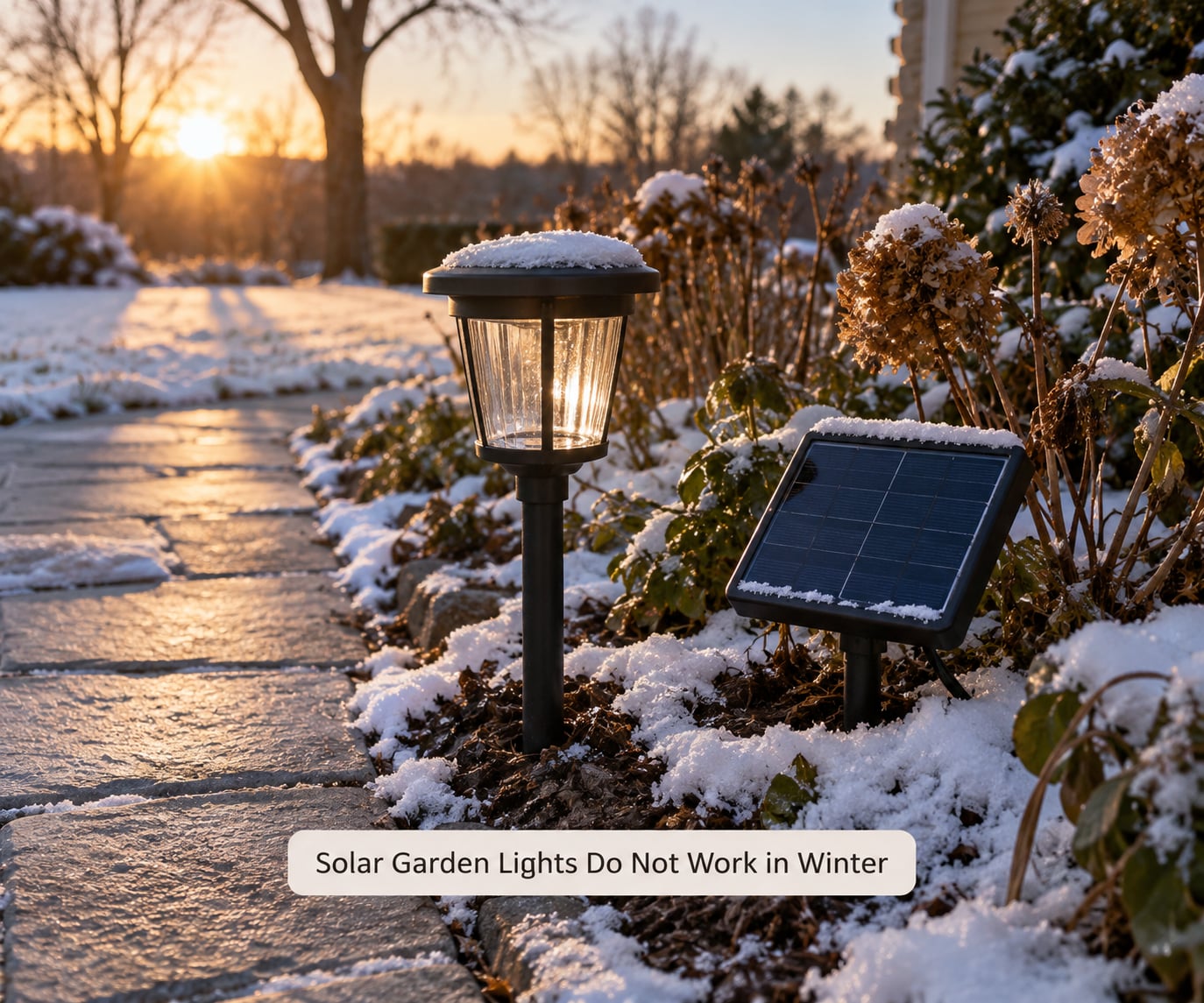
Solar lamps work in winter, but only if you judge them by the worst week rather than the average one. The problem is not that solar panels stop in cold weather. It is that winter stacks four separate disadvantages on top of each other.
Daylight hours are shorter. The sun sits lower, so the light hits the panel at a steep angle and much less of it lands square on the surface. Snow can cover the panel for days at a time. And the batteries themselves hold less charge when it is cold, which is a chemistry fact, not a fault.
So the specs to compare in autumn are the ones that predict a bad week. Look at panel wattage, battery capacity in milliamp-hours, and the number of darkness hours the lamp is rated for, not just the lumen figure on the box. Most quality lights claim one or two nights of autonomy; the ones that die in January usually promised three.
Placement decides as much as the hardware. Give the panel a southern or south-western aspect if you are in the northern hemisphere, keep it clear of leaf litter and snow build-up, and avoid a spot where a tree will cast shadow from November onwards.
8. Bigger Solar Panels Always Produce More Energy
Three numbers get mixed up here, and buying on the wrong one is expensive. Power is what the panel produces at a moment in time, measured in watts. Energy is what it produces over a day or a year, measured in watt-hours. Storage is how much you can hold when the sun is down, measured in watt-hours too but in the battery.
A bigger panel raises power, so it pushes more through the inverter at once, but it does not create energy from nowhere. If you need more total energy, you need more collecting area or more hours, which usually means more panels.
The battery question is separate again. Adding panels to a system whose battery cannot hold the extra output just means more exported energy. Start from the energy you want to shift from daytime to evening, then size the storage to hold it, then size the panels to refill it.
9. Solar Energy Creates More Pollution Than Fossil Fuels
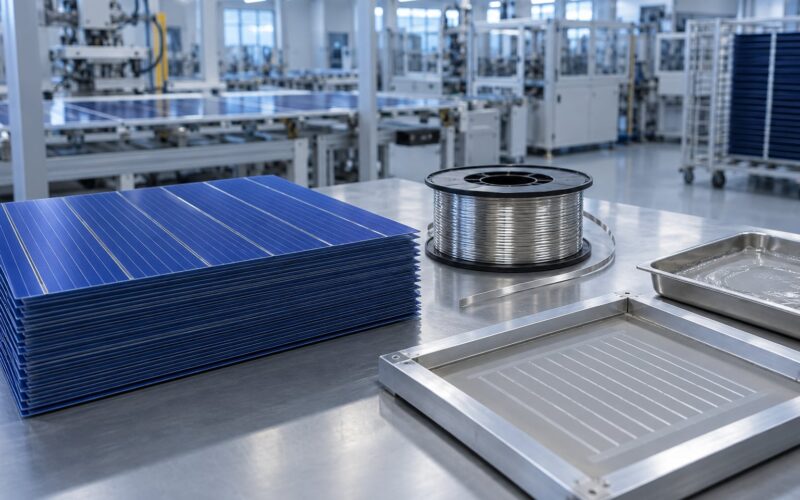
Manufacturing a panel is genuinely energy-intensive. Refining silicon, cleaning glass, applying coatings and shipping the finished module all take real industrial effort, and pretending otherwise would be the kind of greenwashing you would criticise anywhere else.
The fair comparison is over the whole life of the equipment rather than the day it ships. A panel has no combustion, no fuel and no emissions while it operates, and it keeps generating for 25 to 30 years. That long clean-output window is what tips most lifecycle analyses in favour of solar rather than against it.
End of life is improving too. Take-back and recycling programmes exist for modules and for the metals in them, though the practical economics of pulling a panel off a roof and shipping it are still a work in progress. Ask your installer what their end-of-life plan actually is; a confident answer beats a vague one.
10. Solar Panels Will Last Forever
They do not last forever, and the more common exaggeration is the opposite one: people expect a 1% to 2% yearly collapse in output, then panic when their first year shows a much smaller change. Real-world photovoltaic degradation is closer to 0.5% to 0.6% per year, and that figure comes up repeatedly in owner discussions on r/solar for good reason.
Do the arithmetic honestly. A 0.5% annual loss across 25 years leaves a panel at roughly 87% of its original output. That is normal and it is fine, and it is a large part of why the economics work.
Warranties usually cover output for 25 or 30 years, but the paperwork that matters later is the part people lose. Keep the panel serial numbers, your installer agreement, the inverter warranty, and screenshots of your monitoring portal at the one and three year marks. The inverter itself typically has a much shorter life than the panels around it, and knowing its model number ahead of time saves an awkward emergency purchase.
11. Solar Lights Are Too Weak for Outdoor Use
The word solar tells you how the lamp is powered and nothing about how bright it is. Two solar lights from different ranges can differ by a factor of five in useful light, and the deciding numbers are all on the spec sheet.
Check the lumen output for steady-on mode rather than motion-triggered mode, because vendors quote the best number. Check battery capacity, since that decides how long the lamp runs after a dark day. Check the sensor, since a cheap photocell leaves the light on all night and empties the battery by morning, which is the single most common reason solar lights seem to fail.
Then check the IP rating. A rating of IP44 suits a sheltered patio; IP65 and above handles rain jets and hose-down. Placement finishes the job: a lamp sitting under a dense shrub or a wall gets no useful daylight, and no battery size will rescue it.
12. Switching to Solar Means Going Off-Grid
Most people who install solar stay connected to the grid, and staying connected is usually the better plan. Off-grid is a specific, more demanding choice rather than the automatic next step.
A grid-tied system sends surplus to the utility and draws from it when the panels fall short, usually under a net metering arrangement where exported energy is credited against what you import. It costs the least and depends on the grid staying up.
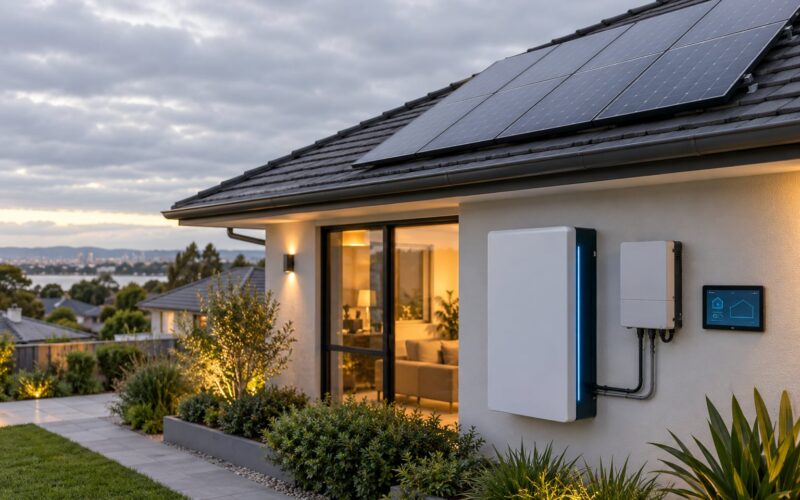
A hybrid system adds a battery and islanding capability, so it can run essential circuits on its own during an outage. That is the option most people actually want once they understand the difference, and it costs meaningfully more.
A true off-grid system has no grid connection at all. It needs a much larger array, a much larger battery, a proper charge controller and a generator as backup, because a cloudy week becomes a real problem rather than an inconvenience. It makes sense for a remote cabin and rarely for a house near a substation.
How Common Myths About Solar Energy Explained in Practice
Take one house on a street where every roof looks similar. Two neighbours get different results, and the difference has almost nothing to do with the panels they bought.
The first neighbour assumed the myth about weather and sized for a sunny year. In a wet month his output sat far below expectation, and because he had skipped storage, most of his production left the house in the middle of the day while his kettle ran off the grid. The second sized the array against a realistic cloudy-week figure and added a modest battery, so midday surplus shifted into the evening instead of being exported.
The same logic applies to a solar garden light. Rather than asking whether solar works in winter, check what the lamp claims for darkness hours, check that the panel sits in an open, unshaded spot, and remember that the first snowy week is the test it has to pass.
Frequently Asked Questions
What is the 20% rule for solar panels?
There is no official 20% rule. The number comes from conversion efficiency, the share of incoming sunlight a panel turns into electricity. Most modern crystalline silicon modules land around 20% to 23% under standard test conditions, and performance drops a little as the cell heats up. Efficiency matters, but total system size and sun exposure decide output far more.
What is the 33% rule in solar panels?
There is no official 33% rule either. Around a third is roughly the ceiling that laboratory records have reached for a single silicon cell under perfect conditions, and some commercial formats have been marketed near that figure. You will not get a third of your sunlight back from a residential roof, so treat any 33% claim as a laboratory number rather than a household one.
Do solar panels work at night?
No. Photovoltaic panels need light, so output falls to zero after dark. What continues at night is the stored energy in a battery, which discharges to run the household or light your garden path. That distinction is why a system with storage behaves differently at midnight from a system without, and why battery capacity shows up in most sizing conversations.
Can solar panels power a whole house?
Most homes can be powered largely or entirely by solar, provided the roof has enough unshaded area and the array is sized to annual consumption. Heavy evening use is harder to cover without a battery, because that is when panels produce the least. A professional assessment using your actual bills and your roof’s orientation gives a far better answer than a rule of thumb.
What happens to solar panels after 25 years?
Most panels are still physically intact and still producing power after 25 years, at roughly 85% to 90% of their original output when degradation runs about half a percent a year. Warranty terms usually end around then, so failures after that point are your responsibility. Keep serial numbers, installer details and monitoring records, because they decide how easy a replacement is.
Conclusion
The corrections that matter most are small ones. Panels work in dull weather and produce more in the cold than in the heat. Grid-tied systems shut off in an outage on purpose. Degradation runs about half a percent a year, not two.
Write down what you actually want to run, walk the site and note where the sun hits in the worst month rather than the best, then compare the written specifications. If it is lighting, start with darkness hours, battery capacity and IP rating. If it is the whole house, start with your consumption and your utility’s current export terms. Every other myth gets less interesting once you have real numbers in front of you.