Solar lights do not need direct sunlight to work at all, but they charge far faster and far more fully when their panel sits in open sun. In bright indirect light they will still charge, just slowly, and the lamp will burn dimmer and for fewer hours after dark. The real question is not where the light shines, it is where the panel is.
That distinction trips up most people. A path light can sit under a tree canopy and light the path perfectly well at dusk, as long as its panel is somewhere that sees sky. When people report solar lights that never work, it is almost always the panel in the wrong place, not the light itself.
I have watched this play out in plenty of yards, and the same three mistakes account for nearly every failed install: a panel tucked behind a fence, a panel under leaves, and a switch left in the off position. All three are free to fix. Let me walk through how the charging actually works, what different light conditions do to it, and where to put things so the lamp earns its place.
Table of Contents
- Do Solar Lights Need Direct Sunlight?
- How Solar Lights Get Their Power
- The five parts of a solar light
- How Much Sunlight Does a Solar Light Need?
- Can Solar Lights Charge in Indirect Sunlight?
- Where to Place a Solar Light for the Best Charging
- What If a Solar Light Is Not Lighting Up?
- How to Get Brighter Light and Longer Runtime
- Seasonal and Weather Considerations
- Frequently Asked Questions
- Can solar lights work without direct sunlight?
- How many hours of sunlight do solar lights need to charge?
- Do solar garden lights charge on cloudy days?
- Can a solar light be charged indoors?
- Should the solar panel be cleaned or kept in the sun all day?
- Conclusion: Start with the Panel
Do Solar Lights Need Direct Sunlight?
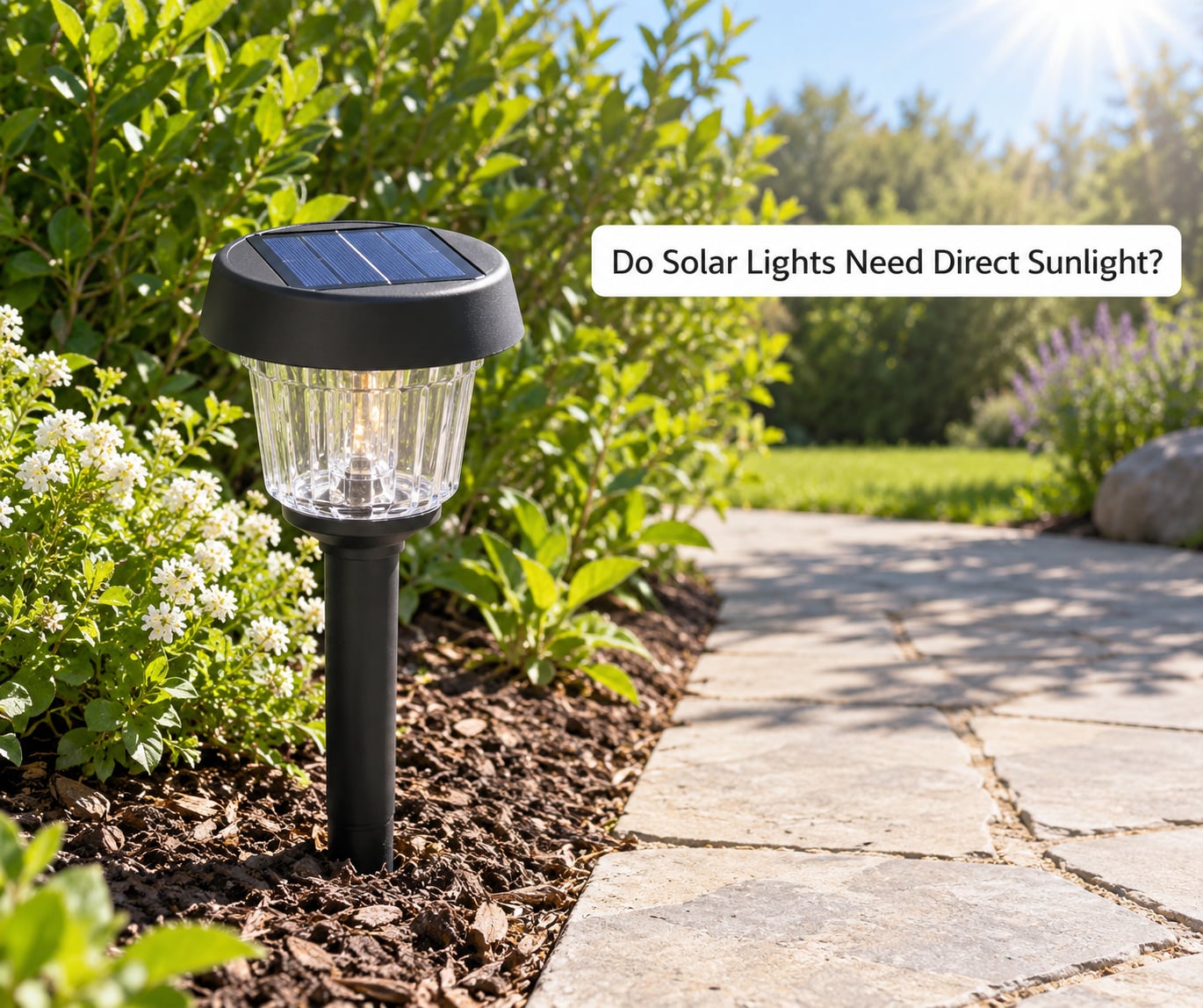
The honest answer is that direct sunlight is the reliable charging condition, not a strict requirement. A photovoltaic panel responds to light intensity rather than to the angle of the sun, so any daylight bright enough to register will push some charge into the battery.
What changes is the amount. Direct sun delivers the energy in a concentrated beam that a panel can collect efficiently. Light bouncing off a wall or filtering through leaves arrives from many angles at lower intensity, and the panel picks up a fraction of it.
So do solar lights need direct sunlight? No, but a lamp charged in shade will usually give you a short, dim night. If you want a light that runs from dusk to dawn, treat four to six hours of unobstructed sun as the target, not a bonus.
How Solar Lights Get Their Power
Every solar light, from a stake light to a motion floodlight, runs the same five-part cycle. Understanding it explains most of the odd behaviour people notice.
The five parts of a solar light
- Photovoltaic panel converts daylight into direct current electricity.
- Charge controller regulates that flow so the battery is not overcharged or drained below its safe floor.
- Rechargeable battery, usually lithium-ion or NiMH, stores the energy for use after dark.
- Light sensor a small photocell reads darkness and switches the lamp on, and back off at dawn.
- LED draws the stored charge and produces the light you actually see.
Sunlight is the energy source in every case. Even when a product description says the panel works in daylight or indirect light, the photons still have to arrive from the sun. Cloud cover scatters the beam, which is why an overcast day still charges a panel, just weakly.
One useful detail: the light sensor reads ambient brightness, not the panel. A lamp that stays lit through the afternoon is a sensor, switch or protective tab problem, not a charging problem. A lamp that lights up at sunset and dies two hours later is a charging problem. Sorting out which of those two you have saves you from replacing a perfectly good fixture.
How Much Sunlight Does a Solar Light Need?
There is no universal runtime figure, because panel area, battery capacity, LED brightness, weather and season all move the number. What you can do is match the condition to a realistic expectation before you install anything.
| Light condition | What the panel collects | What you get after dark |
|---|---|---|
| Full sun, panel clear and unobstructed all day | Full rated output for most of the day | Brightest output and the longest runtime the fixture can deliver |
| Sun with partial shade, a wall or fence casting across for part of the day | Reduced, with charge accumulating in bursts | Dimmer and often short of a full night, especially in shoulder seasons |
| Bright indirect light, open garden or a sunlit patio nearby | A fraction of direct sun output | Some light, often only a few hours and at reduced brightness |
| Deep shade under tree cover or a heavy overhang | Little to nothing useful | Often nothing at all, or a faint glow that fades quickly |
| Overcast day, thin cloud | Partial, scattered light still arrives | Usually enough to top up a battery that started reasonably full |
| Covered porch or under an eave | Minimal, since the roof blocks the beam | Unreliable; a lit lamp here is the exception, not the rule |
Read the last column as a direction of travel rather than a promise. Brightness, battery size and lamp wattage shift everything, which is why two lights in the same shady yard can behave completely differently.
Can Solar Lights Charge in Indirect Sunlight?
Yes, indirect sunlight charges a solar light, just inefficiently. A panel sitting in an open garden with a bright patio nearby will gather real energy, because the air and ground are bouncing usable light onto its surface. The same panel under dense tree cover will not, because the leaves absorb most of what reaches them.
Two situations where people expect charging and do not get it:
- A lamp placed in dappled shade under a tree. The bright patches come and go with wind, and a large share of the beam never touches the panel at all.
- A lamp stood next to a sunlit wall. This looks promising and produces surprisingly little, because the wall reflects only a fraction of the light and the fixture body shades the rest.
If the spot genuinely cannot see sky, the fix is not a better panel. It is a fixture built for that spot: one with a separate panel on a cable, a USB port, or a larger battery that can soak up a slow trickle over several days.
Where to Place a Solar Light for the Best Charging
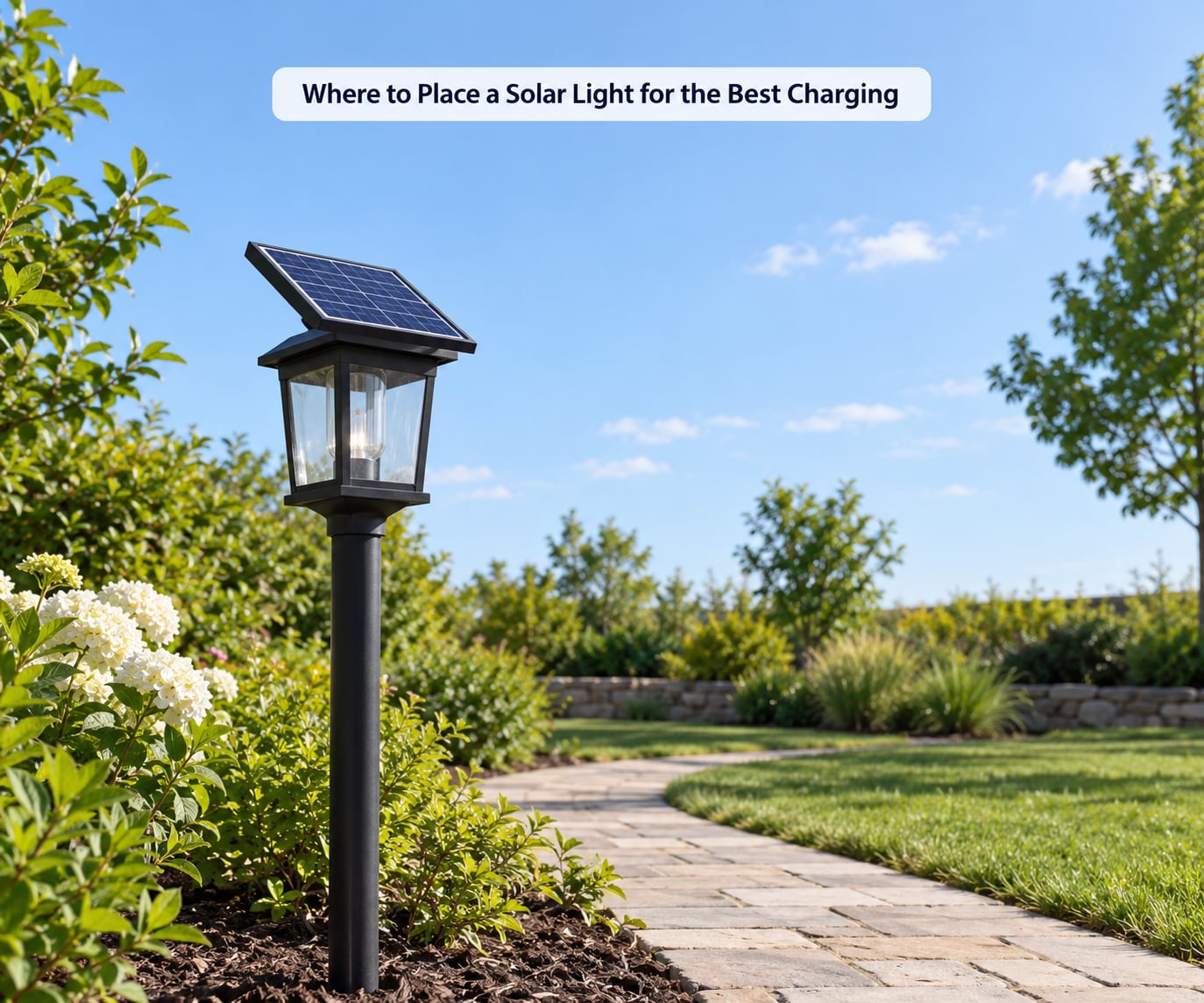
Placement is the whole game. Work through these in order and most installs improve without buying anything.
- Give the panel the longest stretch of open daylight you can manage. Morning and midday sun count more than an hour at the end of the day.
- Clear the sight lines. Prune back branches, move the light away from fences, walls, roof overhangs, sheds and other fixtures that cast shade across it.
- Aim the panel at the sun’s main path. In the northern hemisphere that means broadly south; in the southern hemisphere, broadly north. A tilted panel aimed at midday sun collects noticeably more over a year than one lying flat.
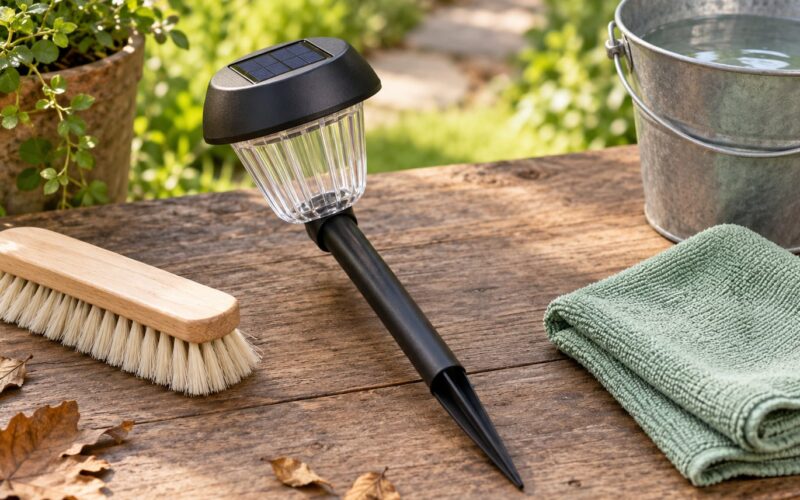
- Keep the panel clean. Dust, pollen, bird droppings, spider webs and a film of dried mud all cut output. A soft cloth and a little water is enough, twice a year at minimum.
- Separate the panel from the lamp if you can. Many fixtures with a remote panel let you put the light over a shaded path and the panel in an open spot nearby.
That last point is the answer to the most common placement puzzle. A dark, sheltered porch or a wooded walkway can be lit perfectly well as long as the panel is somewhere that sees sky. Before you accept a spot, spend a day watching where the sun actually travels rather than where you wish it went.
What If a Solar Light Is Not Lighting Up?
Work through this sequence and most problems resolve without a return trip to the shop. It takes about ten minutes.
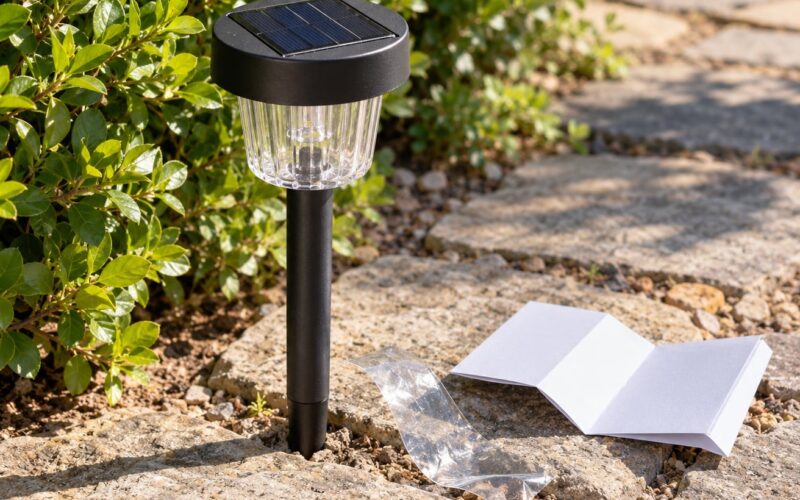
- Check the switch and any protective tab. New lights ship with a small insulating tab or a switch in the off position. Nothing charges into use until it is removed or flipped.
- Give it a full initial charge. Manufacturers commonly ask for several days of useful daylight before judging performance, and several days of bright weather is not always available.
- Look at the panel, not the lamp. Lift leaves, check for snow, mud or shade, and confirm the switch was on during the day. Lights charge while switched off, but only if the switch is on the charging side.
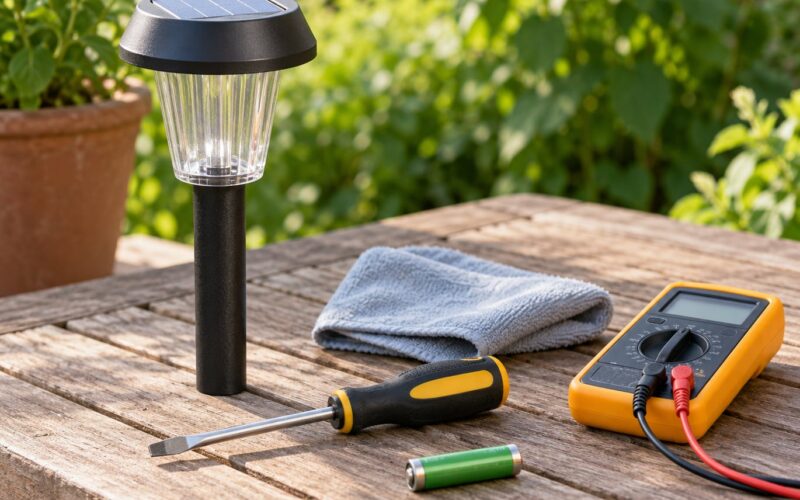
- Test the light sensor. Cover the photocell completely with your hand or a dark cloth. A healthy lamp should come on within a few seconds, which tells you the LED and battery are alive and the problem is upstream.
- Check the battery. If the lamp lights but fades in an hour or two, the battery has likely lost the ability to hold a useful charge. Many cheap fixtures use a non-standard cell size with no replacement available, which is a good reason to buy better the second time.
If the lamp stays on in full daylight, the cause is the sensor, a stuck switch, or a missing tab rather than a lack of sun. Cleaning the photocell and cycling the switch usually sorts it out.
How to Get Brighter Light and Longer Runtime
Once placement is right, these are the remaining levers, roughly in order of how much they matter.
- Match the lamp to the job. A light meant to glow a step is not the same as one meant to light a driveway, and brightness settings that look generous in a showroom are often wrong for a real path.
- Look for a larger panel and a larger battery. Panel area drives how fast the battery fills; battery capacity decides how long it runs. A cheap fixture with both small is the reason many people conclude solar does not work.
- Wipe the panel every few months. A panel that has lost a quarter of its output to grime will show it as shorter nights, and most people blame the battery instead.
- Cut shade at the source. Trimming a branch or moving a light thirty centimetres can be worth more than any product swap.
- Use the dim or motion setting. Many lights offer a low-output mode or a motion-triggered full-brightness burst, and both extend runtime noticeably on a partial charge.
Treat any runtime number on a package as a best case measured in full summer sun. Real results move with weather, how often the light triggers, and the condition of the battery after a couple of seasons.
Seasonal and Weather Considerations
Solar output follows the seasons closely, and the two conditions that catch people out are short days and long runs of dull weather.
In winter the days are short and the sun sits low, so a panel gets fewer hours and hits them at a shallow angle. The same light that runs all night in June may manage a few hours in December, and that is normal rather than a fault. In summer the opposite applies, with long days producing more charge than the battery can always take, which is what the charge controller exists to manage.
Cloud cover scatters light rather than blocking it, so a bright overcast day still puts charge in. Thin cloud matters much less to a panel than people expect. Heavy rain is different, since the light level drops a long way, and a run of stormy days can leave a battery empty.
Keep panels clear of snow. A light buried under a January snowfall has no panel at all, and one sitting in a puddle or under a dripping gutter is collecting less energy than the same panel in open air. Heat works the other way, since batteries and charge controllers dislike extremes, which is another reason the weather rating on a fixture matters outdoors.
If you are installing ahead of winter, give the lights several days of useful daylight before you judge them, and expect the first genuinely dark month to be the hardest test they will face.
Frequently Asked Questions
Can solar lights work without direct sunlight?
They can, but expect reduced results. A panel in bright indirect light still collects enough energy to charge a battery partly, and the lamp will light, usually dimmer and for fewer hours than the same fixture in open sun. Under deep shade or beneath a roof overhang, most solar lights barely charge at all. If a spot never sees sky, look for a fixture with a separate panel on a cable, a USB port, or a much larger battery.
How many hours of sunlight do solar lights need to charge?
Most makers suggest six to eight hours of direct sun for a full day, and several days of good weather for the very first charge. Four to six hours of unobstructed daylight is a reasonable target for everyday use. Partial shade or a bright but indirect spot fills the battery only partly, so runtime drops. Panel size, battery capacity and season all shift the figure, so treat any runtime on a package as a best case.
Do solar garden lights charge on cloudy days?
Yes, a little. Cloud cover scatters sunlight rather than stopping it, so a bright cloudy day still produces a partial charge and can top up a battery that started reasonably full. Heavy overcast or prolonged rain is a different story, since output falls far enough that a battery may not recover what it spent the previous night. A week of dull weather is usually survivable; a week of storms can leave a light dark.
Can a solar light be charged indoors?
Only if it has another charging route. A window is not a substitute for outdoors, since glass filters light and indoor light is far weaker than daylight, so a panel sitting on a windowsill for a week will gain very little. Fixtures with a USB port or an AC adapter input can be topped up indoors, which is the practical answer for winter installs and shaded spots. Check the manual before assuming a port exists.
Should the solar panel be cleaned or kept in the sun all day?
Clean it, and let it see as much sun as the spot allows. Dust, pollen, dried mud, bird droppings and spider webs all reduce output, and a dirty panel is one of the most common reasons a light that used to work all night now stops after two hours. A soft damp cloth twice a year is usually enough. Keep the switch on the charging side during the day, since the battery will not fill otherwise.
Conclusion: Start with the Panel
So, do solar lights need direct sunlight? They do not need it to switch on, but they need generous, unobstructed daylight to fill the battery and run all evening. Bright indirect light charges a panel slowly, and deep shade or a covered porch charges it barely at all.
Before you blame the battery or replace a fixture, go out and look at the panel. Check the switch, pull off any leaves or grime, and count how many hours of clear sky it actually sees. Move the light or swap it for a remote-panel model if the answer is fewer than four hours. That one afternoon of observation solves more solar light problems than anything else I know of.