Yes, solar usually adds value when you own the system outright. US research from Zillow has put the premium on solar-equipped homes in the 3% to 7% range, with an average nearer 3% to 4%. But that number is an average, not a promise, and leased systems and power purchase agreements tend to add much less. Everything depends on your utility rates, your system size, how old the panels are, and who ends up holding the contract at closing.
The reason solar moves value at all is simple: a panel array is an asset that produces a measurable stream of avoided electricity costs. An appraiser can put a number on that stream. A lease is the opposite of an asset for the buyer, because the buyer inherits payments for something they did not choose.
This guide covers what the research says, how appraisers actually treat solar, what sellers can do to protect the premium, and what buyers should ask before they make an offer. Rates and incentives change, so treat every figure here as a planning range rather than a settlement.
Table of Contents
- Does Solar Increase Home Value?
- What Zillow’s research actually found
- When the premium disappears
- How Much Does Solar Add to Home Value?
- How Appraisers Treat Solar Energy
- The discounted cash flow method, in plain English
- Why leased systems are treated as a liability
- Owned vs Leased vs PPA: The Biggest Factor in Resale Value
- Why Buyers May Pay More for Solar
- The monthly number matters more than the percentage
- Energy independence and predictability
- Resilience where the system supports it
- Appeal and low operating cost
- Does Solar Make a Home Sell Faster?
- What Can Reduce the Added Value
- How to Maximize Your Home’s Value with Solar
- 1. Get a realistic savings analysis before you sign
- 2. Own the system outright if you can
- 3. Use equipment and workmanship you can warranty
- 4. Keep the paperwork in one folder
- 5. Prove you are paid off
- 6. Show production against the estimate
- 7. Deal with the roof first
- 8. Show the monitoring
- 9. Disclose savings in monthly terms
- 10. Talk to a local agent early
- What to Ask Before Buying a House with Solar
- What About Solar Batteries and Energy Savings?
- Why US and UK Markets Disagree
- Frequently Asked Questions
- How much does solar increase home value?
- Do leased solar panels increase home value?
- Do appraisers count solar panels when they value a home?
- Do solar batteries increase home value?
- Should I install solar before selling my house?
- What documentation should a seller with solar gather before listing?
- The Best First Step
Does Solar Increase Home Value?
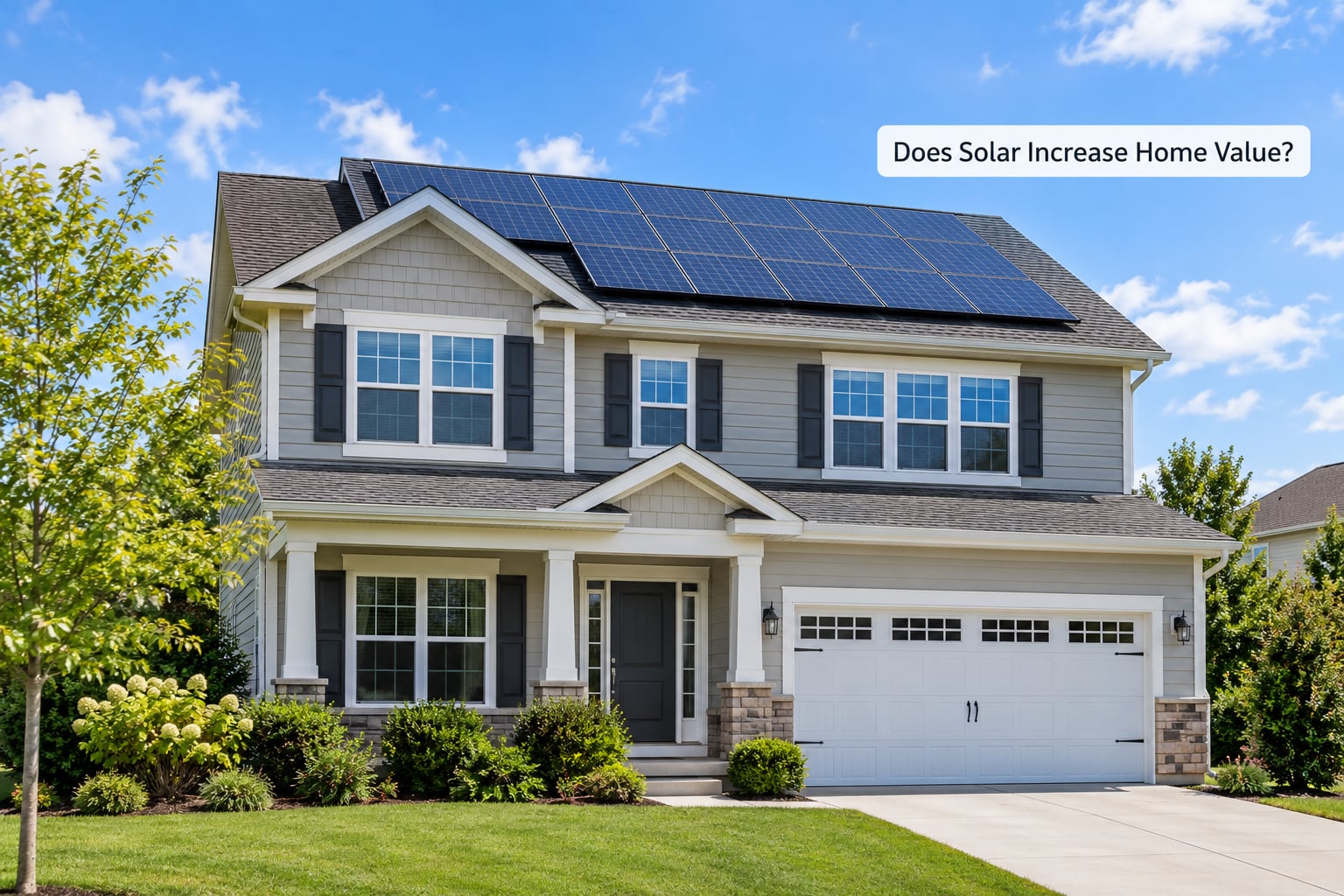
Solar increases home value most for owned systems in markets with expensive electricity, and it does very little for leased systems. That is the short version, and it holds up across most of the research on the topic.
Zillow’s first large study of solar sales found that homes with solar sold for about 4.1% more than comparable homes without. A later Zillow analysis pushed that figure to roughly 6.8%. Studies focused on the Washington DC area have gone higher, around 7.7%. Meanwhile the Department of Energy’s Office of Energy Efficiency and Renewable Energy has described the added value on some homes as a sum running into five figures.
What Zillow’s research actually found
Zillow compared homes with solar to similar homes nearby without it, controlling for size, age, condition and neighborhood rather than just comparing sale prices to list prices. That method matters because raw price comparisons tend to overstate premiums in expensive markets.
The gap between 4.1% and 6.8% is not a contradiction. Buyers have become more familiar with solar over time, and more of them have had a year or two of experience with their own electricity bills. Familiarity tends to raise what buyers will pay.
When the premium disappears
A premium shows up when the panels are owned, in good working order, well documented, and producing savings in a market where electricity costs are high. It shrinks or disappears when the system is leased, when the roof needs replacing, when the panels are old enough that a buyer doubts their output, or when nobody in the transaction can produce paperwork.
Location matters as much as the system. In states with low electricity rates, the avoided cost stream is small, and so is the appraised value.
How Much Does Solar Add to Home Value?
The studies below are the ones real estate agents and appraisers actually reference. Read them as a range rather than a promise for your street.
| Source | Year | Premium found | Where it applied |
|---|---|---|---|
| Zillow real estate research | 2019 | About 4.1% | US markets with comparable sold data |
| Zillow real estate research | 2024 | About 6.8% | US markets, larger sample |
| Washington DC area study | 2020s | About 7.7% | Higher electricity costs, strong adoption |
| DOE, Office of Energy Efficiency and Renewable Energy | 2010s | Added value in the five-figure range on well-placed systems | US, individual case modelling |
| Appraisal Journal research, widely cited | 2010s | Roughly 20 in value for every 1 in annual energy cost avoided | General rule of thumb for appraisers |
The 20-to-1 rule is the one to remember if you remember nothing else. An avoided annual energy cost of 1,000 dollars implies a value contribution somewhere near 20,000 dollars, before you discount for system age and the remaining useful life of the panels.
Panels typically warrant 25 years and lose roughly 0.5% to 1% of output per year. A system installed fifteen years ago has real remaining life, but it also has fewer years for the buyer to collect savings, and that shortens the income stream an appraiser credits.
How Appraisers Treat Solar Energy

Appraisers treat an owned solar system as a depreciating asset that reduces operating costs, and they rarely treat it as a room addition or a kitchen renovation. Fannie Mae’s guidance to appraisers describes solar as a depreciating asset whose contribution to value comes from the energy cost savings it produces, not from the installation invoice.
That distinction explains why two homes with identical hardware can appraise differently. Same panels, same roof, same array. Different electric rates, different remaining warranty, different years of production data. Different numbers.
The discounted cash flow method, in plain English
Most appraisers who build solar into a report use a discounted cash flow analysis, the same way they value a rental property. They take the stream of avoided energy costs the system will produce over its remaining life, discount each future year back to today’s value, and land on a present value.
The discount rate is where judgment enters. A cautious appraiser assumes rates rise slowly, assumes the next roof needs work, and assumes some future maintenance. A generous one assumes more. Two competent appraisers can land within a few thousand dollars of each other, and that gap is worth discussing with your agent before the offer is signed.
Short version of what moves the number up: a large system relative to the home, good south-facing orientation, low shading, clean production records, a young system with a long warranty, and a utility with high rates. What moves it down: a small array, a north or east tilt, partial shading from a new build next door, an expiring warranty, and a buyer who expects a roof replacement soon.
Why leased systems are treated as a liability
Leased systems and power purchase agreements are not assets to the homeowner, so an appraiser cannot add them. The panels are the lessor’s property, mounted on your roof, and the contract continues after you sell unless the buyer assumes it or the lessor removes the system.
A buyer who inherits a lease for 12 more years at 200 dollars a month will usually do the arithmetic and discount the offer. Some buyers want nothing to do with it at all, which shrinks your pool of buyers on the day you actually need one.
Owned vs Leased vs PPA: The Biggest Factor in Resale Value
If you remember one thing about solar and resale, make it this: ownership status outweighs almost every other variable, including panel quality and system size.
| Factor | Owned system | Solar lease | Power purchase agreement |
|---|---|---|---|
| Who owns the panels | You do | The leasing company | The provider owns them, you buy the power |
| Value added at resale | Typically adds a measurable premium | Often none, sometimes a discount | Usually none |
| Transferable to a buyer | Yes, with the house | Only if the lender approves the buyer | Only with provider consent |
| Closing complexity | Low | High | High |
| Out-of-pocket cost after purchase | None | Monthly payment continues | You pay for power you already own a roof for |
| Buyer reaction | Usually positive | Often hesitation | Often hesitation |
The mechanics are what turn a mild discount into a delayed closing. Buyers’ lenders often need written confirmation that the contract is being transferred, assumed or bought out. In a competitive market, an unapproved buyer may walk rather than wait.
You have three options when you hold a lease or PPA. You can buy out the contract and hand the buyer a free-and-clear system. You can request transfer to the buyer and hope the lender approves them. Or you can ask the provider to remove the panels before closing. Removal restores the home to a conventional one, which some sellers prefer over the paperwork battle.
Homeowners on real estate forums describe the moment a contract assumption kills an offer as routine rather than exceptional. Plan for it early, because a buyer who falls in love with your house is a fragile thing to build a closing on.
Why Buyers May Pay More for Solar
Buyers do not pay a premium for panels. They pay a premium for a lower monthly cost, and panels are the most visible reason the number drops.
The monthly number matters more than the percentage
Most households compare a housing payment against a monthly utility bill. A homeowner on solar forum threads reports documented savings of 100 to 150 dollars a month on a paid-off system, and says the savings evidence made the house more affordable for the eventual buyer. Frame your savings monthly and put a comparable number in the listing.
Energy independence and predictability
Rate increases are a real source of anxiety for households on expensive grids. A system that produces most of the household’s power removes a variable monthly bill and adds a ceiling on future rate shocks.
Resilience where the system supports it
Grid outages are more common, and buyers notice that. Standard grid-tied panels shut off during an outage for line worker safety, so most homes need a battery with a transfer switch to run anything at all. Where that is in place, backup capability becomes a talking point rather than a spec sheet item.
Appeal and low operating cost
Some buyers simply like the idea of a house that runs on its own roof, the way others prefer a finished basement or a new furnace. You cannot argue that one scientifically, but it is a genuine slice of the market and it does show up in agent conversations.
Does Solar Make a Home Sell Faster?
Often yes, though the evidence is thinner than the evidence on price. Most realtor reports describe solar homes as easier to market once the savings are documented, because the listing can lead with a number instead of a feature.
In the UK, where estate agent surveys have been widely reported, agents frequently said solar does not raise the price but does help a property sell. A Which? survey drew that conclusion repeatedly in a long thread on r/SolarUK, which is a useful counterweight to the US premium figures and worth reading next to them.
Speed also depends on documentation. A home whose seller can hand over twelve months of bills, a production report and transfer paperwork markets faster than one where the buyer’s agent has to make phone calls to find out whether the panels are paid off.
What Can Reduce the Added Value
Solar can subtract value in real situations. It is worth naming them plainly.
- Unfinished financing. A loan or lease balance still outstanding has to be settled or assumed at closing. One homeowner described a loan balance of roughly 51,000 dollars at 260 dollars a month blocking a sale until it was resolved.
- An aging system. Fifteen-plus-year-old panels with a worn inverter and an expiring workmanship warranty are a liability to a buyer who plans to stay a decade.
- Roof condition. A buyer facing a re-roof in five years may discount for removal and reinstallation, or ask for a credit. Installations mounted with penetrations they would have to redo are worth less.
- Lease transfer friction. If the contract cannot be assumed by the buyer, your buyer pool shrinks at exactly the wrong moment.
- Empty disclosure fields. A buyer on r/RealEstate found the solar section of the seller’s disclosure form blank and had no idea whether the system was owned, leased or financed. Uncertainty does not create a premium.
- Aesthetics and panel tech. Visible hardware on a street of tidy roofs can bother some buyers, and there is a real minority who worry older panels will look dated within a decade.
- Installing right before listing. A new loan obligation created months before a sale reduces what you net, and a brand-new system gives a buyer no history to trust.
- A negative appraisal outcome. Rare, but real. A seller in the UK reported being told their home was worth several thousand pounds less with solar and a battery installed, which is an outlier but not impossible.
None of this means solar devalues homes across the board. It means the premium is conditional, and the conditions are mostly in your control at the moment you install and at the moment you list.
How to Maximize Your Home’s Value with Solar
Ten steps, roughly in the order they matter, if you already have solar or are about to install.
1. Get a realistic savings analysis before you sign
Model your production against your actual usage and your utility’s real rate schedule, including time-of-use pricing. A system sized to your household beats a bigger system that credits less than you use. Ask for the assumptions in writing.
2. Own the system outright if you can
Every comparison above points the same direction. A cash purchase or a loan you retire before selling removes the single largest source of closing friction.
3. Use equipment and workmanship you can warranty
Transferable manufacturer warranties on panels and inverters travel with the house. Choose an installer whose workmanship warranty also transfers, and get the transfer forms signed now rather than the week you list.
4. Keep the paperwork in one folder
Purchase contract, permit approvals, utility interconnection and net metering approval, warranty certificates, transfer forms, recent production reports and the last twelve months of utility bills. Digital copies in one place and a printed set in a drawer.
5. Prove you are paid off
A realtor in Summerville, South Carolina told a client that proof of payoff was required before the deal could move, then could not name exactly which document the buyer’s agent wanted. Get a payoff statement from your lender on request and have it ready.
6. Show production against the estimate
Twelve months of production data compared to the installer’s projected output is the most persuasive page in the folder. Systems that beat their estimate are easy to talk about.
7. Deal with the roof first
If the roof needs work, do it before installation or re-roof before listing. It removes the re-roof deduction, which is often larger than any realistic difference between equipment tiers.
8. Show the monitoring
A working inverter, an accessible panel and an app a buyer can open on their phone read as a maintained system rather than a forgotten one.
9. Disclose savings in monthly terms
Put your documented monthly savings in the listing, and translate it into a payment comparison for buyers who think in mortgage numbers. That is the translation that moves offers.
10. Talk to a local agent early
Before you sign the listing agreement, ask an agent who has sold solar homes in your neighborhood what they actually saw. Their answer will be more specific than any national average, and it is free.
What to Ask Before Buying a House with Solar
Buyers who regret solar purchases usually regret the questions they did not ask. Work through this list with your agent before you write an offer.
- Are the panels owned outright, leased, or part of a power purchase agreement?
- Is there any balance owed, and can I have the payoff letter?
- Can the lease or PPA transfer to me, and will my lender approve the assumption?
- How old is the system, and when does each warranty expire?
- What did the system actually produce last year, and what was projected at installation?
- Has the interconnection and net metering approval carried over to the new owner?
- When does the roof need replacing, and what does that do to the array?
- Is there a battery, and what can it realistically power during an outage?
- Does the price reflect the value of the system, and can we have it reviewed if I disagree?
Item nine matters because the buyer’s leverage often shows up as a request for a credit rather than a higher appraisal. Having your own analysis ready is cheaper than discovering the deduction late.
What About Solar Batteries and Energy Savings?
Batteries raise the question, and they also complicate the answer. A battery’s value to a buyer comes from three things: backup during outages, shifting usage away from peak rates under time-of-use pricing, and adding a second revenue stream where a utility pays for exported or stored energy.
Energy savings, meanwhile, are the foundation of the whole valuation question. How much a system saves depends on where you live, your utility rates, how your household uses power, how big the system is, and how the next owner behaves. Someone who works from home and runs the air conditioning will get a different result from someone who is empty all week.
That variability is why savings should be modeled rather than promised. A production report plus twelve months of bills is the closest thing to a defensible number you will get. An installer’s projection is a forecast, and buyers price forecasts accordingly.
On batteries specifically, expect a smaller premium than the panel array unless the utility pays well for stored energy or the home has a history of long outages. The one r/SolarUK seller who reported a lower valuation had both solar and a battery, and nobody could tell her which component the appraiser disliked.
Why US and UK Markets Disagree
The contradiction between Zillow’s 6.8% and British estate agents saying solar adds nothing is real, and it has three explanations rather than one.
First, electricity costs. British households pay far less per kilowatt hour than US households in California or the Northeast, so the avoided-cost stream that appraisers capitalize is smaller. A premium measured as a percentage of value can still exist while feeling like nothing to an agent whose buyers compare total bills.
Second, adoption speed. The US has a much larger population of recent solar buyers who already know what a production report is. UK buyers are newer to the question, and unfamiliarity prices in as uncertainty.
Third, lease penetration. Where leases and PPAs are common, a large share of installed systems sit on roofs as third-party property, which dilutes any average across all solar homes. Markets dominated by owned systems show the cleaner premium.
The practical takeaway for a US homeowner: your market’s numbers are your numbers. UK survey findings describe a different rate structure and a different buyer population, so they are context rather than a counterargument.
Frequently Asked Questions
How much does solar increase home value?
US research puts the premium around 3% to 7%, with Zillow reporting about 4.1% in 2019 and about 6.8% in a later update. Higher figures show up in high electricity cost markets. That range applies to owned systems; leases and PPAs usually add nothing.
Do leased solar panels increase home value?
Usually not. The panels belong to the lessor, so an appraiser cannot add them, and a buyer may discount for monthly payments they did not sign up for. Buyers’ lenders also need to approve a contract transfer, which sometimes ends the deal. Some sellers buy out the contract before listing so the buyer gets a free-and-clear system.
Do appraisers count solar panels when they value a home?
Owned systems, yes, usually as a depreciating asset that cuts operating costs. Fannie Mae’s guidance treats solar that way rather than as a renovation. Many appraisers run a discounted cash flow on the avoided energy costs, with the long-standing rule of thumb that each dollar of annual savings adds about twenty dollars of value.
Do solar batteries increase home value?
Some, but less reliably than panels. A battery adds value where it delivers real backup capability, where time-of-use rates make stored energy worth arbitrage, and where the utility pays for exported or stored power. In markets without those conditions, an appraiser may give it little weight, especially if the roof also needs work.
Should I install solar before selling my house?
Generally no. A new system adds a loan or payment obligation months before a sale and gives a buyer no production history to trust. If you already own a paid-off system, put the effort into documentation instead: payoff letter, production reports, warranty transfer forms and twelve months of utility bills.
What documentation should a seller with solar gather before listing?
Start with the payoff letter from your lender, the utility interconnection and net metering approval, transferable manufacturer and workmanship warranties, a recent production report compared against the original estimate, and twelve months of utility bills. Buyers and their agents ask for these constantly, and having them ready avoids delays.
The Best First Step
If you own solar and plan to sell, the first move is a folder, not an installation. Get a payoff letter, pull twelve months of utility bills and production reports, confirm the warranties transfer, and photograph the inverter and monitoring app working.
Next, have a realistic savings analysis run using your utility’s actual rates, and translate the result into a monthly figure you can put in the listing. Then speak with a local real estate agent who has sold solar homes in your neighborhood, and set your expectations around a 3% to 7% range rather than a specific number.
If you are still deciding whether to install, model your own numbers first. Owner-occupied households that expect to stay seven years or longer have the clearest case, and that horizon matters more than any headline premium.
Rates, incentive programs and utility rules shift from year to year, so re-check the details for 2026 with a licensed installer and a local appraiser before you commit either way.