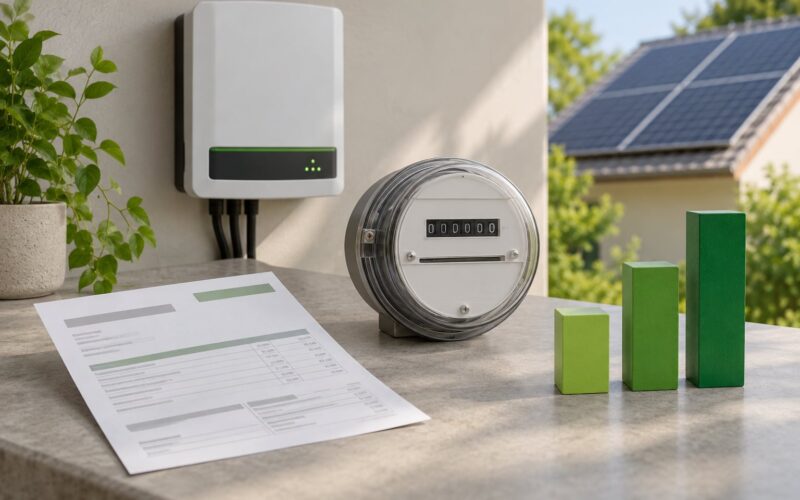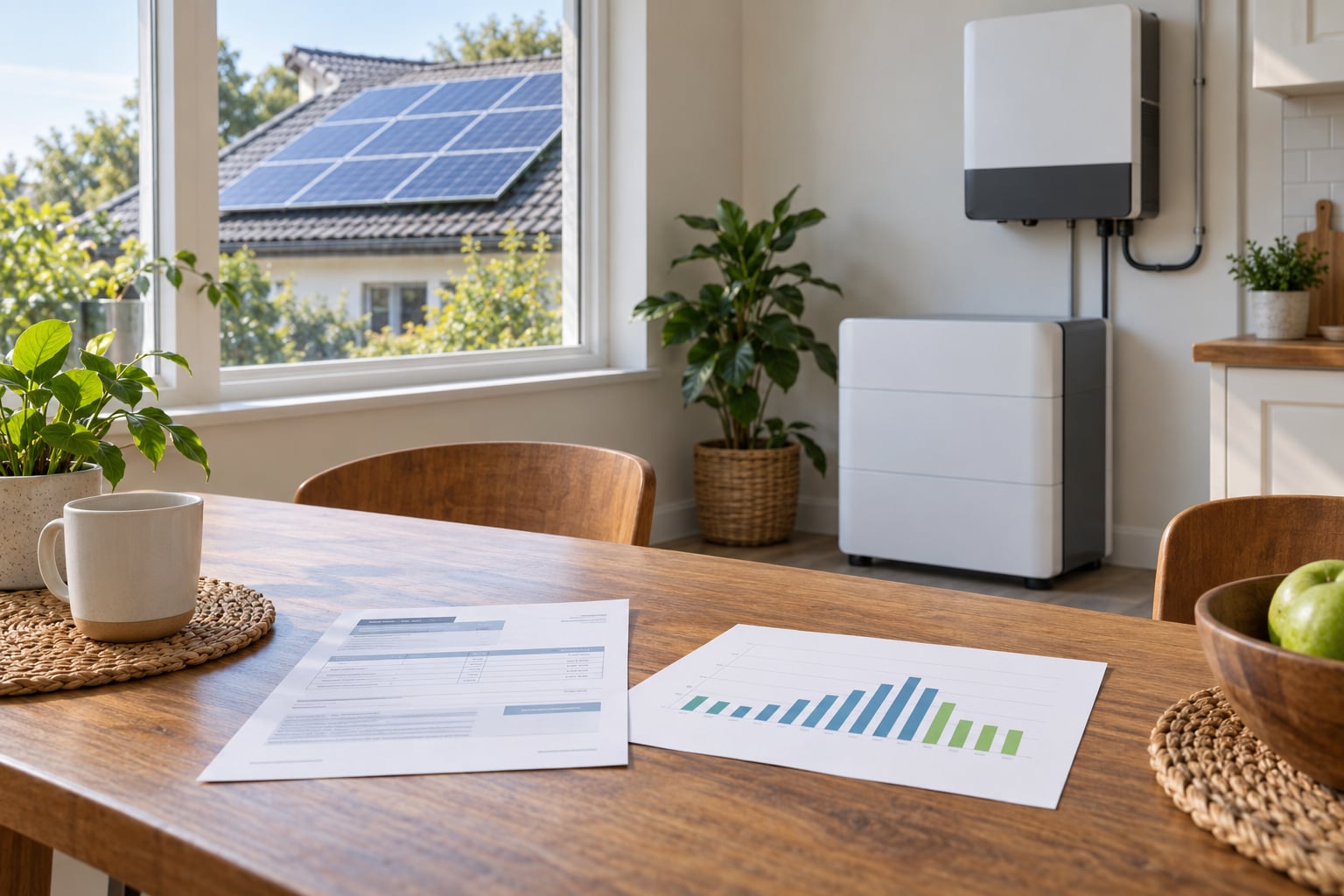
A time of use rate is a utility pricing plan where the price of electricity changes by hour of the day, charging more during high-demand hours and less overnight. For a solar owner that matters because your panels produce at midday while the expensive window usually runs from late afternoon into the evening. This guide breaks down how those rate windows work, how they interact with solar production, and what you can actually control.
The short version: a solar array covers your cheapest rate band almost by default. Everything interesting happens after the sun drops, and that is where a battery or a shifted laundry schedule changes your bill.
Table of Contents
- What Are Time of Use Rates?
- Time of use rates explained for solar owners in one minute
- How Time of Use Rates Work With Solar
- Why Peak and Off-Peak Electricity Costs Differ
- Time of Use Rate Examples for Solar Owners
- How to Read Your Utility Rate Schedule
- Can a Solar Battery Help With Time of Use Rates?
- How to Choose or Respond to a Time of Use Rate
- Frequently Asked Questions
- Are time of use rates always cheaper with solar?
- What time is electricity cheapest under a time of use plan?
- Does a solar battery make sense with time of use rates?
- Are exported solar credits priced at the peak rate?
- What happens if my utility changes its peak hours?
- How can I compare a time of use rate with my current solar bill?
- Conclusion: Start With Your Rate Schedule
What Are Time of Use Rates?
Time of use rates, usually written TOU or billed as a time of day rate plan, price each kilowatt-hour you import from the grid according to which period it falls into. Instead of one flat cents-per-kWh number, your meter is read across several bands and every band carries its own price. Your utility multiplies the kWh used in each band by that band’s rate, then adds the results together.
Time of use rates explained for solar owners in one minute
A utility sorts the 24 hours of a day into two to four rate periods based on how stressed the grid is during those hours. Solar owners care about two things: what their panels produce, and what the grid charges for the power they use when the panels are not producing.
Most plans use three bands, and the exact hours belong to your utility’s tariff rather than to any national standard. A PSEG Long Island time of day plan, for example, runs off-peak from 6am to 3pm, peak from 3pm to 7pm, and super off-peak from 10pm to 6am. Other utilities shift the windows, and some change them by season, so a morning peak in winter can become an afternoon peak in summer for the same customer.
| Rate period | Typical hours | Relative price | Overlap with solar production |
|---|---|---|---|
| Super off-peak | Late night to early morning, often 10pm to 6am | Lowest, frequently well under half the peak rate | None, no production overnight |
| Off-peak | Daytime shoulder hours, often early morning to mid-afternoon | Middle, close to a flat-rate average | High, panels cover most of this band |
| Peak | Late afternoon into evening, commonly 3pm to 9pm | Highest, sometimes triple the off-peak rate | Little or none once the sun is low |
Electricity is cheapest overnight and in the early morning, and most expensive in the late afternoon and early evening. If you only remember one line from this article, make it that one.
TOU rates also differ from demand charges, and the two get confused constantly. A demand charge is billed on your highest 15-minute power draw in a billing month, whether or not it happened during a peak price band. Residential customers rarely pay one, but plenty of commercial and small business customers do.
How Time of Use Rates Work With Solar
A rooftop array produces roughly from a couple of hours after sunrise until a couple of hours before sunset, peaking near solar noon. That output lands almost entirely inside the off-peak band, which is exactly where a solar owner wants to be. The morning and the deep evening are where solar gives you nothing.
The economics come down to two separate prices meeting at your meter. Energy you import during peak costs the full retail peak rate, often somewhere between 45 and 60 cents per kWh. Energy you export during the sunny midday window may earn much less under net billing rules, sometimes only 5 to 8 cents per kWh. The gap between those two numbers is the whole game.
That is why self-consumption, using solar on site rather than sending it to the grid, carries so much more value than export under modern tariffs. Every kWh you use yourself at 7pm instead of buying avoids the full peak import price, and you never had to give away the export credit in the first place.
Under a traditional net metering arrangement, credits you earn offset whatever you import later, and a credit from midday can cover evening usage. Many net billing programs changed that. The common rule now is a credit bucket: credits earned inside a rate period can only offset usage in that same period, unless your tariff allows a transfer. A customer whose peak hours are 3pm to 9pm cannot spend a midday credit against a 7pm import, which is where bill frustration usually starts.
Forum threads on r/solar are full of owners who installed panels expecting near-zero bills and instead watched the import line climb once a TOU schedule landed on their account. A few report being moved onto a time of day plan around the time of installation with little notice. That experience is common enough to be worth checking for yourself rather than assuming.
Why Peak and Off-Peak Electricity Costs Differ
The price bands follow physical stress on the grid, and the reasons are mostly boring in a good way.
Demand is the first driver. When people get home, cook dinner, run the dryer and charge vehicles at once, load climbs fast. Utilities buy power in the wholesale market, and wholesale power costs more in those hours because there is more of it competing for the same limited supply.
Generation mix is the second. Peaker plants, often older gas or diesel units held in reserve, run hardest during the evening ramp. Those plants burn fuel at poor efficiency, so every kilowatt-hour from them carries a higher cost than the cheap midday solar and hydro sitting on the wires.
Weather and time of year matter too. A still, cold evening in December can trigger a shortage event well before a breezy afternoon in May does. That is the logic behind brownout alerts and demand response programs: shift load away from the tightest hours, even if the weather itself is pleasant.
Local network constraints are the last piece. Transmission and distribution lines have physical limits, and buying power close to a congested area costs more than buying it where capacity is spare. It is the same reason electricity near a congested data center market can cost several times more than the national average.
Time of Use Rate Examples for Solar Owners
Here is a worked example with round figures, using cents per kWh throughout. A household uses 30 kWh a day, with 10 kWh consumed during the 4pm to 9pm peak window and the remaining 20 kWh spread across off-peak hours. A 10 kW solar array produces about 15 kWh on a clear day, all of it inside the cheap band.
| Scenario | Peak energy used | Peak cost | Export credit value | Monthly grid cost, energy only |
|---|---|---|---|---|
| Flat rate, no solar | 10 kWh a day at 24 cents | 72 cents a day | None | About 2,160 cents of energy plus delivery charges |
| TOU, no battery, 5 kWh exported | 10 kWh a day at 50 cents | 500 cents a day | 5 kWh at 6 cents, about 30 cents a day | Roughly 14,100 cents a month of energy |
| TOU with a battery, 10 kWh stored | 0 kWh imported at peak | 0 cents | 0 kWh exported | Daytime import only, roughly 4,000 cents a month |
The battery row assumes the pack charges fully from midday surplus and discharges through the whole evening window. A pack too small to cover 4pm to 9pm only claws back part of the peak cost, which matches a common complaint in solar forums: owners buy a battery sized for a short peak block, then the utility extends the peak hours by two years.
Now the opposite case. If that same household works from home during the day and runs the dryer, dishwasher and oven while panels are producing, it consumes 15 kWh on site and exports nothing. Its TOU cost then sits below the flat-rate equivalent, because the array covers the cheap band entirely. TOU can help a solar owner. It punishes the ones whose load lives after sunset.
How to Read Your Utility Rate Schedule
The tariff sheet tells you everything, and most utilities publish it as a PDF with a name and number such as an electric rate schedule. Here is the order I would work through it.
First, find the rate schedule name on your bill. It usually appears near the top of the energy charge section or on the account summary page, printed as a code such as a time of use or time of day identifier. If you cannot find it, call the number on the bill and ask, because customer service can confirm it in a minute.
Second, look for the period definitions. Write down the clock hours and days of week for each band, and check whether they change seasonally or on weekends. The same plan can carry a winter peak of 6am to 9am and a summer peak of 2pm to 6pm, which is exactly what a r/solar user described for their utility.
Third, note the energy charge for each period in cents per kWh, plus any separate base service or delivery charge that applies no matter when you use power. That base charge is the part a solar array cannot remove, and it often becomes the dominant line once your energy costs fall.
Fourth, find the export compensation terms. Look for net metering versus net billing language, the rate at which exported kWh are credited, and whether credits are banked per period or globally. If your system went onto service after a tariff change, expect net billing rather than full retail net metering.
Fifth, check for demand charges and any minimum or system size limits. Some territories cap a new solar interconnection at a percentage of your annual usage, which can hold back a larger array even on a good site.
Can a Solar Battery Help With Time of Use Rates?
Yes, and load shifting is usually the reason people buy one. The value comes from buying energy at the super off-peak rate overnight or capturing free midday surplus, then releasing it during the peak window so the house stops importing expensive power.
Sizing is a timing problem more than a capacity problem. A household that uses 10 kWh between 4pm and 9pm needs a pack that can actually cover five hours of evening draw, which points at a usable capacity around 10 kWh with realistic inverter sizing. A pack rated for 5 kWh will discharge fast and still run dry before 9pm.
Efficiency decides how much comes back out. A pack advertised as 90 percent round-trip loses roughly 10 percent of what goes in, so it has to charge with a bit more than it delivers. Degradation is the other number to read: most modern packs quote a warranty holding about 70 to 80 percent of rated capacity after ten years, and that figure should be on the spec sheet.
Charging from the grid overnight is allowed on most plans and is often the more profitable choice, because you buy at the super off-peak rate and discharge at the peak rate. Solar-charged energy avoids the import cost but gives up export credit instead, so the arithmetic depends on which is larger on your tariff.
Commissioning matters more than buyers expect. Several people on solar forums report batteries that never learned their rate schedule and sat idle through peak hours after installation. Whoever installs it should program the discharge window to match your actual peak hours, then show you the settings before they leave.
Battery work is electrical and structural. Have a licensed electrician handle any panel or service changes, follow the manufacturer’s instructions, and talk to your utility before adding equipment, since some require an application or an interconnection review first.
How to Choose or Respond to a Time of Use Rate
Compare a full year, not a month. Pull twelve months of bills, total the energy charges for each rate period, and divide by kilowatt-hours to get your real average cost per kWh. Then do the same exercise using the tariff sheet for a competing plan. Seasonality matters, since a plan can look cheap in July and awful in January.
Layer on what is coming. If you plan to buy an electric vehicle or add a heat pump in the next few years, model that load too. EV charging moved overnight into the cheapest band, which usually helps on TOU, while a heat pump running during an evening peak can cost real money.
Then be honest about the bad fits. TOU is a poor match when your household load sits after sunset, when your export credits are already near zero, or when the peak window is short and you can shift loads around it without a battery. It is also weak when an overnight-only or tiered plan simply fits your usage better.
| Rate plan | How it prices | Best fit for a solar owner |
|---|---|---|
| Flat rate | One price for every kWh, every hour | Homes whose production and consumption are matched and steady |
| Tiered | Price steps up as monthly usage crosses thresholds | Households wanting predictability without clock-watching |
| Time of use | Two to four price bands by hour and season | Owners with a battery, an EV, or controllable appliances |
| Overnight only | A very low price in a narrow night window | Homes with no solar or a battery that charges off-peak |
Rates and rules change, and they vary by state and utility. Read your own tariff and confirm anything material with your utility or a licensed adviser before you change equipment or plans.
Frequently Asked Questions
Are time of use rates always cheaper with solar?
Not always. Solar usually covers your cheapest rate band, but the remaining import at peak hours can still cost more than a flat plan if your export credits are valued well below retail. TOU tends to win when you have a battery, an electric vehicle charging overnight, or appliances you can schedule. It tends to lose when your household load sits after sunset and your export credit rate is low.
What time is electricity cheapest under a time of use plan?
Overnight and early morning are cheapest, usually in a super off-peak window running from late evening to around 6am on many plans. The most expensive hours are late afternoon into early evening, commonly 3pm to 9pm. Check your own tariff because windows differ by utility and by season, and some plans run a winter morning peak instead of an afternoon one.
Does a solar battery make sense with time of use rates?
Often yes, because a battery buys energy at the super off-peak rate and discharges it during the peak window, which is the clearest arbitrage on a TOU plan. Size it for the length of the evening peak, not just a headline capacity number, and confirm the warranty retention figure. It matters less if your peak window is short or your export credits are already near retail.
Are exported solar credits priced at the peak rate?
Usually not. Under many net billing programs, exported energy earns a lower avoided cost, often in the range of 5 to 8 cents per kWh, while imported peak energy can cost 45 to 60 cents per kWh. That gap is why self-consumption is worth so much more than export. Under legacy full retail net metering, credits still offset retail imports, so check which tariff your system sits on.
What happens if my utility changes its peak hours?
Your savings estimate shifts with it, and a battery sized for a short evening block may no longer cover the window. Peak windows can move by an hour or two, become seasonal, or extend later into the evening as rooftop solar grows. Ask your installer to program the discharge window to your current tariff, and review it each time your utility announces a rate change.
How can I compare a time of use rate with my current solar bill?
Pull twelve months of bills, total the energy charge for each rate period, and divide by total kilowatt-hours for a true average cost per kWh. Then build the same total using the tariff sheet for the plan you are considering, using your real hourly usage profile rather than a monthly average. Add delivery and base service charges to both sides, since a solar array cannot reduce those.
Conclusion: Start With Your Rate Schedule
Start by getting the actual tariff from your utility, not a summary from an installer. Find the peak and off-peak hours, note whether they change by season, and check whether export credits are banked per period or globally.
Next, line those hours up against your solar production and your household usage, then model a full year at those rates. Only after that does it make sense to look at a battery, an EV charger or a smart thermostat. Those tools pay off when the numbers already say the evening window is where your money goes.