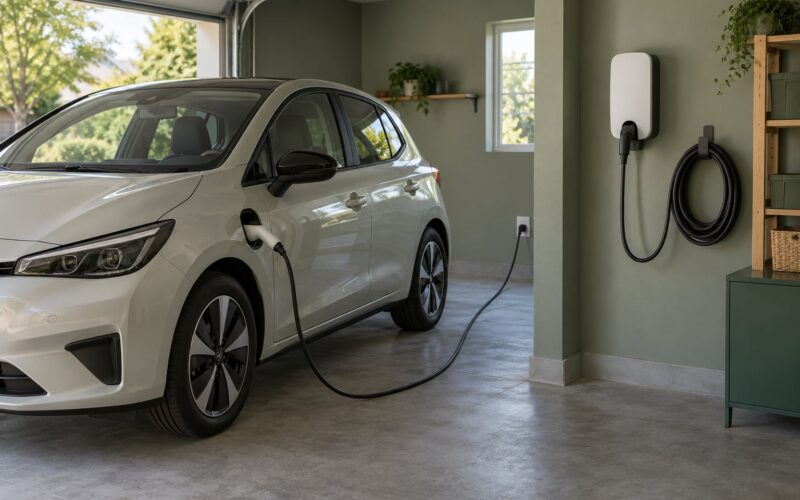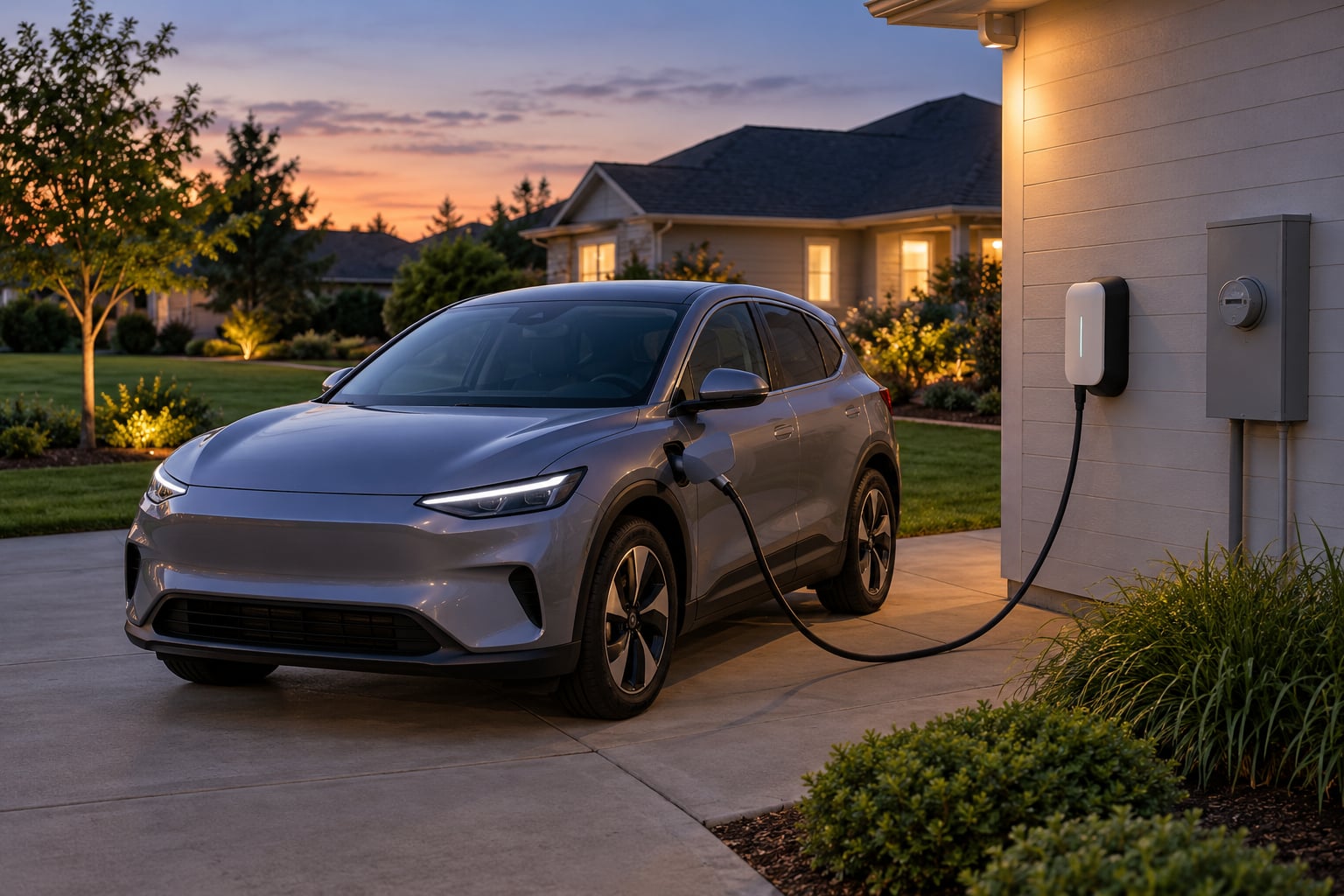
Charging an electric vehicle raises your bill by one predictable thing: the energy you pull from the wall, measured in kilowatt-hours, multiplied by what your utility charges for each of those kilowatt-hours. A household driving about 1,000 miles a month typically adds 250 to 350 kWh, which lands somewhere around 30 to 60 dollars a month at a typical US residential rate near 17 cents per kWh.
That is the whole mechanism behind how electric vehicle charging affects your bill. Once you see it that way, the tariff questions stop being mysterious.
- Your miles set the kWh. Charging later does not reduce the energy you buy, it only changes the price per kWh.
- Your rate structure decides the multiplier. Flat, time-of-use, tiered and demand-charge plans treat the same 300 kWh four very different ways.
- The EV is only part of the total. Check the kWh line, not just the dollar total, before blaming the car for a summer bill.
Rates quoted here are typical US figures. They vary widely by state, utility and season, and they change, so treat every number as an example rather than a quote from your own bill.
Table of Contents
- How Electric Vehicle Charging Affects Your Bill, Month to Month
- How Much Does Charging an EV Cost?
- How Do Electricity Tariffs Change the Cost?
- How Electric Vehicle Charging Affects Your Bill on a Time-of-Use Rate
- What Is the Difference Between Level 1 and Level 2 Charging?
- Does Charging Overnight Reduce Your Electricity Bill?
- How Do Charging Losses and Battery Capacity Affect the Bill?
- Can EV Charging Add Significant Costs to Your Bill?
- How Can You Reduce the Cost of Charging Your EV?
- Frequently Asked Questions
- Does charging an electric vehicle increase your electricity bill?
- Is it cheaper to charge an EV overnight?
- Why does my EV use more electricity than the battery capacity?
- Is public EV charging more expensive than home charging?
- How much does it cost to charge an electric car each month?
- Can charging an EV ever reduce my electricity bill?
- Conclusion
How Electric Vehicle Charging Affects Your Bill, Month to Month
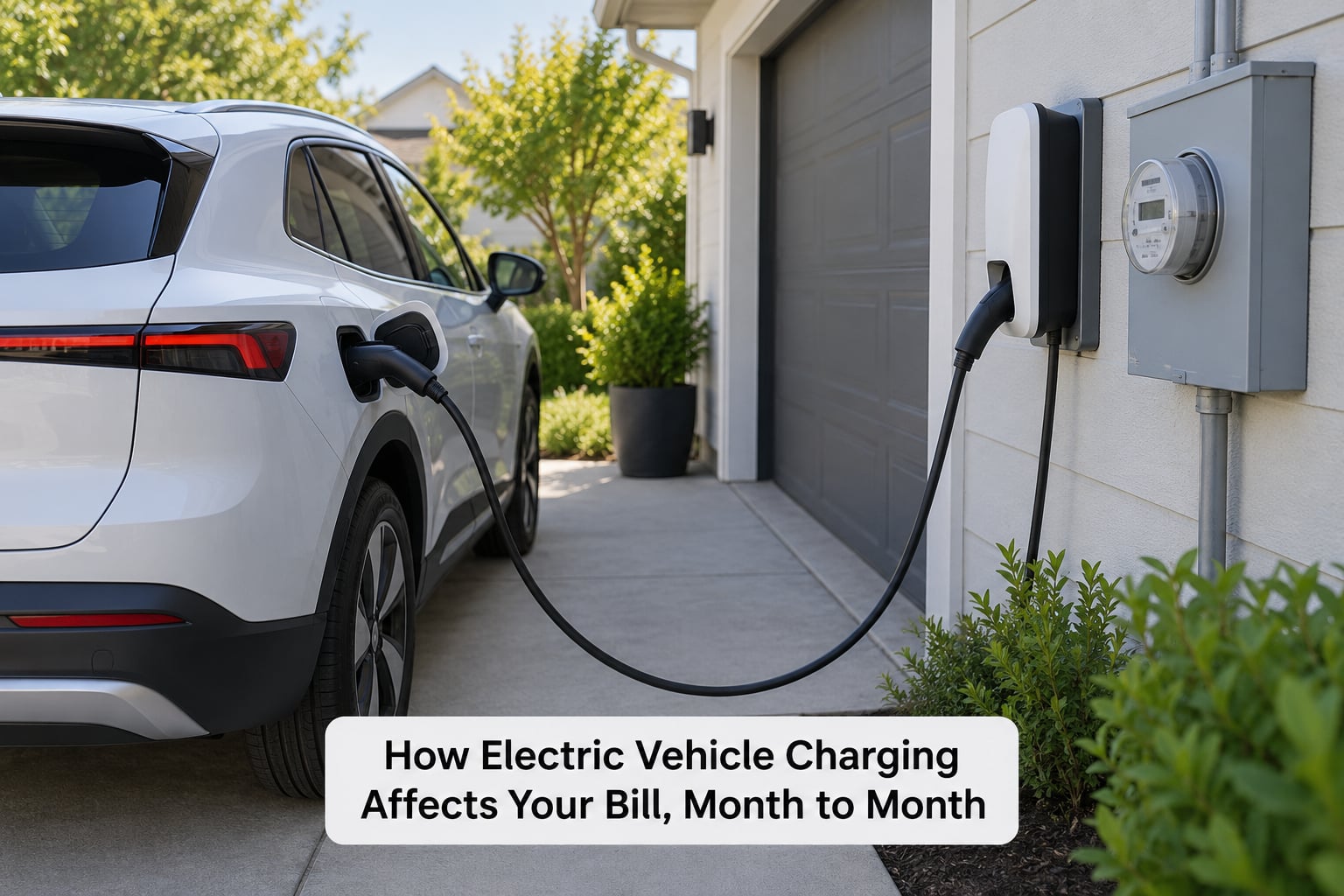
Your utility meters electricity, not vehicles. It counts kilowatt-hours in and multiplies them by a price that may vary by hour of day, by how much you used in total, or by how much power you drew at one moment.
Five things push that number up or down.
- Battery size. A bigger pack needs more kWh to fill, so a full charge costs more money and delivers more range.
- Miles driven. Around 3 to 4 miles per kWh is typical for a modern EV, so 1,000 miles works out to roughly 250 to 330 kWh from the wall.
- Your tariff. The same kilowatt-hour can be worth 3 cents overnight or 40 cents at dinnertime on some plans.
- Charging schedule. Only worth anything if your plan prices hours differently.
- Charging level. Level 2 AC charging loses a few percent in conversion, and DC fast charging loses more.
One correction matters more than any other, and it comes up again and again on owner forums such as teslaownersonline.com: moving your charging to midnight shifts when the energy is drawn, not how much energy is drawn. If you need 300 kWh for a month of driving, you buy 300 kWh whether it happens at 11 p.m. or 2 p.m. The only thing timing changes is the price tag on each one.
Here is a four-step way to isolate the EV’s share of your own bill.
- Find the kWh total on your last 12 bills. Most statements put it near the top with the previous reading and the meter number.
- Subtract your non-EV baseline. A month before the car existed is the cleanest comparison. Adjust for season if you can.
- Divide the difference by your per-kWh rate. That tells you the effective price you paid, which is often different from the headline rate.
- Compare against your driving log. Divide by miles to get a real cost per mile for your car, your utility and your habits.
If the math does not line up, something else is loading the meter. Air conditioning in a heat wave, a new dehumidifier, a heat pump water heater or a second EV will each do it.
How Much Does Charging an EV Cost?
Start with a full charge from empty and work outward. The table below uses a national average residential rate of about 17.45 cents per kWh, an off-peak band near 8 cents, and a peak band near 40 cents, which is what many California and Northeastern time-of-use plans actually charge.
| Battery size | kWh from the wall | Off-peak at 8 c/kWh | Flat at 17.45 c/kWh | Peak at 40 c/kWh |
|---|---|---|---|---|
| 40 kWh | about 44 kWh | roughly 4 dollars | roughly 8 dollars | roughly 18 dollars |
| 60 kWh | about 66 kWh | roughly 5 dollars | roughly 12 dollars | roughly 26 dollars |
| 75 kWh | about 83 kWh | roughly 7 dollars | roughly 14 dollars | roughly 33 dollars |
Those are full charges. Most people do not run from empty to full nightly, so scale them down by how much you actually add. A 60 kWh car doing 1,000 miles a month at 3.5 miles per kWh needs about 285 kWh, which is close to 23 dollars off-peak and about 50 dollars flat at the national average rate.
Public DC fast charging is priced differently. Networks commonly charge 30 to 60 cents per kWh, and many bill by the minute of connection rather than the energy delivered, so a slow session after the battery is full can cost disproportionately. Subscription passes from the big networks lower the per-kWh rate for drivers who use the same few stations often enough to justify a monthly fee.
Owner forums have real numbers, which are more useful than any projection. On mychevysparkev.com, one driver averaging 1,000 miles a month on a PG&E plan reported an increase of about 25 dollars a month, while another driving 1,343 miles a month on Southern California Edison’s Home & EV time-of-use plan saw 58.46 dollars a month, or about 4.4 cents per mile, with usage split 15% peak, 35% off-peak and 50% super-off-peak. Someone in the same thread running two EVs on one PG&E plan still described total electricity at roughly 50 to 60 dollars a month.
How Do Electricity Tariffs Change the Cost?
Four structures cover most American households, and only two of them care about when you charge.
Flat rate. Every kilowatt-hour costs the same. Timing is irrelevant, and the only lever is how much you drive.
Time-of-use. The day is split into peak, off-peak and sometimes super-off-peak periods, each with its own price. This is the plan that rewards overnight charging.
Tiered or usage-banded. The first few hundred kilowatt-hours cost a little, and everything past a threshold jumps to a higher rate. This is where a second EV hurts most, because it raises the cost of every other kilowatt-hour in the house.
Demand charges. Some commercial and some residential tariffs bill on peak 15-minute or hourly demand rather than just energy. A fast Level 2 session can set the monthly peak, and once it does, every other hour is billed against it. This is uncommon in homes but not unheard of.
| Rate period | Typical hours | Typical price per kWh | What it means for charging |
|---|---|---|---|
| Super-off-peak | Midnight to 6 a.m., often weekends too | 2 to 6 cents | Cheapest possible energy, ideal for a full nightly charge |
| Off-peak | Late evening to early morning | 8 to 15 cents | Still a clear saving on most plans |
| Shoulder | Midday and early evening | 15 to 25 cents | Roughly the flat rate, sometimes not worth scheduling around |
| Peak | Late afternoon into early evening | 26 to 45 cents | Two to five times the off-peak price, avoid it |
How Electric Vehicle Charging Affects Your Bill on a Time-of-Use Rate
On a time-of-use plan, the same monthly energy can cost half as much or twice as much depending on the schedule. A 350 kWh month at a 12 cent off-peak rate is about 42 dollars; at a 40 cent peak rate the same 350 kWh is about 140 dollars. Nothing about the car changed, only the clock.
One caution. Utilities have been repricing overnight EV rates upward as EV adoption grows, and SCE drew a large reaction from owners when it proposed roughly a 25 percent increase to overnight EV charging rates. Before committing to a plan, look at the tariff sheet rather than a marketing page, because the off-peak band you are promised today is the one that gets reviewed.
What Is the Difference Between Level 1 and Level 2 Charging?
Level 1 is the ordinary 120-volt household outlet, delivering roughly 1.2 kW. It adds about 4 to 5 miles of range per hour, so a full charge takes 20 to 40 hours and often runs overnight and into the next day. It costs nothing to install because it already exists in your garage.
Level 2 runs on 240 volts, the same voltage your clothes dryer or oven uses, and delivers 7 to 19 kW depending on the unit and the car. That is 15 to 60 miles of range per hour, which makes a full overnight charge practical for almost anyone.
Level 2 often costs a little more in raw energy because AC-to-DC conversion loses 5 to 10 percent of what passes through the charger. Owners on forums compare a combined Leaf and Spark averaging about 4 miles per kWh against about 28 mpg on the combustion side of the same household. The small efficiency loss rarely matters, because the faster charge window is what lets you land in the cheap overnight hours.
The real cost of Level 2 is installation. A dedicated 240-volt circuit usually needs a licensed electrician, and the work has to follow local electrical code. Do not attempt that wiring yourself.
Does Charging Overnight Reduce Your Electricity Bill?
Overnight charging lowers the charging portion of your bill when your plan prices hours differently, and it does nothing to that portion when you are on a flat rate. Charging is also how you spend the least per kWh on almost every time-of-use tariff, because overnight demand is low and so is the price.
There are two smaller effects worth knowing. A car plugged in overnight draws a trickle for its battery thermal management, which costs a few tenths of a dollar a month at most. And if the battery is cold when you plug in, the car spends part of the session warming it up, which means a little more of the energy goes to heating rather than driving.
Most vehicles make this a scheduling job in the app rather than a hardware job.
- Tesla. Open Charging, set the scheduled start and finish times and a departure time, then confirm the car is plugged in.
- Hyundai and Kia. In the vehicle’s app or the connected services menu, add a charging schedule with a target departure time.
- Ford. Use the Pass-through or EV app charging schedule, and pair it with a departure time so the car finishes when you need it.
- Chevrolet and Rivian. Both use a scheduled charging window tied to a departure time in their respective apps.
Pair that with an 80 percent daily limit rather than 100 percent. You lose very little range overnight and avoid sitting at a full charge every single night, which the manufacturers themselves recommend for daily driving. Follow the guidance in your owner’s manual rather than any general rule.
How Do Charging Losses and Battery Capacity Affect the Bill?
The battery capacity on the window sticker is the energy that ends up in the pack. The meter measures the energy that leaves your wall, and those two numbers are not the same.
On AC charging, the car’s onboard charger converts the wall’s alternating current to direct current, and roughly 5 to 10 percent is lost as heat. Cold weather adds more: a battery that has sat outside overnight has to warm itself before it accepts charge efficiently, so a winter charge can pull noticeably more kilowatt-hours than the same trip in spring.
DC fast charging converts the current inside the charger itself, where losses run closer to 10 to 15 percent and the high pack temperature at high power costs a bit more on top. That is one reason fast charging is priced per kWh at a much higher rate.
A larger battery can cost more per mile even when the vehicle is efficient, because you pay for more total energy on every fill and the added capacity carries weight. That is the trade: range costs energy.
| How you charge and drive | Assumed price | Assumed efficiency | Approximate cost per mile |
|---|---|---|---|
| EV, off-peak home charging | 8 c/kWh | 3.5 mi/kWh | about 2 to 3 cents |
| EV, flat-rate home charging | 17.45 c/kWh | 3.5 mi/kWh | about 5 cents |
| EV, public DC fast charging | 45 c/kWh | 3.5 mi/kWh | about 13 cents |
| Gasoline car | 3.50 per gallon | 28 mpg | about 12 cents |
| Diesel car | 3.90 per gallon | 32 mpg | about 12 cents |
Read that as the shape of the comparison, not a quote. Fuel prices move daily and electricity rates do too, which is exactly why home charging on a cheap off-peak window wins and public fast charging often does not.
Can EV Charging Add Significant Costs to Your Bill?
Sometimes the increase is noticeable, and it is usually one of four things rather than the charging itself.
Tier crossings. A tiered plan gets more expensive past a set monthly threshold. A household near the top of a tier can see every ordinary kilowatt-hour reprice when the car pushes it over. This is the single most common cause of a bill jump that does not match the kWh.
Second vehicles. Two EVs charging on one meter multiply the energy, and often cross a tier at the same time. Staggering the two schedules is the easy fix.
Public charging as the default. Apartment residents without a dedicated circuit end up paying network rates most of the time. That is the pattern where EV costs genuinely add up.
Solar export changes. If you have rooftop solar, California’s net-metering rules now credit exports far below the retail rate you pay for imports, with an annual true-up. A homeowner in one SCE thread with 78 panels described going from roughly 1,000 dollars a month of electricity to about 1,000 dollars a year while charging overnight. A home battery changes that equation, because stored solar can charge the car at night instead of being exported at a credit that no longer pays much.
Set against that, one EV replacing gasoline usually leaves the household in a similar or lower place, since home charging runs a fraction of the cost per mile. The cases where it hurt are the ones where the tariff, the second car or the lack of a home circuit dominates.
How Can You Reduce the Cost of Charging Your EV?
- Read your rate schedule first. Find the per-kWh rate, the peak hours, any tier thresholds and any demand charge before buying any hardware.
- Move to an EV or time-of-use plan if your driving fits. If most of your charging happens at a predictable overnight hour, the off-peak band is real money. If you drive irregular hours, a flat rate may be the better fit.
- Schedule charging to a departure time. Start and finish times work, but a departure time is simpler, because the car finishes when you need it.
- Set a daily limit around 80 percent. You keep almost all the daily range and cut the amount of energy you buy on long nights.
- Precondition before fast charging. A battery that arrives warm takes energy more efficiently, which is worth more on a cold road trip than anything else you can change.
- Keep public charging for the road. Home first, workplace second, DC fast for the trips that need it.
- Chase the credits. Utilities commonly rebate the charger or the installation, and qualifying equipment may carry federal tax credits. Check both, and use a licensed electrician for any 240-volt work.
- If you have solar, check export credits and consider storage. Self-consuming the energy you generate is usually worth more than exporting it, and a home battery makes that possible at night.
- Renters and condo owners should get the cost rule in writing. Who pays for the circuit, who pays the electricity, and how any shared charger fee is set are questions worth settling before the first bill, since disputes over those fees are common in owner groups.
Frequently Asked Questions
Does charging an electric vehicle increase your electricity bill?
Yes. Charging an EV adds kilowatt-hours to your meter, and your utility charges you for them at whatever rate applies at that time. A driver covering about 1,000 miles a month typically adds 250 to 350 kWh, which is roughly 30 to 60 dollars a month at a typical US residential rate. If you have rooftop solar, enough of it may offset the charging entirely.
Is it cheaper to charge an EV overnight?
On a time-of-use plan, usually yes. Overnight sits in the off-peak or super-off-peak band, often 2 to 6 cents per kWh against 26 to 45 cents at peak, so the same monthly energy can cost half as much. On a flat rate, timing changes nothing. Scheduling is worth the two minutes of setup either way.
Why does my EV use more electricity than the battery capacity?
Because the meter measures what leaves the wall, not what lands in the pack. AC charging loses roughly 5 to 10 percent in conversion, DC fast charging closer to 10 to 15 percent, and a cold battery spends extra energy warming itself before it accepts charge efficiently. Expect to buy about 10 percent more kilowatt-hours than the battery’s rated capacity.
Is public EV charging more expensive than home charging?
Nearly always. Home charging on a flat US residential rate runs near 17 cents per kWh, and often under 10 cents overnight, while public DC fast networks commonly charge 30 to 60 cents per kWh and many bill by the minute of connection. Subscription passes cut the per-kWh rate if you use the same stations often enough to justify the fee.
How much does it cost to charge an electric car each month?
It comes down to miles driven and your rate. At 3.5 miles per kWh, 1,000 miles a month needs about 285 kWh from the wall: roughly 24 dollars off-peak, about 50 dollars at the national average residential rate, and over 125 dollars if you charged it all at peak. Owners on forums report real increases from about 25 to 60 dollars a month on time-of-use plans.
Can charging an EV ever reduce my electricity bill?
Yes, in two situations. With rooftop solar and net metering, a large array can cover both household use and overnight charging, and one SCE owner reported dropping from about 1,000 dollars a month to roughly 1,000 dollars a year. A home battery helps too, because it lets you charge from stored solar instead of exporting power at a reduced credit.
Conclusion
Start by finding your rate schedule and your real per-kWh rate, then divide your monthly miles by your miles per kWh to get the kilowatt-hours you will actually buy. That single number tells you whether your charging is a rounding error on the bill or the biggest line on it.
Then compare your off-peak or managed charging options against your current plan before you spend money on a charger or a new circuit. Timing changes the price of each kilowatt-hour, not the number of kilowatt-hours, and on a well-chosen plan that is where most of the savings live.