Do solar lights work in winter? Yes, they do. They just collect less energy and hold less of it than they do in July, so a path light that glows until midnight in summer might manage three or four hours on a clear December night. Nothing about the fixture breaks. The physics just gets tougher.
The pattern people report after a cold season is boringly consistent: winter problems are almost always about sunlight hours, snow on the panel, or a battery that has been sitting at a low state of charge for weeks. That is good news, because all three are fixable.
Table of Contents
- Do Solar Lights Work in Winter?
- Why Do Solar Lights Work Differently in Winter?
- 1. Fewer daylight hours
- 2. The sun sits lower in the sky
- 3. Cloud and fog cut the energy reaching the cells
- 4. Cold shrinks usable battery capacity
- 5. Snow, ice and grime block the panel
- How Does Cold Weather Affect Solar Light Batteries?
- How cold is too cold for solar lights?
- Does Snow or Ice Stop a Solar Light from Charging?
- How Much Winter Light Is Needed?
- Which Solar Lights Work Best in Winter?
- How to Get More Winter Performance
- 1. Put the panel where the sun actually lands
- 2. Clear snow and grime early
- 3. Angle the panel toward the low winter sun
- 4. Check the switch position in early autumn
- 5. Switch to the shortest timer or motion mode
- 6. Test before you rely on it
- 7. Keep a compatible spare cell
- Do Solar Lights Need to Be Switched Off in Winter?
- Frequently Asked Questions
- How can I get my solar lights to work in winter?
- How cold is too cold for solar lights?
- Do solar lights need sun or just light?
- How do you charge solar lights in the winter?
- Why are my solar lights only lasting a few hours in winter?
- Can solar lights stay out all winter?
- Conclusion
Do Solar Lights Work in Winter?
The honest answer is that solar lights work in winter as long as three things line up: the panel gets a few hours of unobstructed daylight, the panel itself is not buried under snow, and the cells inside are a chemistry that still holds a charge when the thermometer drops. Miss any one of those and output falls off quickly.
Colder regions simply need more panel area per unit of stored energy, and that is a design decision made by the manufacturer, not something you can fix with a screwdriver. A bigger panel, a better battery or a separate remote panel all help, but a light designed for a mild climate will never become a light designed for a northern January.
Why Do Solar Lights Work Differently in Winter?
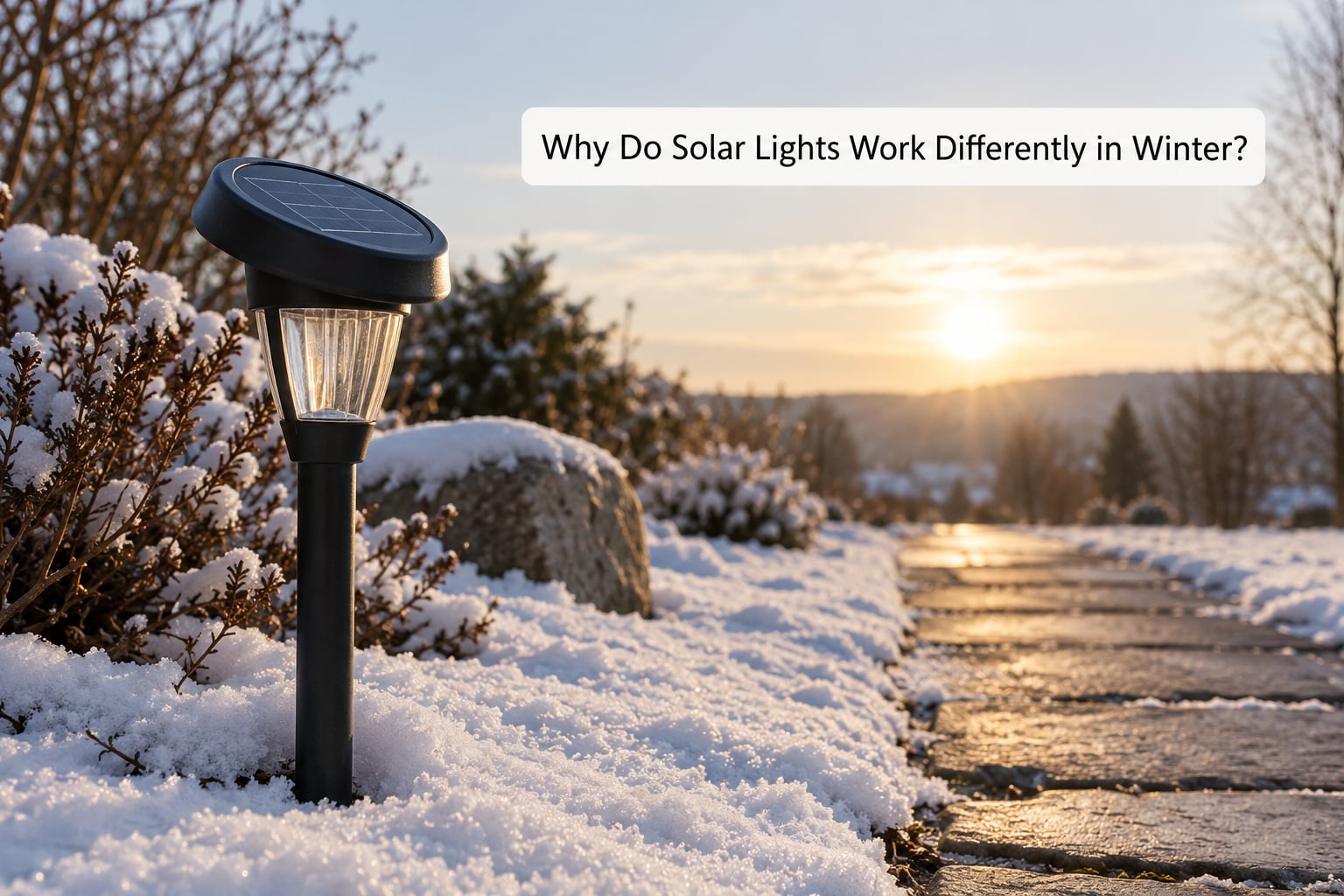
Five things change between July and December, and they stack on top of each other. Fix one and you often gain more than you expect, because the other four are still limiting you.
1. Fewer daylight hours
Runtime is capped by the energy the panel collected that day. A panel that banks eight hours of full sun in June might bank four in December at the same latitude, and the light burns out of charge at roughly the same point in the evening rather than lasting longer because the night is long. If the charge does not cover the night, the last hours go dark.
2. The sun sits lower in the sky
Winter sunlight arrives at a glancing angle. A panel facing straight up catches the least of it. This is why the winter worst case is not the equinox but the short, cloudy stretch around the winter solstice, when low sun and thin cloud happen at the same time.
3. Cloud and fog cut the energy reaching the cells
Outdoor solar lighting typically loses roughly a third to half of its usual runtime under cloudy winter weather. Overcast skies still charge a panel, but at a fraction of the rate, so a week of grey weather is a week of running down the reserve.
4. Cold shrinks usable battery capacity
Batteries deliver less charge in cold conditions and their internal resistance rises, which shows up as a dimmer lamp and shorter runtime even when the charge level reads full. The lamp itself has not failed; the energy behind it has gone.
5. Snow, ice and grime block the panel
A covered panel collects nothing at all. A thin film of road salt and winter dirt is nearly as bad, because it cuts the light before it reaches the photovoltaic cells. This one is fully reversible and most people never think of it.
How Does Cold Weather Affect Solar Light Batteries?
Cold affects batteries in two separate ways, and they pull in opposite directions. Output drops in the cold, and charging becomes slow or unsafe in very low temperatures. That second part catches people out: a lithium cell left flat and below freezing while charging can pick up internal damage that shows up months later as a light that dies quickly or refuses to charge.
Here is how the common rechargeable chemistries behave outdoors in winter.
| Battery chemistry | Cold-weather behaviour | Winter verdict |
|---|---|---|
| Nickel-cadmium (NiCd) | Charges in cold better than most, but the cells are heavy and hold less energy per gram | Budget lights only; usable but old-fashioned |
| Nickel-metal hydride (NiMH) | Very common in pathway lights; capacity falls noticeably in freezing conditions | Fine for mild winters, marginal further north |
| Lithium-ion (Li-ion) | Holds more energy and tolerates discharge in cold, but should not be charged below freezing | Good with a little care |
| Lithium iron phosphate (LiFePO4) | Broad operating temperature range and steadier output in cold; heavier and costlier per cell | Best pick for genuinely cold climates |
Cold-rated solar globes are commonly specified down to roughly -15C, or 5F. At that temperature the housings stay intact with no cracks in the lenses, and rechargeable cells usually recover once spring returns, though output often comes back slightly softer than before.
How cold is too cold for solar lights?
Cold rarely stops a light outright. In practice the light slows down: it dims, runs for fewer hours, and takes longer to recharge. The line most manufacturers draw is at charging, not lighting, and it sits near 0C, or 32F, for lithium cells. Below that, treat the fixture as a light you can leave switched on rather than one you should expect to recharge fully. Check the manual for your specific model, and follow it.
Does Snow or Ice Stop a Solar Light from Charging?
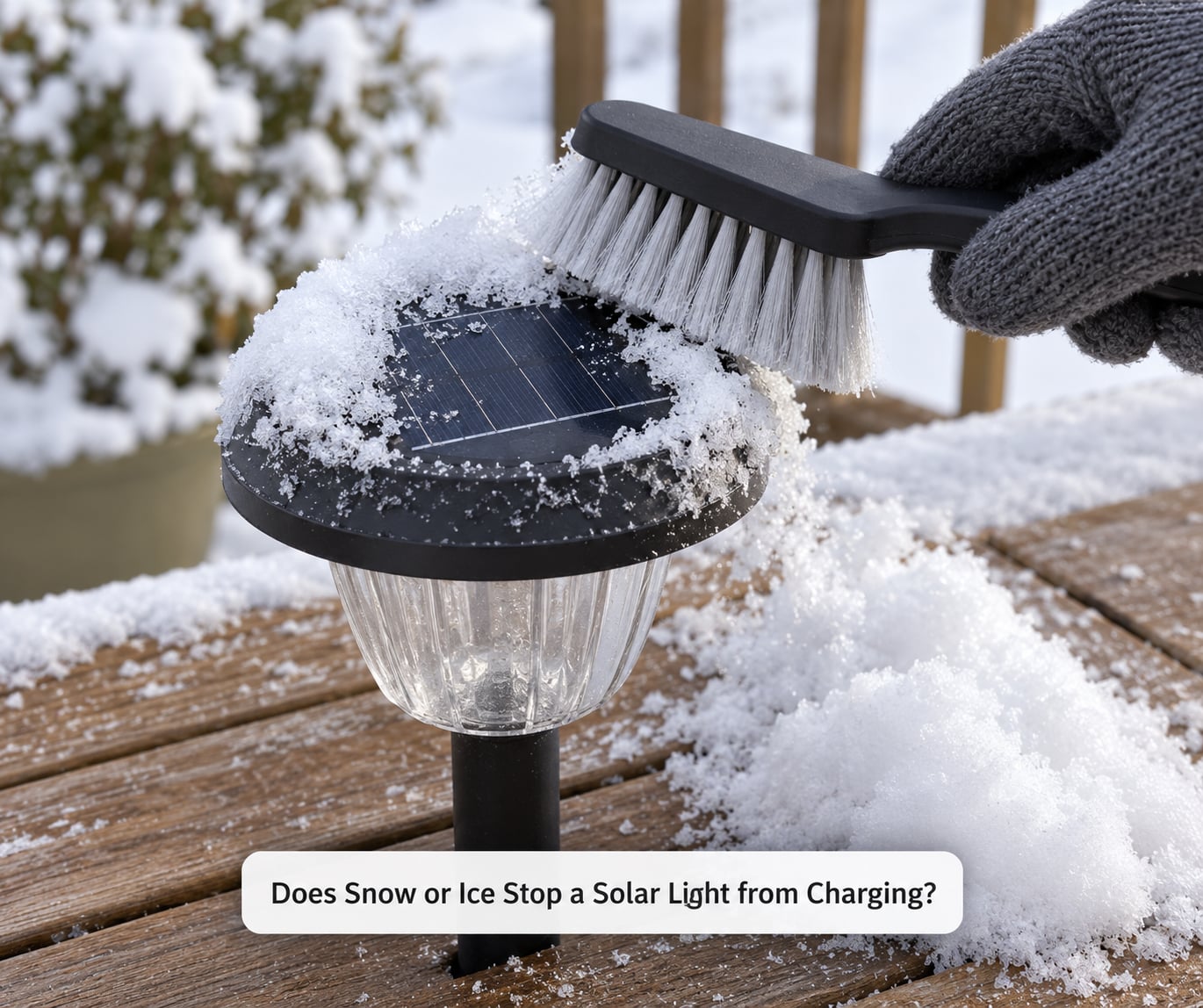
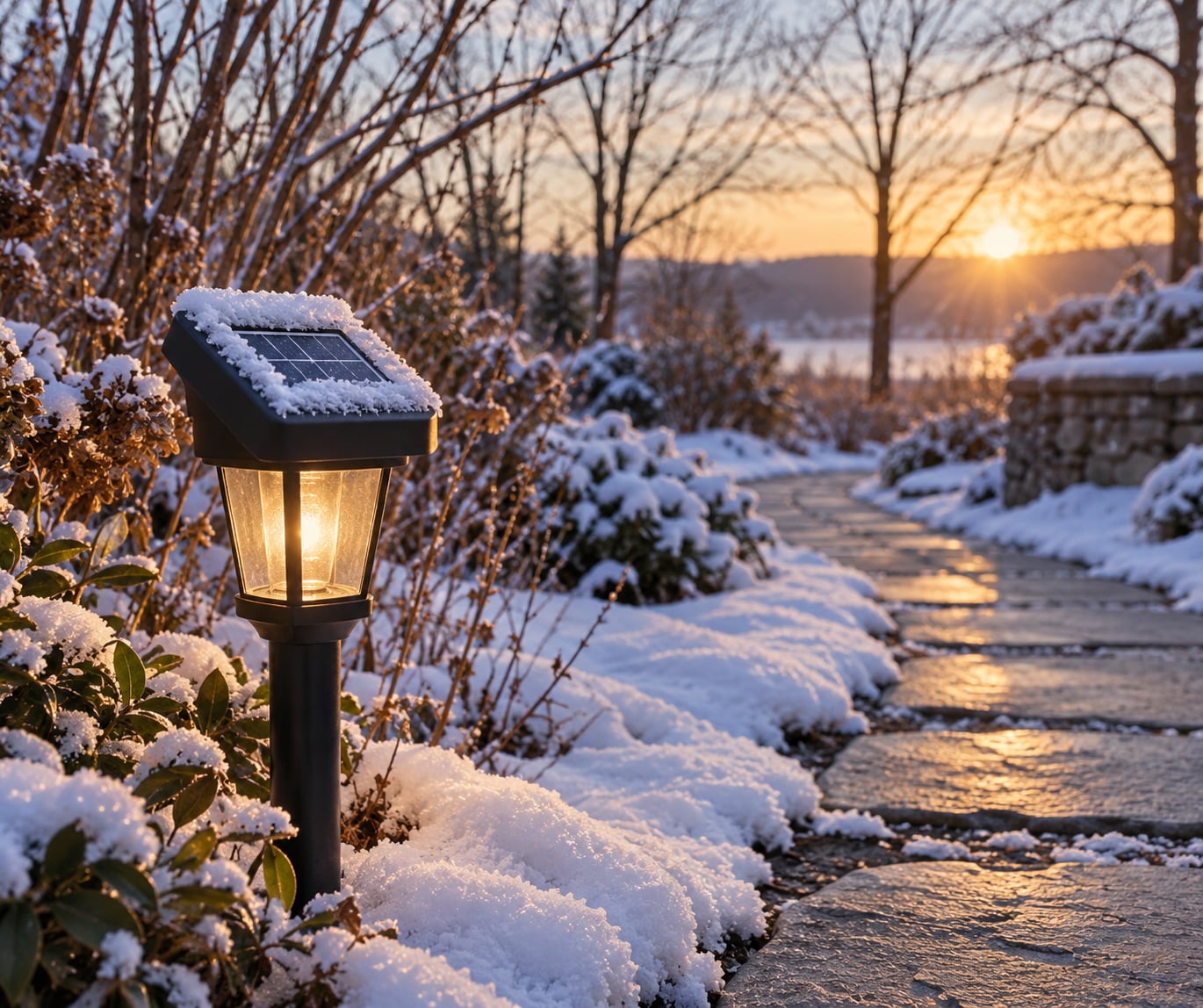
Yes, completely. A panel under even a thin layer of snow produces almost nothing, and a few days of snow in a place that normally gets four hours of winter sun means the fixture starts the next clear day already flat. Nobody out there is going to clear your path lights for you.
Clear snow with a soft plastic brush or a plastic scoop, and push the snow off rather than scraping across the glass. Avoid metal scrapers and anything sharp, because the protective coating scratches off in a single pass and permanent dimming follows. Skip the boiling water and the salt. Salt etches the coating and hot water cracks the panel when it is frozen.
Placement matters as much as clearing. A panel tucked under an eave, a porch roof or a dense evergreen charges poorly all winter long, and no amount of brushing changes that. A light mounted where a tree canopy has grown over it since you installed it will show the same problem.
How Much Winter Light Is Needed?
Most complaints are really about expectations set in summer. The table below puts winter conditions against the share of a typical summer night you can expect. Treat these as planning ranges rather than guarantees, since panel size and quality change the numbers.
| Winter condition | Usable panel hours | Expected share of summer runtime |
|---|---|---|
| Clear and bright | 8 hours or more | Close to a full night |
| Partly cloudy | 4 to 6 hours | Roughly 60 to 80 percent |
| Overcast all day | 1 to 3 hours | Around 30 to 50 percent |
| Heavy snow, panel covered | Almost none | Little or no charge until cleared |
| Constant shade or north-facing | Minimal and unreliable | Often not enough for a full night |
If your aim is light from dusk to midnight rather than a full night, choose fixtures with a motion sensor or a shorter timer mode. Motion-activated lights only spend battery when something walks past, and that alone often buys several more hours on a poor December day.
Which Solar Lights Work Best in Winter?
Look at these features in this order, because each one removes a limit the previous one cannot.
- A larger panel relative to the battery. Panel area decides how much energy arrives in a short day. Small panels over big batteries are the most common winter failure.
- Lithium iron phosphate or quality lithium-ion cells. Better cold behaviour than nickel chemistries, which matters from the first freezing night onward.
- A replaceable battery. Cells age faster than housings. A light with a standard cell holder keeps working for years instead of one season.
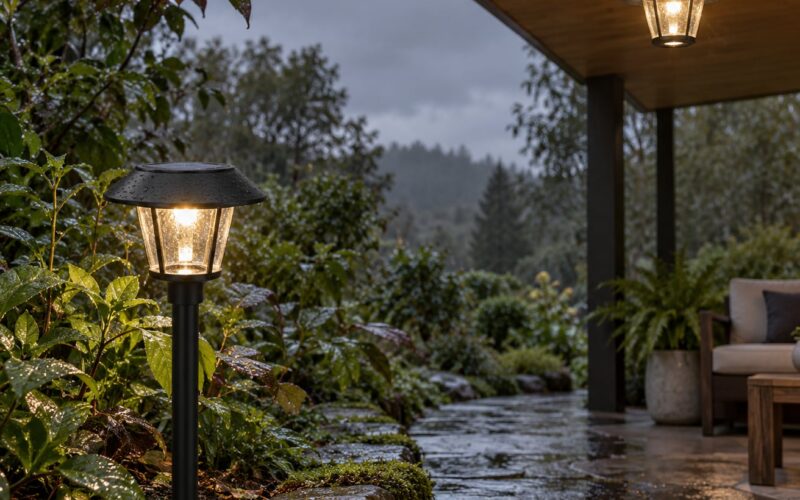
- An IP65 rating or higher. Snow, sleet and freezing rain get into seams. Check the rating rather than trusting a waterproof label.
- A separate or remote panel. Putting the panel in full sun while the lamp sits in shade solves a placement problem you cannot fix with the lamp itself.
- Motion sensing or a dimming mode. Both cut hours of unnecessary burn, which translates directly into more light on the worst nights.
- USB backup charging. Useful in long grey stretches, and the reason some lights survive a whole season indoors and out.
For dark northern gardens, solar flood lights with remote panels tend to cope better than decorative solar balls, because they carry more panel area per amp-hour. For a sheltered patio, string lights and lanterns with a dim mode are often the practical choice.
How to Get More Winter Performance
1. Put the panel where the sun actually lands
Walk your garden at midday on a clear winter day and note where shadows fall. A panel moved out from under an eave or clear of a tree trunk can gain an hour or more of charge, which is worth more than any setting change.
2. Clear snow and grime early
Brush panels off as soon as they clear, using a soft plastic brush. Do it the same way every time so you never reach for anything sharp in a hurry.
3. Angle the panel toward the low winter sun
A steeper tilt catches more light when the sun is low. Before you loosen any screws, check the manual, since many fixtures are designed to be fixed at the factory angle.
4. Check the switch position in early autumn
A surprising number of winter problems are a light that was switched off in summer and never turned back on. It costs nothing to check and it removes the most common cause of a light that appears dead in January.
5. Switch to the shortest timer or motion mode
Most fixtures have a bright all-night setting, a dim setting and a motion setting. Run the efficient one from late autumn onwards and switch back when the days stretch out.
6. Test before you rely on it
Leave the light off for two clear days, then turn it on and time how long it runs. That measurement tells you whether the winter runtime is enough for your path or your steps before the first dark evening you actually need it.
7. Keep a compatible spare cell
Batteries fail first and are the cheapest part to replace. Having a spare of the right size and chemistry on hand turns a lost season into a five-minute swap.
Avoid wiring in anything that is not rated for outdoor use, and follow the manufacturer’s instructions for any fixture you re-angle or open.
Do Solar Lights Need to Be Switched Off in Winter?
Leave them switched on. Most solar lights need their dusk-to-dawn sensor active to charge through the day and light at night, and turning the switch off during the day stops charging for no benefit at all. The light draws almost nothing while the panel feeds the battery.
There are three exceptions. Switch a light off if the cells are fully flat and you suspect freezing, since charging a depleted lithium cell below freezing is the one combination worth avoiding. Some fixtures also have a storage or reset mode meant for long periods out of use, and the manual will say so. And if you are bringing lights indoors for the season, a full charge before they go in helps them come back ready to run.
Frequently Asked Questions
How can I get my solar lights to work in winter?
Start with the panel. Clear snow and winter grime with a soft plastic brush, then move the light out of any shade so it gets four or more hours of direct winter sun. Check that the switch is on, switch the fixture to its motion or dim setting, and let it charge for two full clear days before judging it. If it still dies early, the battery has likely aged out.
How cold is too cold for solar lights?
Cold rarely stops a light from glowing. It dims it and shortens runtime, because battery capacity falls and internal resistance rises. The limit that matters is charging: many lithium cells should not be charged below about 0C, or 32F. Cold-rated solar globes are often specified to roughly -15C, or 5F, with housings that stay intact and cells that recover in spring.
Do solar lights need sun or just light?
They need direct sun for a useful charge. Overcast daylight still produces a small amount of power, but far too little to run a light all night, which is why a week of grey weather leaves most fixtures dark. Diffuse light from a bright overcast sky or reflected snow helps more than people expect, but a north-facing panel or a shaded one will not carry a full night.
How do you charge solar lights in the winter?
Give them as much direct daylight as the season allows, angled toward the low sun, and keep the panel clear of snow and dirt. During an extended cloudy stretch, bring lights with a USB input indoors for a top-up so they keep some reserve. Many users also bring fixtures in for long freezes rather than risk charging flat lithium cells in sub-zero conditions.
Why are my solar lights only lasting a few hours in winter?
The most common reason is simply not enough charge coming in. Winter days are short, the sun sits low, and cloud cover can cut output sharply, so the battery starts the evening partly full and runs out early. Snow or a film of grime on the panel makes it worse. Adding panel area or switching to a motion mode usually changes more than any other tweak.
Can solar lights stay out all winter?
Yes, as long as they are rated for it. Choose fixtures with an IP65 rating or higher, and expect outdoor units built for snow, ice and freezing rain rather than a splash-resistant indoor-style light. Snow load and repeated freeze-thaw cycles stress seals over time, so inspect the housing each spring and replace any fixture whose seams have started to leak.
Conclusion
Solar lights do work in winter. What changes is the size of the gap between what you get on a July night and what you get in January, and that gap is set by daylight hours, panel exposure, snow cover and battery chemistry rather than by any fault in the light.
Start with three checks before you buy anything or blame a fixture. Look at how many hours of direct sun the panel actually gets in midwinter. Find out what battery chemistry is inside. Then time a full run on a clear day. If those three come out well, a winter light is a solved problem, and if they do not, a bigger panel or a lithium iron phosphate cell will fix more than any amount of tinkering.