If your house leaks heat, your furnace and heat pump work longer and burn more fuel to hold the same temperature. That is the whole answer to how insulation affects heating costs: insulation slows heat leaving the building, so the heating system runs fewer cycles, uses less fuel or electricity, and your heating bill drops by roughly the share of energy the home no longer loses. The U.S. Department of Energy puts the average saving from properly sealing and insulating a home at about 15% on heating and cooling.
That 15% is an average across homes that started from very different places, which is exactly why the number surprises people. A drafty 1950s ranch with a bare attic has far more to gain than a tight 2010 build. This guide breaks the effect into pieces you can act on: where the heat actually goes, which fix pays back fastest, what insulation to use, and how to tell whether the work did anything.
We will skip the shopping list. Nobody needs another ranking of materials. What matters is knowing which part of your house is losing the heat before anyone quotes you a job.
Table of Contents
- How Insulation Affects Heating Costs
- Where Heat Escapes From a Home
- How Much Can Better Insulation Reduce Heating Bills?
- How insulation affects heating costs in a typical bill
- How to estimate your own heating cost impact
- Which Insulation Matters Most?
- How to check for air leaks
- How to choose insulation for each area
- How to Improve Insulation Without Replacing Your Heating System
- Common Insulation Mistakes That Increase Heating Costs
- How to Know Whether Insulation Is Working
- Frequently Asked Questions
- Does insulation really lower heating costs?
- What type of insulation is best for an old house?
- How much insulation does a home need?
- Should I install insulation before replacing my furnace or heat pump?
- Can I install insulation myself, or do I need a professional?
- How can I tell if my home has an insulation problem?
- Start With the Biggest Heat Loss
How Insulation Affects Heating Costs
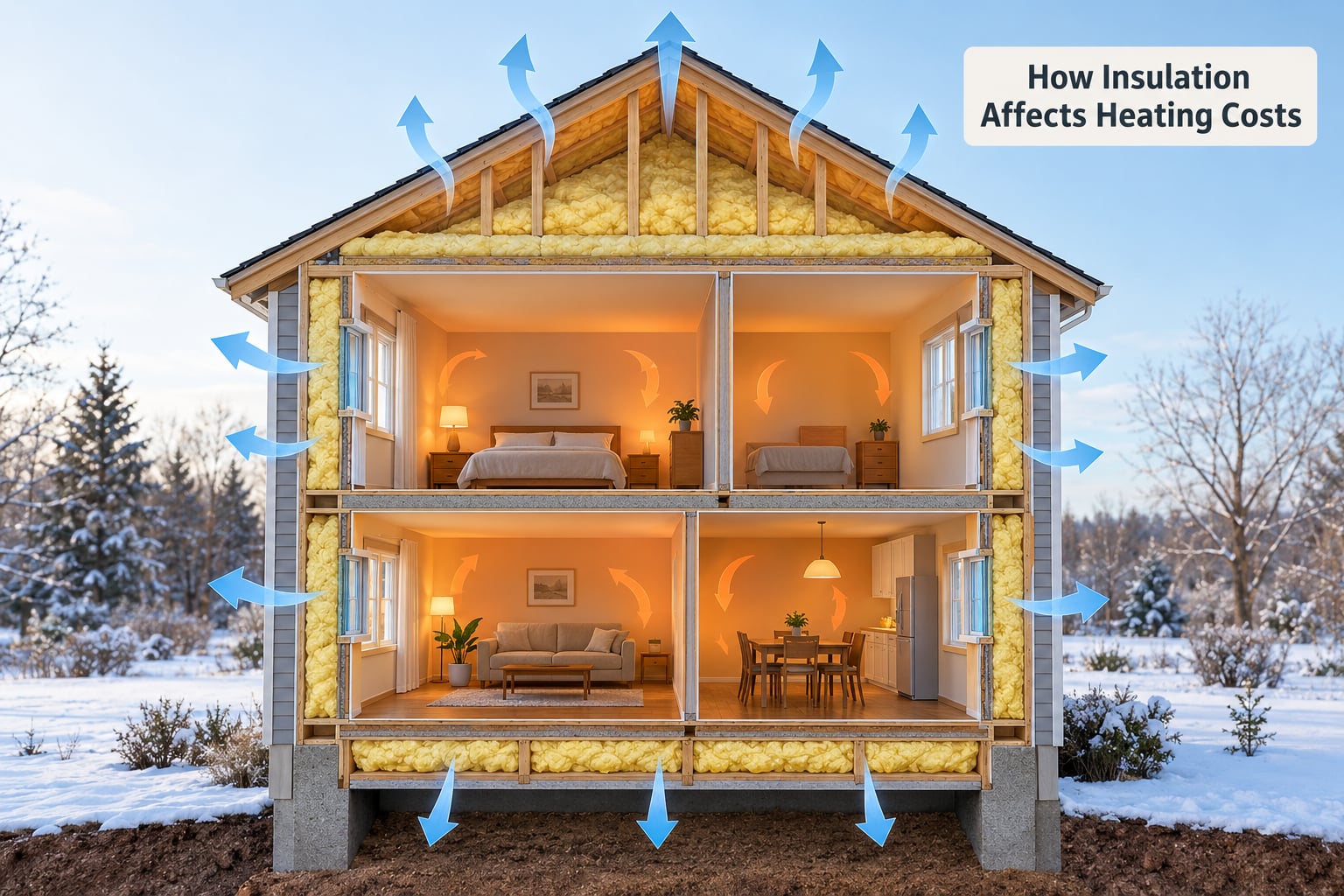
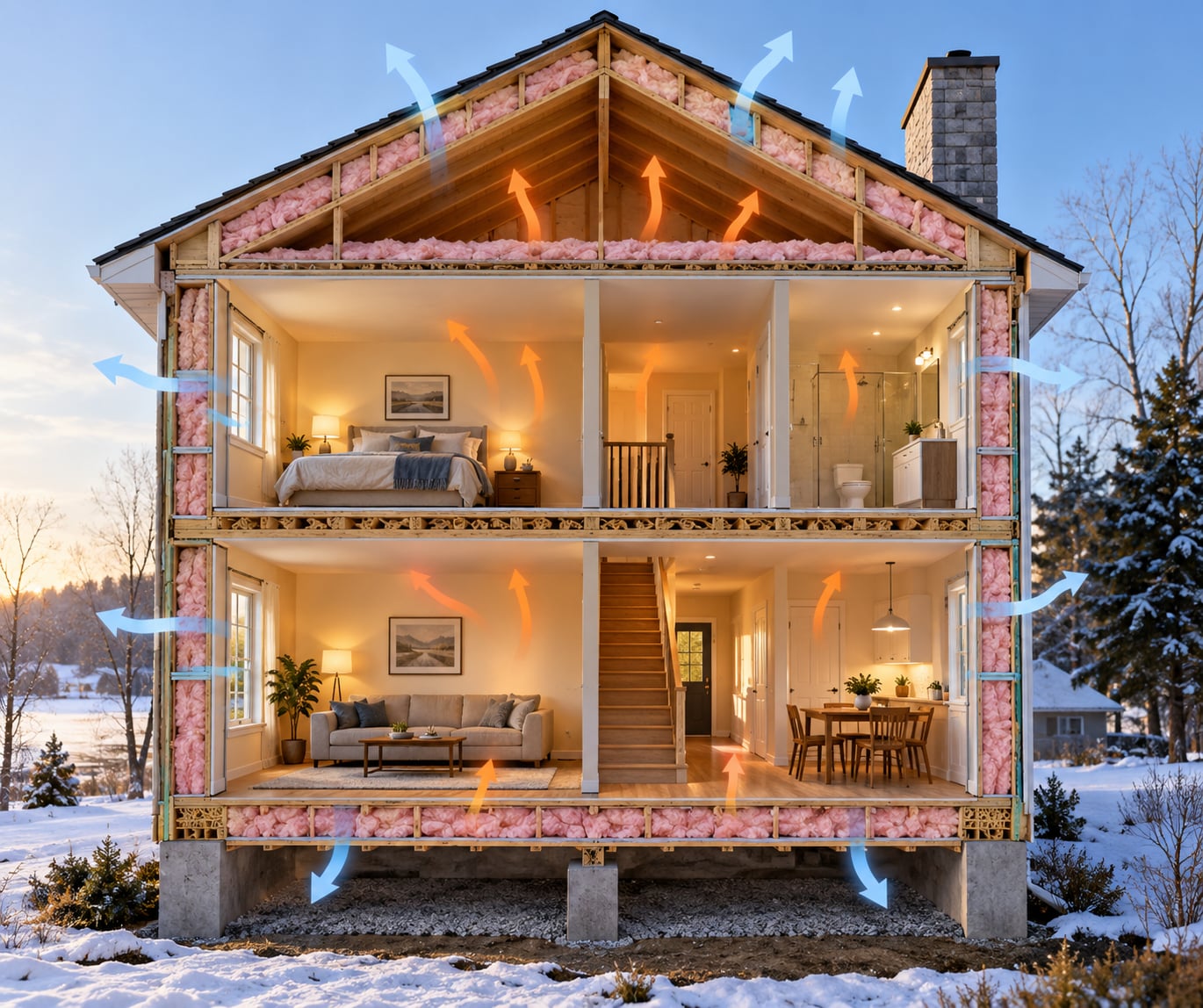
Insulation slows the transfer of heat through the building shell. Air inside a heated home is always warmer than the air outside it, and heat moves toward that cooler side: up through the roof, out through walls and windows, down through floors over unconditioned spaces, and out through every unsealed gap in the envelope.
The heating system has to replace all of it, continuously. Every unit of heat that leaves is a unit of fuel the furnace or heat pump has to buy. So when insulation cuts heat loss, the effect on heating costs arrives through four channels, and only the first one gets talked about.
- Fewer run cycles. The equipment reaches set temperature and shuts down more completely instead of cycling on and off against a steady loss.
- Lower steady-state demand. On a cold night, the heat that gets in through walls, windows and the attic is lower, so the load the system carries all night is smaller.
- A smaller load when you do replace the equipment. A tighter house needs a smaller furnace or heat pump. That changes the quote, not just the fuel bill.
- Less wear on the equipment. Fewer start-stop cycles and shorter run times mean fewer heat exchanger cycles, less fan runtime and a longer service life, which spreads the cost of the machine over more years.
There is also the comfort channel, which is not on the bill but is real. Cold floors, cold corners and drafts disappear when the shell is tightened, and rooms even out. Homeowners chasing comfort usually notice this before they notice the savings.
What insulation does not change is how much you need to set the thermostat to. If you raise the set point after insulating, the saving largely cancels out. That is the most common way a well-executed project ends up looking like it did nothing.
Where Heat Escapes From a Home
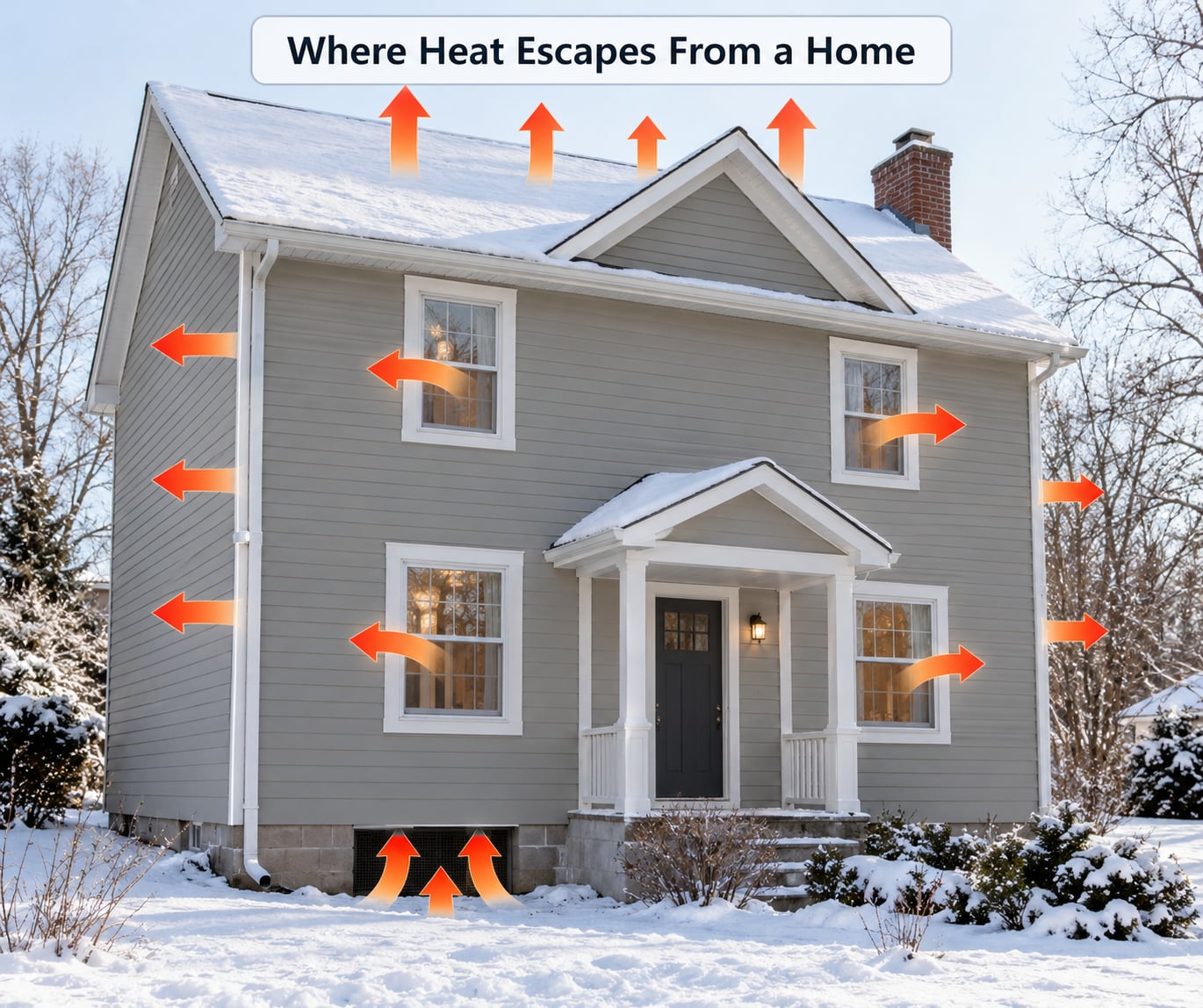
Industry studies break heat loss down by area, and the numbers shift depending on how leaky the house is and whether the windows are single glazed. A reasonable range for an older U.S. home looks like this.
| Area | Common problem | Likely effect on heating costs |
|---|---|---|
| Roof and attic | Thin or missing insulation, blocked soffit vents, air leaking around the hatch or roof penetrations | Often the single largest path for heat to rise out of the house |
| Exterior walls | Uninsulated cavities in pre-1980 homes, missing insulation at rim joists, thermal bridging through studs | Large, continuous surface area, so even modest loss adds up |
| Windows and doors | Single-pane glass, worn weatherstripping, gaps in the trim | Loss plus drafts, plus comfort problems near the glass |
| Floor over a basement or crawl space | Open floor joists, missing rim insulation, unconditioned crawl space | Cold floors and steady upward heat loss in winter |
| Ducts in unconditioned space | Uninsulated or torn flex duct in an attic, basement or garage | Heated or cooled air is lost before it reaches the rooms it serves |
| Air leakage anywhere | Unsealed penetrations, holes at junctions, fireplace and plumbing gaps | Moves warm air out and cold air in, and defeats the value of added insulation |
Roughly speaking, roof and ceiling account for around 25 to 30 percent of heat loss, walls 25 to 35 percent, floors about 10 to 12 percent, windows near 10 percent, doors around 5 percent, and air leakage the remaining 5 to 10 percent. Those are the figures behind most residential energy audits, and they are useful mainly as a starting point, not a diagnosis.
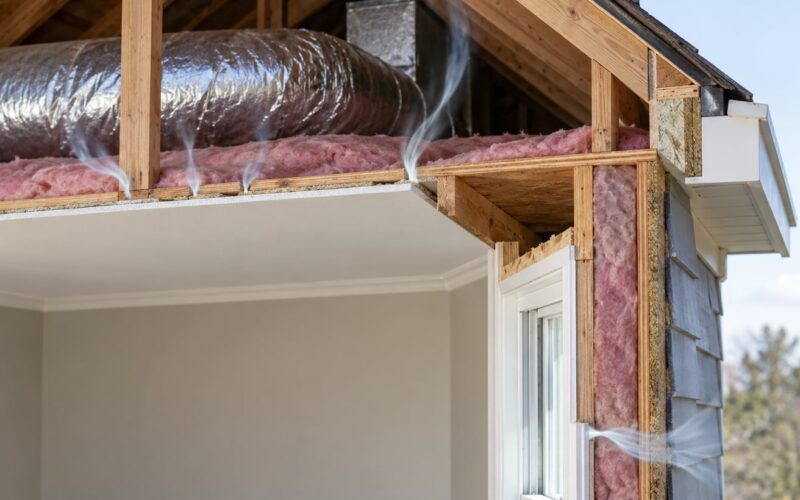
Air leakage deserves separate treatment because it behaves differently from insulation. A leaky attic stairwell pulls warm air out at the top of the house and draws it in through cracks lower down, so the whole volume of air in the home moves. That flow carries heat far more effectively than conduction through a wall, which is why homeowners can insulate the attic correctly and still see almost no change in the bill.
How Much Can Better Insulation Reduce Heating Bills?
The Department of Energy’s roughly 15 percent figure covers combined heating and cooling savings across the whole home, and it is the number most often quoted. Treat it as a reference point. What you actually get depends on four variables, and knowing which ones are working against you is most of the analysis.
- Where you started. The lower the existing R-value, the more headroom. A home with no attic insulation has far more to recover than one at code level.
- Climate and heating type. A cold-climate gas bill responds more sharply to envelope work than a mild-climate one. Electric resistance heat and heat pumps show savings differently depending on your utility rate.
- Leakiness. In a drafty house, air sealing often produces the visible improvement and insulation produces the durable one. Doing only one leaves part of the win on the table.
- Heating equipment condition and ductwork. A furnace in poor condition or leaking ducts in the attic can absorb savings you never see on the bill.
How insulation affects heating costs in a typical bill
The arithmetic is simpler than most vendors make it. If heating accounts for about 60 percent of a household energy bill and insulation plus air sealing removes roughly 15 percent of the heating energy used, the saving lands at about 9 percent of the total bill. You can redo that multiplication with your own numbers in a minute, and it is a better estimate than any promised percentage.
Two things distort the comparison. Energy prices move. If fuel costs rise faster than your consumption falls, the bill can go up in the year you insulate even though you used less of it, and a r/HomeImprovement thread titled “Just spent a lot insulating the house and my electric bill is the same” describes that outcome honestly. Comparing two winters is the only fair test. Note your meter reading on the same dates a year apart, and normalise for how cold each period was.
How to estimate your own heating cost impact
You do not need a vendor’s model to get a defensible number. Pull your last twelve monthly bills and total the heating-season months only, which in most of the country means the colder half of the year. Divide by the heating degree days for that period if you want to remove the weather effect, since a colder winter always produces a bigger bill regardless of your insulation.
Then apply a conservative saving rather than the headline number. If your attic had no insulation, a large share of the heating load was coming through the roof, so a meaningful reduction is plausible. If your home was built after the mid-2000s and already meets code, be suspicious of any quote promising dramatic cuts. That estimate becomes your baseline: measure the meter on the same date a year later, divide the difference by your fuel price, and you have a real annual saving figure instead of an estimate.
Offsets exist, too. Many utilities run weatherization rebates, and Mass Save-style programs are the template most states copied. The 25C federal credit for energy-efficient home improvements has covered qualifying insulation and air sealing, though amounts and rules change and phase-outs have been extended and revised. Confirm current terms with your utility and a tax professional before you count any of it in a payback calculation.
Insulation is also rarely deductible as a plain expense on a primary residence. The route most homeowners use is a credit or a utility rebate rather than a write-off, which is a meaningfully different calculation when you are comparing payback years.
Which Insulation Matters Most?
If you can only do a few things, do them in this order. The ranking is driven by return per dollar and per day of disruption, not by what is easiest to reach.
- Attic and roof openings. The top of the house is where warm air collects, and attic work is usually accessible, cheap and entirely non-disruptive. Sealing the stairwell and the penetrations around a flue or plumbing stack often comes first.
- Air leaks at penetrations and junctions. Recessed lights, bathroom and kitchen exhausts, the rim joist, plumbing chases and the attic hatch. Small holes in a big surface area matter more than they look.
- Windows and doors. Weatherstripping, caulking and sealing the trim is cheap. Replacing failed single-pane windows with insulated units is a larger project with a real payback in comfort.
- Basement and crawl space. Insulating and air-sealing the rim joist, or conditioning a crawl space, removes a steady upward draft across the whole floor.
- Exterior walls. The biggest surface, and the most expensive and disruptive to treat in an existing home. Almost always the last project in the sequence, not the first.
That ordering is why experienced contractors often start with air sealing rather than filling cavities. Doing walls first and air sealing later wastes part of the wall investment, because the leakage keeps pulling heat through the insulation you just added.
How to check for air leaks
You can find most leaks yourself in an afternoon, without buying anything. On a cold, windy day, run the exhaust fans in the bathroom and kitchen so the house is under negative pressure, then walk the envelope looking for drafts at window edges, door frames, the rim joist, baseboards and electrical outlets.
An infrared camera makes this faster and more objective, since it shows the temperature difference on the surface. Light up an attic at night with the house warm inside, and the ceiling tells you immediately whether insulation is missing, settled or blocked by a baffle. If you want a number rather than an image, a blower door test measures the air change rate, and that result is what a contractor should be quoting against.
A home energy audit goes further and is usually worth it before you spend anything large. Independent assessors also tend to be more willing to tell you that a project is not worth the money, which sales-oriented contractors rarely do.
How to choose insulation for each area
Match the material to the assembly, not to the marketing. A crawl space needs something that tolerates moisture, a wall cavity needs something that will stay in place for decades, and an attic floor needs something cheap per R-value.
| Material | Typical R-value per inch | DIY difficulty | Best location | Watch out for |
|---|---|---|---|---|
| Fiberglass batt | About 3.0 to 3.8 | Moderate | Walls, attic floors, some floors over unconditioned space | Compression and gaps at the top of the cavity cut performance sharply |
| Blown-in cellulose | About 3.2 to 3.8 | Easy in open areas | Attic floors and some walls | Settles over time; depth markers matter more than bag counts |
| Spray foam | About 3.5 to 7 depending on type | Professional work | Attics, crawl spaces, rim joists, rim joist and retrofits | Needs correct thickness and a thermal or ignition barrier as the code requires |
| Rigid foam | About 3.6 to 5.0 | Easy to cut | Basement and crawl space walls, garage-side walls, roofs | Per-inch value means thin assemblies, and seams must be sealed |
R-value is thermal resistance per inch, and higher is better. Attic targets vary by IECC climate zone, from roughly R-30 in the mildest zones up to R-60 or more in the coldest, so a cold-region home in Atlanta is not the same project as one in Maine. Check the zone guidance for your area rather than copying a neighbour’s number.
How to Improve Insulation Without Replacing Your Heating System
Most homeowners who get a bad result treated the envelope as a single job. Treat it as a sequence, and stop when the returns flatten.
- Diagnose. Do a walkthrough, an infrared scan or a blower door test before buying anything. Know whether the problem is conduction through a bare attic or infiltration through gaps.
- Air seal first. Seal the attic hatch, rim joist, plumbing chases and penetrations. This is cheap, fast and it protects the value of everything after it.
- Insulate the attic or the floor. Top up to the R-value your climate zone calls for, and add baffles so the soffit vents that keep the roof cool in summer stay open.
- Seal windows and doors. Weatherstripping, new sweeps, and caulk or sealant on the trim. Check the sweep on a garage door too, it is a large moving hole.
- Address the crawl space or basement. Rim joist insulation plus a sealed vapour barrier or a conditioned crawl space makes the floor stop behaving like a cold radiator.
- Measure. Compare meter readings and bills across comparable weather periods, and re-run a blower door test if you had one at the start.
| Task | Friendly for a homeowner | Safety note |
|---|---|---|
| Sealing gaps, caulking and weatherstripping | Yes | Stay off ladders unsupervised; do not seal combustion air intakes |
| Topping up attic insulation | Yes, with care | Do not cover recessed light housings or chimneys; keep soffit vents clear |
| Vapour barrier and crawl space work | Generally, on a crawl space | Ground moisture and drainage need to be right first |
| Electrical, gas or structural changes | No | Licensed trades only |
| Spray foam in an enclosed space | No | Occupants should not be inside during application; professional only |
| Opening up walls or floors | No | Risk of wiring, plumbing and structural members |
One knock-on effect is worth planning for. If you insulate the attic to a high R-value and air seal the envelope before quoting a heat pump, the design load of the home falls, and the correctly sized system is smaller. People who skip the envelope work often end up buying a larger unit than they need and paying to run a bigger machine than the house requires. Doing the envelope first changes the quote.
What you do not need is a full equipment replacement to make insulation worthwhile. A functioning furnace in a tighter house simply runs less. Replace equipment when it fails or when its efficiency and condition warrant it, not as a way to chase savings the envelope should have delivered.
Common Insulation Mistakes That Increase Heating Costs
Most disappointing results come from installation, not from the material. These are the failures that recur, with the fix for each.
| Mistake | Why it wastes money | Correction |
|---|---|---|
| Compressing batts to fit a stud bay | Rated R-value assumes full thickness, so squeezing it in loses much of the performance | Use a wider cavity or a material designed for the space |
| Leaving gaps at junctions and around obstructions | Bypasses the insulated layer entirely | Cut to fit, split around wiring and seal the gaps |
| Blocking soffit vents or burying a roof’s ventilation | Trapped heat in the roof deck can cause ice dams and sheathing decay | Install baffches and keep ventilation paths clear |
| Using loose-fill insulation in a damp crawl space | Wet insulation loses R-value and can carry moisture into framing | Seal and dry the space, or use a rigid or closed-cell assembly |
| Adding insulation and skipping air sealing | Moving air still drives heat through the new material | Seal first, then insulate |
| Stacking layers without checking what is there | Settled or contaminated old insulation stays in place and blocks the improvement | Assess existing depth and condition before topping up |
| Leaving gaps above soffit vents or under the eaves | Air moves straight into the attic space, bypassing the floor insulation | Cardboard baffles or wind blocking at every bay |
Two of these deserve professional judgement rather than a fix-it attitude. Any project that touches wiring, gas lines, a flue or a structural member belongs with a licensed trade. And if you find water in a crawl space, fix the drainage before anyone insulates it, because moisture behind insulation causes damage that costs far more than the insulation saved.
How to Know Whether Insulation Is Working
Two kinds of evidence matter, and only one shows up on your bill. The first is comfort: drafts near windows and doors fade, cold corners and cold floorboards stop, and the difference between the warmest and coldest room narrows. That is usually visible within days of air sealing, because air movement drives the sensation of cold far more than conduction does.
The second is runtime. In the same cold snap, the furnace should cycle off for longer stretches instead of running near continuously, and a heat pump’s compressor should not be working every few minutes. Watch the cycling for a week before and after, at the same thermostat setting.
For the bill itself, compare like with like. Take a meter reading on a fixed date, repeat it a year later, and adjust your thinking for heating degree days, since a milder winter lowers consumption on its own. A home energy audit and a blower door test give you numbers that survive disagreement, which is what you want when the bill says nothing happened.
If consumption fell but the bill did not, energy prices moved. If neither moved, the leak is somewhere you have not treated, most often a duct run in an attic or a leaky rim joist. Insulation is a durable asset, but only if it is paired with the air sealing that makes it perform.
Frequently Asked Questions
Does insulation really lower heating costs?
Yes, when the home was losing heat through a weak area of the envelope. The U.S. Department of Energy reports average savings near 15% on heating and cooling from proper sealing and insulation, but that average covers well-insulated houses too. In a home with a bare attic or a leaky attic hatch, the improvement can be noticeably larger; in a tight home, much smaller. Keep the thermostat where it is or the saving disappears.
What type of insulation is best for an old house?
It depends on the assembly, not the age. Fiberglass batts and cellulose suit accessible walls and attic floors. Spray foam is the most effective choice for attics, crawl spaces and rim joists because it seals as it insulates, though it needs professional application. Rigid foam works well against basement and crawl space walls. Older homes also need air sealing first, because leakage usually costs more than R-value.
How much insulation does a home need?
Enough to meet the R-value target for your IECC climate zone, which ranges from roughly R-30 in the mildest zones to R-60 or higher in the coldest for attic floors. Square footage matters less than people expect: an attic area divided by the coverage per bag gives the bag count, and depth markers matter more than bag labels. Walls follow their own targets because the cavity depth is fixed by the framing.
Should I install insulation before replacing my furnace or heat pump?
Usually, yes. Insulation lowers the design load of the house, which means the correctly sized replacement is smaller and cheaper to run, and the quote you get will reflect a tighter building. Doing the envelope first also stops you paying to heat air that leaks out. If the equipment is failing now, replace the failing unit first, then insulate and resize at the next change.
Can I install insulation myself, or do I need a professional?
Sealing gaps, weatherstripping and topping up attic insulation are reasonable homeowner tasks, provided you do not seal combustion air intakes or cover recessed light housings and chimneys. Spray foam, any work opening walls or floors, and anything touching wiring, gas or structure belongs with a licensed professional. A blower door test before and after is the honest way to know whether the work performed.
How can I tell if my home has an insulation problem?
Look for uneven temperatures between rooms, cold floors, drafts near windows and doors, ice damming along the eaves, and unusually high fuel use in an older home. An infrared camera run on a cold night shows missing or settled insulation immediately. For a number rather than an image, a blower door test measures air leakage, which is usually the more expensive problem to leave unfixed.
Start With the Biggest Heat Loss
Insulation affects heating costs in a way that is easy to verify: less heat lost means less fuel bought. The sequence that works for most homeowners is to find the largest single loss first, treat it with correctly rated insulation and real air sealing, and leave the expensive work, like wall cavities, until the cheap work has shown its result.
Measure before and after on comparable weather periods, and take a blower door reading if you have the option. Then decide about new equipment with a number in hand, because a tighter house and a smaller quote go together.