Rapid shutdown is the National Electrical Code safety rule for rooftop solar. NEC 690.12 requires photovoltaic DC conductors to fall to a safe voltage within 30 seconds of a trigger: 30 V outside the array boundary and 80 V inside it. It exists to protect firefighters and installers working around a roof that is still making power.
It catches people out because flipping the main breaker is easy to assume kills the panels. It does not. A solar array keeps producing in daylight long after the grid connection opens, and closing that gap is exactly what rapid shutdown was written to do.
Here is what the code asks for, where the rule comes from, and how to check the system on your own roof.
Table of Contents
- What Is Rapid Shutdown in Solar Code?
- Why Do Solar Codes Require Rapid Shutdown?
- Where Does the Requirement Come From?
- What Must a Solar PV Rapid-Shutdown System Do?
- What is rapid shutdown in solar code when you have a string inverter?
- How Is Rapid Shutdown Different for Rooftop Arrays and Energy Storage?
- Does Rapid Shutdown Turn Off the Entire Solar System?
- Does This Requirement Apply to Every Residential Solar Installation?
- What Labels and Documentation Should a Compliant System Have?
- Can a Homeowner Install or Modify a Rapid-Shutdown Device?
- How Can Homeowners Check Their Local Solar Code Requirements?
- Frequently Asked Questions
- Is rapid shutdown required for every residential solar installation?
- Does rapid shutdown turn off all power from a solar system?
- Does rapid shutdown apply to a home battery?
- What does a rapid-shutdown switch or device do?
- Is rapid shutdown the same as an AC disconnect?
- What should a homeowner ask an installer about rapid shutdown?
- What to Do First
What Is Rapid Shutdown in Solar Code?
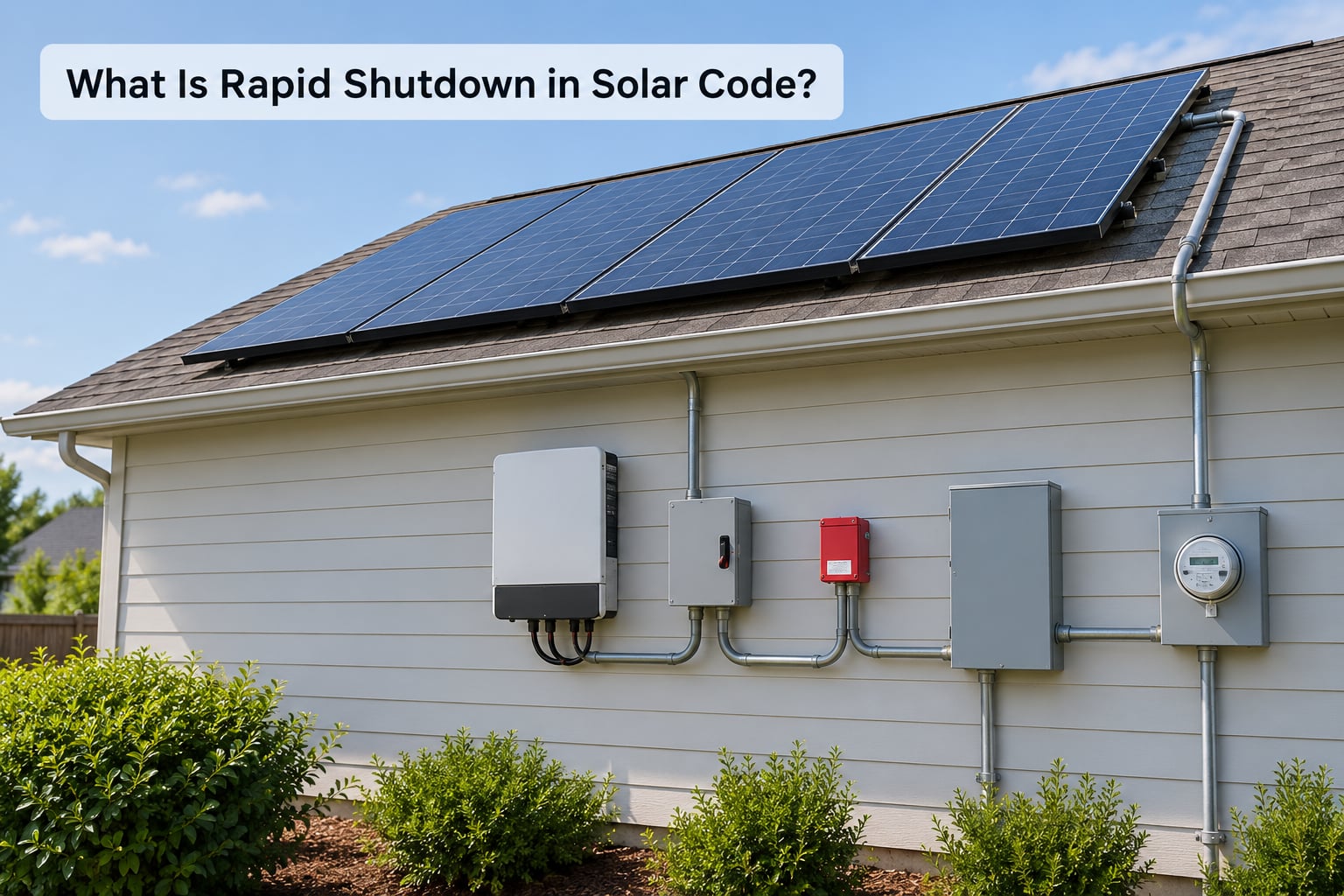
Rapid shutdown is a controlled shutdown of a solar array’s DC side, initiated from outside the array and carried out by equipment at or near the modules. Under NEC 690.12, once it begins, the controlled conductors must reach safe levels inside 30 seconds. It is a performance requirement, not a specific product, and several very different equipment arrangements satisfy it.
What separates it from other kinds of shutdown is who acts, where they act, and how quickly the voltage comes down.
| Control | What it is | Where it acts | What it achieves |
|---|---|---|---|
| Rapid shutdown | Code-required safety function | DC conductors on the array side | Safe voltage within 30 seconds |
| AC disconnect | Standard breaker or fused disconnect | Between inverter and the building service | Stops the inverter producing; does nothing to the roof conductors |
| DC disconnect | Switch or fuse in the array circuit | Along the DC home run | Manually isolates array wiring for service |
| Emergency shutoff switch | Labeled rapid shutdown initiation device | At a readily accessible point near the service | Triggers the rapid shutdown sequence |
Why Do Solar Codes Require Rapid Shutdown?
Because sunlight is not a switch. A typical residential string array sits in the 300 V to 600 V DC range in full sun, and a firefighter working on a roof of a burning house cannot de-energize that from a breaker on the side of the building.
Fire service guidance has long warned that hundreds of volts of DC can still be present on a roof during a response, which turns every roof ladder into a potential electrocution hazard and forces crews to work in awkward protective gear. Pulling that voltage down removes the hazard at the source rather than asking firefighters to manage it.
Installers and maintenance technicians get the same benefit on a normal service call. Reduced voltage means less PPE, fewer steps, and a shorter job. It is one of the few code rules that exists purely because of what happens in the first minutes of an incident.
Where Does the Requirement Come From?
The National Electrical Code, also published as NFPA 70, is a model code rather than a federal law. States and municipalities adopt an edition, often with local amendments, and that adopted edition is what an electrical inspector enforces on your permit.
The residential rapid shutdown requirements sit in NEC 690.12. They first appeared in the 2014 edition and were substantially reworked in 2017, then carried forward into the 2020 and 2023 editions. The 2017 rewrite tightened the geometry, moving the array boundary from 10 feet away from the modules down to 1 foot.
| Code edition | Array boundary | Effect on an installer |
|---|---|---|
| 2014 NEC | 10 ft from the array | Wider zone of controlled conductors; easier to satisfy with string-level equipment |
| 2017 NEC | 1 ft from the array | Module-level electronics effectively required to reach the 80 V limit |
| 2020 NEC | 1 ft from the array | Same boundary, with continued clarity edits |
| 2023 NEC | 1 ft from the array | Same boundary for PV conductors in buildings |
That single change is why two systems on the same street can be judged by different rules. Installers consistently report permit packets bounced for citing the wrong code edition on the drawings, so the edition belongs on the plan set from the start.
What Must a Solar PV Rapid-Shutdown System Do?
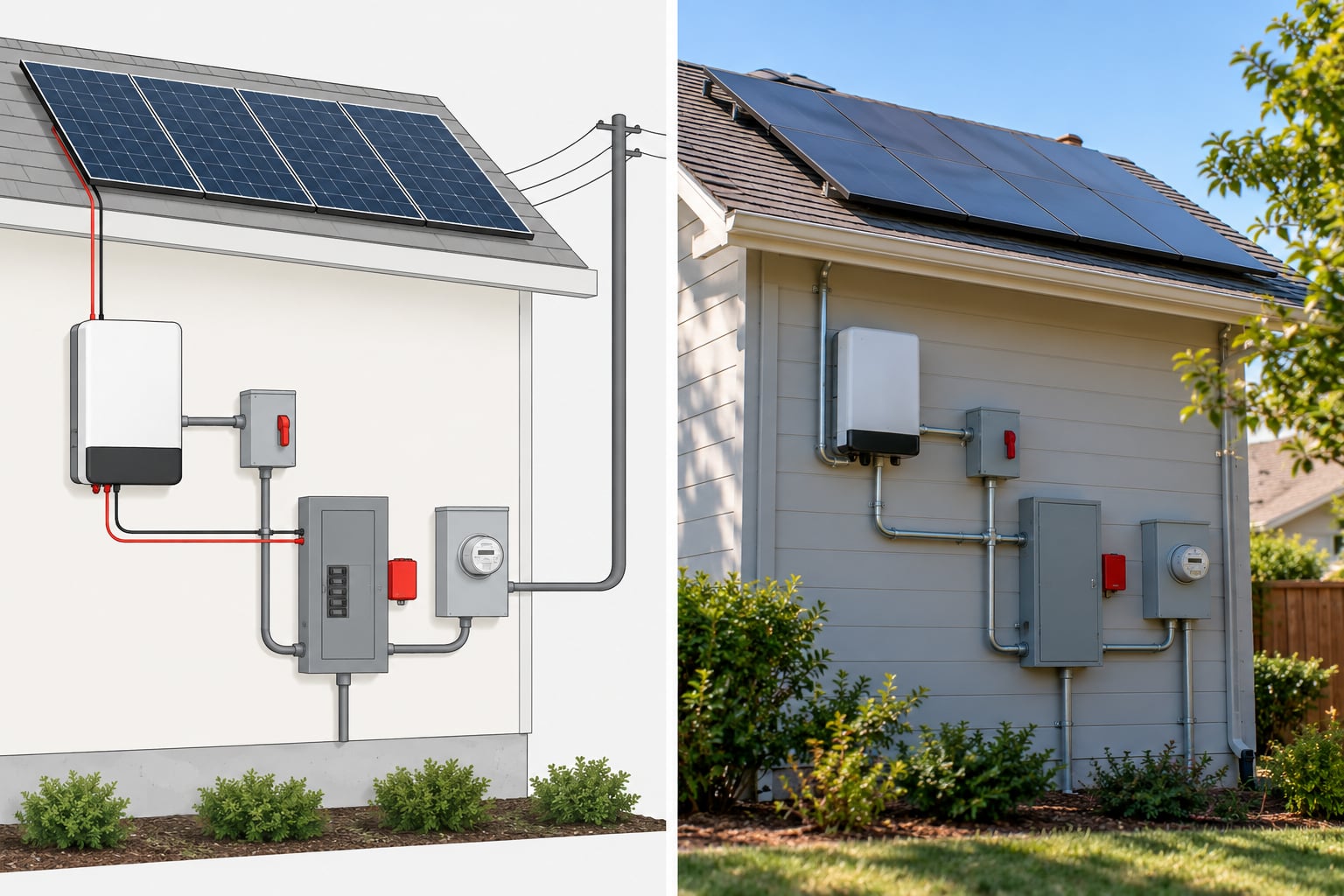
Four jobs, in practice. An initiation device must be located outside the array boundary at a readily accessible point. The conductors leaving the array must be identified as controlled conductors on the drawings. Voltage on those conductors has to fall to 30 V within 30 seconds of initiation. And the conductors inside the boundary have to reach 80 V, or 1 V per module where module-level electronics do the work.
| Initiation location | What initiates it | Controlled conductors | Typical equipment behaviour |
|---|---|---|---|
| Loss of AC supply | Opening the AC disconnect or main breaker | Array DC home run | Module electronics stop producing automatically |
| Rapid shutdown switch | Labeled device near the service entrance | Array DC home run | Sends a shutdown signal or interrupts control power |
| Inverter shutdown | Inverter internal fault or commanded stop | Array DC home run | Inverter drops the array to the required limits |
| Fire alarm interface | Fire alarm system signal, where required | Array DC home run | Initiates shutdown alongside building systems |
What is rapid shutdown in solar code when you have a string inverter?
A plain string inverter with no module-level electronics does not satisfy the requirement by itself, because the modules stay in series at full voltage until something in the array is switched. Adding optimizers or dedicated rapid shutdown devices fixes that on an existing array, which is the usual retrofit path.
Microinverters and AC modules are different, because each module has its own conversion and shutdown electronics. Installers on r/solar note that a microinverter system typically goes quiet the moment the main breaker opens, since UL 1741 anti-islanding forces the microinverters to stop when utility voltage leaves range. The open question in those threads is whether the local authority still wants a separate labeled initiation device, and the answer varies by jurisdiction.
How Is Rapid Shutdown Different for Rooftop Arrays and Energy Storage?
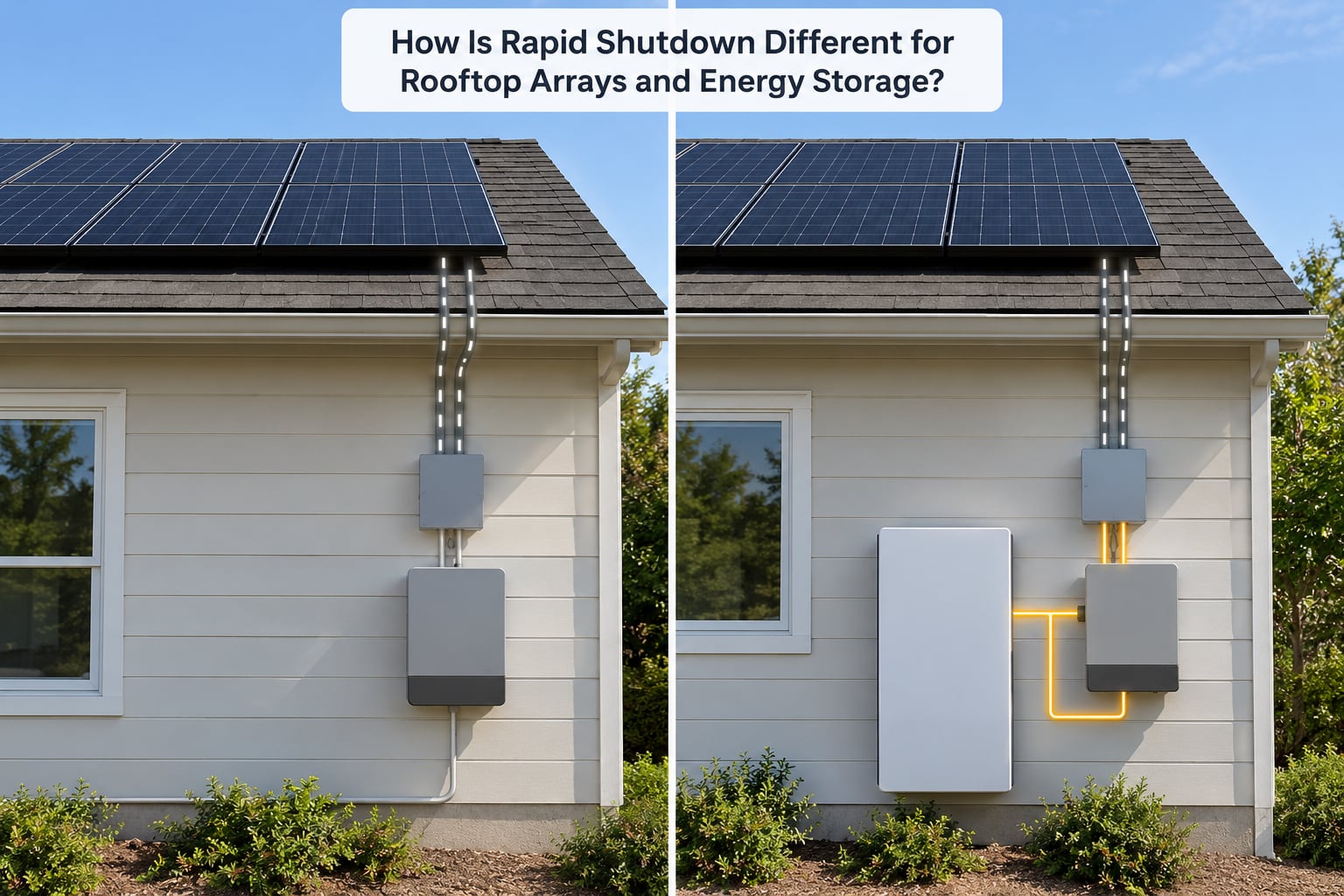
Energy storage has its own section of the code, and the two requirements do not merge. A battery is a stored energy source sitting inside the building, and shutting down the array does nothing to it.
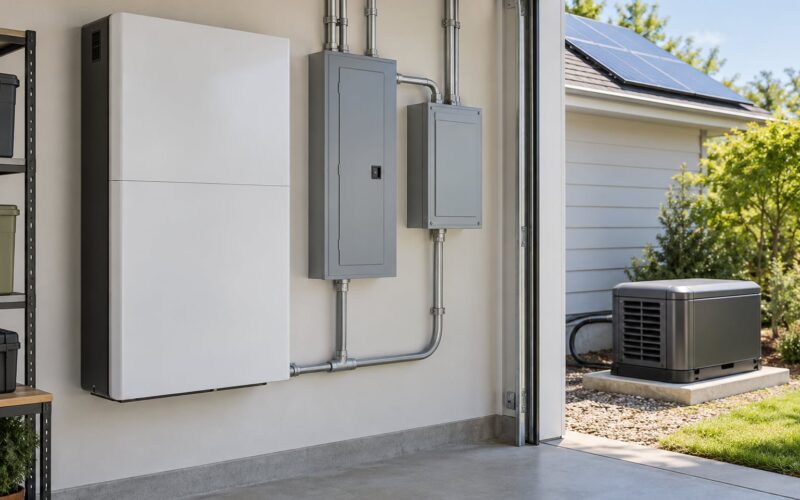
So a hybrid system can have a perfectly compliant PV rapid shutdown while the battery, its disconnects, and the inverter’s low-voltage side remain live. Firefighters dealing with a lithium battery installation need isolation steps that a solar array alone never provides, which is why ESS shutdown and rapid shutdown are treated as separate functions in both the plan set and the emergency response.
Does Rapid Shutdown Turn Off the Entire Solar System?
No, and this is the most common misunderstanding in the field. Rapid shutdown addresses the DC conductors on the roof. Everything downstream of the inverter, including the AC disconnect and any battery, is handled by other equipment for other reasons.
| Function | Trigger | Scope | What it does not do |
|---|---|---|---|
| Rapid shutdown | Loss of AC, switch, or alarm signal | Array DC conductors | Isolate the inverter AC output or the battery |
| Anti-islanding | Utility voltage out of range | Inverter grid connection | Make roof conductors safe for firefighters |
| AC disconnect | Manual breaker operation | AC side of the inverter | De-energize DC conductors on the roof |
Anti-islanding is the one homeowners confuse with rapid shutdown most often, and the two behave differently on a grid outage. Anti-islanding stops a grid-tied inverter from feeding power back into a de-energized utility line. Rapid shutdown is a safety response, and it triggers on much broader events than a grid failure.
Does This Requirement Apply to Every Residential Solar Installation?
Not automatically, and the factors that decide it are worth walking through. The type of array matters, because carports, canopies, and other open shelters are commonly treated differently from arrays on a building, and ground-mount and utility-scale systems follow separate provisions. The code edition your authority enforces matters next, since 2014 and 2017 draws produce different results.
Local amendments, utility interconnection requirements, and the date the permit was pulled all feed into the answer. That last one matters most for older systems. A residential array permitted and installed before your jurisdiction adopted the 2017 edition is generally left alone, and the homeowners who worry about it are usually asking about resale and insurance rather than enforcement.
The practical answer is that no one outside your local authority can tell you definitively. The rule of thumb that survives contact with inspectors is to ask, in writing, and keep the response with your paperwork.
What Labels and Documentation Should a Compliant System Have?
Documentation is half the compliance story, and it is the half homeowners never see. A compliant installation should have a rapid shutdown switch with a label located not more than 3 feet from the device, stating the identification the code requires. The array boundary should be shown on the roof plan so the controlled conductor area is unambiguous to anyone who arrives later.
You should also be able to get the single-line diagram, the equipment documentation for the inverter and any optimizers or rapid shutdown devices, and the permit and inspection record. A voltage measurement taken at commissioning is what actually proves the system meets the limits, and that result should be part of the file rather than a memory in the installer’s head.
If any of that is missing, ask for it. It takes one email, and a refusal is itself informative.
Can a Homeowner Install or Modify a Rapid-Shutdown Device?
Leave this one to a licensed professional. PV circuits stay energized in daylight regardless of what the main breaker is doing, conductors can hold hazardous voltage after everything upstream is opened, and the work falls under the same permit and inspection requirements as the rest of the installation.
Where the code allows it, any change to shutdown controls should follow the manufacturer’s instructions, match what the approved plan set already describes, and be done by a qualified or licensed electrical contractor. Adding a device that was not on the approved drawings can mean a rejected permit on a system that was otherwise fine.
How Can Homeowners Check Their Local Solar Code Requirements?
Work through it in this order. First, find out which NEC edition your jurisdiction enforces and whether the county or municipality has amendments, because that pair sets the entire requirement. Second, ask the authority having jurisdiction directly, and get the answer in writing. Third, confirm the utility’s interconnection requirements, which can add conditions on top of the code.
Fourth, pull the approved plan set and inspection record for your system and check the code edition cited on the drawings against what you just confirmed. Fifth, walk the equipment and look for the labeling described above.
The edition gap between neighbors is worth keeping in mind. Two homes on the same street, installed a year apart, can be reviewed under 2017 on one side and 2020 on the other, if that is what each jurisdiction had adopted at the time. Ask about the edition before you ask about the equipment, because it changes the answer before any hardware is discussed.
Frequently Asked Questions
Is rapid shutdown required for every residential solar installation?
Usually, for arrays on or in buildings, but not unconditionally. Applicability depends on the code edition your jurisdiction enforces, local amendments, the system type, and the permit date. Carports, open shelters, ground-mount and utility-scale arrays are often treated under different provisions. Your local electrical authority, not a general web answer, is the only reliable source for your address.
Does rapid shutdown turn off all power from a solar system?
No. It brings the array DC conductors to a safe voltage within 30 seconds, and it does nothing to the inverter AC output or to a connected battery. Those are handled separately by the AC disconnect, by anti-islanding, and by storage isolation. Rapid shutdown is a roof safety function with a narrow, specific scope.
Does rapid shutdown apply to a home battery?
No, not on its own. Energy storage is covered by a separate section of the code, because a battery is a stored energy source that stays live regardless of the array state. A system with storage can be fully rapid shutdown compliant on the PV side while the battery and inverter remain energized.
What does a rapid-shutdown switch or device do?
It is the initiation point, not the shutdown itself. The switch is a labeled, readily accessible device, normally near the service entrance, that signals the array equipment to enter rapid shutdown or interrupts its control power. The actual voltage reduction happens at the modules, through optimizers, microinverters, or a dedicated rapid shutdown device.
Is rapid shutdown the same as an AC disconnect?
No. The AC disconnect stops the inverter from producing and isolates the AC side, but array conductors can stay at hundreds of volts in daylight. Rapid shutdown is a code-required function that brings those roof conductors to 30 V outside the array boundary and 80 V inside it within 30 seconds. One does not substitute for the other.
What should a homeowner ask an installer about rapid shutdown?
Ask which NEC edition the design is based on, which array boundary applies, what equipment performs the shutdown, where the initiation device is located, and where the required labeling appears. Then request the single-line diagram, the permit and inspection record, and the commissioning voltage test result. Keep those answers with your home records.
What to Do First
Ask your installer or local electrical authority which code edition and amendments govern the PV system, then find the rapid shutdown labeling, the approved one-line diagram, and the permit or inspection record. Those three documents answer most of what people are trying to figure out from the outside.
Do not test or alter energized solar conductors yourself, and do not assume a compliant-looking installator label means the right code edition was applied. The difference between a passing inspection and a failed one usually comes down to paperwork, and paperwork is free to request.