Solar works for renters in three broad ways, and none of them require you to own the roof. You can power small outdoor fixtures with panels and batteries built into a single removable unit, charge a battery box you carry indoors, or plug a compact array into a normal wall outlet so your appliances run on sunlight. Which one fits depends on what you want it to do: light a patio, keep a phone alive through an outage, or shave a little off the electric bill.
That is the whole idea behind how solar works for renters. The physics never change whether you own a house or sign a lease, but the hardware you are allowed to touch absolutely does. Most renters start small, and the systems that work best are the ones you can unplug and carry to the next apartment when the lease ends.
Table of Contents
- What Does Solar Mean for Renters?
- Renter options at a glance
- How Solar Power Is Generated and Stored
- Solar Options That Do Not Require a Landlord
- Solar Lights vs. Solar Power for Renters
- How to Choose Solar Options for a Rental
- What Renters Can Ask Their Landlord or Building
- Safety, Permissions, and Common Mistakes
- Frequently Asked Questions
- Can renters use solar energy without installing anything?
- Are solar lights bright enough for a patio or balcony?
- Can a renter install solar panels on an apartment building?
- Do solar lights work in winter or on cloudy days?
- Do I need the landlord’s permission to use solar garden lights?
- Will a portable solar system lower my electricity bill?
- Where to Start
What Does Solar Mean for Renters?
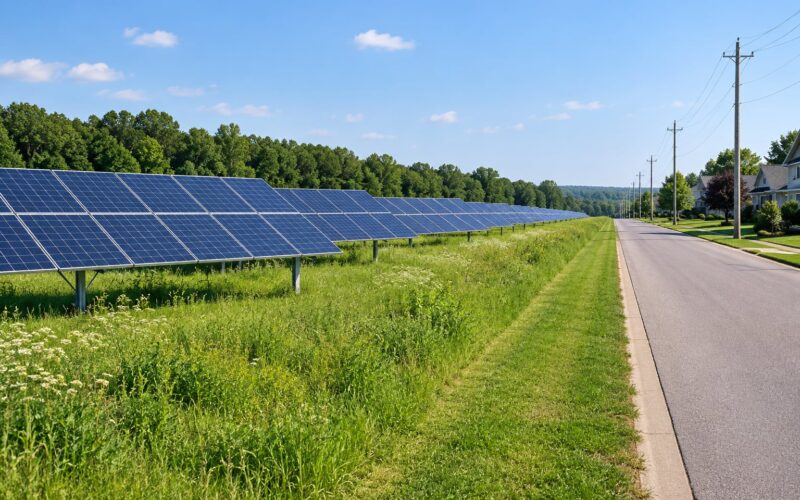
Solar turns light into electricity. A renter can use that electricity in one of two ways: directly, with a panel wired or plugged into something on the balcony or patio, or indirectly, by subscribing to a share of a larger array somewhere off your building and receiving credits on your utility bill.
The direct route is entirely under your control, which is why it feels more like solar. The subscription route, usually called community solar, involves no hardware at your home at all. You pick a provider, subscribe to a small share of an existing array, and the credits show up on your monthly statement.
What you cannot do as a renter is drill into a roof, put panels on a shared building’s structure, or run new wiring into a circuit without written permission. That boundary is the reason so many renter-friendly products are designed to be weight-held and plugged in rather than screwed down.
Renter options at a glance
These are the main categories you will run into, ordered from simplest to most involved.
- Solar garden and path lights — a panel, a small battery and an LED in one stake. Nothing to wire, nothing to ask for.
- Solar wall and balcony lights — the same idea mounted to a railing or wall with removable clips or adhesive.
- Window film and flexible panels — thin panels that stick or suction to glass, output measured in watts rather than kilowatts.
- Portable power stations — a battery unit with AC outlets, charged by a folding panel you set in the sun.
- Plug-in solar kits — a small rigid array with its own inverter, plugged into a standard outlet to run household electronics.
- Community solar subscriptions — no equipment at your home, just bill credits from an off-site array.
How Solar Power Is Generated and Stored
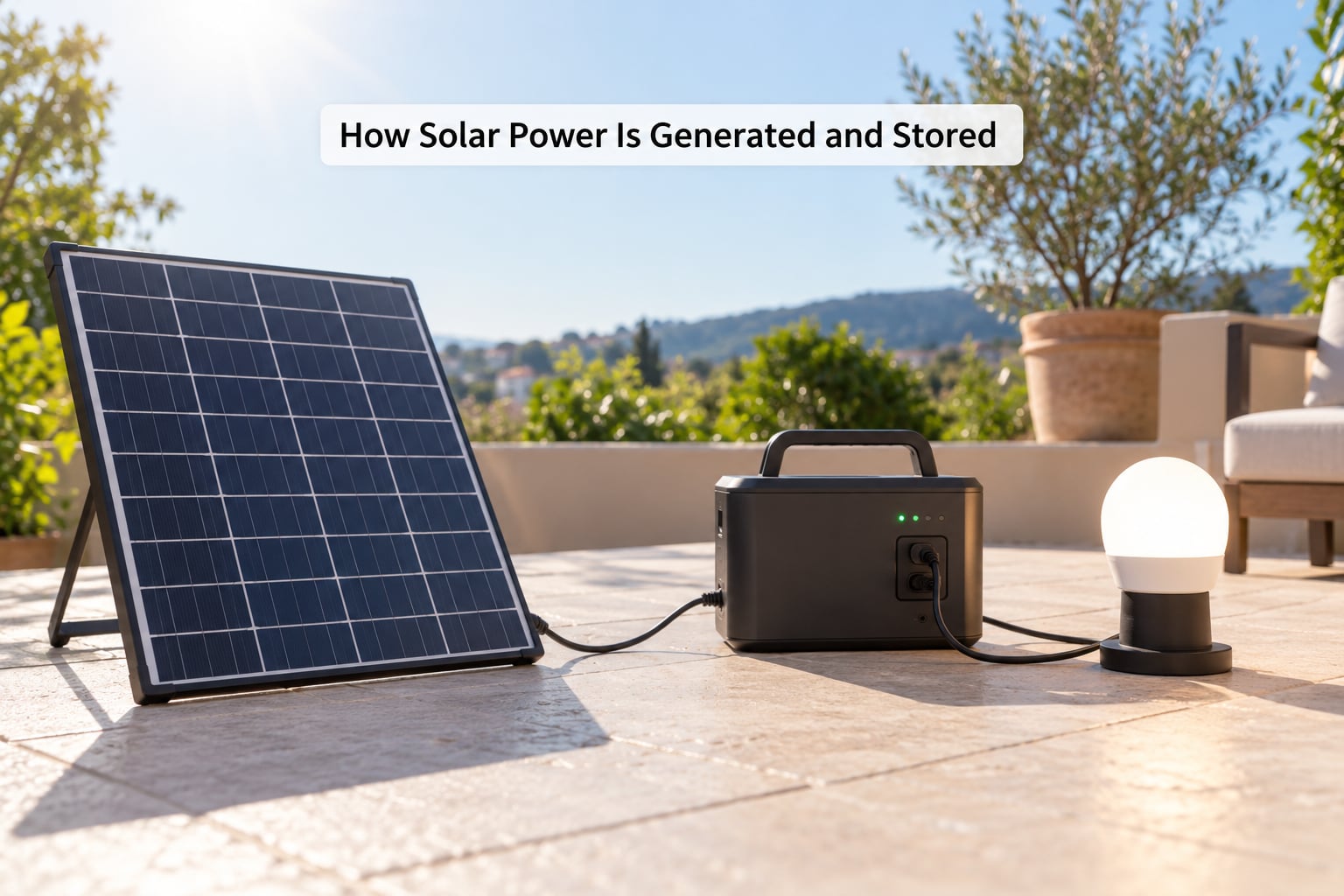
Light hits a photovoltaic cell and shakes electrons loose. The panel collects those electrons as direct current, which is a one-way flow of charge. Household appliances expect alternating current, so something has to translate between the two before anything in your home will run on it.
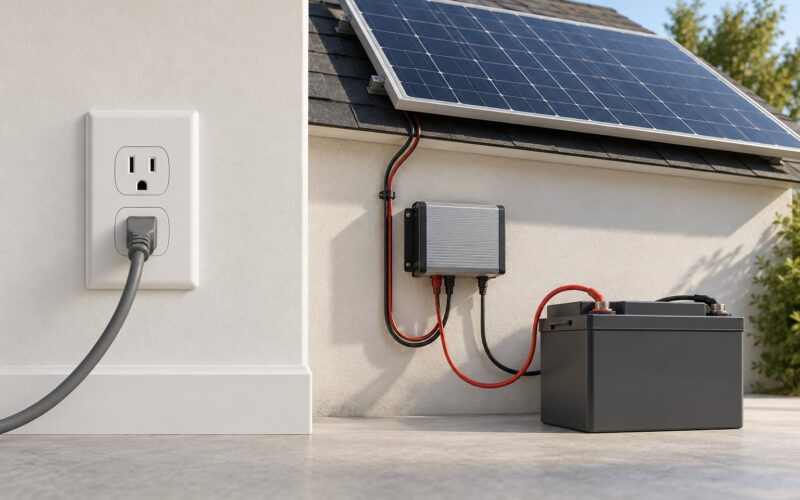
That translator is the inverter. In a garden light it is a tiny chip on the board, hidden inside the housing. In a plug-in kit it is a small box the size of a paperback, usually mounted behind the panel. Either way the job is identical: convert DC into AC at the frequency your appliances expect.
Storage is the third piece, and it is the piece most people overlook. A panel only produces while the sun is up, so a light that has no battery is useless at night. The battery absorbs surplus daytime energy, holds it, and releases it when the panel is dark.
Follow a typical renter setup end to end. A panel on a balcony railing produces maybe 60 to 100 watts in good sun. That current runs through a charge controller, which keeps the battery from overcharging, and the battery holds a few watt-hours. When dusk falls, the controller reverses direction and feeds the stored energy to the LED. On a cloudy day the same panel still produces something, just less, and the light dims rather than switching off entirely.
One consequence of that design trips people up. A panel wired straight into your home’s outlets with no battery is called a grid-tie system, and the moment the utility grid goes down, it shuts itself off. That behavior is required by safety rules, not a defect. A portable power station with a battery is the opposite: it ignores the grid entirely, so it keeps running through an outage.
Solar Options That Do Not Require a Landlord
Everything in this section can be set up and removed inside an afternoon, and none of it asks you to alter the building permanently.
Solar garden lights are the easiest starting point. You push a stake into a planter or lawn, remove the pull tab from the battery, and leave it. Their limitation is brightness: most are built for a path marker or a low glow, not for lighting a table where you eat.
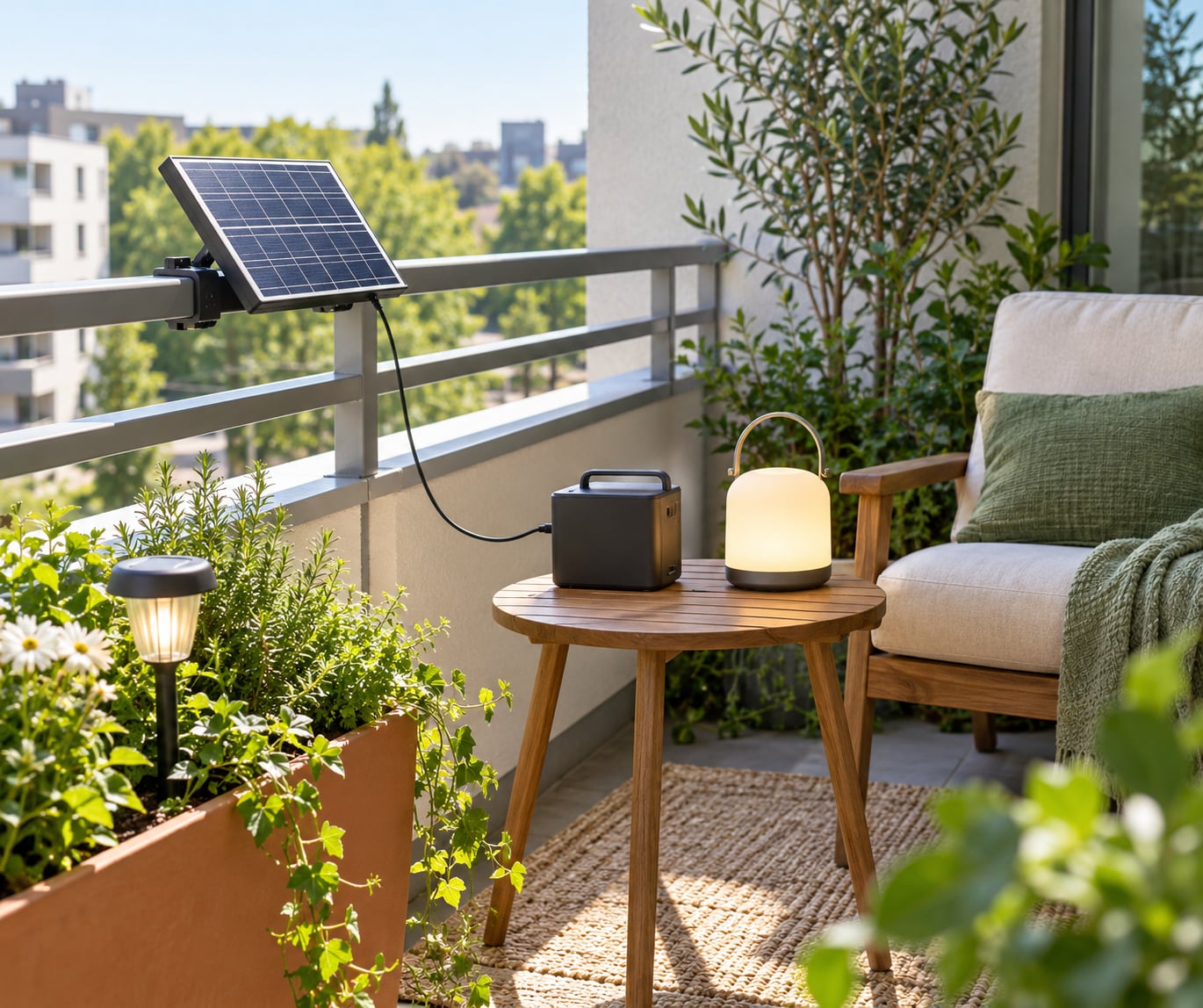
Balcony solar lights clamp onto a railing or sit on a shelf, which makes them better for ambient light on a small outdoor space. The panel needs a clear view of the sky, so a deep balcony with an overhang above it will underperform noticeably.
Portable power stations are for power rather than light. The unit holds a battery, shows a charge level, and offers AC outlets, USB ports and sometimes a 12-volt socket. A folding panel recharges it over a day or two of sun. You can run a lamp, a router, a small fan or a phone charger, and you can ignore the wall outlets entirely if you want.
Plug-in solar kits push the idea further by feeding grid-compatible power into a regular outlet. They genuinely reduce grid draw for electronics that run during daylight hours, but output is measured in hundreds of watts, so expecting to run a whole apartment is unrealistic.
Window and outdoor panels without a battery are the weakest category for real output. They can keep a small device or charge a phone slowly, and thin film degrades faster in heat than rigid panels do. Treat them as a supplement, not a system.
Solar Lights vs. Solar Power for Renters
Pick based on the job, not on the product label. This table maps the usual goal to the option that handles it and the limit you will hit.
| Your main goal | Best fit | Realistic limit |
|---|---|---|
| Mark a path or a doorway at night | Solar garden or path light | Dim, aimed low, needs a few hours of direct sun to fill the battery |
| Light a balcony for evening sitting | Removable balcony solar light | Overhangs and shared walls cut output hard |
| Charge a phone or run small electronics | Window panel or plug-in kit | Partial top-up only, slower in winter |
| Keep lights and a router on during an outage | Portable power station with a folding panel | Capacity is measured in watt-hours; recharging takes a full day of sun |
| Reduce a monthly electricity bill | Community solar subscription or a large plug-in array | Subscribing means no equipment and no control; arrays are capped by your lease and your outlet |
A useful sanity check: measure what the device actually draws, then compare that to a few hours of midday sun. A single LED bulb uses a small fraction of what any of these can supply, which is why lighting always works and heavy appliances never will on one panel.
How to Choose Solar Options for a Rental
Six things decide whether a setup works, and you can check all of them before you buy.
Sunlight exposure. Count the hours your chosen spot gets unobstructed sun. A south-facing open position in a northern climate beats a west-facing one tucked beside a brick wall.
Battery capacity. Capacity is listed in watt-hours. Anything above 500 watt-hours will run a lamp, a router and several phone charges; above 1,000 watt-hours also handles a small fridge for most of an evening.
Weather resistance. Look for a stated IP rating. IP65 means dust-tight and protected against water jets, which is what you want for anything left on a balcony through autumn.
Removable fixtures. Weight-held bases, clamps and suction mounts leave nothing behind. That single choice protects your security deposit and makes moving painless.
Quiet operation. Fans and charge controllers can hum. In a small apartment that noise reads as constant, so check whether the unit runs silently.
Realistic output. Compare the rated wattage against how many peak sun hours your spot actually gets, then cut that by about half for heat, shading and dust. Manufacturers quote ideal lab conditions; balconies never deliver them.
What Renters Can Ask Their Landlord or Building
Approaching the conversation as a specific question gets a better answer than a general request. These are the ones worth raising.
- Does the lease or building rules mention exterior attachments, drilling or anything on the balcony?
- Are common areas already solar-lit, and who maintains them?
- Is there any shared rooftop array, or a plan to add one, that tenants could subscribe to?
- Are window stickers, rail clamps or hanging planters treated as alterations?
- Does the unit’s electrical panel have spare capacity, and who inspects new equipment?
- Will the property accept written permission for a specific, non-penetrating setup, and is there a form for it?
Written is the important word. A verbal yes from a property manager disappears the moment a new manager takes over, and a signed note tied to a specific device is much harder to dispute at move-out.
Safety, Permissions, and Common Mistakes
Most problems with renter solar come from a handful of repeated mistakes. Avoiding them takes less effort than fixing them after a panel falls onto a shared walkway.
Running cables across walkways. A lead trailing from a balcony to a window is a trip hazard that a building will act on immediately. Keep the cable inside the unit, or clip it tight and out of the path.
Leaving a battery in extreme heat or cold. Most lithium packs have operating limits, often somewhere between freezing and very hot. Store indoors between uses rather than baking it on a summer balcony.
Assuming weatherproof means maintenance-free. Panels collect dust and bird droppings, and output falls with grime. Wipe them down a few times a season with a damp cloth.
Plugging a non-certified unit into a wall outlet. Only use equipment tested to an electrical safety standard such as UL 1741 for the inverter portion, and never modify wiring yourself.
Ignoring the lease. A clause banning exterior alterations overrides a friendly conversation. Read the lease first, every time, even if the previous tenant got away with it.
Expecting grid-tie equipment to run in a blackout. Anti-islanding shuts it down by design. For outage power you need a battery, full stop.
Legal rules around renter solar shift from year to year, with a handful of states passing specific plug-in solar laws and others leaving renters in a grey area. Check what 2026 allows in your state before spending anything.
Frequently Asked Questions
Can renters use solar energy without installing anything?
Yes, and most renters start there. Solar garden lights, balcony clip-on lights and portable power stations all generate or store their own electricity with no wiring, no permits and no landlord conversation. Anything larger, like a plug-in array or a subscription to community solar, is still doable, but it involves at least checking your lease first.
Are solar lights bright enough for a patio or balcony?
For path lighting and soft ambient glow, yes. A single stake light will not illuminate a table or let you read a book, and a deep balcony with an overhead overhang will cut output further. For brighter outdoor light, a larger solar wall unit or a portable power station driving a rechargeable lamp gives you more control, since you can place the light where you actually sit.
Can a renter install solar panels on an apartment building?
Not on the structure itself. Drilling, roof mounting or attaching anything to a shared exterior almost always needs written landlord approval, and many leases forbid it outright. The renter-friendly alternatives are a non-penetrating array on your own balcony or patio, a subscription to a community solar project, or a shared rooftop array that the building owner arranges and tenants join.
Do solar lights work in winter or on cloudy days?
They work, but they dim. A panel charges from any daylight, and on a heavily overcast day it may produce a fraction of its rated output, so a light that ran all night on a full summer charge may only last a few hours. Winter brings shorter days and, in northern areas, low sun angles that reduce charging. Position matters more in winter than any other season.
Do I need the landlord’s permission to use solar garden lights?
A light you push into your own planter or yard usually falls outside anything a lease restricts. Anything attached to the building, clipped to a railing, wired into an outlet or fixed to a window falls into lease and building-rule territory, and some leases treat it as an alteration. When in doubt, ask for written permission naming the exact device and its location.
Will a portable solar system lower my electricity bill?
Only slightly, if at all. A portable power station stores energy rather than feeding the grid, so it mainly replaces grid draw during the times you choose to use it. A plug-in solar array does offset real consumption, but a few hundred watts covers a small share of a typical apartment’s usage. For meaningful bill reduction, community solar credits or a building-wide array are the practical route.
Where to Start
Start by standing in your outdoor space for a minute and noticing where the sun actually lands, and for how long. Whatever you choose next, that single observation decides more than any specification sheet will.
Then buy one removable solar light and let it run for a week. It teaches you how your spot charges without a large commitment, and if the light dies in December you have learned something worth more than the money spent.
Once you know how the light performs, a portable power station is the sensible next step for anyone who wants backup power, and a community solar subscription is the better route for anyone whose real goal is the electric bill. Panels on someone else’s roof are the one option that requires a building on your side, and that conversation comes last.