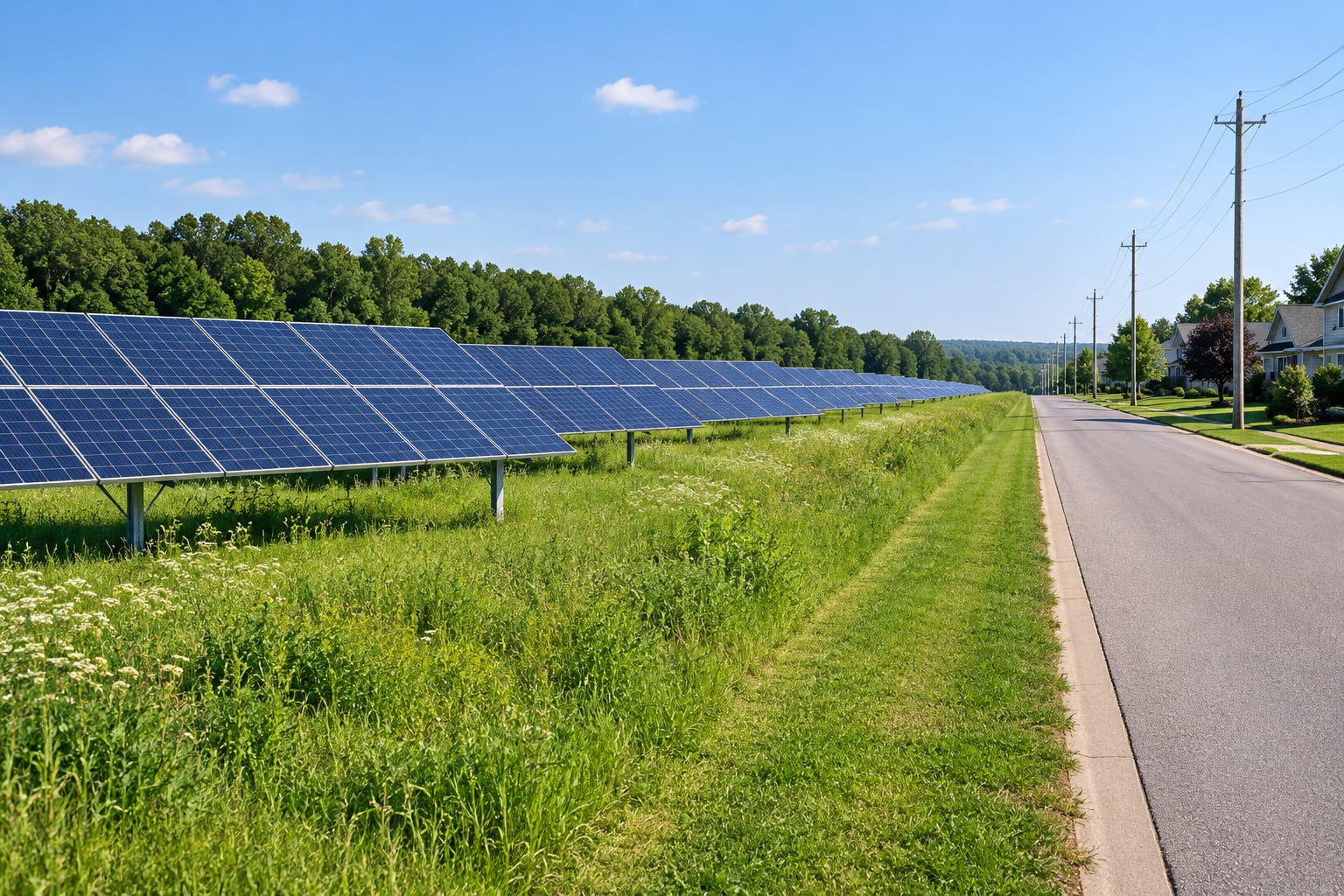
Community solar lets you subscribe to a share of a solar farm built near your utility, without putting a single panel on your roof. The array generates electricity, your utility credits the value of your share to your bill, and you pay the project a small fee for those credits. Nothing gets installed at your house, and you can join whether you rent or own.
Most households hear the words community solar and picture panels on a barn roof down the road. That part is right. What surprises people is that the panels are not the product you buy — the bill credit is.
Table of Contents
- What Is Community Solar?
- Who it is built for
- How Community Solar Works From Signup to Bill
- 1. You check your utility territory
- 2. You review the projects open to you
- 3. You pick a subscription size
- How you get matched to a shared solar array
- 4. The array generates and credits land on your statement
- 5. You pay the project for the share
- How the Monthly Electricity Bill Changes
- Do You Own the Panels or the Energy?
- How Much Does Community Solar Cost?
- Is Community Solar Worth It for Homeowners and Renters?
- Signs it fits
- Reasons people walk away
- Community Solar vs. Rooftop Solar
- How to Join a Community Solar Project
- Frequently Asked Questions
- Can renters join a community solar project?
- Do I own the solar panels in a community solar project?
- How are community solar credits calculated?
- What happens if I move or stop using electricity?
- Does community solar always lower my electricity bill?
- Is community solar the same as buying renewable energy certificates?
- Where to Start
What Is Community Solar?
Community solar is a shared renewable energy model where subscribers receive bill credits on their utility bills for their portion of the electricity generated by a local solar farm.
The developer builds or leases an array of panels, usually on farmland or a brownfield site. Everything the array produces goes onto the shared grid, and the utility credits each subscriber based on the share they bought.
It differs from rooftop solar in one fundamental way. With rooftop panels, the panels are physically attached to your home and your meter runs backward when you generate more than you use. With community solar, the electricity never touches your property at all — it is generated somewhere else and turned into a line item on your statement.
It also differs from buying renewable energy certificates. A certificate is a bookkeeping instrument that claims the environmental attributes of renewable generation somewhere, anywhere, and it does nothing to your bill. Community solar has to be physically sited in your utility territory for the credits to work, so it changes your actual electricity costs.
Who it is built for
Renters and apartment residents are the biggest group, because there is no roof to install on. Condo owners, homeowners with heavy shade or a roof that is too old to carry panels, households planning a move in a few years, and people who simply cannot fund a rooftop system all fit the model.
Small businesses, nonprofits, schools and municipalities can subscribe too, usually in larger blocks. If you want local renewable generation on someone else’s meter, this is the mechanism.
How Community Solar Works From Signup to Bill
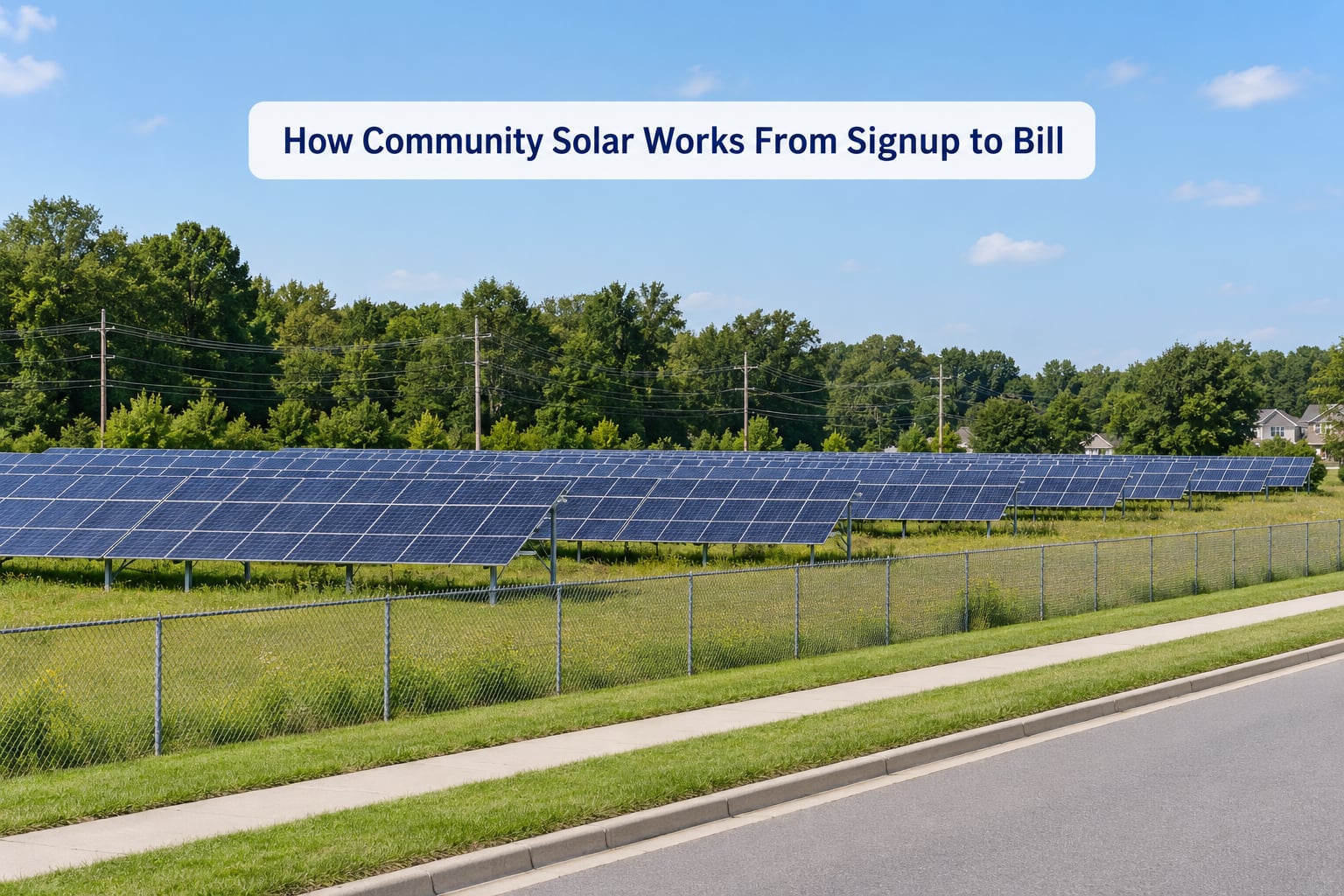
The process runs in five steps, and none of them involve a contractor knocking on your door with a roof estimate.
1. You check your utility territory
Community solar credits only work if the project sits inside your utility’s service area. Start by confirming that community solar is enabled for your utility and state, because the rules are set state by state and a handful of states still have no program at all.
2. You review the projects open to you
Most projects run open enrollment windows, and a subscriber list fills up. Some projects also reserve capacity for income-qualified households through state programs such as Solar for All, where a subscription can come at no cost to the household.
3. You pick a subscription size
You choose roughly what share of your own electricity use you want covered — many projects let you subscribe for a portion of your usage or all of it. The project then reserves that share of the array’s expected output for you.
How you get matched to a shared solar array
Your electricity does not travel from the farm to your meter. Instead, the project sells its output to your utility or to a market participant, and the utility applies the credits to your account on your behalf. The matching is administrative: your share of a bigger pool of kilowatt-hours, settled on your monthly statement.
That settlement mechanism is usually called virtual net metering — credits applied to a bill for generation that happened elsewhere on the same grid.
4. The array generates and credits land on your statement
Every month the farm produces kilowatt-hours, and each subscriber’s share shows up as a credit line on the utility bill. Some utilities show it as a line item. Others net it against the amount you owe. Either way, your normal electricity use is billed first and the credit comes off after.
5. You pay the project for the share
You pay a subscription fee to the company that built and operates the array, and that fee is usually below what you would have paid the utility for the same kilowatt-hours. It is the gap between the two rates that makes up your saving.
How the Monthly Electricity Bill Changes
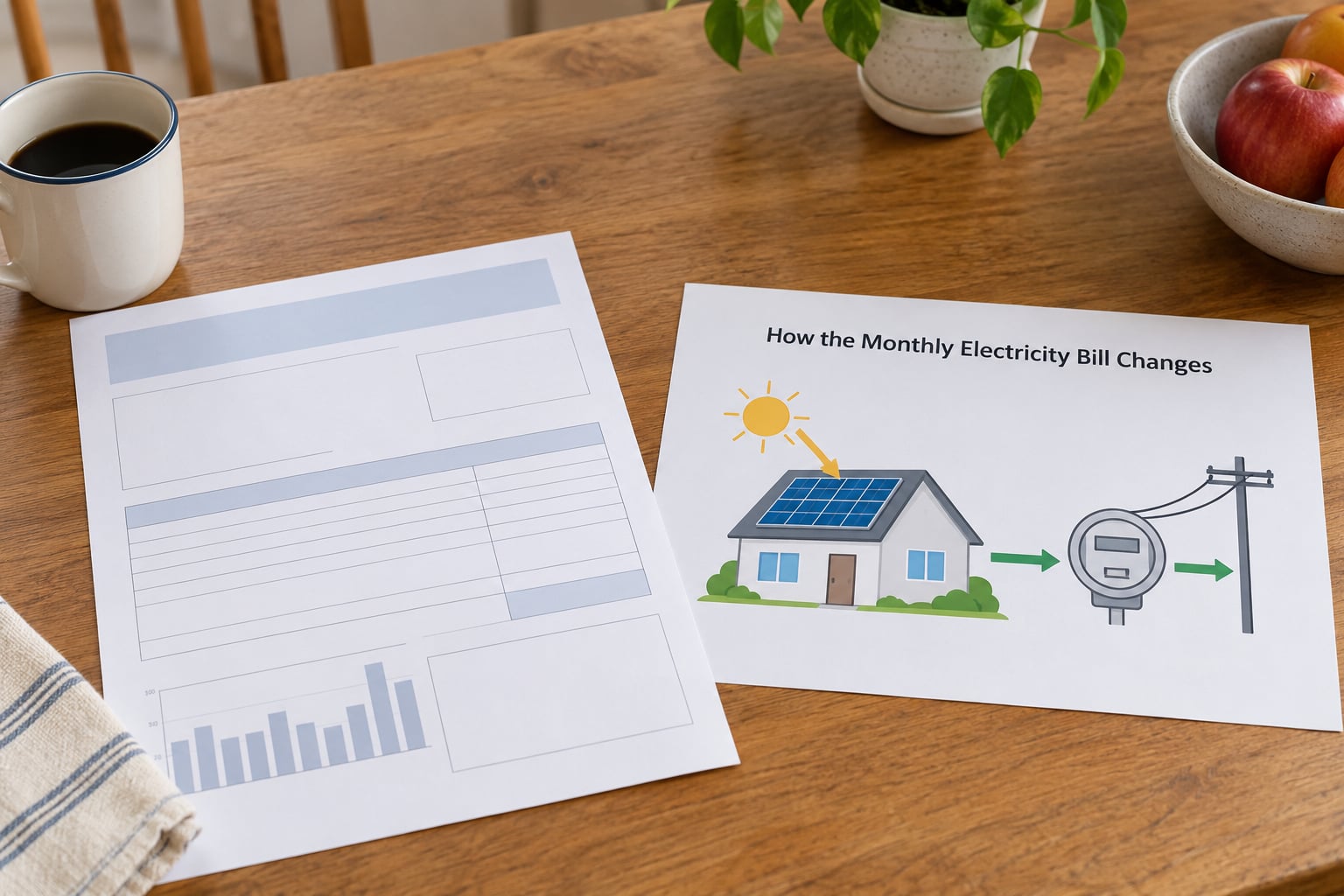
Here is the arithmetic behind a subscription, using round numbers for a single summer month.
The shared array produces 100,000 kWh in the month. The project has 200 subscribers with equal shares, so each one is credited 500 kWh.
A household in that group used 600 kWh that month. They are billed for 600 kWh by the utility, then the 500 kWh subscription credit is applied, leaving 100 kWh at the normal retail rate. The unused 100 kWh of credit carries forward rather than expiring, which matters a lot for a household whose use drops in a mild month.
| What the number means | This example | Where it shows up |
|---|---|---|
| Electricity the household used | 600 kWh | The utility’s usage charges |
| Electricity the array generated | 100,000 kWh | Nowhere on your bill |
| Your share of that generation | 500 kWh | The credit line |
| Credits actually used | 500 kWh | Applied to the bill |
| Credits left over | 100 kWh | Carried to the next month |
Three different numbers get confused here, and keeping them straight saves a lot of head-scratching: production is what the farm made, assigned credits are your slice of it, and used credits are what actually offset a bill you owe.
Avoided export charges are the other thing to understand. Many utilities no longer let households be paid for the excess energy their own panels push onto the grid. A community solar subscriber avoids that whole question, because you are billed only for what you use, and you receive exactly the share you paid for.
Do You Own the Panels or the Energy?
You own neither, in the ordinary sense. What you buy is a subscription: a contractual share of the project’s output for a set term.
Terms commonly run for 10 to 25 years with an annual price adjustment built in, and some contracts auto-renew. There is no asset you can sell, refinance or remove. That is also why there is nothing to maintain and nothing to insure.
Ending a subscription usually means either transferring it or letting it lapse, and the contract decides which. Transfer rules matter most for anyone who might move, so read that clause before you sign rather than after. Forum discussions about community solar keep circling back to exactly this: people who treated the subscription like a mortgage and then tried to sell the house were surprised by the terms they had agreed to.
How Much Does Community Solar Cost?
There is no single price, because projects are structured in a few common ways, and a subscription fee can sit in any of them.
Some projects charge a small one-time fee for setup, then a monthly subscription rate with a discount of roughly 10% against your utility’s rate for the same energy. Others price per kilowatt-hour on the credits they deliver, which is the closest thing to paying only for what you use. A few pair an upfront fee with a lower ongoing rate and no annual escalation.
The number that matters most is the discount percentage, not the headline fee. A modest fee paired with a solid discount usually beats a large setup fee and a thin discount, especially if you expect to move before the contract term ends.
A realistic comparison takes four steps. Write down your last twelve months of actual kWh usage from your utility statements. Ask each project for the exact discount rate against your utility’s rate for the same period. Add every fee the contract mentions, including setup, escalation and any early exit charge. Then compare the two totals for the same twelve months, rather than reacting to a single month’s statement.
On taxes, treat any claims carefully. Residential energy tax credits are generally written around owning generating equipment, and a subscriber does not own the panels. Ask the project and a tax preparer what documentation you will receive before you assume any benefit.
Rates, program rules and incentives vary by state and change often, so treat anything specific as a starting point for your own research, not a promise.
Is Community Solar Worth It for Homeowners and Renters?
For renters, the value is straightforward. You get the bill credit without needing permission from a landlord or a homeowners association, and nothing on the roof can be damaged by future work.
For homeowners, the case is more mixed, and honesty saves disappointment. If your roof is shaded, due for replacement, or your plan is to sell the house within a few years, a subscription avoids a large installation and a resale complication. If you own the house for twenty years with a good south-facing roof and the money to spend, owning panels usually beats paying a subscription for the same period.
Signs it fits
- You rent, or your property is a condo with shared roofing.
- Your roof is shaded or in poor condition.
- You have little budget for an upfront installation.
- You expect to move within the contract term.
- You want local renewable generation on your own utility account.
- You qualify for an income-eligible program with a no-cost subscription.
Reasons people walk away
- The provider takes a sales commission on the subscription, so a heavy-handed pitch is normal.
- Popular projects fill up and leave new subscribers on a waitlist.
- A subscription priced below the utility rate still costs money — it is not free energy.
- If a project underperforms or a provider struggles, your credits can shrink with little warning.
- Long contracts with auto-renewal and escalation clauses are hard to exit.
Ask any community solar sales organization directly how they are paid. The honest answer is a commission per subscription plus a share of project revenue over time, and hearing that explained plainly is a good sign.
Community Solar vs. Rooftop Solar
Community solar versus rooftop solar comes down to one question: do you want to own an asset, or do you want a discount on a bill?
| Criterion | Community solar | Rooftop solar |
|---|---|---|
| Do you own the equipment | No, you hold a subscription | Yes, it sits on your roof |
| Installation | None at your home | Panels, mounting, permit, interconnection |
| Upfront cost | Small or none | Thousands of dollars |
| Ongoing payment | Subscription rate below utility rate | Nothing for energy you generate |
| Maintenance | Project operator handles it | Your responsibility, plus inverter replacement |
| Renters eligible | Yes | No |
| Moves with you | Transferable, subject to terms | Stays with the house |
| Long-term return | Discount, capped by contract | Full value of generation you own |
| Shaded roof | Not a problem | Output drops sharply |
If you can install, finance and plan to stay, rooftop solar usually wins on long-run value. If you cannot install, or will not be there, community solar is the only realistic way to get local renewable credits on your bill.
How to Join a Community Solar Project
Work through these in order and the wrong project is much harder to end up in.
- Confirm your utility territory. Projects must be inside your utility’s service area for credits to apply.
- List what is open. Check each project’s capacity, location, enrollment window and expected first bill.
- Read the subscription terms. Look for the term length, annual rate adjustment, auto-renewal language and any cancellation charge.
- Estimate your credits. Compare your real usage history with the project’s projected output per subscriber and its discount rate.
- Check the transfer process. Ask what happens to the subscription if you move, and how long a transfer takes.
- Ask who takes the risk. Find out what happens to your credits if the project underperforms or the provider changes hands.
- Enroll through the project’s approved process and keep a copy of the contract, not just the confirmation email.
Give it a week before you sign. Sit with the statements and the contract, and come back to it.
Frequently Asked Questions
Can renters join a community solar project?
Yes, and most community solar subscribers are renters. There is no roof installation, so a landlord’s permission is not needed. You need a valid electric service account inside a utility territory where community solar is allowed. Many apartment residents also qualify for income-eligible programs that provide a subscription at no cost.
Do I own the solar panels in a community solar project?
No. You own a subscription share, not the panels. There is nothing to sell, refinance or remove, and nothing for you to maintain. Contracts commonly run 10 to 25 years with annual rate adjustments, so treat the subscription as a service agreement rather than an investment.
How are community solar credits calculated?
Your share is based on the kilowatt-hours the array produces in a billing period, divided among subscribers according to the size of each subscription. Your utility applies those credits to your account. Only the credits matching what you actually used reduce that bill, and unused credits normally carry forward.
What happens if I move or stop using electricity?
Your subscription can usually be transferred to a new service address, but the rules and timing come from your contract. Projects with a waitlist may hold the spot briefly or cancel it. If your usage drops sharply, your credits carry forward, so a low month is not lost value.
Does community solar always lower my electricity bill?
Not automatically. Most subscribers pay roughly 10% below their utility rate for the portion of energy covered, but the result depends on the discount, your fees and how well the project produces. If the array underperforms, your credits shrink. Always compare your own twelve months of usage before and after.
Is community solar the same as buying renewable energy certificates?
No. A certificate is a financial instrument claiming renewable generation from anywhere, and it does not change your bill. Community solar has to be physically located in your utility’s service area so the credits can be applied to your account. It affects real electricity costs, not just environmental accounting.
Where to Start
Pull your last twelve months of usage from your utility statements and write down the total in kilowatt-hours. Then find out whether your state allows community solar and which projects are enrolling subscribers in your utility territory.
Compare two or three projects on the same basis: subscription size, discount against your utility rate, every fee, and what happens to the subscription if you move. If you rent or expect to move soon, community solar is usually the only route to local renewable credits on your bill. If you own the home for the long haul with a workable roof, running the rooftop numbers is still worth an afternoon.