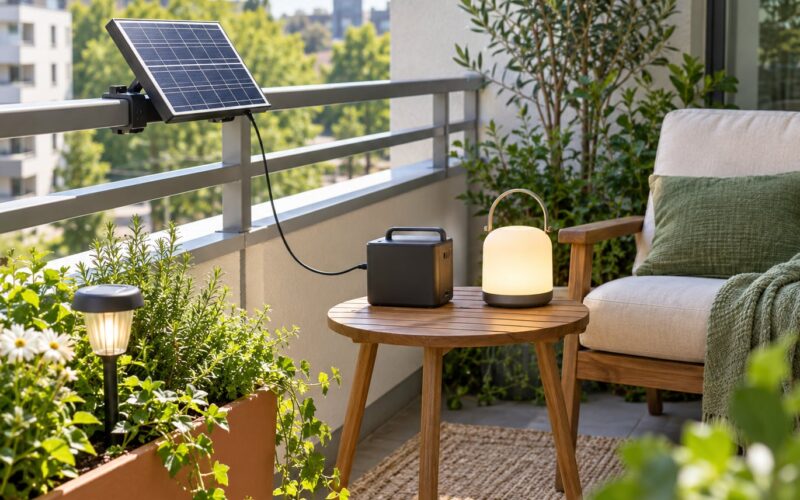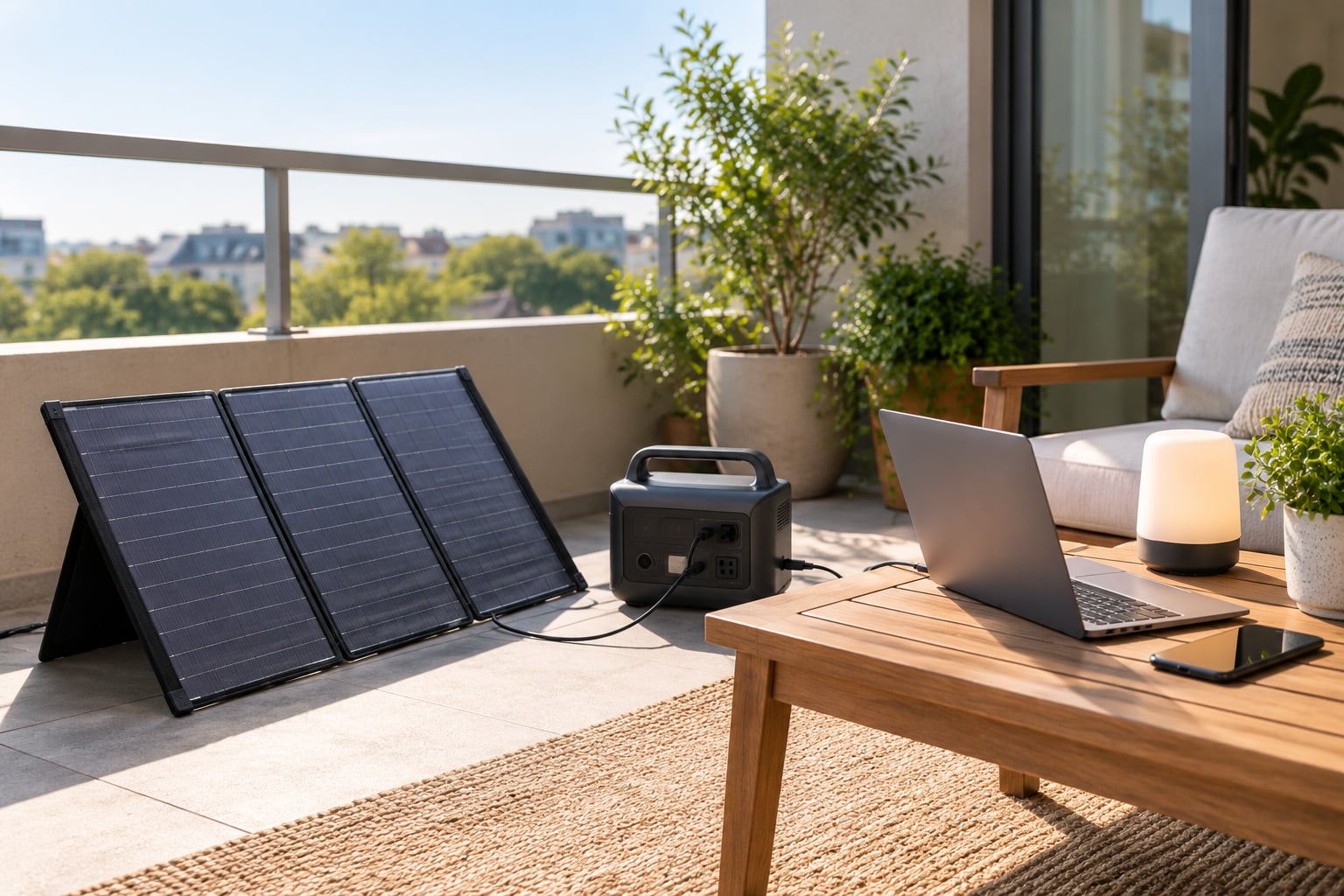
Portable solar panels for apartments are small solar arrays that plug into a normal wall outlet through a certified microinverter, sending power straight to your appliances instead of into a rooftop array. You clamp a panel to a balcony rail or set it on a patio, run one cable inside, and your meter starts running backwards a little. No drilling, no permits, no landlord’s roof.
Do they actually work? Yes, for the right target. A single panel does not run your air conditioning or heat an apartment. It offsets a slice of your everyday consumption — the router humming all day, the refrigerator cycling, a laptop charging, a lamp on during the evening — and that slice is real.
Most people come at this with the wrong question. They ask how many watts the panel is. The useful question is how many kilowatt-hours a day your apartment actually uses, and how many of them arrive while the sun is up.
Table of Contents
- How Do Portable Solar Panels for Apartments Work?
- What Can You Power With a Portable Solar Panel?
- How Much Solar Power Does an Apartment Need?
- Sizing portable solar panels for apartments without a roof survey
- What Size Portable Solar Panel Do You Need?
- Why a bigger battery can beat a bigger panel
- Can You Use Portable Solar Panels for Apartments?
- Battery or No Battery: Which Portable Solar Setup Fits?
- How to Set Up a Portable Solar System Safely
- What to Look for When Buying Portable Solar Panels
- Frequently Asked Questions
- Can I use a portable solar panel in an apartment?
- Do portable solar panels work indoors or through a window?
- How long does a portable solar panel take to charge a power station?
- Can portable solar panels run a refrigerator?
- Is a larger solar panel always better?
- Can I connect portable solar panels to my apartment’s mains electricity?
- Conclusion
How Do Portable Solar Panels for Apartments Work?
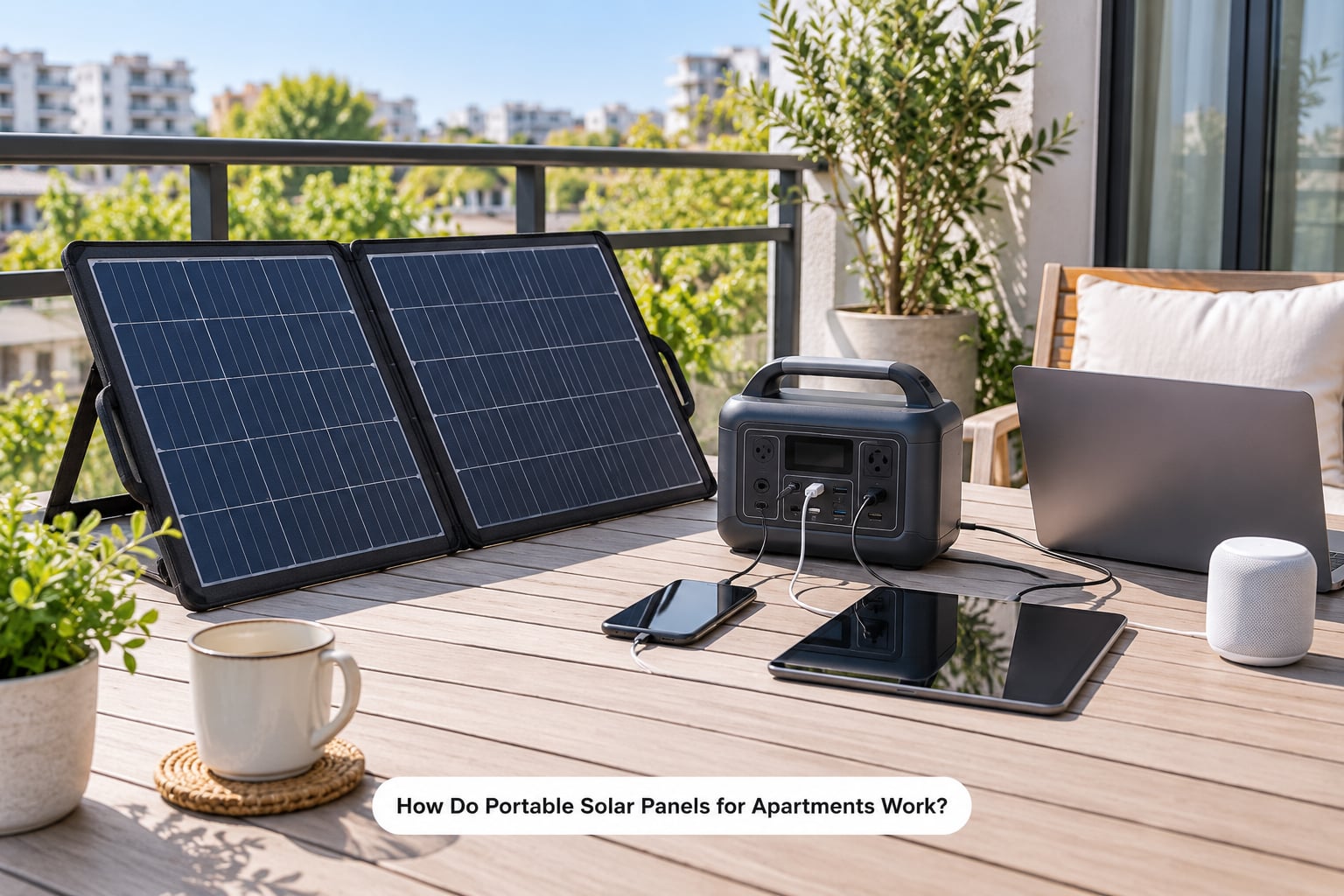
The chain is three parts long, and each one has a job. The panel makes direct current, a microinverter turns it into household alternating current, and the outlet delivers it to your sockets. That’s the whole system.
The panel converts sunlight into DC electricity. Panels rated 200W to 800W cover most apartment use. The watt number is a laboratory peak — real output is lower, and we’ll get to why.
The microinverter is the part people skip and shouldn’t. It does the DC-to-AC translation, matches the grid frequency, and shuts down the moment grid power disappears. That last function is called anti-islanding protection, and it’s a safety requirement, not a feature.
The outlet should be a GFCI-protected receptacle on a dedicated circuit. Extension cords and power strips are not acceptable for this, and a second system on the same circuit will trip it.
A battery is optional. Most plug-in solar sends power straight to whatever is running at that moment and relies on the grid for everything else. Add a battery and you can store the midday surplus for the evening, which is where the money is if you’re on a time-of-use rate.
Look for UL 1741 certification on the inverter and UL 3700 for the plug-in solar assembly as a whole. If a listing shows neither, walk away.
What Can You Power With a Portable Solar Panel?
Start with what a 400W panel produces on a clear day: roughly 1.5 to 2.0 kilowatt-hours, and call it 1.7 for planning. That’s the budget you’re working with, and the table below spends it.
| Device | Typical draw | What 1.7 kWh covers |
|---|---|---|
| Wi-Fi router | 10-15 W | Runs around the clock, with plenty over |
| LED lamp | 10 W | About 170 lamp-hours |
| Laptop charging | 45-65 W | Around 28 hours of charging |
| 40-inch TV | 90-110 W | About 17 hours |
| Refrigerator | 100-200 W while cycling | Compressor cycles comfortably covered |
| Blender or kettle | 500-1,500 W | A few short bursts, not a long session |
| Space heater | 1,200-1,500 W | Effectively nothing |
| Electric vehicle | 2,400-7,000 W | Not a realistic target for a panel |
Those hours are equivalent runtime from one day’s production, not hours you can sit and watch the panel deliver. Panels only generate during daylight, which is why a battery changes what this table means.
How Much Solar Power Does an Apartment Need?
Estimate from your devices, not from the panel’s wattage. Add up what runs continuously — router, modem, a set-top box, a desktop left on — then add the appliances you use daily, then divide by the hours you’d rather not think about.
A typical work-from-home apartment runs around 1 kWh a day on the quiet stuff: a router and modem at 15 W, a refrigerator cycling to roughly 1.5 kWh over 24 hours, a lamp, a laptop, a monitor. That’s the baseload, and offsetting it is where the savings compound.
Now check when you use it. Solar arrives midday on weekdays, when you’re out. If your real usage sits in the evening, a battery matters far more than another 200W of panel.
Sizing portable solar panels for apartments without a roof survey
Divide your daily kilowatt-hours by the number of peak sun hours your spot gets, usually three to five. At 4 hours, a 1 kWh daily load lands around 250W of panel. Add 20% for conversion losses and real weather. Then compare that number against how much sun actually reaches your balcony.
Orientation matters more than any other single factor. A south-facing unobstructed balcony in a low-rise building can do well. A north-facing balcony between two towers produces a fraction of that, and no panel size fixes it.
What Size Portable Solar Panel Do You Need?
Match the panel to your daily kilowatt-hours and your sun hours, then buy a battery sized to the part of your usage that falls after sunset. The panel sets the ceiling; the battery sets how much of it you can actually keep.
Why a bigger battery can beat a bigger panel
A 400W panel with no battery sends every watt it makes to whatever is switched on at that moment, and the rest to the grid at whatever your utility pays for exported power. Export compensation is often a fraction of your retail rate, so surplus has limited value.
Store it instead and the same kilowatt-hour offsets a 30-cent evening kWh instead of a few-cent export. That single change often returns more than adding a second panel would.
Buy the panel with expansion in mind — a model that accepts a second panel in series means you can start at 400W and grow.
Can You Use Portable Solar Panels for Apartments?
Yes, with two separate permissions. One is your landlord’s, because the unit isn’t yours. The other is your state’s, because grid-interactive plug-in solar has only been legal in a growing number of states and the rules change monthly.
Utah passed the first authorizing law in 2025. Since then several states have followed, most capping the inverter at 1,200W with Colorado sitting higher at 1,920W. As of 2026, grids that haven’t authorized plug-in solar generally treat a grid-tied system as unavailable, so check your state’s energy office before you buy.
Placement options, roughly in order of ease: a balcony rail clamp, a weighted kickstand on the patio or ground, a south-facing windowsill, or a shared yard spot if your building allows it. Nothing here requires a hole in the railing.
For your landlord, the ask is small and easy to grant: no drilling, no roof access, no structural changes, a GFCI outlet already in the wall, and a written agreement that you remove it and repair any mark when you move. Put those five things in an email and most objections disappear.
Two apartment risks get ignored. Wind loading on a high-floor rail clamp can send hardware past pedestrians below, so weight the base properly and take the panel down in a storm. And a cable run from balcony to window has to stay out of walkways and out of the rain gutter line.
An off-grid power station is a different story entirely. It stores energy and powers your devices directly, so no state authorization applies and your landlord’s electrical concerns mostly evaporate.
Battery or No Battery: Which Portable Solar Setup Fits?
Match the setup to how much of your usage happens at night. Daytime-only usage needs no battery; heavy evening usage does.
Direct charging, no battery. Smallest and cheapest, often a folding panel with a built-in controller and USB ports for a phone or a small lamp. Nothing runs through your walls at all. Good for a desk setup, terrible for anything bigger.
A small power station. A battery of roughly 500 to 1,000 watt-hours with AC outlets, a couple of USB-C ports and a car socket. This is the sweet spot for most apartments: it powers a laptop, a monitor, a router and lights for a few hours after dark, and it moves between rooms in one hand.
A larger portable solar generator. Several kilowatt-hours of storage, pure sine wave output, sometimes an expansion port for extra panels. It can start a small refrigerator or keep a laptop and router alive for a night or two in an outage. It also weighs 50 to 100 pounds, so plan where it lives and who carries it.
Budget follows the same line. If your goal is offsetting a baseload, a mid-size power station gets you most of the return. If you’re chasing whole-home backup, you’re looking at a much larger purchase that still won’t heat an apartment.
How to Set Up a Portable Solar System Safely
- Pick the spot first. Unobstructed sun, south-facing if possible, and close enough to your outlet that the cable reaches without a trip hazard across a walkway.
- Mount securely. Clamp or weight the panel. Nothing leans unsecured on a railing in wind.
- Check the connection order. Battery to power station, power station to panel controller. Your manual’s order is the correct one.
- Confirm battery compatibility. Voltage and chemistry have to match the power station’s input, and mixing an unmatched pack is how people damage a battery.
- Keep it ventilated. Power stations generate heat while charging. Leave clearance on all sides and never run one inside a closed closet.
- Run one protected cable. Outdoor-rated cable, no extension cord, no power strip, no running it under a rug or through a door gap.
- Verify output before you plug anything in. The display should show incoming solar power and a rising battery percentage before you connect a device.
- Test the outlet. If a GFCI trips, unplug and find the load. Do not reset it repeatedly and keep hoping.
When in doubt, a licensed electrician should look at any wiring you don’t already understand. Low-voltage equipment is safe when it’s certified and connected the way the manufacturer intended.
What to Look for When Buying Portable Solar Panels
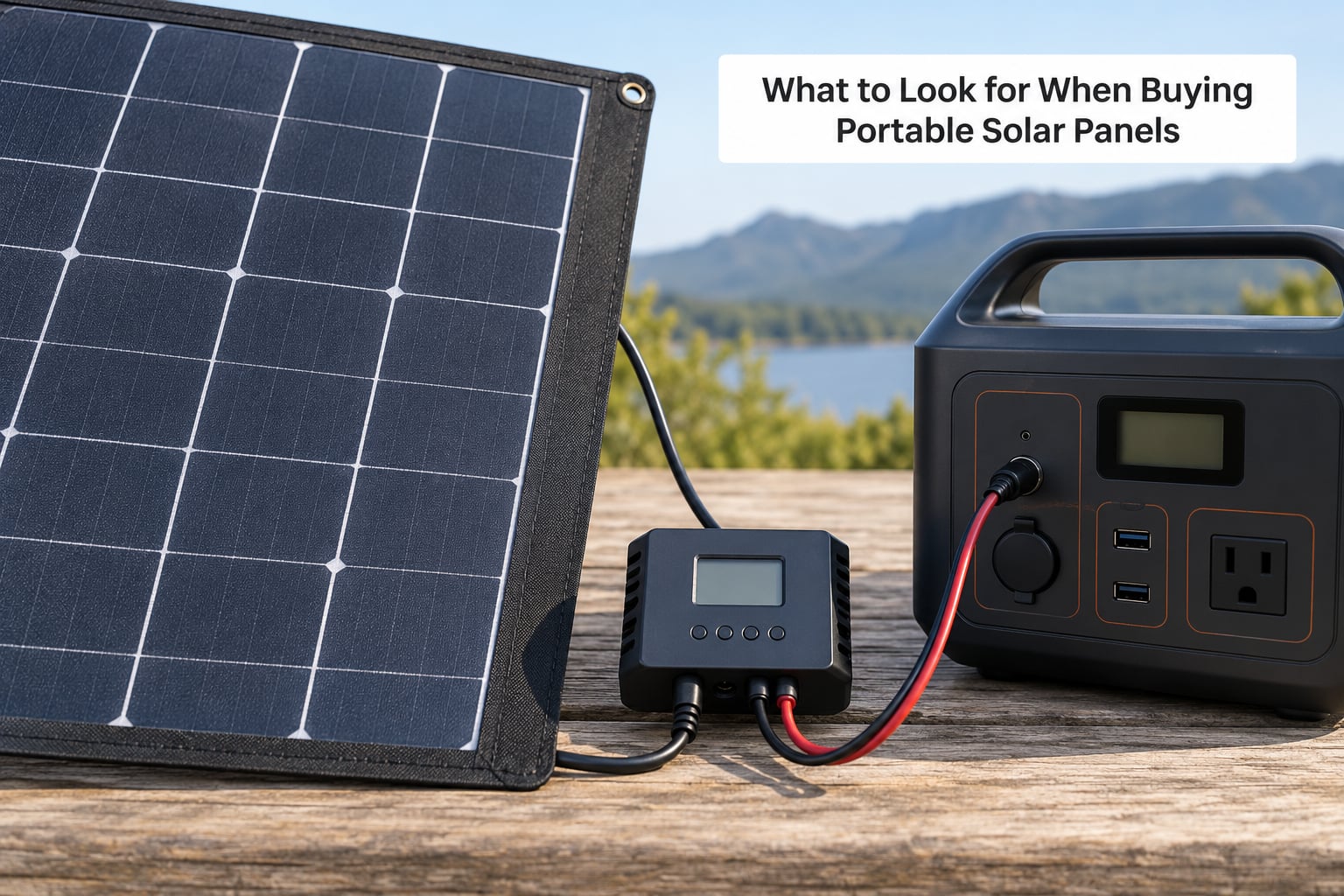
Certification first, output second. Here’s what actually matters, in the order I’d check it.
UL 1741 and UL 3700 listings on the inverter and the assembly, plus anti-islanding as standard. These are non-negotiable.
A dedicated GFCI receptacle, confirmed before you buy. If your apartment doesn’t have one, the electrician conversation comes first.
Zero-export control, usually managed through a CT clamp or a paired meter. Some utilities require it, and it changes how your system behaves on a grid-tied home.
Panel efficiency and construction. Monocrystalline cells give more watts per square meter than polycrystalline. Bifacial panels pick up light bounced off a balcony floor or wall, which can add a few percent.
Portability. Check the packed weight, not the listed wattage. A 200W panel you can carry up three flights of stairs is worth more to a renter than 400W you can’t.
Weather resistance and wind rating. Look for a wind load rating and a tempered-glass surface, and use the mounting hardware supplied rather than anything improvised.
Warranty and monitoring. Five years on panels and two to three on the power station battery is the common range. A real-time app showing live generation is genuinely useful, because it’s how you notice a panel sitting in shade.
Frequently Asked Questions
Can I use a portable solar panel in an apartment?
Yes, and it’s the setup most designed for rented units. A panel clamped to a balcony rail or set on a patio plugs into a GFCI wall outlet through its microinverter. You need your landlord’s written permission and, for a grid-tied system, a state that has authorized plug-in solar. A battery-only power station sidesteps both.
Do portable solar panels work indoors or through a window?
Barely. Solar cells need direct light, and glass plus filters typically cut output to a small fraction of what the same panel produces outdoors. A panel sitting in a window will show a charging indicator and generate a trickle that won’t move your meter. Set it outside in direct sun and run the cable in through the window frame.
How long does a portable solar panel take to charge a power station?
A 400W panel in full sun delivers roughly 300W after conversion losses, so a 1,000 watt-hour battery takes about four hours from empty. Add the power station’s own charging draw and budget five. In winter, under clouds, or on a shaded balcony, double it — a full day of weak sun may be all you get.
Can portable solar panels run a refrigerator?
A refrigerator is one of the better matches, because its compressor cycles rather than running continuously. A panel in the 200W to 400W range can cover a small fridge’s daily consumption, especially if you add a battery to hold midday surplus for the night. Check the fridge’s running watts on its label and size above them.
Is a larger solar panel always better?
No, not without a battery. Extra panel wattage you can’t store becomes export, and exported power is usually credited at a fraction of your retail rate. A modest panel plus a decent battery usually returns more money than a large panel alone. Bigger is only better when you have room to store what it makes.
Can I connect portable solar panels to my apartment’s mains electricity?
Only through the equipment’s own certified microinverter, into a GFCI-protected outlet, and only where your state has authorized plug-in solar. Never connect a panel directly, never use an extension cord, and never bypass the inverter. Most states cap these systems at 1,200W per unit, and the rules shift regularly.
Conclusion
The first decision isn’t which panel to buy. It’s listing what you actually want to run and how many kilowatt-hours that comes to over a day.
Once you have that number, pick the setup your apartment supports: how much sun reaches the balcony, how much space the panel can occupy without falling on anyone, whether your landlord will sign a no-drill agreement, and whether you need power after dark. Get the sunlight and the paperwork right, and the hardware choice gets easy.