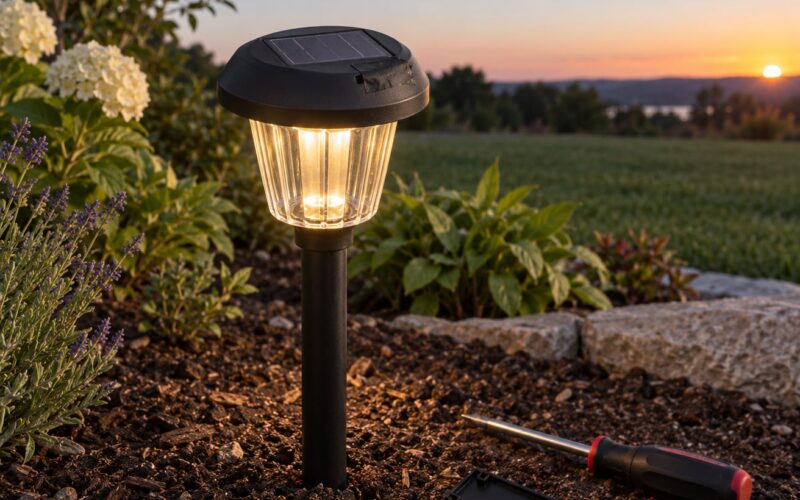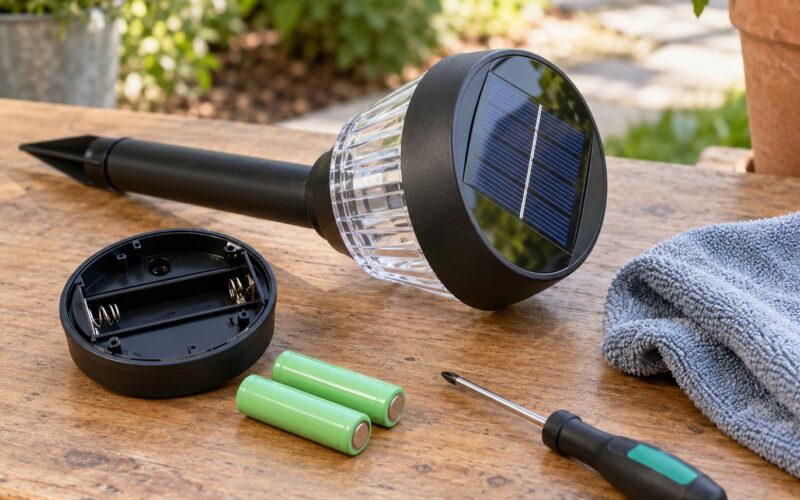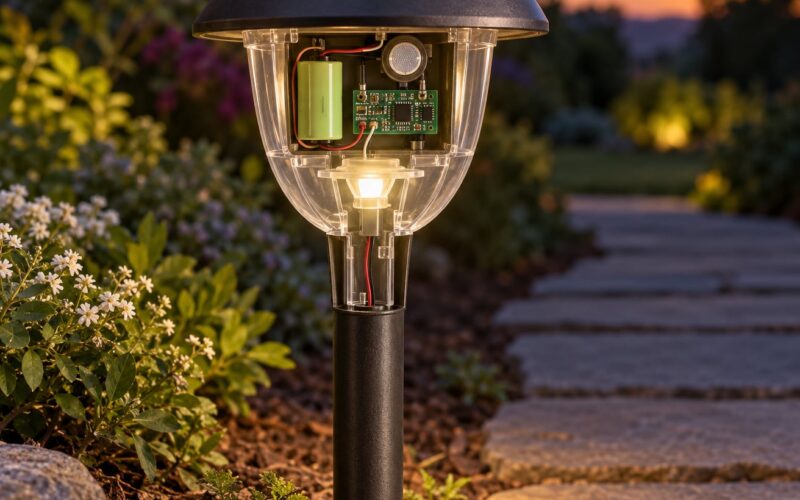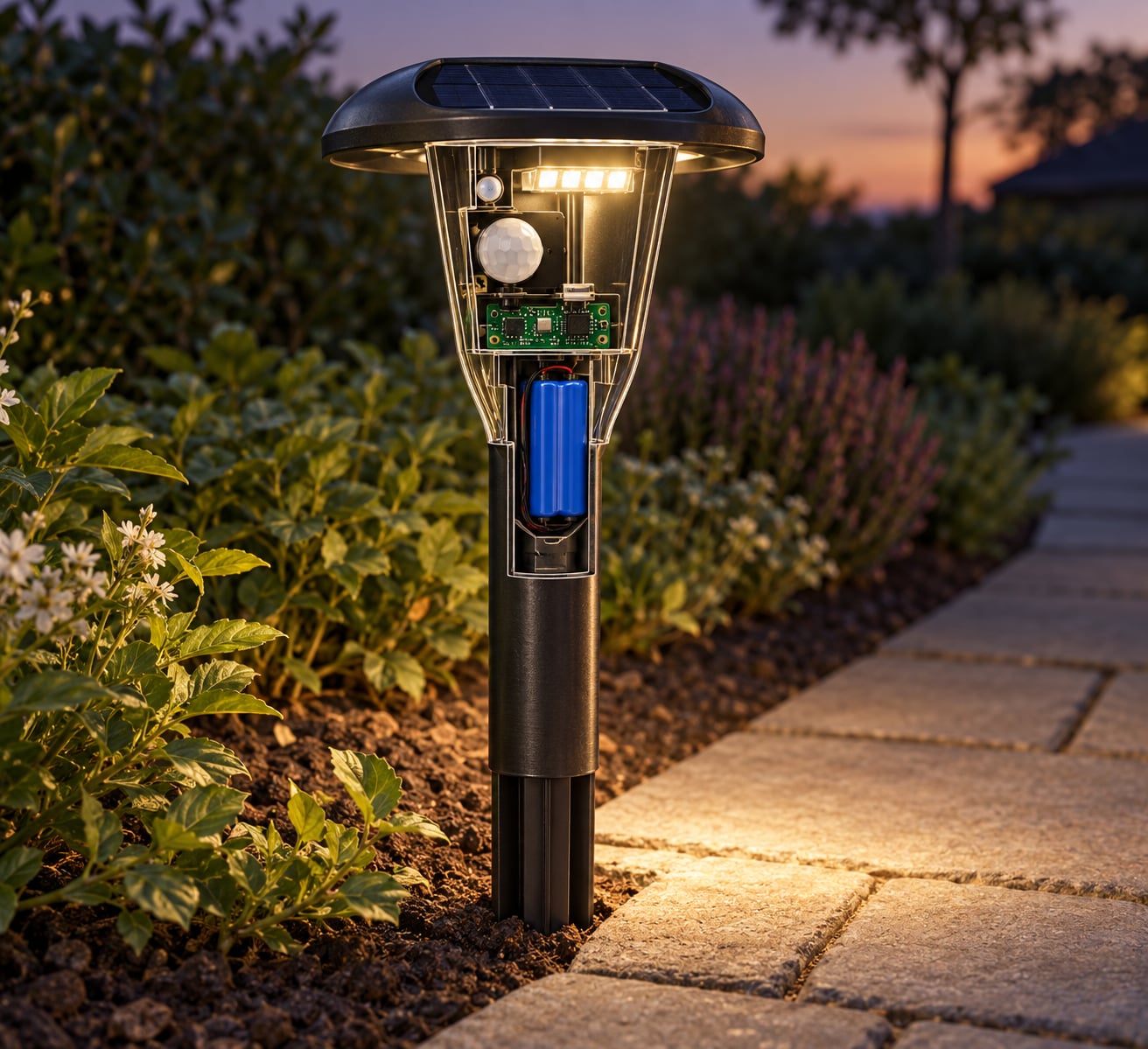
A motion sensor solar light charges a rechargeable battery from its panel during the day, then a light sensor wakes the fixture at dusk. When something moves inside the detection zone, the LED snaps to full brightness for a set number of seconds, dims or switches off, and the panel starts recharging. That charge, sense, light, reset loop is the whole design.
What you get out of a motion sensor solar light depends almost entirely on how the two halves line up. The charging half runs on sun, and the sensing half runs on placement and aim, so a lamp in the wrong spot can never be rescued by a better sensor.
Table of Contents
- How Motion Sensor Solar Lights Work at a Glance
- What Happens When Motion Is Detected?
- How the timer shapes each burst of light
- Which Parts Make Up a Motion Sensor Solar Light?
- What Is the Difference Between PIR and Microwave Sensors?
- What a passive infrared sensor actually sees
- Why Do Solar Lights Have a Dusk Sensor?
- How Do the Lighting Modes and Timer Work?
- How to Get Reliable Motion Detection
- Why Might a Motion Sensor Solar Light Stay On or Stay Off?
- Frequently Asked Questions
- Do motion sensor solar lights work in winter?
- Can a motion sensor solar light detect movement through a window?
- Why does my solar light flash instead of staying off during the day?
- How long should I leave a new solar light in direct sunlight before using it?
- What is the best height and angle for a motion sensor solar light?
- Conclusion
How Motion Sensor Solar Lights Work at a Glance
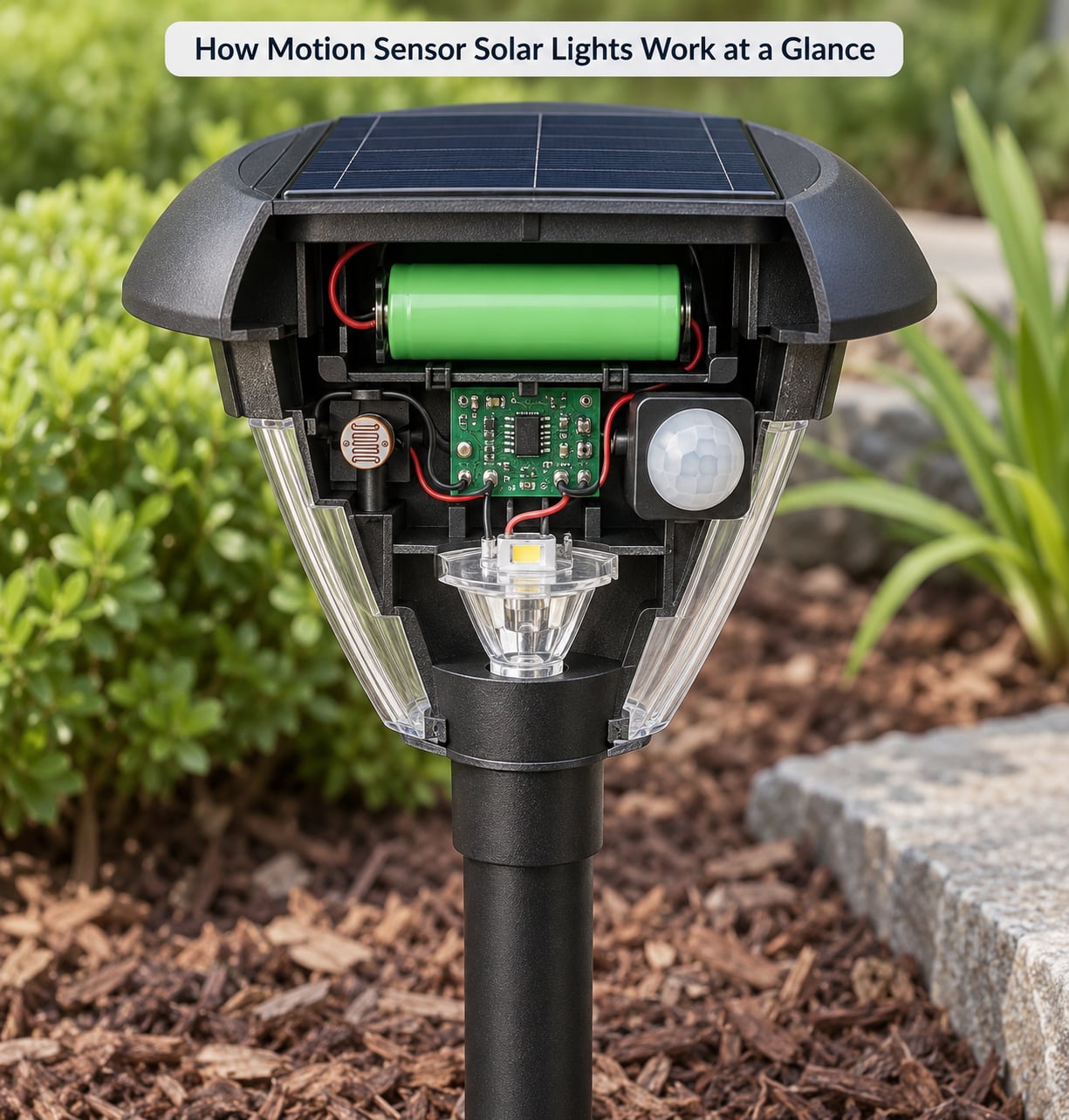
Four things have to cooperate for one of these lamps to do its job. The panel and battery store energy, the light sensor decides when night has arrived, the motion sensor decides whether anyone is there, and the LED spends the stored energy. Everything else is weatherproofing and a few dials.
| Part | What it does |
|---|---|
| Solar panel | Converts sunlight into a small current, usually from a fraction of a watt up to a couple of watts depending on the lamp size. |
| Rechargeable battery | Holds that charge so the light can run after dark. Usually a Ni-MH cell pack, sometimes lithium. |
| Charge controller | Regulates how fast the battery accepts charge and stops it from overcharging or draining flat. |
| Light sensor (photocell) | Measures ambient light and holds the lamp switched off until it gets dark. |
| Motion sensor | Detects movement inside a detection cone, typically a passive infrared or microwave module. |
| LED array | Turns stored energy into light, with output ranging from a soft path glow to a few hundred lumens on brighter wall packs. |
| Control circuit | Reads the sensors, applies the timer and mode settings, and switches the LED on and off. |
Note the split between storing energy and detecting things. Panel and battery decide how long you get light, sensors decide when it starts and whether it stays on. That distinction matters every time a lamp misbehaves.
What Happens When Motion Is Detected?
The cycle runs in a fixed order, and each stage depends on the one before it. Here it is for a typical path light beside a garden gate.
- Charging, all day. The panel feeds current through the charge controller into the battery. A shaded spot or a dusty panel means a smaller charge, and the lamp will not magically make it up at night.
- Dusk trigger. As light drops below the photocell’s threshold, the circuit closes and arms the fixture. On many lamps this also turns the sensor itself on.
- Arming. The motion sensor is now powered and listening. Nothing happens until the detection cone reports a change.
- Detection. Something moves within range and angle. The sensor’s signal changes and the control circuit routes power to the LED.
- Illumination. The LED runs at full brightness. On a timer with a set duration, or in continuous mode if you have chosen it.
- Timeout and reset. When movement stops, a countdown starts. When it ends, output drops to a dim standby level or off, the sensor goes quiet again, and the next sunny day refills the battery.
Two details hide in that list. First, detection only works while the fixture is armed, so a lamp that never triggers in daylight is behaving normally. Second, every trigger spends stored energy, so a light that false-triggers all night can leave the battery too flat to reach full brightness the following evening.
How the timer shapes each burst of light
The timer is the piece most people never touch, and it decides how long a single trigger lights your path. Short settings suit a doorstep where someone walks past in three seconds. Long settings suit a driveway where a car backs in slowly. The cost of a long setting is simple: more minutes of LED time means a bigger draw on the battery each night, and in winter that is the difference between reaching dawn and going dark at midnight.
Which Parts Make Up a Motion Sensor Solar Light?
Seven components do the work, and it helps to know which one is failing before you start taking things apart.
Solar panel. Converts light into electricity. Small path lights often use amorphous silicon panels, which put out less than crystalline panels but survive shade and partial daylight better.
Rechargeable battery. Stores the charge. Ni-MH packs are the traditional choice in garden lights, lithium variants are appearing more often, and this cell is normally the part that dies first.
Charge controller. A small circuit that limits charging current, prevents overcharging on long sunny days and cuts the battery off before it flattens completely. Skip it and the cells age fast.
LED and driver. The driver is the small electronics module that converts battery voltage into the constant current the LEDs need. Modern LEDs last tens of thousands of hours, so brightness rather than lamp life is the usual limit.
Light sensor. A photoresistor or small photodiode that measures ambient light. It both holds the fixture off during the day and tells the circuit when dusk has genuinely arrived rather than when a cloud passes.
Motion sensor. The detection head. It is either passive infrared or microwave, and each reacts to a different kind of movement.
Control circuit. A microcontroller that reads all of the above, applies the mode switch and timer, and drives the LED. On inexpensive lamps some or all of this logic lives in one chip behind the sensor window.
Battery chemistry is worth a moment on its own, because it decides service life more than any other part. Ni-MH packs tolerate cold poorly and gradually lose capacity over one or two seasons. Lithium packs hold more energy per cell and recover better from deep discharge. Either way, brightness and trigger reliability tend to drop before the light goes completely dark.
What Is the Difference Between PIR and Microwave Sensors?
Both sensors report movement, but they detect completely different things. Passive infrared watches for changes in heat, microwave sends out a radio signal and listens for echoes.
| Passive infrared (PIR) | Microwave (Doppler) | Dual-technology | |
|---|---|---|---|
| What it detects | Change in infrared heat across its field of view | Change in reflected radio energy in a defined zone | Both, and requires the two to agree |
| Typical range | Around 10 to 16 ft on small path lights, longer on wall packs | Often 20 ft or more depending on the unit | Follows the PIR range |
| Typical angle | About 120 degrees, sometimes 180 | Wider coverage, often a broad cone | About 120 to 180 degrees |
| Common blind spots | Objects moving straight toward it, and crossing its warm background | Very still or very slow movement | Reduced, since both signals must line up |
| False triggers from | Animals, moving branches, warm windows, dryer vents | Wind in foliage, rain, passing vehicles at range | Fewer, because one signal alone is not enough |
| Through walls or glass | No, it needs a line of sight across its field | Often yes, since radio waves pass through thin material | Limited by the PIR half |
| Best suited to | Paths, entries and backyards with clear side-to-side crossing | Open drives and wide areas with sparse coverage | Visible entrances where you want fewer false alarms |
That through-wall behaviour is the single biggest reason people are surprised by microwave lamps. A microwave unit can report motion in a spot where nobody is standing, because it is reacting to something on the other side of a shed wall. It is a genuine feature for a dark driveway, and a genuine annoyance next to a bedroom window.
What a passive infrared sensor actually sees
A PIR sensor does not emit anything. It reads the infrared radiation coming off nearby surfaces and watches for that picture changing. When a warm body crosses its field of view, the pattern shifts and the sensor triggers. That is why a PIR lamp catches you best when you walk across its cone rather than straight at it: walking at it produces far less change across the field than crossing it does.
It also means a PIR sensor still works in complete darkness. Infrared detection is independent of visible light, so a path light fires just as well on a moonless night as on a bright one.
Why Do Solar Lights Have a Dusk Sensor?
The dusk sensor exists so the lamp does not waste its charge in daylight. It is a light meter wired into the control circuit, and it does three things at once: it keeps the LED off while there is enough sun to charge, it tells the circuit when to arm the motion sensor, and it overrides the sensor if the lamp is being tested in bright conditions.
Most photocells are simple on-off devices with a threshold, but the more capable ones have a delay built in. That delay stops a passing shadow or a gust of cloud from waking the lamp up at two in the afternoon, and it stops the lamp from switching off the moment the sun briefly peeks through.
Where the sensor sits matters. On a path light it usually faces the sky from under the cap, but a wall pack mounted flush against a shaded wall can see so little daylight that the lamp triggers at two in the afternoon. Repositioning or covering the cell with the supplied sticker is often the whole fix.
How Do the Lighting Modes and Timer Work?
Almost every solar motion light in a garden centre has the same three physical controls, usually moulded into the housing rather than printed on a box.
ON, OFF, AUTO switch. AUTO is normal running: charge in the day, detect at night. ON usually forces the light on continuously so the panel can charge the battery more aggressively during poor weather, and OFF stops all output. Leave it in ON overnight and you will flatten the pack before the first week is out, so use OFF or AUTO for anything longer than a charging afternoon.
LUX dial. Sets how dark it must be before the lamp triggers. The sun symbol is daytime operation, the moon symbol is night only. Turn it toward the sun and the lamp will respond to movement in daylight, which is occasionally useful for testing.
TIME dial. Sets how many seconds the LED stays on after movement stops, on most fixtures somewhere between five seconds and a couple of minutes.
SENS dial. Adjusts how much change is needed to count as movement. Turned too high you get squirrels and moving branches; too low the lamp reacts to a warm updraught.
As for the lighting modes themselves, there are really three. Continuous mode keeps the LED at a set brightness all night, which looks nice but drains the pack and leaves little for detection. Motion-activated mode is full brightness on trigger, then off, and it is what most people want. Dim-to-bright is the compromise: a low standby glow most of the night that jumps to full output on movement. It is gentler on the battery than continuous mode while still marking the path, though it needs more stored energy to do it.
How to Get Reliable Motion Detection
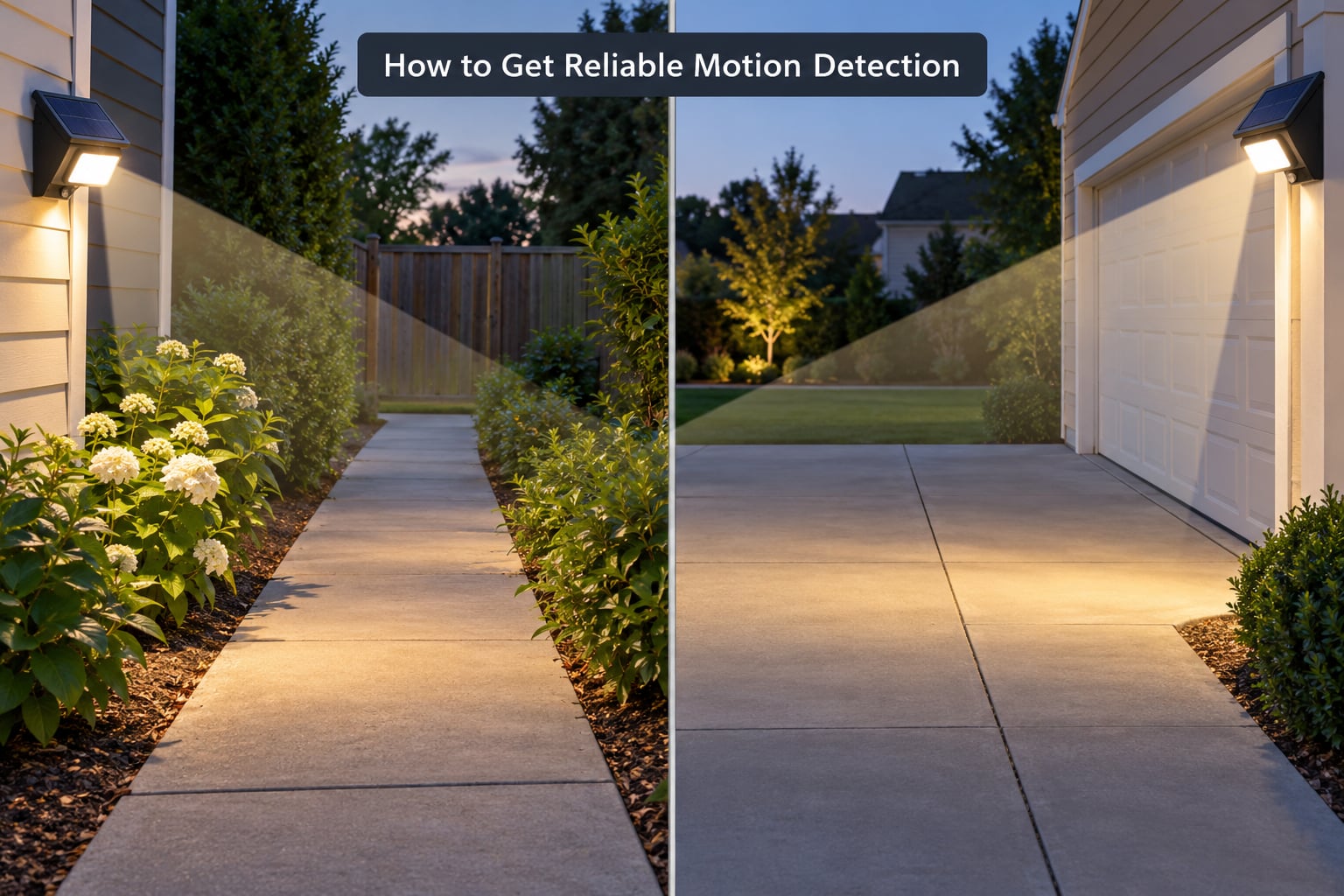
Most disappointing sensors are not broken, they are pointed at the wrong thing. A lamp covering the spot nobody walks through will sit there every night doing nothing useful.
Aim across the path, not down it. A PIR sensor registers the change in heat across its field of view, so someone crossing left to right produces a strong signal and someone approaching head-on produces almost none. Standing at your gate and looking at where you actually walk tells you more than any range figure on the box.
Give it height and a clear line of sight. Mounting between roughly 7 and 10 ft puts the sensor above raccoon, cat and most dog height while still inside its useful range, and it keeps the ground clear of tall grass and leaf litter that blocks the window.
Protect the sun. A lamp in full sun collects several times the energy of one under a tree line or beside a wall. If you only have partial shade, pick a fixture with a larger panel and a lithium battery rather than expecting a small one to stretch.
Mount it solid. A stake that wobbles shifts the detection cone by a few degrees every time the wind gets into it, and heavy frost heaving of the ground does the same over a season. Screw the fixture to a post or wall where you can, and seal the cable entry so water cannot creep in behind the panel.
For PIR models, avoid pointing across a warm window, a dryer vent or an air conditioning unit. For microwave models, remember the cone reaches further and can pass through thin material, so if you are getting phantom triggers from an adjacent yard, move the unit or lower the sensitivity rather than moving the neighbour.
Why Might a Motion Sensor Solar Light Stay On or Stay Off?
Almost every complaint falls into one of two buckets: the lamp is running when it should not, or it is asleep when it should not. Both have short lists of causes.
| Symptom | Likely cause | Fix |
|---|---|---|
| Never triggers at night | Photocell sees very little daylight from its mounting spot, so the lamp never arms | Reposition the fixture, or cover the light sensor with the supplied opaque sticker |
| Triggers in broad daylight | LUX dial turned toward the sun symbol | Turn LUX toward the moon and confirm the panel sees direct sun |
| Dim or short runtime | Battery only partly charged, shaded panel, or an aged cell pack | Move to full sun, clean the panel glass, run two to three full days of charging in AUTO |
| Fails after one or two seasons | Cell pack capacity has dropped, often after cold months or repeated deep discharge | Replace the battery pack with the same chemistry and voltage; the panel and LED usually still work |
| Works for a few weeks then quits | Water ingress at the panel-to-fixture connection or a partially blocked sensor window | Open the housing, dry the connector, reseal with neutral-cure sealant or self-amalgamating tape |
| Flashes or cycles on and off all night | Battery too flat to hold the LED steady, or the photocell is flickering between light and dark | Give it a full day of charging, and check nothing casts intermittent shade across the sensor |
| Fires constantly at random | Sensitivity too high, or a branch, heat source or animal in the cone | Turn SENS down, trim vegetation, and aim the cone where people actually walk |
| Catches people only sometimes | Motion directed straight at a PIR sensor, or its detection range is shorter than the area you need | Re-aim across the walking line, raise the fixture, or move to a microwave or dual-technology model |
One rule covers most of these: judge a new light after its first proper charge, not its first night. Give it two or three full days of direct sun in AUTO before you decide anything about it.
Frequently Asked Questions
Do motion sensor solar lights work in winter?
They do, but runtime shortens. Winter brings lower sun angles, more cloud and colder temperatures, and a Ni-MH pack delivers less from the same charge. A well-positioned lamp with a full summer charge can easily fade well before midnight. Lithium packs and a wider panel help more than anything else.
Can a motion sensor solar light detect movement through a window?
It depends entirely on the sensor. A passive infrared sensor needs a clear line of sight across its field of view and will not see through glass. A microwave sensor sends out radio waves that pass through thin material, so it can report movement behind a window or wall. That is useful for a dark driveway and irritating next to a bedroom.
Why does my solar light flash instead of staying off during the day?
Usually the battery. A flat pack cannot hold a steady current, so the LED pulses as the circuit hunts for a workable output. The other cause is a photocell flickering between light and dark, usually because a branch, a wall shadow or a dirty lens keeps changing what the sensor sees. A full day of charging in AUTO usually settles the first case.
How long should I leave a new solar light in direct sunlight before using it?
Two to three full days of good sun, with the switch on AUTO or OFF. New cell packs often ship unconditioned or partly charged, and a lamp judged on its first night will look far worse than it is. Keep the panel clear of shade during that period, because the whole first charge has to come from the panel alone.
What is the best height and angle for a motion sensor solar light?
Between about 7 and 10 ft, aimed across the direction people walk rather than along it. That height puts the sensor above most animal movement while leaving its field of view clear of grass and leaf litter. A passive infrared sensor reacts to the change across its cone, so a side-to-side crossing produces a much stronger trigger than someone walking straight at it.
Conclusion
Every motion sensor solar light runs the same loop: the panel charges the battery, the photocell waits for dusk, the motion sensor wakes the LED, and the timer puts it back to sleep so the charge lasts until morning. Once you can name which stage is failing, most problems become obvious.
Start with three things. Put the light where it gets full sun and aim the sensor across the way people walk, not along it. Give it two or three full days of charging in AUTO before judging it. Then, if it misbehaves, check the LUX dial and the sensor window before you replace anything, because those two cause most of the faults I get asked about.