A solar light stays off until it gets dark because a small photocell reads the ambient light and flips a switch once that level crosses a set threshold. That is the short answer to how dusk to dawn sensors work: the photocell is a light-dependent resistor, bright light lowers its resistance, darkness raises it, and a tiny control circuit applies or removes power from the LEDs based on that change.
Below is the whole chain, from the moment the sun goes down to the moment the light clicks back off, plus what to check when a light ignores it. Updated for 2026.
Table of Contents
- What Is a Dusk to Dawn Sensor?
- How Do Dusk to Dawn Sensors Work in Solar Lights?
- The Light Sensor Changes Electrical Resistance
- The Control Circuit Uses the Change to Switch the Light
- Dusk Sensor, Motion Sensor, and Timer: What Is the Difference?
- How dusk to dawn sensors work alongside a PIR motion sensor
- Why Do Some Solar Lights Stay On During the Day?
- How Can You Make a Solar Light Detect Darkness More Reliably?
- Frequently Asked Questions
- Can a dusk-to-dawn sensor be replaced?
- Why does my solar light turn on before it is fully dark?
- Do solar lights work on cloudy days?
- What is the difference between a photocell and a motion sensor?
- Should the solar panel stay in direct sunlight all day?
- Key Takeaways
What Is a Dusk to Dawn Sensor?
A dusk to dawn sensor is a light-sensitive switch, and in most solar lights the light-sensitive part is a photocell, also called a photoresistor or an LDR. It sits in a small clear window on the housing and does one job: it reports how much light is falling on it.
The phrase you see on the box is really a promise about what the sensor does for you. Instead of a timer guessing when evening starts, the light reads the sky. When the reading says dark, it turns the LEDs on. When the reading says bright, it turns them off, which is why solar lights switch on at dusk and go dark again at sunrise without anyone touching a switch.
Most solar lights use the sensor in one of two ways. Some have a dedicated round photocell disc next to the panel. Others use the photovoltaic panel itself as the sensor, since a panel’s output voltage sags in the dark. The dedicated disc gives finer control and is easier to shade or clean, which is why it shows up on the better-made fixtures.
It helps to separate a dusk to dawn sensor from the two other things that switch lights on. A motion sensor reacts to movement, not to light level. A timer switch reacts to the clock. A dusk to dawn sensor reacts to brightness, and on a hybrid fixture it works alongside the other two rather than instead of them. The comparison table further down sets out the operating principle, energy use and best fit for each.
How Do Dusk to Dawn Sensors Work in Solar Lights?
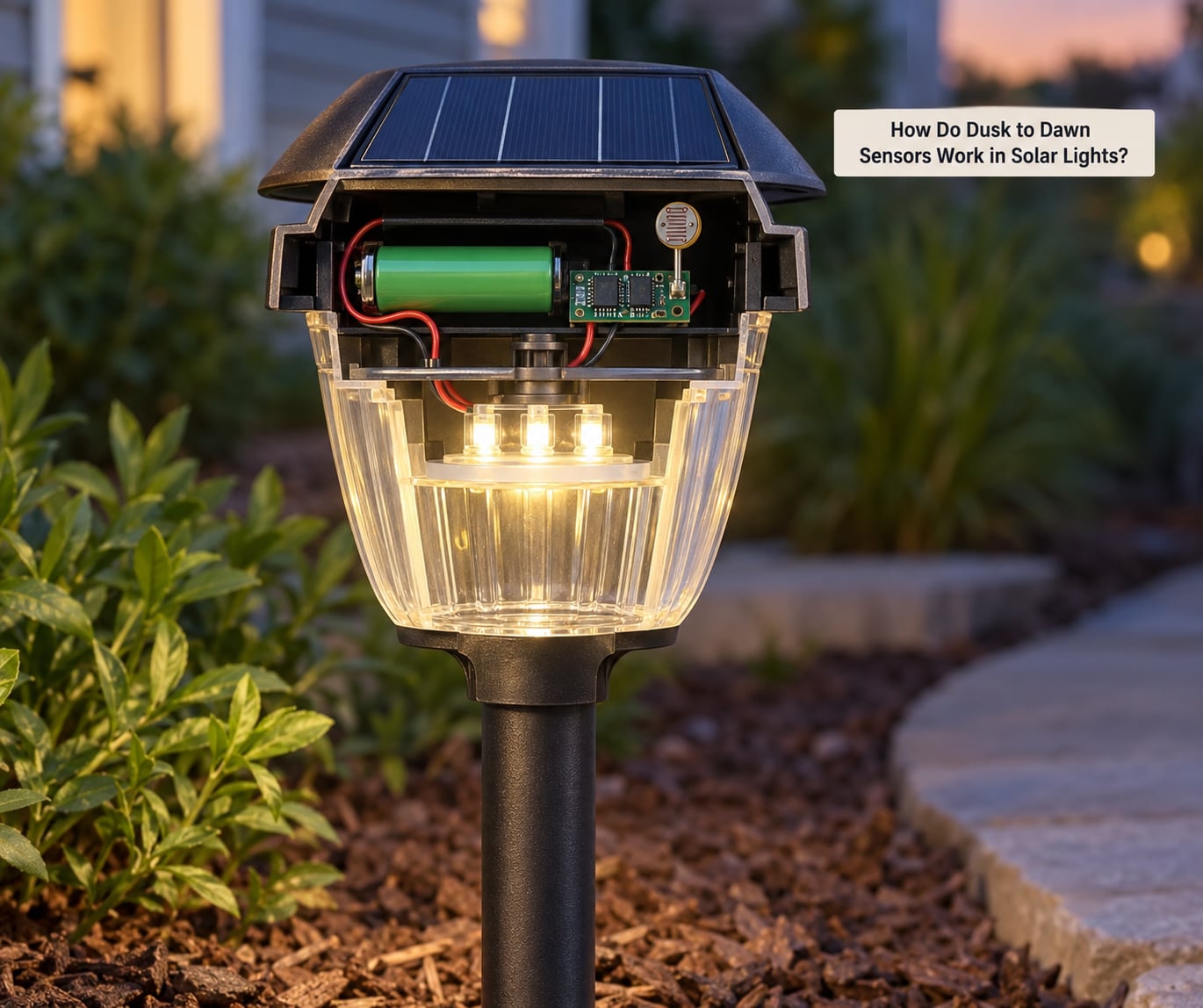
The sequence is short and always the same: measure ambient light, compare it with a threshold, then switch. Everything below is a variation on those three moves, and once you have seen them you can diagnose almost any solar light that misbehaves.
| Stage | Ambient light level | Photocell resistance | Fixture state |
|---|---|---|---|
| Daylight | High, direct sun or bright overcast | Low, a few thousand ohms or less | LEDs off, panel charging the battery |
| Falling dusk | Dipping past the switch-on threshold | Rising through the set range | Delay timer starts, LEDs still off |
| Night | Low, only the fixture’s own spill | High, tens of thousands of ohms | LEDs on at full or reduced output |
| Dawn | Rising back past the switch-off threshold | Falling again | LEDs off, charging resumes |
The Light Sensor Changes Electrical Resistance
The photocell is a semiconductor disc, usually made from cadmium sulfide (CdS), whose electrical resistance falls as the light on it increases. Bright sun might leave it reading a few thousand ohms. In the dark it climbs into the tens of thousands, and that is the whole trick: the sensor converts brightness into a resistance the circuit can measure.
Plenty of pages online get this backwards and claim daylight pushes resistance up and blocks the circuit. It is the other way round. Light lowers resistance; darkness raises it. Once you have that direction right, the rest of the circuit makes obvious sense.
Two numbers matter for real lights. The first is the threshold, the light level at which the sensor changes its mind, usually set somewhere between deep twilight and full darkness and often quoted in lux. The second is the spread between the point where it switches on and the point where it switches off, and that gap is deliberate.
A model with a dedicated photocell also gives you somewhere to adjust behaviour. Many fixtures carry a small dial marked something like LUX, SENS or DAY, and turning it moves the threshold so the light comes on earlier or later. Cheap fixtures usually fix the threshold in firmware and give you no adjustment at all.
The Control Circuit Uses the Change to Switch the Light
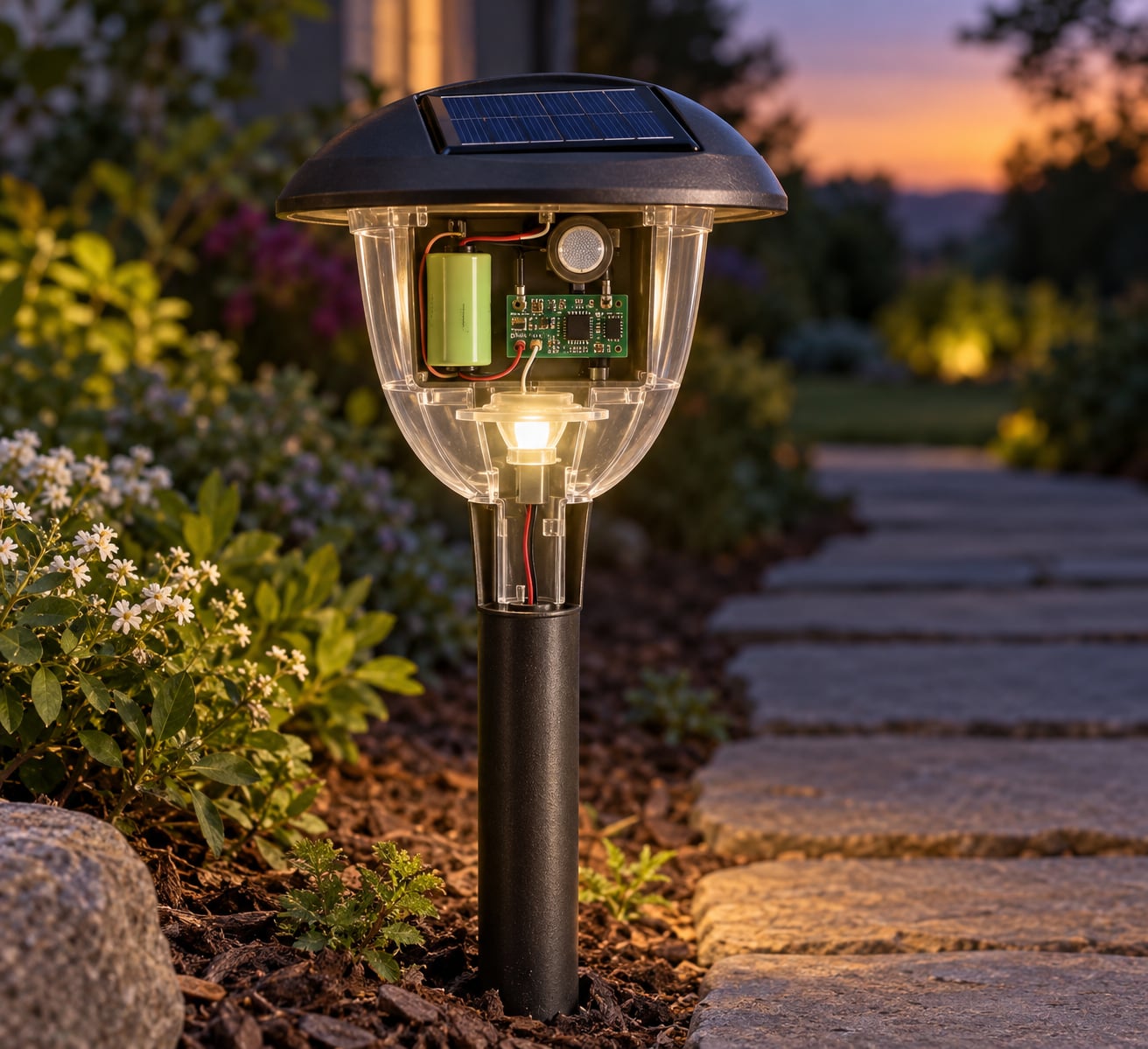
A small board sits between the photocell and the battery. It measures the sensor’s resistance, compares it with the built-in threshold, and drives a switching device. In cheaper fixtures that device is a transistor or a triac. In heavier ones it is a relay with a normally open contact that closes to hand power to the lamp.
Two extra behaviours are built into nearly every one of these circuits, and both explain things you would otherwise find baffling. The first is the delay timer, which holds the switch in its current state for several seconds or minutes after the light level crosses the threshold, so a passing cloud, a bird or a headlight cannot pulse the light on and off.
The second is hysteresis, which is simply the gap between the switch-on and switch-off levels. Switch on at 20 lux and switch off again at 50, rather than at the same 20, and the light will not hunt or flicker during the long minutes of twilight.
Other settings ride on the same circuit. Some fixtures dim to a low level after midnight and drop to full output when motion is detected. Some remember the last hours of brightness instead of switching dead. Both mean the LED output is not always full brightness, and a light that stays partly on through the morning is usually in one of those modes rather than broken.
One design note worth knowing if you build your own circuit: many low-cost controllers only sample the photocell while the LEDs are off. That is why some DIY dusk detectors produce a visible flicker at the switch-over moment, as builders on EEVblog and the Arduino forums have pointed out. The flicker is the sensor reading, not a fault.
Dusk Sensor, Motion Sensor, and Timer: What Is the Difference?
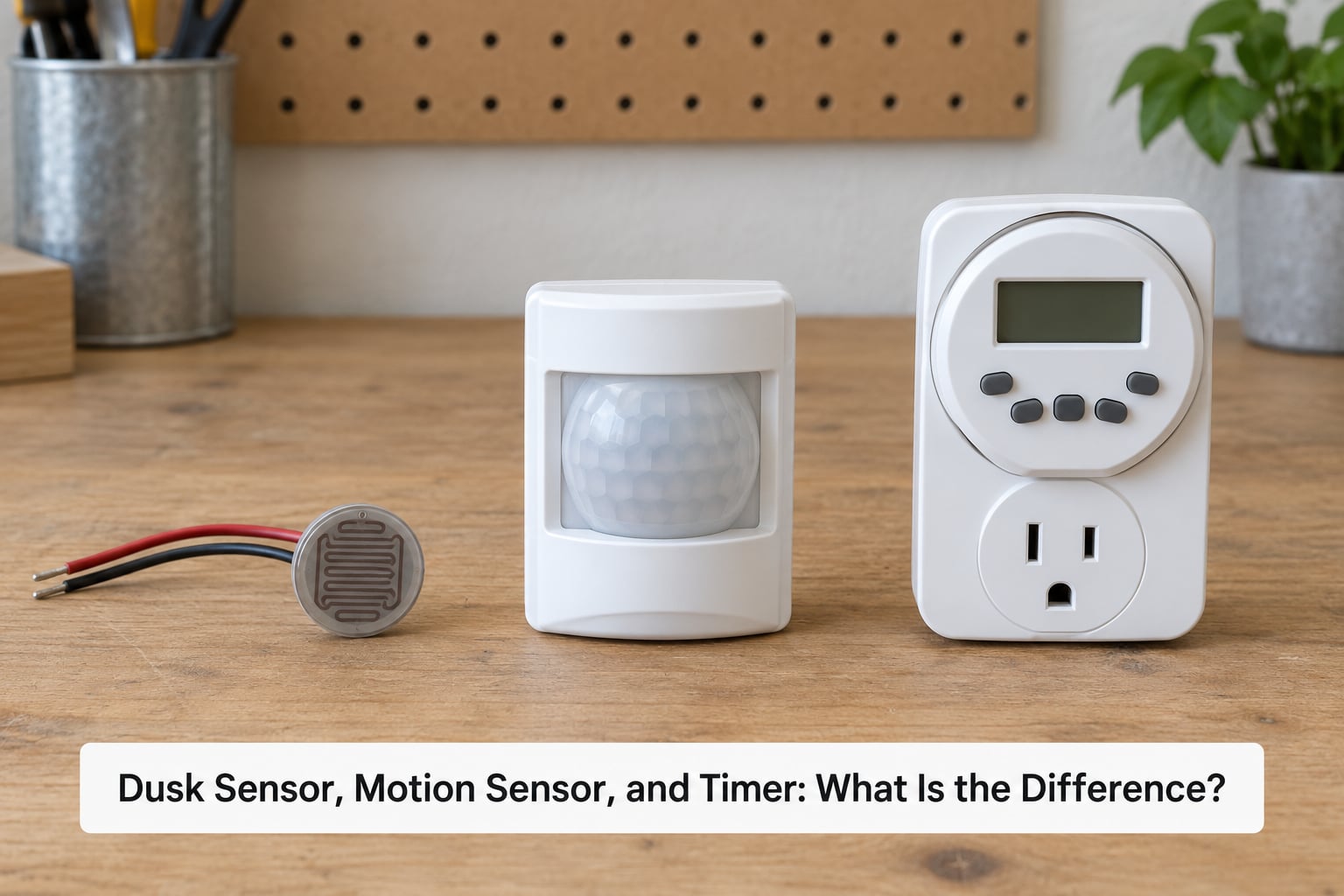
The three options differ in what they measure, which decides everything else about them. A photocell measures brightness, a PIR measures movement in the field, and a timer measures the clock, so their power draw and their failure modes have very little in common.
| Option | How it decides | Energy use | Best for |
|---|---|---|---|
| Dusk to dawn photocell | Reads ambient light against a fixed threshold, switches at dusk and dawn | Near zero while waiting, only the sensor’s own draw | Path, driveway and garden lights that must run every night |
| PIR motion sensor | Detects infrared heat movement across its field of view | Draws continuously, runs the load for a set hold time | Porches and side paths where light is only needed when someone walks up |
| Timer switch | Follows a clock schedule set by hand, with no light or motion input | Depends entirely on whether you set the hours right | Fixtures with unusual schedules, and locations where no sensor wiring is possible |
How dusk to dawn sensors work alongside a PIR motion sensor
On a hybrid fixture the two sensors divide the work. The photocell acts as a gate: while daylight is detected the motion sensor is ignored entirely, so the light stays off even if someone walks past. After dark the gate opens and the PIR takes over, switching the LEDs to full output for its hold time and then dropping back to a dim standby level or off.
Almost all of them carry an override, usually a DIP switch, a mode slider or a TEST setting on the wall switch. On a TEST setting the light comes on regardless of daylight so you can aim a sensor. An ON or always-on setting pins the output on and effectively bypasses the photocell for good, which is how you turn a dusk to dawn light into a permanently lit one without rewiring anything.
Electricians on r/electrical and r/AskElectricians note that people misread these controls constantly: a wall switch accidentally moved out of the sensor position leaves the fixture on all day, which looks like a sensor fault and is not one.
Why Do Some Solar Lights Stay On During the Day?
A solar light that burns through the afternoon is nearly always telling you something specific. Work through these in order, cheapest test first.
- Something is shading the sensor. A tree, a wall, an overhang or a neighbouring fence keeps the photocell in permanent shade. If the panel doubles as the sensor, a shadowed panel reads dark all day. Check at noon before you dismantle anything.
- Light is leaking onto the sensor. A porch lamp, a street light, a neighbour’s security flood or the fixture’s own reflected beam can hold the reading above the switch-off threshold. Rotating or relocating the sensor fixes more of these than anything else.
- The panel is dirty or film-covered. Dust, pollen, algae and mineral deposits cut both charging and, on panel-as-sensor designs, the light level the sensor reports. A cloth and a little water usually restore it.
- The switch is in the wrong mode. Many fixtures offer ON, OFF, AUTO and sometimes TEST. ON pins the light on. TEST often ignores daylight entirely.
- The battery is flat. A light that runs dim and short each night, or flickers at the moment it should come on, is usually reporting a depleted battery. Solar batteries lose capacity after a couple of seasons of heat and shallow charging, and a swollen cell will do the same job more violently.
- The sensor itself has failed. CdS cells drift and eventually stop responding, and moisture gets into the housing through a failed seal. Corroded contacts and a fogged window are both visible once the cover is off.
- It never charged properly. New lights are often shipped with an empty or partly charged battery. Several full days of direct sun before the first test fixes most of the disappointment.
If the light cycles on and off every half minute rather than staying on, that is a different problem. It usually means the sensor is only sampled while the LEDs are off, so the fixture’s own output pushes the reading over the threshold, the light turns on, the reading falls, and it turns off again. Repositioning the sensor away from the fixture’s own beam or dropping the sensitivity dial usually settles it.
How Can You Make a Solar Light Detect Darkness More Reliably?
Placement does most of the work, and it is free. Give the sensor the widest possible view of open sky, away from tree canopy, roof edges and walls, and keep it clear of any light source it could mistake for sunrise.
- Aim it at the sky, not the path. The sensor reads brightness, so it wants the same view the sun and the brightest part of the dusk sky have.
- Keep it away from its own light. If the fixture has a separate sensor, tuck it under a lip or on the shaded side so the LED beam cannot hit it.
- Clean twice a year. Panel, sensor window and the four screws around the cover. Wipe the photocell window before you touch the sensitivity dial, since grime alone can shift the threshold.
- Use the mode that suits the job. AUTO for all-night path lighting, TEST while you aim a motion sensor, ON if you want it permanently lit.
- Let it charge fully first. A full day of direct sun before judging performance, and another full day after any battery change.
- Expect an old battery, not a new sensor. Replacing the battery on a fixture with a sealed panel is usually cheaper and more effective than replacing the photocell.
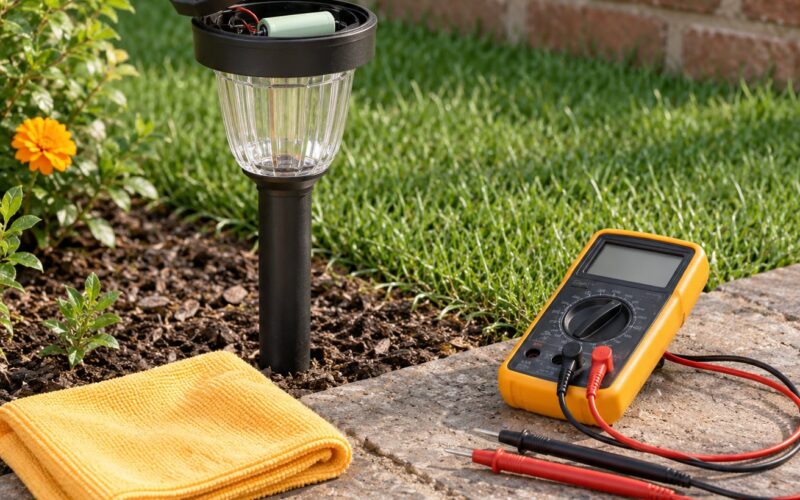
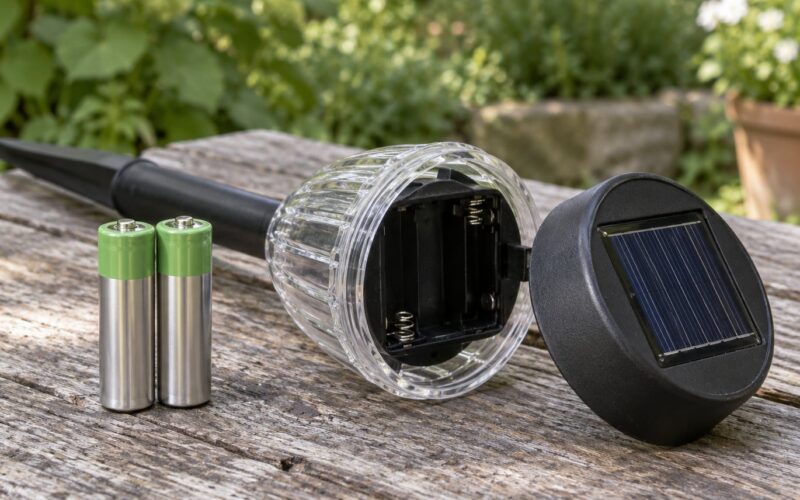
If a light has been outside all season, has run dim, or has been through a freeze, suspect the battery before the electronics. Replacing it takes a screwdriver in almost every case and restores most of these lights to normal behaviour.
Frequently Asked Questions
Can a dusk-to-dawn sensor be replaced?
Usually yes, if the fixture uses a discrete sensor disc rather than a sealed one. On lights with a removable photocell, unplug the two leads, fit the new cell and match the dial setting. Cheap solar lights often bond the sensor permanently to the board, and bulbs with a built-in sensor are replaced as a whole. Check for a spare part number before dismantling anything.
Why does my solar light turn on before it is fully dark?
Three things cause it. The threshold is often set earlier than you expect, especially on a fresher cell, so the sensitivity dial can move it later. Light from a porch lamp, a driveway or a neighbour’s flood reaching the sensor does the same thing. And a dusty or algae-covered sensor window reads the sky as darker than it is. Cleaning first, adjusting second.
Do solar lights work on cloudy days?
The dusk to dawn sensor still works on a cloudy day, because overcast daylight is far brighter than the threshold. What suffers is output. A cloudy day produces a fraction of the charge a clear one does, so a light that was barely making it through a few dull days will come on late, run dim and shut off early. The sensor is fine; the battery is not.
What is the difference between a photocell and a motion sensor?
A photocell measures light. It is a light-dependent resistor that changes resistance as brightness changes, and it switches the light on and off at dusk and dawn. A PIR motion sensor measures movement instead, using infrared heat across its field of view. On a hybrid fixture the photocell acts as a gate that only lets the motion sensor work after dark.
Should the solar panel stay in direct sunlight all day?
Yes, as much as the site allows. Direct sun sets both the charge rate and, on designs where the panel doubles as the sensor, how dark the sensor reads at dusk. Six hours of unobstructed sun is a reasonable target for a path light, more for a flood light. Any shade across the panel at midday is the first thing to check when a light switches on too early.
Key Takeaways
How dusk to dawn sensors work comes down to one idea: light lowers a photocell’s resistance, darkness raises it, and a small circuit switches the LEDs accordingly, with a delay and a gap between the two thresholds so nothing flickers at twilight.
When a light misbehaves, start with the cheapest checks. Cover the sensor with an opaque cap or tape and wait a minute, and a healthy light should come on. If it does, the problem is placement, stray light or a dirty window rather than the sensor itself. If it does not, check the mode switch, then the battery, and only then suspect the electronics.