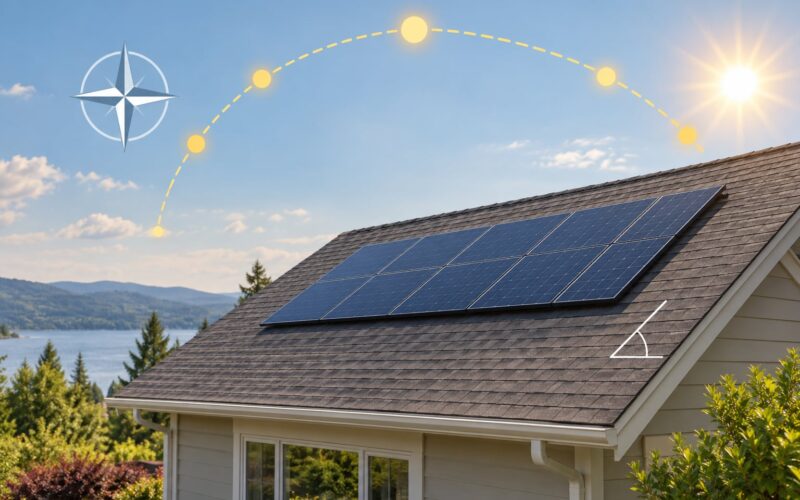
Roof direction decides how directly sunlight strikes your panels across the day, and that angle is the single biggest controllable factor in annual energy production. A roof plane pointed at the equator collects the most; an east or west plane usually loses about 10 to 20 percent, and a north-facing plane can lose considerably more. Shading and roof condition can erase that gap entirely. That is how roof direction affects solar output in plain terms.
Most of the confusion here comes from mixing up two separate things. Roof direction is the compass heading your roof plane faces, measured in degrees as the azimuth. Roof pitch is how steeply that plane leans. They interact, but they are not the same setting, and getting the pitch exactly right matters far less than people think.
One note before we go further: this guide assumes the Northern Hemisphere, so the best direction is south. In the Southern Hemisphere, swap north and south throughout the article. Everything else, including tilt and shading, stays the same.
Table of Contents
- Why Roof Direction Matters for Solar Panels
- How Roof Direction Affects Solar Output by Orientation
- Cardinal Directions Explained
- Why Panel Tilt Works with Roof Direction
- What Changes Solar Output More Than Direction
- How to Find Your Roof Direction
- How to Compare Roof Options Before Installing Panels
- Safety and Professional Guidance for Rooftop Solar
- Frequently Asked Questions
- What is the best roof direction for solar panels?
- Do solar panels work well on a flat roof?
- Can a north-facing roof still produce solar electricity?
- How much does roof shading reduce solar output?
- Should the roof slope or direction matter more?
- Can I install solar panels on a roof that will be replaced soon?
- Conclusion
Why Roof Direction Matters for Solar Panels
Solar cells make the most electricity when sunlight lands on them square-on. When the sun hits a panel straight in the face, the beam passes through the surface with the least distance and the least reflection. Tilt that beam and two things happen: some of it bounces off into the sky, and the rest spreads over a wider area of glass, so each square inch receives less of it.
That second effect has a name, cosine loss. You do not need the formula. What matters is the practical consequence: a roof plane facing the equator spends most of the day closest to perpendicular to the sun’s path, and a roof plane facing away from the equator spends most of the day at a steep angle to it.
The sun is not overhead all day, and it is not in the same place all year. In the Northern Hemisphere it tracks across the southern sky, rising in the east, passing high across the south, and setting in the west. In winter it sits lower and the day is shorter, which is why the hours around noon matter so much more than the hours at either end.
Direction is the biggest lever you control, but it is not the whole story. A badly shaded south-facing array can produce less than a completely clear east-facing one, and that single fact changes how you should read every number in this guide.
How Roof Direction Affects Solar Output by Orientation
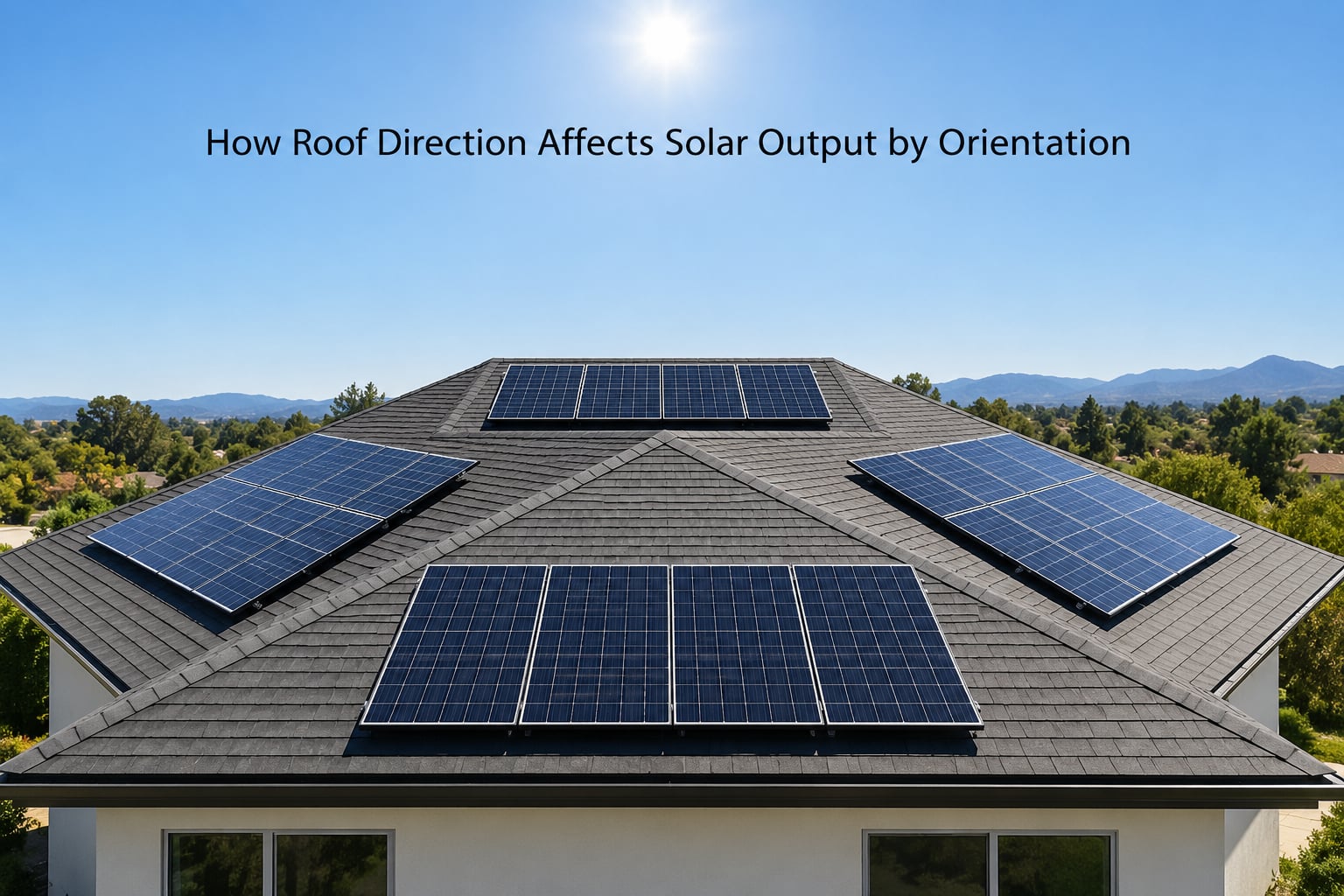
The table below estimates annual production relative to an ideally oriented system at the same site. Treat these as directional comparisons rather than guaranteed results. Real output depends on your latitude, climate, tariff, roof material and the number of panels you can fit.
| Roof direction | Estimated annual output vs ideal | Peak generation window | Strongest use case |
|---|---|---|---|
| South | About 100% | Late morning to mid-afternoon | Maximising total annual kWh |
| Southeast / Southwest | About 95% | Morning or afternoon respectively | Balancing output across the day |
| East | About 85 to 90% | Morning to midday | Households that use power early |
| West | About 85 to 90% | Midday to evening | Households that use power late |
| North | About 60 to 70% | Around midday, weakly | Only where little else is available |
These figures are close to what the US Department of Energy’s Solar Energy Technologies Office and widely used modelling tools assume for fixed, roof-mounted arrays in the continental US. A ten-degree shift off the ideal azimuth typically costs less than 1 percent, so small errors do not matter. Thirty to forty-five degrees off does.
Cardinal Directions Explained
Azimuth is simply a compass bearing, and rooftops rarely land on the four points anyway. A plane at 165 degrees is a little east of south. At 195 degrees it is a little west. Installers quote both numbers in the same format, so when you see 180 degrees you are looking at due south, and 0 or 360 degrees means due north.
A south-facing plane in the Northern Hemisphere collects the strongest midday light because that is when the sun sits nearest the equator-facing side of the sky. East-facing panels wake up early and ramp hard through the morning, then flatten out. West-facing panels stay quiet until late morning and then produce strongly into the afternoon and early evening.
Homeowners on east and west arrays report output that stays in the 80 to 85 percent range rather than collapsing, and the reason is simple. A panel only needs usable light, not a perfect square-on beam, so it keeps generating at lower efficiency whenever the sky is bright.
Why Panel Tilt Works with Roof Direction
Pitch and direction solve different problems. Direction decides which side of the sky you can see. Tilt decides how high that view extends, in summer and in winter.
Flat panels mounted at 10 degrees on a south-facing roof collect more in summer, when the sun is high, and less in winter, when it is low. Steeper panels do the opposite. Most homeowners land somewhere in the middle because a lower summer gain costs them less than a lower winter gain.
The Department of Energy puts a broad useful window at roughly 15 to 40 degrees of tilt across most of the continental US. That range is wide on purpose. A common rule of thumb is to set tilt near your local latitude, then soften it by about 10 degrees if summer output matters more to you. Either way, a moderately tilted panel on a decently oriented roof beats a flat panel on a poorly oriented one.
Roof pitch is usually quoted as a ratio, such as 6:12, meaning six inches of rise for every twelve inches of run. A 6:12 pitch is about 27 degrees, and a 4:12 pitch is about 18 degrees. Anything in the 4:12 to 8:12 range is workable for panels without elaborate mounting.
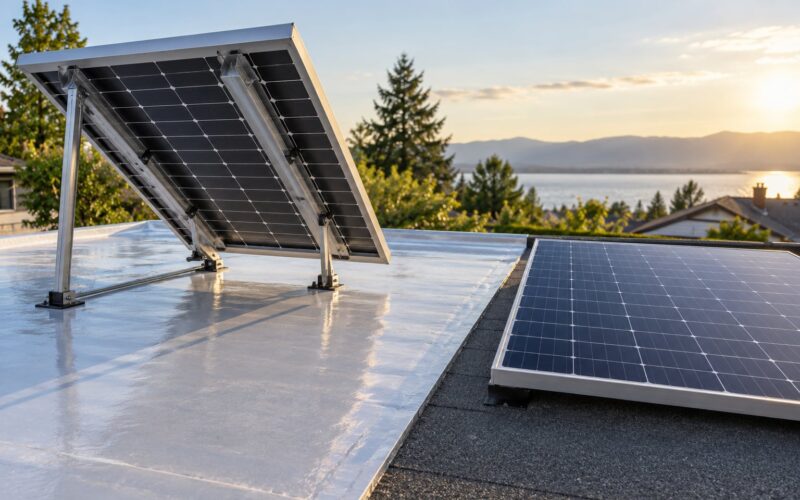
If your roof pitch is genuinely unsuitable, an adjustable tilt rack mounted on a low-slope roof can add 10 to 20 percent annual output. On a pitched roof the same rack is usually poor value, because you can tilt it toward the equator only by accepting a steeper angle than the roof already gives you.
What Changes Solar Output More Than Direction
Direction is the factor homeowners ask about most, and it is not always the factor that moves their number. Ranked roughly by how much they can hurt, here is what else matters.
1. Shading. Trees, chimneys, neighbouring buildings, a satellite dish or a light pole can cut output more than orientation ever will. Even partial shade on part of an array drags down the whole circuit if panels are wired in series. This is the number one reason a south-facing roof can lose to a clear east-facing one.
2. Available roof area. A perfect south-facing plane that holds eight panels produces less than a shadier east-west pair that holds sixteen. Setbacks and fire-code clearances eat into usable space, and older homes often have several small planes instead of one good one.
3. Module layout. Panels laid out badly, with mismatched shading across one circuit or a long run of cable, produce less than the panel count suggests. A dual-input inverter, microinverters or power optimisers help when two directions share one system, which is a common reason east-west arrays disappoint.
4. Roof material and condition. Asphalt shingles are straightforward. Standing seam metal can use clamps with no penetrations. Tile, slate and weathered wood complicate mounting and cost more labour, and steep roofs of any material take noticeably longer to work on.
5. System losses. Inverter conversion, wiring, dust, heat and panel degradation each shave a few percent. A hot, dusty, unshaded array in a mild climate performs worse than a cool, clean one in a bright climate, which is why temperature matters as much as raw sun hours.
6. Snow and debris. Panels shed snow reasonably well on a tilt, but a shallow pitch under a northern sky can hold winter losses longer.
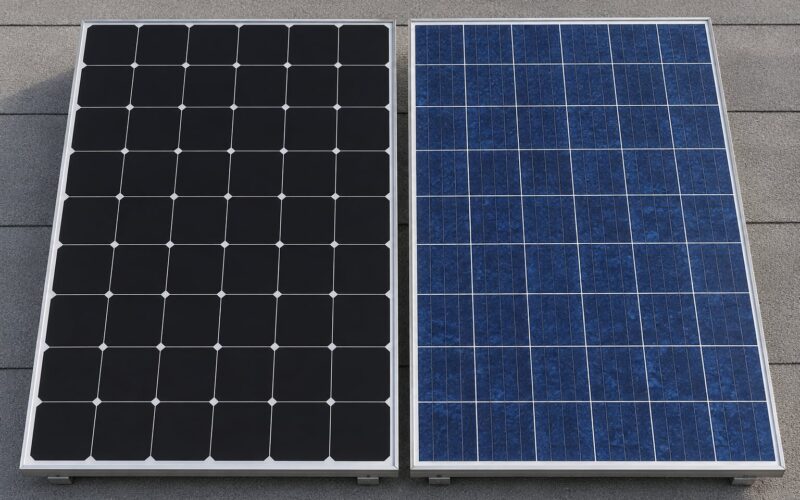
7. Panel efficiency. More efficient modules squeeze more watts from the same square footage, which matters most when roof area is the binding constraint rather than direction.
Direction sits near the top of that list, but it is not at the very top. NREL’s finding that roughly 82 percent of US buildings receive enough sunlight for solar is a useful reminder that the roof has to work before you optimise it.
How to Find Your Roof Direction
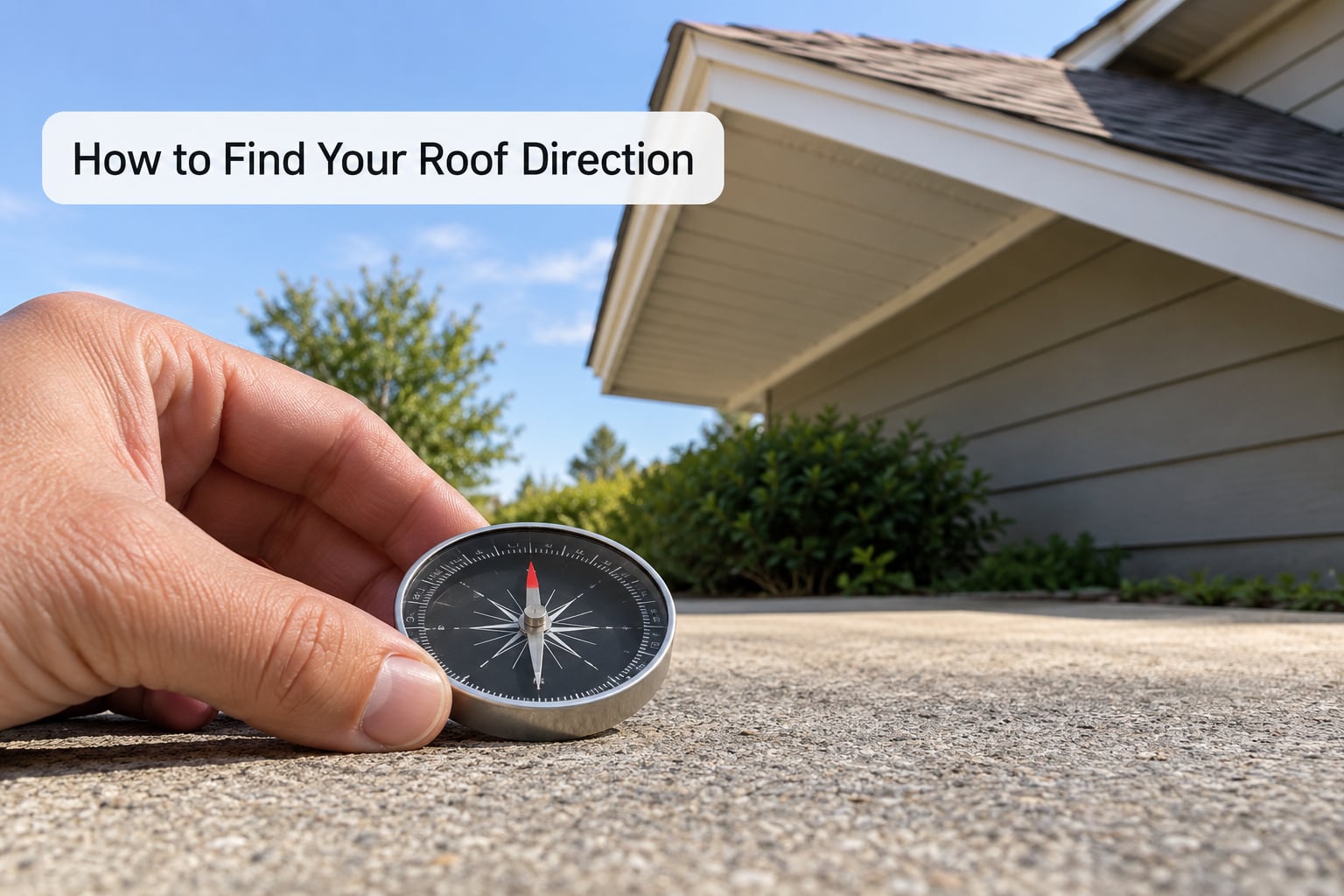
You can do this from the ground in about five minutes. What you want is the compass heading of the roof plane, not the heading of your house.
- Use your street as a reference. Stand in the driveway and open your phone maps app with the north orientation showing. Turn your phone until the map’s north arrow points the same way as the map’s top edge, then note which way your front of the house faces. Roads usually run close to cardinal directions, so this gets you within a few degrees.
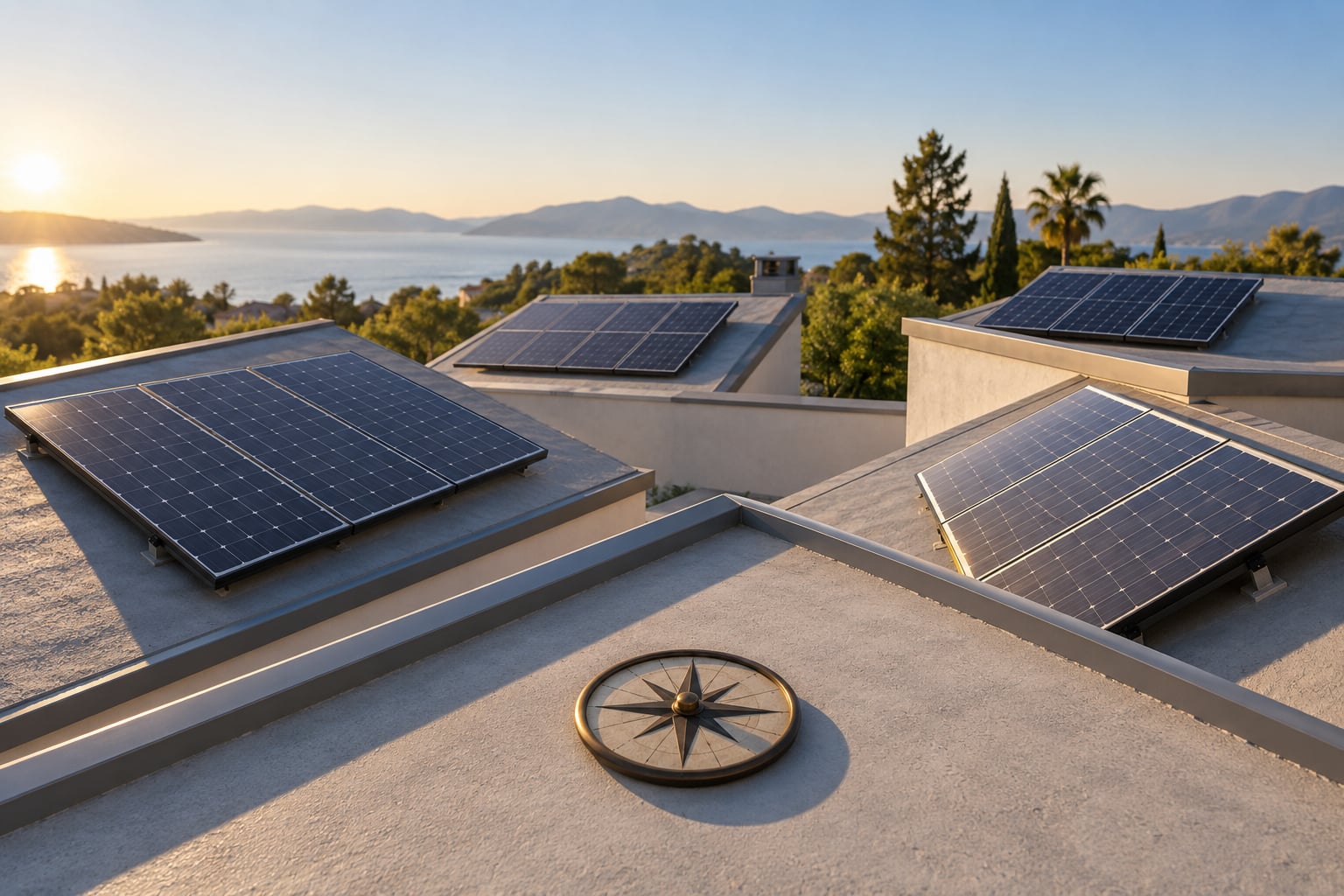
- Check the roof planes separately. A house with an L-shape or a front gable often has several planes pointing different ways. Walk the perimeter and check each section. The big plane facing your back garden may be south even if the front of the house faces east.
- Confirm with a compass app. Stand well back from the building, hold your phone flat at chest height and open the compass. Rotate slowly until the readings settle, then note the bearing. Cross-check with the first method, because phone compasses drift badly near cars, steel roofing and electrical panels.
- Read the result in degrees. Due south is 180 degrees. Add roughly 15 degrees for each compass point east of south, and subtract for each point west. A south-east plane is around 135 degrees, south-west around 225.
- Ask for the azimuth number in writing. Any serious installer will put the azimuth and tilt of the proposed array on the proposal sheet. If they describe it as “your main roof” without a number, ask again.
Do not climb onto the roof or open anything up to take measurements. Standing on a ladder with a tape is how people get hurt, and you can get a pitch figure from a fascia board or the roof edge from the ground.
How to Compare Roof Options Before Installing Panels
Most homes offer two or three workable options. Rank them on the same set of things every time rather than taking the first quote you are handed.
Start with shading on each plane. Watch each candidate area across a full day if you can, and again in winter when the sun is low. A tree that misses the roof in July can block a December afternoon entirely, and trees grow.
Then count usable area. Measure the plane, subtract setbacks and access paths, and work out how many panels actually fit in portrait or landscape orientation. A tidy-looking south face with a chimney in the middle may yield less than a plain east face.
Check structural and roof-life issues. How old is the covering? If it needs replacing in the next five years, panels installed now come down and go back up, which costs money twice. Roof planes also need to carry the added load and resist uplift, and that is a job for someone qualified to assess it.
Model the numbers, not the adjectives. Ask each installer for a written production estimate in kWh per year for each option they are proposing, and for the assumptions behind it: system size, azimuth, tilt, shading losses and local irradiance. The National Renewable Energy Laboratory’s PVWatts calculator and sun-path tools like SunCalc will model a specific address for free, and they are a fair cross-check on any quote you receive.
Match the array to your tariff. Under net metering, exported power is credited at roughly what you pay for power, so total annual kWh matters most. Under net billing or a time-of-use plan, self-consumption matters more, and a west-facing array can beat a south one on bill savings even while producing less overall. This is the real reason to prefer east over west or west over east, and it depends on your utility rather than on any rule about the sun.
If the roof genuinely will not work, the next options are an adjustable rack, a carport or ground mount, or a community solar subscription where you buy a share of a larger array off site. Each trades cost or complexity for orientation you cannot get from the roof.
Safety and Professional Guidance for Rooftop Solar
Roof work, and any work on electrical equipment, belongs to licensed and qualified people. Do not climb onto the roof, lift tiles or measure pitch from a ladder to make your own decision about an install.
Follow the manufacturer’s instructions for any equipment you own, and expect a qualified installer to assess roof condition, mounting method, structural loading, the electrical connection and your local permitting and inspection requirements. Those are not box-ticking steps either; a mounting method that suits asphalt shingles will not suit standing seam metal, and fire-code setbacks around a chimney are not negotiable.
Frequently Asked Questions
What is the best roof direction for solar panels?
In the Northern Hemisphere, a roof facing south is best, because it stays closest to perpendicular to the sun through the middle of the day. In the Southern Hemisphere, north is best. Within about 10 degrees of the ideal heading you lose very little, so southeast and southwest planes are usually fine at roughly 95 percent of ideal annual output. East and west follow at roughly 85 to 90 percent.
Do solar panels work well on a flat roof?
They work, but not as well as the same array on a tilted roof. On a flat roof, panels are mounted on tilted frames or ballasted racking, usually between 5 and 15 degrees, which costs usable roof area because the rows must be spaced far enough apart to avoid shading each other. A low tilt also leaves more dust and snow on the glass and shortens racking life in some climates.
Can a north-facing roof still produce solar electricity?
Yes. It just produces less, typically around 60 to 70 percent of an ideally oriented system in the Northern Hemisphere. Generation concentrates around midday and the summer months, when the sun is highest. If a north-facing plane is unshaded, has a good pitch and offers more usable area than your other options, it can still be worth installing, especially alongside a battery for midday charging.
How much does roof shading reduce solar output?
It depends on how much is shaded and for how long. A short obstruction on one part of an array can cut total output by 10 percent or more, and shade across several panels early and late in the day can cut much further. On a series-wired string, shaded panels pull the whole circuit down, which is why optimisers, microinverters or a dual-input inverter are worth discussing with your installer.
Should the roof slope or direction matter more?
Direction matters more. A south-facing roof with a shallow 4:12 pitch will normally beat an east-facing roof with a steep 8:12 slope, because direction changes annual output by far more than pitch does. The Department of Energy’s useful tilt window is wide, roughly 15 to 40 degrees, which tells you most ordinary pitches are acceptable. Fix direction first, then fine-tune tilt if the numbers justify it.
Can I install solar panels on a roof that will be replaced soon?
You can, but expect to pay for removal and reinstallation, and to negotiate who covers that cost. Many installers and their insurers will not warrant a system mounted on a roof near the end of its life. If a replacement is planned within a few years, either replace the roof first or plan the panel removal into the contract in writing before you sign.
Conclusion
Direction sets your ceiling and shading decides whether you reach it. Identify the direction of every roof plane, check what shades them through a full day, confirm the tilt and usable area, then ask for a written kWh estimate per option before you choose an array.