
What is net metering? It is a utility billing arrangement that lets you send the excess electricity your rooftop solar produces back to the grid and receive a bill credit for every kilowatt-hour you export. In plain terms, you get paid for the power you generate beyond what your home uses, and you are only charged for the electricity you actually take from the grid.
It matters because rooftop panels usually make far more power at midday than a house can use. Net metering decides what that surplus is worth and how it lands on your bill. Rules come from your utility and the state regulator, not from the installer, and they differ a lot depending on where you live.
Below is a plain-language walkthrough of how the arrangement works, what happens to leftover credits, and the questions to ask your utility before signing anything. Rules and rates change, so treat every number here as an illustration rather than a quote for your address.
Table of Contents
- What Is Net Metering?
- Who decides the credit rate?
- How Does Net Metering Work?
- What Is Net Metering, Step by Step?
- What Happens When the Solar System Produces More Than You Use?
- Does Net Metering Require Solar Batteries?
- How Is Net Metering Different From Feed-in Tariffs and Standard Billing?
- How Much Can Net Metering Save?
- What to Ask Your Utility Before Installing Solar
- Is Net Metering Worth It for Every Home?
- Frequently Asked Questions
- Is solar energy taxed when it is credited through net metering?
- Can renters use net metering for a solar system they do not own?
- Will net metering power my house during a blackout?
- What happens to net-metering credits when I move to another home?
- Does net metering make my electricity bill zero every month?
- Conclusion
What Is Net Metering?

Net metering, often shortened to NEM or called net energy metering, is a billing mechanism rather than a piece of hardware. Your panels stay wired to the grid, and a special meter measures electricity flowing in both directions. Whatever your home does not consume on site goes out to the neighborhood, and the utility turns that export into a credit on your next statement.
The people who use it are usually residential homeowners with a grid-tied system, commercial building owners with panels on a larger roof, and community solar subscribers who do not own equipment at all. Tenants under a power purchase agreement get a version of it too, though the credit lands with the property owner rather than the renter.
What you get in return is a bill based on net use instead of gross consumption. If you export 600 kWh and import 400 kWh over a month, the two numbers cancel and you owe only the fixed charges your rate plan still carries. That single mechanic is the whole reason net metering has been the largest incentive behind residential solar for two decades.
Who decides the credit rate?
Your utility publishes a rate schedule, and the state utility commission or public service commission approves it. California replaced its traditional program with a successor framework often called NEM 3.0, and several other states have trimmed export credits or moved customers onto net billing. So the honest answer to “what will my surplus be worth” is: ask your utility, then read the tariff.
How Does Net Metering Work?
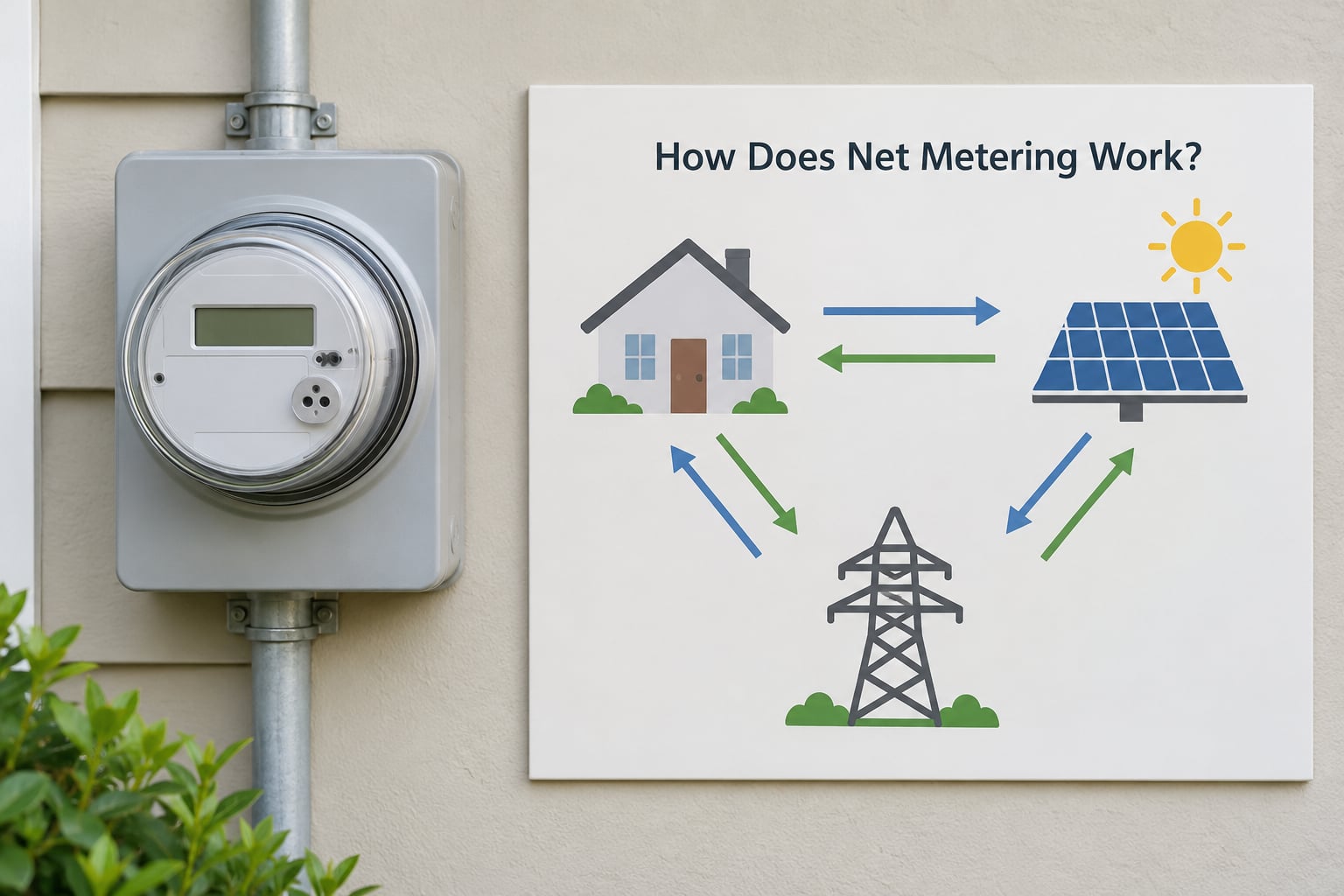
It runs on a monthly cycle. Panels produce power through the day, your home takes what it needs in real time, and the remainder flows out through the meter. The meter runs backward while that happens, recording a negative quantity or an export reading.
At night and on cloudy days the direction flips: you import from the grid and the meter runs forward, drawing down credits at the same rate they were earned. At the end of the billing period the utility subtracts one from the other and bills the difference, plus fixed charges that net metering never removes.
Here is the pattern in a small example. A household generates 700 kWh in a month and uses 500 kWh. The export meter logs 200 kWh outward, the import meter logs the 500 kWh drawn at night and on grey days, and the utility credits 200 kWh at the household’s retail rate. The next month, if generation drops to 550 kWh while use rises to 620 kWh, those banked credits cover the 70 kWh gap before any new money is spent.
What Is Net Metering, Step by Step?
Six steps cover almost every residential program, whether your utility calls it net metering, net billing or something else.
- Connecting to the grid. Your installer files an interconnection application with the utility, and the utility either approves the system, approves it with conditions, or enrolls you in a different compensation program.
- Generating surplus power. On clear midday hours your array often produces more than the house can absorb, and the difference leaves your property on the same wire that brings power in.
- Using a bidirectional meter. A meter that runs in both directions records your import and your export separately, which is what turns stray surplus energy into an accounting entry.
- Earning credits. Exported kilowatt-hours are banked as credits on your account, valued at a rate your tariff sets. Under full retail net metering that rate matches what you pay to import.
- Drawing power later. When your home needs more than it is making, the meter runs forward and those credits are spent before you are charged anything for energy.
- Reconciling the cycle. Your statement nets the two directions, then adds fixed charges, and at year end some utilities reconcile or true-up the balance according to their rules.
One clarification worth holding onto: energy your house uses directly never touches the meter. Only the surplus that flows out is credited, and only what comes in at night or on cloudy days is charged against those credits.
What Happens When the Solar System Produces More Than You Use?
Surplus is the normal case, not an edge case. A typical residential array makes most of its power between late morning and mid-afternoon, while household demand peaks before breakfast and after dark. Credit systems exist specifically to move that afternoon production into your evening consumption.
Two things happen to it. Under monthly netting, unused credits simply roll into the next billing period and keep accruing across the year. Under annual netting or true-up, the utility tallies everything over twelve months and settles the balance once, which can mean a lump charge on a single statement if you consistently exported more than you imported.
What the balance is worth depends on the program. Traditional net metering credits export at the full retail rate, so a stored kilowatt-hour is worth the same as a kilowatt-hour you would have bought. Net billing programs pay a lower, wholesale-style rate for exported power, sometimes a fixed rate set at interconnection and sometimes one indexed to an hourly market. Feed-in tariff programs pay a set price per exported kilowatt-hour regardless of your own usage.
Some jurisdictions let you cash out or donate the remaining balance at year end, and a few require it. Where credits simply expire, an oversized system loses value fast, because everything past your own consumption is earning the weakest rate on the schedule. Homeowners who compare a purchased system against a power purchase agreement keep running into the same point: the contract decides who captures the export value, not the homeowner who is just renting the roof.
Does Net Metering Require Solar Batteries?
No. Batteries are optional under every common net metering arrangement, because the grid itself does the storage. Your credit balance is the battery, and it sits there at no maintenance cost.
A home battery changes what the credits are for rather than whether you can have them. It gives you backup during an outage, and grid-tied systems shut down for safety when the grid fails, so only a battery plus a transfer switch or hybrid inverter keeps lights on. On time-of-use rates it also shifts consumption into cheaper hours, which can be worth more than exporting midday surplus.
The trade-offs are straightforward. A battery adds equipment cost, more components that can fail, and cycling that reduces capacity over time. Some utilities also require an export limiter, a device that caps how much you can push back onto the grid, and rebate or incentive programs sometimes disqualify a system once a battery is included. Decide on the battery based on outage needs and rate structure, not because net metering demands one.
How Is Net Metering Different From Feed-in Tariffs and Standard Billing?
All four arrangements handle exported electricity, but they hand the value to different parties and price it very differently. This is the comparison most installers skip, and it is where the money is.
| Program | How export is valued | Who captures the value |
|---|---|---|
| Net metering (full retail) | Exported kWh credited at the same cents-per-kWh you pay to import | The solar owner, through credits that offset future bills |
| Net billing or net metering successor | Exported kWh credited at a lower, often fixed or market-linked rate | Split between the solar owner and the utility’s other customers |
| Feed-in tariff | All generation, used or exported, paid at a set price per kWh | The generator, often on a long-term contract |
| Standard billing with no export credit | Exported kWh earn nothing at all | Whoever bought the power on your behalf |
One caution on feed-in tariffs: in the United States they show up mainly as commercial or community-scale contracts, and the European and Australian versions sit under different regulatory systems than a US residential tariff. If someone offers you a long-term fixed price per kilowatt-hour, read who owns the system and where the contract sits on your title.
How Much Can Net Metering Save?
The cleanest way to estimate it is to multiply annual production by the value of an exported kilowatt-hour, then add the value of the solar you consumed directly instead of buying. Here is an illustrative annual cycle for a system with no battery.
| Month | Solar generated (kWh) | Home used (kWh) | Net position |
|---|---|---|---|
| January | 620 | 710 | Draws 90 kWh from the grid |
| April | 880 | 560 | Exports 320 kWh, builds credit |
| July | 1,010 | 720 | Exports 290 kWh, credit grows |
| October | 790 | 540 | Exports 250 kWh |
| Annual total | 11,200 | 9,400 | About 1,800 kWh net export |
Under full retail net metering, that roughly 9,400 kWh of on-site use plus the export is worth being valued at your all-in retail rate rather than a wholesale rate. Under a net billing program the same 1,800 kWh of export is worth noticeably less, and the difference over twenty-five years is the single biggest swing factor in any payback estimate.
What moves the answer: your utility rate and tariff, how your production lines up with your consumption, the size of the system relative to your usage, fixed charges and demand charges that credits never touch, and whether any year-end reconciliation can claw value back. A good installer should show you this math with your own twelve months of data, not a national average. If they will not, that is a conversation to have before signing.
What to Ask Your Utility Before Installing Solar
Get these answers in writing from the utility, not from the salesperson, because only the utility and the regulator set the terms. Homeowners who ask early avoid the most common surprise, which is discovering months later that their interconnection application was never actually submitted and their system has been running through a limiter the whole time.
- Is a net metering program available on my rate plan? Ask for the schedule name printed on your bill and where the tariff is published.
- What is my export credit worth per kilowatt-hour? Ask whether it equals my retail rate, a fixed lower rate, or a market-linked rate.
- Do credits roll over monthly, annually, or not at all? This single answer changes the value of an oversized system more than anything else.
- Is there a year-end true-up, and can I cash out the remainder? Some programs require a payment; others issue a final bill credit.
- What interconnection fees and fixed charges survive net metering? Demand charges, connection fees and customer charges usually still appear.
- Does my utility or state require an export limiter? Limits on how much you can send back affect the size of the system you should buy.
- Who owns the credits on a leased or PPA system? The contract decides, and it is often not you.
- What happens to credits if I sell the home or move? Ask whether credits transfer, expire at closing, or must be settled out.
- Are there shutdown or curtailment rules during grid emergencies? Utilities retain authority to limit exports under stress conditions.
- How long does interconnection approval take? Months of delay is common, and you may produce uncompensated power in the meantime.
Your state energy office and the DSIRE policy database are useful for confirming what your commission has approved. Neither replaces your own utility’s tariff, so treat them as context rather than a substitute.
Is Net Metering Worth It for Every Home?
It works best when three conditions line up: strong unshaded roof, a system sized close to what the household actually uses, and a utility that credits export near the retail rate. Under those conditions the value is straightforward and the payback maths is boringly reliable.
The value drops when the system is oversized, since everything past your own consumption earns the weakest rate on the schedule. Heavy shade, a rental where the owner keeps the credits, a tariff that has moved to net billing, or an export limiter that caps your output all narrow the case. Households planning an electric vehicle or a battery for outage resilience should look at the production profile over a full year rather than a typical month, because a bigger array in winter behaves very differently than the same array in June.
Frequently Asked Questions
Is solar energy taxed when it is credited through net metering?
Credits applied to your electricity bill are generally not treated as taxable income in the United States, because no money actually changes hands. The exception worth checking is a state where you receive an actual cash payout rather than a bill credit, since cash payments can be reported as income. Rules vary by state and change, so ask your utility how your specific program reports credits on its annual statement.
Can renters use net metering for a solar system they do not own?
Usually not directly. On a leased or power purchase agreement system the owner captures export credits, and the contract decides how much of the saving reaches you, often through a lower contracted rate. Renters without any system on the building generally cannot net meter at all, though community solar subscriptions let them buy a share of a larger array and receive credits on their own bill without owning anything.
Will net metering power my house during a blackout?
No. Grid-tied solar systems shut down during an outage so that repair crews are not exposed to live equipment, and net metering itself only affects billing. Backup during a blackout requires a battery plus a transfer switch or hybrid inverter, or a separate generator. Note that some battery setups are still subject to utility outage-operations rules, so check your equipment list before assuming power is available.
What happens to net-metering credits when I move to another home?
It depends entirely on your utility, and the answer is worth getting in writing before closing. Many utilities pay out or require you to settle the remaining balance at the time of transfer, while others carry nothing over. Your new home may also land on a different tariff with different export rates. Sellers should ask early, because an unsettled balance can delay closing.
Does net metering make my electricity bill zero every month?
Not usually. Net metering removes the energy charge that matches what you import beyond what you export, but fixed customer charges, demand charges and other fees stay on the statement. A month of unusually heavy usage or an unfavorable production month can still produce a real bill. Compare your net metered statement against your old bill rather than expecting a zero every cycle.
Conclusion
Net metering is what makes surplus rooftop solar worth something: exported kilowatt-hours come back to you as credits, and your bill reflects only the energy you actually take from the grid. Everything else, from rollover rules to year-end reconciliation, comes down to the tariff your utility and state regulator have approved.
Start by pulling up your last twelve months of usage and asking your utility, in writing, for the export credit rate, the rollover rule and any year-end settlement. Once you have those three answers, request a solar quote built around your real numbers. We have kept up with these rules as of 2026, but they change often enough that your own utility’s answer beats anything written here.