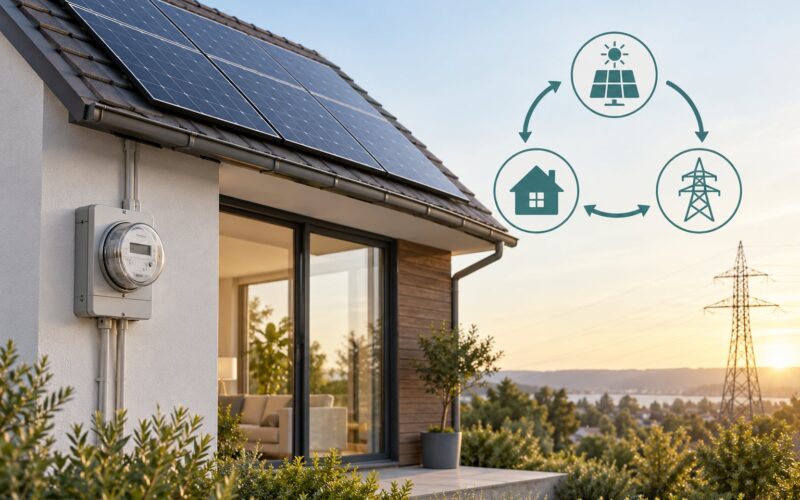
Solar panels make direct current, and your house runs on alternating current, so something has to translate one into the other. A string inverter, also called a central inverter, is a single box that converts the combined output of many panels wired in series. A microinverter is a small box behind each panel that converts that one panel on its own. That single design choice decides how your system behaves when a chimney casts a shadow, when you want to add panels later, and what happens the day a component dies.
This is a string inverter vs microinverter comparison without the sales pitch. There is no universally better option, only a better fit for a particular roof, budget and set of future plans.
Table of Contents
- String Inverter vs Microinverter Explained at a Glance
- How String Inverters Work
- Where DC power optimizers fit
- How Microinverters Work
- Performance When Panels Are Shaded
- String Inverter vs Microinverter Cost
- String inverter vs microinverter cost per watt
- Monitoring, Maintenance and Lifespan
- Which Should You Choose?
- Frequently Asked Questions
- Are microinverters better than string inverters?
- Do microinverters work with solar batteries?
- What is the difference between microinverters and DC optimizers?
- How long do string and microinverters last?
- What happens when one microinverter fails?
- Conclusion
String Inverter vs Microinverter Explained at a Glance
The table below covers the ten differences that actually change how a system performs day to day. Everything else is detail on one of these rows.
| Criterion | String inverter | Microinverter |
|---|---|---|
| How panels are wired | Panels chained in series into one or two strings feeding one inverter | Each panel wired independently to the service panel |
| Where DC becomes AC | Once, in a central unit, usually on a wall or in the garage | Panel by panel, at the roof |
| Partial shade | Weakest panel drags down its whole string | Only the shaded panel’s output drops |
| Mixed panel types | Best kept identical within a string | Fine to mix makes and sizes |
| Monitoring | System-level totals, sometimes per MPPT | Panel-level, showing each unit’s output |
| Equipment cost | Lower per watt | Higher per watt, more hardware |
| Impact of one failure | Entire system output stops | One panel stops; the rest keep running |
| Repairs | One swap, easy to reach | Per-unit swap, often needs roof access |
| Adding panels later | May need a second inverter or a redesign | Just add units and wire them in |
| Battery and backup | Most hybrid string inverters are built for this | Possible, but the design is more restrictive |
| Rapid shutdown | Needs a module-level device to satisfy code | Inherent in the architecture |
One row deserves emphasis before anything else: failure impact. A single central unit is also a single point of failure for the whole array. That trade is at the heart of the entire comparison.
How String Inverters Work
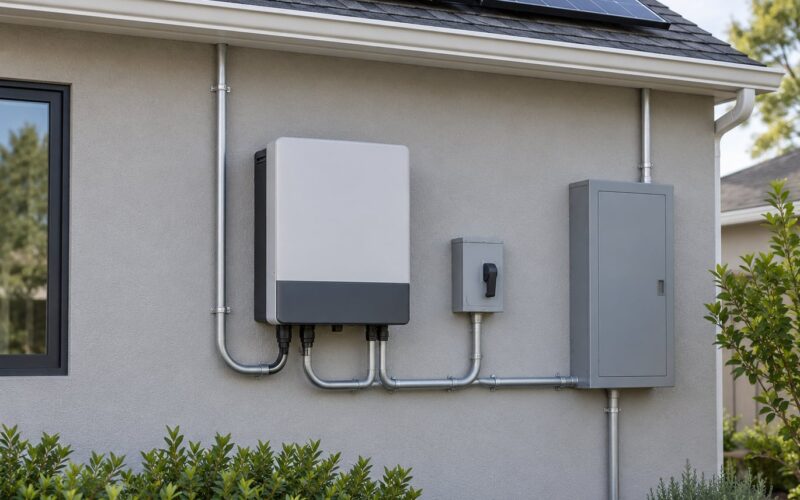
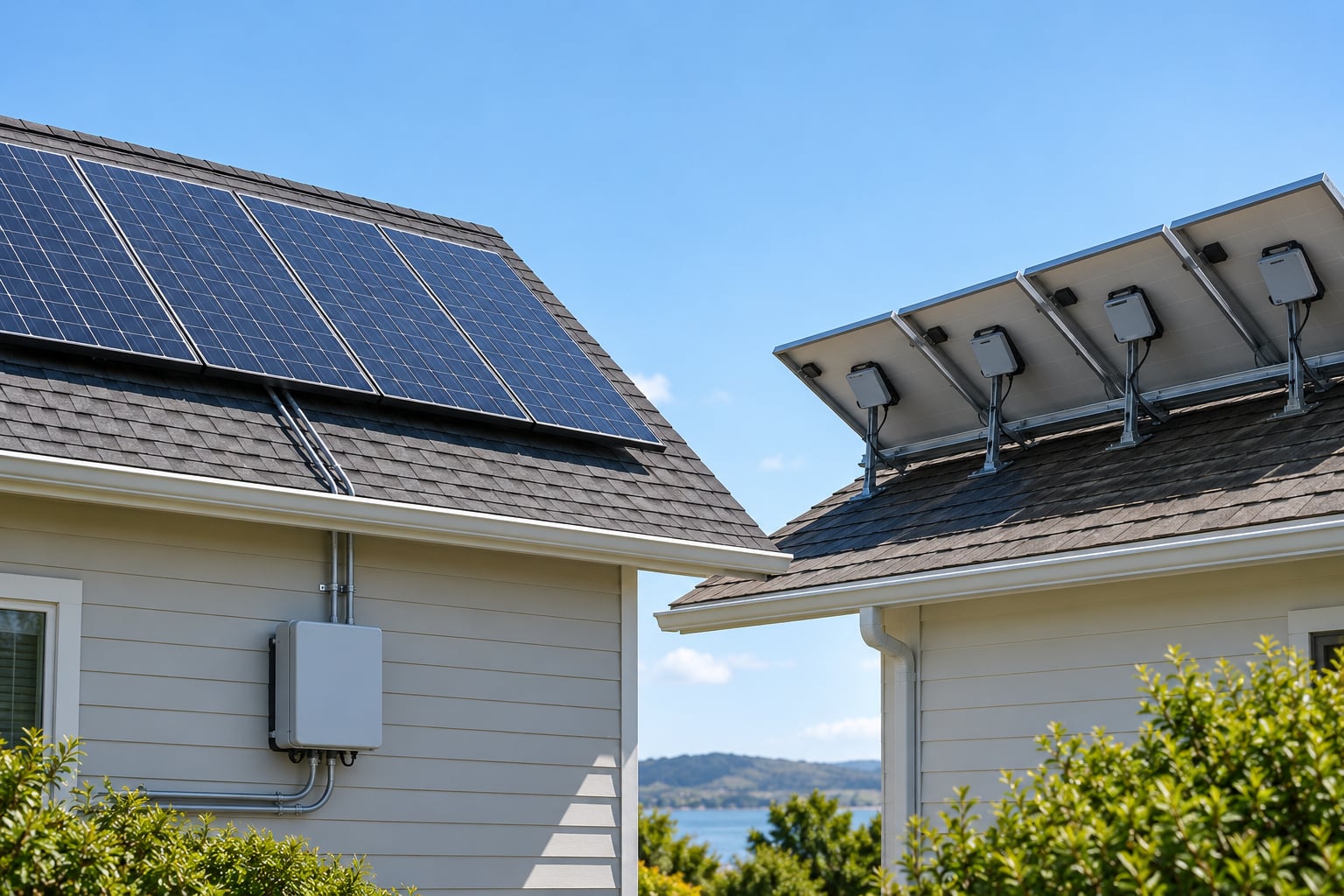
A string inverter takes the direct current from many panels and converts it to alternating current in one step, usually through several maximum power point tracking channels. The panels are wired in series like links in a chain, so current flows through every panel before it reaches the inverter.
Here is the consequence of that wiring, and it is not a flaw so much as arithmetic. Current through a series circuit is set by its weakest link, so a shaded, dirty or simply lower-producing panel caps what the rest of the string can deliver. Voltage from the string adds together, which is why a string needs enough panels to stay inside the inverter’s operating window.
That is the whole argument for module-level power electronics in one sentence: take the conversion out of the shared circuit and each panel stops being responsible for its neighbours.
Where DC power optimizers fit
DC optimizers are the middle path, and they are worth understanding before you compare only two options. An optimizer mounts on the back of each panel and performs maximum power point tracking there, but it sends optimized direct current to a central string inverter that still does the final conversion.
You get most of the shade tolerance and panel-level monitoring of microinverters while keeping one central inverter. The catch is that the optimizers and the central unit are usually from the same product family, so a future inverter swap is less flexible than it looks on paper.
How Microinverters Work
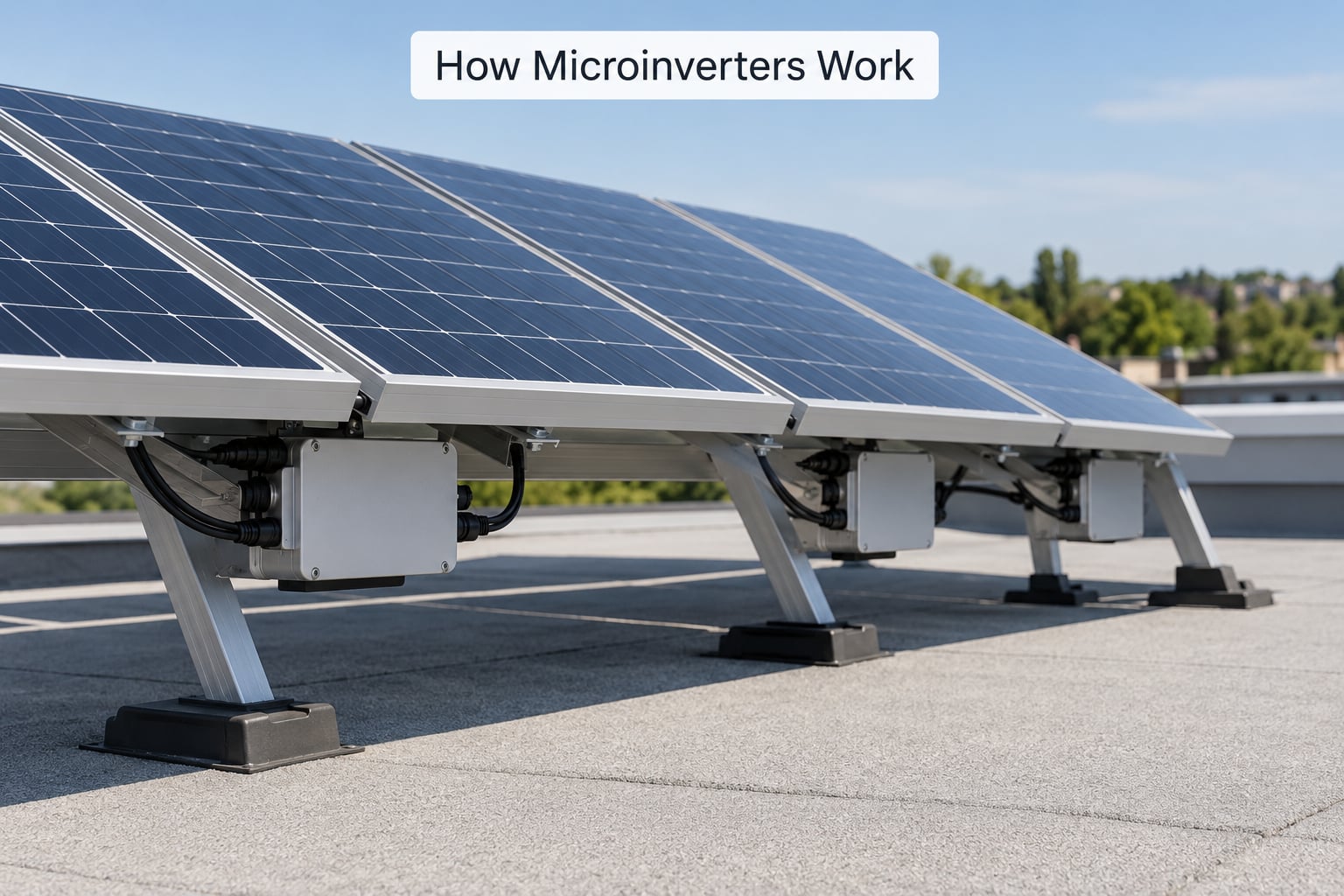
Each microinverter sits on the back of a single panel, runs its own maximum power point tracking, and outputs alternating current directly. Because the conversion happens per panel, there is no shared DC circuit for shade or mismatch to travel along.
Those alternating current outputs merge together on a branch circuit that runs to a combiner box, then to the main service panel. From the panel outward, the system looks like ordinary parallel wiring rather than a high-voltage DC chain, which is part of why rapid shutdown requirements are easier to satisfy.
Enphase is the best-known name here, and the IQ8 series is the current generation of its microinverters. SolarEdge is the other major player, but it sits on the optimizer side of the fence, pairing a string inverter with per-panel DC optimizers.
Performance When Panels Are Shaded
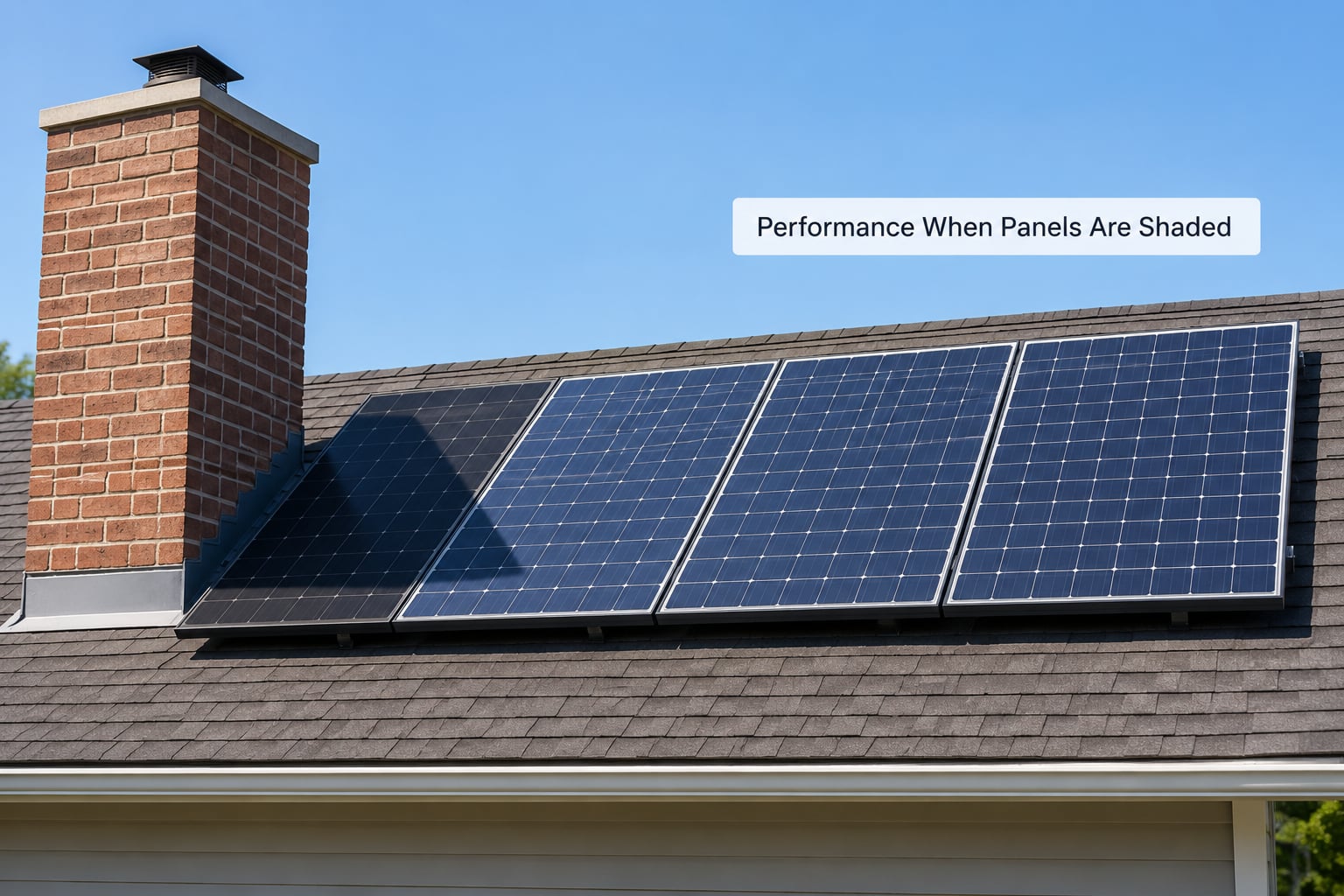
Shading is where the two architectures separate most clearly. In a basic string system, shade on one panel pulls down the output of every panel in that string, which installers on r/solarenergy describe plainly: each panel should produce as much or as little as it can, and in a string it cannot.
With microinverters, the shaded panel simply makes less. The rest of the array is unaware of it, so the loss stays bounded to the panel actually in shadow.
Be honest about the limits of that advantage, because the sales version leaves it out. Microinverters do not create energy from a shaded panel, they only stop the shade from spreading. A roof with heavy afternoon tree cover loses meaningfully with either architecture.
Two other things move the shading math. A chimney or a vent pipe shades a predictable strip at the same time each afternoon, which is the best case for optimizers and microinverters. A tree that grows taller over five years turns a small annual loss into a large one, and no inverter type fixes that.
There is also a direct-current and alternating-current pairing issue worth knowing about. DC clipping happens when a string inverter’s DC input ceiling is exceeded; AC clipping happens when the array’s output is capped by grid or export limits. Both are normal and neither is a fault, but microinverter arrays are far less prone to the first because no single unit ever sees the whole array’s DC.
String Inverter vs Microinverter Cost
Microinverters cost more per watt, and that premium is mostly hardware rather than labour. You are buying one inverter per panel instead of one per roof, plus a combiner, extra wiring and a more involved commissioning process. The string option buys a single unit and a shorter run of DC conduit.
Prices move constantly and every installer quotes differently, so treat any figure you are given as a starting point for negotiation rather than a fact. The relative picture is stable, though.
String inverter vs microinverter cost per watt
| Configuration | Relative equipment cost | What you get for it |
|---|---|---|
| Single string inverter | Lowest | Whole-array conversion, system-level monitoring, shade losses spread across each string |
| String inverter plus DC optimizers | Middle | Panel-level tracking and monitoring with one central inverter |
| Full microinverter array | Highest | Independent conversion, per-panel monitoring, single-unit failures, easy expansion |
Running the numbers over a system lifetime can change the order of these options. A string inverter that fails at year twelve, gets replaced, and then gets replaced again can close the gap. That is a real possibility, not a certainty, and it is the strongest financial argument for spending more on hardware up front.
The other cost driver is labour. An odd roof with multiple facets means more string design work and more mismatch losses, and that is where a per-panel architecture starts to earn its premium. If shade forces you to keep panels you would rather remove, microinverters can make a panel that would otherwise sit idle worth keeping.
Monitoring, Maintenance and Lifespan
Monitoring is the difference you will notice most after the first few months. A string inverter usually gives you system totals and, at best, output per tracking channel, so a single underperforming panel in a ten-panel string is genuinely hard to find. Panel-level monitoring shows you every unit, and a fault becomes a number you can read instead of a guess.
Failure handling reverses the pattern. One dead microinverter costs you one panel’s output; the array keeps running. One dead string inverter costs you the whole system until it is diagnosed, ordered and swapped, which can mean weeks with no production. Enphase support threads document repeat production faults on small systems, and older SunPower microinverter owners have reported system-wide communication failures that forced far more than a single unit replacement.
That last point is the one most guides skip: obsolescence. A microinverter is a model-specific part, and when its manufacturer moves on, direct replacements get harder to find. A string inverter is a commodity with a large second-hand market, and a failed central unit is rarely a dead end. Ask any installer what happens to your warranty claim in year fifteen before you sign anything.
Warranty length is not lifespan. Residential string inverters commonly carry coverage in the ten-to-twelve-year range, and some microinverter lines stretch further, often twenty-five years. Actual service life depends far more on heat, humidity and ventilation than the label suggests, and panels themselves usually carry their own separate and much longer warranty. Treat inverter warranty and panel warranty as two different promises from two different manufacturers.
Routine maintenance is lighter on a string system, which has one box to inspect and clean. Microinverter systems have more units and more AC connections, and each is another potential failure point. Homeowners on eevblog and r/solar tend to come back to the same conclusion: for a simple install, the extra hardware is hard to justify.
Which Should You Choose?
Choose a string inverter if your roof is a single plane with no shade, all panels are the same model, and you would rather spend the difference on panels or a battery.
Choose microinverters if any of these are true: shade lands on part of the array, the roof is broken into multiple orientations, you want to know exactly how each panel is doing, you plan to add panels later, or the array is small enough that losing it to one failure would hurt.
Choose a string inverter with DC optimizers if you have some shading and some unshaded roof, want panel-level visibility, and prefer one central device to service.
Here is the 30-second version. Shade, complexity and monitoring pull you toward microinverters. Simplicity and cost pull you toward a string. If you are genuinely torn, ask each installer to model the shade loss on your specific roof in writing before you compare anything else, because that single number usually settles the question faster than any equipment spec.
Whichever way you go, do four things before signing. Map the shade across your roof across a full day and across a year. Confirm every panel faces the same direction and pitch, or find out how much the mismatch costs you. Get a written system design with the string layout, not a quote with a total on it. And compare lifecycle cost from at least two qualified installers, including what a mid-life inverter replacement costs in each design.
Frequently Asked Questions
Are microinverters better than string inverters?
Microinverters are usually better for arrays with partial shade, mixed panel orientations or a need for panel-level monitoring. A string inverter can be more economical for a straightforward roof with one orientation and no shading, and it is usually the simpler choice when you plan to add a battery, because most hybrid string inverters are designed for that from the start.
Do microinverters work with solar batteries?
They can, but battery compatibility depends on the battery system, inverter controls and the electrical design. Many home batteries are designed to work with a hybrid string inverter, while some microinverter ecosystems use their own battery and gateway. Ask the manufacturer directly, because a battery that is advertised as compatible is not always compatible with every inverter in the same brand.
What is the difference between microinverters and DC optimizers?
A microinverter converts one panel’s DC output directly into AC on the roof, while a DC optimizer usually sits with each panel and sends optimized DC to a central string inverter. Optimizers reduce shade and mismatch losses and give panel-level monitoring, but the central inverter still does the conversion, so you keep one device to service and one product family to stay compatible with.
How long do string and microinverters last?
Many residential inverters carry warranties of about 10 to 12 years, and some microinverter products offer longer coverage, but warranty length is not the same as guaranteed lifespan. Heat, humidity and poor ventilation shorten real service life more than the label suggests. Panels carry their own separate and much longer warranty, so treat the two as different promises from different manufacturers.
What happens when one microinverter fails?
Only that panel stops producing, and the rest of the array keeps running, which is the clearest practical advantage over a string inverter where one failure can stop the entire array. The trade-off is logistics: replacing a unit often means roof access, pulling a panel and recommissioning the system, and older models can be hard to source as a direct replacement.
Conclusion
Microinverters buy you shade tolerance, per-panel visibility and the knowledge that one broken unit will not stop your whole system. A string inverter buys you a cheaper, simpler machine with one thing to service. Shade and roof complexity point to microinverters; a clean single-plane roof and a planned battery point to a string inverter.
Start by mapping the shade on your own roof and asking two installers to model that loss in writing. That number decides this faster than any spec sheet, and it costs you nothing to get.