No. Properly installed solar panels do not damage a sound roof, because the array is a bolted frame rather than a permanent alteration of the shingles. So do solar panels damage your roof in practice? Sometimes, and the risk comes from the penetrations, and from mounting hardware on a roof that was already near the end of its life. Get the roof inspected before anything is signed.
That answer frustrates people who have read horror stories about torn shingles and leaks. Those failures are real, and they are almost always traceable to workmanship, materials, or timing rather than to solar panels as a technology.
Table of Contents
- Do Solar Panels Damage Your Roof? It Depends on the Installation
- How Solar Panels Are Attached to a Roof
- Do Solar Panels Damage Your Roof Over Time?
- Do solar panels protect roof shingles?
- Which Roof Types Are Most at Risk?
- How Much Weight Do Solar Panels Put on a Roof?
- What Can Cause Leaks or Roof Damage?
- How to Install Solar Panels Without Damaging the Roof
- Should You Install Solar Panels on an Old or Damaged Roof?
- What Questions Should You Ask a Solar Installer?
- Frequently Asked Questions
- Do solar panels make shingles wear out faster?
- Are solar panels safer on a metal or tiled roof?
- Does the age of my roof matter before installing solar panels?
- Can solar panels be removed without damaging the roof?
- Is a ground-mounted system better for a fragile roof?
- Will installing solar panels cancel my roof warranty?
- Conclusion
Do Solar Panels Damage Your Roof? It Depends on the Installation
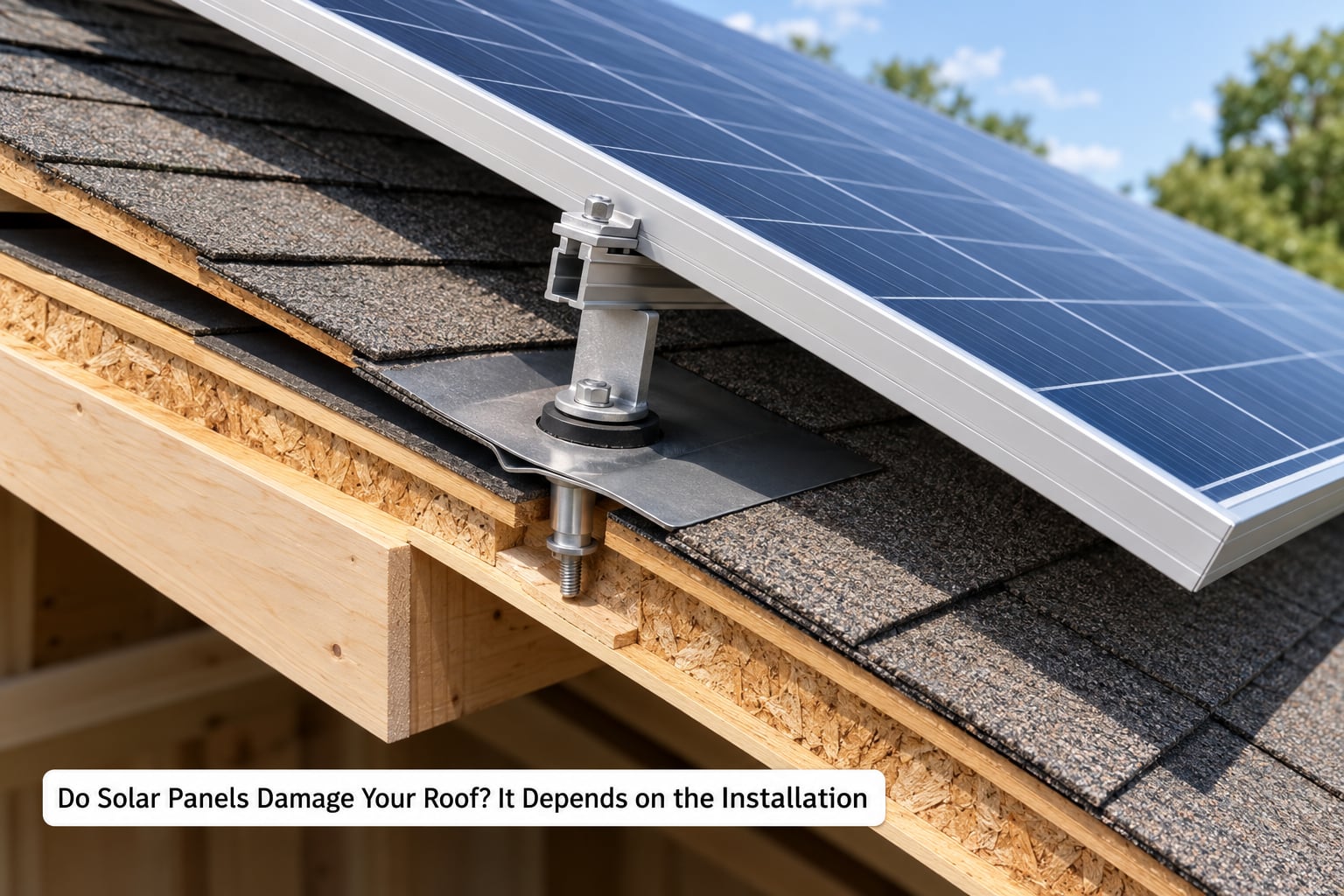
A correctly mounted array adds a modest dead load, seals every hole it makes, and can outlive several shingle warranties. An incorrectly mounted one can drive a lag bolt into a rafter that is not there, cover a flashing detail with sealant instead of metal, or sit on a roof scheduled for replacement in three years.
The mounting method is the biggest fork in the road. Homeowners comparing options should understand what each approach does to the roof surface underneath it.
| Mounting option | How it attaches | Effect on the roof |
|---|---|---|
| Penetrating roof mount | Lag bolts into rafters, L-foot standoffs, rails, clamps | One sealed hole per mount point, inside the shingle’s water-shedding layer |
| Tile or slate hook | Hook under the tile, often with a deck penetration or a bonded mount | No hole at all on some systems; on others, a penetration that must be flashed and later sealed from above |
| Standing seam clamp | Clamps pinch the raised seam of a metal roof | No penetration at all, which is the safest choice on a metal roof |
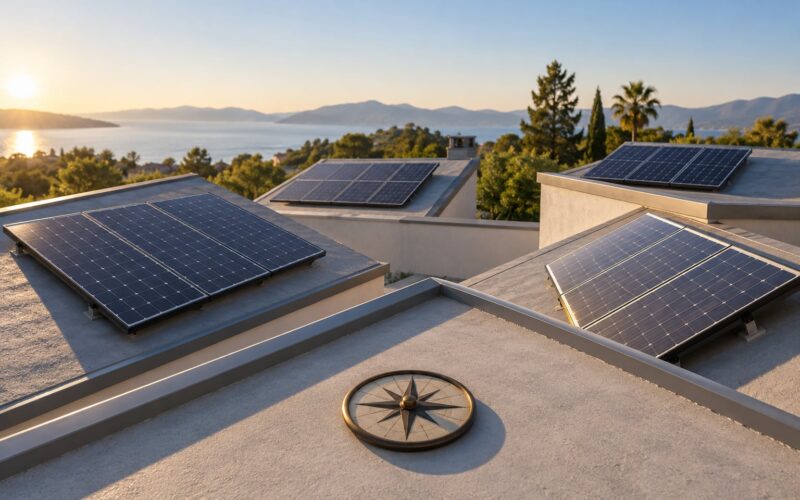
| Ballasted | Concrete blocks or weighted frames hold racking in place | No holes, but far more weight resting on the roof, usually on low-slope commercial membranes |
| Hybrid ballasted | Ballast plus a few mechanical attachments | Fewer penetrations, heavier load, membrane protection pads required |
| Ground mount | Posts set in the ground outside the building | No roof involvement at all, at the cost of land, trenching and more steel |
Two rules cover most of the ground. Use the hardware designed for your specific roof material, and never let panels be stepped on, carried across, or set down on shingles during installation.
How Solar Panels Are Attached to a Roof
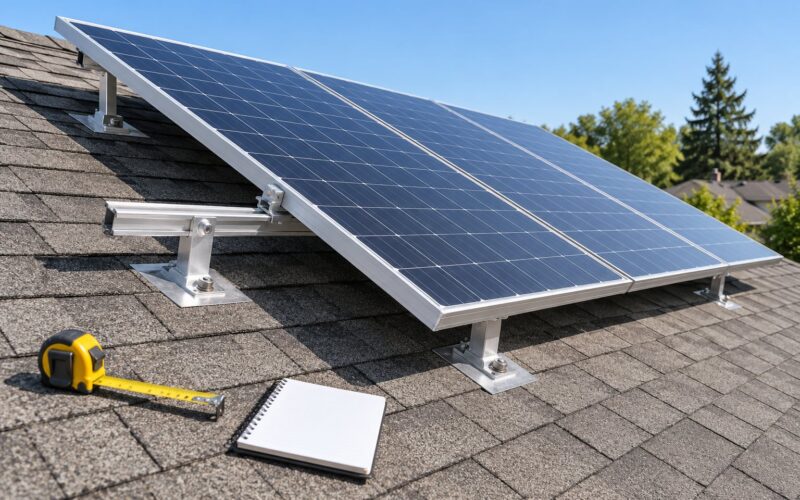
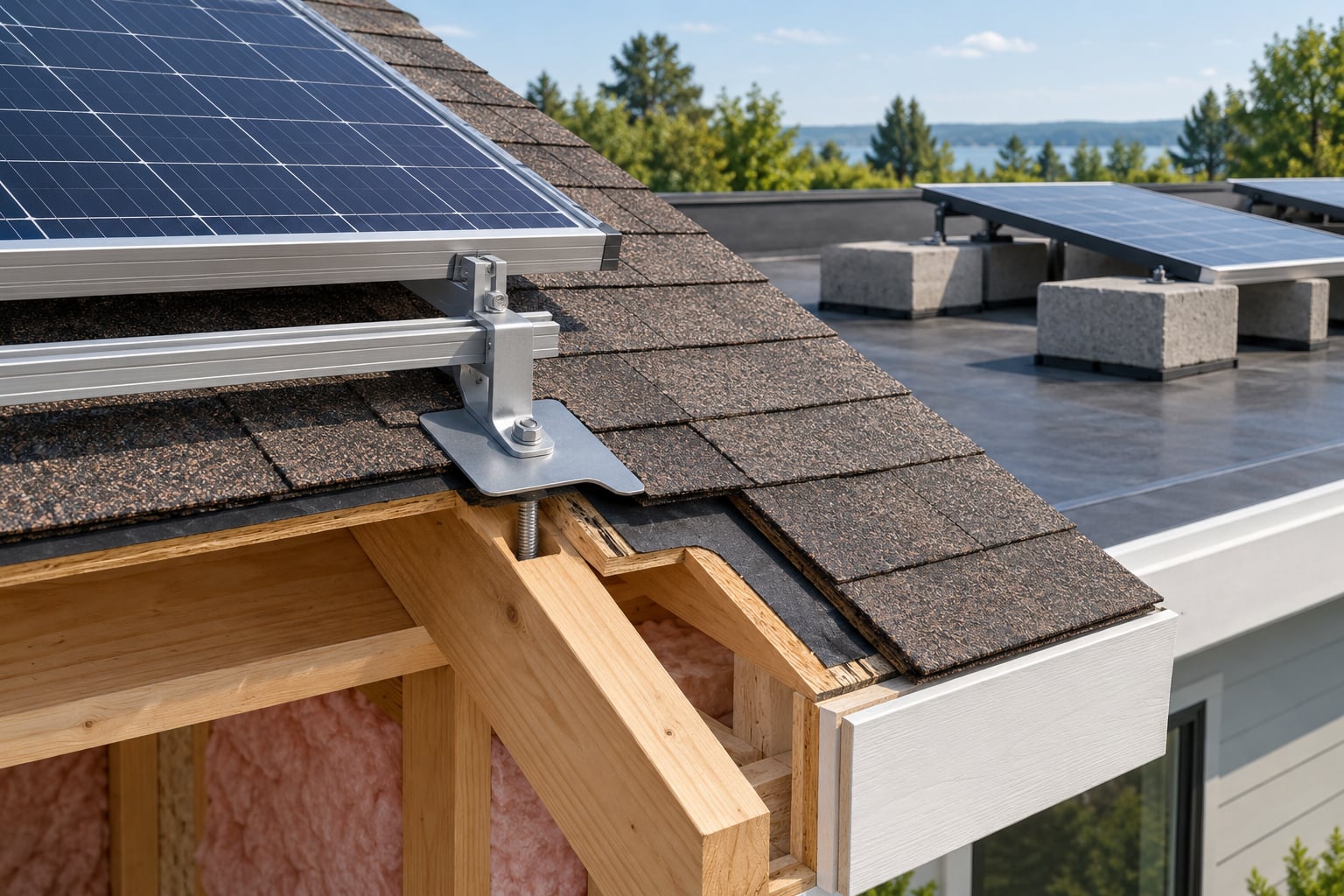
Panels are clamped to an aluminum or galvanized racking system. The racking is bolted through the roof surface into the framing beneath, and each hole is surrounded by a shaped metal flashing that makes water flow around it instead of into it.
The standard sequence for one penetration looks like this.
- Find the rafter. The bolt must land in framing, not in the gap between rafters and not in bare roof deck sheathing.
- Mark the drill point. A stud finder or joist scan confirms framing location before anything is powered up.
- Drill the pilot hole. A hole smaller than the bolt, positioned to keep the flashing’s uphill edge under the course above.
- Drive the lag bolt. It threads into the rafter and pulls the standoff down tight.
- Set the standoff. The L-foot holds the rail at a fixed height above the surface, so panel edges sit clear of the shingles.
- Slide the flashing under the shingle course above. This is the layer that actually sheds water. Sealant is a backup, not the primary defense.
- Seal and clamp. A bead of sealant at the uphill edge, then the mid and end clamps torqued to spec.
Shingle over flashing over shingle is the principle. Water arrives on the top shingle, hits the metal, and exits over the lower shingle without entering the hole. Get the layering backwards and no amount of caulk will save it.
Installers must follow the roof manufacturer’s and the racking manufacturer’s instructions. Penetrating a roof is roofing work, so on many projects it belongs to a licensed roofer rather than the solar crew alone.
Do Solar Panels Damage Your Roof Over Time?
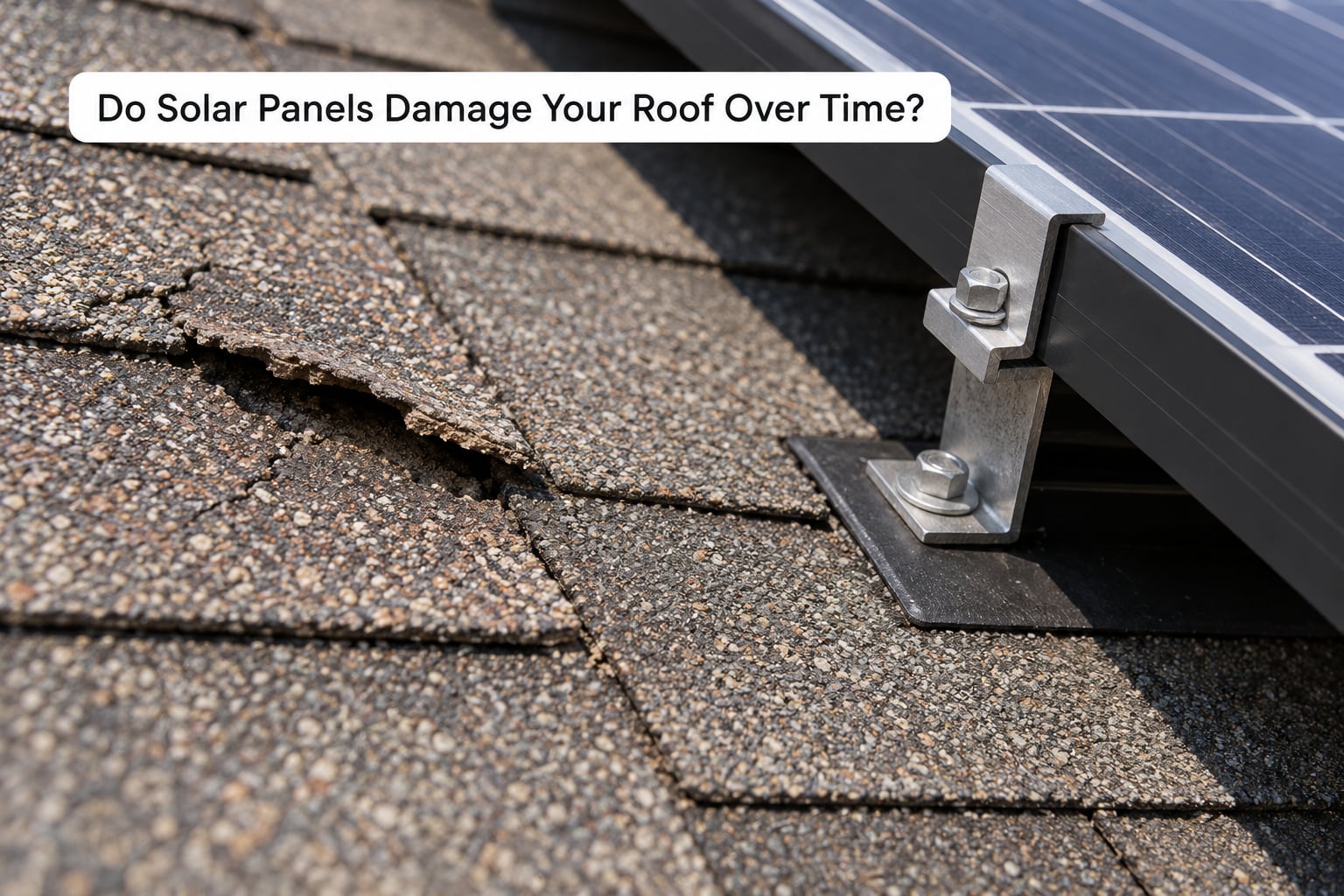
Long-term damage is a slow story, and it usually starts with the roof rather than the panels. A shingle roof that is already curling, granule-loss heavy, or patched in several places will keep deteriorating under the array, and the array makes that repair expensive to reach.
Several things work slowly against the roof surface.
- Dead load. Panels and racking add a permanent weight, which most residential roofs handle comfortably but which needs checking on unusual or older structures.
- Wind uplift. Panels act as a sail. Under-anchored arrays can pump and shift, loosening fasteners over time.
- Thermal movement. Rails expand and contract through a season, walking fasteners gradually loose.
- Corrosion. Fasteners and rails near dissimilar metals can streak and weaken at the penetration.
- Blocked drainage. A badly laid out array can trap leaves and sediment in valleys or gutters behind the panels.
- Foot traffic. Every inspection, cleaning, and repair means someone walking on shingles. Foot traffic is the quietest cause of early shingle failure.
Homeowners in r/solar and r/Roofing describe the same pattern repeatedly: the array looks fine, the shingles under it keep aging, and the day the roof does need work somebody has to move 30 or 40 pounds of glass off it first.
Do solar panels protect roof shingles?
Often, yes. The same shading that keeps a room cool in summer also shields the roof surface from ultraviolet degradation, cuts the daily temperature swing that cracks granules, and blocks hail and falling branches. Owners on forums report noticing this on the portions of roof that stay under the array while the exposed slopes look worn first. Protection is not a substitute for good roofing, but it is a real side benefit of a full-coverage design.
Which Roof Types Are Most at Risk?
Roof material decides the failure mode. Asphalt shingles are forgiving; concrete and slate tile are brittle; standing seam metal should never be drilled at all.
| Roof type | Typical attachment | Main risk |
|---|---|---|
| Asphalt shingle | Lag bolt, L-foot, flashing under the course above | Cracked or lifted shingles when the installer is careless, and leaks if flashing is skipped |
| Clay or concrete tile | Tile replacement flash or tile hook | Brittle tiles cracking under foot and under clamp pressure; tile hooks need a real deck attachment or an adhesive rated for the load |
| Slate | Slate-specific hook and bolt | Slate cannot be walked on casually; a single slipped tool can crack a 200-year-old tile |
| Standing seam metal | Non-penetrating seam clamps | Drilling into a metal roof when clamps were available. Homeowners report exactly this mismatch, and it is unnecessary |
| Corrugated or ag panel metal | Purlin screws and flashed penetrations | Fastener holes in exposed metal are long-term leak and rust points |
| Flat EPDM or TPO membrane | Ballasted or hybrid-ballasted with protection pads | Ballast weight beyond the membrane’s allowance, punctures during install, and ponding water behind the array |
| Wood shake | Specialist attachment only | Fragile material, fire code requirements, and few installers experienced with it |
| Aging or already leaking | None, until the roof is repaired | Mounting hides the problem until a storm reveals it, and the installer may deny responsibility |
Older or damaged roofs are the highest risk category, and the danger is not structural. It is that panels cover the evidence of decay and make every subsequent repair slower and pricier.
How Much Weight Do Solar Panels Put on a Roof?
Modern panels are heavier than most people expect, and ballasted systems heavier still. The numbers below are typical, not exact, since panel sizes and mounting hardware vary by model.
| Component | Typical weight |
|---|---|
| Standard module | Around 40 pounds each |
| Racking: rail, clamps, mid and end clamps | Roughly 5 to 10 pounds per module |
| Standoffs and flashed mounts | About 2 to 5 pounds per mount point |
| Full 10-module roof array with racking | Roughly 450 to 550 pounds spread across the attachment points |
| Ballasted flat-roof system | Several hundred pounds per module held in concrete blocks |
For most residential roofs, that distributed load is well inside what the framing was designed to carry, which is why structural checks are routine rather than alarming. Dead load is also not the main danger. Wind load is, because a panel presents a large flat surface to a storm and engineers design for pressures well above what a still photo suggests.
Unusual, heavy, weak, or uncertain structures are different. Vaulted ceilings, post-and-beam frames, older homes with mixed repairs, and very large arrays deserve an engineer’s assessment. Building departments require a structural review in some jurisdictions for good reason.
What Can Cause Leaks or Roof Damage?
Ask the question do solar panels damage your roof often enough and you will find people describing one of a small number of specific failures. None of them is caused by the panels themselves.
- A penetration that misses the framing. A bolt into bare sheathing or empty deck space has nothing to hold and nothing to seal against.
- Sealant used instead of flashing. Caulk is a backup detail. Homeowners on r/Roofing report installers tearing shingles above the mounts and “sealing some of it,” which is not a flashing detail.
- Flashing installed upside down or above the wrong shingle course. It sheds water straight down the hole.
- Damaged shingles from handling. Panels carried across the roof and set down on the deck crack and scuff shingles well outside the array footprint.
- Wrong hardware for the material. Penetrating mounts on standing seam metal where seam clamps should have been used.
- Loose fasteners and thermal cycling. Rails that expand and contract walk bolts out of their holes over a decade or two.
- Blocked runoff. Leaves and sediment collecting behind the array or in gutters, holding water against the surface.
- Work on a roof already failing. The leak exists anyway, and the array delays the discovery.
One detail surprises almost everyone: the drip inside the house is rarely under the hole. Water enters at the penetration, travels along a rafter or across the sheathing, and finds an exit somewhere else entirely. That is why “the leak is nowhere near my panels” is a normal finding, not evidence that the array is innocent.
How common are leaks? There is no reliable national count, because most problems are settled privately and the reporting is not systematic. The pattern in homeowner forums is a minority of installs with a problem, concentrated heavily in rushed work and in roofs that were already old.
How to Install Solar Panels Without Damaging the Roof
You are not going to drive a lag bolt into your own rafter, and you should not want to. This is roofing work and electrical work under a permit, done by licensed trades. What you can control is the process you demand before the crew arrives.
- Get a roof inspection first. Ask for a written report on remaining useful life, condition of the deck, and any soft spots.
- Check both warranties before signing. The panel and inverter warranty, and the roofing manufacturer’s warranty terms on penetrations.
- Verify the installer. Look for NABCEP certification or an equivalent, plus a state license, and check whether roofing work is subcontracted to a licensed roofer.
- Ask for photographs of every penetration before the panels go on. This is the single most useful step in the whole process.
- Require code-compliant hardware. Mounting rated for your local wind and snow loads, and for the roof material.
- Keep materials off the roof. Panels and pallets get staged on the ground and lifted into place.
- Walk the roof afterward. Photograph penetrations, confirm the site is cleaned, and get a post-install inspection in writing.
Ask for a workmanship warranty that explicitly covers roof penetrations and leak repair, not just the equipment. Equipment warranties run 25 years; the workmanship term is often far shorter, and that is the one that matters here.
Should You Install Solar Panels on an Old or Damaged Roof?
Replace the roof first if it is close to the end. The common guidance in homeowner forums and among installers is to have at least ten years of remaining life before mounting an array that will last 25 to 30.
Covering a failing roof is bad for a simple reason: the leak happens anyway, and now it happens later and more expensively. Panels over the damaged area are also hard to remove for repair, and the roofer charges more to work around hardware. A roof replacement under an array is a removal-and-reinstallation job on top of the reroof.
That extra work is why one Bogleheads poster concluded the removal and reinstall charges during a reroof largely cancel out the energy savings. It is also why the cost of taking panels off and putting them back is worth pricing in writing before you sign anything.
Ask the roofer and the solar company for that removal-and-reinstatement figure up front, in the contract. It turns a future surprise into a line item you can compare between bids.
Two other conditions disqualify a roof from immediate work. An active leak that has never been diagnosed, and a roof with less than a few years of documented life left. Both need resolving first, and a reputable installer will say so before quoting.
What Questions Should You Ask a Solar Installer?
These are the questions that separate careful companies from the rest. Ask them of every bidder and compare the answers.
- How old is my roof, and how much useful life does it have?
- Will you photograph every roof penetration before the panels are installed?
- What type of flashing goes on each mount, and is it under the shingle course above?
- Who performs the roofing penetrations, and are they licensed for it?
- What happens to my roof manufacturer’s warranty? Who handles the paperwork?
- Does the permit include a structural review, and who files it?
- What is your workmanship warranty on penetrations, and does it cover leak repair?
- If a leak appears, who responds, who pays for the diagnosis, and who pays for the repair?
- Will you remove and reinstall the array if I replace the roof later, and at what cost?
- Does my homeowners insurance cover leak damage caused by the installation?
Red flags are easy to spot once you know them. A quote that arrives without anyone walking the roof. A refusal to discuss the roofing warranty. Panels staged across the shingles during install. Vague language about who is responsible for a leak, or a workmanship warranty that only names the panels and inverter.
Get two or three quotes, confirm licensing where your state requires it, and read the leak-liability clause closely. The cheapest bid is often the one that costs the most when something goes wrong.
Frequently Asked Questions
Do solar panels make shingles wear out faster?
Not on their own. Shingles age from ultraviolet exposure, thermal cycling, and weather, and panels usually cover the roof surface that would take the most UV and heat. What wears faster is anything the crew walked on or carried across during installation, plus the fasteners that loosen as rails expand and contract over many seasons. A roof in good shape under a well-installed array often outlasts the same roof with no array at all.
Are solar panels safer on a metal or tiled roof?
It depends on the hardware. Standing seam metal is the safest surface of all, because seam clamps attach without any hole. A metal roof drilled for lag bolts is riskier than any shingle job. Clay and concrete tile can be mounted with tile hooks that leave the deck untouched, but tiles are brittle and crack easily under foot traffic and clamp pressure. Ask which method the installer intends and why, per material.
Does the age of my roof matter before installing solar panels?
Yes, and it is the first question any good installer should ask you. The usual guidance is at least ten years of remaining useful life, because a system lasts 25 to 30 years and roofs that need replacing sooner force an expensive removal and reinstallation. A written inspection that estimates remaining life is worth more than a general verbal opinion that the roof looks fine.
Can solar panels be removed without damaging the roof?
Usually yes, but not always cleanly. Removing an array leaves the original penetrations open, and those need to be patched and resealed with the right detail, not a blob of sealant. The bigger cost is removing the panels safely and reinstalling the system afterwards, which means a roofer and a solar crew on the same roof. Ask for that combined figure before you install.
Is a ground-mounted system better for a fragile roof?
It removes roof risk entirely, since nothing is drilled and no weight is added to the structure. The tradeoffs are real: you need usable land, trenching and permitting for the conduit run, more steel, and an array that can be shaded by trees or the house itself. It is a sensible answer for a slate or old shake roof that a roofer does not want penetrated, not a default choice for everyone.
Will installing solar panels cancel my roof warranty?
Sometimes, and the paperwork is what decides it. Many roofing manufacturers warrant the roof only if penetrations are flashed to their specifications or if a post-install inspection is arranged through the installer. Get the warranty document in advance, take photographs of every flashing detail, and ask the installer to file the re-inspection request. A roof that is already failed before the panels arrive is not the installer’s problem at all.
Conclusion
A properly designed installation on a structurally sound, well-maintained roof should not damage it. Panels sometimes add years to a roof’s life by shading it, and the weight they add is well within what most residential framing was built to carry.
So start with the roof, not the panels. Get a written inspection of remaining useful life, require photographs of every flashing detail before the array covers them, and put the leak-liability language and the removal-and-reinstallation figure in the contract. Those three documents are what separate a sound installation from a costly one.