Landscape lighting generally needs somewhere between 50 and 300 lumens per fixture, and that single number changes completely depending on what the light is for. A path light judged at four feet needs a fraction of what a spotlight lighting a 30-foot oak needs. This guide breaks the answer down by purpose, distance and placement so you can size each fixture instead of guessing.
If you are replacing bulbs in an existing system, scroll straight to the table near the end and match your fixture type. If you are starting from nothing, read the whole thing in order, because the mistakes people make here come from sizing every fixture the same.
Table of Contents
- How Many Lumens Do I Need for Landscape Lighting?
- What Does Lumen Measure in Outdoor Lighting?
- How Many Lumens for Paths, Driveways, and Steps?
- How Many Lumens for Trees, Shrubs, and Garden Beds?
- How Many Lumens for Outdoor Security and Ambient Lighting?
- How to Choose the Right Lumen Output for Your Space
- Lumen Recommendations by Landscape Lighting Purpose
- How Solar Landscape Light Output Compares
- Frequently Asked Questions
- How many lumens do I need for a path light?
- How many lumens do you need to uplight a tree?
- Is 3000 lumens good for outdoor lighting?
- Is 100W too bright for outdoor lights?
- How many lumens do solar landscape lights really put out?
- How much area will 10,000 lumens light up?
- Conclusion
How Many Lumens Do I Need for Landscape Lighting?
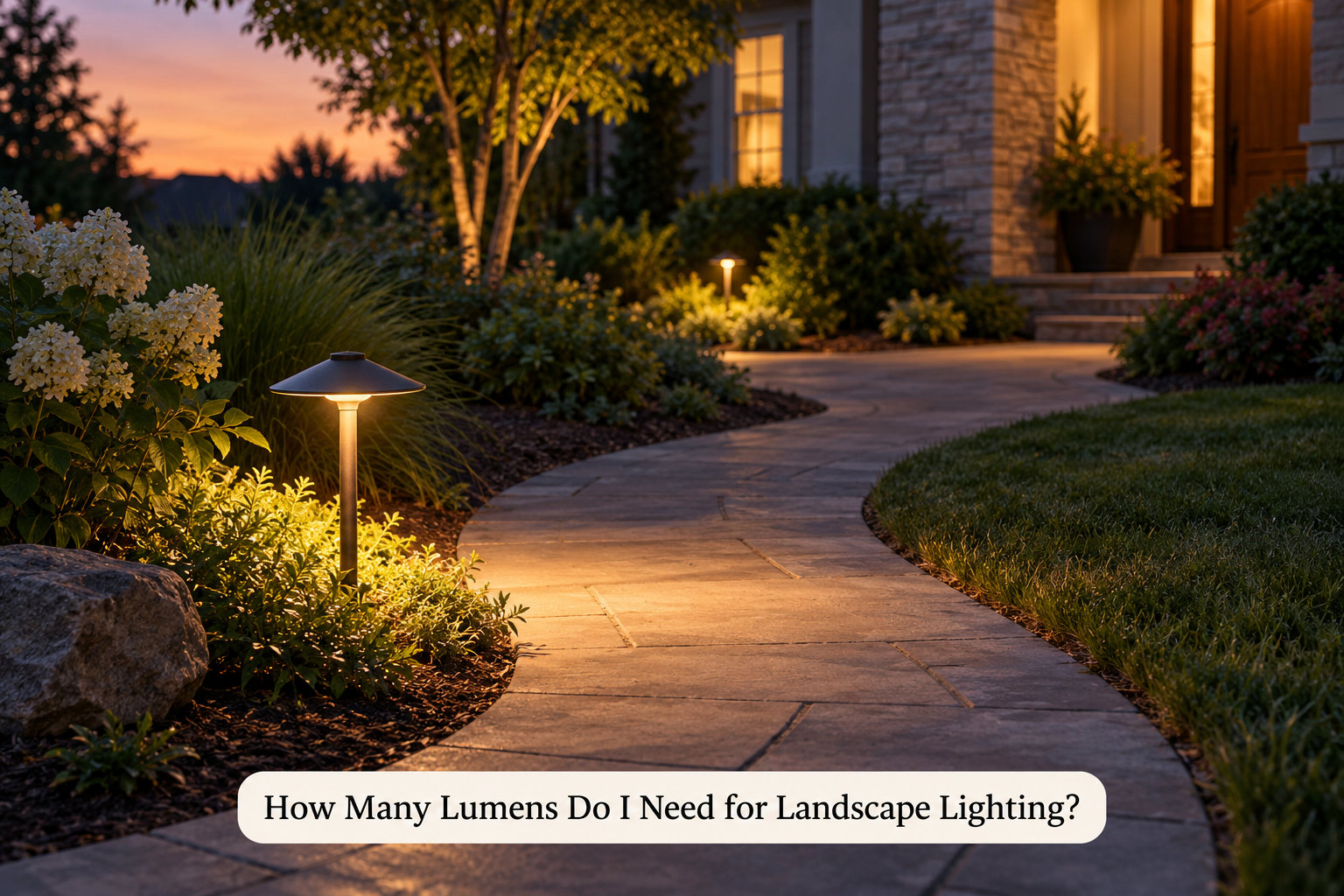
The short answer: most residential fixtures land between 50 and 300 lumens, with security floods pushed far higher.
Recommended lumens by fixture type:
- Path and area lights: 100-300 lumens for guiding feet along a walkway without creating glare at eye level.
- Step and stair lights: 12-100 lumens because you only need to see the tread edge from a few feet away.
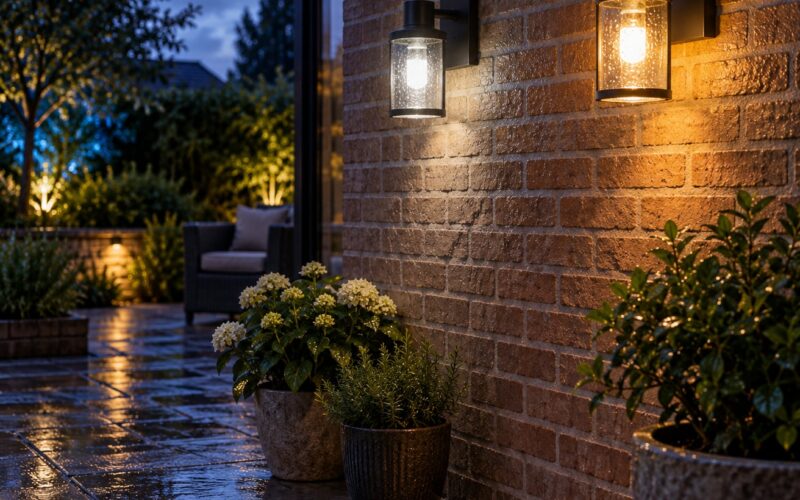
- Hardscape and wall washers: 50-185 lumens to graze stone, brick or a retaining wall evenly top to bottom.
- Shrub and small tree uplights: 120-300 lumens aimed at a trunk or low canopy roughly 6 to 10 feet away.
- Large canopy tree uplights: 300-700+ lumens placed further back so light climbs rather than blasts the bark.
- Flood and security lights: 700-1,300 lumens for driveways, side yards and entry points that need real visibility.
Those numbers assume shielded optics aimed at a surface. The same lumen rating in a clear glass fixture pointed at a walkway will feel twice as bright, because your eye is catching the light source instead of the surface it lands on.
What Does Lumen Measure in Outdoor Lighting?
A lumen measures luminous flux, which is simply the total amount of visible light a fixture puts out in all directions. It tells you how much light exists, not how much of it lands where you want it.
Three other numbers get mixed up with lumens constantly:
- Watts are how much power the LED draws. A 3-watt path light and a 12-watt flood can both draw power happily; only one of them lights a driveway.
- Lumens per watt is the efficiency rating. Good outdoor LED modules land around 60-100 lumens per watt, so a 3W path light at 80 lumens per watt gives you 240 lumens.
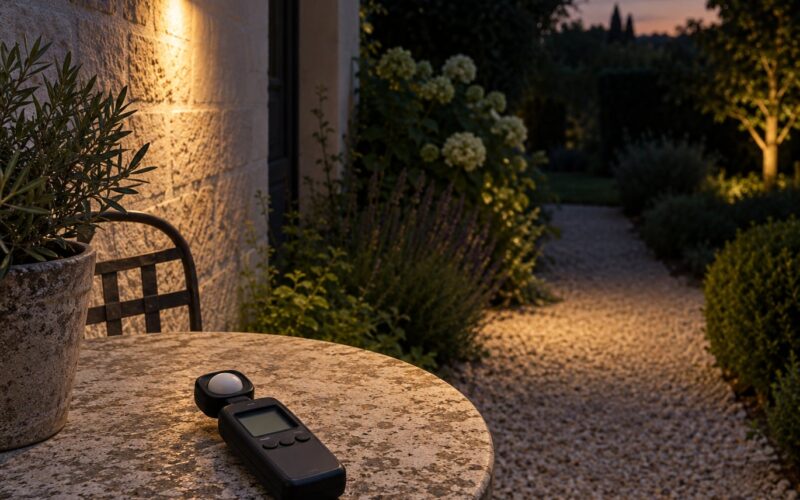
- Foot-candles or lux measure how much light actually lands on a surface. This is the number that predicts whether you can see a trip hazard.
That last distinction explains why two fixtures rated at 300 lumens can behave completely differently. If one spreads its light across a wide 60-degree flood and the other concentrates it into a 15-degree spot, the spot delivers roughly ten times the illuminance at the target.
Mounting height matters too, in plain English. Light spreads as it travels, so the same fixture at 18 inches throws a tight bright circle, and the same fixture at 6 feet throws a wide dim one. That is why tree uplights need more lumens than path lights even when both sit at ground level, the uplight is simply lighting something much further away.
How Many Lumens for Paths, Driveways, and Steps?
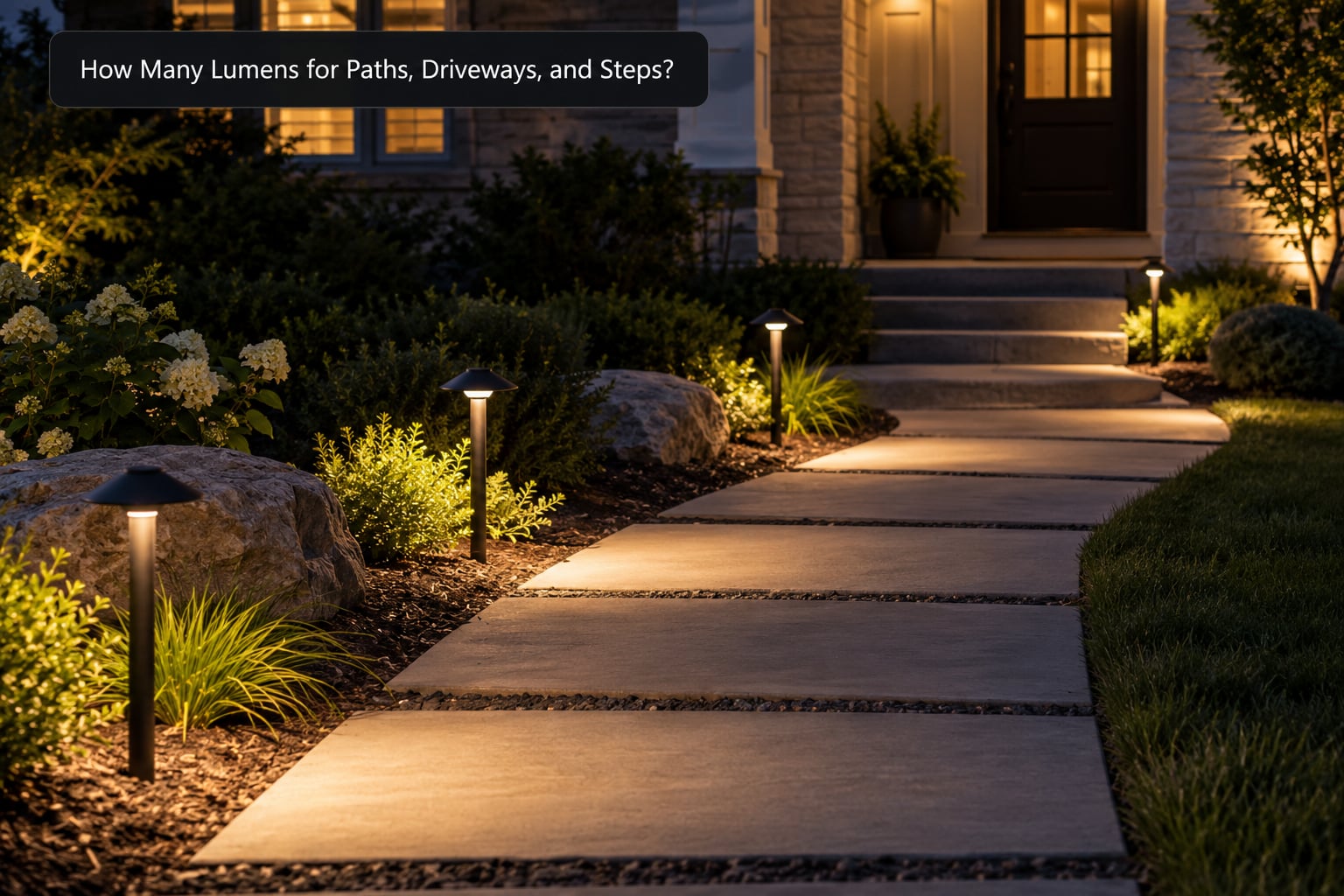
Low-level guidance lighting is the easiest place to overdo it. Your eye is at roughly walking height, right next to the bulb, so even modest output feels bright at close range.
- Marker lights: 50-150 lumens. Enough to define the edge of a path or the lip of a step, nothing more.
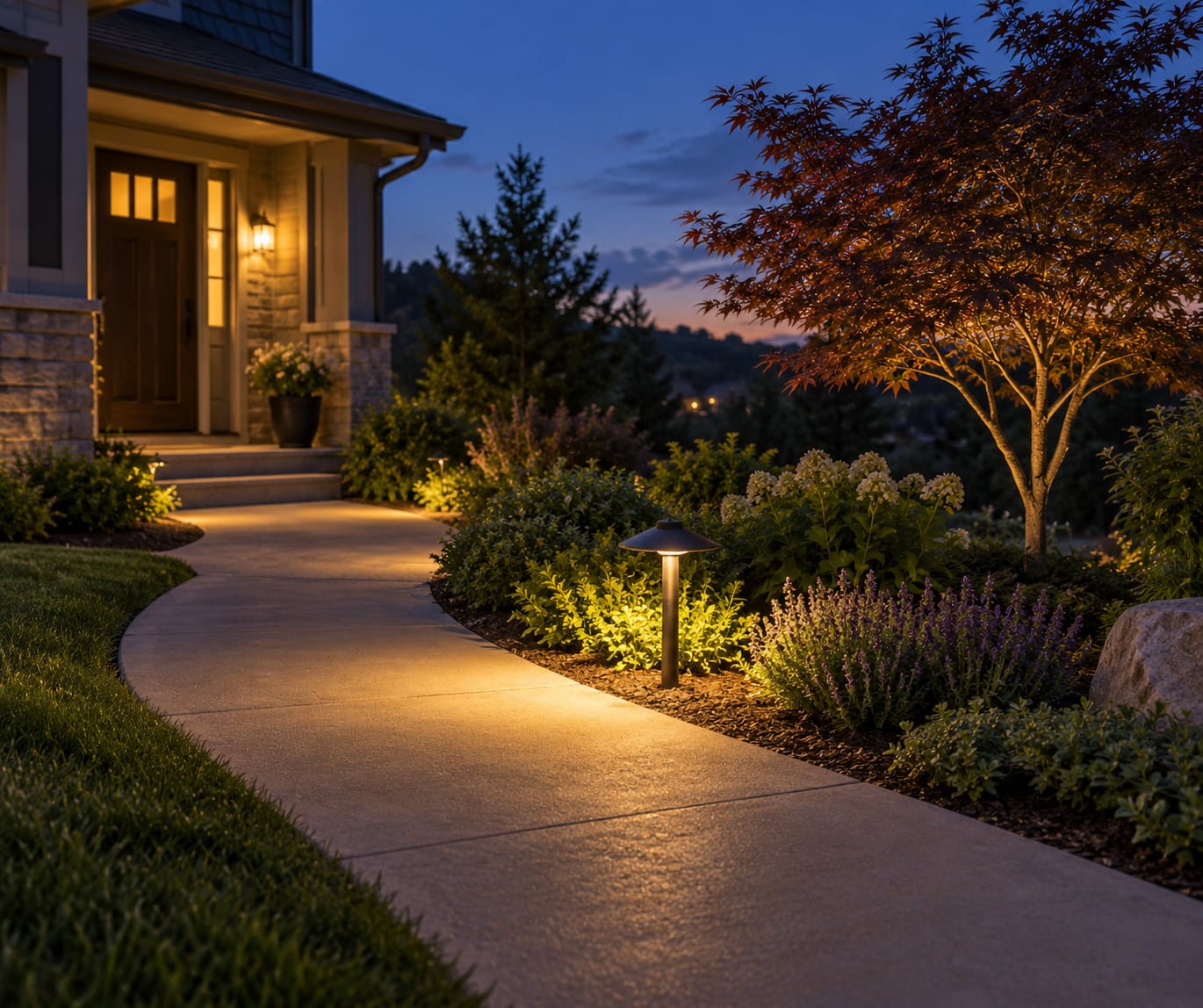
- Standard paths and steps: 100-300 lumens. The working range for most residential walkways.
- Wide walkways and patio edges: 200-500 lumens. Use a broader beam and accept soft pools rather than an even wash.
- Driveways: 300-700 lumens. Here the goal shifts from guidance to seeing a car reverse at night.
Spacing matters as much as output. Path lights set 6 to 10 feet apart give a connected trail of light. Push them to 15 feet apart and you get a runway stripe with dark gaps between, which reads as an unfinished installation rather than a lit path.
Shields and hoods do more work than most people expect. A fixture with a full-cutoff shield sends light down and forward only, so you can step it up a lumen range without the beam hitting anyone’s eyes. If you are installing without shields, drop down one range rather than guessing.
On steps, aim the light downward and slightly forward so the tread reads bright and the riser stays darker. Lighting the tread is what prevents a trip, and it also keeps glare down for anyone climbing toward you.
How Many Lumens for Trees, Shrubs, and Garden Beds?
Accent lighting gets judged from across the yard, not from underneath it, which is why the numbers are higher than intuition suggests.
- Small shrubs and perennials: 100-300 lumens from about 2 to 3 feet away.
- Medium ornamental trees: 200-500 lumens from 6 to 10 feet back, two fixtures per tree usually looks better than one.
- Large canopy trees: 300-700+ lumens placed 8 to 15 feet away so the light travels up the trunk and spreads.
- Garden beds: 50-185 lumens per well light, aimed at foliage rather than at the soil.
Two uplights on opposite sides of a tree almost always look better than one. A single fixture makes a bright hot spot on one side of the trunk and leaves the other half in shadow, and the eye reads that unevenness immediately.
Keep the beam narrow, roughly 10 to 35 degrees, for trees. Wide floods on accent lighting flatten bark texture into a pale wash, and pale bark lit too hot loses all detail. If you can only find wide-beam fixtures for a tree job, step back further and lower the output rather than cranking the brightness.
How Many Lumens for Outdoor Security and Ambient Lighting?
Security lighting has a different job. It is not about making a scene look good; it is about removing shadows and confirming who is standing there before you open the door.
- Ambient fill: 150-400 lumens spread across a space you want to be able to see, not to stare at.
- Entrances and porch: 300-700 lumens at the door, ideally shielded so the light lands on the approach and not in the neighbour’s window.
- Dark corners and side gates: 500-1,000 lumens mounted high and angled down.
- Driveways and back doors: 700-1,500 lumens where you want identification, not just a glow.
More lumens do not automatically make a space safer. A 1,500-lumen flood mounted head-high on the side of a house creates a hard shadow behind every bush and washes out the contrast that lets you judge distance. Mounting higher, angling more steeply down, and pairing it with a lower-output fixture usually beats one very bright light.
Motion activation changes the math in a good way. Since the light is off most of the night, you can run brighter fixtures without creating a permanently lit yard, and detection zones matter more than raw output. Aim the sensor across the approach rather than straight at it.
How to Choose the Right Lumen Output for Your Space
Work through these six steps before you buy anything. It takes about ten minutes and saves a reinstall later.
1. Name the job. Path guidance, step safety, tree accent, wall wash, ambient or security. Different jobs have different acceptable brightness and very different glare tolerances.
2. Measure the distance. The throw distance from fixture to target is the single biggest factor. Every time you move a spotlight back 10 feet you need meaningfully more lumens to keep the same brightness on the target.
3. Pick the coverage shape. A 15-degree spot covers a narrow column of trunk. A 60-degree flood covers a wide section of wall. Narrow beam for accents, wide beam for areas, shielded flood for anything near a walkway.
4. Choose a lumen range, not a single number. Use the ranges earlier in this guide as a band, then sit in the middle of it.
5. Check the specs that change everything else. Look for an IP65 wet-location rating for anything exposed to rain, a color temperature between 2200K and 2700K for foliage and stone, and a dimmable driver if you might want to dial back later.
6. Test one fixture before you commit. Buy a single unit, place it at dusk, and look at the actual surface before you run cable for eight more.
Two specs get overlooked and both bite later. Transformer loading: add up the wattage of every fixture and leave 20 to 25 percent headroom, because circuits pushed to their limit reduce real output below the fixture rating. Voltage drop on long 12V runs does the same thing quietly, which is why the far end of a long driveway looks dimmer than the near end.
Lumen Recommendations by Landscape Lighting Purpose
| Application | Lumens per fixture | Typical spacing | Why that range |
|---|---|---|---|
| Subtle path marker | 50-150 lm | 8-10 ft | Judged from a few feet away, so brightness quickly becomes glare |
| Standard walkway | 100-300 lm | 6-10 ft | Gives a continuous trail of light with overlapping pools |
| Steps and stairs | 12-100 lm | Every other step | Only the tread edge needs to read, from close up |
| Small shrubs | 100-300 lm | 2-3 ft from the plant | Short throw, and foliage scatters light softly |
| Medium trees | 200-500 lm | 2 fixtures per tree | Enough to climb the trunk without hot spots |
| Large canopy trees | 300-700+ lm | 2-3 fixtures, 8-15 ft back | Light has to travel height, and narrow beam keeps detail |
| Garden beds and walls | 50-185 lm | 2-4 ft apart along the run | Even grazing wash rather than individual hot spots |
| Front entrance | 300-700 lm | One or two fixtures | You need to see faces and the area in front of the door |
| Driveway | 300-700 lm | Every 20-30 ft along the edge | Guidance plus enough light to check for obstacles |
| Security accents | 700-1,500 lm | 1-2 per dark zone | Overrides shadows and ambient light from the street |
How Solar Landscape Light Output Compares
Solar fixtures are rated differently, and the headline number rarely reflects what you get on a cloudy night in month two. Read a solar spec sheet for four things.
- The actual lumen figure, not a brightness rating. Anything under 100 lumens produces a soft glow that suits path markers and beds but not accents.
- Panel size and battery capacity, because these decide whether the rated output survives a partly shaded night. A small panel feeding a large battery will run dim until the sun returns.
- Automatic dimming behaviour. Many fixtures step down to a fraction of rated output to stretch runtime through the night. A light that claims 200 lumens may deliver that peak for the first two hours only.
- Weather rating and sensor quality. Look for an IP65 rating and a dusk-to-dawn sensor that actually switches off at dawn rather than flickering between modes.
Battery capacity also ages. A fixture that hits its rated output on a full charge in its first summer will usually produce less after a full year outdoors, so buying a solar light slightly above your target lumen range is more sensible than buying exactly at it.
Solar makes the most sense where running cable is awkward: beds, borders, isolated trees and paths far from an outlet. For driveways, entries and anything where light matters for security, a wired low-voltage fixture gives you steadier output and a dimmer for control.
Frequently Asked Questions
How many lumens do I need for a path light?
Most residential path lights work between 100 and 300 lumens. Subtle marker lights can sit as low as 50 lumens, while wide walkways benefit from 200 to 500 lumens spread across more fixtures. The key is spacing: lights 6 to 10 feet apart create a connected trail, while wider gaps leave dark patches between them. Shielded housings let you use more output safely because the beam stays pointed down and forward.
How many lumens do you need to uplight a tree?
Small shrubs need roughly 100 to 300 lumens from 2 to 3 feet away, medium ornamental trees need 200 to 500 lumens from 6 to 10 feet back, and large canopy trees need 300 to 700 lumens or more from 8 to 15 feet away. Two narrow-beam fixtures on opposite sides of a trunk look far better than one, since a single uplight leaves half the tree in shadow and creates a hot spot on the rest.
Is 3000 lumens good for outdoor lighting?
Yes, for outdoor flood and security lighting aimed at a driveway, back door or side yard, 3000 lumens is a strong output that overrides ambient light. For paths, steps, shrubs and wall washing it is far too much, and the result is glare and flattened texture. Match the range to the job: guidance and accent work sits mostly between 50 and 700 lumens, while security and wide-area coverage needs the higher end.
Is 100W too bright for outdoor lights?
At 100 watts, a modern LED outdoor fixture typically produces somewhere between 8000 and 12000 lumens, which is far more than most residential landscape jobs need. That output suits a large driveway or a commercial area. For a porch, entry or walkway you are usually looking at 6 to 10 watts, or roughly 800 to 1200 lumens, so judge brightness by lumens and distance rather than by the wattage printed on the box.
How many lumens do solar landscape lights really put out?
Treat the printed rating as a peak figure achieved on a full, sunny charge rather than a nightly average. Many solar fixtures dim automatically through the night to stretch runtime, so a 200-lumen light may deliver that for the first hour or two and much less afterward. Output also drops after a year of outdoor use as the battery ages. Check the IP weather rating and the dusk-to-dawn sensor behaviour too, since both matter more than the headline number.
How much area will 10,000 lumens light up?
It depends almost entirely on fixture type, beam angle and mounting height, so no single area figure is reliable. A concentrated spot spreads 10,000 lumens over a small target and reads as very bright. A wide flood spreads the same output over a large lawn or driveway for an even, softer wash. The most reliable approach is to divide your measured area by the coverage of one fixture, add a 20 percent overlap allowance for evenness, and then divide the total lumens needed across that fixture count.
Conclusion
Start with the job, not the fixture. Decide whether each light guides feet, reveals a tree, washes a wall or secures an entry, then pick the lumen range that matches that job and the distance the light has to travel.
Buy one fixture, place it at dusk and look at the real surface before you run cable for a dozen more. Most of the problems people hit with landscape lighting come from output that was never checked against the thing it was supposed to light.