How salt air affects outdoor fixtures comes down to three things: it corrodes the metal, it hardens the rubber gaskets that keep water out, and it turns a corroded electrical connection into a heating problem. The salt itself is not an acid. It pulls moisture out of humid air, forms a thin conductive film on every exposed surface, and lets the chloride ions in that film eat into the metal underneath.
Most people notice the cosmetic part first, a chalky white bloom or rust streaks below a screw head, and assume the fixture is fine. The trouble usually shows up later, when a path light flickers, a wall pack stops holding brightness, or a breaker trips and you start wondering whether it is the fixture or something else.
Salt-air corrosion is also not the same thing as rust. Rust is one form of corrosion, limited to iron and steel. Salt air corrodes aluminum, brass, copper, and stainless steel too, just with different results, which is why a fixture can look clean and still be quietly losing its seals.
What follows is a mechanism-first look at the damage, the parts that fail first, and a maintenance routine that works whether you are fifty feet from the surf or fifty miles inland. Last reviewed in 2026 against current manufacturer care guidance and salt-spray test standards.
Table of Contents
- What Is Salt-Air Corrosion?
- How Far Does Salt Damage Reach?
- How Salt Air Affects Outdoor Fixtures by Material
- Which Parts Fail First?
- How to Protect Outdoor Fixtures From Corrosion
- How to Inspect and Maintain Coastal Fixtures
- What to look for on every inspection
- How often to inspect
- Cleaning a salt-exposed fixture safely
- When to stop and call someone qualified
- What Repair or Replacement Options Make Sense?
- Frequently Asked Questions
- Do all outdoor metal fixtures rust in salt air?
- Is stainless steel enough for coastal outdoor fixtures?
- How often should coastal outdoor fixtures be maintained?
- Does salt air damage solar panels and batteries?
- Should homeowners repair corroded electrical parts themselves?
- Conclusion
What Is Salt-Air Corrosion?
Salt-air corrosion is the slow oxidation of a surface caused by salt-laden moisture, and it needs three ingredients together: metal, oxygen, and a liquid film that carries dissolved salt between them.
Remove the liquid and the process stalls. That is why a bag of dry salt on a shelf in a dry room does nothing for years, while the same salt settling on a fixture under a marine layer quietly attacks it every night.
There are two distinct versions worth separating. Atmospheric corrosion is what most outdoor fixtures experience: airborne salt particles settle on a surface, absorb moisture, and work on the finish in thin films. Direct saltwater exposure is what happens to a fixture in a splash zone, a dock, a flood line, or anything repeatedly soaked, and it moves far faster because the electrolyte supply never dries out.
Five variables set the pace, and they multiply rather than add. Moisture decides whether the film forms at all, and most coastal air sits above roughly 60 percent relative humidity much of the year. Oxygen drives the reaction at the exposed surface. Salt concentration sets how conductive the film is. Wind determines how much salt reaches a given fixture and strips the protective film back to bare metal. Time is what turns all of it into visible damage.
One last distinction matters for a service call. Surface rust is a finish problem you can wipe or coat. Structural corrosion is a substrate problem, where the metal has actually lost section, and once a bracket or a screw head crumbles, coating it is a temporary patch at best.
How Far Does Salt Damage Reach?
Coastal influence usually extends several miles inland, and the distance that matters is not a straight line from the water. It is the path the air takes.
Prevailing wind does most of the deciding. On a coast with onshore winds, salt-laden air moves inland and stays in the first band of homes, trees, and dunes it hits. Behind a ridge or a stand of dense vegetation, exposure drops off sharply. A bay, an inlet, a river channel, or a large saltwater lake puts high-salt air far from any ocean, which surprises people every year in places with no beach in sight.
Sheltered and exposed spots on the same property can age very differently. A fixture tucked under an eave, inside a soffit, or behind a wall mount collects almost no spray and may outlast a fully exposed fixture ten times over. The same fixture mounted on an open post, a railing, or a ground stake in a planting bed sits in the airflow, wicks moisture up from damp soil, and goes first.
Sea level and building design shift the local microclimate. A ground-level path light in a shaded, irrigated bed dries out between waterings. A wall pack mounted on a sun-facing stucco wall runs warm and holds condensation on its underside all night. Salt plus warmth plus trapped moisture is a worse combination than any one of them alone.
For most homeowners the practical read is simple. Within about half a mile of breaking surf, plan on quarterly attention. Out to a few miles, twice a year is usually enough. Inland, an annual check still pays for itself, because ground stakes, metal boxes, and any wiring run through damp soil stay exposed to salt even where the air is clean.
How Salt Air Affects Outdoor Fixtures by Material
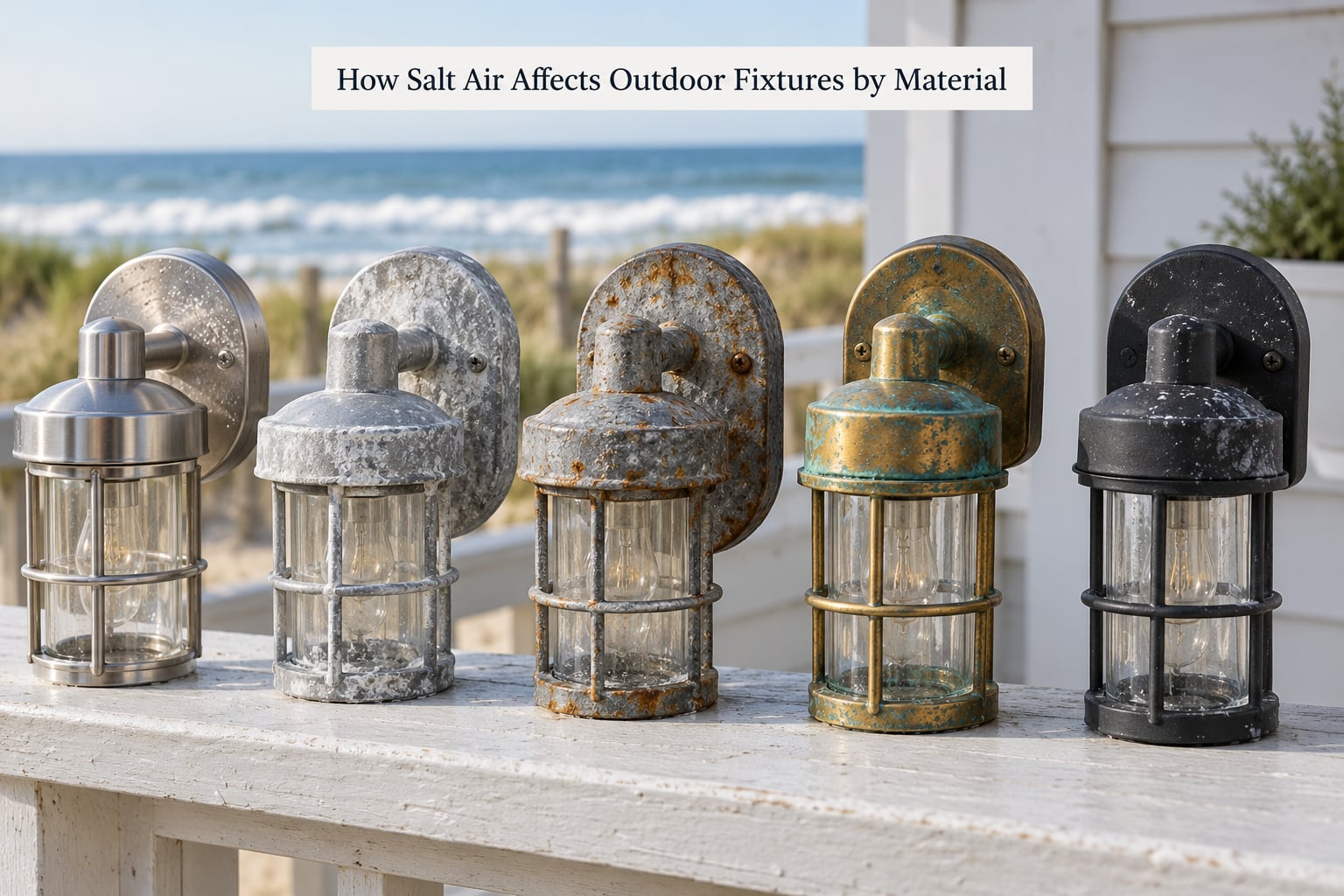
No material is immune, but the way each one fails is different, and that difference decides whether the damage is cosmetic or terminal.
Aluminum is the most common housing material because it is light and cheap to cast, and it resists corrosion well until something goes wrong. The metal forms a thin protective oxide layer on contact with air, and that layer does most of the work. Chloride ions destroy it, which is how a housing ends up with micro-pitting instead of an even dulling. Once the powder coat is breached by a scratch, a lawn mower, or a mounting bump, corrosion starts at that exact point and spreads outward.
316 stainless steel holds up far better than 304 stainless steel, which is the version a lot of coastal fixtures ship with. 304 has less chromium and will develop chloride pitting and rust-colored staining within a season or two of marine exposure. 316 is the grade specified for marine and coastal hardware, and asking a seller which grade their screws and brackets are made of tells you in one question whether they thought about salt at all.
Galvanized steel gets a zinc coating that sacrifices itself slowly, which buys years. Once the zinc is gone, the exposed steel underneath corrodes fast, and the first symptom is often a white zinc bloom on the mounting plate rather than a classic orange rust.
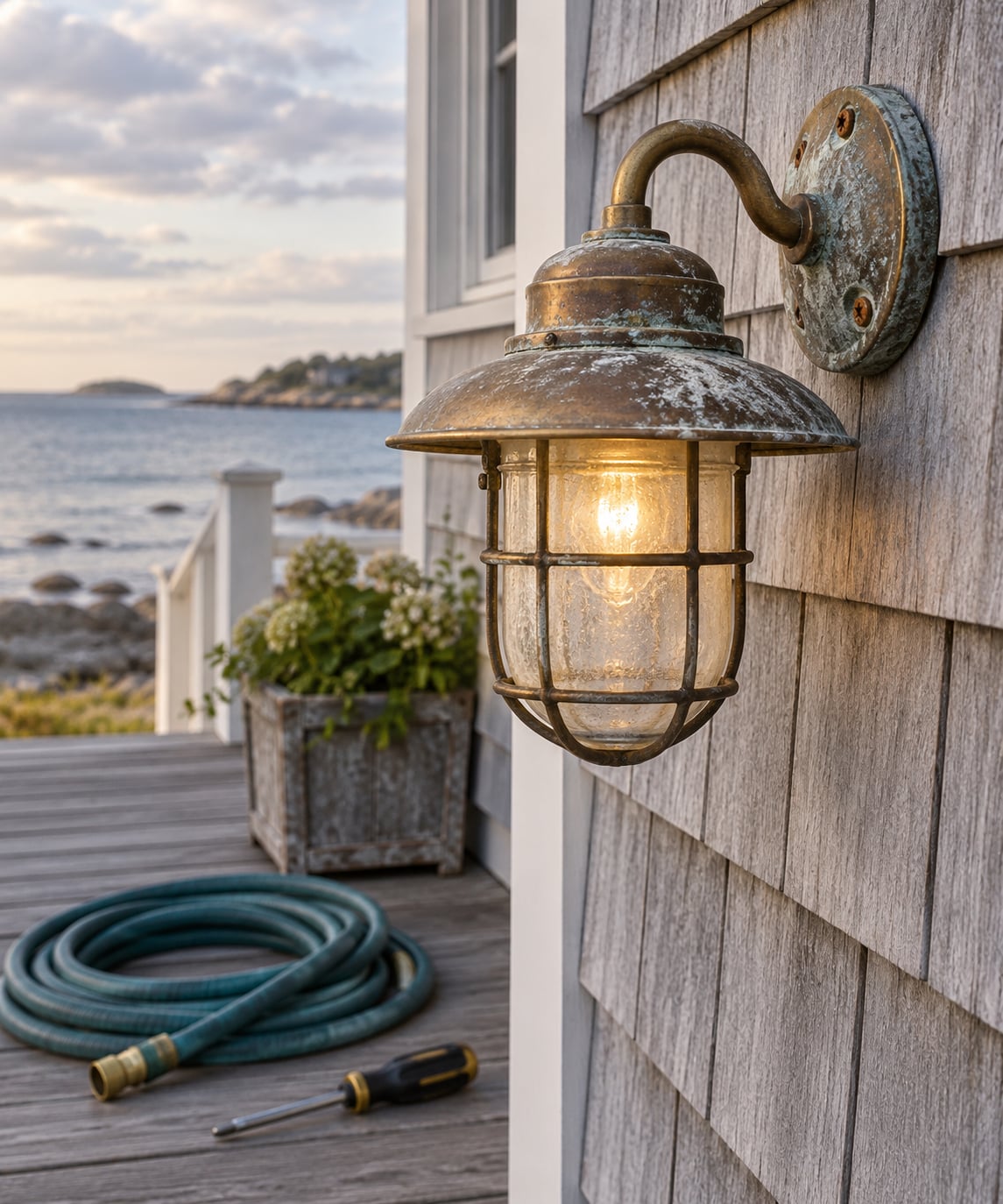
Plain or mild steel has no protection at all. Bare steel within a few hundred feet of surf can show visible corrosion in weeks to a few months. Brass and bronze corrode slowly and mostly for appearance, developing a brown or green patina and a dull, uneven surface, but they do not pit the way aluminum does.
Plastic and polycarbonate parts never corrode, though polycarbonate lenses hazing and yellow under UV exposure, and glass lenses etch where salt deposits sit on the surface long enough to work chemically. The real limit of any non-metal part is the seal around it, which is rubber and does age.
That is the difference to hold onto: corrosion resistance is not the same as rust resistance. Stainless steel does not rust, but in salt air it can pit, stain, and seize. Powder coating is a barrier, not a material property, and every chip in that barrier is a starting line.
Which Parts Fail First?
The fixture body is rarely the first thing to go. Fasteners, seals, and connections are weaker, and they are the parts most likely to be excluded from a finish warranty.
| Component | Why it fails first | Typical time to first visible sign | Usually covered by a finish warranty |
|---|---|---|---|
| Mounting screws, brackets, plates | Galvanic pair with an aluminum or brass body, plus a thin zinc or steel coating | Weeks to a few months close to shore | No |
| Rubber gaskets and O-rings | Harden, crack, and lose compression, letting brine in | 2 to 5 years | Sometimes, if called a gasket warranty |
| Wiring and terminal connections | Oxidized contact raises resistance, which produces heat | 1 to 4 years | Rarely |
| LED driver housing | Moisture reaching a sealed cavity condenses on the board | 2 to 5 years | Under a separate electrical warranty |
| Powder-coated housing | Fails only after a chip, and then only at the chip | 3 to 10 years depending on exposure | Often, if the coating failed without damage |
| Solar panel and battery compartment | Repeated condensation under a sealed glass surface | 1 to 3 seasons | Varies widely by maker |
The failure sequence follows the same order almost every time. Fasteners corrode and lose clamping force, so the fixture shifts and the mounting plate grinds against the housing. The shift opens a seam, and water that used to bead on the powder coat starts running behind it. The gaskets, already hardened, stop sealing. Moisture reaches the wiring, where resistance climbs and generates heat inside a sealed box that cannot cool. The LED flickers, dims unevenly, then dies.
Homeowners on r/HomeFixCorner describe exactly this pattern, with a fixture body still in good shape and the mounting screws turning to rust within a season or two. The body looks fine because the body was never the weak link.
Concealed areas are the reason this surprises people. The back of a wall pack, the underside of a lens, the inside of a ground stake, and the cavity behind a mounting plate can all hold standing water and look clean from the ground. A fixture with a soft rattle, a tilting head, or moisture beading under the lens is telling you something the visible finish is not.
How to Protect Outdoor Fixtures From Corrosion
Protection is mostly a materials and drainage problem, and it is far cheaper to do at install time than to repair later. Always follow the manufacturer’s specification for your specific fixture, and follow your local electrical code.
- Match the material to the exposure. Within a few miles of salt water, choose solid brass or bronze, thick-coated marine-grade aluminum, or 316 stainless hardware. Keep 304 stainless out of coastal installations.
- Keep the hardware consistent. Do not let steel screws land in an aluminum or brass body. Replace supplied screws with 316 stainless or polymer-coated fasteners, and match the bracket material to the housing.
- Plan for drainage. Every fixture needs a path for water to leave. Confirm weep holes and drainage slots are clear, and never caulk over them. Sealing a fixture that needs to vent traps water inside the housing where salt can work undisturbed.
- Let the housing breathe. Avoid tight, sealed enclosures with no ventilation path. Trapped condensation in a warm box does more damage than the outside weather does.
- Protect during installation. Leave factory protective film on coated parts until the fixture is mounted, and avoid dragging fixtures across masonry or stacking metal on metal, which scratches the coating before you ever plug it in.
- Touch up damage early. Clean, dry, and recoat a chip in the powder coat with a compatible product before salt finds it. A five-minute fix now versus a pitted housing later is the whole game.
- Rinse with fresh water on a schedule. Salt is soluble, and a gentle rinse removes the deposit before it becomes a layer. Aim a soft stream at the surface, not into seams or weep holes.
- Skip the abrasives. No steel wool, scouring pads, stiff brushes, acidic cleaners, or pressure washers on coated or anodized surfaces.
How to Inspect and Maintain Coastal Fixtures
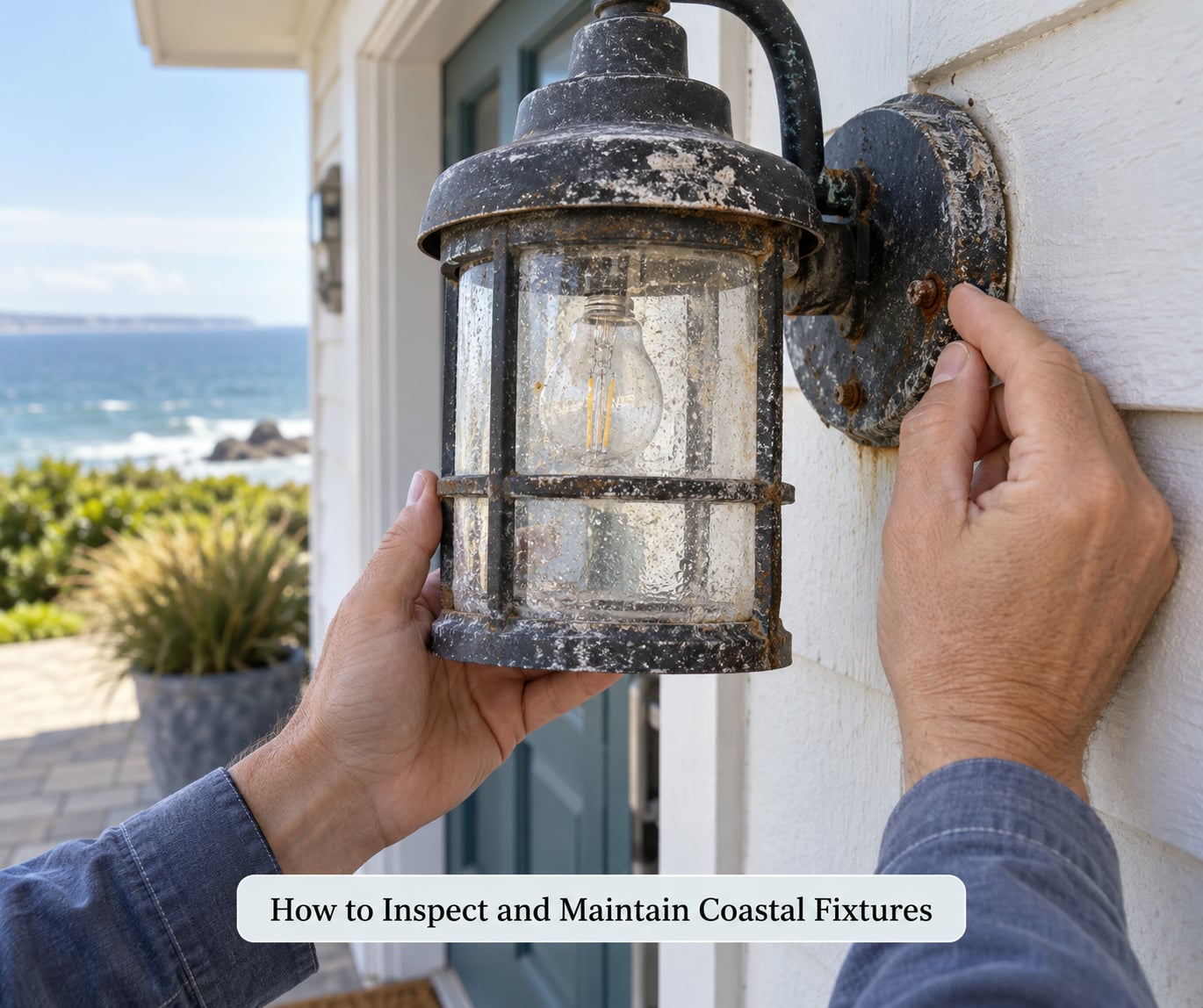
A repeatable routine catches problems while they are still cheap: check drainage, fasteners, coatings, and seals, in that order, on a fixed schedule.
What to look for on every inspection
Look for rust streaks running down from fasteners, white or grey salt bloom on galvanised and stainless parts, pitting on aluminum housings, and coating that is flaking or lifting at an edge. Then check for the mechanical and electrical signs: screws that spin instead of tightening, a head that no longer sits flat, a housing that rocks, a cracked or compressed gasket, water beading under the lens, flickering or uneven output, a fixture or transformer that feels warm to the touch, and wiring with discoloration, stiffness, or a crust at a connection.
How often to inspect
Within half a mile of the surf, quarterly. Out to a few miles, twice a year, timed before and after storm season. Inland or on sheltered walls, annually is enough. Ground stakes and anything in an irrigated bed deserve a look every time you are out there anyway, because they wick moisture from the soil.
Cleaning a salt-exposed fixture safely
Turn the power off at the breaker and confirm the fixture is de-energized, then let it cool. Wipe loose salt away with a dry microfiber cloth so you are not grinding grit into the finish. Rinse with fresh water using a soft, low-pressure stream, add a little mild pH-neutral soap if a film remains, and work with a soft cloth or non-abrasive sponge. Rinse again to carry the residue away, then dry thoroughly with a clean cloth and let the fixture air-dry fully before you switch the power back on.
Once it is clean and dry, follow up with a protection step appropriate to the material: marine-grade wax, a light protective oil, a clear acrylic coating, or a corrosion-inhibiting spray, applied only where the manufacturer says it is compatible.
When to stop and call someone qualified
Isolate power at the breaker and do not open a fixture if you find warm surfaces, a burning or unusual smell, buzzing, discoloration on wiring, or a repeatedly tripping breaker or GFCI. Any work inside the housing, at a junction, or on a circuit is licensed-electrician territory. Never open a fixture that is energized, and do not rely on a wall switch alone to de-energize it.
Keeping a dated record of what you cleaned and when does more than feel tidy. Manufacturers often require documented maintenance before they honor a finish warranty, and photos before and after storm season help with insurance claims.
What Repair or Replacement Options Make Sense?
Once corrosion has started, the decision comes down to whether you are dealing with a surface problem or a systems problem.
A surface problem is still worth fixing. Clean the fixture, remove loose oxidation with a non-abrasive method, and recoat bare or chipped areas with a product compatible with the housing. A rusty but structurally sound fixture with intact seals and healthy wiring is a weekend project. Pitted aluminum that flakes under a fingernail is not, because the metal has already lost section and the coating will not restore it.
A hardware problem is a cheap fix with a real lesson. Swapping rusted screws, brackets, or a mounting plate for 316 stainless or polymer-coated hardware usually costs far less than a new fixture and buys years. Do it on the whole run at once, since mismatched hardware in the same installation is what accelerates galvanic attack in the first place.
Replacement makes more sense when the seals have hardened and cracked, when the wiring or the LED driver has been inside a wet cavity, or when the housing is pitted through. In those cases, matching the replacement to the existing mounting system matters more than matching the model: confirm the mounting footprint, the voltage, and the fixture’s ingress rating before you buy.
Solar fixtures follow the same logic with extra steps. The panel glass, the battery compartment, and the sealed LED module each fail on their own schedule, and a corroded body with a healthy panel is usually worth repairing rather than replacing. Many makers sell the battery and panel as separate parts, which is far cheaper than a whole new fixture, and the quality of the cell matters more than the age of the light.
Frequently Asked Questions
Do all outdoor metal fixtures rust in salt air?
No. Rust is corrosion of iron and steel, so it appears on brackets, screws, and galvanized parts. Aluminum, brass, copper, and stainless corrode in other ways, such as micro-pitting, dull tarnish, patina, or white zinc bloom, which can be just as damaging without ever looking like rust. Any metal can fail, so material matters more than appearance.
Is stainless steel enough for coastal outdoor fixtures?
Only the right grade. 304 stainless has less chromium and develops chloride pitting and rust-colored staining within a season or two of marine exposure. 316 stainless is the grade specified for coastal and marine hardware and holds up far longer. The grade matters most on fasteners, brackets, and mounting plates, since those are the parts that contact an aluminum or brass body first.
How often should coastal outdoor fixtures be maintained?
Within about half a mile of the surf, inspect quarterly and give the housing a fresh-water rinse twice a year. A few miles inland, twice a year is generally enough. Inland or on sheltered walls, an annual check works. Ground stakes and anything in damp soil need attention whenever you are nearby, because they wick moisture up from the ground as well as taking salt from the air.
Does salt air damage solar panels and batteries?
Yes, though the mechanism is different from metal corrosion. Salt film on the panel glass cuts light output, and repeated condensation under the sealed glass corrodes the cell connections and drains the battery faster. A common coastal complaint is salt working into a pump housing or sealed LED body within a single season. Keep the panel glass clean with plain fresh water and keep the battery compartment dry.
Should homeowners repair corroded electrical parts themselves?
Cleaning the outside of a fixture is fine, but anything inside the housing, at a junction, or on a circuit belongs to a licensed electrician. Turn the power off at the breaker first, not the wall switch, and never open a fixture that is energized. Warm surfaces, burning smells, buzzing, discolored wiring, or a repeatedly tripping breaker or GFCI are reasons to stop inspecting and call someone qualified.
Conclusion
Start with the two things that decide most outcomes: which metal the fixture is made of, and whether water can get out of it. Everything else is maintenance timing.
Do one job this week. Pick a fixture, kill the power at the breaker, rinse it down with fresh water, dry it, and look hard at the screws, the mounting plate, and the gasket line. If the hardware is rusted and the housing is sound, replace the hardware with 316 stainless or polymer-coated fasteners. If the housing is pitted through, the seals are cracked, or the wiring has been inside a wet cavity, plan on a replacement matched to the existing mounting system and rated for your exposure.
Salt air will corrode whatever you install within reach of it. Which materials you choose, and whether you keep water moving out instead of letting it sit, decides whether that takes three seasons or thirty years.