To measure the brightness of outdoor lights at home, you record how much light falls on the surface you care about, in lux, using a handheld lux meter or a phone light-meter app. The whole job takes about ten minutes per fixture if you measure at dusk, hold the sensor flat at the point where you actually need light, and take three readings instead of one.
That last detail is where most people go wrong. Two people can measure the same path light and get numbers that differ by a factor of three, because one held the phone under the lamp and the other held it flat at ankle height six feet away, and neither wrote down the conditions.
This guide covers the three methods that work at home, what each one is actually good for, and how to read the number you get back. It also covers solar lights, which need a bit of extra care because moonlight and street lighting quietly contaminate a nighttime reading.
Table of Contents
- What You Need
- Step-by-Step
- Pick the Method That Matches the Job
- Set Up the Test Area at Dusk
- Place the Meter at the Point You Actually Need Light
- Take Three Readings and Write Them Down
- Compare the Reading With What the Area Needs
- Common Mistakes
- Frequently Asked Questions
- Can I measure outdoor light brightness with my phone?
- What is a good lux level for an outdoor path or patio?
- Is the lumen rating the same as brightness measured in lux?
- How do I compare two outdoor lights fairly at home?
- Can I measure brightness without getting close to an electrical fixture?
- Why does a solar outdoor light look brighter in the app reading than it does to my eyes?
- Conclusion
What You Need
Four approaches cover almost everything, and you only need one of them.
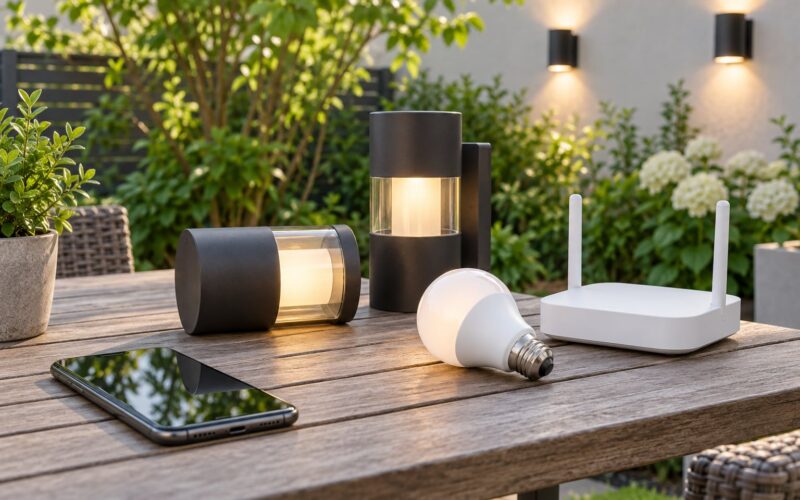
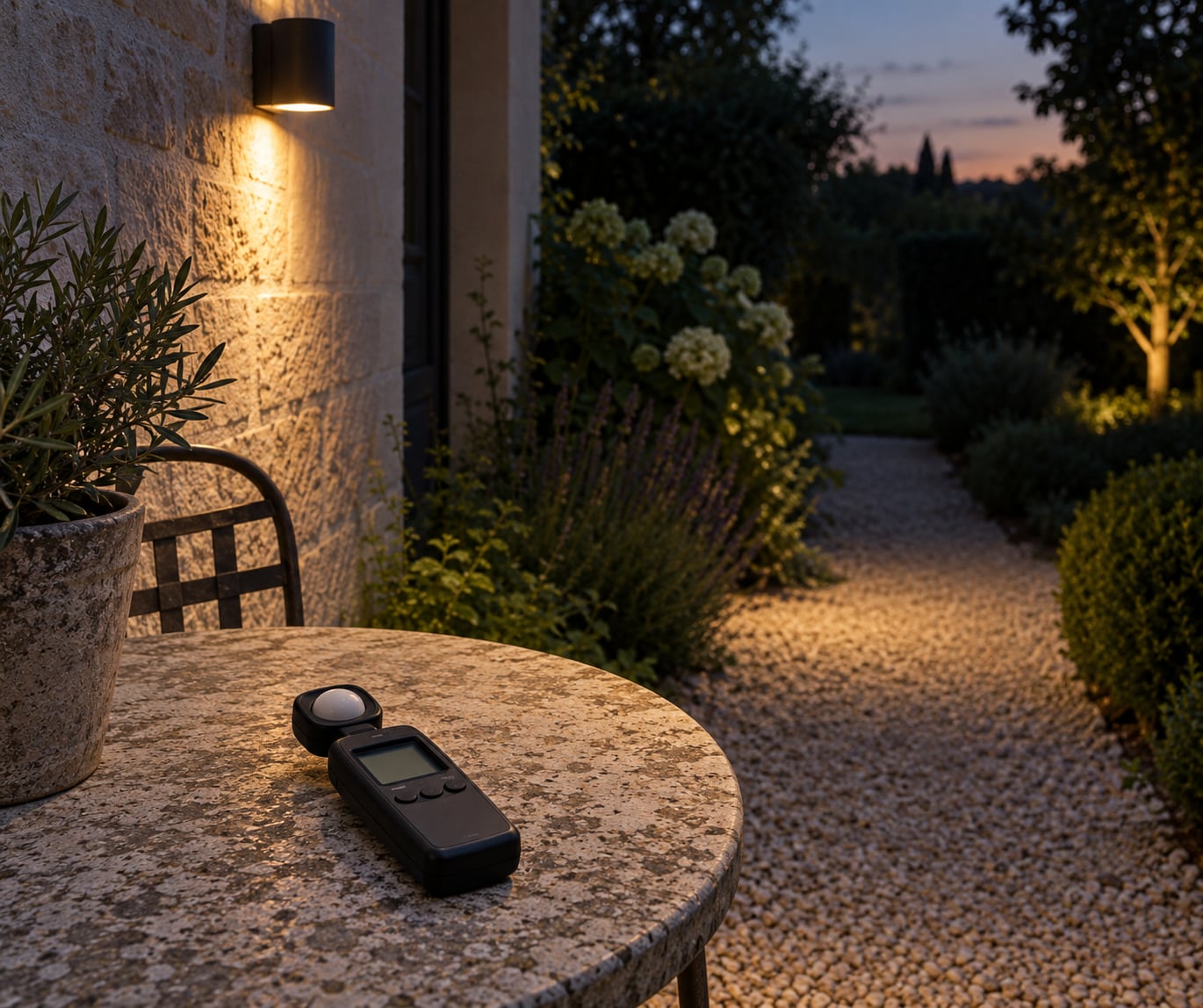
A dedicated lux meter is the accurate option. These handheld photometers give repeatable readings you can compare across nights and seasons, which makes them the right tool if you are diagnosing a light that keeps going dim or comparing two fixtures properly. You do not need a laboratory unit; the inexpensive handheld models are good enough for garden and patio work, and any of them beats eyeballing two fixtures on different nights.
A phone light-meter app is the practical entry point. Search your app store for a lux meter or photometer app, open it, and hold the phone flat with the sensor facing the surface. iPhones use the ambient light sensor built into the top of the phone near the front camera, and Android phones have something similar. Readings are useful for comparison and broadly right in normal light, but they are not calibrated instruments. Forum users treat them as a way to avoid dragging out the proper meter for a quick check, which is fair.
Manufacturer specifications tell you what a fixture produces, not what lands on your path. That is a useful screening step before you measure: it tells you roughly what order of magnitude to expect and whether a fixture is in the right range at all.
A visual comparison is enough when you are simply choosing how many lights to install along a path, and not enough for anything you intend to record.
You also want a dark-clothed jacket or a way to shield the sensor, a phone for notes, and a stable step stool if you are measuring a raised step face. Keep your meter out of the rain, and never open, unscrew or reach inside a fixture to reach the light. Mains wiring belongs to a licensed electrician, and hard-wired fittings are not DIY territory.
Step-by-Step
Pick the Method That Matches the Job
Use a lux meter when the answer matters: troubleshooting a light that has dimmed, testing safety lighting on a set of steps, or comparing two fixtures you are considering buying. Use a phone app when you want a rough reading and a same-night comparison between two lights you already own. Use the manufacturer figure as a pre-check, never as a substitute for a reading on your own ground.
Set Up the Test Area at Dusk
Measure at dusk or at full dark, once the light has switched on and settled. Solar lights and dusk-to-dawn photocell lights usually take 30 to 60 seconds to reach full output, so wait before you read.
Switch off every competing light you control: porch lamps, other solar path lights, a motion light on the neighbour’s wall. You cannot switch off a streetlight, which is exactly why outdoor readings taken close to a kerb are hard to trust. If a streetlight or a bright full moon is contributing, note it in your record because the reading is then an upper bound, not the light’s own output.
Clear the obstructions that matter. Stand where you actually walk, not behind the shrub that shades half the path.
Place the Meter at the Point You Actually Need Light
Hold the sensor flat, face pointing straight down at the surface, with the display angled so you can read it without leaning into the light path. For a path light, the useful measurement point is the walking surface at the centre of the beam, roughly at the height of your hand or lower. For a step light, measure on the tread and on the riser face separately, because they are two different problems: one is tripping hazard, the other is seeing the edge.
Hold the position still for two or three seconds. Many meters average over that window, and movement during the reading produces a number that drifts.
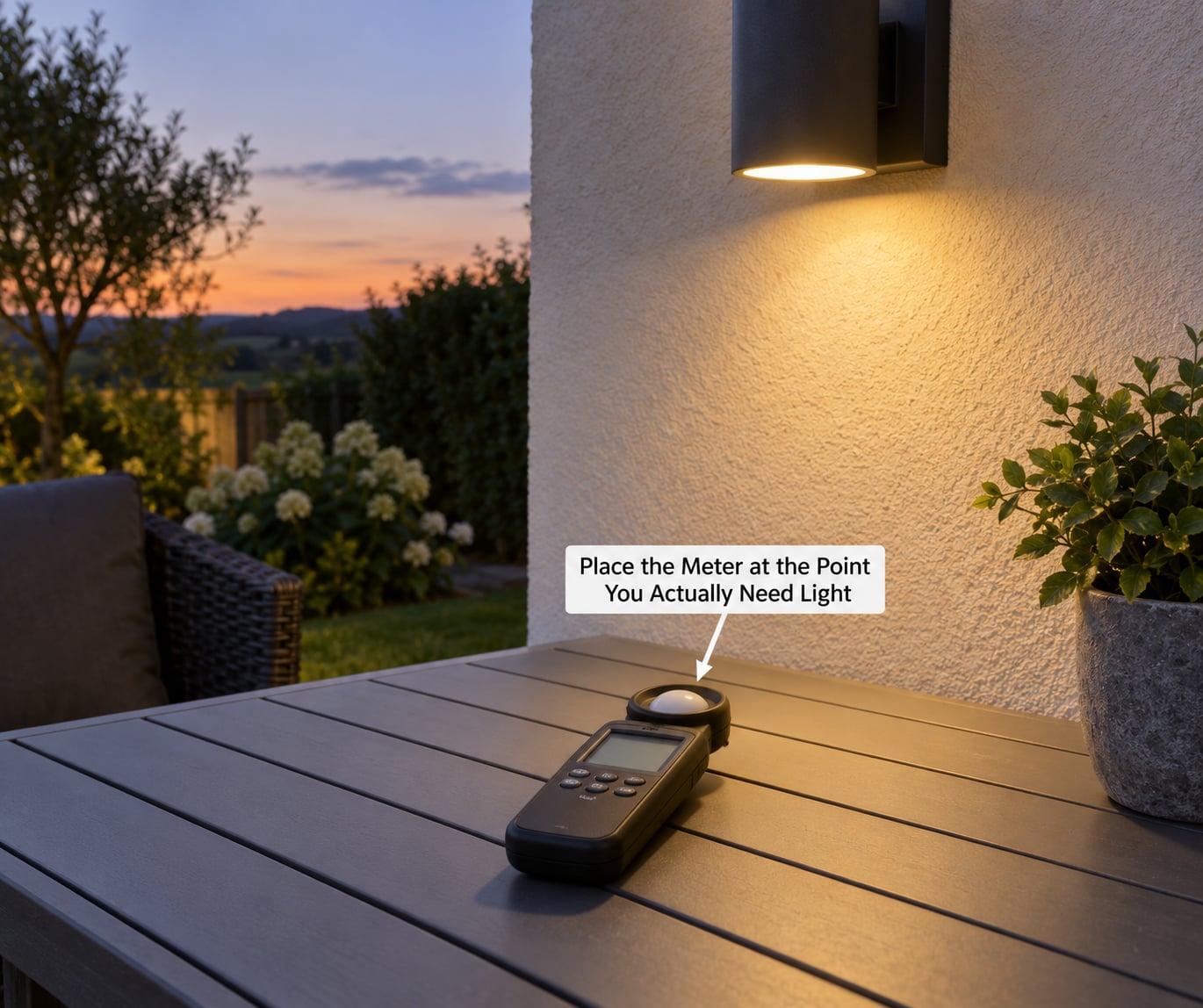
Do not measure directly beneath the lamp. Up close you are reading the hotspot at very short range, which tells you almost nothing about the area you care about three feet away.
Take Three Readings and Write Them Down
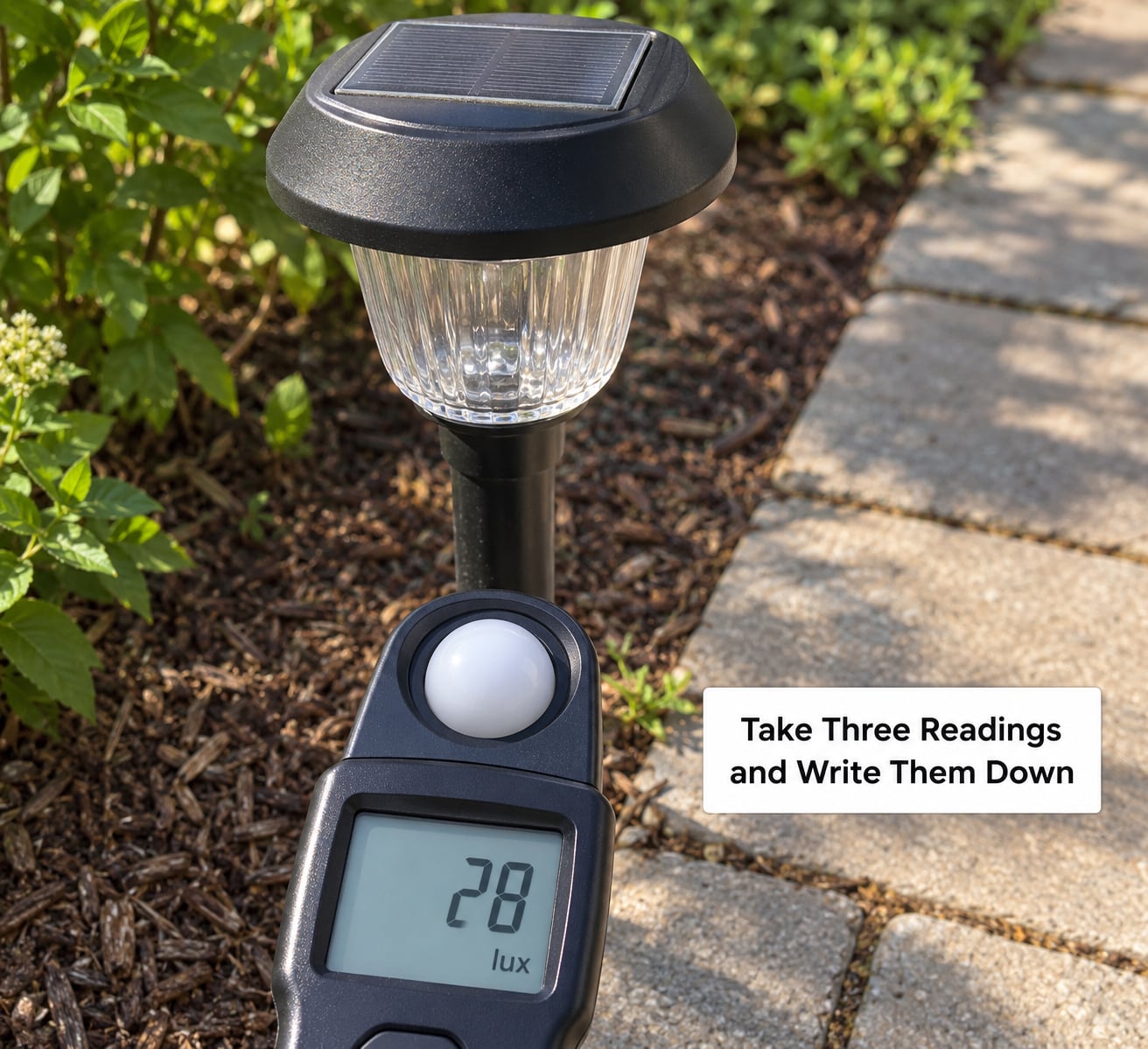
Read the display, write the number down, then step away, reposition and read again. Three readings averaged together is far more useful than a single number, and the spread between them tells you something useful too: a tight spread means even light, a wide spread means the beam is patchy and you will trip on the dark parts.
Repeat that at every point that matters: the middle of the path, the bottom of the steps, the doorway threshold, the seating area on the patio. If you are comparing two lights, use the same points, the same distance and the same night.
Compare the Reading With What the Area Needs
Judging brightness by eye goes wrong because your eyes adapt constantly and because a bright spot next to darkness looks dimmer than it is. Use the number as a reference against the job the light is doing.
| Area | Useful range at the surface | What it looks like |
|---|---|---|
| Garden path or walkway | 5 to 20 lux | Enough to see where you are stepping, not enough to read by |
| Steps and stairs | 20 to 50 lux | Every tread edge and riser clearly outlined |
| Deck or patio seating | 20 to 50 lux | Comfortable for eating, reading faces across the table |
| Entryway and doorway | 50 to 100 lux | Keys visible at arm’s length without hunting |
| Driveway or parking area | 100 to 300 lux | Vehicle edges and obstacles picked out at a distance |
| Motion-activated security light | 200 to 500 lux at the target | A dark yard goes clearly visible when triggered |
These are practical working ranges, matching the general illuminance recommendations used in lighting design for residential outdoor areas. Treat them as a band, not a pass-and-fail line. A single path light measuring 8 lux in the middle of its beam may be perfectly adequate, while a security light measuring 30 lux at the wall is not doing its job no matter how good it looks.
One number also hides more than it shows. Beam angle decides whether the light spreads or punches a hot circle. Glare from a visible lamp face makes a space feel bright even at low measured lux. Color temperature changes perceived brightness, with cooler white appearing brighter to most people at identical output. Surface reflectance does the rest: the same light reads much higher on pale gravel than on dark mulch. If your measurement and your experience disagree, one of those four is usually the reason.
Common Mistakes
Treating a phone app reading as a calibrated result. Phone sensors are uncalibrated and drift between devices and between apps. The fix is simple: use the phone for comparison, never as an absolute figure, and check a second app if a number matters. One final tip is to record which phone you used, because a phone swapped later can quietly change your baseline.
Measuring at the wrong time. A reading at 9 pm on a clear night and a reading after three cloudy days are not the same test. Solar lights in particular output their peak on the first clear night after a full day of sun and dim steadily as the battery drains. Measure on the same phase of the night every time, and record the weather.
Holding the sensor at the wrong height or angle. A tilted meter reads low, and a meter held high above the path reads differently from one at ankle height. Keep the sensor flat and parallel to the surface and at the same height every single time.
Measuring straight up under the lamp. The reading will be high and useless. Step back to the point where the path is actually used.
Comparing lights switched differently. Many solar lights have a brightness mode and a dim mode. Comparing one in dim mode with one in bright mode tells you about the switch, not about the fixtures. Put both in the same mode.
Ignoring shadows, glare and dark patches. Take readings at several points along the same run of path. One high reading and one very low reading in the same place means an uneven beam, which is a trip hazard no average will reveal.
Working close to live fittings in the dark. Do not remove covers, do not touch wiring, and do not lean a ladder against a fixture you are measuring. Keep the meter and your phone away from standing water, and use a torch or a light on your head so you are not reading the display in the dark with one hand on a ladder.
Finally, write your readings down. A single number tells you very little. A date, a location, a weather note and three averaged readings will tell you in six months whether your lights are performing the way they did the night you installed them, which is the question most people actually have.
Frequently Asked Questions
Can I measure outdoor light brightness with my phone?
Yes, within reason. Install a lux meter or photometer app, open it at maximum brightness, and hold the phone flat with the sensor facing the surface, two or three seconds per reading. Phone sensors are uncalibrated, so treat the number as useful for comparing two lights measured the same way, not as an absolute measurement or a safety certification.
What is a good lux level for an outdoor path or patio?
A garden path sits comfortably around 5 to 20 lux on the walking surface. Steps and a patio seating area want more, roughly 20 to 50 lux, so you can see tread edges and read a face across the table. Entryways benefit from 50 to 100 lux. Measure at the surface, at the point where you walk, not beneath the lamp.
Is the lumen rating the same as brightness measured in lux?
No. Lumens describe light emitted by the source in every direction. Lux describes light arriving at a specific surface, which depends on beam angle, distance, mounting height and surface colour. A 300 lumen fixture spread over a large area may deliver only 5 lux on your path, while a narrow 100 lumen spot can hit 200 lux on one small patch.
How do I compare two outdoor lights fairly at home?
Measure both on the same night, in the same weather phase, at the same points, with the meter at the same height and angle and in the same brightness mode. Take three readings at each point and compare the averages, not the single highest number. If you can only measure one on each night, keep every distance and angle identical.
Can I measure brightness without getting close to an electrical fixture?
Yes. Stand at the point where you need the light and aim the sensor at the ground, paving or step face. You never need to touch the fixture, remove a cover or reach near a connection. Anything hard-wired, damaged or needing a bulb changed is work for a qualified electrician, and any fixture showing heat, scorch marks or a smell should be switched off at the isolator.
Why does a solar outdoor light look brighter in the app reading than it does to my eyes?
A few things are happening at once. Ambient light from the street or the moon adds to what the sensor reads, so the app overstates what the fixture alone is producing. Colour temperature also matters: a warm white LED reads as dimmer to the eye than a cool white one at the same output. And the battery output falls through the night, so an early reading is not representative.
Conclusion
The fastest reliable way to measure the brightness of outdoor lights at home is a handheld lux meter at dusk, sensor held flat over the exact spot where you need light, three readings averaged, and the conditions written down beside the number. A phone app is a fine substitute when you only want to compare two lights.
Start with one fixture, one location and one clear night. Record the baseline, and check it again in a few months.