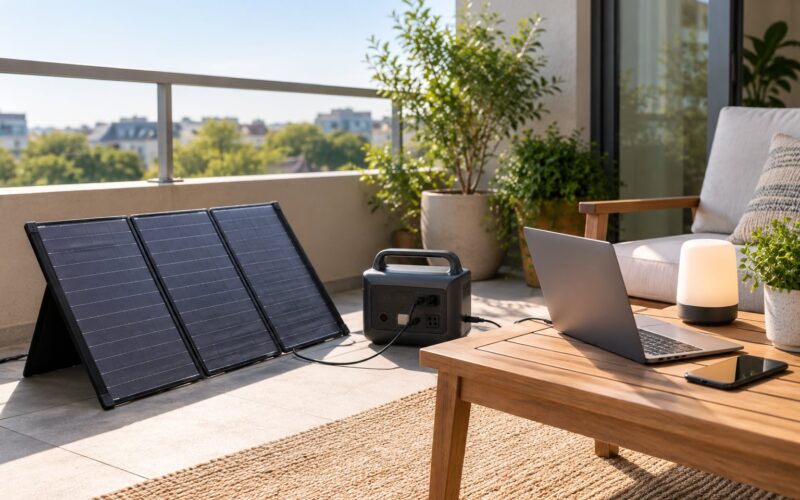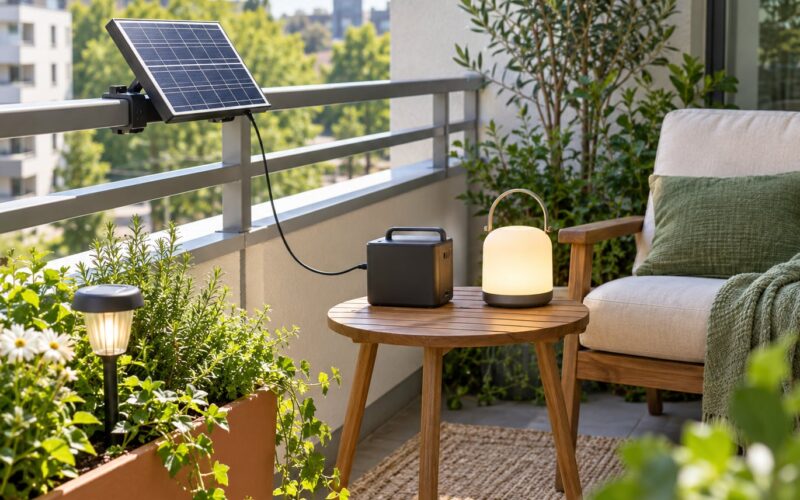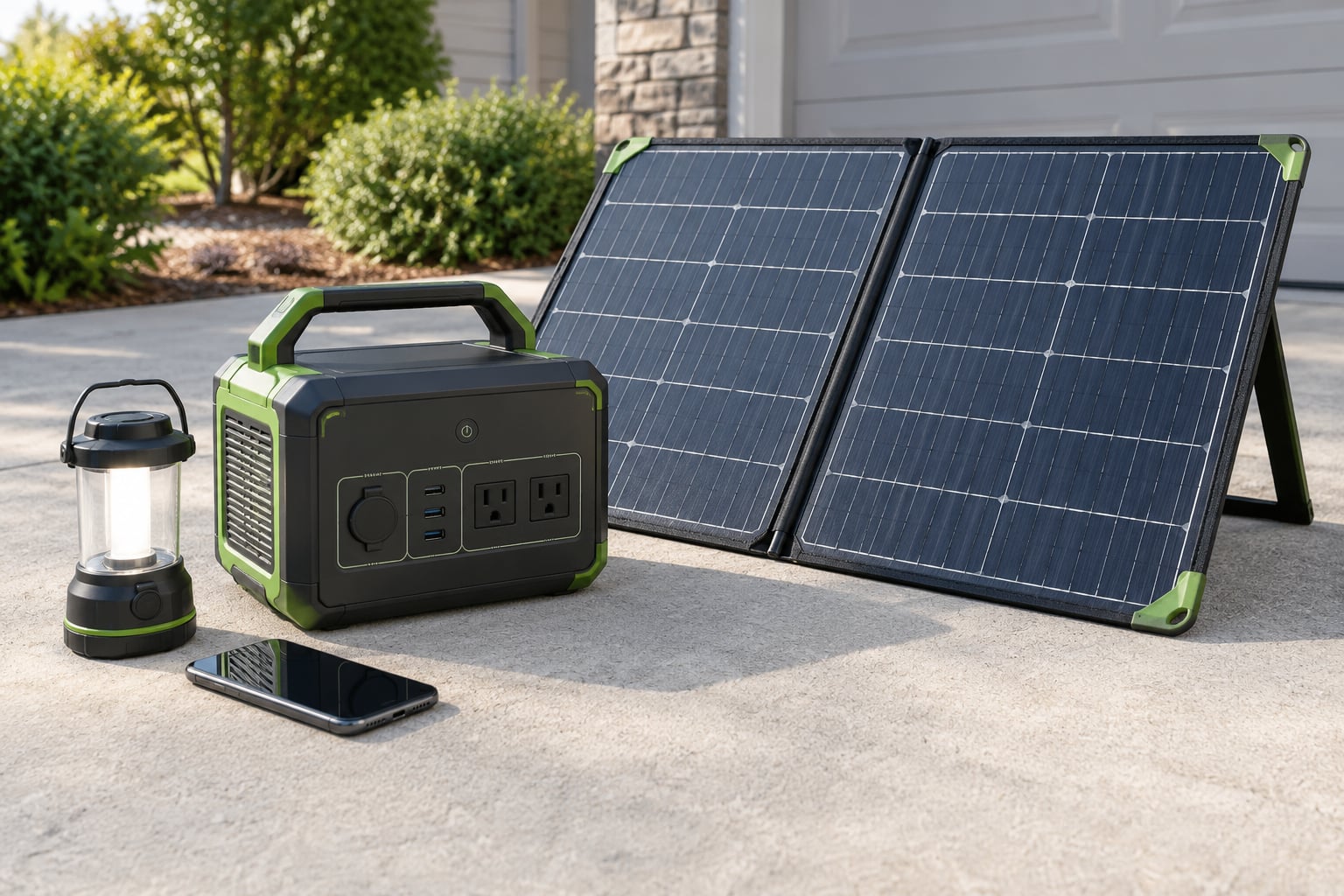
A solar generator is a battery with a built-in inverter, charge controller and outlets, usually sold with folding solar panels to recharge it. A battery on its own is only the storage part. So when people ask how a solar generator differs from a battery, the honest answer is that they are not opposites: one contains the other, plus the parts that make stored power usable.
That distinction matters more than the marketing suggests. A solar generator stores energy rather than producing it on demand, so its runtime depends on how much sunlight you banked earlier. Understanding that is what keeps people from buying the wrong box for a three-day outage.
Table of Contents
- How a solar generator differs from a battery at a glance
- What Is a Solar Generator?
- What Is a Battery?
- The Main Differences in Power and Function
- Whether the inverter is included
- Whether solar charging is built in
- Whether it can power household appliances
- Whether it produces or stores
- Capacity, Runtime, and What You Can Power
- Charging and Energy Sources
- How many panels for 2,000 watts?
- Portability, Cost, and Maintenance
- Which Should You Choose?
- Frequently Asked Questions
- Is a solar generator just a battery?
- Can a solar generator power a refrigerator during an outage?
- Do I need solar panels if I buy a portable power station?
- Which is better for home backup, a solar generator or a battery?
- Can I connect a regular battery to household appliances?
- What size battery do I need for an emergency power supply?
- Bottom Line
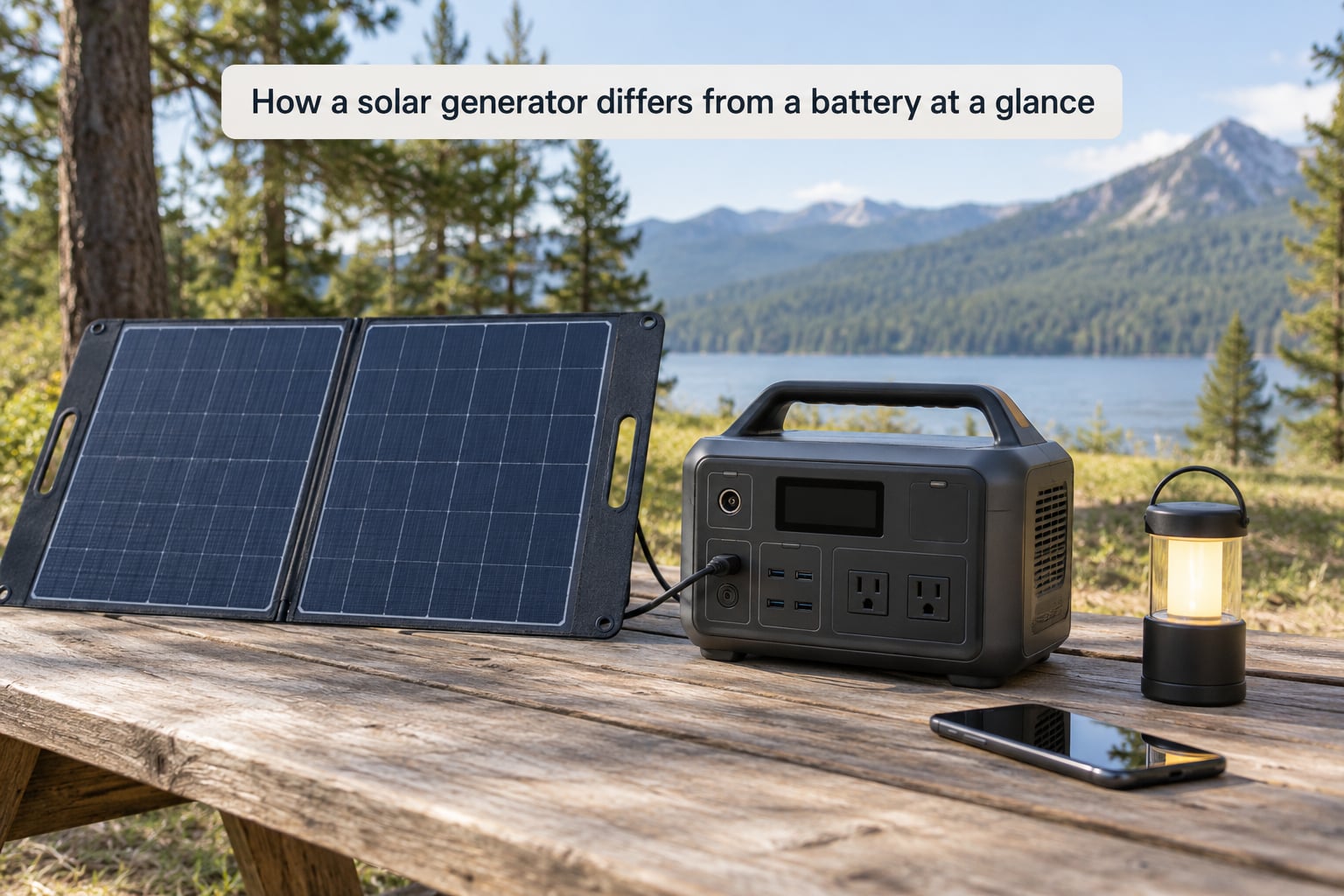
How a solar generator differs from a battery at a glance
| Factor | Solar generator | Standalone battery | Gas generator |
|---|---|---|---|
| What it is | Battery, inverter, charge controller, outlets, often panels | Storage cells and a battery management system | Engine, alternator, fuel tank |
| Energy source | Sun, wall outlet, car or generator | Whatever charges it: solar, grid, generator | Gasoline or propane |
| Produces usable AC power | Yes, built in | Only if paired with an inverter | Yes, always |
| Typical capacity | 300 to 2,000 Wh portable; 5 to 20+ kWh installed | Same ranges, no fixed size | Tank size, not watt-hours |
| Runtime | Fixed by stored energy and load | Fixed by stored energy and load | Fixed by fuel in the tank |
| Refill time | Wall in 1 to 3 hours, solar in 6 to 10+ hours in good sun | Depends on the charger | Refuel in minutes |
| Noise | Silent | Silent | Loud while running |
| Emissions | None at point of use | None at point of use | Carbon monoxide and exhaust |
| Portability | Portable units weigh roughly 20 to 100 lb | Varies; fixed banks are installed | Heavy, needs fuel storage |
| Maintenance | Keep charged, keep vents clear | Same, plus terminal checks | Oil changes, filters, fuel stabilizer |
| Best for | Camping, tailgating, job sites, short outages | Whole-home backup with existing solar | Long outages, heavy continuous load |
| Key limitation | Cannot power more than its inverter allows | Useless without an inverter and charge control | Unsafe indoors, noisy, refuelling |
The table is where most confusion ends. A gas generator makes electricity on demand, so a full tank is a promise. A solar generator and a battery both hold a fixed amount of energy, and both go quiet when that reserve is gone.
What Is a Solar Generator?
A solar generator is a portable power station: a lithium battery paired with a pure sine wave inverter, an MPPT charge controller and a set of AC, USB and 12-volt outlets. Foldable solar panels often come in the box, and the panel feeds the charge controller, which tops up the battery.
Four parts do all the work. Solar panels turn sunlight into direct current. The MPPT charge controller matches panel voltage and current to what the battery can safely absorb. The battery holds the energy. The inverter converts stored DC back into the AC power your appliances expect.
The label is marketing, not engineering. A solar power station is a battery boxed up with an inverter and built-in charging, and portable power station is the more accurate name for the same hardware.
What Is a Battery?
A battery is pure energy storage. It accepts electricity when it is charging and releases it when a load draws from it, and nothing more. A bare battery has no inverter, no charge controller and no outlets.
That matters when you talk to a shop. Ask whether the price includes an inverter and a charge controller, because a lithium bank without them is only half a system. Large home banks are sized against a hybrid inverter rated for the whole bank, and getting that order right is what decides whether the system performs.
The Main Differences in Power and Function
Whether the inverter is included
This is the single biggest functional gap. A solar generator ships with an inverter, so you plug a fridge into a wall socket and it works. A bare battery needs a separate inverter, which is an extra cost, extra wiring and extra responsibility.
Whether solar charging is built in
Portable solar generators have an MPPT controller and a dedicated solar input, so panels plug straight in. A fixed home battery is usually charged by the solar array already on your roof through a hybrid inverter, not by a loose panel.
Whether it can power household appliances
Only systems with an inverter can. Household appliances run on alternating current at a stable voltage and frequency, and a raw battery outputs raw DC at a varying voltage. Motors, compressors and anything with a compressor need that clean sine wave output.
Whether it produces or stores
Neither the solar generator nor the battery produces energy. Only panels and engines produce. Everything else moves and stores what they made earlier, which is why a cloudy week matters.
Capacity, Runtime, and What You Can Power
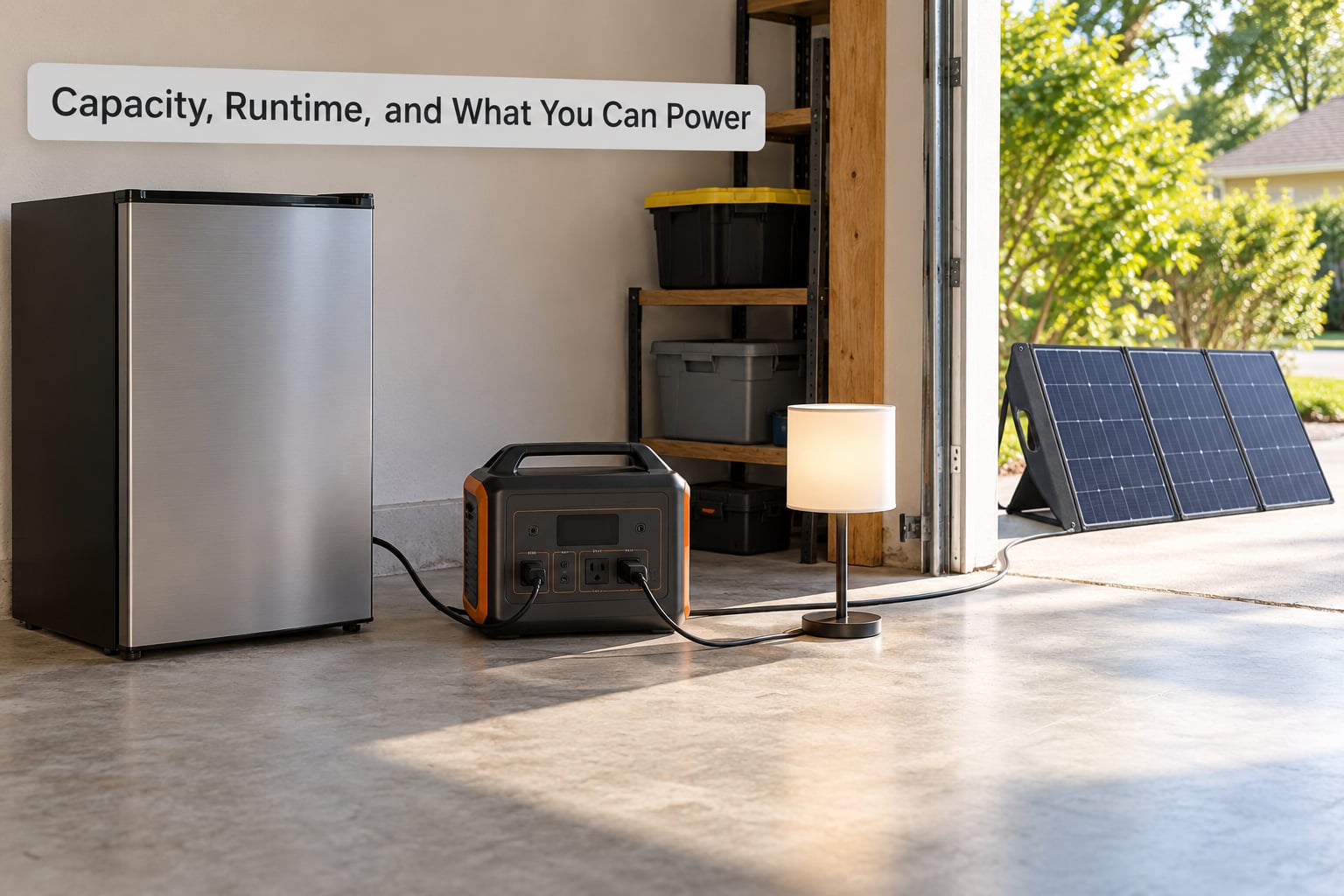
Capacity is measured in watt-hours (Wh) or kilowatt-hours (kWh): one watt running for one hour equals one watt-hour. Runtime is capacity divided by the load, and real usable capacity runs below the nameplate once you account for conversion losses and the reserve the unit keeps for itself.
| Appliance | Typical draw | 500 Wh station | 1,000 Wh station | 2,000 Wh station |
|---|---|---|---|---|
| Phone charging | 10 W | Over 30 hours | Over 60 hours | Over 100 hours |
| LED lamp | 10 W | Over 30 hours | Over 60 hours | Over 100 hours |
| Laptop | 60 W | About 6 hours | About 12 hours | About 24 hours |
| Wi-Fi router | 15 W | About 24 hours | About 48 hours | About 90 hours |
| Refrigerator (compressor cycling) | 100 W average | About 4 hours | About 8 hours | About 16 hours |
| TV | 120 W | About 3 hours | About 6 hours | About 13 hours |
| Space heater | 1,500 W | Not suitable | Under 30 minutes | About 1 hour |
Two numbers matter and they are not the same. Capacity decides how long it runs. Inverter size decides what you can plug in, so a 2,000 Wh unit with a 1,800 W inverter will not run a 2,000 W heater no matter how full the battery is. A bigger battery adds hours, not horsepower.
That same math decides how long a home system can carry a household. Batteries suit shorter, lower-power outages much better than they suit running the whole house for days on a single charge.
Charging and Energy Sources
A solar generator can be topped up four ways. A wall outlet is the fastest, usually 1 to 3 hours for a portable unit. Solar panels take most of a day in good weather. A car cigarette lighter or 12-volt socket works but is slow, and a gas generator can charge one through its outlet if you own both.
The gap between wall and solar charging is real. A larger portable unit can refill from house current in roughly two hours, while the same unit takes four to five hours from panels in good sun. Treat panel charging as a slow top-up that happens while you are out, not as an emergency refill.
How many panels for 2,000 watts?
Use the 33% rule. Panel nameplate output assumes ideal lab conditions, so divide the target by three for a realistic figure. For 2,000 watts you want roughly 6,000 watts of panel capacity, which is three 400-watt portable panels or eight 100-watt flexible panels, assuming full sun.
In winter or in cloudy regions, add more. And remember the inverter ceiling still applies, because charging faster than it can output gains you nothing after the battery is full.
Portability, Cost, and Maintenance
Portability is where portable solar generators clearly win. A unit sized for a fridge runs about the weight of a large suitcase and needs no fuel storage. Fixed home battery banks are bolted down and wired through your panel, which is a job for a licensed installer with a permit.
Cost has two halves. A portable unit bundles everything into one purchase, while a home battery plus hybrid inverter plus installation is quoted as a system. Over time the running costs invert the ranking: no fuel, no oil changes, no filters.
Lifespan and maintenance are modest chores. Keep the unit partly charged if you store it long, keep vents clear of dust and lint, and keep it away from standing water. LiFePO4 chemistry generally tolerates more charge cycles than NMC lithium or lead-acid, which is why it dominates portable power stations now.
Safety differs by fuel source. A gas generator produces carbon monoxide and must never run indoors, in a garage or near an open window. Battery systems produce no exhaust at the point of use and can sit in a hallway, though lithium packs still need thermal management and a clear path for expansion.
Which Should You Choose?
Pick a portable solar generator for a fridge, phone, lamp and laptop during a short outage, for camping, tailgating, van life or a job site, and for anyone who wants backup power indoors without storing gasoline. Pairing it with a modest folding panel keeps it topped up for a few days.
Choose a standalone home battery when you already have solar panels on the roof and want the whole house covered, or when you want a hybrid inverter that manages grid, solar and storage in one box. This route needs a licensed installer.
Keep a gas generator for the worst case: deep winter storms lasting several days with heavy continuous loads like heat pumps or well pumps. The strongest setups combine all three, letting cheap energy fill the battery first and the engine cover the gaps.
Frequently Asked Questions
Is a solar generator just a battery?
Mostly yes, and that is the clearest way to think about it. A solar generator is a lithium battery plus an inverter, a charge controller and AC, USB and 12-volt outlets, often sold with folding panels. It stores energy rather than producing it, so once the battery is empty you need sun, a wall outlet or a generator to refill it.
Can a solar generator power a refrigerator during an outage?
Yes, provided the inverter can handle the startup surge a compressor draws. A 1,000 Wh unit with at least a 1,200 W inverter typically runs an average fridge about 8 hours, assuming roughly 100 W of average draw. Keep in mind real usable capacity sits below the nameplate, and a 2,000 W heater will not work on the same box.
Do I need solar panels if I buy a portable power station?
No. The unit works fine off a wall outlet or a car socket, and it arrives ready to run. Panels are what make it self-sufficient, and they refill it slowly. Most owners treat panels as a slow daytime top-up rather than a way to recover a full charge after an outage.
Which is better for home backup, a solar generator or a battery?
For a few hours of fridge, lights and internet, a portable solar generator is simpler and needs no install. For running the whole house for days, a fixed battery with a hybrid inverter is the better answer, especially if you already have roof panels. Many households keep a gas generator for extended storms.
Can I connect a regular battery to household appliances?
Not directly. Household appliances need alternating current at a stable voltage and frequency, while a raw battery outputs direct current. You need an inverter, plus a charge controller if you also intend to recharge it from panels. Connecting a battery straight to an appliance will damage the appliance or the battery.
What size battery do I need for an emergency power supply?
Add up the watts of what you want running, then multiply by the hours you need it. For a fridge, router, LED lights and phone charging, 1,000 to 2,000 Wh covers a day or two. Add roughly 20 percent for conversion losses, and check that the inverter’s continuous and surge ratings match your largest motor load.
Bottom Line
Start by deciding whether you need portability or whole-house coverage. A portable solar generator for essentials during a short outage is the simplest path; a fixed battery with a hybrid installer is the right call when panels are already on your roof. Either way, keep it charged, and check the inverter rating before you buy anything.