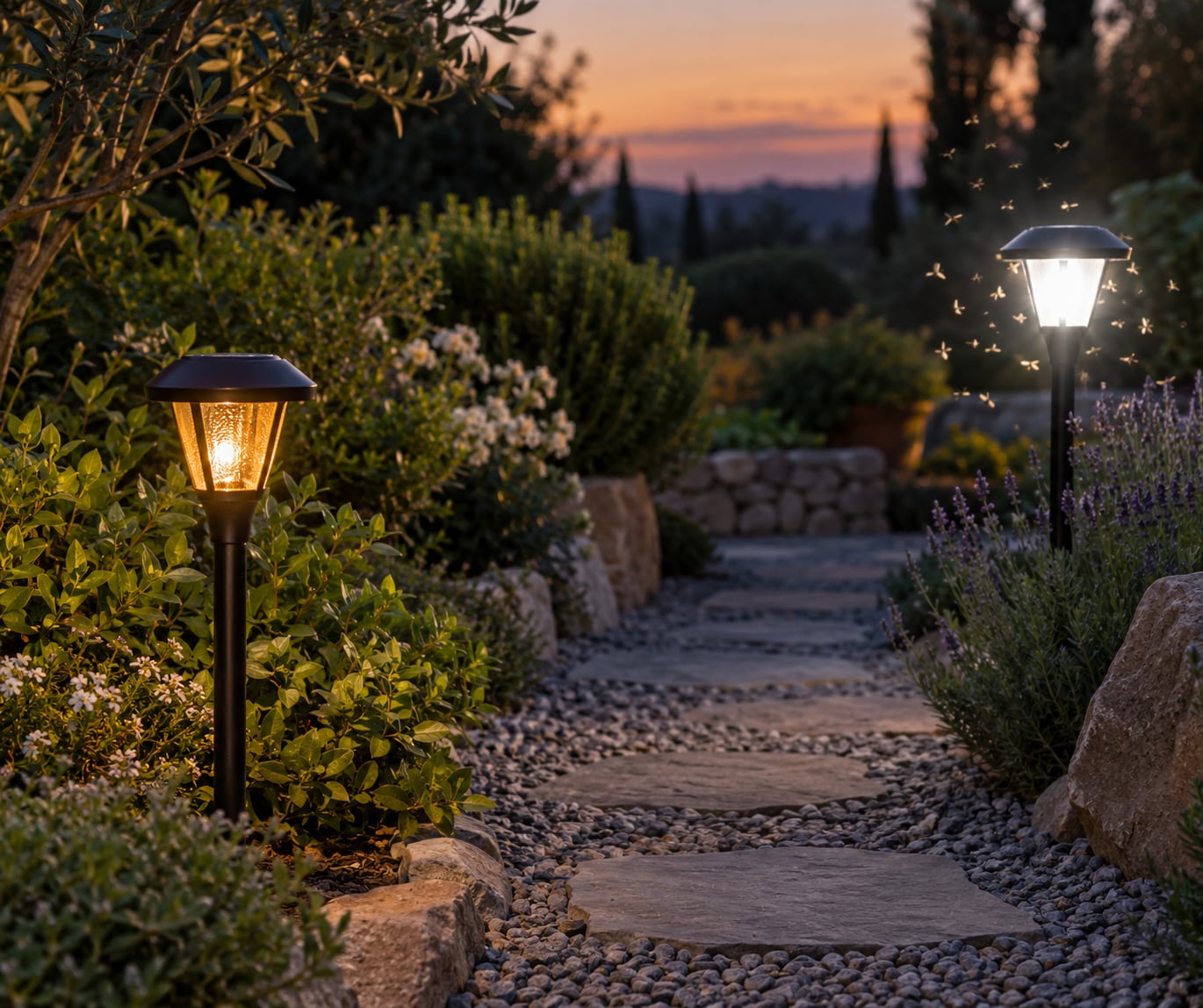
Ask whether solar lights attract bugs and the honest answer is that some do, but far fewer than the incandescent and halogen fixtures most people are comparing them to. Solar path lights put out almost no heat and almost no ultraviolet light, so the swarm you remember from an old halogen bulb usually never shows up. What pulls insects to the remaining light is brightness, color temperature and how close that light sits to plants, water and your patio door.
The catch is that the cheapest solar lights are exactly the wrong kind. A cool-white chip at 5000K, unshaded, sitting a foot off the ground in a bed of hostas is a small insect nightclub. The fixes below cost nothing more than moving a stake, covering a bulb with amber film, or switching a lamp from dusk-to-dawn to motion-activated.
Table of Contents
- Do Solar Lights Attract Bugs?
- Why Do Solar Lights Attract Bugs at All?
- Why Outdoor Lights Change Insect Activity
- Do Solar Lights Attract More Bugs Than Electric Lights?
- How to Reduce Bugs Around Solar Lights
- What Color of Light Attracts the Fewest Bugs?
- What Bug Problems May Not Be Caused by the Light
- Frequently Asked Questions
- Are solar lights worse than electric lights for bugs?
- What color of solar light attracts the fewest insects?
- Should solar garden lights be on all night to reduce insects?
- Why do bugs gather around solar lights even when they are dim?
- How can I keep bugs away from a solar light near a patio?
- Conclusion
Do Solar Lights Attract Bugs?
Yes, standard solar lights can attract some bugs, but typically far fewer than traditional outdoor lights, and the difference comes down to heat and spectrum rather than the solar panel. A field study at the University of Wisconsin-Madison found LED fixtures drew roughly 50% fewer insects than incandescent bulbs of comparable brightness, and work published in the Journal of Economic Entomology found warm-spectrum LEDs drew up to 70% fewer moths than halogen.
Nobody has found a garden light that attracts zero insects. The realistic goal is fewer, not none.
Why Do Solar Lights Attract Bugs at All?
- Almost no heat. Incandescent and halogen bulbs throw off infrared heat that warms the air around them, and many insects are drawn to that warmth as much as to the light. LEDs run cool enough to hold in one hand.
- Very little ultraviolet. Insect eyes are most sensitive in the 300-500nm range, which is where UV sits. LED chips emit almost nothing there compared with an incandescent filament or a fluorescent tube.
- Lower output. A stake light usually puts out single-digit to low-tens of lumens. It lights a walkway edge, not a whole yard, so there is less light to navigate toward.
- Short exposure. A small battery panel means most fixtures dim or shut off partway through the night, and the first couple of hours after sunset are when insect activity peaks anyway.
Note the pattern in forum threads on r/NativePlantGardening and forestriverforums.com: gardeners almost never claim their solar lights are bug-free, but they do consistently report swapping a cool-white fixture for a warm-toned one and seeing moth numbers drop at the patio table.
Why Outdoor Lights Change Insect Activity
Most flying insects show positive phototaxis, a navigation habit where they steer toward a light source. Moths developed it for a reason. Ancient navigators used the moon, which sits very far away, whose rays arrive almost parallel over a very wide area. A moth flying in a straight line keeps that moon angle steady.
A garden lamp is a few feet away instead of 240,000 miles, so the angles swing wildly as the insect moves. The light reads as a navigational cue, the insect keeps correcting toward it, and it ends up circling the fixture. That is why the swarm orbits rather than passes by.
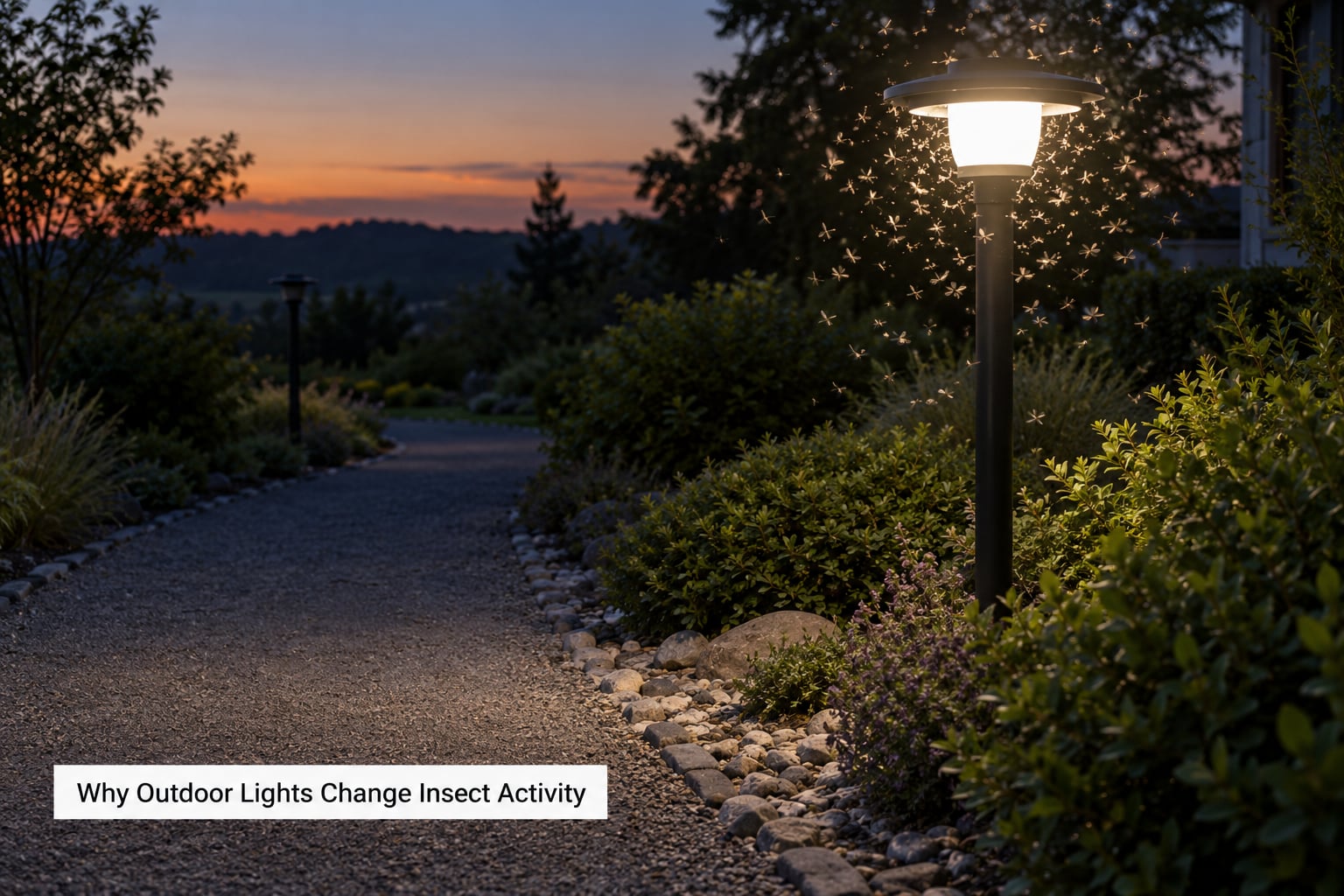
Two things decide how much of that happens: how bright the source is compared with the surroundings, and how far away it is. A dim lamp among dim surroundings disappears. A bright lamp in a dark yard stands out like a runway, and every insect crossing the yard changes course to check it out.
Attraction and visibility are different problems, and that distinction matters when you are diagnosing a complaint. On a patio surrounded by hedges, a lamp can be genuinely pulling insects toward a warm, sheltered pocket of air. Along a fence line in open air, the same lamp may simply be making the mosquitoes that were already there easier to spot.
Color temperature (measured in Kelvin) shifts which wavelengths reach the insects. Lower Kelvin values are warmer, more amber. Higher values are bluer and closer to daylight, which is exactly the band insect eyes lock onto hardest.
Do Solar Lights Attract More Bugs Than Electric Lights?
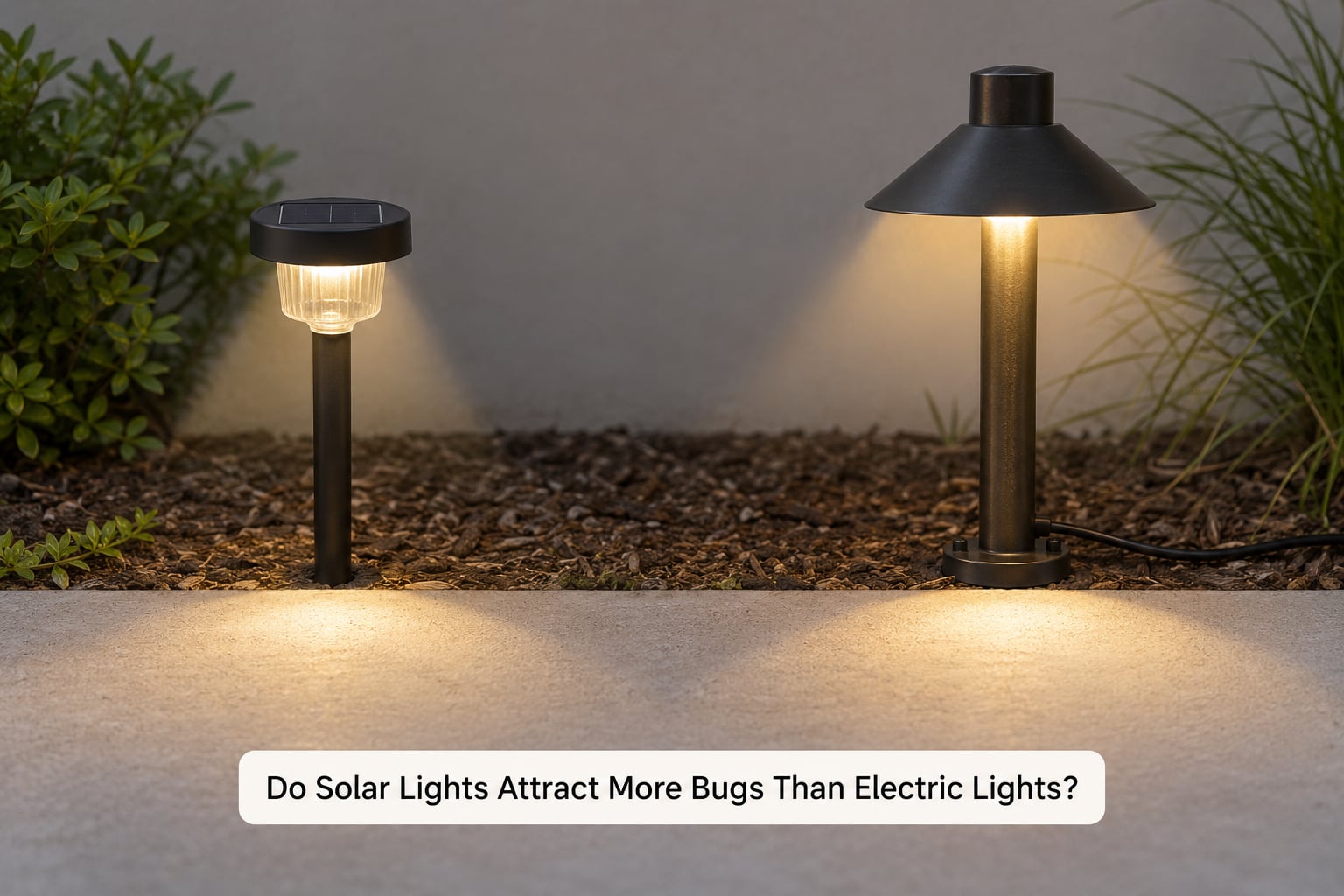
No, and the reason is simple: the power source has nothing to do with it. Insects respond to the light coming out of the lens, not to the panel on top. A solar LED and a grid-powered LED with the same chips, the same Kelvin rating and the same hood produce the same insects, at the same brightness, for the same hours.
Where the two differ is in the fittings people actually buy, and the gap is mostly about shielding and runtime rather than chemistry.
Cheap solar path lights tend to be small housings with a bare emitter visible from the side, and each one throws a bright pool into a tiny area. That high lumen density in one spot reads as a beacon. Many wired fixtures ship with a hood, a diffuser or a downward tilt that a stake light skips, which is why a wired warm LED beside the same flower bed can look calmer than the solar one next to it.
Runtime cuts the other way. A wired floodlight can burn all night on mains power. A solar light on a full summer charge typically has a few good hours of bright output before it fades, and it dims earlier in cloudy stretches or when the panel sits under tree shade. Fewer hours of light means a shorter buffet for whatever eats the insects.
Anglers on forums.pondboss.com use that on purpose, running solar dock lights to gather moths for fish, and they note the effect fades as the battery drains through the night.
How to Reduce Bugs Around Solar Lights
Work down this list in order, because the first two fixes solve most cases.
- Change the color temperature first. Aim for 2200K amber or 2700K warm white. Anything listed at 4000K or above is a bug magnet in disguise.
- Switch to motion-activated mode. A light that stays dark until something walks past gives insects no reason to loiter. It also cuts runtime, which helps the battery hold a brighter output longer.
- Add a shield. A hood, a deeper cap, or amber lens film taped over the emitter cuts the sideways glare that insects navigate by. Aim the beam down at the path rather than out across the bed.
- Move the fixture. Pull it back from dense foliage, standing water, a birdbath, a compost bin and fruit trees, and place it a few feet off the ground on a wall mount if you can.
- Lower the brightness. Many solar fixtures have a dimmer or a brightness setting on the panel. Most paths do not need full output.
- Keep the lens clean. Dirt and water film on the diffuser cut output and change the light’s spread, so the lamp draws attention at a lower setting than you would expect.
What Color of Light Attracts the Fewest Bugs?
| Color temperature | Light color | UV and blue content | Bug attraction |
|---|---|---|---|
| 2200K | Amber | Minimal | Lowest |
| 2700K | Warm white | Low | Low |
| 3000K | Warm white | Moderate | Moderate |
| 4000K | Neutral white | Higher | High |
| 5000K and above | Cool or daylight white | Highest | Highest |
Heat matters too, and it is the one place where solar keeps a permanent edge over older bulbs.
| Light source | Heat output | Insect attraction |
|---|---|---|
| Solar LED (warm white) | Almost none | Low |
| Solar LED (cool white) | Almost none | Moderate to high |
| LED (warm white, shielded) | Almost none | Low |
| CFL fluorescent | Low | Moderate |
| Halogen | Medium to high | High |
| Incandescent | High | Highest |
Two cautions before you start modifying fixtures. First, never open a solar light or cut into a wire in a way that exposes the battery or the panel wiring; when in doubt, replace the fixture rather than rewire it outdoors. Second, skip the high-voltage bug zapper lamps. They run UV tubes, they kill insects outright, and they pull a large share of the local insect population to one spot, which is a poor trade next door to a pollinator garden.
If your light has an integrated LED chip with no replaceable bulb, color is fixed at the factory. Covering the emitter with amber lens film is the realistic option, and for a stake light the cheap ones you can reposition in an afternoon beat a sealed fixture you cannot change at all.
What Bug Problems May Not Be Caused by the Light
Sometimes the lamp is blamed for a problem it did not start. Before you replace a fixture, check what else is feeding the area.
- Standing water. A blocked drain, an empty bucket, a birdbath that is not emptied and a low spot in the yard are mosquito nurseries. The lamp is just where you notice them.
- Food and waste. Trash bins, pet bowls, a grill drip tray, fallen fruit and a compost pile all draw insects from well beyond your yard, then the light makes the crowd visible.
- Shelter. Dense shrubs, tall grass, woodpiles and under-deck spaces give insects cover near warmth and water. Vegetation and a lamp together are a much better combination than either alone.
- Spiders. A web stretched between a railing and a stake light looks like a bug problem and is not one. It is also a sign the local insect population is doing well.
- Predators. Bats, spiders, frogs and geckos hunt the insects your light gathers. Some homeowners on r/NativePlantGardening deliberately leave a dim warm fixture running to feed them, and accept the traffic as the price.
- Weather and season. Activity spikes in spring and summer and on warm, still, humid evenings. On a cool night with wind, the same yard can look clear.
Seasonal numbers help here: the first two hours after sunset carry most of the traffic, so a light you switch on at dusk and leave running is working harder than you think.
Frequently Asked Questions
Are solar lights worse than electric lights for bugs?
No. The power source makes no difference to insects, since they respond only to the light that reaches their eyes. A solar LED and a wired LED with the same color temperature, brightness and shield attract the same number of insects. Solar fixtures often attract fewer simply because most are dimmer, shielded less, and run for fewer hours each night than a mains-powered floodlight.
What color of solar light attracts the fewest insects?
Amber at roughly 2200K attracts the fewest insects, followed by warm white at 2700K to 3000K. Cool white and daylight fixtures at 4000K and above emit far more of the blue and ultraviolet wavelengths that insect eyes lock onto hardest, which is why they produce the biggest swarms. Check the Kelvin rating on the listing or the box before you buy.
Should solar garden lights be on all night to reduce insects?
Leaving a solar light on all night gives insects a steady, well-lit target for hours, so it usually increases the number that pass through. Running the same fixture in motion-activated mode keeps it dark until something approaches, which cuts both the attraction and the runtime. It also stretches battery life, so the light stays brighter through the evening.
Why do bugs gather around solar lights even when they are dim?
Two reasons. A dim lamp in a dark yard still stands out against near-black surroundings, so insects crossing the space change course to inspect it. And solar path lights pack a bright emitter into a small unshielded housing, which creates a high concentration of light in one spot. Adding a hood, aiming the beam downward and dropping the brightness setting all help.
How can I keep bugs away from a solar light near a patio?
Start with color and placement. Choose a 2200K to 2700K fixture, keep it pointed down, and move it away from hedges, a water feature, trash bins and any fruit tree. Switch it to motion mode, lower the brightness, and wipe the lens clean. If bugs still gather, the source is probably food, water or shelter near the patio rather than the lamp itself.
Conclusion
Solar power itself does not attract bugs, and solar fixtures usually draw fewer insects than the incandescent and halogen lights they replaced. If a swarm is showing up at your patio this summer, do three things: replace or cover a cool-white bulb with amber or warm white output at 2700K, aim the beam down and add a hood, and move the lamp away from foliage and water. Only after that is it worth blaming the fixture, because water, trash and shelter are usually the real buffet.